
Author: Hristo Hristov
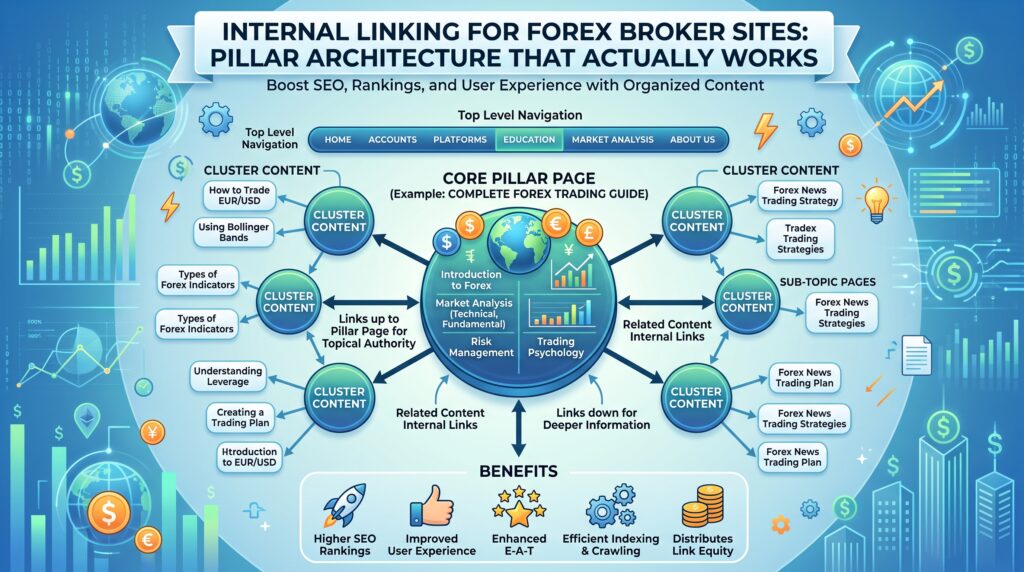
Internal Linking for Forex Broker Sites…from where to start?
Most internal linking guides tell you to link to your most important pages. For a forex broker site, that advice is incomplete — and in some cases actively harmful.
The standard pillar-cluster guidance — link from high-traffic content pages to commercial conversion pages — does not account for what regulated forex broker sites actually contain. Regulatory disclaimer pages that must exist for compliance but should not receive link equity. KYC registration flows that should be noindexed and excluded from the linking architecture entirely. Multi-jurisdiction subdirectories where cross-linking between markets dilutes the geo-targeting signals your hreflang and GSC configuration spent weeks establishing. Compliance footers that link to 30 regulatory documents from every article page on the site, sending hundreds of internal links to noindexed content on every Googlebot crawl cycle.
A broker marketing team that applied generic pillar-cluster advice to their site without accounting for these constraints would build a more complex version of a broken internal linking structure — not a fixed one.
Practitioner Observation — Internal Linking Audits
When I audit the internal linking structure of a forex broker site for the first time, the most consistent finding is homepage dominance. Sixty to eighty percent of all internal links across the site point to the homepage — through the logo, the navigation, and the footer template that repeats on every page. The homepage already has the highest authority on the site. It does not need more links. What it needs is to pass that authority to the pages that actually convert — account types, spreads, platform comparisons, regulation pages. Instead, those pages receive fewer internal links than blog posts published three years ago and never updated. The practical consequence is that Google’s crawlers follow the internal link architecture and conclude the homepage is the most important page on the site — which is true structurally, but wrong commercially. A broker does not make money from its homepage ranking. It makes money from its account opening page, its spread comparison page, and its regulation page ranking. The internal linking should reflect that. In most broker sites I review, it does not.
This article is the implementation layer of the technical framework built across the previous articles in this cluster. The site structure guide established how to build the multi-jurisdiction architecture. The content strategy article defined which content types belong at each stage of the commercial funnel. The technical indexation guide covered which pages to noindex and block. Without a deliberate internal linking architecture, those three systems do not connect — link equity leaks to noindexed pages, crawl budget is wasted on regulatory documents, and educational content generates traffic that never finds a path to a commercial page.
Table of Contents
Why Generic Internal Linking Advice Fails on Internal Linking for Forex Broker Sites?
Three structural features of regulated broker sites break generic internal linking advice.
Compliance pages are important — but not as link targets. Generic advice says “link to your important pages from high-traffic content.” A regulatory risk disclosure page is important for compliance but should be noindexed, excluded from the sitemap, and not receiving link equity from editorial content. Treating it as an important page in the internal linking structure is the most common broker internal linking error — and the most damaging to crawl budget efficiency.
KYC flows are conversion destinations — but not editorial link targets. Generic advice says “link to your conversion pages.” For a broker, the account registration and KYC flow is the conversion destination — but it should be noindexed and excluded from the internal link architecture. The correct link target is the account type commercial page (indexed, receives editorial links) not the registration form (noindexed, accessed via CTA button from the commercial page). The distinction matters because linking editorially to a noindexed page wastes anchor text relevance and sends conflicting crawl signals to Googlebot.
Related pages in different jurisdictions are not the same as related pages in the same jurisdiction. Generic advice says “link between related pages.” Cross-jurisdiction internal links — UAE accounts page linking to the Malaysia accounts page — dilute the geo-targeting signals established through hreflang tags and GSC country targeting. The pages are topically related but geographically distinct. In a multi-jurisdiction architecture, geographic context is the most important dimension of “relatedness.”
The Pillar-Cluster Model for Forex Broker Sites
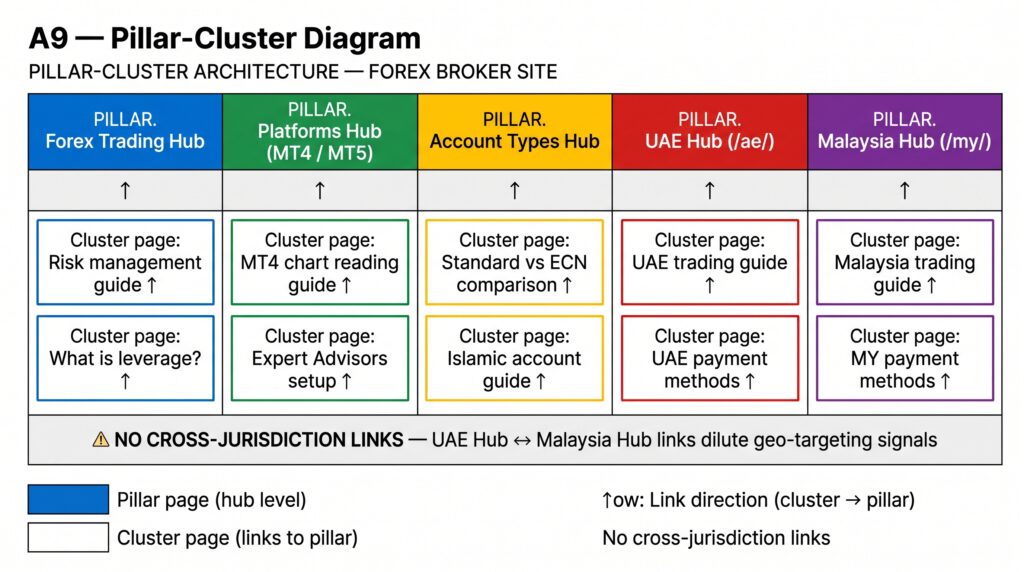
The pillar-cluster model organises a forex broker site’s internal links around commercial hub pages (pillar pages) and topic-specific content pages (cluster pages) that link back to them. The model is not new — what follows is the forex broker-specific implementation that generic guides do not provide.
Cluster pages link up to their pillar. Pillar pages link down to all cluster pages. UAE and Malaysia hubs do not cross-link.
Cluster pages link up to their pillar. Pillar pages link down to all cluster pages in their topic. Jurisdiction hubs do not cross-link to each other.
Pillar pages cover a major commercial topic at hub level and sit at the top of the authority flow within their topic. A forex broker site typically has five to seven pillar pages: the primary forex trading commercial page, a platforms hub covering MT4/MT5 and any proprietary platform, an account types hub, a markets hub, and a jurisdiction landing page for each target market (the /ae/ page, the /my/ page, and so on).
Cluster pages are topic-specific pages that link back to their pillar. Educational articles from the content strategy (A8) are cluster pages that link to the relevant trading or account type pillar. Platform tutorials link to the platforms pillar. Geo-specific content for UAE traders links to the UAE jurisdiction hub. Regulatory guides link to the account types hub or the relevant jurisdiction hub.
The linking rule: Every cluster page links to its pillar page with consistent, descriptive anchor text. Every pillar page links to all cluster pages within its topic. No cluster page links to another cluster page without routing through the pillar first. Link equity flows upward from cluster to pillar — and is redistributed outward from pillar to cluster via the pillar’s outbound links.
What to Exclude From Your Internal Link Architecture
The pillar-cluster model above defines where link equity should flow. Three categories of pages that most broker sites accidentally include in their internal link architecture consume that equity without contributing to it.
Compliance and Regulatory Pages
Regulatory disclaimer pages, risk disclosure documents, terms and conditions, annual reports, and privacy notices should all be noindexed . The internal linking implication: noindexed pages should not appear in the internal link architecture as link sources or as link targets from editorial content.
The most common error is the article footer template. A site with 100 published articles that includes links to the risk disclaimer, terms of service, privacy notice, and regulatory disclosures in every article footer has 100 internal links pointing to each compliance document. Googlebot follows these links on every crawl cycle — distributing link equity to noindexed pages that cannot rank and should not accumulate authority. The commercial pages that need that link equity — the account type hub, the platforms hub, the jurisdiction landing pages — receive proportionally less because it is being diluted across compliance documents.
The fix: remove compliance document links from article page templates entirely. Consolidate all compliance links in the main site footer (one instance per document) or a dedicated compliance directory landing page that is itself disallowed in robots.txt.
IF YOU HAVE A DEVELOPER
“Remove the links to /legal/, /risk-disclosure/, /terms/, /privacy/, and any other compliance documents from our article page footer template. These links should only appear in the main site footer — not on every article page.”
KYC and Account Registration Flows
Registration and KYC flow pages should be noindexed (A6 Issue 4) — which means they should not appear as editorial internal link targets. This seems counterintuitive: the registration page is the conversion destination, so why not link to it from content?
Because linking editorially to a noindexed page wastes anchor text relevance and sends a conflicting signal to Googlebot. The correct conversion internal link path is: article → account type commercial page (indexed, receives editorial links) → CTA button to registration (noindexed, accessed via button not editorial link). The account type page is the final indexed link target in the editorial structure. The registration flow is accessed from the commercial page via a CTA — not via anchor text links from articles.
IF YOU HAVE A DEVELOPER
“Check that no article body links directly to /register/, /open-account/, or any KYC flow page. All article body links should target the account type page. Registration access comes from the CTA button on that commercial page.”
Affiliate and IB Portal Pages
Affiliate and IB portal subdomains should be blocked entirely from the main domain’s linking architecture (A6 Issue 8). No editorial article should link to partner.broker.com, ib.broker.com, or any affiliate portal page. These subdomains should have their own robots.txt disallow and receive zero link equity from the main domain’s editorial content.
The affiliate portal receives user traffic via a direct URL in the main navigation or footer — not via editorial internal links from articles. If any article currently links to an affiliate portal page as a destination, remove those links. They are distributing authority to a subdomain that should be isolated from the main domain’s SEO architecture.
Multi-Jurisdiction Linking Rules
A7 established the site structure for multi-jurisdiction broker sites. A9 establishes the internal linking rules that govern how jurisdiction pages link within that structure. Three rules apply consistently regardless of how many jurisdiction subdirectories the broker operates.
Rule 1 — Jurisdiction pages link within their own context. Pages in the /ae/ subdirectory link to other UAE content: the UAE account types page, UAE trading conditions, UAE-specific educational articles, and the UAE jurisdiction hub. They do not link to /my/ or /sa/ equivalents, even when the topics are closely related. Keeping links within the jurisdiction subdirectory reinforces the geo-targeting signals established via GSC country targeting and hreflang — which A7 established at the technical layer. Internal linking is the content-layer implementation of that technical geo-signal.
Rule 2 — Global blog content links to jurisdiction commercial pages with explicit geo-relevance. The global blog cluster (Cluster A articles at the root domain) can link to jurisdiction-specific commercial pages when the geographic relevance is explicit in the anchor text. “Account types available for UAE traders” as an anchor text from a global article to broker.com/ae/accounts/ is appropriate — the geo-context is clear. “Our account types” linking from a global article to the UAE accounts page without any UAE framing is ambiguous and should be avoided.
Rule 3 — No cross-jurisdiction links between commercial pages. The UAE accounts page does not link to the Malaysia accounts page. The UAE trading conditions page does not link to the Saudi Arabia trading conditions page. Even when the content structures are nearly identical, cross-jurisdiction commercial page links create ambiguous geo-signals for Googlebot. If a trader lands on the UAE accounts page, every internal link on that page should keep them within the UAE context.
FOR YOUR SEO TEAM
The rule is simple: links within /ae/ pages stay within /ae/, links within /my/ pages stay within /my/. Only the homepage and global blog articles link across jurisdictions — and only with explicit geographic context in the anchor text.
MT4 and MT5 Platform Pages in the Hub Architecture
Platform pages occupy an unusual position in the pillar-cluster model. They are commercial hub pages — pillar level — but their content is near-duplicate across the industry. The internal linking architecture for platform pages follows directly from that diagnosis.
MT4 and MT5 platform pages are pillar pages, not cluster pages. They sit at the hub level of the platforms pillar alongside any proprietary platform the broker offers. Educational articles about using MT4 — chart reading on MT4, Expert Advisors setup guides, MT4 mobile trading tutorials — are cluster pages that link back to the MT4 pillar. The MT4 pillar page links to: account type pages (which accounts include MT4 access), trading conditions (spreads and execution speeds on MT4), and the platform download CTA.
The anchor text rule for platform cluster pages is critical: use broker-specific anchor text, not generic MetaTrader text. “Trade with MT4 on our standard account” is more effective than “MetaTrader 4 platform” as an anchor from a cluster article — it adds the broker-specific context that differentiates the platform page from the near-identical descriptions on hundreds of other broker sites. Each broker-specific anchor text link is a small differentiation signal that compounds across the full platform cluster.
QUICK CHECK FOR ANY READER
Go to your MT4 or MT5 educational article. Does it contain a link back to your main platform page? If not, that is a missing pillar link — the article is generating platform-related traffic that is building no authority on the commercial page that converts that traffic.
The Conversion Internal Link Path
The content-to-conversion funnel in the forex broker content strategy article covers which content types belong at each stage of the commercial journey. A9’s conversion link path is the internal linking implementation of that framework — the specific link chain that moves a trader from educational entry point to commercial conversion opportunity.
The four-link conversion path:
| Link | From | To | Example Anchor Text |
|---|---|---|---|
| 1 | Educational article (risk management, leverage, trading strategies) | Geo-specific account type page | “…apply these principles to a regulated account with negative balance protection — our UAE account types cover the risk safeguards available.” |
| 2 | Geo-specific account type page | Trading conditions page | “compare the spreads and execution speeds available on each account type” |
| 3 | Trading conditions page | Regulatory proof content | “our CySEC regulatory standing and client fund protection” |
| 4 | Regulatory proof page | Account opening CTA | CTA button — not an editorial link |
Each link in this chain must be placed within the article body — not in a sidebar widget, not in a “Related Articles” section. Sidebar and footer widgets place links outside the content flow. They offer options to the reader rather than guiding them. A body link placed at the moment the reader has enough context to move to the next stage is fundamentally different from a widget that lists adjacent topics. The former is a guided path; the latter is a directory.
Most broker sites have the awareness-stage educational articles. Most broker sites have the commercial account type and trading conditions pages. What is almost universally missing is the internal link body chain that connects them. The sessions entering via educational content find no guided path to a commercial page — they exit via the back button or via the browser, not via a conversion path internal link.
Anchor Text for Regulated Financial Content
Generic internal linking guides say “use descriptive anchor text.” Regulated broker sites have an additional constraint that generic guides do not cover: financial promotions compliance applies to internal anchor text.
FCA financial promotions guidelines and CySEC guidance on marketing communications apply to website content including navigation, CTAs, and internal linking text — not only to article body text and advertising copy. Promotional financial claims in anchor text may require compliance review under these regulations. Anchor text such as “best forex broker,” “highest returns trading platform,” or “guaranteed tight spreads” makes financial claims that could constitute a financial promotion requiring approval under the relevant regulatory framework.
COMPLIANCE NOTE
The guidance above reflects general principles — verify with your compliance team that specific anchor text passes your regulator’s financial promotions requirements before deploying at scale. FCA and CySEC guidelines are updated periodically.
Safe anchor text patterns for regulated broker sites: Descriptive and non-promotional — “our trading conditions,” “CySEC regulatory information,” “account types available,” “our MT4 platform,” “forex trading spreads on our standard account.” These avoid superlatives, performance implications, and comparative claims without substantiation.
The practical benefit beyond compliance: descriptive, specific, non-promotional anchor text provides clearer semantic signals to Google than generic or promotional alternatives. “Our CySEC regulatory information and client fund protection” as an anchor text tells Google exactly what the destination page covers. “Click here” or “best broker” tells Google almost nothing. Compliance-aware anchor text is simultaneously safer and better for SEO — the two objectives align rather than conflict.
Internal Linking and Crawl Budget

Pages with many inbound internal links get crawled more frequently by Googlebot. This is desirable for commercial pillar pages and editorial cluster articles. It is the opposite of desirable for compliance pages that have already been excluded from the sitemap and marked noindex.
A regulated forex broker site with 100 published articles, each containing an article footer with eight compliance document links, has 800 internal links pointing to noindexed regulatory content. Googlebot follows these links on every crawl cycle — consuming crawl budget on pages that cannot be indexed and will never rank. The commercial pillar pages — the account type hub, the platforms hub, the jurisdiction landing pages — receive proportionally less crawl attention because the crawl budget is being distributed across noindexed compliance documents in every article footer.
The fix has two components. First, remove compliance document links from article page templates (covered in the compliance pages section above). Second, for large broker sites with 500 or more pages, consolidate compliance links further: instead of linking from the site footer to 15 individual compliance documents, link to a single compliance hub page (broker.com/legal/) that aggregates all compliance links in one location — and apply robots.txt disallow to the entire /legal/ directory. The footer link to the compliance hub is acceptable; links to individual compliance documents from every page on the site are not.
This connection to crawl budget management is covered at the technical level in the technical indexation guide. Internal linking is the content-layer complement to that technical fix — the two must be implemented together to fully recover wasted crawl budget on a regulated broker site.
IF YOU HAVE A DEVELOPER
“Remove the links to all legal, compliance, and regulatory documents from our article page footer template. These links should appear only in the main site footer — not on every article page.”
How to Identify Your Existing Pillar Pages
Most broker sites already have de facto pillar pages — commercial hub pages that Google has identified as the most important pages on the domain through accumulated click data. The pillar-cluster architecture does not need to be built from scratch on an established site. It needs to be formalised around what already exists.
The identification methodology uses GSC data and takes 20 minutes. Open Google Search Console → Performance → Pages. Sort by clicks, descending. The top five to ten pages by click volume are almost always the de facto pillar pages — they are what Google already treats as the most commercially important pages on the domain.
For each of those top-performing pages: what topic does it cover? Which other pages on the site are thematically related and should be functioning as cluster pages linking to this pillar? Does each of those cluster pages currently contain a body link to the pillar? Every missing link is a formalisation opportunity — not a new content requirement, just a link addition to existing pages.
The formalisation step: once de facto pillar pages are identified, ensure that (1) all related cluster pages have at least one body link to the pillar with descriptive anchor text, (2) the pillar page itself links to all cluster pages within its topic, and (3) every new piece of content produced in that topic cluster includes a pillar link from publication date. The architecture compounds as new content is added — each new cluster article strengthens the pillar it links to.
FOR CMOS AND FOUNDERS — NO TECHNICAL KNOWLEDGE REQUIRED
Open Google Search Console → Performance → Pages → sort by Clicks. The pages at the top are your most important pages in Google’s view. Share this list with your SEO team and ask: “Which other pages on our site are related to each of these? Are those related pages linking back to them?”
The Four-Step Internal Link Audit
Most broker sites that have not deliberately built a pillar-cluster architecture have three problems simultaneously: orphaned content that generates traffic but builds no authority; compliance link leaks that waste crawl budget on every crawl cycle; and educational content with no conversion path to a commercial page. The audit below identifies all three. It takes half a day and requires no specialist tools beyond Screaming Frog’s free tier and Google Search Console.
Step 1 — Find orphaned pages. Use Screaming Frog (free tier covers up to 500 URLs). Crawl the site. In the Pages tab, filter by “Inlinks” and look for pages showing zero inbound internal links. These are orphaned pages — Googlebot can only discover them via the XML sitemap or via external backlinks. They generate organic traffic when they rank but contribute nothing to the pillar-cluster authority structure because no internal links connect them to commercial pillar pages. On most broker sites, 20–40% of published editorial content is orphaned. Every orphaned cluster article is a missing link from a page that could be strengthening a pillar. Fix: identify which pillar each orphaned article belongs to and add one body link from the article to the pillar page.
STEP 1 — IF YOU HAVE A DEVELOPER
In Screaming Frog: crawl the site → Pages tab → filter Inlinks column for 0 → export the list. Every page on that list is invisible to your internal linking structure.
Step 2 — Identify compliance link leaks. In Screaming Frog, go to the Inlinks tab and filter by target URL. Search for any compliance page URLs containing /legal/, /risk-disclosure/, /terms/, /privacy/, /documents/, or any other compliance directory. Note how many article pages are linking to each compliance document. On sites with standard article footer templates, this number is typically equal to the total number of published articles — 100 articles × 8 compliance footer links = 800 internal links pointing to noindexed content. Fix: remove compliance links from article page templates (one developer task, 30 minutes, site-wide impact).
Step 3 — Map cluster pages to pillar pages. Take the list of cluster pages (educational articles, platform tutorials, geo-specific content, comparison pages). For each cluster page: does it contain at least one body link to its intended pillar page? A cluster article about risk management that does not link to the forex trading hub is missing its pillar link. A platform tutorial that does not link to the MT4 pillar page is missing its pillar link. Missing cluster-to-pillar links are the highest-priority internal linking fixes — they represent direct authority leakage from pages that may have external backlinks and organic traffic but are not passing that authority to commercial hub pages.
Step 4 — Check the conversion path. For each awareness-stage educational article: does it contain a body link to a commercial or decision-stage page within the article text (not in a sidebar or footer widget)? An educational article generating 500 monthly sessions with no body link to any commercial page is sending 500 sessions into a dead end — traffic that enters the site and finds no internal path to a conversion opportunity. Fix: add one conversion path body link per educational article using the four-link path structure from H2 #6.
WHAT MOST BROKER SITES FIND
Steps 1 and 4 fail simultaneously: orphaned content that generates traffic but links to nothing, and educational content that links to other educational articles but never to a commercial page. Fixing both in sequence — add pillar links to orphaned articles, then add conversion path links to all educational content — typically produces the most significant internal linking improvement available on an established broker site without publishing a single new piece of content.
Fixing all three problems is a structural change to how new content is produced — not a one-time edit. The audit output should feed into the content production workflow for every article published going forward: every new cluster article is published with a pillar link already in place, a conversion path body link already included, and no compliance page links in the template.
Connecting the Full Technical Framework
The internal linking architecture in this article connects the three previous technical layers: the indexation fixes that determine which pages are indexed and crawlable, the site structure that defines where jurisdiction pages sit, and the content strategy that determines what fills each page. All four working together — correct indexation, clean site structure, differentiated content, and deliberate internal linking — form the organic growth architecture that the individual pieces cannot produce alone.
If you want to know how your broker site’s internal linking is currently distributed — and where authority is being lost to noindexed compliance pages or orphaned content — that diagnosis is part of an Full SEO audit.
FAQ
Q1: What is pillar-cluster internal linking architecture for a forex broker site?
Pillar-cluster architecture organises a forex broker site’s internal links around commercial hub pages (pillar pages) and topic-specific content pages (cluster pages) that link back to them. Pillar pages cover major commercial topics at hub level: the forex trading hub, platforms hub, account types hub, and jurisdiction-specific landing pages for each target market. Cluster pages are topic-specific articles, platform tutorials, geo-specific guides, and comparison content that each link back to their relevant pillar page with descriptive anchor text. Link equity flows from cluster pages up to pillar pages, concentrating authority on the commercial pages that need to rank.
Q2: Should compliance and regulatory pages be included in a forex broker site’s internal linking architecture?
No. Compliance pages (risk disclosure documents, terms and conditions, annual reports, privacy notices) should be noindexed and excluded from the internal linking architecture. Linking to noindexed compliance pages from editorial content wastes anchor text relevance and signals to Googlebot that these noindexed pages are editorially important, creating conflicting crawl signals. The most common mistake is article footer templates that link to compliance documents on every page — this can send hundreds of internal links to noindexed pages, consuming crawl budget without contributing authority to any commercial page. Compliance links should appear only in the main site footer, not in article page templates.
Q3: How should internal links work across multi-jurisdiction subdirectories on a forex broker site?
Jurisdiction subdirectory pages should link within their own geographic context. Pages in the UAE subdirectory link to other UAE content — the UAE accounts page, UAE trading conditions, UAE-specific educational content. Cross-jurisdiction internal links between commercial pages (UAE accounts page linking to Malaysia accounts page) dilute the geo-targeting signals established via hreflang tags and Google Search Console country targeting settings. The only pages that appropriately link across jurisdictions are global blog articles and the homepage — and these should include explicit geo-context in the anchor text when linking to jurisdiction-specific commercial pages.
Q4: How does internal linking affect crawl budget on a regulated forex broker site?
Pages with many inbound internal links get crawled more frequently by Googlebot. On regulated forex broker sites, article footer templates typically link to multiple compliance documents from every page — a site with 100 articles has 100 internal links pointing to each compliance document. Googlebot follows these links on every crawl cycle, consuming crawl budget on noindexed regulatory content. Removing compliance document links from article templates and keeping them only in the main site footer can recover 30 to 50 percent of the crawl budget currently wasted on pages that cannot be indexed and will never rank.
Q5: What anchor text rules apply to internal links on FCA or CySEC-regulated broker sites?
Financial promotions regulations (FCA PS20/10, CySEC financial promotions guidance) apply to internal anchor text on regulated broker sites as well as to article body content. Promotional financial claims in anchor text — such as “best forex broker,” “highest returns platform,” or “guaranteed tight spreads” — may constitute a financial promotion requiring compliance approval. Safe anchor text is descriptive and non-promotional: “our trading conditions,” “CySEC regulatory information,” “account types available,” “our MT4 platform.” Descriptive anchor text also provides clearer semantic signals to Google, making compliance-aware anchor text both legally safer and SEO-optimal for regulated broker sites.
Q6: How do I audit internal links on a forex broker site?
A forex broker internal link audit has four steps: crawl the site with Screaming Frog (free tier covers up to 500 URLs) and filter for pages with zero inbound internal links — these orphaned pages generate traffic but build no pillar authority; filter inbound links by target URL to find compliance and regulatory pages receiving internal links from article templates (the compliance link leak problem); verify that each cluster article contains a body link to its intended pillar page; and check that each educational article has at least one internal link to a commercial or decision-stage page within the article body. Most broker sites fail steps one and four simultaneously.