
Last reviewed: June 2026 · Author: Hristo Hristov
Why Forex Brokers Rank Below Comparison Sites?
Open Google, search “best forex broker,” and count how far down the page you scroll before seeing a broker’s own website.
ForexBrokers.com is at position one. BrokerChooser is at position two. Investopedia is at position three. The broker’s own site — if it appears on page one at all — is somewhere between position six and ten, below three comparison sites, possibly a Wikipedia article, and a forum thread. Most broker marketing teams have tried to fix this: better meta descriptions, more content, keyword optimisation, faster page speed. None of it moved the comparison sites. The reason is not that the SEO execution was wrong — it is that comparison sites have structural competitive advantages that meta description improvements do not address.
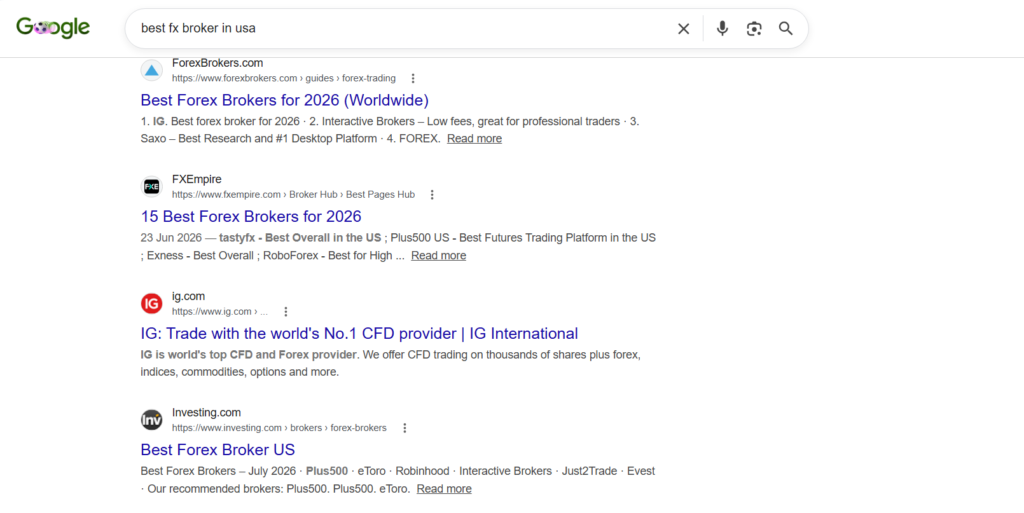
ig.com is a rear exception only to prove our point, media/affiliate websites are dominating these keywords
This article names all five structural advantages that comparison sites hold and pairs each one with the specific strategy that addresses it. Understanding why the gap exists is the prerequisite for building an organic strategy that works within this competitive reality rather than against it. Every section below is a structural diagnosis followed immediately by a gap-closing strategy — because the goal is not to explain why things are hard but to show exactly what moves are available.
Table of Contents
Why Forex Brokers Rank Below Comparison Sites-The Five Structural Reasons Comparison Sites Outrank Broker Sites
These are not ranking disadvantages that better content or more backlinks will overcome in six months. They are structural — built into the business model of comparison sites and the regulatory constraints of broker sites. Understanding each one changes how you allocate your organic investment.
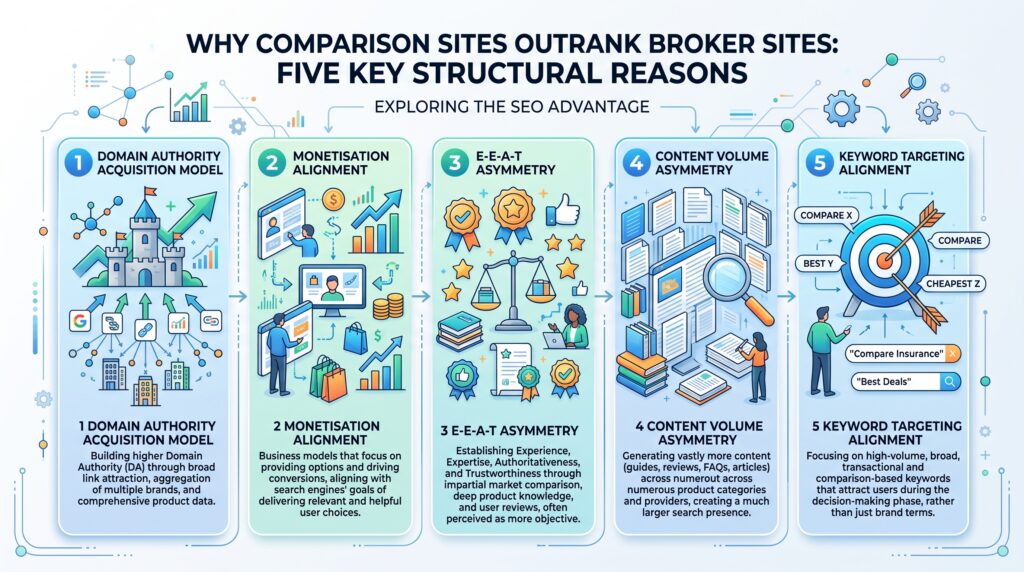
| # | Structural Reason | Root Cause | Gap-Closing Strategy |
|---|---|---|---|
| 1 | Domain authority acquisition model | Every listed broker contributes to the comparison site’s authority | Earn links from regulatory sources and data-led content — not by competing for the same backlink types |
| 2 | Monetisation alignment | 100% of comparison site revenue depends on organic traffic | Concentrate SEO investment on highest-ROI queries — branded and geo-specific — not all forex keywords equally |
| 3 | E-E-A-T asymmetry | Google assesses comparison sites as neutral evaluators, broker sites as commercial entities | Invest in content categories where broker E-E-A-T advantages override this: regulatory, data-led, decision-stage |
| 4 | Content volume asymmetry | Comparison sites publish 5,000w reviews of brokers; brokers publish thin pages(P.S recently they improve, but affiliate/media website still dominate) | Publish broker-authored review content at comparable depth — primary source data is the differentiator |
| 5 | Keyword targeting alignment | Comparison sites target research-stage queries; broker sites target conversion-stage queries | Deliberately publish research-stage content in the specific sub-categories where broker authority wins |
Reason 1 — The Domain Authority Acquisition Model
Comparison sites earn backlinks from every broker they list — implicitly and explicitly. When a broker directs clients to “check our rating on ForexBrokers.com,” they are endorsing and amplifying the comparison site’s authority. Affiliate programmes pay comparison sites commission for referred clients, and those commercial relationships generate editorial links over time. Every broker that wants to be reviewed contributes to the authority of the site that outranks them. This is not a conspiracy — it is a structural backlink acquisition model that broker sites cannot replicate at comparable cost.
A broker site earns backlinks through content quality and outreach. A comparison site earns backlinks by existing and being useful to the entire industry simultaneously. The authority gap is not effort-based — it is structural. Gap-closing strategy: Focus backlink acquisition on sources where broker sites have a natural claim: regulatory body acknowledgement pages, financial industry publications, and data-led content (execution statistics, spread analysis) that earns links organically because it provides information unavailable elsewhere.
Reason 2 — Monetisation Alignment
A comparison site’s entire revenue depends on organic traffic. Every click from a trader who reads “best forex broker” and lands on ForexBrokers.com is a potential affiliate commission. This creates a business model where SEO investment is proportional to survival — comparison sites invest in SEO at a rate that broker sites, whose primary revenue comes from trading spreads and account fees, structurally cannot match with equivalent intensity across all keywords.
The SEO team at a comparison site is a revenue centre. The SEO function at a broker is a cost centre competing with paid acquisition, compliance, and platform development for budget. Gap-closing strategy: Narrow the investment gap by targeting specific queries where organic ROI is highest — branded comparison queries and geo-specific commercial queries — rather than distributing SEO budget evenly across all forex keywords simultaneously.
Reason 3 — E-E-A-T Asymmetry
Google’s quality rater guidelines assess YMYL content in the context of who is producing it. For “best forex broker” queries, a comparison site is evaluated as a neutral third-party evaluator — potentially lower commercial bias, higher informational trust. A broker publishing “why we are the best forex broker” is evaluated as a commercial entity with an inherent conflict of interest. This asymmetry is structural — it reflects an accurate assessment of the different relationships these two content producers have with the subject matter.
Gap-closing strategy: Shift content investment toward query types where broker sites have inherent E-E-A-T advantages. Three categories exist where broker authority overrides comparison site neutrality: regulatory-specific content (only a regulated broker can author it from first-person regulatory standing), first-party operational data (execution statistics that only the broker has access to), and decision-stage proof content (the broker’s own regulatory standing, fund protection, and platform performance data). These are the four differentiated content types covered in the forex broker content strategy article.
Reason 4 — Content Volume Asymmetry
ForexBrokers.com publishes a dedicated 3,000–5,000 word review page for every broker they list — updated quarterly with live spread data, regulatory information, platform screenshots, and user ratings. The average broker’s equivalent is below that. The content volume gap per target query is big in favour of the comparison site. For Google’s quality assessment, the comparison site’s review of a broker is more comprehensive than the broker’s description of itself for the same query.
Gap-closing strategy: Publish broker-authored review and proof content at comparable depth. The broker-data-led content type — execution statistics, slippage analysis, spread data from the broker’s own trading infrastructure — produces depth from primary source material that comparison sites cannot replicate with equivalent authority. This is the content investment that closes the volume gap while simultaneously winning on E-E-A-T.
Reason 5 — Keyword Targeting Alignment
Comparison sites target “best forex broker,” “forex broker comparison,” “forex broker reviews” — the research-stage queries traders use before choosing a broker. Broker sites target “open trading account,” “forex trading platform,” “deposit funds” — the conversion-stage queries traders use after choosing a broker. One set of queries maps to where organic SEO has the highest traffic volume and the most potential to influence the decision. The other maps to where a broker’s existing client base transacts.
The keyword mismatch is not a strategy error — it reflects the natural commercial priorities of each business type. Gap-closing strategy: Deliberately publish content that targets the research-stage query categories where broker sites can compete specifically — and the section below defines exactly which categories those are.
What to Fight For, What to Concede, and What to Leverage
The most commercially useful decision in A10 is not which SEO tactics to use — it is which competitive battles to choose. Three categories exist for every comparison site keyword.
| Category | Example Queries | Why This Category | Investment Priority |
|---|---|---|---|
| ✗ CONCEDE | “best forex broker,” “top forex brokers 2026,” “forex broker comparison,” “forex broker reviews” | Comparison sites have 10+ years of backlink accumulation, full-time editorial teams, and complete monetisation alignment on these queries. Organic cost exceeds the value of any potential traffic gained at realistic investment levels. | STOP — redirect budget to Fight category |
| ✓ FIGHT | “[broker name] review,” “[broker name] vs [competitor],” “is [broker name] regulated,” “can I trust [broker name]” | Broker has inherent E-E-A-T advantage as the subject of these searches. Decision-stage traders (1–2 weeks from depositing) ask these queries. Broker-authored content with primary source data competes directly with comparison site reviews. | HIGHEST PRIORITY — maximum organic investment |
| → LEVERAGE | “best forex broker UAE,” “forex broker comparison Malaysia” (via comparison site listings), plus geo-specific broker queries where comparison sites have thin coverage | Being well-listed on ForexBrokers.com and BrokerChooser generates referral traffic without organic competition. Geo-specific queries are the organic Fight category within the Leverage dynamic — where local knowledge beats global comparison sites. | INVEST IN LISTING QUALITY + geo-specific content |
FOR CMOS AND CEOS — THE BUDGET REALLOCATION
Most broker organic SEO budgets are weighted toward the red Concede category — competing for “best forex broker” head terms that comparison sites have structurally locked. The highest-ROI reallocation: move that budget to the green Fight category (branded queries) and geo-specific content production. The investment required to move from position 8 to position 4 for “best forex broker” is 10× what is required to move from position 4 to position 1 for “[broker name] review.”
The Branded Query Strategy — Your Highest-Value Organic Content
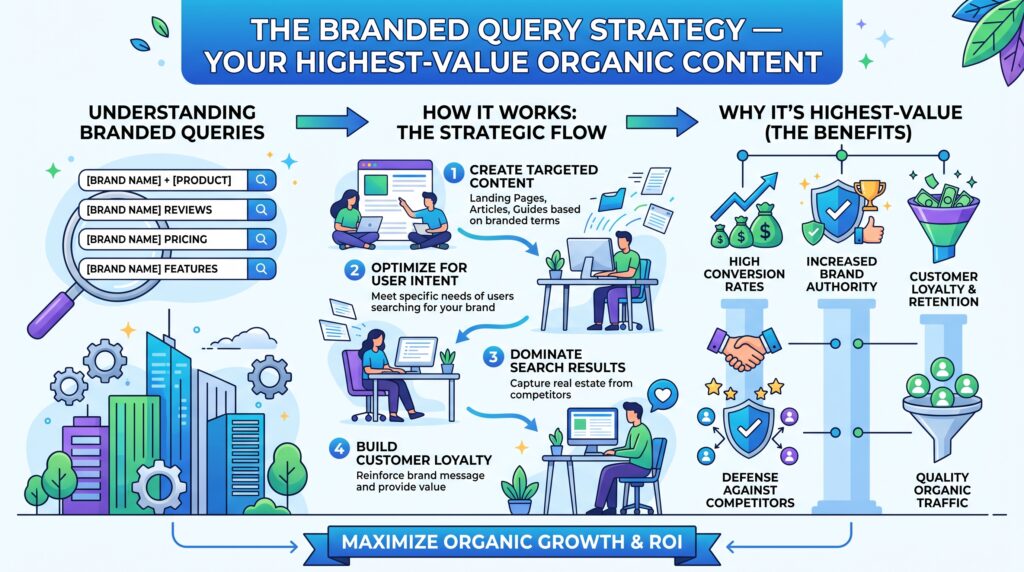
Search your own broker name in Google right now. Who holds position one for “[your name] review”? For most forex brokers, the answer is ForexBrokers.com, BrokerChooser, or a forex review aggregator — not the broker’s own website.
This matters more than almost any other organic ranking gap. “[Broker name] review” queries are asked by traders in the final one to two weeks before depositing. They have already decided to trade forex. They are evaluating whether to trust this specific broker. The answer they find is on a third-party site that may not represent the broker accurately, may be written by someone who has never used the platform, and may earn commission for recommending competitors. The broker has no voice in this conversation on the page that matters most commercially.
The alternative: A broker-authored review page on the broker’s own domain. Data-led, regularly updated, structured like a genuine review rather than a marketing landing page. Execution speed statistics from inside the platform. Live spread data by account type. Regulatory standing with direct links to the relevant regulatory register. Client fund segregation structure explained in plain terms. Platform comparison with named competitors where the data supports the comparison.
When this content is authoritative, specific, and regularly updated with live data, it competes directly with third-party comparison site reviews for branded queries — and often ranks above them because it has something the comparison site review does not: primary source access from inside the platform. A comparison site approximates your execution speed; your own article reports it from the trading logs.
The same logic applies to “[broker name] vs [competitor]” queries. A balanced, data-led comparison article on the broker’s own domain, acknowledging competitor strengths and explaining specifically where the broker’s offering is stronger, targets traders in the final evaluation stage with genuine E-E-A-T on the primary subject.
COMPLIANCE NOTE — REQUIRED BEFORE PUBLISHING BRANDED QUERY CONTENT
Broker-authored review content and comparative financial promotions require compliance review under FCA PS20/10 and CySEC financial promotions guidelines before publishing. This is not a reason to avoid the strategy — it is a 2–4 week process to complete before deploying at scale. Your compliance team should review the content, not block the approach. The commercial value of ranking #1 for “[broker name] review” justifies the review timeline.
This branded query content is the decision-stage content type from the How long takes SEO for FX Brokers — the highest-converting content category and the one most brokers have zero coverage of. A10 provides the competitive context for why it is the priority.
Where Comparison Sites Are Weak — The Geo-Specific Opportunity
Comparison sites are globally-focused with thin market-specific coverage. Their “best forex brokers UAE” or “best forex brokers Malaysia” pages are typically global content with regional headings — they lack genuine local regulatory knowledge, local payment method specificity, and local market-specific trading data. This is where the structural authority model breaks down in favour of regulated broker sites.
| Query Type | Comparison Site Strength | Broker Opportunity |
|---|---|---|
| “best forex broker” (global head terms) | Dominant — decades of authority, full-time editorial teams, complete monetisation alignment | Concede — structurally unwinnable |
| “best forex broker UAE / Malaysia / Brazil” (country-level) | Moderate — have country pages, but content is generic with local heading | Competitive — requires geo-specific site structure |
| “DFSA-regulated forex broker,” “AED forex account,” “UAE trading payment methods” (local-specific) | Weak — thin content, no local regulatory knowledge, no local market data | Win — broker’s local authority is structurally superior |
A CySEC-regulated broker with genuine MENA market presence publishing content about DFSA regulatory recognition, AED account structures, UAE-specific payment methods, and the specific instruments favoured by UAE retail traders has inherent authority on these queries that ForexBrokers.com’s generic “best forex brokers UAE” list cannot match. The comparison site describes what is available in the UAE. The broker explains how to trade forex as a UAE resident from the first-person operational perspective of a platform that serves UAE clients.
The geo-targeting framework covers which markets to prioritise for this approach. The multi-jurisdiction site structure guide covers how to build the architecture that delivers geo-specific content efficiently. This section explains why: the geo-specific level is where the comparison site structural advantage breaks down, creating the specific organic opportunity that the geo-targeting and site structure work is designed to capture.
The Content Only Broker Sites Can Publish
The E-E-A-T asymmetry in Reason 3 runs in both directions. Comparison sites have inherent authority on neutral third-party comparative queries. Broker sites have inherent authority on three content categories that comparison sites cannot match — and Google’s quality assessment recognises this asymmetry for YMYL financial content.
Regulatory-specific content. A CySEC-regulated broker writing about what CySEC’s investor compensation fund covers and how it protects a retail trader’s capital has first-person regulatory standing that a comparison site cannot replicate. The broker IS the regulated entity. Contentworks or ForexBrokers.com can describe CySEC’s compensation scheme; only a CySEC-regulated broker can write “as a CySEC-regulated entity, here is exactly how your funds are protected under our licence.” That authorial standing is inherent E-E-A-T — no amount of comparison site authority compensates for not having the regulatory standing to make the claim in the first place.
First-party operational data. A comparison site publishes execution data from external testing or third-party measurement services. The broker publishes execution data from inside the platform — from the actual trade logs of real client transactions. The difference between a comparison site’s execution speed estimate and a broker’s own execution statistics from 2.3 million trades in Q1 2026 is the difference between approximation and primary source. Google’s quality rater guidelines explicitly value primary source data for YMYL financial queries.
Platform-specific operational depth. A comparison site describes MT4 as available on a broker platform. The broker can describe how their specific implementation of MT4 performs — their specific spreads on the platform, their specific execution model, their specific server location and infrastructure. This platform-specific depth is something comparison sites approximate from external testing; brokers own it from internal data. The technical indexation guide covers how to differentiate platform pages technically; this content strategy is the editorial complement to that technical differentiation.
THE STRUCTURAL ADVANTAGE THAT COMPARISON SITES CANNOT BUY
No comparison site can publish “our execution speed across 2.3 million trades in Q1 2026.” No comparison site can write from the first-person regulatory standing of a CySEC licence holder. These are inherent broker advantages that no amount of comparison site domain authority can override for the specific queries where this content is the most relevant answer.
How the Technical SEO Framework Connects to the Comparison Site Problem
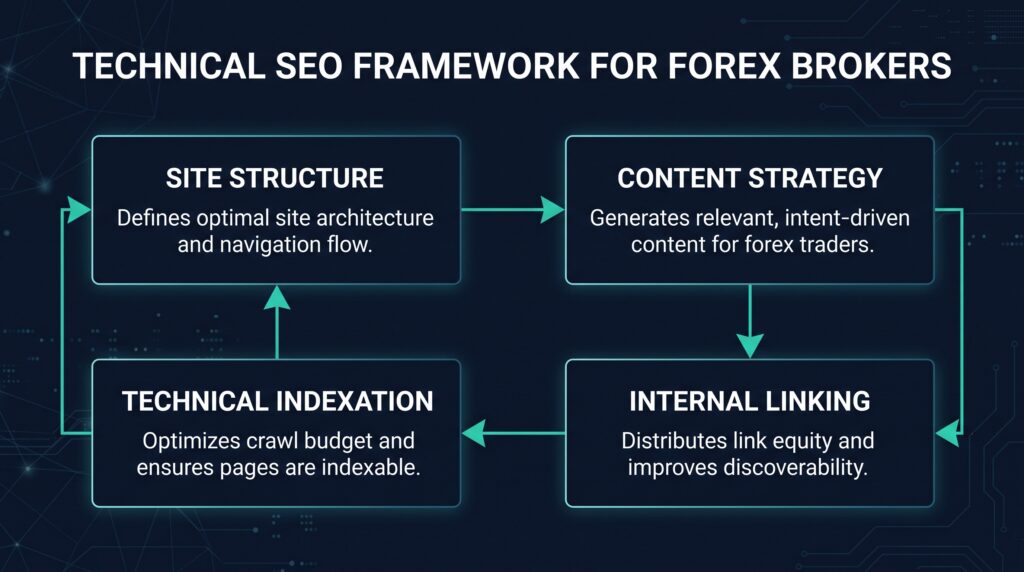
The comparison site competitive dynamic is the strategic context for every technical article in this cluster. Each technical guide addresses a specific aspect of the structural disadvantage identified above.
Site structure enables geo-specific gap-closing. The multi-jurisdiction subdirectory architecture — /ae/ for UAE, /my/ for Malaysia — is the technical prerequisite for the geo-specific content strategy that beats comparison sites at the local level. Without the correct structure, geo-specific content cannot be efficiently crawled, geo-targeted, or internally linked. The site structure guide is the technical implementation of the geo-specific gap-closing strategy in H2 #4 above.
Content strategy produces the content comparison sites cannot publish. The four differentiated content types — regulatory-differentiated, broker-data-led, geo-specific, and decision-stage — are precisely the content categories where broker E-E-A-T advantages override comparison site structural advantages. The branded query content strategy in H2 #3 is the decision-stage content type and provides the competitive context for why those four types matter.
Internal linking (A9) converts comparison-adjacent traffic into commercial outcomes. Organic traffic that enters through branded query content and geo-specific content still needs a guided internal link path to the conversion point. Without the conversion internal link path from the internal linking guide, the organic sessions gap-closing strategies generate exit the site without reaching a commercial page. The internal linking architecture is what ensures those sessions produce measurable commercial outcomes.
Technical indexation fixes (A6) ensure rankings produce commercial value. Comparison sites have clean indexation — no compliance pages consuming crawl budget, no KYC flows indexed accidentally, no MT4 pages generating duplicate content signals. Broker sites, often have all three. Fixing these issues ensures that any organic positions earned through the gap-closing strategies above actually deliver crawl budget and link equity to the commercial pages that convert traffic to FTDs — not to regulatory documents or registration forms.
FOR CEOS AND FOUNDERS — THE FULL PICTURE
A10 is the strategic frame. The articles linked in this section are the implementation playbook for each gap-closing strategy. Think of A10 as the game board and A5–A9 as the moves. If you have read this article and want to understand how to build the specific structures that execute it, those articles are the next step.
How to Measure Your Current Comparison Site Gap
Two analyses that any CMO or in-house SEO manager can run in 30 minutes using tools they already have.
GSC query analysis — where are you losing to comparison sites? In Google Search Console, go to Performance → Queries. Filter for queries where your site ranks in positions 5–20. For each of these queries, run a manual Google search and note how many of positions 1–4 are occupied by comparison sites. Queries where positions 1–4 are three or four comparison sites and your site is at 8–15 are the head-term Concede category — stop investing here and redirect budget. Queries where only one comparison site appears in positions 1–3 and you are at position 5–8 are priority Fight targets — investment here produces the fastest visible ranking improvement.
Branded query check — your single highest-priority organic gap. Search “[your broker name] review” and “[your broker name] vs [main competitor]” in Google. Note who holds positions 1–5. If comparison sites occupy positions 1–3 for your own branded review query, that is the highest-priority organic gap in your entire keyword universe — more commercially valuable than any non-branded keyword ranking improvement available at equivalent investment. A trader searching your exact name is in the final evaluation stage. Who answers that query is the most commercially consequential SEO outcome on your domain.
Most broker marketing teams that run this analysis find they are spending the majority of organic budget competing for Concede-category keywords — and have zero content targeting the Fight-category branded queries where their authority advantage is highest. The reallocation of investment from Concede to Fight is the strategic change. The technical framework (A6–A9) and the content production (A8) are the execution.
If you want to know exactly where your broker site stands relative to the comparison sites occupying your target keyword positions — that competitive mapping is part of an SEO audit.
RankMath FAQ Block — Include in WordPress Article + Copy into RankMath Schema
Add to the WordPress article body at the end using RankMath FAQ block. Also copy each Q+A into RankMath → Schema → FAQ as plain text (no HTML, no bold, no bullets). All 6 required. Q1 displaces the Reddit community thread at #1. Q2 displaces forexbrokers.com from the AI overview. Both displacements happen because A10’s answers are more specific and structured than either a community thread or a comparison site homepage can provide. After publish: monitor Reddit #1 displacement and forexbrokers.com AI overview removal within 14 days.
FAQ
Q1: Why do comparison sites like ForexBrokers.com outrank forex broker websites for “best forex broker” searches?
Five structural factors give comparison sites a persistent ranking advantage over broker sites for head-term forex keywords. First, comparison sites earn backlinks from every broker they list, creating a self-reinforcing authority model that broker sites cannot replicate. Second, their entire revenue depends on organic traffic, so their SEO investment is proportional to business survival in a way broker SEO budgets are not. Third, Google quality raters assess comparison sites as neutral third-party evaluators and broker sites as commercial entities with conflicts of interest, creating an E-E-A-T asymmetry. Fourth, comparison sites publish 3,000 to 5,000 word reviews of individual broker platforms while broker sites publish 500-word account pages — a 10 to 1 content volume gap. Fifth, comparison sites target research-stage queries where traders evaluate options, while broker sites target conversion-stage queries where traders transact
Q2: Can a forex broker ever outrank comparison sites in organic search?
Yes, in specific query categories where broker sites have structural advantages. Head-term queries like “best forex broker” are structurally unwinnable for broker sites at any realistic investment level — these should be conceded. However, three categories are winnable: branded comparison queries where the broker is the subject (searches for their own name plus “review” or versus a specific competitor), geo-specific queries where comparison sites have thin local coverage (country-specific or city-specific forex broker queries where local regulatory knowledge and local market data give the broker inherent authority), and regulatory-specific queries where only a regulated entity can author the content credibly. The strategy is to concentrate organic investment in these winnable categories rather than competing for head terms.
Q3: What is the branded query strategy for forex broker SEO?
The branded query strategy focuses organic SEO investment on queries containing the broker’s own name: searches for “[broker name] review,” “[broker name] vs [competitor],” “is [broker name] regulated,” and “can I trust [broker name].” These queries are searched by traders in the final one to two weeks before depositing — the highest commercial intent in the organic search funnel. Broker sites have inherent E-E-A-T advantages on these queries because they are the subject of the search. Broker-authored review content with live spread data, execution statistics, regulatory standing information, and platform comparisons competes directly with third-party comparison site reviews for these branded queries, and often wins because the broker has primary source data that comparison sites approximate from external testing.
Q4: Where are comparison sites weak in forex SEO and how can brokers exploit those gaps?
Comparison sites are globally-focused with thin geo-specific coverage. Their “best forex brokers UAE” or “best forex brokers Malaysia” pages are typically global content with local headings — they lack genuine local regulatory knowledge, local payment method detail, and local market-specific trading information. A regulated forex broker with an actual presence in a target market, publishing content about local regulatory protections, local payment infrastructure, and local market-specific trading patterns, has inherent authority on geo-specific queries that globally-focused comparison sites cannot match. This geo-specific opportunity is where broker sites most consistently outrank comparison sites without needing to match their domain authority or content volume at the global level.
Q5: How do forex brokers benefit from comparison sites while also competing with them?
Comparison sites serve two simultaneous roles in a broker’s distribution model: organic competitors for head-term keywords, and referral traffic sources for listed brokers. A broker that earns a prominent listing on ForexBrokers.com, BrokerChooser, or Investopedia’s broker comparison pages receives referral traffic from traders who found the comparison site first — traffic the broker did not generate through its own organic rankings. This referral traffic is not in competition with the broker’s own organic programme; it complements it. The strategic approach is to concede the head-term keywords to comparison sites, invest in being well-listed on major comparison platforms, and simultaneously pursue the winnable organic categories (branded queries, geo-specific queries, regulatory content) where direct organic rankings are achievable.
Q6: What content should a forex broker publish to compete with comparison sites organically?
Forex broker sites should focus organic content investment on four categories where comparison sites cannot compete structurally: regulatory-differentiated content (articles only a licensed broker can author, such as specific regulatory protection explanations from the broker’s own regulatory standing), broker-data-led content (execution statistics, slippage analysis, and spread data from the broker’s own trading infrastructure), geo-specific content (locally authoritative market-specific content for each target geography), and decision-stage content including broker-authored review and comparison pages targeting branded queries. These four content types produce organic rankings in categories where broker E-E-A-T advantages override the domain authority and content volume advantages that comparison sites hold for head-term keywords.