
Last reviewed: June 2026 · Author: Hristo Hristov
Your forex broker’s execution model is one of the most commercially significant decisions in your business — and most broker marketing teams treat its communication as a compliance footnote.
ECN, STP, and Market Maker Forex Brokers, who this change marketing efforst?
Every guide about ECN, STP, and Market Maker brokers has been written for traders deciding which broker type to use. This article is written for the broker’s marketing team deciding how to communicate their execution model to those same traders. The distinction matters: a CMO who understands what Investopedia tells traders about the conflict of interest question is far better equipped to address it honestly than one who has never read it.
Practitioner Observation
In almost every broker marketing review I have conducted, the execution model page describes the technology accurately — latency figures, liquidity providers, order routing — but the ad copy running on Google and Meta makes claims the execution policy does not support. The spread advertised is the minimum observed under optimal conditions. The execution speed quoted is the best-case figure from a controlled test. Neither is disclosed as such. The marketing team and the compliance team are not reading each other’s work.
This article covers all three execution models — ECN, STP, and Market Maker — and the A-Book/B-Book operational distinction that determines the real marketing implications of each. Whether your broker operates one model or a hybrid of all three, the marketing framework below applies.
Table of Contents
The Three Execution Models — Plain-English Definitions
🔴 SECTION IMAGE — Generate and upload
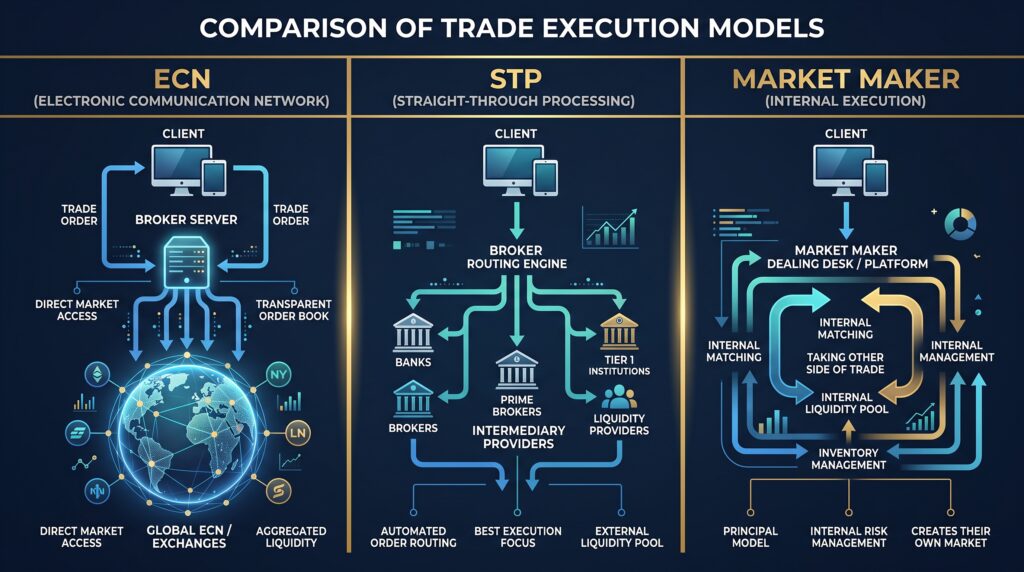
The definitions are brief by design — every sophisticated reader already knows these terms exist. What is worth being precise about is the A-Book/B-Book distinction that sits underneath the ECN/STP/Market Maker taxonomy and determines the real marketing implications of each model.
| ECN | STP | Market Maker | |
|---|---|---|---|
| Dealing Desk | No | No | Yes |
| Order Execution | Direct to interbank / liquidity network | Straight to liquidity providers | Broker creates internal market |
| Pricing Model | Raw spread + commission per trade | Marked-up spread, no commission | Fixed or variable spread, no commission |
| Conflict of Interest | None — profits same regardless of client outcome | Minimal — spread markup is fixed, no direct counterparty relationship | Structural — broker profits when clients lose (must be disclosed) |
| Best Suited For | Experienced, active, high-volume traders | Active retail traders valuing NDD execution | Beginners, smaller accounts, traders valuing pricing simplicity |
The conflict of interest row is the most commercially important. It determines what each execution model can truthfully claim in marketing materials and what each must disclose in regulatory documentation.
ECN — Electronic Communication Network
ECN brokers connect client orders directly to a network of liquidity providers — interbank participants, institutional traders, other ECN participants — where orders are matched at the best available price. The broker earns revenue through a commission on each trade. No conflict of interest: the broker profits the same amount whether the client wins or loses the trade.
Variable spreads that tighten during high-liquidity sessions and widen during volatility or major news events. Minimum deposits typically higher than Market Maker equivalents. The marketing reality: ECN execution is a genuine premium offering for sophisticated and high-frequency traders — but it requires a transparent commission cost explanation that many broker marketing teams underemphasise in favour of the “raw spreads” headline. Present the total cost (spread + commission), not just the raw spread.
STP — Straight-Through Processing
STP brokers pass client orders directly to one or more liquidity providers without a dealing desk intervening. The broker marks up the raw spread from the liquidity provider and earns revenue from this markup — typically no separate commission charge. No dealing desk means no direct counterparty relationship and minimal conflict of interest on execution.
The distinction from ECN: STP brokers work with a defined pool of liquidity providers rather than a full electronic network, and apply a markup to provider quotes rather than charging a per-trade commission. For marketing purposes, STP and ECN share the most important positioning advantage: Non-Dealing Desk (NDD) execution. For retail trader acquisition, marketing them together under “NDD execution” is usually cleaner and more effective than explaining the technical execution difference.
Market Maker — Dealing Desk
Market Maker brokers create their own internal market and act as the counterparty to client trades. The broker takes the other side of every position that is internalised — earning revenue from the spread between bid and ask prices. When a client loses a trade, the Market Maker profits from that loss to the extent the position was internalised. This is the conflict of interest that regulation requires disclosure on.
The model offers genuine advantages: fixed spreads available regardless of market volatility, guaranteed execution in normal conditions without requotes, lower minimum deposits, and simpler pricing with no commission calculation required. These are real advantages for the client segment they serve — the marketing challenge is not hiding the model but positioning it honestly for the right audience.
The Real Distinction — A-Book vs B-Book
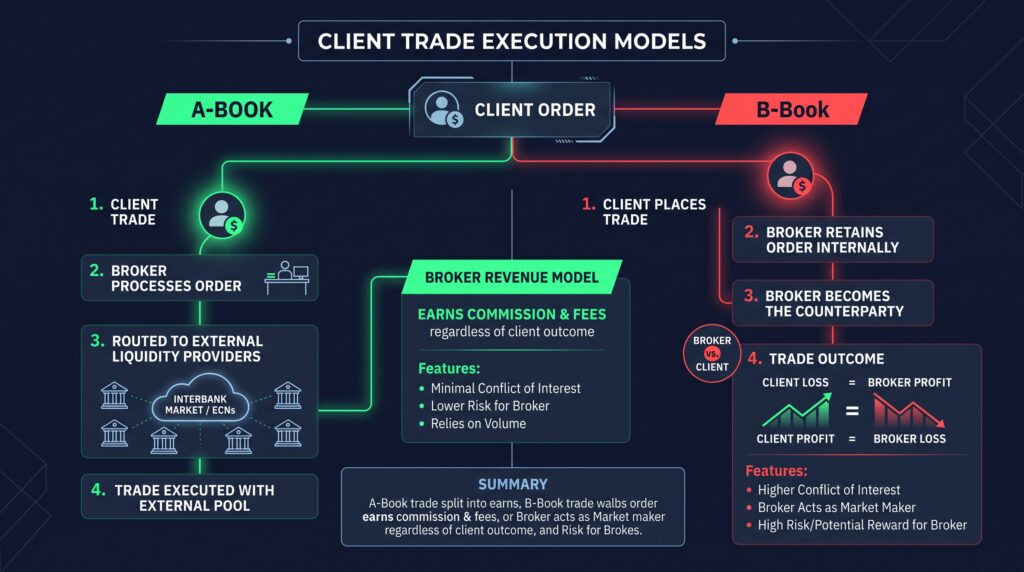
This diagram shows what happens to a client trade after it reaches the broker — the distinction that determines whether a conflict of interest exists.
A-Book: The broker passes the client trade to the external market — interbank network or liquidity providers. The broker profits from commission or spread markup regardless of whether the client wins or loses. No conflict of interest between broker revenue and client trading outcome. True ECN brokers are A-Book. Many STP brokers are A-Book for most positions.
B-Book: The broker internalises the trade and acts as counterparty. The broker profits when the client loses. This is the Market Maker model. Legal, regulated, disclosed in the execution policy, and used by the majority of retail forex brokers globally — but it is the source of the conflict of interest question that every sophisticated trader eventually asks.
Hybrid (the most common reality): Most major regulated brokers with significant retail books operate hybrid models. Small accounts and consistently losing traders are B-Booked. Large accounts and consistently profitable traders are A-Booked. This is standard industry practice — the marketing implications of the hybrid model are covered separately below.
FOR CEOs AND FOUNDERS — THE ONE QUESTION THAT MATTERS
“Do we A-Book or B-Book our client trades?” is the most important compliance and marketing question about your execution model. If your marketing team does not know the answer, your marketing copy may be inaccurate — and your compliance team almost certainly knows this. Ask them directly.
What Your Regulator Requires You to Disclose About Your Execution Model

The ECN/STP vs Market Maker discussion is not just a marketing positioning question — it is a regulatory disclosure requirement. Every regulated broker must publish an execution policy that explains how client orders are handled. The marketing copy must be consistent with that policy.
MiFID II execution policy — FCA and CySEC regulated brokers. Article 27 of MiFID II requires brokers to publish an order execution policy that explains, for each financial instrument, how they execute client orders. For Market Maker brokers, this must disclose that the broker may act as principal — taking the other side of client trades. For ECN/STP brokers, the policy describes how orders are routed to liquidity providers. This is a regulatory document, not optional marketing copy. Any marketing claim about execution must be consistent with what this policy discloses. Marketing as “ECN” when the execution policy describes a dealing desk arrangement is a regulatory breach. Note: The European Commission adopted new, more prescriptive RTS on order execution policies on 14 April 2026. These are expected to enter into force in late Q2/Q3 2026 and will apply to firms approximately Q4 2027/Q1 2028, giving firms an 18-month adjustment window. The core Article 27 disclosure obligation is unchanged, but the content requirements for execution policies will become significantly more detailed, particularly for firms dealing on own account (B-Book/Market Maker model).
FCA Consumer Duty (effective July 2023). Consumer Duty has added a clarity requirement that is directly relevant to execution model communication: marketing materials, including website copy about execution, must be understandable to the target client segment. A Market Maker broker that uses technical language to obscure the conflict of interest in client-facing materials — rather than explaining it clearly — may now face a Consumer Duty finding as well as a transparency concern. The regulatory direction is toward more disclosure, not less.
ASIC best execution — Australian brokers. Australian regulated brokers must demonstrate best execution under ASIC market integrity rules, including disclosure of execution arrangements that may involve conflicts of interest. The disclosure obligation is materially similar to MiFID II’s requirements, applied within the Australian regulatory framework.
Marketing a Market Maker Model Honestly — The Conflict of Interest Question
The conflict of interest question is the defining marketing challenge for Market Maker brokers. Most broker marketing teams respond to it in one of three ways — and all three fail:
Ignoring it — hoping traders do not ask. Traders do ask. Sophisticated traders specifically look for the execution policy disclosure. Ignoring the conflict of interest question in marketing does not make it go away; it means traders find the answer from a forum thread or a competitor’s marketing.
Deflecting it — mentioning regulation without addressing the specific structural issue. “We are fully regulated by CySEC” does not answer “do you take the other side of my trades.” Regulation is the safeguard framework; it is not a substitute for execution model transparency.
Overclaiming — marketing as ECN when the execution model is Market Maker or hybrid. This creates a marketing accuracy problem that is also a regulatory problem. The execution policy disclosure document is publicly available. Traders who investigate find the inconsistency. Regulators who investigate find a Consumer Duty or COBS fair communication breach.
The fourth approach — which no competitor article provides because they are either trader-education pieces or broker-branded content — is addressing the conflict of interest honestly with a marketing framework:
Step 1 — Acknowledge, do not hide. The execution policy discloses the Market Maker model. Your marketing should be consistent with that disclosure. A sentence such as “as a regulated Market Maker, we act as principal on client trades — which is why we are regulated by [regulator] and required to hold client funds in segregated accounts” is accurate, compliant, and proactively addresses the question.
Step 2 — Explain the regulatory safeguards. A B-Book Market Maker operating under FCA or CySEC regulation has: negative balance protection (clients cannot lose more than they deposit), segregated client funds (client money is separate from broker capital), and financial compensation scheme coverage where applicable (UK: FSCS up to £85,000; EU: ICF up to €20,000). These safeguards make the model safe for retail traders despite the structural conflict. They are the honest marketing response to the conflict of interest question.
Step 3 — Position for the right client segment. Fixed spreads, guaranteed execution, no commission, lower minimum deposits, and simple pricing are genuine Market Maker advantages. They serve beginners, smaller-account traders, and traders who value cost predictability. Market the model to the segment where its advantages outweigh the conflict of interest concern — not to institutional-level traders who specifically require pure A-Book execution and will leave when they find the execution policy.
Marketing ECN and STP Execution — The “No Conflict of Interest” Positioning and Its Limits
ECN and STP brokers have a genuine marketing advantage on the conflict of interest question. Most use it less credibly than they could — either by not explaining it clearly enough to capture its value, or by overclaiming in ways that create regulatory and reputational risk.
What “no conflict of interest” legitimately means: In a true A-Book ECN or STP model, the broker makes the same revenue regardless of whether the client’s trade wins or loses. There is no financial incentive to manipulate prices, artificially widen spreads, or trigger stop-losses. This is a genuine and marketable differentiator from the Market Maker model — and it is exactly what sophisticated traders are asking about when they evaluate broker types.
The two limits of this claim that every ECN/STP marketing team must understand:
Limit 1 — Commission costs are the honest corollary. Marketing “no conflict of interest” without being transparent about commission-based pricing is an incomplete claim. A trader who chooses an ECN broker on the basis of “no conflict of interest” positioning and then discovers they are paying $7 per standard lot per side in commissions has received an incomplete picture. Present the total cost — raw spread plus commission — not just the raw spread headline. The total cost for an active trader at a genuine ECN is often lower than equivalent spread-only pricing; show this calculation rather than hiding the commission.
Limit 2 — The “ECN” label is used loosely. Many brokers marketed as ECN actually route some order flow to internal liquidity, pass orders to a small number of preferred liquidity providers rather than a genuine electronic network, or operate hybrid models for smaller accounts. A broker that markets as “ECN” but operates differently for some client types is making a claim their execution policy does not fully support. This is a Consumer Duty fair communication issue under FCA regulation and a parallel requirement under CySEC. Credible ECN/STP marketing rests on a published execution policy that matches the marketing claim — and quarterly execution statistics (average speed, slippage rates, fill rates) that evidence the claim with data.
THE EVIDENCED ECN POSITION — HARDEST TO COPY, MOST CREDIBLE
Execution statistics published quarterly — average execution speed in milliseconds, slippage rates per instrument, fill rates, rejection rates. This is broker-data-led content (the content type from the forex broker content strategy article) applied to execution model marketing. It converts “no conflict of interest” from a marketing assertion to an evidenced position that no competitor can replicate without their own data.
Spread vs Commission — How to Market Each Pricing Structure
The execution model determines the pricing structure. The pricing structure has distinct marketing implications for different client segments. The question is not which pricing model is better — it is which pricing model your target acquisition segment prefers, and how you present it to maximise conversion.
| Spread-Based (Market Maker / STP) | Commission-Based (ECN) | |
|---|---|---|
| Target trader profile | Beginners, small accounts, infrequent traders | Experienced, active, high-frequency, algorithmic traders |
| Cost calculation | Simple: spread × lot size. No extra step. | Raw spread + commission per lot. Show total. |
| Marketing headline | “From 0.8 pips on EUR/USD, no commission” | “Raw spreads from 0.0 pips + $6 commission per standard lot” |
| Why it works for the segment | Cost predictability is valued. No commission feels simpler and cheaper to a beginner. | Active traders know their total cost at tight spreads + commission beats wide spread pricing. Show the calculation. |
| Common marketing mistake | Advertising the lowest possible spread without explaining spread variability during volatility | Advertising raw spreads only, hiding the commission until account opening |
ECN vs STP — When the Distinction Matters for Marketing
Most broker marketing teams spend time explaining the ECN vs STP distinction to traders who neither need nor want that level of technical detail. The commercial judgment is when to distinguish them and when to market them as a single category.
When the distinction does not matter: For retail trader acquisition at small-to-medium account levels, ECN and STP share the same critical positioning advantage — Non-Dealing Desk execution, no dealing desk counterparty, no conflict of interest between broker revenue and client outcome. Marketing them together as “NDD execution” is cleaner, more credible, and easier to understand than the technical explanation of electronic networks vs straight-through processing. Most retail traders do not know or care about the difference. They care about “does the broker take the other side of my trades?” The NDD answer covers both models accurately.
When the distinction matters: For institutional-level clients, prime brokerage relationships, and sophisticated professional traders who specifically request direct market access, the ECN distinction is meaningful — these clients require confirmed interbank access, L2 pricing depth, and FIX protocol API connectivity. If a broker genuinely operates true ECN execution for this segment, marketing it specifically is accurate and commercially valuable. If a broker has STP execution, marketing as ECN to this institutional segment is inaccurate and a regulatory risk that grows as the client becomes more sophisticated.
Hybrid Models — What Most Major Brokers Actually Operate

Most major regulated forex brokers with significant retail client bases do not operate a pure ECN, pure STP, or pure Market Maker model. They operate hybrid A-Book/B-Book models — and their marketing communication needs to be honest and accurate given this reality.
What the hybrid model looks like operationally: Small accounts and consistently losing traders are B-Booked — their trades are internalised and the broker acts as counterparty. Large accounts and consistently profitable traders are A-Booked — their trades are passed to the external market. The rationale is straightforward risk management: a broker does not want to be the counterparty to large positions from consistently profitable traders (this creates unhedged risk). Small losing accounts are more profitably managed internally. This is standard practice among major regulated retail brokers and is legally and correctly operated under regulatory oversight.
The marketing challenge for hybrid brokers: A hybrid broker cannot truthfully claim “pure ECN execution” or “no conflict of interest for all clients.” Some clients are B-Booked. Marketing as “we are ECN” when the execution policy describes a dealing desk arrangement for retail accounts is a marketing accuracy problem that is also a regulatory breach. Sophisticated traders — particularly the high-value traders a broker most wants to attract — are specifically looking for this inconsistency.
The honest hybrid marketing framework:
Segment the marketing message by account type. Retail account marketing: transparent about the execution model applied to standard accounts, focused on regulatory safeguards (negative balance protection, segregated funds, compensation schemes), pricing simplicity, and the minimum deposit accessibility. Professional or institutional account marketing: accurate ECN/NDD positioning, commission-based pricing, execution statistics, liquidity provider disclosure.
This segmented approach is accurate, compliant, and commercially effective. It does not try to make a hybrid model sound like something it is not. It targets each client segment with the honest version of the offer that serves them best.
FOR CEOS AND FOUNDERS — BUILD WHAT YOUR MARKETING NEEDS TO SAY
The execution model is a product decision with long-term marketing consequences. Launching as “ECN” when the technology infrastructure supports hybrid-only creates an accuracy problem that becomes a regulatory problem as the broker scales and client sophistication increases. Build the infrastructure the marketing will need to support — or market what the infrastructure actually delivers. Both are valid commercial decisions. Only one creates regulatory exposure.
How Execution Model Affects IB and Affiliate Marketing
One consideration no competitor article in this SERP addresses: the execution model affects IB and affiliate relationships in commercially significant ways that broker marketing and business development teams need to understand.
Commission structure alignment with IB model. ECN and STP brokers typically structure IB commissions as a share of the spread or commission generated by referred clients — the IB earns a share of the broker’s revenue regardless of whether the referred client is profitable. Market Maker brokers may offer volume-rebate IB structures where IB commissions are generated by client trading volume. The Market Maker IB structure means IB interests and client interests can diverge: an IB earns more from a client who trades frequently and unprofitably than from a client who trades selectively and profitably. This is a known structural tension in the Market Maker IB model that sophisticated IBs are increasingly aware of.
IB reputational alignment. An IB that refers clients to a Market Maker broker is referring them to a counterparty that profits from those clients’ losses. High-quality IBs in regulated markets — particularly those with their own regulatory obligations under FCA or ASIC IB registration requirements — are increasingly selective about the execution models of the brokers they promote. An ECN or STP broker can use their execution model as an IB recruitment argument: “We have no conflict of interest with your clients’ outcomes, which means our business interests and yours are aligned.” This is a meaningful differentiator in IB programme recruitment for brokers competing for the same introducing broker relationships.
Affiliate programme design by execution model. Pure Cost Per Acquisition (CPA, paid per first-time deposit) works well for Market Maker brokers — it aligns the affiliate’s incentive with the broker’s customer acquisition goal and avoids the revenue share complexity. Revenue share (a percentage of the client’s trading spread or commission revenue, paid ongoing) aligns better with ECN/STP commission-based models where ongoing trading generates ongoing commission that can be shared. Choosing the IB/affiliate payment model that matches the execution model’s revenue structure reduces friction in the ongoing financial relationship with partners.
How your broker’s organic positioning relative to comparison sites intersects with execution model is worth considering: comparison sites that list your broker often highlight execution model as a key evaluation criterion. A credible, evidenced execution model claim on your own site strengthens both your organic E-E-A-T positioning and your comparison site listing quality.
If you want to know whether your execution model communication is working for or against your acquisition strategy — that assessment is part of an audit.
FAQ
Q1: What is the difference between ECN, STP, and Market Maker forex brokers?
ECN (Electronic Communication Network) brokers connect client orders directly to a network of liquidity providers where orders are matched at the best available price. The broker earns revenue from commission per trade with no conflict of interest between broker and client outcomes. STP (Straight-Through Processing) brokers pass orders directly to liquidity providers without a dealing desk, earning revenue from a spread markup applied to the raw liquidity provider price. Neither ECN nor STP brokers act as the counterparty to client trades. Market Maker brokers operate a dealing desk and act as the counterparty to client positions, creating their own internal market and earning revenue from the spread between bid and ask prices. Market Makers may profit when clients lose, which creates a structural conflict of interest that regulated brokers must disclose in their execution policy.
Q2: What is the A-Book and B-Book distinction in forex broker execution?
A-Book execution means the broker passes every client trade to the external market through liquidity providers or an electronic communication network. The broker profits from commission or spread markup regardless of whether the client wins or loses, creating no conflict of interest between broker revenue and client outcome. B-Book execution means the broker internalises the trade and acts as the counterparty, profiting when the client loses and losing when the client profits. Market Maker brokers typically B-Book retail client positions. Most major regulated forex brokers operate hybrid models, A-Booking consistently profitable and large-account clients while B-Booking smaller accounts and losing traders. The A-Book and B-Book distinction is the operational reality behind the ECN, STP, and Market Maker taxonomy and determines what a broker can truthfully claim about conflicts of interest in their marketing communications.
Q3: How should a Market Maker forex broker address the conflict of interest question in its marketing?
Market Maker brokers should address the conflict of interest question directly rather than ignoring it, deflecting it, or overclaiming a different execution model. The honest marketing framework has three elements: acknowledge that the Market Maker model involves the broker acting as counterparty to client trades, which is disclosed in the execution policy as required by regulation; explain the regulatory safeguards that protect retail clients despite this structural conflict, including negative balance protection, segregated client funds, and financial compensation scheme coverage where applicable; and position the Market Maker advantages for the client segment that values them, specifically fixed spreads, guaranteed execution, no commission charges, and lower minimum deposit requirements. These advantages genuinely serve beginner and smaller-account traders, making the Market Maker model appropriate for this segment regardless of the conflict of interest that must be disclosed.
Q4: What is a hybrid forex broker execution model and how should it be marketed?
A hybrid forex broker operates both A-Book and B-Book execution depending on client type and account size. Typically, small retail accounts and consistently losing traders are B-Booked with the broker acting as counterparty, while large accounts and consistently profitable traders are A-Booked with trades passed to the external market. This is standard practice among major regulated retail forex brokers and is legally operated under regulatory oversight. The marketing challenge for hybrid brokers is accuracy: a hybrid broker cannot truthfully claim pure ECN execution or no conflict of interest for all clients, since some client positions are B-Booked. The honest hybrid marketing approach segments the message by account type, using transparent regulatory safeguard messaging for retail accounts and NDD or ECN positioning for professional and institutional accounts. Marketing copy must be consistent with the execution policy disclosure document.
Q5: What does “no conflict of interest” mean for ECN and STP forex brokers and what are its marketing limits?
For ECN and STP brokers operating A-Book execution, “no conflict of interest” means the broker earns commission or spread markup regardless of whether client trades win or lose, creating no financial incentive to manipulate prices or work against client outcomes. This is a legitimate and marketable advantage. However, there are two limits to this claim. First, commission costs are the honest corollary: ECN and STP brokers should present commission pricing transparently alongside the no-conflict positioning rather than emphasising the positioning while underemphasising the cost. Second, the ECN label is used loosely by brokers who actually operate hybrid or STP models. A broker that markets as ECN must ensure their actual execution policy supports this claim, or risk a regulatory fair communication issue under FCA Consumer Duty or equivalent CySEC requirements.
Q6: How does a forex broker’s execution model affect its IB and affiliate marketing programme?
A forex broker’s execution model affects IB and affiliate relationships in two significant ways. First, commission structure: ECN and STP brokers typically structure IB commissions as a share of the spread or commission generated by referred clients, aligning IB incentives with client trading activity. Market Maker brokers may offer volume-rebate IB structures where IB earnings are generated by client trading volume regardless of profitability, which can create a divergence between IB interests and client interests. Second, reputational alignment: an IB referring clients to a Market Maker broker is referring them to a counterparty that profits from client losses. Sophisticated and regulated IBs in major markets are increasingly selective about execution model transparency from the brokers they promote, making the ECN or NDD execution model a meaningful IB recruitment argument for brokers who operate it accurately.
Disclaimer
The information contained in this section is provided for informational and educational purposes only. It does not constitute legal advice, financial advice, investment advice, or compliance advice of any kind. Regulatory frameworks, disclosure requirements, and compensation scheme limits are subject to change. All references to MiFID II, FCA, CySEC, ASIC, FSCS, and ICF obligations should be independently verified against the current rules and guidance published by the relevant regulatory authority. This content does not apply to any specific broker and makes no claim about the execution practices of any individual firm. Verify all regulatory references and marketing claims with your qualified compliance team and legal counsel before publication, and ensure consistency with your firm’s own execution policy disclosure document.