
Forex Broker Retargeting Strategy, what does it mean?
A user who has registered an account but not yet funded it is not a generic site visitor — they are the single highest-value retargeting audience a forex broker’s paid acquisition programme generates, and most retargeting strategies treat them identically to a cold prospect.
This user has already cleared the highest-friction step in the entire funnel: they have provided identity information and accepted terms to open an account. Their non-conversion to a funded client is rarely indifference — it is almost always a specific, addressable friction point somewhere in the onboarding process. Generic retargeting, with broad brand messaging and undifferentiated creative, wastes the opportunity to address that specific friction directly.
When I look at a forex broker’s retargeting setup, registered non-depositors are almost always collapsed into the same general remarketing pool as cold site visitors — the highest-intent users in the entire funnel receiving the same generic ad creative as someone who bounced off the homepage after four seconds.
This guide covers the registration-to-funded segment specifically: what makes it different, the KYC friction connection, the compliance layer that applies with particular weight here, timing windows based on the typical conversion decay curve, creative format selection, and the operational discipline of removing funded users from the audience the moment they convert.
Table of Contents
Forex Broker Retargeting Strategy-Why the Registration-to-Funded Segment Is Different
Three properties distinguish this segment from general site-visitor retargeting.
Demonstrated intent. Registration requires providing identity information and accepting terms — a meaningfully higher commitment than browsing a landing page. This is not a cold audience; it is an audience that has already taken the most consequential step in the conversion path short of funding itself.
Smaller but higher-value. This audience is a fraction of total site traffic but converts at a dramatically higher rate than cold retargeting once addressed correctly. Budget allocated to this segment generally produces better return than equivalent budget spent on broader prospecting retargeting.
Higher compliance stakes. Messaging to this segment sits closer to the actual financial promotion driving deposit than top-of-funnel awareness content, meaning the highest compliance rigor tier from the format-compliance matrix applies in full.
A broad “come back and trade with us” message treats a user who has already registered identically to someone who has never heard of the broker. This wastes the specificity advantage — the broker already knows this user is registered, knows roughly how long ago, and (if onboarding analytics are in place) often knows which step of the KYC process they have not completed.
The KYC Friction Connection — Messaging That Addresses the Actual Drop-Off Point
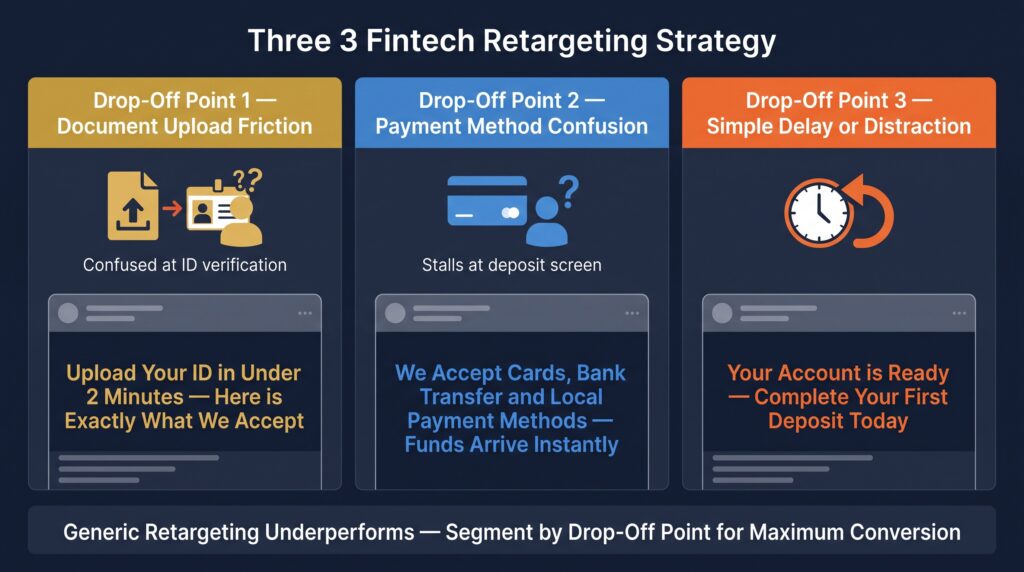
Retargeting messaging for registered but unfunded users should address the specific reason they have not completed funding rather than relying on generic encouragement. Three drop-off points cover most cases, building on the KYC Framework:
- Document upload friction. Users abandon at identity verification, often due to confusion about accepted document types or photo quality requirements. Retargeting creative addressing this directly — “upload your ID in under 2 minutes, here’s exactly what we accept” — outperforms generic brand messaging for this specific drop-off cause.
- Payment method confusion. Users complete KYC but stall at funding due to uncertainty about available deposit methods, processing times, or minimum amounts. Retargeting clarifying available payment methods and timelines addresses this directly.
- Simple delay or distraction. The user intends to complete funding but has not returned. This is the segment most amenable to a clear, time-sensitive but compliant reminder.
The practical implementation: If onboarding analytics identify which specific step a user has not completed, segment the retargeting audience and messaging accordingly rather than treating all registered-unfunded users as one undifferentiated group. A user stalled at document upload needs different messaging than a user who has completed KYC but not yet deposited.
The GDPR Consent Distinction — Registration Data vs Marketing Use
⚠ Legal Verification Required: The contract-vs-marketing-consent distinction covered in this section reflects the generally accepted GDPR compliance interpretation for advertising retargeting. Data protection law application varies by jurisdiction, specific processing context, and your organisation’s existing consent architecture. Verify the application of this section to your specific setup with your DPO or legal counsel before implementation. Do not treat this as legal advice.
A registered user has provided personal data with a specific lawful basis — typically contract performance, since they are entering into a client relationship with the broker. This lawful basis covers using the data to deliver the service: processing the registration, conducting KYC, communicating about account status. It does not automatically extend to using that same data to build an advertising retargeting audience on Google or Meta — advertising use generally requires a separate lawful basis, most commonly marketing consent obtained through the website’s consent management platform.
The practical implication: The registration-to-funded retargeting audience should be built from users who have separately provided marketing consent — not simply every user who has registered. A broker whose registration flow does not separately capture marketing consent (distinct from the contractual consent needed to open the account) may have a smaller compliant retargeting audience than their total registration count would suggest, but it is the audience that can be legally retargeted.
What this means practically for audience construction: When building the custom audience list in Google Ads or Meta Ads Manager, filter the registered-user data export to only those records with active marketing consent before uploading. This is a data hygiene step that should be automated — consent status synced to the CRM and filtered at export — rather than manually verified per campaign.
*This is the generally accepted compliance interpretation, not definitive legal advice. Confirm the lawful basis distinction applies correctly to your specific data processing setup before relying on it for audience construction decisions.
Regulatory Exclusions Applied to This Specific Segment
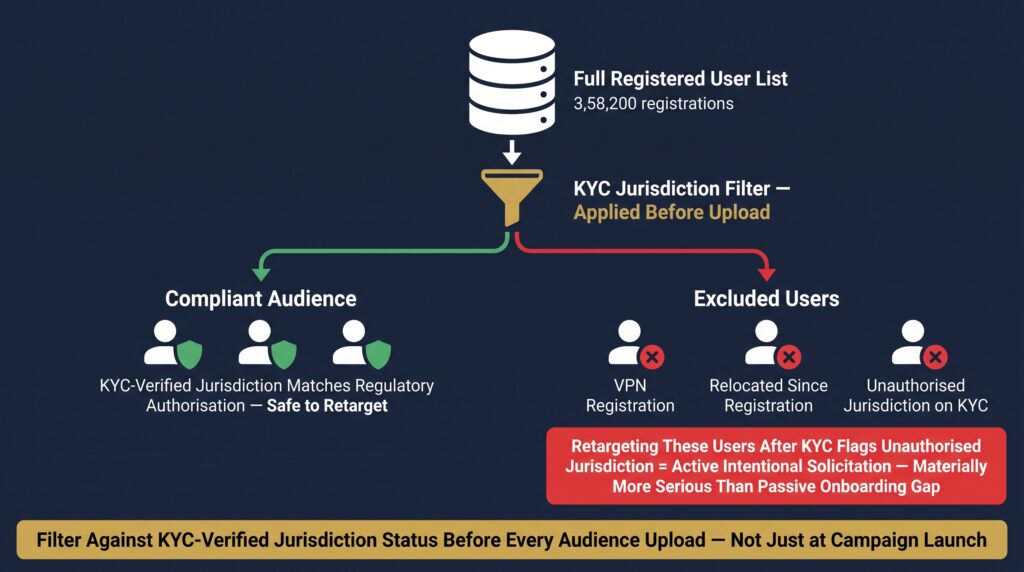
A registration-to-funded retargeting audience must exclude any user whose KYC-verified jurisdiction is outside the broker’s regulatory authorisation — even if their original ad click and registration appeared to come from an authorised jurisdiction. This discrepancy occurs when a user registers using a VPN, has since relocated, or otherwise provided location information at registration that does not match their KYC-verified actual jurisdiction.
Why this is more serious than a standard exclusion failure: Retargeting a user toward funding after KYC has identified them as being in an unauthorised jurisdiction compounds the original onboarding gap into an active, intentional solicitation — a materially more serious compliance issue than passively allowing an unauthorised registration to occur.
The practical control: Before any registration-to-funded retargeting audience is uploaded to an ad platform, filter against the current KYC-verified jurisdiction status — excluding any user flagged as outside the broker’s authorised markets, regardless of how they originally registered.
Timing Windows — The Conversion Decay Curve
Registration-to-funded conversion probability decreases the longer the gap since registration, with the majority of conversions typically occurring within the first 48-72 hours and a longer tail extending to 2-3 weeks before the segment is reasonably considered cold.
| Window | Frequency | Messaging Focus | Compliance Note |
|---|---|---|---|
| Days 1-3 | HIGH | Friction-specific messaging addressing the most common KYC drop-off points directly | Highest compliance rigor — closest to active financial promotion |
| Days 4-14 | TAPERING | Value-reinforcement — platform features, regulatory credibility, support availability | Same risk warning and claim standards apply throughout |
| Days 15-21 | LOW | Final compliant re-engagement before moving to standard nurture cadence | Audience review for continued marketing consent validity |
This is a general pattern observed across forex broker onboarding funnels. A broker with sufficient historical conversion data should calibrate these windows to their own actual decay curve rather than applying the general pattern uncalibrated.
Creative Format Selection for This Segment
This segment sits at the bottom of the funnel — the stage requiring the highest compliance rigor per the format-compliance matrix, because creative is closest to the actual financial promotion driving deposit. Static and short video formats addressing specific KYC friction points directly — document upload instructions, available payment methods, clear next-step guidance — are the most appropriate formats for this segment.
UGC and testimonial formats are particularly inappropriate here specifically — more so than for general brand awareness content — because messaging at this stage is closest to directly encouraging a financial commitment. This is exactly where the typical-results restriction carries the most regulatory weight, since the audience is one step away from making the deposit a testimonial would implicitly be encouraging.
Coordinating Paid Retargeting With Email Sequences
The registration-to-funded segment is also the primary audience for the email sequences covered in the forex broker email sequences guide. Paid retargeting and email should be coordinated rather than operating as independent channels — sending the same message simultaneously across both creates redundancy and message fatigue.
A coordinated sequencing approach: Email addresses the specific friction point first, in a more detailed, less time-pressured format. Paid retargeting reinforces within 24-48 hours with a shorter, more visual version of the same core message. A final email provides a clear, simple last-step reminder before the segment moves to the tapering frequency window described above. This combined sequence typically outperforms either channel operating independently.
Audience Suppression — Why the Funded Moment Must Trigger Immediate Removal
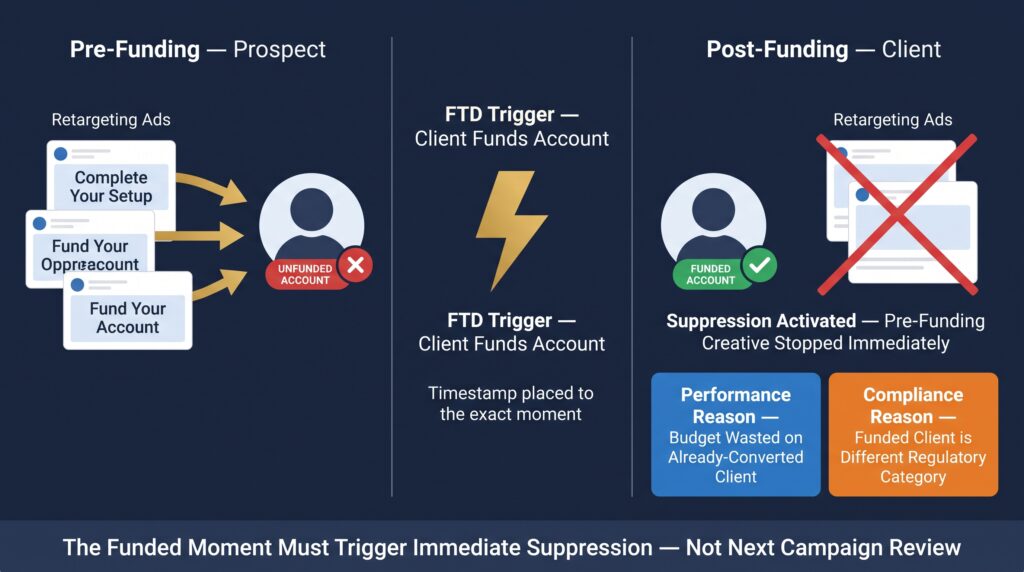
This is the practical operational closer — and the insight that most clearly separates a sophisticated retargeting setup from a generic one.
The dual reason for prompt suppression:
Performance. Continuing to show “complete your account setup” or “fund your account” messaging to a client who has already funded wastes budget and creates a poor client experience — potentially undermining trust at the exact moment the relationship should be strengthening.
Compliance. A funded client occupies a different regulatory category than a prospective client. Ongoing client communications carry different applicable requirements than pre-funding financial promotions actively encouraging a deposit decision. Continuing to serve pre-funding financial promotion creative to an existing funded client is, at minimum, a messaging misalignment — and potentially a compliance consideration depending on the specific creative content still being served.
THE TECHNICAL IMPLEMENTATION REQUIREMENT
Audience suppression should be triggered by the funding event in near-real-time — not a periodic batch update (daily or weekly sync) that could leave a funded client in the registration-stage retargeting audience for hours or days. This typically requires a direct integration between the broker’s CRM or trading platform (which knows the moment a deposit clears) and the advertising platform’s audience management API, rather than a manual or batch-scheduled export process.
The connection back to the metric this entire segment exists to influence — the FTD framework — closes the loop: every element of this retargeting strategy exists to move a registered user to the FTD event as efficiently and compliantly as possible, and the moment that event occurs, the strategy’s job for that specific user is complete.
FOR CEOs — THE ONE QUESTION TO ASK YOUR TEAM
Ask your marketing team how quickly a funded client stops seeing “complete your registration” retargeting ads. If the answer is “within a day or two” rather than “immediately” or “within the hour,” there is a suppression latency gap that wastes budget and risks message misalignment with existing clients.
If you want this segment’s retargeting strategy built and audited for compliance — audience construction, timing, creative, and suppression logic all reviewed together — that is part of the diagnostic.
FAQ
Q1: Why is the registration-to-funded segment different from general retargeting?
The registration-to-funded segment is different from general retargeting because users in this segment have already demonstrated significant intent by providing identity information and accepting terms to create an account, placing them meaningfully further along the conversion path than a cold site visitor. This segment is typically smaller than total site traffic but converts at a substantially higher rate once addressed with messaging specific to their stage rather than generic brand awareness content. The compliance stakes are also higher for this segment because retargeting messaging sits closer to the actual financial promotion driving a deposit decision than top-of-funnel awareness content, meaning the highest compliance rigor tier applies. Treating this segment identically to general site-visitor retargeting wastes the specificity advantage a broker has: knowledge that the user is registered, how long ago, and often which step of the onboarding process they have not completed.
Q2: How should retargeting messaging address KYC drop-off for unfunded registered users?
Retargeting messaging for registered but unfunded users should address the specific reason they have not completed funding rather than using generic encouragement. The three most common drop-off points are document upload friction, where users abandon at identity verification due to confusion about accepted document types, and retargeting creative explaining exactly what documents are accepted and how quickly the process takes can address this directly; payment method confusion, where users complete identity verification but stall at funding due to uncertainty about available deposit methods or processing times, which retargeting can clarify directly; and simple delay, where the user intends to complete funding but has not returned, which is the segment most amenable to a clear, compliant reminder. If onboarding analytics identify which specific step a user has not completed, the retargeting audience and messaging should be segmented accordingly rather than treating all registered but unfunded users as a single undifferentiated group.
Q3: Can a forex broker use registration data to build a retargeting audience under GDPR?
A forex broker should not assume that registration data can automatically be used to build an advertising retargeting audience. When a user registers, their personal data is typically processed under a contractual lawful basis covering delivery of the service such as account setup, KYC processing, and account communications. This lawful basis does not automatically extend to using the same data for advertising retargeting on platforms such as Google or Meta, which generally requires a separate lawful basis, most commonly marketing consent captured through the website’s consent management platform. The practical implication is that a compliant registration-to-funded retargeting audience should be built only from users who have separately provided marketing consent, not from every registered user. This typically requires filtering registered-user data by consent status before uploading custom audiences to advertising platforms, ideally as an automated step rather than a manual per-campaign check. This interpretation should be verified with a data protection officer or legal counsel for the broker’s specific data processing setup, as the application of data protection law can vary by jurisdiction and processing context.
Q4: What regulatory exclusions apply to a registration-to-funded retargeting audience?
A registration-to-funded retargeting audience must exclude any user whose KYC-verified jurisdiction falls outside the broker’s regulatory authorisation, even if their original registration appeared to come from an authorised market. This discrepancy can occur when a user registers using a VPN, has since relocated, or otherwise provided location information at registration that does not match their actual verified jurisdiction once KYC is completed. Retargeting a user toward funding after KYC has identified them as being in an unauthorised jurisdiction is more serious than a standard exclusion oversight, because it compounds the original onboarding gap into an active, intentional solicitation. The practical control is to filter the retargeting audience against the current KYC-verified jurisdiction status before any audience upload to an advertising platform, rather than relying on the jurisdiction inferred from the original ad click or registration IP address, which may not reflect the user’s verified location.
Q5: What is the typical conversion timing window for registration-to-funded retargeting?
Registration-to-funded conversion probability typically follows a decay pattern, with the majority of conversions occurring within the first 48 to 72 hours after registration and a longer tail extending to 2 to 3 weeks before the segment is reasonably considered cold. A recommended timing structure follows this curve: high-frequency, friction-specific messaging addressing common drop-off points during the first 72 hours, tapering to lower-frequency value-reinforcement messaging covering platform features and regulatory credibility during days 4 through 14, and a final compliant re-engagement sequence during days 15 through 21 before the segment moves to standard low-frequency nurture cadence. This is a general pattern observed across forex broker onboarding funnels, and a broker with sufficient historical conversion data should calibrate these specific windows to their own actual decay curve rather than applying the general pattern without adjustment, since the precise timing varies based on KYC process complexity and client profile.
Q6: Why should funded clients be removed from retargeting audiences immediately?
Funded clients should be removed from registration-stage retargeting audiences immediately for two reasons. The performance reason is that continuing to show messaging such as complete your account setup or fund your account to a client who has already funded wastes advertising budget and creates a poor client experience at the exact moment the relationship should be strengthening rather than continuing a pre-funding sales sequence. The compliance reason is that a funded client occupies a different regulatory category than a prospective client, as ongoing client communications carry different applicable requirements than pre-funding financial promotions that actively encourage a deposit decision. Continuing to serve deposit-encouragement creative to an existing funded client represents at minimum a messaging misalignment. The technical implementation requires audience suppression triggered by the funding event in near-real-time through a direct integration between the broker’s CRM or trading platform and the advertising platform’s audience management capability, rather than a periodic batch update that could leave a funded client in the pre-funding retargeting audience for hours or days after the funding event occurs.