
Last reviewed: June 2026 · Author: Hristo Hristov
What is best Forex Broker Site structure for Multi-Jurisdiction SEO?
The strategic decision between multi-domain and single-domain architectures for forex broker SEO has been well-described. This article starts where that conversation ends: how to actually build the structure, configure the tools, and avoid the implementation errors that most multi-jurisdiction broker sites contain.
A CMO who has chosen “subdirectory with hreflang” still has fifteen specific decisions to make before a single page is live — URL path structure, hreflang tag implementation for regulatory pages, GSC property configuration, XML sitemap architecture, canonical strategy for product variant pages, crawl budget management as markets are added. Most multi-jurisdiction broker sites I review have made at least three of these incorrectly. The errors are not random. They follow predictable patterns that are specific to regulated financial services sites, and they are almost always the result of applying generic international SEO guidance to a site type that generic guidance was not written for.
This article covers the three architecture options with a decision framework, then the full implementation detail for building a clean multi-jurisdiction structure within the regulatory constraints your licence imposes. If you are still deciding which geographic markets to target before building the structure, the forex broker geo-targeting framework covers that decision first.
Pattern Observation — Hreflang in Regulated Broker Sites
The most consistent hreflang error I find in regulated broker site reviews is bidirectional confirmation missing on commercial pages. The homepage has correct hreflang implementation — every jurisdiction pointing to every other. But the spread comparison page, the account types page, and the platform feature pages have no hreflang at all. GSC signals this as duplicate content across domains rather than as a hreflang error — which is why it gets misdiagnosed. The root cause is that hreflang was implemented once at launch on the top-level pages and never extended to new commercial content added afterwards.
Table of Contents
Forex Broker Site structure for Multi-Jurisdiction SEO-Why Architecture Is the Foundation — Not an Afterthought
The architecture decision made at launch is very hard to change once content is produced and backlinks are built. A broker that launches with a subdirectory structure and attempts to migrate to ccTLDs at month 18 faces a domain migration — with all the authority disruption that entails. Backlinks built to the original URLs. Rankings on pages that will 301 redirect. A 6–12 month organic traffic dip while Google processes the migration and re-evaluates domain authority across the new structure.
Two concrete consequences of getting it wrong early: first, authority dilution — if content is split across multiple domains without a clear strategy, link equity is divided between domains that are each too weak to rank competitively in their respective markets. Second, technical debt — retrofitting hreflang, canonical tags, and GSC configuration onto a site that was not built for them costs three to five times more than building correctly from the start, and produces worse results because the underlying URL structure resists clean implementation.
The timeline impact of structural errors is covered in the forex broker SEO timeline framework — a domain migration resets organic authority signals and typically adds 6–12 months to the ranking window. Build the right foundation before the first piece of content is written. Fix the architecture later and you are paying twice.
The Three Architecture Options — Decision Framework
The standard multi-domain vs single-domain framing is a simplification. The full decision involves three architectures. For most forex brokers, the subdirectory option is the correct starting point — but the decision depends on your regulatory status, budget, and expansion timeline.
| Dimension | ccTLD broker.com.au | Subdirectory ✓ broker.com/ae/ | Subdomain ae.broker.com |
|---|---|---|---|
| Geo-targeting signal | ★★★ Strongest | ★★★ Strong | ★★ Moderate |
| Domain authority management | ✗ Diluted — each TLD builds separately | ✓ Consolidated — all backlinks strengthen root domain | ⚠ Partially diluted |
| Regulatory fit | Best — local entity + local licence per market | Good — single licence, multi-market geo-targeting | Moderate — language-platform separation |
| Implementation complexity | High — separate domains, CMS, GSC properties per market | Medium — one domain, hreflang, GSC subdirectory properties | Medium-high — separate GSC per subdomain |
| Best-fit forex scenario | Established broker with local entity + local regulatory licence in target market (e.g. ASIC-licensed broker building dedicated AU presence) | Most forex brokers on a single CySEC/FCA/ASIC licence targeting MENA, SEA, or LatAm | Arabic RTL site requiring separate CMS infrastructure, or affiliate/IB portal separation |
✓ = Recommended default for most internationally-licensed forex brokers. Verified against Google Search Central international SEO guidance, June 2026.
ccTLD — When It Is the Right Choice
A country-code top-level domain (broker.com.au for Australia, broker.co.uk for the UK, broker.co.za for South Africa) sends the strongest geo-targeting signal available. Google treats ccTLDs as inherently associated with their respective markets, which reduces the reliance on hreflang and GSC country targeting as supplementary signals.
The constraint: ccTLD is appropriate for forex brokers only when a local entity and ideally a local regulatory licence exist in the target market. An ASIC-licensed broker building a dedicated Australian-market presence has a natural fit with broker.com.au — the domain architecture, the regulatory licence, and the local entity align. A CySEC-regulated broker launching UAE-targeted content from a single Cyprus entity does not have this alignment, and a .ae ccTLD would require a UAE local entity that most internationally-licensed brokers do not have.
ccTLD is a three-to-five year strategy for established brokers with local entities in each target market. It is not a year-one architecture for a broker launching multi-jurisdiction targeting from a single licence. The authority dilution cost — link equity split across multiple TLDs that each start at DR 0 — is prohibitive at launch stage.
Subdirectory — The Right Starting Point for Most Forex Brokers
RECOMMENDED DEFAULT FOR SINGLE-LICENCE BROKERS
Subdirectory architecture (broker.com/ae/ for UAE, broker.com/my/ for Malaysia, broker.com/br/ for Brazil) concentrates all domain authority on a single root domain while still sending geo-targeting signals via hreflang tags and GSC country targeting settings per subdirectory. Every backlink the domain earns — regardless of which jurisdiction page it points to — strengthens the entire domain simultaneously. This compounding effect is what ccTLD architecture cannot replicate at the same investment level.
The recommended URL structure: broker.com/{iso-country-code}/ for geography-targeted pages. UAE: /ae/. Malaysia: /my/. Saudi Arabia: /sa/. Brazil: /br/. Arabic-language cross-MENA content: /ar/. Global default content at the root: broker.com/. This structure is explicit, crawl-friendly, canonical-compatible, and hreflang-implementable.
Subdomain — The Specific Use Case
Subdomain architecture (ae.broker.com, ar.broker.com) sits between ccTLD and subdirectory in terms of authority behaviour — Google treats subdomains more like separate domains than subdirectories for authority distribution purposes, which makes them suboptimal as a primary geo-targeting structure for the same reason ccTLD is suboptimal: authority dilution.
Subdomain is appropriate for two specific forex broker use cases: a distinct language-platform that requires separate CMS infrastructure (an Arabic RTL site that cannot be built within the main CMS’s subdirectory architecture without significant custom development); and the affiliate/IB portal, which should always be on a separate subdomain specifically so it can be blocked from indexation independently from the main domain — as covered in the forex broker technical indexation guide.
Hreflang Implementation for Regulated Broker Sites
Hreflang is the technical signal that tells Google which language and locale variant of a page to serve to users in each market. For forex broker sites, the implementation has three specific considerations that generic hreflang guides do not cover.
The Basic Structure — Self-Referencing Tags on Every Jurisdiction Page
Every jurisdiction page must include hreflang tags referencing all other language and locale variants, plus a self-referencing tag for its own locale, plus an x-default for the global default page. Here is the correct implementation for a CySEC-regulated broker targeting UAE, Malaysia, and Saudi Arabia with English content, plus an Arabic cross-MENA page, and a global default:
<!-- On every UAE English page (broker.com/ae/...) -->
<link rel="alternate" hreflang="en-AE" href="https://broker.com/ae/forex-trading/" />
<link rel="alternate" hreflang="en-MY" href="https://broker.com/my/forex-trading/" />
<link rel="alternate" hreflang="en-SA" href="https://broker.com/sa/forex-trading/" />
<link rel="alternate" hreflang="ar"    href="https://broker.com/ar/forex-trading/" />
<link rel="alternate" hreflang="x-default" href="https://broker.com/forex-trading/" />
The same tag set must appear on every other jurisdiction variant of the same page — the Malaysian version, the Saudi version, the Arabic version, and the global default all contain the complete list. Hreflang is always bidirectional: if /ae/ references /my/, then /my/ must reference /ae/ in return.
The Regulated-Site Rule — Never Apply Hreflang to Compliance Pages
Critical — Forex Broker Specific
Do not apply hreflang tags to regulatory disclaimer pages, compliance documents, terms and conditions, KYC pages, or annual reports. These pages should be noindexed . Applying hreflang to a noindexed page creates a direct conflict: hreflang says “this page exists in multiple language versions across multiple markets” while noindex says “do not index this page.” The result is GSC International Targeting errors that are difficult to diagnose. Apply hreflang exclusively to commercial and editorial content pages that are actively indexed and targeted for organic ranking.
The x-default Rule for Global and Offshore Broker Pages
The x-default tag should point to the primary commercial page that serves users who are not in any specifically targeted jurisdiction — not the homepage. For a CySEC broker targeting MENA and SEA but accepting global clients, the x-default for the forex trading page points to broker.com/forex-trading/ (the global commercial page), not to broker.com/. Pointing x-default to the homepage is the most common hreflang error in broker sites and causes Google to treat the homepage as the default for all non-targeted markets, which dilutes the geo-targeting signals for all jurisdiction-specific pages simultaneously.
URL Architecture for Jurisdiction-Specific Content
Within the chosen architecture, the URL path structure determines whether jurisdiction pages differentiate cleanly or create the duplicate content clusters. Three URL architecture patterns are critical to get right.
Account type pages — jurisdiction first, product second. The jurisdiction ISO code belongs in the subdirectory, not as a query parameter. Wrong: broker.com/accounts/standard/?market=ae. Right: broker.com/ae/accounts/standard/. The clean path approach is canonical-friendly, hreflang-compatible, and clearly signals to Googlebot which market the page serves. Query parameters create crawlable URL variants that multiply the thin content problem from A6 Issue 4.
Jurisdiction-specific trading conditions. broker.com/ae/trading-conditions/ contains UAE-specific leverage limits (1:500 for global licence), spreads, and account types. broker.com/eu/trading-conditions/ contains EU-specific ESMA leverage limits (1:30) and the corresponding risk warning percentage. These are legitimately different pages — the URL structure makes the differentiation explicit to Google and avoids the duplicate content trap that identical trading conditions pages across jurisdictions create.
The regulatory archive — build it at launch, not after. A single /legal/ directory at the root with jurisdiction subdirectories containing all compliance documents:
broker.com/legal/ (noindex, disallow in robots.txt)
├── /legal/cysec/ (CySEC documents — noindex)
├── /legal/fca/ (FCA documents — noindex)
├── /legal/asic/ (ASIC documents — noindex)
└── /legal/privacy/ (Privacy notices per regulation — noindex)
All pages in /legal/ are noindexed and disallowed in robots.txt. Accessible via direct link from footer and account opening pages for users and regulators. Invisible to organic search. Build this structure at launch — retrofitting it after 50 compliance documents are scattered across the domain costs significantly more and leaves indexation residue in GSC for months.
GSC Multi-Property Setup for Multi-Jurisdiction Broker Sites
Three GSC property decisions determine whether you have visibility into how Google is processing your multi-jurisdiction structure — or whether you are flying blind across markets.
| Property Type | What It Shows | Setup | Use For |
|---|---|---|---|
Domain propertysc-domain:broker.com | All URLs across all subdirectories, subdomains, and protocols in one view | DNS verification required. Set up first — this is your primary overview. | Overall domain health, Coverage report, global sitemap submission, total organic performance |
URL prefix propertiesbroker.com/ae/broker.com/my/ | Jurisdiction-level crawl data, indexation per market, hreflang errors per subdirectory | Create one URL prefix property per active jurisdiction subdirectory. Set country targeting in International Targeting settings per property. | Country targeting signals, jurisdiction-specific sitemap submission, market-level performance tracking |
Partner subdomain propertypartner.broker.com | Partner portal indexation status — should show zero indexed pages if correctly blocked | Set up separately from main domain. Verify robots.txt disallow is working — Coverage should show all pages excluded. | Monitoring that the affiliate portal is not leaking into the main domain’s index |
Country targeting per subdirectory: In each URL prefix property, navigate to International Targeting → Country and set the target market. UAE subdirectory → United Arab Emirates. Malaysia subdirectory → Malaysia. This creates a second geo-targeting signal that supports hreflang. Without it, Google relies on hreflang alone — with both signals pointing to the same market, geo-targeting classification is faster and more reliable.
XML Sitemap Architecture
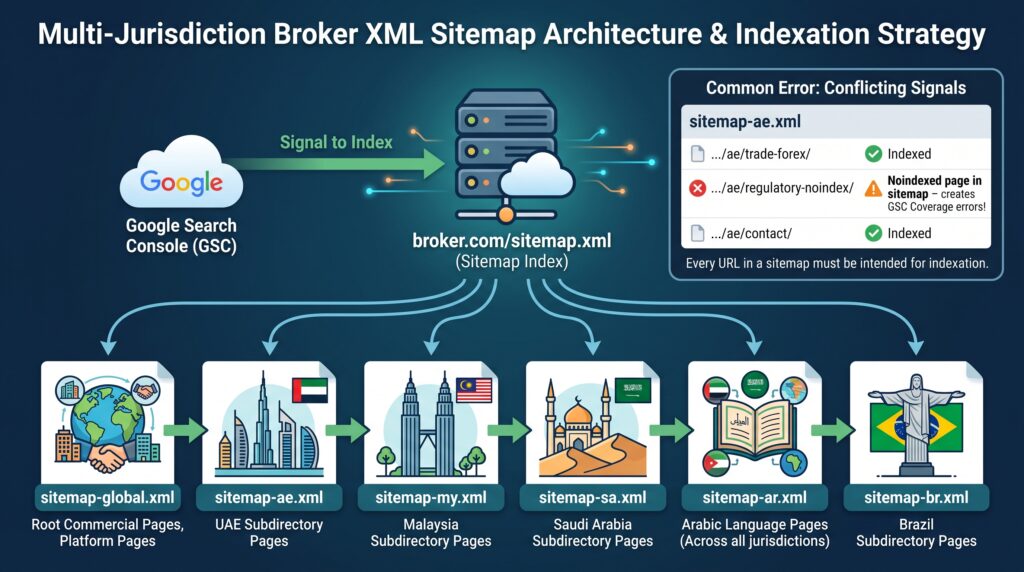
The sitemap structure is the implementation of your indexation strategy. Every URL in a sitemap signals to Google “please index this.” Every noindexed page in a sitemap creates a conflicting signal — and GSC Coverage errors. The correct architecture for a multi-jurisdiction broker:
broker.com/sitemap.xml (index pointing to child sitemaps)
├── /sitemap-global.xml (root commercial pages, platform pages)
├── /sitemap-ae.xml (UAE subdirectory pages)
├── /sitemap-my.xml (Malaysia subdirectory pages)
├── /sitemap-sa.xml (Saudi Arabia subdirectory pages)
├── /sitemap-ar.xml (Arabic language pages)
└── /sitemap-br.xml (Brazil subdirectory pages)
What to exclude from every sitemap: /legal/ directory and all subdirectories (compliance documents — noindex), /kyc/ and /register/ directories (account pages — noindex), partner.broker.com partner subdomain (blocked in robots.txt), and any page with an active canonical tag pointing to a different URL. Submit each jurisdiction child sitemap to its corresponding URL prefix GSC property — this ensures jurisdiction-level indexation data is visible per market.
Internal Linking Strategy Across Jurisdictions
The internal linking rule for multi-jurisdiction broker sites: jurisdiction subdirectory pages link within their own context by default. /ae/ content links to other /ae/ content — account pages, trading conditions, platform pages, educational guides for UAE traders — not to /my/ or /global/ equivalents. Cross-jurisdiction internal links create ambiguous geo-signals that work against the GSC country targeting and hreflang signals you have set up.
Three legitimate cross-jurisdiction link patterns: the homepage (which links to all jurisdiction landing pages — this is expected and does not create confusion); the global blog cluster (Cluster A articles are global editorial content and can link to any jurisdiction commercial page when the geo-relevance is explicit in the anchor text: “if you are targeting UAE, the /ae/accounts/ page covers UAE-specific account types”); and global platform pages (MT4/MT5 platform pages are not jurisdiction-specific and can receive links from all jurisdiction subdirectories without creating geo-signal conflict).
Crawl Budget Management as You Scale
Every jurisdiction subdirectory added increases the crawlable URL pool. A broker with UAE + Malaysia + Saudi Arabia + Arabic + Brazil content has five times the crawlable surface area of a single-market site. Four structural decisions that protect crawl budget as the site scales:
| Decision | Implementation | Crawl Budget Impact |
|---|---|---|
| Block compliance directory in robots.txt | Disallow: /legal/ — prevents crawling entirely, not just indexing | High — saves crawl budget on every regulatory document added |
| Block partner portal subdomain | Disallow: / on partner.broker.com robots.txt | High — removes hundreds of thin pages from crawl path |
| Jurisdiction sitemap structure | Child sitemaps prioritise commercial pages — excluded pages never enter crawl queue via sitemap | Medium — Googlebot prioritises sitemapped pages |
| KYC and registration pages noindex | <meta name="robots" content="noindex"> + robots.txt Disallow on /register/ and /kyc/ | Medium — removes multi-step KYC flow from crawl pool |
CDN Configuration for Geo-Targeting Signals
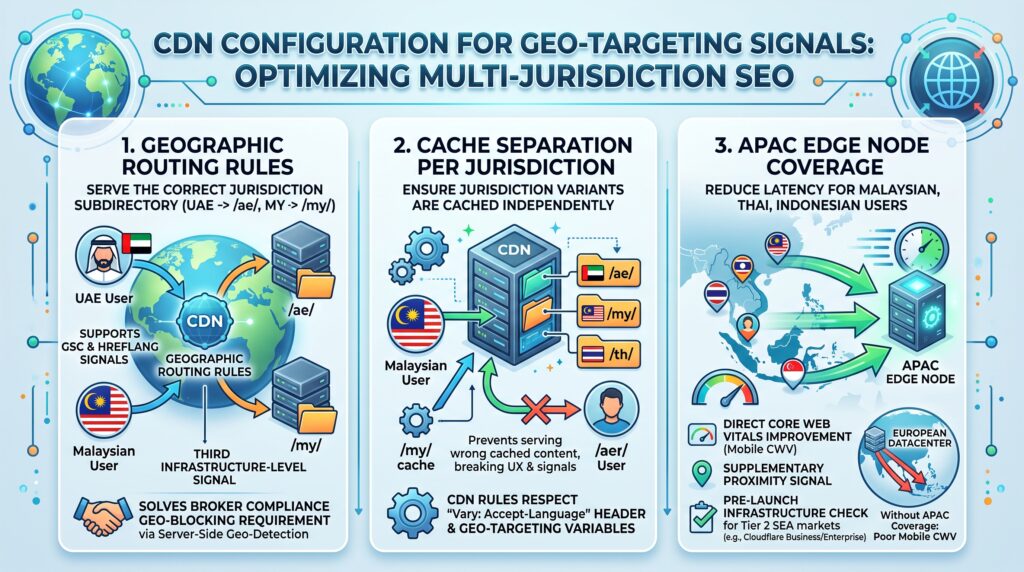
The CDN layer supports the site structure decisions above. Three CDN-level settings that affect multi-jurisdiction SEO:
Geographic routing rules serve the correct jurisdiction subdirectory to users in each target market — UAE users to /ae/, Malaysian users to /my/. This supports the geo-targeting signals set via GSC and hreflang with a third infrastructure-level signal. It also solves the compliance geo-blocking requirement in A6 Issue 2 (geo-blocking and Googlebot access) — CDN-level geo-detection is server-side by definition, which is the correct implementation for broker compliance geo-blocking.
Cache separation per jurisdiction ensures jurisdiction variants are cached independently. A cached /ae/ page served to a Malaysian user breaks both the user experience and the geo-targeting signal. CDN caching rules must respect the Vary: Accept-Language header and any geo-targeting variables in the routing logic.
APAC edge node coverage reduces latency for Malaysian, Thai, and Indonesian users — a direct Core Web Vitals improvement and a supplementary proximity signal for APAC market targeting. Brokers hosting all content from European datacentres without APAC CDN coverage will underperform on mobile Core Web Vitals in Southeast Asia, which is a ranking signal in the markets A7 recommends prioritising first. Cloudflare Business or Enterprise tier covers APAC adequately. This is a pre-launch infrastructure check for any broker adding Tier 2 SEA markets.
Connecting Architecture to Technical Indexation
The site structure decisions in this article are the foundation that the technical indexation work in the forex broker technical SEO guide sits on. Get the architecture right before content production begins — retrofitting a clean structure onto an already-indexed site is significantly more complex than building it correctly from the start. The forex broker SEO audit covers how to assess whether an existing site structure is creating the indexation problems this article prevents.
If you are building a multi-jurisdiction broker site and want to validate the architecture before content production begins — that structural review is part of an audit.
FAQ
Q1: Should a forex broker use ccTLD, subdirectory, or subdomain for multi-jurisdiction SEO?
For most forex brokers operating under a single primary licence (CySEC, FCA, ASIC) and targeting multiple markets, subdirectory architecture (broker.com/ae/ for UAE, broker.com/my/ for Malaysia) is the correct starting point. It concentrates domain authority on a single root domain while still sending geo-targeting signals via hreflang and GSC country targeting. ccTLD is appropriate only for brokers with a local entity and local regulatory licence in the target country. Subdomain works for language-platform separation only.
Q2: How do I implement hreflang for a forex broker site with multiple jurisdictions?
Each jurisdiction page needs self-referencing hreflang tags pointing to all language and locale variants plus an x-default for the global default. Use locale codes that combine language and country: en-AE for UAE English, en-MY for Malaysia English, ar for Arabic cross-MENA content. Apply hreflang only to commercial and content pages — not to regulatory disclaimer pages, compliance documents, or KYC pages. The x-default tag should point to the primary commercial page, not the homepage.
Q3: How should I set up Google Search Console for a multi-jurisdiction forex broker site?
Create a domain property (sc-domain:broker.com) as the primary view covering all subdirectories and subdomains. Then create URL prefix properties for each jurisdiction subdirectory (broker.com/ae/, broker.com/my/) and set country targeting in each property’s International Targeting settings. Submit jurisdiction-specific child sitemaps to their corresponding URL prefix properties. This gives you domain-level visibility plus market-level crawl and indexation data per jurisdiction.
Q4: What is the correct XML sitemap structure for a multi-jurisdiction forex broker site?
Use a sitemap index at broker.com/sitemap.xml pointing to jurisdiction-specific child sitemaps: sitemap-global.xml, sitemap-ae.xml, sitemap-my.xml, and so on. Exclude all pages in the compliance and legal directories, KYC and registration flow pages, and affiliate portal subdomains from all sitemaps. Submit each jurisdiction child sitemap to its corresponding GSC URL prefix property. Never include noindexed pages in any sitemap — the conflict between sitemap inclusion and noindex directive generates GSC Coverage errors.
Q5: How do regulatory compliance pages affect hreflang implementation on a forex broker site?
Regulatory compliance pages (standalone risk disclosure pages, terms and conditions, annual reports, privacy notices) should be noindexed and should not have hreflang tags. Applying hreflang to a noindexed page creates a conflicting signal: hreflang indicates the page exists in multiple language versions across multiple markets while noindex instructs Google not to index it. The result is hreflang errors in GSC’s International Targeting report. Apply hreflang exclusively to commercial and content pages that are actively indexed and targeted for organic ranking.
Q6: What is the most common site structure mistake on multi-jurisdiction forex broker sites?
The most common and most costly mistake is choosing the wrong architecture at launch and attempting to migrate later. Moving from multi-domain to single-domain subdirectory, or from subdirectory to ccTLD, after 12 months of content production requires a domain migration that disrupts rankings, resets domain authority signals, and typically adds 6 to 12 months to the organic ranking timeline. The second most common mistake is applying hreflang to compliance and regulatory pages, which creates hreflang conflict errors in GSC without any organic benefit.