
How to Set Up Ad Tracking for Forex Brokers-what is different here?
Search for forex broker FTD tracking setup and you’ll mostly find content written for iGaming — the terminology overlaps, but the compliance context doesn’t.
“FTD” (first-time deposit) is shared terminology between iGaming and forex, since both industries measure the same fundamental conversion event. This means the same tracking tools (Voluum being the most common) produce content for both audiences, and a forex marketing team searching for guidance frequently lands on genuinely well-produced material that is mechanically similar but contextually wrong — gambling’s regulatory environment, typical campaign structures, and compliance considerations differ meaningfully from forex’s.
The tracking setup I inherit most often when auditing a forex broker’s paid media account is technically functional — clicks are firing, pixels are loading, GA4 is collecting sessions — but nobody has asked whether any of it is actually measuring what determines whether paid media is profitable, which is the cost to acquire a depositing client, not a registered one.
This guide extracts the technical “how” that transfers directly (postback mechanics) while replacing the gambling-specific compliance framing with the forex-specific one this series has built. It also completes the pairing with the reporting and attribution framework already established — this is the tactical infrastructure that framework depends on to actually function.
Table of Contents
The Compliance Line — Platform ToS Risk vs Financial Services Regulatory Risk
Redirect tracking — routing a click through a tracking domain before reaching the final landing page — carries two entirely separate compliance dimensions for a regulated forex broker, and conflating them is the single most common mistake.
The platform ToS dimension: Ad platforms can flag or suspend accounts that use redirect patterns resembling cloaking or policy circumvention, connecting directly to the suspension triggers established in the account suspension guide. This is the dimension general affiliate marketing tracking guides typically address — will this configuration get my ad account flagged.
THE FINANCIAL SERVICES REGULATORY DIMENSION — UNADDRESSED ANYWHERE ELSE
A redirect configuration that shows compliance-approved content to an ad platform’s automated reviewer while routing real users to different, potentially non-compliant content constitutes cloaking in the regulatory sense, not just the platform-policy sense — the same severe compliance violation flagged in the account suspension framework, but now with genuine financial promotion and consumer protection implications beyond losing an ad account.
The actual test, stated precisely: The line between legitimate redirect tracking (used for analytics, A/B testing, or geo-routing) and prohibited cloaking depends entirely on whether the content shown is substantively consistent for all viewers — not on whether a redirect mechanism is used at all. A redirect that exists purely for tracking attribution while showing identical landing page content to every visitor is legitimate. A redirect that shows different claims, different risk warning treatment, or different product framing depending on whether the viewer is detected as an ad platform reviewer versus a real user is cloaking, regardless of the technical justification offered for the redirect’s existence.
Postback Setup for FTD Tracking — What Transfers From iGaming Guidance and What Doesn’t
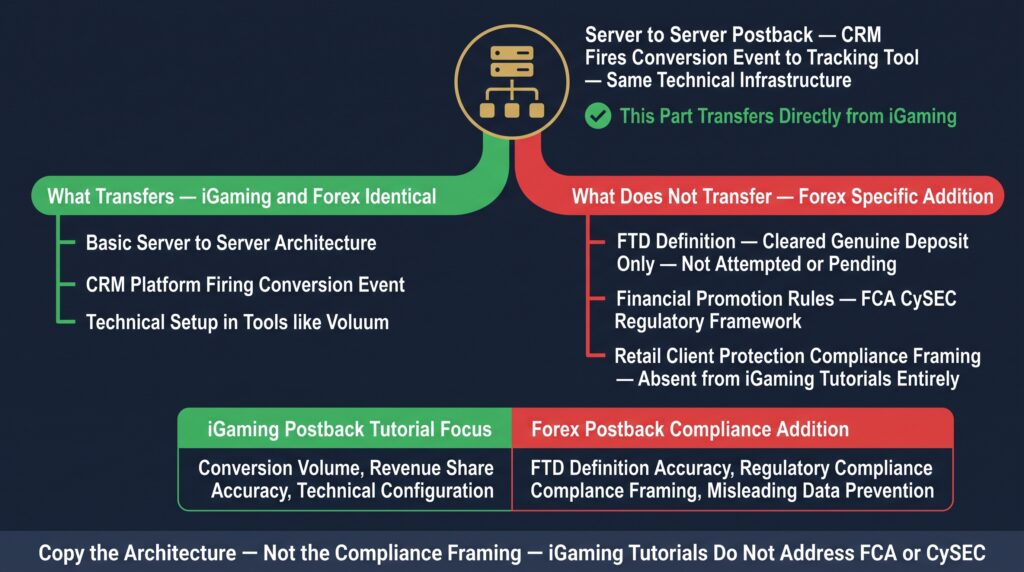
The postback mechanic itself — the broker’s CRM or trading platform sending a server-to-server notification to the tracking tool when a registered user becomes a funded account — transfers directly from iGaming guidance, since both industries measure the same fundamental “first deposit” event using the same technical infrastructure pattern.
What transfers: The basic server-to-server postback architecture, the general concept of firing a conversion event from the CRM/platform back to the tracking tool, and the technical setup steps within a tool like Voluum for configuring a postback URL.
What doesn’t transfer — the forex-specific addition: The postback should fire based on the same FTD definition already established in the FTD guide — a cleared, genuine first deposit, not merely an attempted or pending one, since firing on an incomplete event creates exactly the kind of inflated, misleading reporting data the compliance diagnostic principle depends on being accurate. The compliance framing around what the tracking tool should and shouldn’t be used for is entirely different from the gambling-specific framing in typical iGaming postback tutorials, which generally don’t address financial promotion rules, retail client protection, or the specific regulatory bodies (FCA, CySEC) governing forex marketing at all.
How to Set Up Ad Tracking for Forex Brokers-Why This Is the Infrastructure the Reporting Framework Assumed
The cross-platform reporting consolidation discussed in the reporting and attribution guide requires exactly the tracking infrastructure covered in this article — a consistent UTM and postback discipline feeding a single source of truth, typically the broker’s CRM, rather than relying on each ad platform’s self-reported conversion data independently.
The direct dependency: The compliance-diagnostic-built-into-reporting principle established in that guide — flagging a campaign whose CPA falls suspiciously below the regional benchmark — only works if the underlying data feeding that report is accurate and complete. A tracking infrastructure with missed postbacks, inconsistent sub-ID tagging, or platform-reported conversion data that diverges from CRM-confirmed reality undermines the entire reporting framework, regardless of how well-designed that reporting structure is on paper.
A broker who has built that reporting framework needs this article’s infrastructure to actually implement it — this is the “how” to that article’s “what,” completing a deliberate strategy-and-execution pairing consistent with the approach used elsewhere in this content series.
GDPR and Consent Implications of Tracking Infrastructure
Per the GDPR consent distinction established in the retargeting strategy guide, data flowing through a tracking tool’s postback system — particularly data subsequently used to build retargeting or lookalike audiences per the Meta policy changes guide‘s consent requirement — must trace back to properly consented data, not simply technical pipeline correctness.
Where this commonly goes wrong: A technically well-configured tracking setup that pulls from a CRM data export without consent filtering creates the exact compliance gap already flagged elsewhere in this series, now manifesting at the infrastructure layer rather than the audience-building layer. The tracking tool itself has no awareness of which records carry valid marketing consent — that filtering must happen before data enters the tracking and audience-building pipeline, not be assumed as a property of the pipeline’s technical correctness.
The practical action: Confirm that any CRM export feeding the tracking infrastructure is filtered by current marketing consent status before it reaches the tracking tool, consistent with the same consent-filtering discipline already established for retargeting and lookalike audience construction.
Sub-ID Structure — Mirroring the Certification Mapping Discipline
A tracking tool’s sub-ID and campaign naming structure should mirror the same market and certification naming discipline established in the account structure guide and the Meta account structure guide — encoding regulatory market and entity into the tracking tool’s own campaign hierarchy keeps the tracking layer auditable against the same compliance structure already governing the ad platforms themselves.
The practical implication: Maintaining two disconnected naming systems — one for ad platform campaigns, a different one for tracking tool sub-IDs — creates an unnecessary reconciliation burden during any compliance audit, where someone must manually map tracking data back to the correct regulatory market and entity. A consistent naming pattern across both layers eliminates this reconciliation step entirely.
The Compliance Review Point for New Tracking Configurations
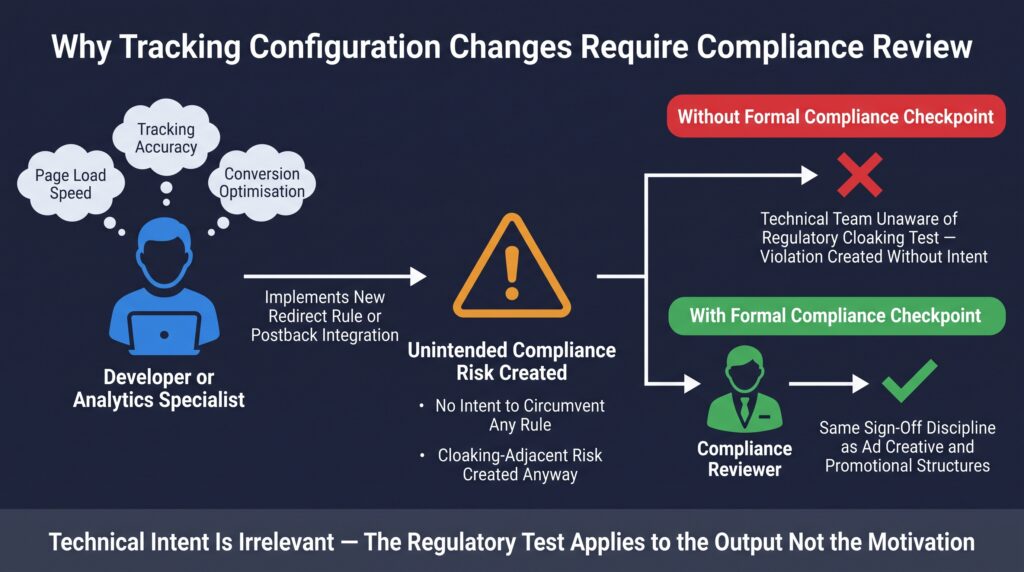
Any new tracking configuration — a new redirect rule, a new postback integration, a new sub-ID structure — should go through the same compliance sign-off discipline established in the account structure guide for ad creative and in the bonus and incentive rules guide for promotional structures.
Why this matters specifically for tracking changes: A technically-motivated tracking change — implemented purely for analytics accuracy or conversion optimization reasons, with no intent to circumvent any rule — can inadvertently create the cloaking-adjacent risk described earlier in this guide without anyone involved intending a compliance violation. A developer or analytics specialist optimizing redirect logic for page-load speed or tracking accuracy may not be thinking about the regulatory cloaking test at all, which is precisely why this review step needs to exist as a formal checkpoint rather than relying on the technical team’s awareness of a compliance concern outside their usual scope of attention.
Vendor Selection — Beyond Voluum, Forex-Specific Criteria
Voluum is the most commonly referenced tracking tool in forex and broader affiliate marketing circles, with alternatives like RedTrack occupying similar positioning. The specific selection criteria for a regulated forex broker should extend beyond general feature comparison to include:
Postback reliability and redundancy: A missed postback creates an attribution gap that compromises the compliance-diagnostic use established in the reporting guide, not just an analytics inconvenience — the tool’s documented postback delivery reliability should be a genuine selection criterion, not an afterthought.
Audit log capability: Can the tool produce a record showing exactly what content configuration was active and shown to which traffic source at a given time? This capability directly supports defending against a cloaking allegation if one were ever raised, by demonstrating the actual content delivered was consistent rather than relying on memory or incomplete records after the fact.
Data residency and the vendor’s own GDPR compliance: Since the tracking tool processes data ultimately tied to client records, the vendor’s own data handling and residency practices matter for the broker’s overall data protection posture, not just the broker’s own configuration choices.
A Practical Compliance Line Checklist
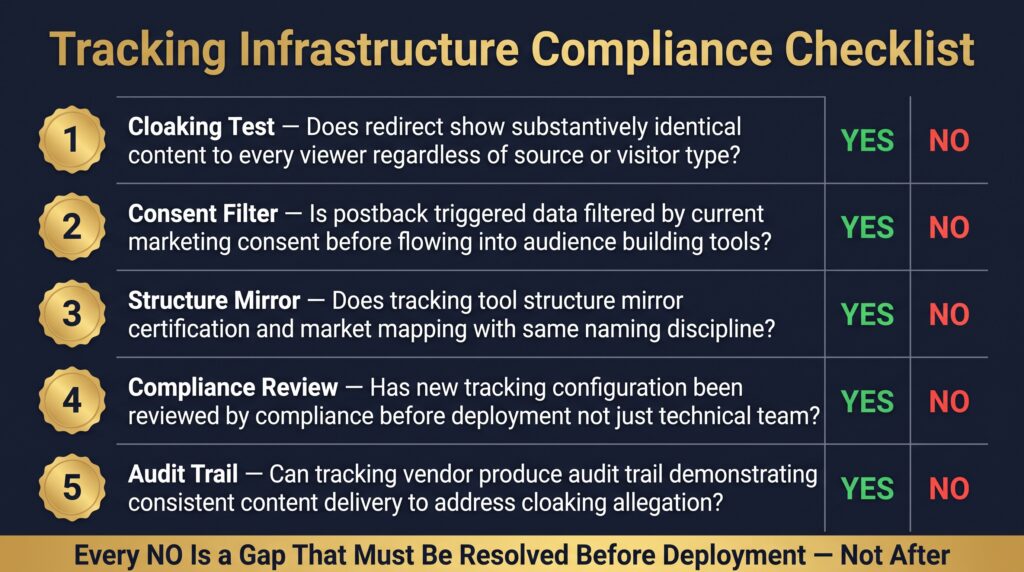
A practical checklist for any tracking infrastructure decision:
1.Does the redirect show substantively identical content to every viewer? Regardless of source or detected visitor type — this is the core cloaking test.
2.Is postback-triggered data filtered by current marketing consent? Before flowing into any audience-building tool, per the established retargeting consent discipline.
3.Does the tracking tool’s structure mirror your certification/market mapping? Same naming discipline across ad platforms and the tracking layer.
4.Has any new tracking configuration been reviewed by compliance? Before deployment — not just by the technical team implementing it.
5.Can your tracking vendor produce an audit trail if ever needed? Demonstrating consistent content delivery to address any future cloaking allegation.
Working through these five questions for any tracking infrastructure decision — not just at initial setup, but for any subsequent change — keeps the technical optimization work this infrastructure enables from inadvertently crossing the compliance line this entire guide has been built around.
If you want your current tracking setup — Voluum or otherwise — reviewed against this compliance line specifically, that review is part of the diagnostic.
FAQ
Q1: Is Voluum tracking guidance for iGaming applicable to forex brokers?
Partially. The technical postback mechanic — a server-to-server notification sent from a CRM or trading platform to a tracking tool when a user converts — transfers directly between iGaming and forex, since both industries measure the same fundamental first-time deposit event using the same underlying technical architecture. However, the compliance context surrounding that technical setup does not transfer at all. Most tracking platform content addressing first-time deposit tracking, including content from the tracking platforms themselves, is explicitly written for online gambling affiliates and does not address financial promotion rules, retail client protection requirements, or the specific regulatory considerations that apply to regulated forex and CFD advertising. A forex broker should extract the technical setup steps from such guidance while replacing the compliance framing entirely with forex-specific regulatory considerations.
Q2: What is the actual compliance line between redirect tracking and cloaking?
The line between legitimate redirect tracking and prohibited cloaking depends entirely on whether the content shown is substantively consistent for every viewer, not on whether a redirect mechanism is used at all. A redirect that exists purely for tracking attribution while showing identical landing page content, claims, and risk warning treatment to every visitor regardless of their source or detected visitor type is legitimate redirect tracking, commonly used for analytics, A and B testing, or geographic routing purposes. A redirect that shows different content, different claims, or different risk warning treatment depending on whether the viewer is detected as an advertising platform’s automated reviewer versus a genuine user constitutes cloaking, regardless of the technical justification offered for why the redirect exists. This distinction matters specifically for regulated forex brokers because cloaking in this context carries financial promotion and consumer protection implications beyond the platform terms of service risk that affects any advertiser using similar redirect technology.
Q3: How should a forex broker set up FTD postback tracking?
A forex broker should configure a server-to-server postback that fires from the broker’s CRM or trading platform to the tracking tool at the moment a registered user becomes a genuinely funded account, using the same first-time deposit definition applied throughout the broker’s compliance and reporting framework, meaning a cleared, completed deposit rather than merely an attempted or pending one. Firing the postback on an incomplete event creates inflated and misleading conversion data that undermines any compliance diagnostic or reporting structure relying on accurate first-time deposit figures. The basic postback configuration steps within a tracking tool are largely consistent across industries, but the broker should ensure the underlying conversion definition triggering that postback matches their own regulatory and reporting standards rather than a generic or industry-agnostic default the tracking tool might otherwise apply.
Q4: Should tracking tool campaign names match ad platform campaign naming?
Yes. A tracking tool’s sub-ID and campaign naming structure should mirror the same regulatory market and certification entity naming discipline already used for advertising platform campaign structure, keeping the tracking layer auditable against the same compliance framework already governing the ad accounts themselves. Maintaining two disconnected naming systems, one for advertising platform campaigns and a separate one for tracking tool sub-identifiers, creates an unnecessary reconciliation burden during any compliance review, requiring someone to manually map tracking data back to the correct regulatory market and entity after the fact. A consistent naming pattern applied across both the advertising platform and the tracking tool eliminates this reconciliation step and makes the entire paid acquisition system auditable as a single coherent structure rather than two separately maintained systems that happen to relate to the same campaigns.
Q5: What should a forex broker look for when selecting a tracking tool?
Beyond general feature comparison, a regulated forex broker should evaluate tracking tools against three specific criteria. Postback reliability and redundancy matters because a missed postback creates a genuine attribution gap that compromises compliance diagnostic reporting, not merely an analytics inconvenience. Audit log capability matters because the ability to produce a record showing exactly what content configuration was active and shown to which traffic source at a given time directly supports defending against any future cloaking allegation by demonstrating that content delivery was consistent rather than relying on incomplete records reconstructed after the fact. The tracking vendor’s own data residency and data protection compliance also matters, since the tool processes data ultimately tied to client records, making the vendor’s own practices relevant to the broker’s overall data protection posture rather than only the broker’s own configuration choices.
Q6: Does a new tracking configuration need compliance approval before deployment?
Yes. Any new tracking configuration, including a new redirect rule, a new postback integration, or a new sub-identifier structure, should go through the same compliance sign-off process already used for advertising creative and promotional structures, rather than being treated as a purely technical decision outside compliance review scope. This matters because a technically motivated tracking change implemented purely for analytics accuracy or conversion optimization reasons, with no intent to circumvent any rule, can inadvertently create cloaking-adjacent risk if it results in different content being shown to different visitor types based on detected source. A developer or analytics specialist optimizing redirect logic for technical reasons may not be considering the regulatory cloaking distinction at all, which is precisely why a formal compliance review checkpoint needs to exist for tracking infrastructure changes rather than relying on the implementing team’s awareness of a compliance concern outside their typical area of focus.