
Last reviewed: June 2026 · Author: Hristo Hristov
What is an FTD in Forex?
Every forex broker tracks FTDs. Most forex broker marketing teams cannot clearly answer why FTD is the right metric to track, how their channel mix is affecting their FTD profile, or whether they should be optimising for FTD count or FTD quality.
FTD — First Time Deposit — is the point at which a registered trader becomes a paying client. It is the first revenue event in the broker-client relationship, the first confirmation that the entire acquisition funnel worked, and the most direct measurement of whether marketing investment is producing commercial outcomes. Despite being the most important metric in forex broker marketing, most teams have a clear definition of FTD and a fuzzy framework for driving it.
Practitioner Observation
In every broker marketing review I have conducted, the team has a monthly FTD target on the whiteboard and a paid acquisition dashboard on the screen — but no view of which channels are producing funded accounts versus registrations that never deposit, what the average first deposit amount is by traffic source, or whether the FTDs being acquired at current CAC will generate positive LTV at 90 days.
This article covers what FTD is, why it is the right primary metric, how each acquisition channel produces a different FTD profile, what marketing teams control that directly affects FTD rates, how FTD attribution works (and where it typically breaks), and the relationship between first deposit amount and client lifetime value that most measurement frameworks miss entirely.
Table of Contents
What FTD Means — and What It Doesn’t
FTD stands for First Time Deposit — or First Time Depositor when referring to the client rather than the event. Both usages are common and often interchangeable in forex broker marketing. The FTD event is the moment a new client makes their first real-money deposit on a trading platform. Counting FTDs counts events; counting first-time depositors counts unique clients. Standard practice: one FTD per client, attributed to their first deposit event regardless of account type.
DISAMBIGUATION — TWO MEANINGS OF FTD
FTD in forex broker operations: First Time Deposit — the primary client acquisition metric. This article.
FTD in investment and securities: Failure to Deliver — when a party to a securities transaction cannot deliver the securities or funds on the settlement date. A completely different term in a different context. Investopedia ranks for “FTD in forex” with their Failure to Deliver article — the two share an acronym and nothing else.
What FTD is NOT: FTD is not the same as demo account opening — a trader with a funded demo account has not made an FTD. FTD is not the same as registration — a registered client without a deposit has not made an FTD. Both confusions are commercially significant. Optimising for demo account openings or registration completions rather than FTDs is optimising for the wrong funnel stage. The marketing spend has been incurred; the commercial return has not yet occurred.
Why FTD Beats CPL, CPA, and Registrations as Your Primary Metric
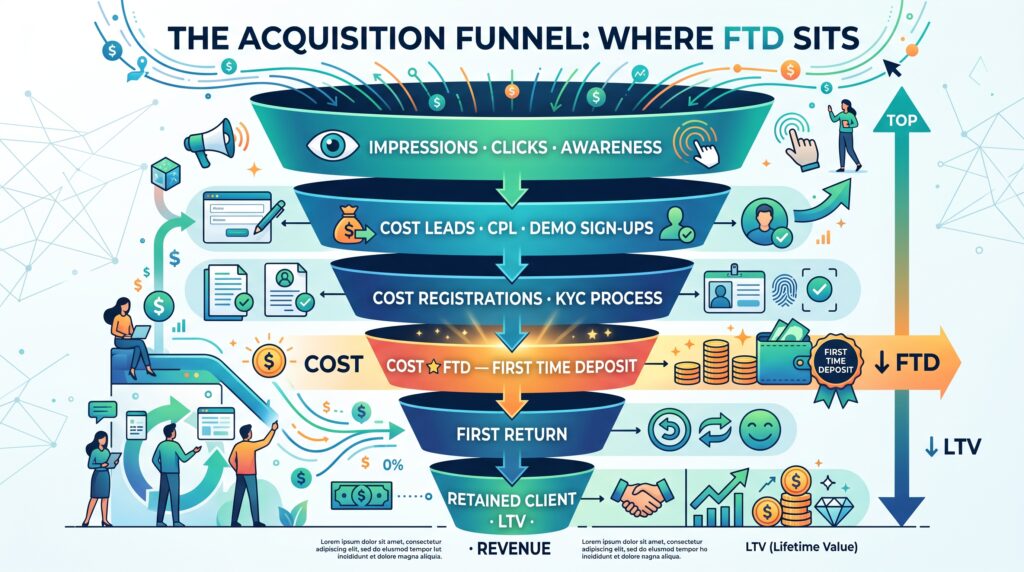
Every stage above FTD is a cost. FTD is the first return. Measuring marketing on any earlier stage measures effort, not commercial outcome.
The case against the competing metrics is straightforward:
CPL (Cost Per Lead) measures top-of-funnel efficiency — the cost of generating an inquiry or form submission. A campaign with £10 CPL and 2% registration-to-FTD conversion is significantly less valuable than one with £30 CPL and 18% registration-to-FTD conversion. Optimising for CPL optimises for the wrong stage. The lower-CPL campaign costs less per click but produces fewer paying clients per pound spent.
Registrations measure form submission completion. A registered client without a deposit has cost the broker their full acquisition investment with zero commercial return. Treating registration volume as the primary success metric creates the illusion of a healthy acquisition programme while obscuring the actual conversion gap between registered leads and funded accounts.
CPA defined as registration has the same limitation. The correct definition — used by most affiliate networks — is CPA = FTD. Internal broker marketing teams should adopt this definition consistently. If your internal performance reports show CPA against registrations rather than against FTDs, the metric is measuring the wrong conversion event.
Why FTD wins: It is the first revenue event. The first moment marketing spend has produced a commercially active client. It forces accountability for the full conversion journey — not just the click — and it is the only early-funnel metric that connects directly to commercial outcome.
FOR CEOS AND FOUNDERS — ONE DIAGNOSTIC QUESTION
Ask your marketing team: “What is our primary acquisition metric?” If the answer is CPL, registrations, or demo sign-ups — the team is measuring effort, not commercial outcome. The correct answer is FTD or Cost per FTD.
How Each Marketing Channel Produces a Different FTD Profile
Each acquisition channel produces a distinct FTD profile across four dimensions: registration-to-FTD conversion rate, time from registration to FTD, average first deposit amount, and post-FTD retention rate. Evaluating all channels on FTD count alone misses the commercial variation between them.
| Channel | Reg→FTD Rate | Time to FTD | Avg First Deposit | Post-FTD Retention | Best Used For |
|---|---|---|---|---|---|
| Paid Search | High | Fast | Moderate | Good | High-intent FTD volume. Scalable with budget. Best combined with retargeting. |
| Paid Social | Medium | Slower | Lower | Variable | Brand awareness + retargeting. Complements higher-intent channels. |
| SEO Organic | Medium | Slow | Highest | Highest | Highest average deposit + best retention. Evaluate on FTD quality, not count. |
| Comparison Affiliate | High | Medium | Moderate–High | Medium | Research-stage traders. Similar profile to organic. Attribution challenges. |
| IB Referral | Highest | Fastest | Highest | Highest | Pre-qualified, trusted referrals. Highest FTD quality across all dimensions. |
Ratings are directional — actual profiles vary by broker, market, and offer. Use this as a framework for building your own channel FTD profile data.
The most important insight from this comparison: SEO organic typically produces the highest average first deposit amount and best post-FTD retention of all channels — yet is evaluated last in most broker marketing conversations because it produces the lowest total FTD count at early stages. A marketing team evaluating all channels on FTD count alone will consistently undervalue organic and overvalue high-volume, low-quality channels. The paired metric framework (FTD count + average first deposit amount) addresses this directly — covered in the LTV section below.
KYC Friction and the FTD Conversion Window
Between registration and first deposit sits the KYC verification process — the conversion bottleneck that most marketing teams treat as the compliance team’s problem. It is not. KYC process design directly affects registration-to-FTD conversion rate.
The conversion window: The period between a trader completing registration and making their first deposit typically ranges from same-day (fast-approval processes) to 14 days (manual review with slower turnaround). Traders who have not deposited within 14 days of registration have typically made a decision against the broker — either they opened an account elsewhere, lost momentum, or encountered a KYC friction point that prevented completion. The conversion window is not fixed — it is a design parameter that broker marketing and operations teams can influence.
What the marketing team controls inside this window:
- Verification timeline — faster processing = higher FTD conversion. Every additional day in the verification window is a day in which the trader can decide against depositing.
- Document complexity — fewer required documents = lower abandonment. The minimum viable KYC principle: request what the regulator requires, not what feels comprehensive from a risk management perspective.
- Status communication during verification — traders left in uncertainty during the KYC wait open competitor accounts. A status email at 24 hours (“your verification is in progress, you’ll hear from us within X hours”) reduces abandonment.
- Document quality guidance — rejection due to poor-quality document images is a major FTD conversion killer. A “how to photograph your ID” brief reduces first-submission rejection rates and the re-submission loop that drains the conversion window.
The full KYC design framework — including jurisdiction-specific requirements, EDD for high-value clients, and the perpetual KYC shift — is in the forex broker KYC guide. A13’s point: KYC is not just a compliance gate. It is a direct conversion rate lever sitting inside your FTD metric, and every design decision about it belongs partly in the marketing team’s domain.
Offer and Bonus Design for FTD Optimisation
Deposit bonuses and welcome offers directly affect FTD rates — but the relationship is more nuanced than “better bonus = more FTDs.” Offer design affects both FTD rate and FTD quality.
The bonus-hunter problem: Aggressive deposit match bonuses (100% match up to a high threshold) attract high FTD volume — and a meaningful proportion of bonus hunters who deposit to capture the bonus, meet the minimum turnover requirement, and withdraw. These FTDs inflate FTD count without proportional revenue contribution. The registration-to-FTD rate improves; the FTD-to-retained-client rate deteriorates. Volume metrics look good. Revenue metrics do not.
Offer types and their FTD quality implications:
| Offer Type | FTD Volume | FTD Quality | Risk |
|---|---|---|---|
| Deposit match bonus (e.g. 100% up to $5,000) | High | Variable — attracts bonus hunters | High churn after turnover requirement met |
| Risk-free first trade | Medium | Higher — platform trial intent | Lower volume but better retention signal |
| Cash rebate on first month’s trades | Lower | High — attracts active traders | Self-qualifying — only active traders benefit |
| No bonus — conditions only | Lowest | Highest | Every FTD chose the broker on merit — zero bonus hunters |
FCA COBS 4.6 and CySEC financial promotions guidance restrict bonus offers to retail clients in regulated jurisdictions. Compliance review required before any offer is deployed. Verify current restrictions with your compliance team.
Verify with your compliance team that any bonus or promotional offer is approved under your specific regulatory licence before deployment.” If in doubt about the regulatory framing, soften to “bonus and offer regulations vary by jurisdiction — compliance review is required before any offer is live.
FTD Attribution — Why It Is Harder Than It Looks
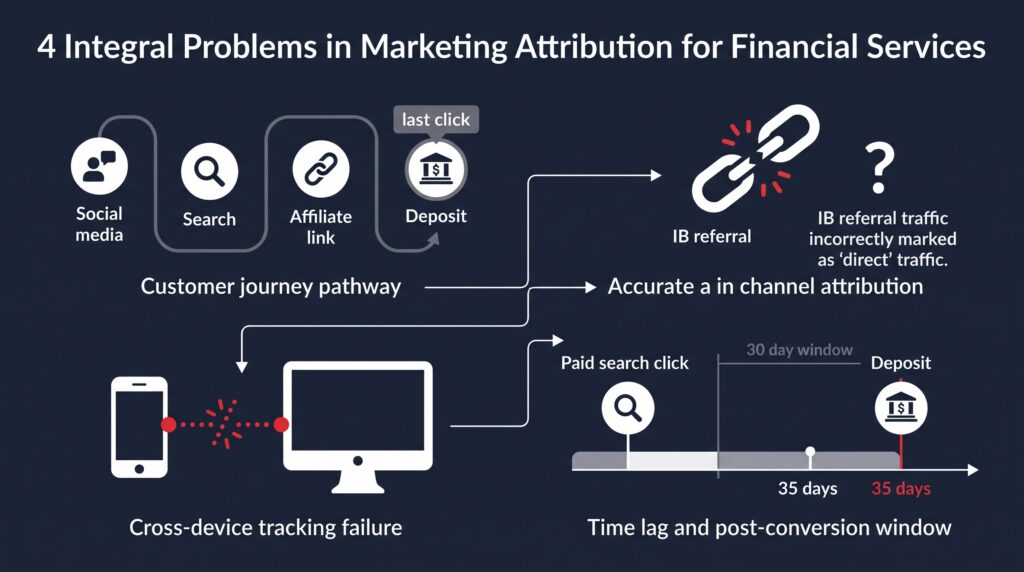
FTD attribution — crediting the marketing source responsible for a client’s first deposit — sounds straightforward. Four systematic problems affect most broker attribution setups and cause consistent misreporting of channel performance.
Problem 1 — Multi-touch journeys and last-click bias. A client who sees a Facebook ad, reads an organic search article three days later, clicks a comparison site affiliate link, registers, waits 48 hours for KYC approval, and deposits has four potential attribution sources across a 6-day journey. Most broker analytics platforms default to last-click — crediting the affiliate link. This systematically over-credits affiliates and under-credits brand awareness and organic channels that influenced the decision without triggering the final conversion click. The affiliate looks like a hero; organic looks like it does nothing.
Problem 2 — IB attribution gaps. When a client is introduced by an Introducing Broker through an offline or telephone relationship, the FTD cannot be captured digitally without an IB-specific tracking link. IB referrals without tracking codes appear as “direct” in analytics — making the IB channel’s FTD contribution invisible in standard reporting and systematically understating the true ROI of the IB programme.
Problem 3 — Cross-device journeys. A client who researches on mobile and deposits on desktop has a broken attribution chain in any standard cookie-based analytics setup. Cross-device attribution requires login-based tracking (the client is authenticated on both devices) or probabilistic matching — neither of which is implemented in most broker analytics stacks.
Problem 4 — The registration-to-FTD time gap vs attribution windows. If a client registered from a paid search click and deposits 35 days later, they will appear as an “organic direct” FTD in any attribution platform set to the standard 30-day lookback window. The paid search campaign is not credited, appears less effective than it is, and loses budget to other channels in the next planning cycle — a self-reinforcing misallocation spiral.
PRACTICAL FIX — WHERE TO START
Extend your attribution lookback window to 60–90 days to capture the full registration-to-FTD conversion timeline. Implement IB-specific tracking links for all Introducing Broker programmes. Run a direct comparison of last-click vs first-click attribution for your top three channels — the gap between them reveals which channels you are over-crediting and under-crediting at current measurement.
First Deposit Amount as an LTV Predictor — The Measurement Most Teams Miss
This is the section that changes how a CMO evaluates channel performance. Not a theoretical observation — a practical measurement methodology that most broker marketing teams are not using.
The correlation: The size of a client’s first deposit is one of the strongest available predictors of their lifetime value. A client who deposits $100 for their first deposit has a fundamentally different commercial profile from a client who deposits $5,000. The larger depositor has demonstrated greater financial commitment to trading, greater confidence in the broker’s trustworthiness, greater available capital for ongoing position-taking, and typically greater trading experience. All four factors correlate with higher trading volume, longer client tenure, and higher lifetime revenue contribution to the broker.
The example that changes the budget conversation:
CHANNEL COMPARISON — FTD COUNT VS FTD QUALITY
Paid Social Campaign vs SEO
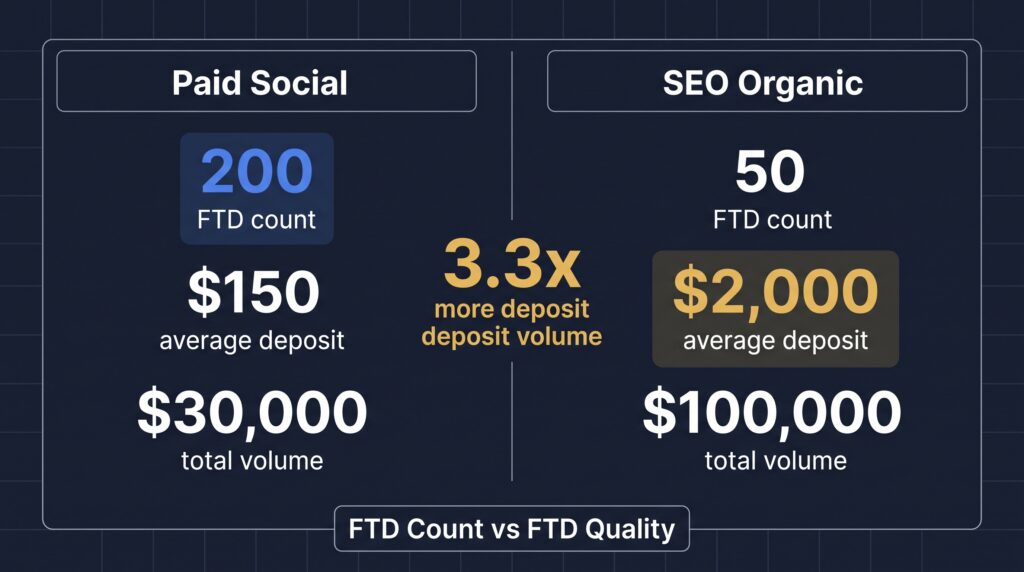
Wins on FTD QUALITY (3.3× more deposit volume)
A marketing team evaluating both campaigns on FTD count has just allocated more budget to the commercially worse-performing channel.
The paid social campaign “won” on FTD count — it produced four times as many deposits. The organic programme won on first deposit volume — it produced 3.3× more capital committed by new clients. On lifetime value (assuming the first deposit amount correlation holds), the performance gap widens further.
The paired metric framework — implement this immediately: Track FTD count AND average first deposit amount as paired metrics for every channel and campaign. Calculate first deposit value (FTD count × average first deposit amount) as the headline commercial metric. FTD count tells you volume efficiency. Average first deposit amount tells you commercial quality. Neither is sufficient alone. First deposit value gives you the most commercially accurate top-line acquisition performance metric available without waiting months for LTV data.
The caveat: The correlation is not perfect. Some small first depositors become significant long-term clients — particularly in markets where cultural preference is to start small and scale. Establish this correlation from your own client data rather than assuming universal ratios. The directional principle — higher first deposit amount correlates with higher LTV on average — is consistent across forex broker client bases. The specific ratio is yours to discover and own as competitive intelligence.
THE SHIFT THIS CREATES IN CHANNEL EVALUATION
When you add average first deposit amount to your channel reporting, the relative ranking of channels by commercial value often changes significantly. IB referrals and organic typically move up. Broad paid social moves down. This is not a reason to defund paid social — it is a reason to be precise about what each channel is actually contributing and to allocate incremental budget accordingly.
Directional FTD Benchmarks — How to Calibrate Your Performance
No public forex broker FTD benchmark database exists. The following are directional patterns based on observable industry behaviour — not cited research. They exist to give context, not to substitute for your own data.
Registration-to-FTD conversion rates vary significantly by channel (as the table above shows) and by KYC design. Paid search and IB referral channels typically convert registered clients to FTD at the highest rates because of the combination of high purchase intent and pre-established trust. Paid social converts at lower rates but can produce significant volume at scale. The most common cause of below-expectation registration-to-FTD conversion is not channel quality — it is KYC friction applied uniformly to all registered clients regardless of their expressed intent.
Time-to-FTD varies by market. Some regions show faster commitment timelines — traders research briefly and decide quickly once trust is established. UK and Western European markets often show longer due diligence periods, with traders reading multiple sources before committing. Understanding the time-to-FTD distribution for your primary market determines the correct attribution lookback window. If 40% of your FTDs happen 14–30 days after registration, a 7-day attribution window is misattributing nearly half your conversions.
Average first deposit amounts are strongly influenced by minimum deposit requirements, regulatory environment, and KYC depth. Brokers requiring higher minimum deposits self-select for clients with more capital. FCA-regulated brokers typically see higher average first deposits than equivalent offshore-regulated brokers — the regulatory trust threshold filters in clients who have done more research and are more committed to long-term trading.
The only benchmarks that matter for your business are yours. Build a channel-by-channel FTD profile report using the dimensions above — registration-to-FTD rate, time-to-FTD distribution, average first deposit amount, post-FTD retention at 30/60/90 days — updated quarterly. After two quarters, you will have the most commercially accurate view of your acquisition programme available, and you will never evaluate channel performance on FTD count alone again.
If you want to understand how your channel mix is affecting your FTD profile — and whether you are measuring FTD count when you should be measuring FTD quality — that diagnosis is part of an audit.
FAQ
Q1: What is an FTD in forex trading?
FTD stands for First Time Deposit in forex broker operations, referring to the first real-money deposit made by a new client on a trading platform. It is also used to describe the client themselves — a First Time Depositor. FTD is the primary acquisition metric for forex broker marketing teams because it represents the first revenue event in the broker-client relationship — the moment a registered lead becomes a commercially active client. FTD is distinct from registration (completing the account opening form), demo account opening (accessing the platform with virtual funds), and lead generation. A note on terminology: in investment and securities contexts, FTD can also mean Failure to Deliver, which refers to the failure to deliver securities on the settlement date. This is an entirely different term with no connection to the forex broker metric described here.
Q2: Why is FTD the most important metric for forex broker marketing teams?
FTD is the first revenue event in the forex broker client lifecycle — the point at which a lead becomes a paying client and acquisition investment produces a commercial return. Competing metrics fail at the top-line level for specific reasons: cost per lead measures demand without confirming commercial conversion; registrations measure form submission without confirming trading intent; demo account openings measure platform interest without confirming capital commitment. FTD is the only metric that confirms a trading client exists. Everything before FTD is acquisition cost with no confirmed commercial outcome. Marketing teams that measure performance on CPL or registrations rather than FTD optimise for the wrong stage of the funnel and systematically underestimate the true cost of acquiring a commercially active client.
Q3: How does the KYC process affect FTD conversion rates for forex brokers?
The KYC verification process sits between registration and first deposit and directly affects how many registered clients complete account opening and make their first deposit. Three KYC variables have measurable conversion impact on FTD rates: verification timeline, where longer processing times give traders a window to open accounts with faster-approving competitors; document complexity, where each document required beyond the regulatory minimum adds an abandonment point; and communication clarity, where traders not told what documents to prepare before starting KYC abandon at higher rates than those who receive clear pre-KYC guidance. The marketing team has legitimate input on all three design decisions without compromising regulatory compliance, making KYC process design a conversion rate lever that sits inside the FTD metric.
Q4: What is the difference between FTD count and FTD quality for forex broker marketing?
FTD count measures how many first deposits a broker receives in a given period, regardless of deposit amount. FTD quality measures the average first deposit amount, which correlates with client lifetime value. Optimising purely for FTD count can produce worse commercial outcomes than optimising for FTD quality, because different channels produce very different average first deposit amounts. A channel that produces 200 FTDs averaging 150 dollars generates 30,000 dollars in first deposit volume. A channel that produces 50 FTDs averaging 2,000 dollars generates 100,000 dollars in first deposit volume, and likely a higher lifetime value profile. Marketing teams should track both FTD count and average first deposit amount as paired metrics for each channel and campaign, using first deposit value (count multiplied by average amount) as the most commercially accurate top-line acquisition metric.
Q5: How should forex broker marketing teams approach FTD attribution across multiple channels?
FTD attribution has four systematic challenges for forex brokers. First, multi-touch conversion journeys where clients interact with multiple marketing channels before depositing, and last-click attribution systematically over-credits the final touch while under-crediting brand awareness and organic research phases. Second, IB attribution gaps where Introducing Broker referrals without tracking links appear as direct traffic in analytics, making IB programme ROI invisible in standard reporting. Third, cross-device journeys where mobile research and desktop conversion break cookie-based attribution chains. Fourth, the registration-to-FTD time gap, where attribution lookback windows shorter than the actual conversion timeline misattribute FTDs to organic when the original source was paid acquisition. Addressing these requires longer attribution windows, login-based tracking where possible, dedicated IB tracking links, and a sceptical view of last-click attribution models.
Q6: What does the first deposit amount indicate about a forex broker client’s lifetime value?
The size of a client’s first deposit is one of the strongest available predictors of their lifetime value to the broker. Clients who make larger first deposits have typically demonstrated greater financial commitment to trading, greater confidence in the broker’s trustworthiness, greater available capital for ongoing trading activity, and typically greater trading experience. All four factors correlate with higher trading volume, longer client tenure, and higher lifetime revenue contribution. While the correlation is not perfect and varies by market, the directional principle is consistent: higher first deposit amount correlates with higher lifetime value on average. This means marketing teams should evaluate channel performance not only on FTD count but on average first deposit amount by channel, since a channel producing fewer but larger FTDs can significantly outperform a high-volume low-deposit channel on commercial outcomes.