
Last reviewed: June 2026 · Author: Hristo Hristov
Your trader has found your broker, clicked Open Account, filled in their email and personal details — and then hit the KYC screen. What happens next determines whether they become a first-time depositor or a lost lead.
What Is KYC in Forex Trading?
Most guides about KYC in forex trading are written by identity verification software companies. They explain what KYC is, why it is legally required, and then suggest their software as the solution. This guide takes a different angle: what does a forex broker’s marketing and operations team actually need to understand about KYC to run a commercially effective brokerage?
Practitioner Observation
In every broker acquisition funnel I have reviewed, the gap between KYC completion rate and benchmark is the single largest quantifiable revenue leak on the site — yet it is the stage with the least dedicated content, the fewest internal links pointing to it, and no entry in the paid acquisition attribution model.
The compliance obligation is real — KYC is a licence condition, not optional. But the process design that meets it is a choice, and that choice has commercial consequences. This article covers what KYC is, how it varies by regulatory jurisdiction, what it is costing your brokerage in FTDs, and what your marketing team can do about it.
Table of Contents
What KYC Actually Means — The Plain-English Version
KYC stands for Know Your Customer — sometimes Know Your Client in financial services contexts. It is the process by which a regulated forex broker verifies the identity of its clients before allowing them to open a live trading account, fund it, and begin trading.
For a retail forex trader, KYC typically means submitting:
- Proof of identity — passport, national ID card, or driver’s licence
- Proof of address — utility bill, bank statement, or government letter dated within the past three months
- Appropriateness assessment — questions about trading experience and financial situation (required in some jurisdictions)
- Source of funds — documentation for larger initial deposits above the broker’s risk threshold
Why does it exist? KYC is a regulatory requirement derived from international anti-money laundering (AML) and counter-terrorism financing (CTF) frameworks — specifically the FATF recommendations that financial regulators implement domestically. A trading platform that allows anonymous account opening is a vehicle for moving money internationally without oversight. KYC closes this channel. It is a licence condition for every regulated broker — not a choice.
The plain-English summary: KYC answers the question “who is this person?” before the broker lets them trade.
KYC vs AML — The Distinction Your Team Needs
In most forex broker conversations, “KYC” and “AML” are used together or interchangeably. For a marketing or operations team, the distinction matters because they involve different processes, different timelines, and different effects on the trader experience.
| KYC — Know Your Customer | AML — Anti-Money Laundering |
|---|---|
| When: Once, at onboarding | When: Continuously, after account is open |
| Question answered: Who is this person? | Question answered: Is this person’s behaviour suspicious? |
| Trader experience: Visible — they submit documents and wait for approval | Trader experience: Invisible in normal operation |
| Commercial impact: Directly affects registration-to-FTD conversion rate | Commercial impact: Operational workload for compliance team |
| When compliance says: “KYC issue” = document verification problem at onboarding | When compliance says: “AML alert” = monitoring flag on an existing account |
KYC is the gate. AML is the ongoing watch. Both are regulatory requirements — but only KYC directly affects the trader onboarding experience and your FTD conversion rate.
KYC Requirements by Regulatory Jurisdiction
Not all KYC requirements are equal. The documents required, the verification depth, the source of funds threshold, and the appropriateness assessment format all vary by the regulatory jurisdiction under which the broker operates. Understanding which regime applies to your licence is the starting point for designing a KYC process that satisfies compliance without adding unnecessary friction.
| Regulator | Standard Documents | Appropriateness Test | Notable Feature | Friction Level |
|---|---|---|---|---|
| FCA (UK) | ID + proof of address + source of funds above threshold | Yes — COBS 10A for complex instruments | Consumer Duty (Jul 2023) — unnecessary onboarding friction is now a regulatory flag, not just bad UX | High |
| CySEC (Cyprus) | ID + proof of address | Yes — MiFID II appropriateness under ESMA guidelines | Risk-based approach under AMLD; retail CFD leverage limits and risk warnings as part of onboarding | Medium |
| ASIC (Australia) | ID + proof of address (electronic verification accepted) | Yes — DDO/TMD screening questionnaire (PDS delivery is a separate disclosure requirement)” | AML/CTF Act via AUSTRAC; PDS delivery adds a step not present in EU/UK frameworks | Medium |
| Offshore (FSCA, VFSC, IFSC) | ID + proof of address (lighter document requirements) | Minimal or none | Higher FTD conversion rates — trade-off is lower investor protection credibility for large deposits | Low |
Requirements correct as of June 2026. Verify against your specific licence conditions with your compliance team.
The Conversion Rate Problem — What Your KYC Design Is Costing in FTDs
This is the section that most KYC guides never cover — because the companies writing them sell KYC software, not marketing advice. Here is the honest version.
KYC is a funnel stage. Every other stage in your acquisition funnel — ad click, landing page, registration form — is routinely optimised for conversion. KYC is almost never treated as an optimisation opportunity. It should be. Every decision about how many documents to require, how long verification takes, and how clearly the process is communicated has a measurable impact on the percentage of registered traders who complete account opening and make their first deposit. THE KYC CONVERSION FUNNEL — WHERE TRADERS DROP OFF STAGE 1 Registration 100% → STAGE 2 KYC Screen Drop-off begins here → STAGE 3 Document Upload Highest drop-off point → STAGE 4 Verification Wait Uncertainty = abandonment → RESULT FTD Goal ↓ unclear docs required ↓ rejection / re-submission ↓ opens competitor account Each stage is an optimisation opportunity. Most brokers only optimise Stage 1 (registration).
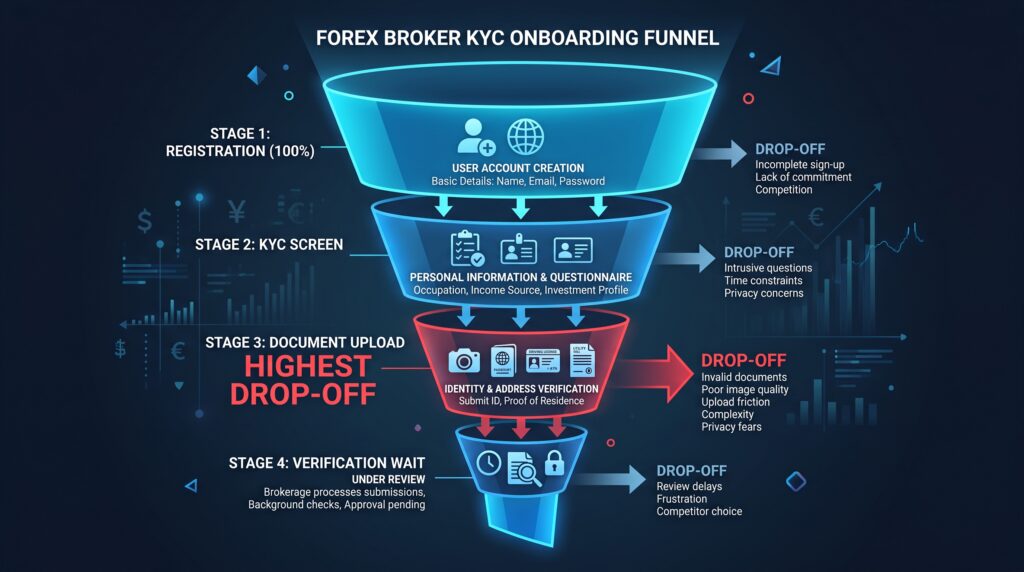
The KYC flow is a conversion funnel, not a compliance checkpoint. Most broker acquisition optimisation stops at the registration form.
Three variables your marketing team can influence — without compromising compliance:
1. Document complexity. What does your regulator actually require for a standard retail client? In most regulated jurisdictions, the minimum is an identity document and proof of address. Each additional document required beyond the regulatory minimum adds a drop-off point. Asking for source of wealth documentation from every client regardless of deposit size is a risk-management approach with a conversion cost. Ask your compliance team: “What is the minimum our licence requires for a standard retail client?” The gap between that answer and your current onboarding flow is a conversion optimisation opportunity that requires zero regulatory trade-off.
2. Verification timeline. A trader in active decision mode at the point of registration has a shorter decision window than most broker verification timelines allow. A trader told “verification takes up to 5 business days” during the KYC flow has time to research, find an alternative broker, and fund a competitor account before you have confirmed their identity. The commercial target is same-day or next-day verification for standard document submissions. Some technology investment is required; the FTD improvement is measurable.
3. Communication before the KYC screen. The most common cause of KYC abandonment is discovering that you need a document you do not have immediately available. A trader who reaches the document upload screen and discovers they need a bank statement dated within the past three months — when they only have a statement from four months ago — abandons. A trader who was told before they clicked “Open Account” exactly what to have ready abandons at a significantly lower rate. Pre-KYC communication is a UX intervention, not a compliance intervention, and it is entirely within the marketing team’s scope.
THE MINIMUM VIABLE KYC PRINCIPLE
The compliance obligation is to meet your regulator’s requirements. The commercial obligation is to meet those requirements with the minimum friction necessary to satisfy them. These two obligations are compatible — the challenge is that compliance teams optimise for zero regulatory risk while marketing should be optimising for minimum regulatory risk consistent with commercial performance. The marketing team’s role is not to weaken KYC — it is to ensure KYC does not require more than the regulator actually mandates.
Enhanced Due Diligence — When Standard KYC Is Not Enough
Standard KYC covers the majority of retail forex clients. For a specific category of clients, regulators require Enhanced Due Diligence — a deeper verification process that takes longer, requires more documentation, and has higher abandonment risk. The challenge: EDD is typically triggered by the highest-value client profiles.
EDD is required for:
- Politically Exposed Persons (PEPs) — individuals who hold or have held prominent public positions, and their immediate family and close associates
- Clients from high-risk jurisdictions — countries on FATF’s grey or black list, or the broker’s own high-risk country list
- Unusually high initial deposits — above the broker’s source of funds threshold, requiring documentation of where the funds came from
- Adverse media or sanctions proximity — clients flagged by initial screening for prior regulatory action or sanctions list proximity
The commercial tension is straightforward: PEPs and high-net-worth individuals often overlap. A high-value deposit prospect who triggers EDD is simultaneously the most commercially valuable lead and the most operationally complex to onboard.
THE WHITE-GLOVE EDD APPROACH
Forward-thinking brokers treat EDD as a relationship management process rather than a compliance delay. A dedicated onboarding relationship manager, proactive timeline communication, and transparency about what additional documentation is needed and why — these convert EDD from a friction point into a differentiated service for high-value clients. The broker who handles EDD smoothly earns disproportionate trust from high-value clients who are accustomed to being treated as problems rather than valued prospects.
Designing Your KYC Process for Commercial Outcomes
Four design levers within the marketing team’s influence — none of which require compromising regulatory compliance:
Document pre-communication. Tell traders exactly which documents they need before they start the KYC flow. A dedicated “what you’ll need” section on the account opening page, a confirmation email listing required documents immediately after registration, and in-flow guidance at each upload step. Document abandonment is highest when traders discover at the upload screen that they need something they do not have. Pre-communication eliminates this surprise.
Step sequencing. Does identity verification happen before or after the trader confirms their initial deposit amount and preferred funding method? Some brokers collect deposit commitment before starting KYC — this creates investment confirmation that increases KYC completion rates because the trader has already committed to a next step. Others start KYC first. If your data allows it, A/B test both sequences for your specific acquisition mix.
Timeline communication. Tell traders their verification timeline upfront and send a confirmation when verification is complete. A trader who knows their verification takes up to 24 hours and receives a completion email waits with expectation. A trader left in uncertainty opens a competitor account during the uncertainty window. The communication costs almost nothing. The conversion impact is material.
Document quality guidance. Rejection due to low-quality document images is one of the most common causes of KYC abandonment. A brief “how to photograph your ID” guide — good lighting, all four corners visible, no glare, not expired — reduces rejection rates and the re-submission loop that kills conversion between submission and approval.
FOR CMOS AND FOUNDERS
None of these four levers require a compliance department meeting. Document pre-communication, step sequencing tests, timeline email, and document quality guidance are all marketing and UX decisions. They happen after the compliance team has defined the minimum requirements — which is the only discussion that needs a compliance sign-off.
Perpetual KYC — The 2025–2026 Shift Every Broker Needs to Understand
Traditional KYC is a point-in-time process: verify the client once at onboarding and conduct periodic reviews (typically every one to three years, depending on risk classification). Perpetual KYC — pKYC — is the shift to continuous monitoring, where client data, risk profiles, and document validity are updated in real time as client circumstances change.
A client who changes address, changes employment, or whose transaction pattern diverges from their known profile is flagged for re-verification automatically under a pKYC framework — rather than waiting for the next scheduled periodic review.
Why pKYC is emerging now: FCA’s Consumer Duty implementation (effective July 2023, ongoing interpretation) has increased scrutiny of whether client information held by regulated firms is current and accurate. FATF’s 2023 Recommendations update strengthened the expectation of ongoing customer due diligence rather than snapshot verification. EU AMLD6 implementation across EU member states has increased ongoing monitoring obligations for MiFID-regulated brokers.
What pKYC means for broker operations: More frequent client re-verification communications. Technology investment in automated monitoring triggers. A compliance workflow that is ongoing rather than periodic. For the marketing team: re-verification communications are a client engagement opportunity if handled well — a proactive, clearly explained re-verification request signals that the broker takes compliance seriously and manages client relationships actively. Handled poorly — an abrupt compliance demand with no context — it becomes an attrition trigger for clients who find the process confusing.
The SEO Implications of KYC Pages — What Most Forex Brokers Don’t Know
This section covers something that no KYC tech vendor article, no compliance guide, and no glossary definition has ever addressed: the SEO implications of how your KYC pages are structured on your website.
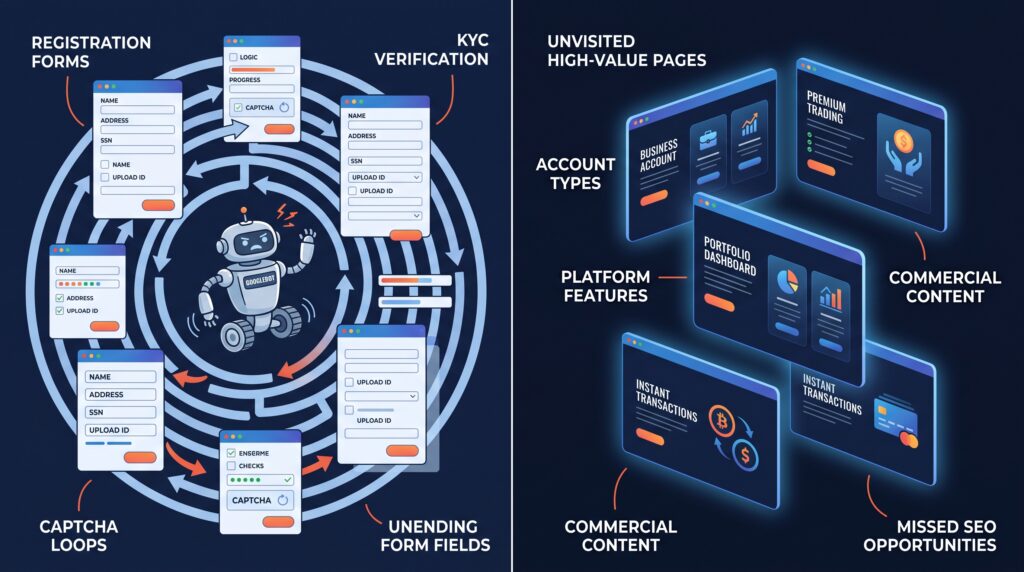
A forex broker’s KYC registration flow typically spans multiple URLs — the account opening form, the document upload interface, the verification status page, and the funded account confirmation. These pages are frequently accessible to Google’s crawlers because they were never explicitly excluded from indexation.
The three problems this creates:
First, thin content signals. Form pages and status screens have minimal editorial content — Google crawls them, finds nothing substantive, and the crawl is wasted. Second, compliance exposure. Form field structures and onboarding flow details become visible in search result snippets in some cases — this is rarely a major compliance issue but it is unnecessary exposure. Third and most importantly, crawl budget. Every crawl Googlebot spends on your KYC flow pages is a crawl not spent on your commercial hub pages — account types, platform pages, regulatory proof content — the pages that actually generate organic commercial value.
QUICK CHECK — DO THIS NOW
Open your XML sitemap (usually at yourdomain.com/sitemap.xml). Search for any URL containing /register/, /open-account/, /kyc/, /verify/, or /documents/. If any appear there, they should not. Your KYC flow pages should be noindexed and excluded from the sitemap.
The full technical fix — noindex configuration, robots.txt exclusions, and URL parameter handling for multi-step KYC flows — is covered in the forex broker technical SEO indexation guide as Issue 4. If your KYC pages are currently indexed, the fix is straightforward and the crawl budget recovery is immediate.
For a broader view of how content strategy connects to regulatory compliance positioning — including how regulatory-differentiated content gives broker sites an E-E-A-T advantage that comparison sites cannot match — the forex broker content strategy article covers the content layer that sits on top of the compliance foundation A11 establishes.
If you want to know whether your broker site’s KYC pages are currently indexed and how this is affecting your organic crawl efficiency — that diagnosis is part of an audit.
FAQ
Q1: What is KYC in forex trading?
KYC stands for Know Your Customer (or Know Your Client) and is the process by which a regulated forex broker verifies the identity of clients before allowing them to open a live trading account. For a forex broker, KYC typically requires a trader to submit proof of identity such as a passport or national ID card, proof of address such as a utility bill or bank statement dated within the past three months, and in some regulatory jurisdictions, information about their financial situation and trading experience. KYC is a regulatory licence condition — not optional — derived from international anti-money laundering and counter-terrorism financing frameworks that all regulated forex brokers must implement as a condition of their regulatory approval.
Q2: How does KYC affect conversion rates and FTD completion for forex brokers?
KYC is a conversion funnel stage between registration and first deposit, and its design directly affects the percentage of registered traders who complete account opening. Three variables have measurable conversion impact: document complexity, where each additional document required beyond the regulatory minimum adds abandonment at that step; verification timeline, where longer processing times create a window where traders make decisions in favour of competitors with faster approval; and communication clarity, where traders who are not told what documents to prepare before starting KYC abandon at higher rates than those who receive clear pre-KYC guidance. The minimum viable KYC principle applies: the compliance obligation is to meet the regulator’s requirements — not to add beyond them. The gap between what the regulator requires and what a broker’s onboarding currently requests is a conversion optimisation opportunity that requires no regulatory trade-off.
Q3: How do KYC requirements differ between FCA, CySEC, and ASIC-regulated forex brokers?
KYC requirements vary significantly by regulatory jurisdiction. FCA-regulated brokers operate under Consumer Duty obligations (effective July 2023) which require that onboarding processes including KYC do not create unnecessary friction for eligible retail clients — making KYC friction a regulatory concern as well as a commercial one. Source of wealth checks are required above specific risk thresholds and appropriateness assessments under COBS 10A apply for complex instruments. CySEC-regulated brokers operate under the EU MiFID II and AMLD framework, with appropriateness testing and risk categorisation requirements. ASIC-regulated brokers must comply with Australian AML/CTF Act requirements via AUSTRAC and deliver a Product Disclosure Statement as part of onboarding — a step not present in EU or UK frameworks. Offshore-regulated brokers face lighter KYC requirements, which improves onboarding conversion but reduces investor protection credibility for larger deposits.
Q4: What is the difference between KYC and AML in forex trading?
KYC and AML are related but distinct compliance processes. KYC (Know Your Customer) is identity verification that happens once at onboarding — it answers who is this person, are they who they say they are, and are they on any sanctions or politically exposed persons list. KYC friction affects the trader experience at the point of account opening. AML (Anti-Money Laundering) is ongoing transaction monitoring that continues after the account is open — it answers whether a client’s transaction behaviour is consistent with their known profile and whether there are patterns suggesting money laundering or financial crime. AML is typically invisible to the trader in normal operation and creates operational workload for the compliance team rather than friction in the trader experience. When a compliance team mentions a KYC issue, they mean an identity verification problem at onboarding. When they mention an AML alert, they mean an ongoing monitoring flag on an existing account.
Q5: What is perpetual KYC (pKYC) and how does it affect forex brokers in 2025 and 2026?
Perpetual KYC (pKYC) is the shift from point-in-time identity verification at onboarding to continuous monitoring of client data, risk profiles, and document validity over the lifetime of the account. Traditional KYC verifies a client once and conducts periodic reviews every one to three years. Perpetual KYC updates client risk profiles and triggers re-verification automatically when client circumstances change — address changes, employment changes, or transaction patterns that diverge from the known client profile. The shift toward pKYC is being driven by FCA Consumer Duty implementation requirements, FATF 2023 recommendations on ongoing customer due diligence, and EU AMLD6 obligations for MiFID-regulated brokers. For forex broker operations, pKYC means more frequent client re-verification communications, technology investment in continuous monitoring, and a compliance workflow that is ongoing rather than periodic. Marketing teams should treat pKYC re-verification touchpoints as client engagement opportunities rather than purely compliance exercises.
Q6: What are the SEO implications of KYC pages for forex broker websites?
Forex broker KYC registration flow pages — account opening forms, document upload interfaces, verification status pages — are frequently accessible to search engine crawlers because they were not explicitly excluded from indexation. This creates three problems: thin content signals on form pages that have minimal editorial content, potential compliance exposure through form fields visible in search results, and crawl budget consumption on pages that should never appear in organic search. KYC and account registration pages should be configured with noindex directives, excluded from the XML sitemap, and blocked in robots.txt where appropriate. Link equity and crawl budget should be directed to commercial pages — account type hubs, platform pages, and regulatory proof content — not consumed by onboarding flow pages. The full technical fix for KYC page indexation, including URL parameter handling for multi-step flows, is covered in the forex broker technical SEO indexation guide.