
Last reviewed: June 2026 · Hristo Hristov
Recently i spoke with CEO who described a situation I hear almost every week. SEO programme running for six months. Technical fixes done in month one. Content published consistently — one to two articles per week. A handful of backlinks acquired from relevant financial publications. Organic traffic slightly up, mostly branded. For every commercial term that actually drives FTDs — “best forex broker,” “low spread trading,” “MT5 broker comparison” — the site is still on page three or four, behind comparison platforms and affiliate directories they had never heard of before the keyword research started.
Their agency’s response: “SEO takes time.”
That is technically true. But it tells a CMO nothing about whether their campaign is on track or stalled. It does not tell them what they should be seeing in Search Console at month six on a healthy programme, or when patience becomes a signal that something is genuinely wrong.
This article answers the actual question. Not “it depends” as a final answer. Not six to twelve months as a catchall. The month-by-month breakdown for a forex broker specifically — with the two variables that determine your realistic timeline and the diagnostic signals that tell you whether progress is real or illusory.
Table of Contents
The Honest Answer: It Depends on Where You Are Starting From
Every SEO timeline article lands on six to twelve months. That range is not wrong — it is just not specific enough to be useful when you are running a programme and need to explain progress to a board.
The correct answer for a forex broker depends on two things that rarely get addressed directly. First: your domain starting point. A new broker domain with no history operates on a fundamentally different timeline than an established broker domain that has been online for four years, even if that existing domain’s SEO has been neglected or poorly executed. Second: the keywords you are targeting. Trying to rank for “best forex broker” puts you against a completely different set of opponents than targeting “low spread ECN broker for day traders.” These two variables can shift the realistic timeline by twelve to eighteen months in either direction.
Before the monthly breakdown, establish which category applies to you.
Two Starting Points, Two Timelines
Track A — New Domain (DR 0–15): No existing authority, no prior indexing history, no established trust signals. Google’s YMYL trust evaluation period applies in full. The first three to six months will show minimal visible ranking movement — that is expected, not failure. Realistic timeline to meaningful commercial traction: ten to fourteen months.
Track B — Established Broker Domain (DR 20–50): Existing trust signals, previously indexed pages, some backlink profile even if thin. The algorithm has a history to evaluate. The YMYL trust delay is reduced but not eliminated. Realistic timeline to meaningful commercial traction: six to nine months from the restart of a proper programme.
| Track A — New Domain (DR 0–15) | Track B — Established Domain (DR 20–50) | |
|---|---|---|
| Starting Authority | Zero — no existing signals | DR 20–50, prior trust history present |
| YMYL Trust Window | Full — typically 6–12 months | Reduced — 3–6 months depending on history |
| First Keyword Movement | Month 2–4 (informational only) | Month 1–3 (informational + some commercial) |
| First Commercial Terms | Month 10–12 | Month 6–8 |
| Meaningful Traction | Month 10–14 | Month 6–9 |
| Budget Crossover Estimate | Month 14–20 | Month 8–14 |
Most CMOs reading this can identify their track immediately. The exception: teams managing an “established” domain that had a migration or major restructure in the past year. Check the referring domain trend in Ahrefs or SEMrush — if a domain live for four years shows a flat or declining backlink profile, a reset event may have moved it much closer to Track A than it appears on the surface. More on that below.
The Forex Broker SEO Timeline: Month by Month
Four phases. For each: what happens, what healthy looks like in the data, and what is a genuine warning signal versus what just looks concerning but is part of the normal curve.
Months 1–3: Technical Foundation and First Indexing
This phase is infrastructure, not rankings. Technical audit and fixes, keyword mapping, initial content published, Search Console configured, indexing requests submitted. Most brokers see minimal visible ranking movement here. That is correct — not a failure.
What healthy looks like in GSC at 90 days:
- Impressions growing week over week, even if clicks are near zero. Rising impressions mean Google is starting to map your pages to queries — prominent rankings come later.
- Crawl rate increasing in the Coverage report
- First long-tail, low-volume keywords beginning to appear at positions 20–50 in Performance
- Core Web Vitals passing
- No accumulating crawl errors
What stalled looks like:
- Zero impression growth after eight weeks. Not slow — zero. This is a technical signal: indexing blocked, canonicals broken, robots.txt misconfigured. Not a patience issue.
- Flat crawl rate for weeks at a time
- No increase in the indexed page count in GSC Coverage
Track difference: Track B may see first informational keyword movement as early as month two if existing domain signals are strong. Track A should expect nothing commercially useful before month four at the earliest.
From the data A new broker domain in a mid-competition geo typically shows 500–2,500 impressions/month at 90 days with clicks in single digits — that is the normal baseline, not a failure signal.
Months 3–6: Early Keyword Visibility — and the Plateau Nobody Explains
Some informational keywords start appearing at positions 15–30. Branded search grows month over month. Commercial terms are still absent from the first two pages for anything meaningful. Then, around month four or five on new financial domains, something unexpected often happens: rankings plateau. They may even slightly regress for two to four weeks despite no change in strategy, no technical issues, nothing obviously wrong.
I have seen CMOs panic at this point. A few cancelled their programmes entirely.
The plateau is real. On new financial domains it is common. And it is almost never a content problem.
Google’s quality evaluation process for YMYL content uses human quality raters alongside algorithmic signals to assess the credibility of new financial sources. This evaluation period does not announce itself in Search Console — it shows up as a stall in ranking momentum while Google determines whether your domain meets the credibility threshold for financial content. Rankings resume when sufficient trust signals have accumulated.
The correct response during this window: keep publishing, and accelerate E-E-A-T signal building specifically. Named authors on every content page. Licence numbers linked to live FCA, CySEC, or relevant regulator registers — not to your own About page. Methodology or editorial policy pages that explain who creates and reviews your financial content. Risk disclaimers present on every CFD and trading content page as required by your regulator. These are not optional extras. They are the trust signals quality raters check on financial sites.
From the data The plateau pattern is consistent enough across new financial domains that practitioners have a name for it: the YMYL sandbox. Somewhere between months four and six, impression growth stalls for three to six weeks — sometimes dips slightly — despite no change in content quality or publishing frequency. The correct response is to hold strategy and build E-E-A-T signals, not change direction. The mature CySEC-regulated broker domain I track is currently showing 181K impressions and 12.4K clicks over three months at average position 8.8 — that is what GSC looks like on the other side of that window.
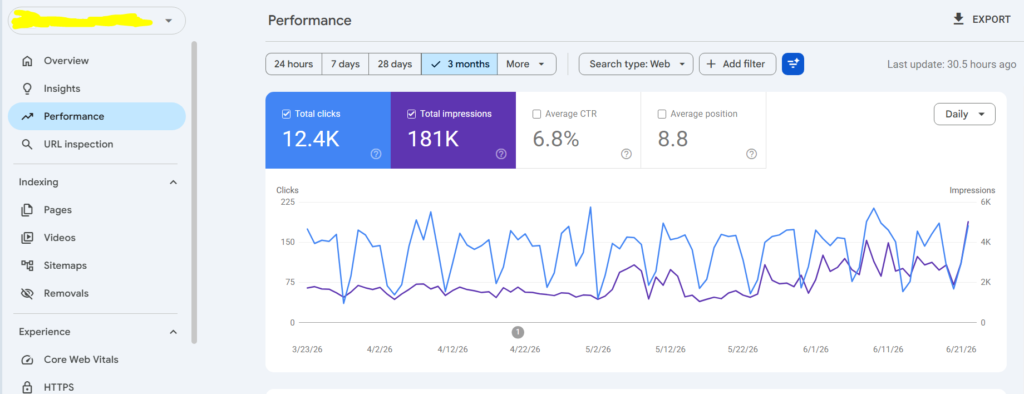
What healthy looks like at months 3–6:
- Informational long-tail keywords entering positions 10–25
- Branded queries growing consistently month over month
- Overall GSC impressions on an upward trend even through the plateau period
- Backlink acquisition running at two to four quality referring domains per month
What stalled looks like:
- Six or more weeks with flat impressions and no upward movement at all
- The same pages appearing and disappearing in GSC Coverage (index instability — a technical signal, not a trust signal)
- No informational keyword movement whatsoever by month five
Months 6–9: Authority Accumulates — and the Backlink Inflection Point
This is where the difference between a well-executed and a poorly-executed programme starts showing up in the data.
For Track B, commercial keyword movement should begin here — mid-tail terms like “low spread broker broker comparison,” or “forex broker” entering top-20 positions. For Track A, strong informational authority and first sub-commercial keyword entries at positions 15–30 are the realistic milestone. Not head terms. Not the comparison queries the affiliate sites own. The queries where broker-created content has a genuine advantage: product-specific, feature-specific, geo-specific terms where aggregator sites have not localised properly.
On backlinks: programmes that have accumulated fifteen to twenty-five referring domains from credible financial and business sources by month six consistently show faster commercial keyword movement in months seven to nine than programmes with fewer than five quality links. The quality differential matters significantly in regulated financial content — a single link from a fintech publication with genuine editorial standards is worth more than fifteen links from financial link directories that accept anything. This is because the quality of your backlink sources contributes to domain credibility signals that quality raters factor into YMYL evaluations.
The internal linking payoff also begins here. Content published in months one to six starts reinforcing itself across the cluster. Pages that were individually thin in authority accumulate relevance via well-structured internal links. This is the practical reason cluster articles should be published in batches rather than spaced six weeks apart — the network effect at months six to nine is measurably stronger when the cluster was built faster.
What healthy looks like:
- First commercial modifier keywords entering top-20
- Informational content stabilising on page one for target sub-topics
- Featured snippets beginning to appear on direct-answer informational queries
- Monthly organic sessions growing, not just impressions
Months 9–12+: Meaningful Traction and the Commercial Crossover
This is where the programme becomes commercially defensible in a board meeting.
First-page positions for mid-competition commercial keywords. Organic traffic starting to contribute to the FTD pipeline alongside paid channels. And the question the CMO now needs a real answer to: at what point does organic cost-per-FTD drop below paid acquisition cost-per-FTD?
Forex PPC for competitive head terms runs approximately €30–80 CPC. CPAs of €300–1,200+ per FTD, depending on geography, campaign structure, and broker tier. Organic SEO has near-zero marginal cost per click once rankings are achieved. The budget crossover — where organic generates enough qualified traffic at sufficient conversion rate to produce FTDs below the current PPC CPA — typically happens between months fourteen and twenty for new domains, and months eight and fourteen for established domains.
Those are planning benchmarks, not guarantees. The actual crossover depends on organic traffic volume and the site’s FTD conversion rate. But it is the commercially correct framing for a CMO managing both organic and paid budgets. The question is not “is SEO producing traffic?” It is “when does SEO become our cheapest FTD acquisition channel?” For most brokers spending seriously on PPC, that question justifies the investment far more clearly than traffic numbers alone.
For Track A at month twelve, if the programme has been executed correctly — technical foundation solid, content cluster built, E-E-A-T signals consistent, quality backlinks accumulated — the domain exits the YMYL trust evaluation period and commercial keyword movement accelerates noticeably. Rankings stuck at positions 12–18 for months start moving to 5–9 without any strategy change. This acceleration at months twelve to fourteen is one of the most reliable indicators that a new financial domain has cleared its trust evaluation. If it does not happen by month sixteen or seventeen, the programme needs a fresh audit — something in the trust signal architecture is still weak.
Why Forex Broker SEO Takes Longer Than Almost Any Other Industry
The timeline above assumes everything executes correctly. Three structural factors make forex broker SEO harder to accelerate than most industries — and why honest timeline conversations need to address them directly rather than treating them as edge cases.
You Are Not Competing Against Other Brokers — You Are Competing Against Affiliates
This is the single reframe that changes how most broker CMOs understand their timeline problem.
When a broker targets “best forex broker” or “top trading platforms,” they are not competing against IC Markets, eToro, or XM for those keywords. They are competing against ForexBrokers.com, BrokerChooser, Investopedia, DailyForex, and thirty to forty comparison and review platforms that have been building content and backlinks specifically for these queries for ten to fifteen years. Some have domain ratings above 70. Their content libraries run to thousands of pages. They have purpose-built comparison landing pages for every broker feature combination the industry produces.
A new broker domain targeting these head terms is not just early — it is structurally locked out on a twelve-month timeline regardless of content quality, technical execution, or budget. The authority gap cannot be closed in a year.
The correct response is not to stop doing SEO. It is to sequence correctly. Target the keywords affiliates are thin on or absent from: brand-specific queries, feature-specific long-tail, market-specific terms for geos where aggregate comparison sites have not localised properly, and educational questions that affiliate sites treat as low-priority because they do not directly rank-compare brokers. Build authority through positions you can actually win in the next twelve months. The head terms become reachable as topical authority compounds over twenty-four to thirty-six months.
The first conversation I have with any new broker client covers this specifically. They arrive with a target list dominated by head terms. I show them who currently ranks for those terms. Then we build two lists: the keywords we can realistically win in the next twelve months, and the keywords we are building toward over two to three years. The timeline gets longer — but the strategy gets honest.
For the full breakdown of how the broker versus affiliate competitive dynamic works and what it means for content strategy, see Forex Broker SEO vs Affiliate SEO: Why They Compete.
The YMYL Trust Delay — Why Google Holds New Financial Sites Back Even With Good Content
YMYL — Your Money or Your Life — is Google’s classification for content where poor information can cause real harm: financial advice, medical guidance, legal content. Financial sites operate under stricter quality evaluation criteria, and new financial domains face an extended trust evaluation period before rankings normalise.
Getting these signals right is the same work covered in a proper forex broker SEO audit, the two processes run in parallel, not sequentially.
This is not a penalty. It cannot be appealed or shortcut. It is a trust accumulation mechanism.
Practically: a new forex broker domain publishing genuinely expert content may see that content rank at positions 15–30 for months before it moves higher — not because the content is inadequate, but because the domain has not yet accumulated the trust signals Google requires to surface it prominently on financial queries. The YMYL evaluation adds roughly three to six months to effective ranking timelines on new financial domains compared to non-financial domains of equivalent authority. This is the structural reason why the generic “six to twelve months” answer consistently undershoots reality for a new broker domain.
What shortens the trust delay:
- Named, credentialed authors on every content page — not “Editorial Team” or “Trading Desk” bylines
- Licence numbers linked to live regulator register pages (FCA, CySEC, ASIC), not to your own About page
- Risk disclaimers on all CFD and trading content pages, positioned as required by your regulator
- An explicit methodology or editorial policy stating who creates and reviews financial content
- Consistent publishing that accumulates trust signals across the domain over time
What extends it unnecessarily:
- Anonymous authorship across the content library
- Promotional language where factual, balanced language is expected on financial guidance pages
- Regulatory disclosures missing or buried in footers only
- Claims that cannot be independently verified by a quality rater
For the full E-E-A-T audit framework specific to forex broker sites — including what quality raters actually check and how compliance language functions as an SEO signal — see the Forex Broker SEO Audit article.
What Resets the SEO Clock — And Nobody Warns CMOs About It
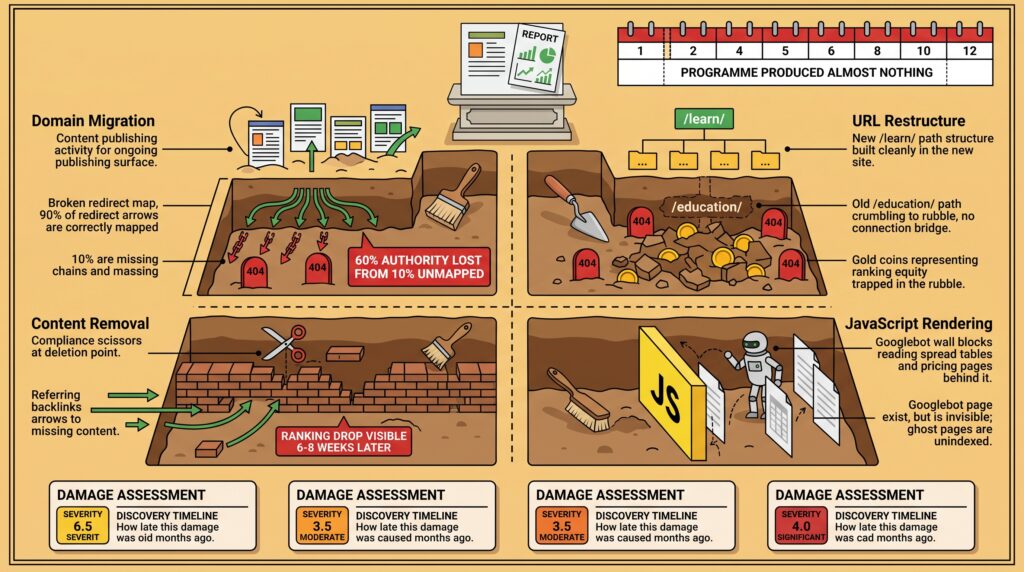
Many CMOs asking “how long does forex broker SEO take?” are actually asking a different question: why has our twelve-month programme produced almost nothing?
In a significant number of broker audits I have conducted, the answer is a clock-reset event that happened early in the programme and was never flagged. The team continued publishing content, acquiring backlinks, and reporting on activity. But the underlying progress had been partially or fully reset by a technical event that destroyed ranking equity — and nobody noticed.
Domain migration without complete redirect mapping. Moving to a new domain, or from HTTP to HTTPS, without mapping every previously indexed page to its new URL. Any page with existing rankings and backlinks that now returns a 404 has lost its history entirely. A migration that is 90% correctly mapped can reset 60% of existing authority if the missing 10% includes the highest-equity pages.
Major URL restructure. Reorganising site architecture in a way that changes existing page URLs — changing /education/ to /learn/, restructuring the trading platform section, creating new URL patterns for instrument pages. Every previously indexed URL that now returns a 404 has lost its ranking equity.
Content removal for regulatory compliance. Deleting blog posts or guide pages because compliance review flagged claims as inappropriate. If those pages were indexed, had accumulated referring backlinks, and were passing authority to other pages via internal links — their removal creates a measurable authority drop that shows up in rankings six to eight weeks later.
Platform migration with JavaScript rendering changes. Switching trading technology in a way that moves spread comparison tables, instrument data, or pricing pages behind JavaScript that Googlebot cannot read. Those pages effectively disappear from the index.
From the audit floor In nearly every stalled broker SEO programme I audit — twelve months of effort, minimal commercial traction, team frustrated — there is a clock-reset event somewhere in the history. Usually a migration or platform update in months two to four. The team has been publishing ever since, acquiring backlinks, reporting on impressions. But the domain they have been building on is weaker than the one they started with, and nobody flagged it. The most common version I find: a trading platform update that changed URL patterns across instrument and account-type pages, with incomplete redirect mapping. Hundreds of previously indexed pages silently returning 404s. Months of accumulated equity gone — visible only when you pull the Coverage report and referring domain trend side by side.
The diagnostic check: if your programme feels stalled despite consistent execution, pull the Coverage report and the referring domain trend in parallel. A Coverage report showing declining indexed page count alongside a flat referral profile is the most reliable indicator of a reset event somewhere in the programme’s history.
AI Search Visibility — A Faster, But Different, Timeline
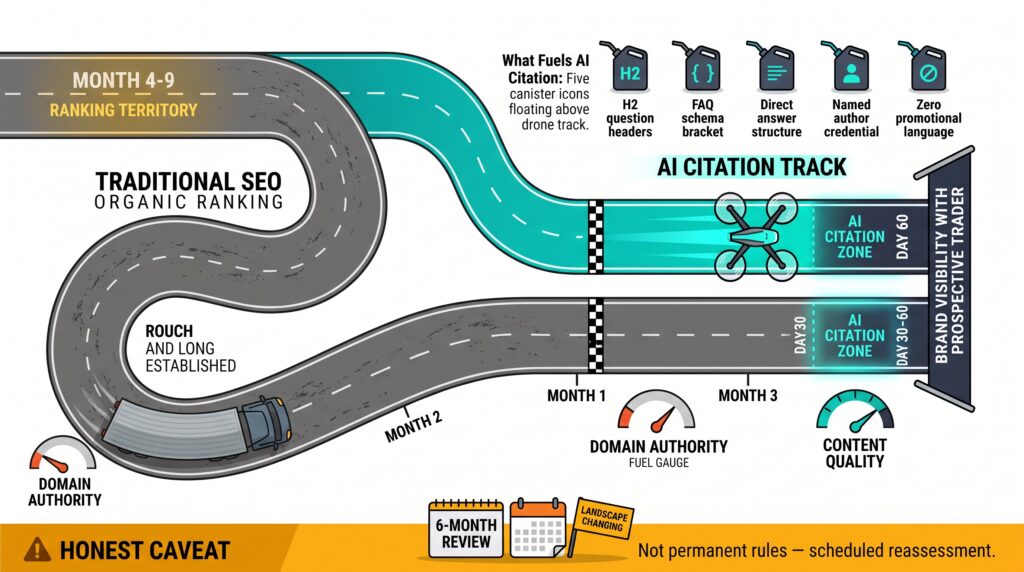
The SEO timeline question in 2026 has an answer that did not exist two years ago.
Alongside Google organic rankings, there is now a second visibility channel — AI-powered search — that operates on a different timeline and different logic. Google AI Overviews, Perplexity, and ChatGPT with browsing generate answers to financial questions by extracting content from indexed web pages. The sites they cite are not always the sites ranking at position one in traditional organic results. A new broker domain can appear in an AI overview citation within thirty to sixty days of publishing well-structured, direct-answer content — even if that content will not rank organically for the same query for six to nine months.
Why this matters practically: a growing share of prospective traders begin their research through AI assistants. “What is the best forex broker for beginners?” asked in Perplexity returns an AI-synthesised answer with cited sources. Those citations are determined by content quality and structure, not primarily by domain authority. A broker’s educational content explaining what spread is, how leverage works, or what CFD trading involves can appear in AI citations faster than its commercial pages rank in organic search — because structured educational content is what AI extraction systems are designed to use.
What makes content AI-citable:
- H2 headers written as direct questions or clear factual statements
- FAQ schema — FAQPage structured data is the single strongest structural signal for AI overview citation eligibility
- Direct, unambiguous answers within the first two to three sentences below each header
- Named author with stated credentials or experience
- No promotional language in informational sections
Organic ranking for a mid-competition informational forex query on a new domain: four to nine months. AI overview citation for the same query, with correctly structured content: thirty to sixty days. This gap is real and commercially useful. AI visibility drives brand impressions and educational authority positioning — it is not a direct FTD conversion channel in the way mature organic rankings become, but it positions the broker in the AI-mediated research process that increasingly precedes trading account decisions.
One honest caveat: the AI search landscape is changing fast. How citation eligibility works in Perplexity and ChatGPT’s browsing features in late 2026 or 2027 may look different from today. This section has a scheduled six-month review for that reason.
How to Know If Your Forex SEO Is Actually Working: Phase Diagnostic Signals
When I audit a broker’s organic programme at the six, nine, or twelve-month mark, the first thing I open is GSC Performance. The table below maps what healthy data looks like at each phase — and what is a genuine warning signal versus what just looks concerning but is normal development.
How to read this table The signal ranges below reflect general benchmark patterns for regulated broker domains in mid-competition geos. Exact figures vary by geography, broker tier, and keyword competition density. Use them as directional reference points — the direction of movement matters more than hitting a specific number.
| Phase | Months | Healthy GSC Signal | Healthy Ranking Signal | Warning Signal | Common Cause |
|---|---|---|---|---|---|
| Foundation | 1–3 | 300–2,500 impressions/month — clicks in single digits is expected | Informational keywords at positions 20–50; Core Web Vitals passing | Zero impression growth after 8 weeks | Indexing blocked; robots.txt; canonical errors |
| Early Visibility | 3–6 | Impressions on consistent upward trend; branded queries growing monthly | Informational keywords entering positions 10–25; long-tail at 5–15 | Impressions flat for 6+ weeks; index instability in Coverage | YMYL trust window (normal if still growing); technical issue if both flat |
| Authority Building | 6–9 | 5,000–20,000 impressions/month — click volume beginning to grow alongside impressions | Commercial modifier keywords entering top-20; first featured snippets | Impressions growing but clicks remain near zero; no commercial movement | Head-term-only targeting; pages not matching commercial intent |
| Traction | 9–12+ | ~60K impressions/month, ~4K clicks/month at average position 8.8 — based on a regulated broker domain currently tracked | First-page positions for mid-competition commercial terms; organic in FTD pipeline | Rankings stuck at positions 12–20 past month 14–15 | YMYL trust not cleared; E-E-A-T signals weak; insufficient backlinks |
Three things that are not warning signals at months one to six on a new domain, regardless of how they look in reporting:
No commercial keyword rankings. Expected. The competitive structure of the forex SERP makes first-page commercial visibility at months three to six on a new domain structurally impossible. This is not failure — it is the normal development curve.
Low organic click volume. Impressions growing while clicks remain low is the correct early signal that rankings are forming. Clicks arrive when rankings move to positions where CTR becomes meaningful — typically page one.
Branded traffic dominating. Branded search growing month over month is genuine authority accumulation — people searching for the broker by name after encountering them elsewhere. It compounds into non-branded authority over time.
CMOs who cancel SEO programmes at month four or five because these three signals look bad typically restart at month twelve with the same low-competition window they already had — having paid for foundational months that were working correctly.
Frequently Asked Questions
How long does forex broker SEO take to show results?
For a new domain (DR 0–15), meaningful commercial traction typically appears between months ten and fourteen, assuming consistent execution, quality backlink acquisition, and E-E-A-T signal building throughout. For an established broker domain (DR 20–50) restarting a proper programme, six to nine months is realistic for first-page commercial keyword movement. The YMYL trust evaluation period adds three to six months to effective timelines for new financial domains compared to non-financial sites of equivalent authority.
Why is my forex broker SEO not showing results after 6 months?
Three causes account for most cases. First, the YMYL trust evaluation window — on new financial domains, a ranking plateau at months four to six is normal and typically resolves at months seven to nine if trust signals are strong. Second, a clock-reset event (migration, URL restructure, content deletion) that reset accumulated authority early in the programme. Third, head-term keyword targeting on queries dominated by comparison sites with ten-plus years of authority — first-page positions on those terms are twenty-four to thirty-six months away regardless of execution quality.
What is the difference in SEO timeline between a new forex domain and an established broker site?
New domains carry zero existing authority and face the full YMYL trust evaluation window, adding three to six months to effective timelines. Commercial keywords are typically accessible from month ten to fourteen. Established broker domains (DR 20–50) benefit from prior trust signals and a reduced trust delay, making first-page commercial keyword movement achievable in six to nine months from programme restart — provided no clock-reset events have occurred and the historical backlink profile is clean.
When can a forex broker expect organic SEO to reduce paid advertising spend?
The budget crossover — where organic cost-per-FTD drops below PPC cost-per-FTD — typically occurs between months fourteen and twenty for new domains, and months eight to fourteen for established domains. Forex PPC CPCs for competitive terms run approximately €30–80 with CPAs commonly in the €300–1,200+ range depending on geography and campaign quality. The exact crossover depends on organic traffic volume and the site’s FTD conversion rate — it is a planning benchmark, not a guarantee.
Does AI search visibility follow the same timeline as Google organic rankings for forex brokers?
No. AI overview citation for well-structured, question-answering content can occur within thirty to sixty days of indexing on new domains, compared to three to nine months for equivalent Google organic rankings. FAQPage schema, H2 headers written as direct questions, named authorship, and factual non-promotional language are the structural requirements. AI visibility drives brand impressions and educational authority — it complements organic rankings rather than replacing them and tends to convert to direct sessions less efficiently than a page-one organic ranking.
If any phase in this timeline maps to where your programme is right now and you want a specific opinion on what is stalling it — that is exactly what I do.