
What is YMYL Content for Forex Brokers?
Last reviewed: June 2026 · Author: Hristo Hristov
What is YMYL Content for Forex Brokers?
Your forex broker’s content is assessed by Google quality raters at the same level of scrutiny as medical content.
Most broker marketing teams produce blog articles, trading guides, and market commentary at the same content standards they would apply to a technology or lifestyle blog. Google quality raters apply a different standard entirely to forex broker content — the highest possible E-E-A-T standard, derived from the same quality assessment framework that governs medical diagnosis articles, legal advice pages, and government service information.
Practitioner Observation
In every E-E-A-T assessment of a regulated broker site I have conducted, the most common gap is not content quality — it is verifiability. The regulatory licence number exists on the site. The regulator’s public register exists online. The link between the two does not. A quality rater attempting to verify the broker’s authority to publish financial content clicks the licence number, lands on the broker’s own About page, and hits a dead end. The verification fails not because the broker is unregulated — but because the site was built by people who assumed the regulator’s name was enough.
This article covers what YMYL means for forex broker content specifically, what E-E-A-T requires from a regulated financial entity (different from what it requires from a general website), the single most powerful E-E-A-T signal available to a licensed broker, the author credential requirements for financial content under the YMYL standard, the comparison site vs broker site E-E-A-T asymmetry, and a five-point E-E-A-T audit you can run on your broker site today.
Table of Contents
What Is YMYL and what does means YMYL Content for Forex Brokers
YMYL — Your Money or Your Life — is Google’s framework for identifying content where low quality could directly harm the reader’s financial wellbeing, health, safety, or access to important resources. It is not a ranking factor in the technical sense. It is a quality assessment trigger: when a page is identified as YMYL, Google quality raters apply heightened E-E-A-T scrutiny because the consequences of low-quality content are most severe in these categories.
Google’s quality rater guidelines describe YMYL content in tiers. The highest tier — the one that attracts the most demanding E-E-A-T assessment — includes medical information and health advice, financial advice and financial products, legal information, major news affecting important decisions, and government and civic information.
Forex broker content sits in the highest YMYL tier. A CFD trading guide, a leverage explanation, a comparison of account types, a market analysis, a regulatory disclosure — all of these cover financial products and financial services. All of them are assessed at the highest quality rater standard. There is no low-stakes content on a regulated forex broker site from Google’s quality assessment perspective.
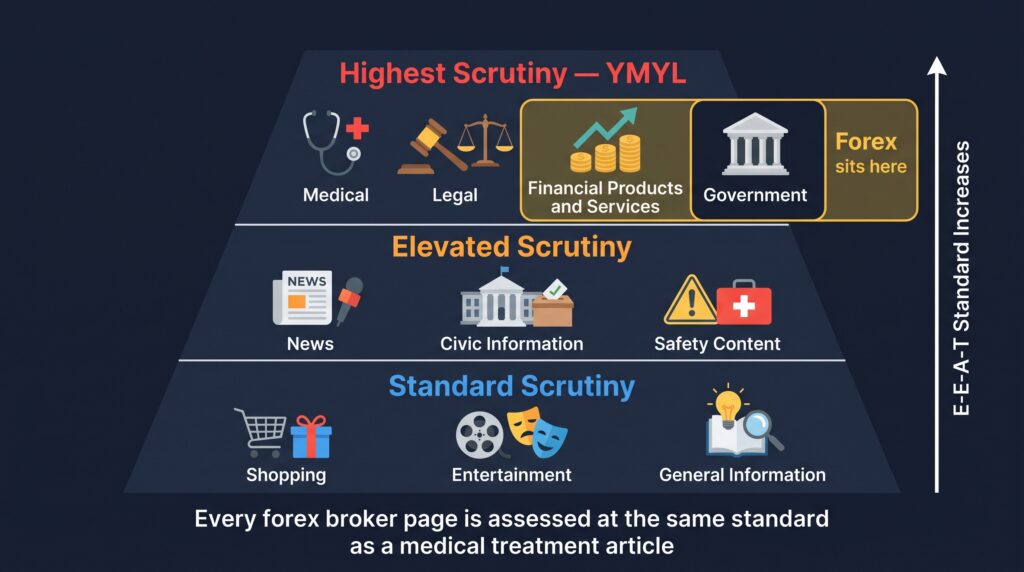
Every piece of content on a regulated forex broker site is in the highest YMYL tier. This is the quality rater assessment standard that determines how your content is evaluated — not just your homepage or regulatory pages.
FOR CEOS AND FOUNDERS
If your broker’s content team does not know what YMYL is or has not been briefed on how quality raters assess regulated financial content — they are producing content to the wrong standard. This is not a cosmetic problem. It affects how Google’s quality systems assess every page on your site.
What E-E-A-T Means for a Regulated Financial Entity
E-E-A-T (Experience, Expertise, Authoritativeness, Trust) is not a single ranking signal — it is a quality assessment framework that Google quality raters use to evaluate content. For a regulated forex broker, each component has a specific meaning that differs from what it means for a general website or informational blog.
| Component | For a general website | For a regulated forex broker |
|---|---|---|
| Experience | Author’s hands-on experience with the topic | Institutional operating history in regulated financial services — years regulated, markets served, client track record |
| Expertise | Author knowledge and subject depth | Verified financial qualifications (CFA, regulatory approvals, FSA examinations) from named, credentialled authors |
| Authoritativeness | Backlinks, citations, industry recognition | Regulatory register entry — government-maintained confirmation of authorisation to provide financial services |
| Trust | Transparency, accurate information, site security | Entity transparency (regulated name, company registration, licence number), segregated fund confirmation, investor compensation scheme coverage |
The Authoritativeness row is where regulated brokers have a structural E-E-A-T advantage that no unregulated competitor can replicate. The next section covers how most broker sites fail to use it.
Regulatory Licensing — Your Strongest Available E-E-A-T Signal
Every generic E-E-A-T guide will tell you to build authority through backlinks and create quality content. None of them identify the specific E-E-A-T signal that only a regulated financial entity possesses — and which no unregulated competitor can ever replicate.
An FCA-regulated broker appears on the FCA Financial Services Register. A CySEC-regulated broker appears on the CySEC entity register. An ASIC-regulated broker appears on ASIC’s publicly searchable register. These are not self-certifications, industry awards, or editorial citations. They are government-maintained public databases confirming that the entity has been audited, approved, and continues to meet regulatory requirements for operating as a financial services firm.
Google quality raters assess regulated financial content by asking: can I verify that this entity is authorised to publish financial content and provide financial services? The regulatory register entry answers that question definitively — at a level of institutional trust that no backlink profile, no author bio, and no “about us” page can replicate. A quality rater following the link from a broker’s website to the FCA register entry that confirms their authorisation is completing the most direct possible Trust verification for a YMYL financial content publisher.
The implementation failure most regulated broker sites make: the licence number is in footer small print. The regulatory body logo has no link. The “About” page mentions FCA regulation without linking to the specific entity entry. A visitor — or a quality rater — who wants to verify the broker’s regulatory standing has to manually search the FCA register rather than following a direct link.
The correct implementation:
- Licence number displayed prominently — above the fold on the homepage, not only in the footer
- Direct link to the specific entity entry on the regulatory register — not to the regulator’s homepage, to the actual entry for this specific broker
- Regulatory standing information on every page covering financial products or investment-related content — not only the About or Legal pages
- For multi-jurisdiction brokers: the relevant regulator and licence for the geographic version of the site clearly indicated
THE E-E-A-T ADVANTAGE ONLY REGULATED BROKERS HAVE
A comparison site, an affiliate publisher, or an unregulated information site cannot link to a financial regulatory register entry confirming their authorisation to provide financial services — because they are not authorised to provide them. The regulatory register entry is an E-E-A-T signal that is structurally unavailable to the comparison sites and affiliate publishers that currently outrank broker sites on forex queries. Use it.
Author Credentials for YMYL Financial Content
Generic E-E-A-T guides say “display author credentials.” For YMYL financial content, the credential standard is materially higher than a general author bio — and most broker content teams are not meeting it.
What counts for YMYL financial content:
- Relevant financial qualifications — CFA, CIMA, ACCA, regulatory examination passes (FCA CF30 approval or jurisdiction equivalents), or demonstrated professional financial services accreditation
- Verified role at a regulated entity — being employed by or associated with the regulated broker writing the content is itself an authority signal. “Head of Market Analysis at XYZ Markets, regulated by FCA, Licence [number]” establishes that the author is writing within their professional regulatory context
- Demonstrated financial services experience — years in regulated roles, specific positions that establish domain authority for the topic being addressed
What does not count as sufficient for YMYL financial content:
- “Editorial team” or “XYZ Markets Research Team” — unnamed attribution on YMYL financial content fails quality rater E-E-A-T assessment
- Generic “financial writer” or “content writer” bios without specific qualifications
- Experience in adjacent but non-regulated fields — marketing writing for a fintech company does not establish YMYL financial Expertise
The practical implementation: Every article covering financial products, trading mechanics, market analysis, or regulatory information should display the author’s full name, specific financial qualification or regulatory approval, current role at the regulated entity, and a link to their professional profile. “Written by [Full Name], CFA, Head of Market Analysis at [Broker], regulated by [Regulator], Licence [number]” is the YMYL author attribution standard. “Written by the Editorial Team” is not. The latest guidance is in Quality Rater Guidelines Reference
The Comparison Site vs Broker Site E-E-A-T Asymmetry
The quality rater assessment mechanics explain why comparison sites structurally outrank broker sites for “best forex broker” queries — not just in links and domain authority, but in the E-E-A-T framework itself.
Google quality rater guidelines address conflicts of interest explicitly in Trust assessment. Content from sources with concentrated commercial interests requires stronger Trust signals to achieve equivalent quality ratings. A comparison site’s commercial interest is affiliate commissions from multiple brokers — distributed across the competitive landscape. A broker site’s commercial interest in “best forex broker” content is concentrated: the reader should open an account with this specific broker.
This structural asymmetry means that a broker site publishing “best forex broker” comparison content faces a higher Trust signal threshold than a comparison site publishing the same content. The quality rater assessment mechanism is not irrational — it reflects a genuine conflict of interest difference. The strategic implication: broker sites achieve higher E-E-A-T quality ratings on content about their own regulated products (where the regulatory standing IS the Trust signal and the commercial interest is explicit and understood) than on comparison content (where the conflict is most concentrated and hardest to signal past).
The full competitive dynamic — why comparison sites rank above brokers, the Fight/Concede/Leverage framework for broker content strategy — is in the forex broker comparison site ranking guide. A14’s contribution: the quality rater mechanics that underpin that competitive reality.
How the Technical Site Framework Connects to E-E-A-T Signals
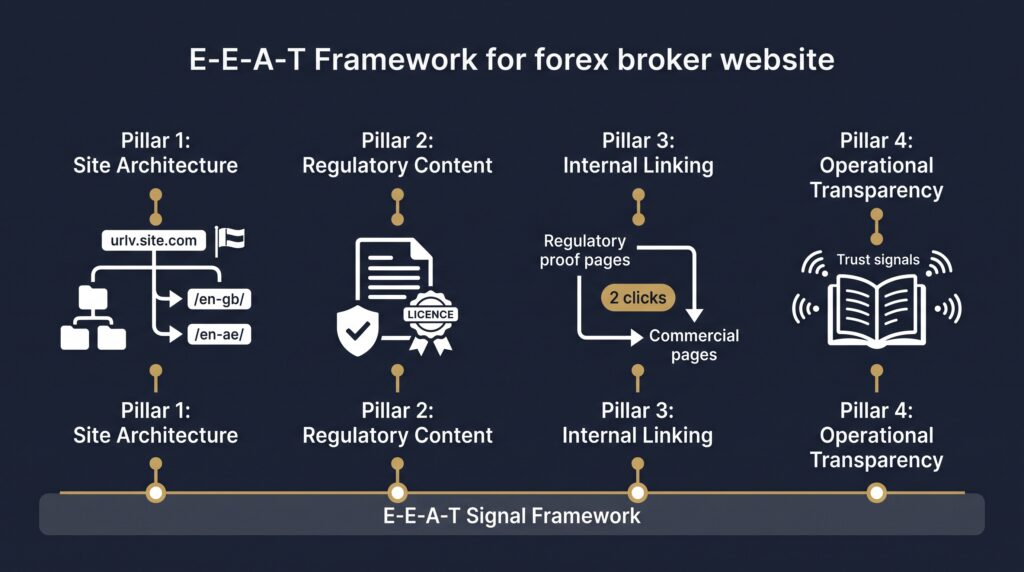
E-E-A-T is not only about content quality. Every technical decision about a forex broker site contributes to the quality rater assessment. Here is how the specific technical framework connects to E-E-A-T signals.
Site architecture and geographic targeting. A multi-jurisdiction broker site with clean geographic subdirectory structure (/en-gb/, /en-ae/) sends quality raters a clear signal about which regulatory context applies to which content. A quality rater assessing the UK version of the site can immediately confirm the FCA regulatory licence applies to this content. Ambiguous geographic structure creates regulatory context uncertainty — the quality rater cannot confirm which authority is relevant, which weakens the Trust assessment for the entity’s YMYL financial content in that market.
Regulatory-differentiated content as the highest E-E-A-T content type. The content types that only a licensed forex broker can author — execution policy disclosures, client fund protection explanations, jurisdiction-specific regulatory guides, KYC policy documentation — are the highest E-E-A-T content on a broker site. These are topics where the broker’s regulated status IS the Expertise and Authoritativeness signal. A quality rater reading a broker’s detailed explanation of their FCA execution policy is reading content that can only be accurately authored by the entity that holds the licence. This is maximum YMYL E-E-A-T on the content itself. The forex broker content strategy framework identifies regulatory-differentiated content as the category that comparison sites and affiliates cannot credibly replicate.
Internal linking from Trust proof to commercial content. Well-structured internal linking from regulatory proof content (Regulatory Information, Execution Policy, Client Fund Protection pages) to commercial content (trading guides, account type comparison pages) connects the entity’s Trust signals to the content being quality-rated. A quality rater following a well-structured broker site’s internal link architecture should reach regulatory proof content from any commercial page within two clicks.
Operational transparency content as Trust signals. The transparency content that covers the broker’s actual operations — how KYC works and why, how the execution model functions and what it means for clients, what FTD metrics measure and how marketing tracks commercial outcomes — is Trust-building content in the E-E-A-T framework. A broker that publishes honest, specific information about how it operates, including the commercially complex aspects, demonstrates the institutional transparency that quality raters associate with high-Trust regulated financial entities.
The Five-Point E-E-A-T Audit for Your Forex Broker Site
Run this in one afternoon. Five questions. Clear pass or fail for each. The gaps you find are your E-E-A-T action list.
| # | Audit Point | Audit Question | Pass | Fail |
|---|---|---|---|---|
| 1 | Entity Verification | Can a quality rater identify your regulated entity name, regulatory body, licence number, and link to your register entry within 30 seconds of landing? | Licence visible above fold. Direct link to register entry. Regulatory info on financial content pages. | Licence in footer only. Regulatory logo without link. Register entry not linked directly. |
| 2 | Author Credential Coverage | Do all financial content articles have named authors with displayed financial qualifications and roles? | Every YMYL article: named, qualified, role-displayed author. | Any “editorial team,” unnamed, or generically attributed YMYL content. |
| 3 | Regulatory Proof Content | Does your site have dedicated content explaining your regulatory standing, client fund protection, and investor compensation scheme coverage? | Dedicated regulation page in main nav. Regularly updated. Specific protections explained. | Regulatory info in footer disclaimers only. No dedicated content. Outdated text. |
| 4 | External Trust Verification | Can a quality rater verify your entity’s financial reputation on sources beyond your own site? | Register entry confirms status. Professional review coverage. Industry body memberships. | No external verification beyond self-published claims. Reliance only on own site content. |
| 5 | Content Quality Consistency | Does every piece of financial content on your site meet YMYL quality standards — or do peripheral blog articles fall below your core page standard? | Consistent editorial standards across all published content. Regular YMYL quality review. | High-quality core pages alongside low-quality blog content. Inconsistent YMYL standards. |
HOW TO USE THIS AUDIT
Score each of the five points as Pass, Fail, or Partial. Any Fail is a priority fix. Any Partial is a scheduled improvement. A broker site that passes all five points is operating at the correct E-E-A-T standard for highest-tier YMYL content. Most regulated broker sites currently pass two or three of the five.
FOR CEOS — THE ONE-LINE SUMMARY
Google assesses your broker site as if it were a medical information publisher. The five points above are the E-E-A-T standard that assessment implies. Point 1 (regulatory register link) takes one afternoon to fix and has the highest single-improvement impact of any E-E-A-T action on a regulated broker site.
If you want to know where your broker site stands on each of these five E-E-A-T dimensions — that assessment is what an audit produces.
FAQ
Q1: What is YMYL and how does it apply to forex broker content?
YMYL stands for Your Money or Your Life, which is Google’s framework for identifying content where low quality could directly harm the reader’s financial wellbeing, health, safety, or access to important resources. Forex broker content falls into the highest YMYL tier because it covers financial advice, financial products, and financial services — the same tier as medical diagnosis, legal advice, and government services. This means Google quality raters apply the most stringent E-E-A-T assessment standards to every piece of content on a forex broker site, including trading guides, market analysis, account type explanations, and promotional pages. There is no low-stakes content on a regulated forex broker site from Google’s quality assessment perspective — all of it is evaluated at the highest possible E-E-A-T standard.
Q2: Why is regulatory licensing such a strong E-E-A-T signal for forex broker sites?
Regulatory licensing is the strongest available E-E-A-T signal for a regulated forex broker because it is a government-maintained, publicly verifiable confirmation that the entity is authorised to provide financial services. An FCA-regulated broker appears on the FCA Financial Services Register, a CySEC-regulated broker on the CySEC entity register, and an ASIC-regulated broker on the ASIC register — all publicly searchable databases maintained by financial regulators. Google quality raters assess whether financial content publishers can be verified as credible and authoritative. A regulatory register entry provides this verification at the highest possible institutional level — confirming the entity has been audited, approved, and continues to meet regulatory standards for operating as a financial services firm. No backlink, author bio, or about page provides equivalent third-party institutional trust confirmation. Regulated broker sites that do not prominently link to their specific regulatory register entry are failing to use the most powerful E-E-A-T signal they have.
Q3: What author credentials does Google look for in YMYL forex broker content?
For YMYL financial content on forex broker sites, Google quality raters look for author credentials that establish genuine domain authority in financial services, not just content creation experience. Credentials that count include relevant financial qualifications such as CFA or CIMA designations, regulatory approvals or examinations, and demonstrated experience in regulated financial services roles. The author’s institutional affiliation with the regulated entity itself is also an authority signal — writing within one’s professional regulatory context establishes expertise for YMYL financial topics. Credentials that are insufficient for YMYL financial content include generic content writer bios, unnamed editorial team attribution, and experience in adjacent but non-regulated fields. Every article covering financial products, trading mechanics, market analysis, or regulatory information on a broker site should have a named, qualified author with specific financial credentials and role displayed — not an anonymous or generically attributed byline.
Q4: How does Google assess forex broker sites differently from comparison sites for the same queries?
Google quality raters apply the YMYL financial standard to both forex broker sites and comparison sites but assess them differently for Trust. A comparison site’s commercial interest — affiliate commissions from multiple brokers — is more distributed than a broker site’s commercial interest in converting the reader to their specific platform. Quality rater guidelines address conflicts of interest explicitly in E-E-A-T assessment: content from sources with concentrated commercial interests requires stronger Trust signals to achieve equivalent quality ratings. For broker sites, this means that content about their own regulated products, where the entity’s regulatory standing is the Trust signal, achieves higher E-E-A-T quality ratings than broker-authored comparison content, where the commercial conflict is most concentrated. The practical implication: forex broker sites should focus their content investment on authoritative, specific content about their own regulated products and regulatory standing rather than competing with comparison sites on their strongest ground.
Q5: What is the most important single E-E-A-T improvement a forex broker site can make?
The most impactful single E-E-A-T improvement for a regulated forex broker site is implementing the regulatory register entry as an active, prominently displayed Trust signal rather than a buried footer disclaimer. This means displaying the regulatory licence number above the fold on the homepage, linking directly to the entity’s specific entry on the regulatory register rather than to the regulator’s homepage, and including regulatory standing information on every page that discusses financial products or investment-related content. This improvement is uniquely available to regulated entities — it is not replicable by unregulated competitors — and it addresses the most commonly identified gap in regulated broker site E-E-A-T assessments. It requires no new content production, no backlink acquisition, and no technical development beyond adding a link and updating the licence number display placement.
Q6: How does a forex broker’s site structure affect its E-E-A-T assessment?
Site structure affects E-E-A-T assessment for forex broker sites in three specific ways. First, geographic targeting clarity: a well-structured multi-jurisdiction site with clear geographic subdirectories helps quality raters identify which regulatory context applies to which content, strengthening the entity verification assessment for each market. Second, editorial architecture: internal linking from regulatory proof content to commercial pages allows quality raters to navigate from trading guides to the regulatory evidence of the entity publishing them, reinforcing Trust signals throughout the site. Third, content quality consistency: a clean site structure with clear content hierarchies allows quality raters to assess the site’s overall content standards — poorly structured sites with inconsistent content quality across sections create an uneven E-E-A-T profile where high-quality core pages cannot compensate for low-quality peripheral content. Site structure is not a decorative SEO element for YMYL financial sites — it is part of the entity’s quality presentation to automated and human quality assessors.