
Last reviewed: June 2026 · Hristo Hristov
Most broker keyword strategies I review are copies of an affiliate’s keyword strategy. That is the problem — and most teams do not realise it until they have spent twelve months and a significant content budget producing almost no commercial organic traction.
Here is the situation I see regularly. A forex broker CMO receives a keyword strategy from their SEO agency. The priority targets: “best forex broker,” “best forex broker for beginners,” “lowest spread broker 2026,” “forex broker comparison.” The CMO looks at the list and something feels slightly wrong, though they may not be able to articulate why.
What feels wrong is this: those are the same keywords the broker’s own affiliate partners are using to send traffic back to the broker. The CMO is being asked to spend budget competing on organic search for the same queries that affiliates are already buying, ranking for, and monetising — on the broker’s behalf.
This article explains why the conflict exists structurally, what the competitive reality actually looks like in the SERP, and gives brokers a practical keyword framework that aligns with how brokers actually make money — rather than how affiliates do.
Table of Contents
Why Brokers and Affiliates End Up on the Same SERP
The convergence is not accidental. Both a forex broker and a forex affiliate are trying to intercept the same person: a trader who is evaluating which platform to open a live account with. The trader’s search journey runs through the same keywords regardless of who is trying to reach them. A trader typing “best forex broker” into Google is a potential direct acquisition for the broker and a potential CPA commission for the affiliate. Same person, same query, two different interception strategies.
The affiliate channel exists in forex specifically because brokers historically could not reach all potential traders through their own organic or paid channels efficiently. Affiliates filled the gap by building the comparison and review infrastructure that lives at the top of commercial forex SERPs. Brokers then pay those affiliates a commission for each trader they refer. It is a symbiotic relationship — until the broker also tries to rank for the same comparison queries their affiliates own. At that point it becomes a funding conflict: the broker is paying the agency to compete against the channel they are also paying commissions to.
Understanding why this happens requires looking at the economic logic behind each model.
The Monetisation Asymmetry: Same Keywords, Completely Different Economics
This is the insight that almost no one in the forex SEO space has written directly. Affiliates and brokers target the same keywords from completely different economic motivations — and once you see this clearly, the broker keyword strategy problem becomes obvious.
The affiliate’s economics. An affiliate earns a one-time CPA payment per first-time deposit, typically in the range of €150–600 per FTD depending on the broker tier, regulated jurisdiction, and deal terms. Some affiliate arrangements use revenue share, but CPA dominates acquisition affiliate deals. The affiliate’s entire incentive is to generate the click that produces the FTD. The optimal content for this is comparison and review material that ranks for high-commercial-intent queries at the moment a trader is deciding which broker to use. “Best forex broker,” “IC Markets vs Pepperstone,” “lowest spread broker for scalping” — these are the queries searched by traders at the point of decision. Affiliates have been building content and backlink profiles specifically for these terms for ten to fifteen years. Their keyword strategy is perfectly aligned with their business model.
The broker’s economics. A broker earns the trader’s lifetime value — spreads, commissions, and fees accumulated over months or years of active trading. A consistently active retail trader on a standard account may generate €3,000–15,000+ in revenue over two to three years. The broker’s optimal content is not content that wins an acquisition click. It is content that attracts traders who stay, trade regularly, and eventually refer others. Platform education. Market analysis. Risk management guides. Content that builds the kind of trust and capability in a trader that reduces churn and increases lifetime value. This is fundamentally different content, targeting fundamentally different queries, than what affiliates produce.
Forex Broker SEO vs Affiliate SEO
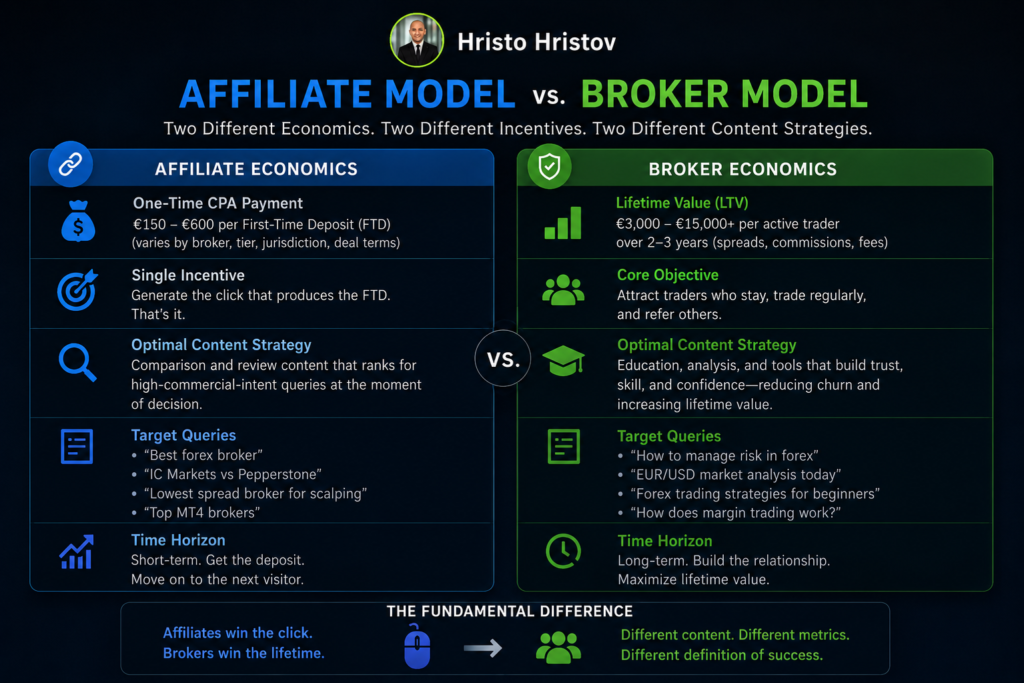
The broken logic most brokers follow. Because affiliate sites rank visibly on the commercial terms brokers want, most broker SEO teams copy what they can see. It looks like a working model — the affiliates are ranking, getting clicks, sending FTDs. So the broker builds comparison pages, “best broker” lists, and head-term content. They are optimising for the acquisition click — the same economic outcome their affiliates are already delivering. The broker’s genuine SEO advantage is in the content affiliates cannot and will not produce: deep platform knowledge, trader retention content, regulatory expertise, and the brand authority that comes from being the actual product rather than the intermediary reviewing it.
What the SERP Actually Looks Like
Before building any broker keyword strategy, it is worth seeing what the competition actually looks like — not as a description, but as a data point.
Who Ranks for “Best Forex Broker” and Why
I ran the SERP for several commercial forex queries in June 2026. The pattern across all of them is consistent. Positions 1–10 are occupied almost entirely by comparison sites, review aggregators, and financial media — not by brokers with few exceptions
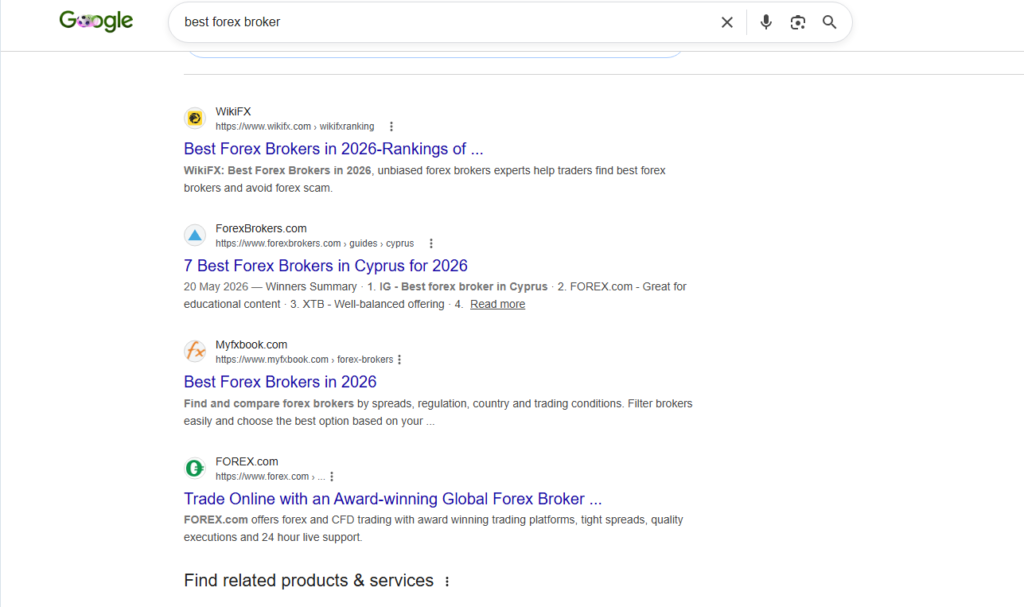

The SERP — June 2026 I ran “best forex broker” in June 2026. Here is what the visible positions look like: WikiFX (broker review aggregator), ForexBrokers.com (comparison site, DR ~70), Myfxbook.com (trading community platform), FOREX.com (actual broker — Gain Capital, domain registered 1999), DayTrading.com (financial media), Investing.com (financial media, DR ~90+), plus a YouTube carousel from the CompareForexBrokers affiliate channel. Of all the results visible on the first page, exactly one is an actual forex broker — and it is a brand with over 25 years of domain history and a DR that most new brokers will not reach in the next decade. The rest are affiliates, comparison platforms, and financial media. This is not an SEO problem you solve with better content in year one. It is the structural reality of this SERP.
The sites that own these positions share three characteristics. First, they have domain ratings well above 60 — accumulated over a decade of link building in the financial services space. Second, they have built content libraries of several hundred to several thousand pages specifically targeting the trader acquisition funnel. Third, they have been doing this consistently since at least 2012–2015, compounding their authority every year.
These are not competitors a broker can displace in a twelve-month SEO campaign. They are the structural owners of the comparison SERP and have been for years. Recognising this is not discouraging — it is clarifying.
The Authority Gap in Numbers
Reaching page one for a head-term commercial forex query requires, at minimum, a domain rating above 50, 150–250+ referring domains from credible financial and business sources, and 24–36 months of consistent content publishing and backlink acquisition from a starting point of low authority. A new broker domain at DR 10–20 with a 12-month plan is not close to that threshold.
These are not impossible numbers. They are achievable — but they describe a 36-month investment, not a 12-month sprint. The brokers that currently rank alongside affiliates for head-term comparison queries did not start there. They built topical authority on educational and feature-specific content first, established domain credibility with Google over multiple years, and then pushed into comparison terms as that authority compounded. The strategic error is trying to start at the end of that sequence.
The practical implication: a broker entering organic SEO with realistic expectations needs a keyword framework that distinguishes between what they can win now, what they can build toward in 12–24 months, and what requires a 36-month foundation. That is the three bucket framework.
The Three Keyword Buckets: Where Brokers Win, Lose, and Build Toward
Every keyword a forex broker could target falls into one of three buckets. Most broker keyword strategies are heavily weighted toward Bucket 1. The correct allocation — especially in the first 12 months — is the opposite.
| Bucket | Who Owns It Now | Examples | Realistic Entry Timeline | Year-One Priority |
|---|---|---|---|---|
| 1 — Affiliate-Owned | Comparison sites, review aggregators, DR 65–90 incumbents | “best forex broker,” “forex broker comparison,” “IC Markets review” | 24–36 months from a DR 0–20 starting point | LOW — build toward, do not target now |
| 2 — Broker-Natural | Nobody — affiliates have no incentive to create this content | Platform tutorials, product feature explainers, regulatory content, money management guides | 3–6 months on any established domain | HIGH — own from day one |
| 3 — Contested/Neutral | Neither side has dominant authority — thin or absent coverage | Geo-specific long-tail, regulatory change queries, niche instrument queries, operator-intent searches | 6–12 months on a new domain | HIGH — primary commercial target in year one |
Bucket 1 — Affiliate-Owned: Do Not Fight These Before Month 24
Bucket 1 is the comparison and review territory that affiliates have spent ten to fifteen years building authority for. “Best forex broker,” “best forex broker for beginners,” “lowest spread forex broker,” “forex broker comparison,” individual broker review pages for every major brand in the market. Every position in the top ten for these queries is held by a site with a decade of link building behind it.
A new broker domain targeting these terms is not running a slow SEO campaign. It is attempting a competition where the opponent started in 2010 and has been training daily since. The content quality does not matter at this stage — the authority gap is the constraint, not the writing.
Bucket 1 — The keyword list most broker agencies hand you These are the queries that end up on most broker target lists and should not be year-one priorities: “best forex broker” (200K+ searches/month globally — 100% comparison site territory), “best forex broker for beginners” (40K+/month — affiliates have dedicated landing pages per geo for this), “lowest spread forex broker” (high commercial intent, all top-10 positions held by comparison platforms), “IC Markets review” / “Pepperstone review” (ironically, the actual broker often ranks lower than the review sites writing about them), “forex broker comparison” (pure affiliate architecture — structured comparison tables are exactly what these sites are built around). If your agency’s year-one keyword list looks like this, the strategy is built for affiliates, not for a broker.
This does not mean never targeting Bucket 1. It means earning the right to compete there by building authority through Bucket 2 and Bucket 3 first. The brokers that currently appear alongside affiliates in comparison SERPs — IC Markets, Pepperstone, XM on branded terms — got there through years of topical authority building, not by starting with a “best forex broker” landing page on a new domain. The sequence matters.
Bucket 2 — Broker-Natural: Own These From Day One
Bucket 2 is the content category that affiliates have no economic incentive to produce well. Affiliates earn per acquisition click — they optimise for the trader making a decision. They have no incentive to help an already-registered trader use their MT5 platform more effectively, understand how trailing stops work, or improve their risk management. A trader reading “how to use MT5’s strategy tester” already has a broker. That content does not produce CPA commissions.
For a broker, this is the most commercially important content category — and almost always the most underdeveloped one. When I review a broker’s content library, Bucket 2 is consistently where I find the thinnest coverage, the oldest publish dates, and the least strategic investment. The content that would build the deepest client relationships and reduce churn most effectively is the content that gets ignored because it does not look like what the SEO agency is optimising for.
What Bucket 2 looks like in practice:
- Platform-specific education: MT4 and MT5 tutorials, mobile app guides, strategy tester walkthroughs, EA setup instructions
- Product and feature explainers: what a floating spread is versus a fixed spread, how swap-free accounts work, what negative balance protection means in practice
- Regulatory and compliance content: what FCA regulation means for a retail trader, how CySEC licensed brokers handle client fund segregation, what ESMA leverage rules apply in their market
- Risk and money management: position sizing, drawdown management, margin call mechanics explained without jargon
- Trading strategy education that uses the broker’s specific platform features as the vehicle
Affiliates cover some of these topics at a surface level. A broker covers them with product authority — “here is exactly how our swap-free accounts work, including the administrative fee structure and the eligible instruments” — that a comparison site cannot replicate. That product-level depth is where Bucket 2 content creates a genuine moat.
Bucket 3 — Contested and Neutral: Win These in Year One
Bucket 3 is the keyword category that neither affiliates nor brokers have built dominant authority for — the gaps in the SERP where genuinely useful, well-structured content from a credible source can reach page one within 6–12 months even on a newer domain.
These are the year-one commercial wins that build topical authority fast enough to fund a push into Bucket 1 territory in years two and three.
Bucket 3 keyword patterns:
- Geo-specific long-tail: Aggregate comparison sites cover UK, US, and Australia thoroughly. They are thin or absent on smaller regulated markets — “forex broker UAE residents CySEC regulated,” “forex broker Philippines BSP compliant,” “regulated forex broker for South African traders.” These have lower volume but higher conversion intent and almost no established competition.
- Regulatory change queries: When the FCA, ESMA, or CySEC changes leverage limits, reporting requirements, or marketing rules, affiliates are slow to update their content. A broker publishing accurate, compliance-aware regulatory explainers immediately after a rule change consistently captures this traffic window.
- Niche instrument or feature queries: “Forex broker with US equities CFDs,” “broker offering Islamic account CySEC regulation,” “copy trading forex broker Europe 2026.” Comparison sites treat these as footnotes. A broker for whom this is a core product can own the query with one well-structured page.
- Operator and B2B intent: “How does a forex broker make money on spread,” “forex broker white label cost 2026,” “how IB commission structures work.” Affiliates do not target these because the audience is not a retail trader making a deposit decision. For Hristo’s ICP — broker CMOs — these are exactly the queries worth building content around.
Bucket 3 — Real examples of winnable queries A few concrete examples of what Bucket 3 looks like in practice (volumes are indicative estimates for mid-2026): “CySEC regulated forex broker” — ~400–700/mo, comparison sites cover this generically but a Cyprus-based broker with a proper regulatory content page owns it with ease; “best forex broker Nigeria” — ~200–400/mo, almost no localised competition from aggregate comparison sites; “forex broker Islamic account Europe” — ~150–300/mo, affiliates treat this as a footnote, a broker for whom this is a core product can dominate; “forex broker white label cost” — ~100–200/mo, B2B intent that affiliates never target; “MT5 broker low minimum deposit” — ~200–350/mo, feature-specific query where a broker with the right product page wins immediately. None of these individually moves significant revenue. Together, as a cluster built over 6–9 months, they establish the topical authority that makes phase two competition possible.
The Bucket 3 strategy is not about chasing low-volume keywords indefinitely. It is about building the topical authority and domain credibility that makes Bucket 1 competition viable in year two and three. Every Bucket 3 win is a trust signal — for Google, for quality raters, and for the trader who finds a broker that actually answers their specific question rather than a generic comparison page.
The AI/GEO Competition Layer — How 2026 Changed This Dynamic
The broker versus affiliate SEO conflict looked different in 2023 than it does now. The emergence of AI-powered search has shifted the economics in a way that strengthens the case for the Bucket 2 and 3 strategy significantly.
Google AI Overviews, Perplexity, and ChatGPT with browsing are now generating direct answers to commercial and informational forex queries. When a trader asks “what is the best forex broker for beginners?” in an AI assistant, the response is a synthesised answer citing ForexBrokers.com, BrokerChooser, and Investopedia — the same affiliate and comparison sites that dominate organic. The organic click that previously went to the position-one affiliate result is being partially absorbed by the AI answer above it. For brokers, this makes an already difficult Bucket 1 keyword fight less commercially attractive: even if you reach position one for “best forex broker,” the zero-click AI answer above it is now absorbing a portion of the intent that query used to deliver.
The inversion that matters for brokers. AI overviews favour structured, educational, question-answering content — which is exactly Bucket 2. A broker’s educational article on “what is a floating spread?” can appear in an AI overview citation within 30–60 days of publish on a new domain, even before it achieves a strong organic ranking. The AI system cares about content structure, named authorship, FAQPage schema, and direct question-answering format. Domain authority matters less at this stage than relevance and structure. This is the opposite of how comparison-term organic rankings work.
The practical result: Bucket 2 content is now a two-channel asset. It builds organic authority over 6–12 months through standard SEO. And it produces AI overview citations within weeks of publish for educational queries — queries where the broker has genuine product depth advantages over affiliate sites that cover everything at moderate depth.
Bucket 1 content is becoming less commercially attractive on two fronts simultaneously: the ranking timeline remains 24–36 months, and the click value of ranking at position one is being reduced by AI overview absorption. The argument for prioritising Bucket 2 and Bucket 3 over Bucket 1 is stronger in 2026 than it has ever been.
The Broker Co-Existence Strategy: A Three-Phase Framework
The goal is not to defeat affiliates in organic search. The goal is to build a broker organic programme that delivers increasing commercial value on a 36-month horizon while the affiliate channel continues to operate in parallel. These are not competing strategies — they serve different moments in the trader acquisition and retention cycle.
Phase 1 (0–12 Months): Own What Affiliates Ignore
Full investment in Bucket 2 and Bucket 3 content. Platform education library, product feature explainers, regulatory content for the primary target geos, risk and money management content, and brand-specific queries that only the broker can answer with genuine authority. Target 2–4 quality backlinks per month from fintech media, regulated financial publications, and relevant business directories — not link farms.
Expected outcomes at month 12: page-one positions for the majority of Bucket 2 targets, meaningful Bucket 3 commercial keyword entries at positions 5–15, first AI overview citations appearing on educational queries, and organic beginning to contribute to informational sessions that reduce support load and churn. The affiliate channel continues unchanged — this phase does not compete with affiliates, it builds the foundation for phase two.
Phase 2 (12–24 Months): Build Toward the Contested Keywords
With Bucket 2 and 3 authority established and compounding, begin targeting the mid-tail Bucket 1 variants — geo-specific comparisons, niche trading style comparisons, and the lower-competition edges of the head term cluster. “Best forex broker Nigeria,” “forex broker comparison Germany low spread,” “regulated broker for scalping Europe.” These are not the hardest Bucket 1 terms — they are the tier below, where a domain with 12 months of Bucket 2 and 3 authority can compete.
Expected outcomes at month 24: organic contributing 15–25% of new FTD pipeline on assisted conversion basis, commercial keyword movement into the mid-tier Bucket 1 space, domain authority building toward the threshold required for head-term competition in phase three.
Phase 3 (24–36 Months): Compete for Affiliate-Dominated Terms
With accumulated domain authority from phases one and two, begin targeting the head-term Bucket 1 queries. The domain is now in a structural position to compete — not because the strategy changed, but because the foundation was built correctly. This is where brokers who started the sequence correctly begin to appear alongside affiliates in the commercial comparison SERPs.
The brokers that fail at phase three almost universally tried to start there instead of earning entry through phases one and two. Organic is a compounding asset, not a quick acquisition channel. The frame for a CMO budgeting for this investment should be: what is the value of organic FTD acquisition at zero marginal cost-per-click in year three, compared to the current paid acquisition cost? For most brokers running significant PPC spend, that calculation makes the 36-month investment straightforward to justify.
For a detailed breakdown of what the organic timeline looks like at each phase — including the YMYL trust sandbox mechanics and what GSC should show at each milestone — the forex broker SEO timeline article covers it in full.
If your current keyword strategy looks more like an affiliate’s than a broker’s — that is a fixable problem. It starts with an audit.
Before the strategy comes the baseline The three-phase framework above assumes you know which bucket your current keyword strategy falls into, where your domain authority actually sits, and which technical or E-E-A-T issues are limiting your organic ceiling. Most broker teams I speak to do not have a clear answer to any of those three questions. That is the starting point of a proper forex broker SEO audit — mapping the current state before investing in a direction.
Frequently Asked Questions
Why do forex brokers and affiliates compete for the same keywords?
Both are trying to intercept the same trader at the point of account-opening decision. Affiliates earn a one-time CPA per FTD, so they optimise for comparison-intent queries. Brokers earn lifetime trader value, so they should optimise for retention and educational content — but most copy the affiliate keyword playbook instead. The conflict exists because both business models converge on the same high-commercial-intent queries from completely different economic motivations.
Can a forex broker outrank affiliate comparison sites in organic search?
Yes — but not in year one and not on head terms. Sites like ForexBrokers.com and BrokerChooser have domain ratings above 65 and a decade of content investment. A broker can reach page one for those terms with 24–36 months of consistent execution from a DR 20+ starting point. The more productive year-one question is: which keywords can the broker win that affiliates are not competing for?
What keywords should a forex broker target instead of affiliate comparison terms?
Three buckets: first, platform-specific educational content affiliates have no incentive to create well — MT5 tutorials, product feature explainers, regulatory content. Second, geo-specific and regulatory queries where comparison sites have thin or no localised coverage. Third, brand and product queries only the broker can answer authoritatively. These three buckets build organic authority while aligning with broker economics, not affiliate economics.
Does AI search change the broker versus affiliate SEO dynamic?
Yes, and in the broker’s favour for educational content. AI overviews are absorbing comparison-intent clicks from affiliate position-one results, reducing the commercial value of Bucket 1 keywords even when ranked. Simultaneously, AI systems favour structured educational content where brokers have genuine product depth advantages. Broker educational content can appear in AI citations within 30–60 days of publish — before organic rankings mature.
How long does it take a forex broker to build meaningful organic traffic independent of affiliates?
For educational and product-specific content, meaningful traction is achievable in 6–12 months on an established domain. For commercial comparison terms, expect 24–36 months from a new domain. The correct path: invest in Bucket 2 and Bucket 3 from day one, use that accumulated authority to fund a Bucket 1 push in year two. Attempting Bucket 1 from a new domain in month one is the most common organic budget waste in forex broker marketing.
If your current keyword strategy looks more like an affiliate’s than a broker’s — that is a fixable problem. It starts with an audit.