
Last reviewed: July 2026 · Author: Hristo Hristov
Growth Consultant · Fintech, Forex & Prop Firms
Content Strategy for a Forex Broker, where to start?
Most forex broker content programmes have the same problem. Traffic is growing. Organic sessions are up month on month. The content team is producing consistently. And yet the contribution to first-time deposits is almost impossible to measure — because it is almost zero.
The problem is not the content quality. It is the content mix. A broker can publish excellent articles and still build a programme that is structurally incapable of contributing to FTD acquisition — because the content types that generate traffic are not the same content types that convert traders into funded accounts.
This article gives you a framework for building a content strategy that does both. Not instead of the educational content you are already producing — alongside it, and in the right proportion.
WHO THIS ARTICLE IS FOR
This framework applies to regulated forex brokers where content is either underresourced relative to paid acquisition spend, or where content performance is measured in sessions and rankings rather than FTD contribution. If your content programme already maps directly to your conversion funnel and you can attribute organic FTDs to specific content types — this article will confirm what you already know.
Table of Contents
Why Content Strategy for a Forex Broker is Different than ordinary one?
A standard content strategy framework — publish educational content, build topical authority, earn backlinks, rank for target keywords — is a valid approach for most industries. For a regulated forex broker, it is incomplete in three specific ways.
The affiliate competition problem. The affiliate competition problem is query-specific, not universal. For generic educational queries like ‘what is leverage in forex’ or ‘how does margin work,’ brokers actually rank well — because these topics are closely tied to broker products and Google recognises the broker as a credible source. The structural disadvantage appears specifically on comparison and review queries — ‘best forex broker,’ ‘lowest spread forex broker,’ ‘is XM regulated’ — where affiliate sites with editorial independence outrank brokers structurally regardless of content quality. Understanding which queries brokers can win and which they cannot is the starting point for a content strategy that actually allocates budget correctly. As covered in the affiliate keyword conflict analysis, this is a structural disadvantage that content quality alone cannot overcome.
The YMYL quality threshold. Google classifies CFD and forex content as Your Money, Your Life — a category held to a materially higher standard than general content. Educational content that passes a standard quality review may still fail the YMYL threshold if it lacks the E-E-A-T signals Google quality raters look for in regulated financial content. This means the same article that ranks well for a financial news site may not rank at all for a broker site, even with equivalent technical SEO.
The conversion attribution gap. Traffic from educational content is real. But the trader who reads “what is a pip” today is typically 12 to 36 months from opening a live account. Most broker analytics stacks cannot bridge that gap — which means educational content looks unproductive in attribution models even when it is contributing to long-term brand awareness. The result is pressure to produce more educational content to show traffic growth, while the content types that actually drive near-term FTDs remain underfunded.
The framework below addresses all three. It does not tell you to stop publishing educational content. It tells you what to publish alongside it — and in what proportion.
The Four Content Types Every Forex Broker Needs
A forex broker content programme that contributes to FTD acquisition uses four content types in combination. Each type serves a different audience, a different funnel stage, and a different SEO purpose. None of them replaces the others.
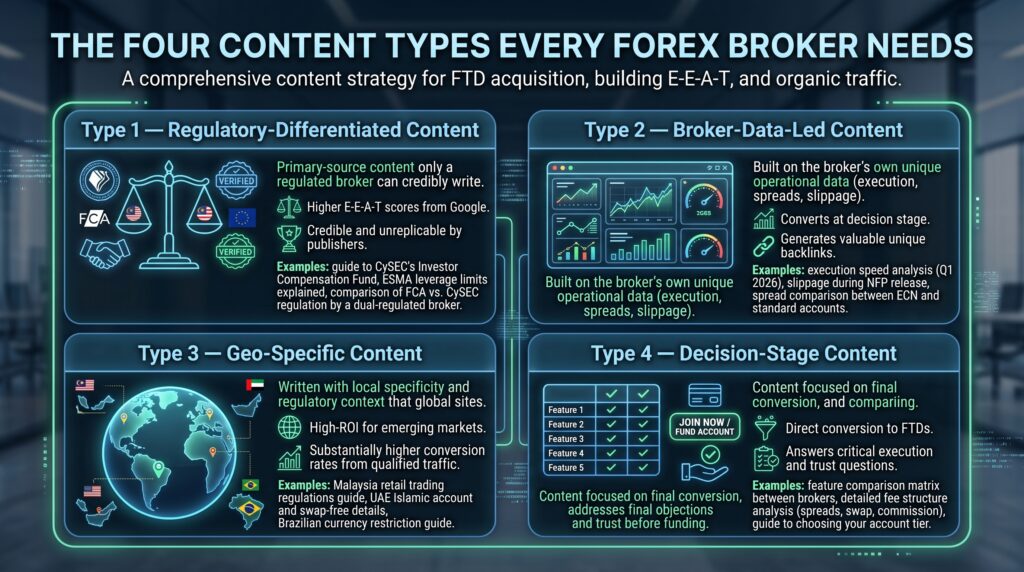
Type 1 — Regulatory-Differentiated Content
This is content that only a regulated broker can author credibly. A CySEC-regulated broker writing about EU investor protection under MiFID II is not competing with Investopedia — because Investopedia is not a regulated entity and cannot speak from the position of an authorised firm. The broker is the primary source. Google’s quality systems recognise this. Quality raters are instructed to give higher E-E-A-T scores to content where the author has direct, verifiable experience in the subject — and a regulated broker has exactly that on regulatory topics.
Examples: A guide to how CySEC’s Investor Compensation Fund works and what it covers. An explanation of ESMA leverage limits from the perspective of a broker operating under them. A comparison of what FCA regulation requires from a broker versus what CySEC requires — written by a broker regulated under both.
This content ranks for queries with low competition and high commercial intent — traders researching regulation before they open an account. It builds E-E-A-T signals that benefit the entire site. And it is structurally unreplicable by any affiliate or educational publisher.
Type 2 — Broker-Data-Led Content
This is content built on the broker’s own operational data — execution statistics, slippage analysis during volatile sessions, spread tightness during specific market events, fill rates across trading instruments. No affiliate site, no educational platform, and no competitor broker can publish data from your trading infrastructure. It is primary source content by definition.
Examples: Execution speed analysis across one million trades during Q1 2026. Slippage data during the US Non-Farm Payrolls release. Spread comparison between standard and ECN account types across the broker’s 50 most-traded instruments.
This content converts at the decision stage because it directly answers the question traders ask before committing funds: can I trust this broker’s execution? A data-led answer to that question is more persuasive than any marketing claim. It also generates backlinks from trading communities and financial media because it is original research — something republishable that no competitor produced first.
Type 3 — Geo-Specific Content
This is content written for a specific geographic market with the specificity that only a broker operating in that market can credibly provide. A broker licensed by the UAE’s SCA writing about forex trading regulations for UAE residents is more credible than a global educational site writing the same article — because the broker has the licence, the local client base, and the operational experience. As covered in the geo-targeting framework, geo-specific content is one of the highest-ROI content investments for brokers targeting emerging markets.
Examples: A guide to forex trading regulations in Malaysia for retail traders. A UAE-specific article on Islamic trading accounts and swap-free conditions under local regulatory requirements. A Brazil-specific breakdown of how currency restrictions affect forex trading for Brazilian residents.
These articles compete in markets where affiliate comparison sites have weak local presence and where the broker’s regulatory and operational context is a genuine credibility signal. Traffic volumes are lower than generic educational queries — but conversion rates are substantially higher because the audience is geographically qualified.
Type 4 — Decision-Stage Content
This is content for traders who have already decided to open a forex trading account and are now choosing which broker. They are not searching for education. They are searching for proof, validation, and comparison. The queries are specific: “is [broker name] regulated,” “how does [broker name] handle client funds,” “what spreads does [broker name] offer on EUR/USD.”
Examples: A detailed breakdown of how client funds are segregated and protected. A transparent explanation of the broker’s fee structure with no hidden costs. A direct comparison of the broker’s execution model against the industry standard — supported by real data from Type 2 content.
Decision-stage content generates less traffic than educational content. It converts at rates educational content cannot approach — because the reader is already in the decision window. Most broker content programmes have almost none of it, because it requires writing about the broker itself rather than about forex in general. That is both its production challenge and its competitive advantage.
How to Distribute Your Content Budget Across the Four Types
There is no universal ratio that works for every broker. The right distribution depends on your domain authority, your geographic targets, the maturity of your content programme, and how much existing decision-stage content you have. The framework below is a starting point for a broker with a mid-range domain (DR 35–55) and a content team producing eight to twelve articles per month.
| Content Type | Recommended Share | Primary Purpose | Funnel Stage |
|---|---|---|---|
| Educational | 30% | Topical authority, backlink acquisition, brand awareness | Awareness |
| Regulatory-Differentiated | 25% | E-E-A-T signals, YMYL eligibility, trust building | Consideration |
| Decision-Stage | 25% | Direct FTD contribution, conversion at purchase intent | Decision |
| Geo-Specific | 20% | Market-specific acquisition, low-competition ranking | Consideration + Decision |
At this distribution, educational content still represents nearly a third of output — enough to build topical authority and generate the traffic volume needed for domain growth. But it is no longer the default category that absorbs budget when the content plan is underdefined.
The shift that matters most is from zero decision-stage content to 25%. Most broker content programmes that have been running for two or more years have substantial educational archives and almost no decision-stage content. Adding decision-stage content does not require reducing educational output — it requires redirecting the marginal article from “another educational topic” to “one more reason to choose this broker over a competitor.”
How to Build Your Content Calendar
Cluster architecture for regulated brokers
A content cluster groups a pillar article with supporting articles around a central topic. For a regulated broker, the cluster architecture maps directly onto the four content types — with the pillar article targeting the highest-volume commercial query and the supporting articles building topical depth across all four types.
Example cluster for a CySEC-regulated broker targeting the UK and EU markets:
- Pillar: Forex trading under CySEC regulation — what traders need to know
- Support (Regulatory): How the Investor Compensation Fund protects CySEC-regulated accounts
- Support (Data-Led): Execution speed and slippage data: Q1 2026 performance report
- Support (Decision): How to verify a forex broker’s CySEC licence before depositing
- Support (Geo): CySEC-regulated forex brokers for UK residents: what changed after Brexit
Each article links to the pillar and to at least two other cluster articles. The pillar links to all supporting articles. Internal linking flows topical authority through the cluster and signals to Google that the broker has genuine depth on the regulatory topic — not just a single article written to target one keyword. For a deeper treatment of how internal linking architecture works across a full broker site, see internal linking for forex broker sites.
Publishing cadence and internal linking
Three articles per week is the minimum cadence for building a crawl rhythm that Google responds to consistently. Below this frequency, the gap between crawls is too long to build momentum in the early months of a content programme. Above five articles per week without a proportional increase in content quality, the signal-to-noise ratio drops and thin content risk increases.
At three articles per week, a broker publishing across the four content types produces approximately 48 articles per quarter — enough to complete two full content clusters and begin a third. Each article should contain a minimum of three internal links: one to the cluster pillar, one to a related article in the same cluster, and one to an article in a different cluster that shares a relevant topic. This structure builds cross-cluster authority and reduces the risk of topical isolation — where a cluster ranks internally but fails to transfer authority to the commercial pages that actually matter.
How to Measure Content Performance for FTDs Not Just Traffic
Most broker content programmes are measured on sessions, rankings, and organic traffic growth. These are valid leading indicators but they do not tell you whether content is contributing to FTD acquisition. To measure content performance for FTDs, three additional data points are required.
Assisted conversion tracking. In Google Analytics 4, multi-touch attribution shows which pages a converting user visited before completing the conversion event. If your primary conversion event is a funded account — not a registration — you can identify which content types appear in the conversion path. This is the most direct measure of content-to-FTD contribution available without CRM integration.
Decision-stage page performance. Track rankings and click-through rates specifically for decision-stage content. A page ranking in position 8 for “[broker name] regulation” that receives 200 clicks per month from users searching the broker’s name is contributing more to FTD acquisition than a page ranking in position 3 for “what is leverage” with 2,000 clicks from traders in the awareness stage.
Content category traffic distribution. In GSC, segment organic traffic by content type using URL structure or manual tagging. What percentage of total organic sessions come from each of the four content types? The benchmark for a programme contributing meaningfully to FTDs: decision-stage and regulatory-differentiated content combined should account for at least 30% of organic sessions. Most broker programmes start below 10%.
For a detailed breakdown of what organic signals look like at each stage of a content programme’s maturity, see how long forex broker SEO actually takes to show results.
The Four-Step Content Audit
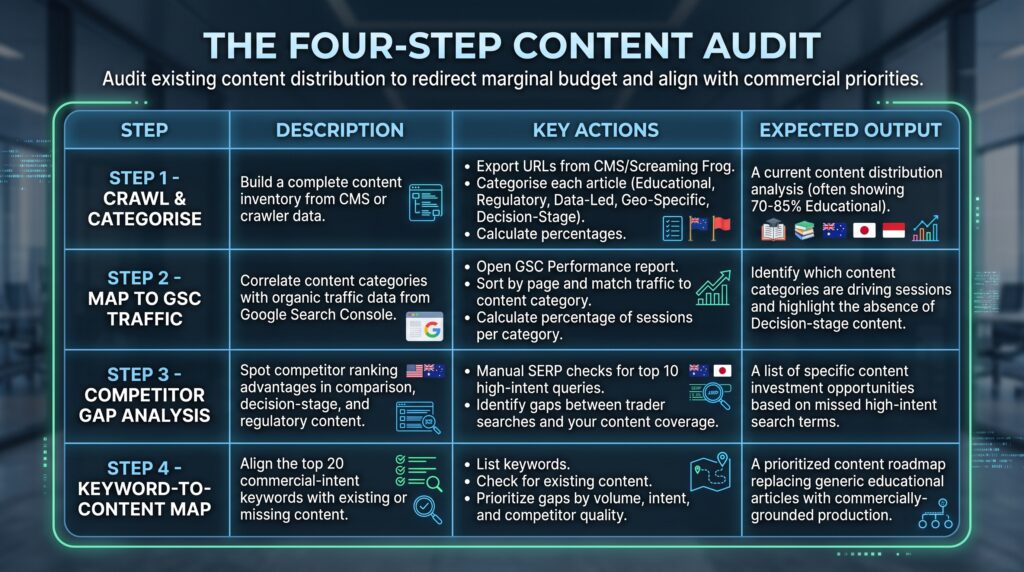
Before building a new content calendar, audit what already exists. Most brokers who do this find their content distribution looks nothing like their stated commercial priorities — and the audit tells them exactly where to redirect the marginal budget.
Step 1 — Crawl and categorise
Export all published URLs from your CMS or use a crawler like Screaming Frog to pull the full content inventory. Categorise every article into one of the four content types: Educational, Regulatory-Differentiated, Broker-Data-Led, Geo-Specific, or Decision-Stage. Calculate the percentage of total published content in each category. This is your current content distribution — and for most brokers it shows 70 to 85% of published content is Educational with minimal coverage of the other three types.
Step 2 — Map to GSC traffic
In Google Search Console, open the Performance report and sort by page. Match your highest-traffic pages to their content category from Step 1. What percentage of total organic sessions comes from each category? This confirms where your content investment is currently producing traffic — and usually reveals that Educational content is generating most sessions while Decision-stage content, which has the highest conversion potential, is absent entirely.
Step 3 — Competitor gap analysis
What comparison, decision-stage, and regulatory content do your main competitors rank for that your site has zero coverage for? A manual SERP check for the top 10 high-intent queries in your primary target market shows the gap between where traders are searching at the decision stage and where your content exists. This is the content investment opportunity. For the geo-specific dimension of this gap analysis, the geo-targeting framework provides the market-by-market prioritisation.
Step 4 — Keyword-to-content map
List the top 20 commercial-intent keywords for your target market. For each keyword, does your site have content targeting it? For every gap in the decision-stage and comparison categories — that is a missing content investment. Prioritise the gaps by search volume multiplied by commercial intent and competitor content quality. The output is a prioritised content roadmap that replaces “publish more educational articles” with a specific, commercially-grounded production plan.
Most brokers who complete this audit find their content distribution looks nothing like their stated commercial priorities. The fix is not producing more content — it is redirecting existing budget toward the categories where commercial contribution is measurable.
Why Differentiated Content Gets AI Citations — and Educational Content Rarely Does
As AI search grows as a distribution channel, the content strategy question becomes not just “what ranks organically?” but “what gets cited by AI engines?” The answer reinforces the case for the four-type framework.
When a trader searches “what is a pip” in ChatGPT or Perplexity, the AI cites Investopedia, BabyPips, or a major financial publisher — rarely a broker site. The broker’s version of this article, however well-optimised, does not get cited because the AI has better, older, more authoritative sources for generic educational content. This is the AI equivalent of the organic authority gap.
What does get cited from broker sites: regulatory-differentiated content — a CySEC broker writing about EU investor protection is cited because no better-credentialled source exists for that specific regulatory context. Broker-data-led content — execution statistics are cited because the broker is the primary source and the data exists nowhere else. Decision-stage content — broker-specific information is cited because only the broker is the authoritative source on itself.
The four differentiated content types produce better organic rankings, higher conversion rates, and stronger AI citation frequency simultaneously. As AI search continues to grow as a share of total search traffic, the gap between a mixed four-type content strategy and a purely educational one will widen. For a full treatment of how to optimise for AI citation alongside organic rankings, see the YMYL and E-E-A-T framework for forex brokers.
If you want to know which of these content types your broker site is missing — and what that gap is costing in organic FTDs — that assessment is part of a content audit.
Frequently Asked Questions
Q1: What content should a forex broker publish to differentiate from competitors?
Four content types differentiate a regulated forex broker from competitors and from educational sites: regulatory-differentiated content (articles only a regulated broker can author credibly, such as CySEC investor protection guides); broker-data-led content (execution statistics, slippage analysis, spread data from the broker’s own trading infrastructure); geo-specific content (market-specific articles for UAE, Malaysia, or Brazil that a global educational site cannot produce with local credibility); and decision-stage content (proof and validation articles for traders ready to open an account). These four types avoid the generic educational content trap that most brokers fall into.
Q2: Why do most forex brokers publish the same educational content?
Because the dominant content strategy advice in the forex industry is “create educational content” — and every broker follows it. The result is that every broker publishes the same articles: What is Forex Trading, How to Read Charts, What is MetaTrader, What is a Pip, and so on. These articles compete directly against Investopedia, BabyPips, and major financial publishers that have been producing the same content since 2005 with domain ratings of 80 to 90 plus and hundreds of thousands of backlinks. A broker publishing these topics in 2026 cannot win against that authority foundation regardless of content quality.
Q3: What is broker-data-led content and why does it convert better than educational content?
Broker-data-led content uses the broker’s own operational data as the content foundation: execution speed across millions of trades, slippage analysis during volatile market events, spread tightness during specific trading sessions. This content type converts better because it directly answers the question traders ask at the decision stage — can I trust this broker’s execution and platform? No affiliate comparison site, no educational platform, and no competitor broker can publish data from your trading infrastructure. It is primary source content that only the broker can produce, making it unreplicable and structurally protected from competition.
Q4: How does a forex broker audit its content strategy?
A forex broker content audit has four steps: crawl and categorise all published content by intent stage (educational, comparative, regulatory, decision-stage) and calculate the distribution; map organic traffic per category in Google Search Console to see what percentage of sessions come from each content type; run a competitor gap analysis to find which high-intent keywords competitors rank for that your site has no content for; and map your target market’s top commercial intent keywords against your published content to identify the gaps. Most brokers find 70 to 80 percent of their content is in the educational category with minimal commercial intent coverage.
Q5: What is the difference between awareness-stage and decision-stage content for forex brokers?
Awareness-stage content targets traders at the beginning of their interest in forex — articles like What is Forex Trading or What is Leverage attract people typically 12 to 36 months from opening a live account. Decision-stage content targets traders ready to deposit — articles addressing broker regulation, execution proof, fund safety, and direct broker comparisons attract people 1 to 4 weeks from opening an account. Most broker content programmes are heavily weighted toward awareness-stage content, which generates traffic but rarely contributes directly to first-time deposits. Decision-stage content generates less traffic but far higher conversion rates per session.
Q6: Why doesn’t educational forex content help a broker’s SEO even when it is well-written?
Educational forex content like What is a Pip or Best Trading Strategies faces competition from sites with 15 or more years of topical authority: Investopedia (domain rating 93), BabyPips (domain rating 70 plus), and major financial publishers with thousands of backlinks per article. A broker publishing these topics in 2026 is competing against an authority structure that has been compounding since 2005. Quality of writing or SEO optimisation cannot overcome this authority gap. The only way to win with educational content is to add something these sites cannot add: proprietary broker data, regulatory-specific first-person context, or geo-specific local market knowledge.