
Last reviewed: June 2026 · Author: Hristo Hristov
This is not a licensing guide.
If you searched for “best countries to target for forex broker SEO” and found an article about CySEC vs. FCA registration costs and capital requirements — that is the article ranking above this one. It answers a different question. This article answers the one that costs broker CMOs real budget every year: where should your organic content investment go?
The gap matters. Licensing jurisdiction and SEO target market are different decisions, and assuming they are the same is the most consistent geo-strategy error I encounter when auditing broker organic programmes. A CySEC-regulated broker can build significant organic presence in the UAE, Malaysia, and Brazil simultaneously. A broker licensed anywhere can have no viable year-one SEO path to the UK market — not because of their licence, but because the affiliate competition requires DR 55+ to appear on page one for commercial terms.
If you have €3,000–5,000 per month allocated for forex SEO content in 2026, this guide answers where that budget produces the highest return. It breaks every major forex market into three tiers — by organic ROI potential, affiliate competition density, and the regulatory reality of targeting each — and builds toward a sequenced geo-strategy that most brokers overlook until they are already 18 months into a programme that should have started somewhere else. If you have already read the forex SEO timeline breakdown, you will recognise that market selection directly changes your ranking window. Here is the full geo picture.
Table of Contents
Why Geo Selection Is the Most Underrated Decision in Forex SEO
Most brokers make dozens of SEO decisions before they ever think about geography. They optimise the homepage, build platform pages, begin publishing trading guides. What they rarely do in year one is ask: “Are we targeting the right countries?”
The reason this question is underrated is that search volume alone gives you a wish list, not a plan. UK, Germany, and Australia show the highest forex search volumes in most keyword tools. If you stop there, you allocate your year-one budget to the three hardest markets in the world to rank in as a new domain. Three variables together determine whether a geographic market is the right investment for your broker right now:
Search volume — how many people in this market are searching for forex trading keywords monthly. The starting point, not the endpoint.
Affiliate competition density — the domain rating floor you need to appear on page one for commercial intent keywords in this market. This varies dramatically by geography. UK page one for “best forex broker” requires DR 60+. Malaysia page one for the equivalent requires DR 25–30. This one variable changes the entire geo-strategy.
Regulatory viability — whether your specific licence allows you to publish commercial SEO content targeting traders in that jurisdiction without compliance exposure. This is the variable most geo-strategies never model. There is a full framework for it in the licensed-vs-targetable section below.
When all three are mapped together, the answer to “which countries should I target” almost never starts with Tier 1 markets for a new or sub-DR-30 domain.
Tier 1 — High Volume, High Barrier: UK, Germany, Australia
TIER 1 — YEAR 3 TARGET
Tier 1 markets have the highest forex search volume globally. They also have the most entrenched affiliate competition — comparison sites with DR 60–90, ten to fifteen years of content investment, and editorial calendars built specifically to capture every commercial forex intent query. These are year-three targets for most international broker domains. They are built toward through the Tier 2 domain authority programme covered in the next section.
| Market | Est. Monthly Volume* | DR Floor | Timeline from DR 0 | Year-One Approach |
|---|---|---|---|---|
| United Kingdom | KD 28 · #3 organic (forexbrokers.com DR 62): 352/mo · AI Overview at #1 (Ahrefs, Jun 2026) | 55–65 | 18–24 months | Brand + educational only. No commercial head terms. |
| Germany | KD 3 · #1 organic (trading.de DR 48): 382/mo · #4: GBE Brokers (DR 53): 3.0K/mo (Ahrefs, Jun 2026) | 45–55 | 14–20 months | German-language required. Defer without native production. |
| Australia | KD 3 · #2 organic (forexbrokers.com DR 62): 1.9K/mo · #4: Pepperstone (ASIC broker, DR 72): 5.7K/mo (Ahrefs, Jun 2026) | 50–60 | 18–24 months | ASIC-licensed: commercial OK. Offshore: educational only. |
*Estimates for primary commercial head term per market. Verify against current keyword tool data before publishing.
United Kingdom — Highest Volume, Highest Barrier
The UK is the most-searched English-language forex market globally and the most difficult for a new domain to penetrate. Positions 1–7 for “best forex broker UK” and its variants are controlled by Moneysupermarket, Forbes Advisor, Investopedia, FX Empire, and BrokerChooser — all at DR 65–90, all with content programmes that have been running for a decade or more.
FCA-regulated brokers have a structural E-E-A-T advantage in UK SERPs: the FCA regulation badge and named compliance officer function as trust signals that Google quality raters weight heavily under YMYL guidelines. CySEC-regulated brokers can produce UK-accessible educational content without significant compliance barriers. Direct commercial conversion content targeting UK residents requires careful FCA compliance review — the liability sits in the content, not the domain.
Year-one recommendation for any sub-DR-35 domain: brand queries, platform-specific education, and long-tail informational terms only. Do not allocate primary year-one budget to UK commercial keywords regardless of how well-written the content is. The domain authority floor is the constraint, not the content quality.
Germany — High Volume, Language Barrier
Germany is the largest Continental European forex market and uniquely demands genuine German-language content. BaFin-regulated brokers have the strongest trust signals in this market. CySEC EU passporting makes German service provision legally clear, but German-speaking traders have higher localisation standards than English-speaking markets — translated English underperforms significantly against native German editorial content.
The DR floor here (45–55) is lower than the UK, which means a broker with a dedicated German content production resource can enter faster. Without it, Germany is a phase-two investment. Do not enter this market with machine-translated or template content — it ranks poorly and damages the domain’s credibility in a market where precision and professionalism are part of the trust signal.
Australia — ASIC Restrictions Changed the Opportunity
Australia was a higher-opportunity market before ASIC’s 2021 product intervention orders restricted what offshore brokers can actively market to Australian retail clients. The current position: ASIC-licensed brokers retain full commercial organic access and have a competitive DR floor of 50–60 to work against. Offshore brokers (Seychelles, Vanuatu, Belize) face a specific constraint — educational content is publishable; active commercial solicitation content targeting Australian residents carries compliance risk that should be reviewed by regulatory counsel before deployment.
This makes Australia unique among Tier 1 markets — the barrier is partly regulatory, not purely competitive. Offshore brokers should treat it as an educational content market until ASIC licensing is obtained or a formal compliance position is confirmed.
Tier 2 — Where Brokers Build in Year One: MENA, SEA, LatAm
TIER 2 — YEAR 1–2 PRIMARY TARGET
Tier 2 markets are where broker organic programmes produce real results in year one. These markets combine substantial commercial forex search volume with affiliate competition that is beatable at DR 25–40, and in most cases offer clear regulatory viability for internationally-licensed brokers. The commercial case for Tier 2 first is not about settling — it is about generating proof-of-concept organic FTDs in year one, which is the evidence every board needs before committing to a 24-month Tier 1 investment.
| Market | Volume* | DR Floor | Timeline | Language | Licence Fit |
|---|---|---|---|---|---|
| UAE | KD 1 · #1 IG.com (DR 81): 1.9K/mo · #3 SmartFX broker (DR 23): 1.1K/mo (Ahrefs, Jun 2026) | 20–30 | 8–14 mo | English. Arabic for advantage. | CySEC/FCA strong |
| Saudi Arabia | KD 38 · #1 forexbrokers.com (DR 62): 214/mo · No AI Overview · Arabic KWs: no Ahrefs data — English dominates (Ahrefs, Jun 2026) | 25–35 | 10–16 mo | English. Arabic preferred. | Verify w/ counsel |
| Malaysia | KD 53 · #3 forexbrokers.com (DR 62): 1.9K/mo · AI Overview #1 (Ahrefs, Jun 2026) | 40–55 | 8–14 mo | English + Malay | Accessible |
| Thailand | KD 35 · #1 forexbrokers.com (DR 62): 440/mo · No AI Overview (Ahrefs, Jun 2026) | 30–40 | 8–14 mo | Thai differentiates. | Educational-first |
| Singapore | KD 10 · #2 moneysmart.sg (DR 67): 2.6K/mo · AI Overview #1 (Ahrefs, Jun 2026) | 40–50 | 12–18 mo | English | MAS — brand focus |
| Brazil | KD 1 · #3 br.advfn.com (DR 74): 925/mo · #4 TradingView BR (DR 91): 1.3K/mo (Ahrefs, Jun 2026) | 20–30 | 8–14 mo | PT-BR required | Commercial OK |
| Mexico | KD data unavailable — Spanish local KWs show no Ahrefs data. Use GKP for directional volume. | 15-25 | 8–14 mo | Spanish required | Commercial OK |
*All search volume figures require verification against current Ahrefs/SEMrush data. DR floors are for commercial mid-tail terms, not head terms.
UAE and Saudi Arabia — The MENA Opportunity
MENA is the highest-value Tier 2 region for most international forex brokers. The UAE has a large, financially-literate population across both the expat community and the domestic market. Saudi Arabia is growing rapidly in retail forex interest. Affiliate competition in both markets is real but beatable — the DR floor for commercial mid-tail terms in English sits at 25–35, and the affiliate sites competing in this market operate with significantly lower content depth than their UK counterparts.
CySEC-regulated brokers have a structural credibility advantage in MENA that is worth deploying explicitly. An EU regulatory badge carries more weight in the regional trust hierarchy than an offshore jurisdiction licence. In practice, CySEC-regulated brokers produce better engagement signals from MENA organic traffic than Seychelles or Vanuatu-licensed brokers targeting the same content — the regulatory badge does visible trust work in this market.
English is fully viable for the UAE’s expat population and the financially-literate segment of Saudi Arabia. Arabic-language content — even at a basic level — produces disproportionate organic advantages because affiliate competition in Arabic is materially lower than in English. The practical approach: launch with English, add Arabic as a phase-two content layer once the English programme is producing results. Arabic RTL technical implementation (charset, direction tags, Arabic-specific sitemaps) should be addressed before Arabic content goes live.
First-Person Observation — UAE SERP, June 2026
When I pulled the UAE SERP for “best forex broker UAE” in June 2026, a broker at DR 23 — well below the typical affiliate competition floor — held position 3 with over 1,000 monthly organic visits. The top position belonged to IG, an FCA-regulated broker. Both outperformed every affiliate comparison site in the SERP.
The regulatory signal is doing real ranking work in MENA. A DR 23 broker with the right licence is more competitive here than a DR 45 affiliate without one. That is the Tier 2 argument in a single live data point — not a theory.
Malaysia, Thailand, and Singapore — Southeast Asia
SEA is the fastest-growing retail forex market globally and the most fragmented for affiliate competition. Each market operates with a different language, regulatory framework, and organic competitive landscape — a nuanced per-market approach significantly outperforms a generic “Southeast Asia strategy.”
Malaysia is English and Malay bilingual, with strong retail forex interest and affiliate competition that is lighter than any Western market. English-language commercial mid-tail terms are achievable at DR 25–35 within 8–14 months with consistent content production. Securities Commission Malaysia regulates domestic brokers, but international brokers with established licences are widely accessible to Malaysian traders and the SEO landscape reflects this. Malaysia is the recommended first SEA entry point for brokers without existing regional language infrastructure.
Thailand has a growing retail forex audience and very low English-language affiliate competition. Thai-language content is a genuine first-mover opportunity — most affiliate sites targeting Thailand have thin Thai coverage. The regulatory status for foreign brokers publishing commercial content targeting Thai residents is complex. Educational-first is the correct initial approach: platform tutorials, trading education, and market analysis are publishable without the commercial solicitation question arising.
Singapore is a high-quality but more restricted market. MAS (Monetary Authority of Singapore) applies strict requirements to financial marketing targeting Singaporean residents. English-language competition is higher (DR floor 40–50). Brand and educational content are viable; commercial conversion content targeting Singaporean residents requires MAS compliance review. Treat Singapore as a brand-awareness long-term play rather than a year-one FTD acquisition target.
Brazil and Mexico — Latin America
LatAm is an underserved region in most international broker SEO strategies and rewards early movers disproportionately. Brazil is the largest LatAm forex market with rapidly growing retail interest and thin affiliate coverage in Brazilian Portuguese — this is a genuine content gap that most international brokers have not yet moved to fill. The constraint is absolute: Brazilian Portuguese is non-negotiable. Spanish content does not serve Brazilian traders and will not rank in Brazilian SERPs. Brokers without Brazilian Portuguese production infrastructure should budget for it before treating Brazil as a primary target.
Mexico is a Spanish-language market with lighter competition than Spain or Argentina. CNBV regulates domestic brokers but internationally-licensed brokers are widely accessible to Mexican retail traders. A natural addition for any broker already producing Spanish content for another LatAm market — the incremental cost of Mexico-specific content on a Spanish-language base is low.
Tier 3 — Massive Volume, Navigate Carefully: India, Indonesia, Nigeria
TIER 3 — HIGH VOLUME, REGULATORY COMPLEXITY
Three of the highest-search-volume forex markets in the world sit in Tier 3. They are not in Tier 1 or Tier 2 because of regulatory complexity — not lack of demand. A broker who navigates Tier 3 correctly can access millions of organic searches per month at very low affiliate competition levels. A broker who enters with standard commercial conversion SEO content risks compliance exposure that far outweighs the organic traffic gained.
Regulatory Disclaimer
The approaches described in this section are based on observed broker practice in these markets — this is strategic guidance, not legal advice. Before publishing commercial forex content targeting markets where your broker licence does not explicitly cover the jurisdiction, consult regulatory counsel. The content types described here exist in these markets; they are not a recommendation to deploy without independent compliance review.
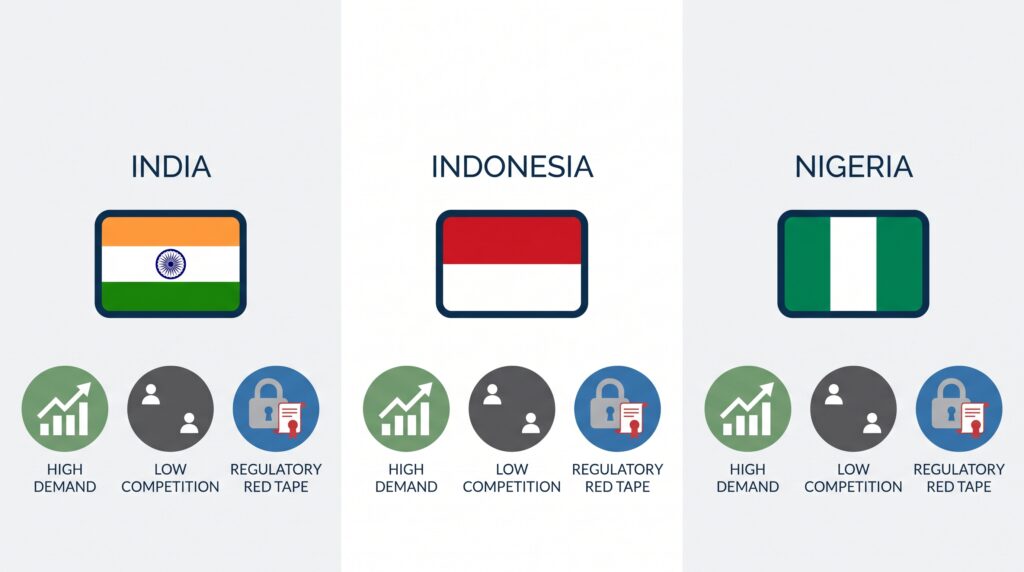
India — The Largest Grey-Market Opportunity
India has the largest retail forex search volume of any single country outside the major Western markets. Retail forex trading in non-INR currency pairs is restricted for Indian residents under FEMA (Foreign Exchange Management Act), and the RBI has applied this restriction consistently. Despite this, substantial broker SEO activity targeting Indian search traffic exists and produces meaningful brand reach.
The approach that works: educational and informational content that stops short of direct commercial solicitation. Platform tutorials (how to use MT5, how to set a stop-loss, how to read a candlestick chart), trading strategy guides, and market analysis rank well in Indian SERPs and build genuine brand recognition with Indian retail traders without constituting a direct invitation to open an account or deposit funds.
The line between educational content and commercial conversion content is the India SEO compliance question. In practice: content that teaches trading without directing the reader toward a specific account-opening action is the viable approach. Content that explicitly targets “forex broker India” head terms, references INR deposit methods for Indian traders, or directly invites Indian residents to open accounts crosses into the exposure zone and should not be deployed without legal review of the specific content.
DR floor for educational content ranking in India (English): 15–25. Timeline: 8–12 months for well-structured educational content. Organic traffic from India at this level builds brand awareness but does not convert at the same FTD rate as MENA or Tier 2 SEA traffic — this is a brand-building play, not a primary acquisition channel in year one.
Indonesia and Vietnam — Language-First Opportunities
Indonesia is the largest Southeast Asian forex market by retail participation volume. BAPPEBTI (the commodities and futures trading regulatory body) governs domestic forex activity, and foreign broker marketing to Indonesian residents requires compliance review. The SEO opportunity sits in Indonesian-language (Bahasa Indonesia) content — affiliate coverage in Bahasa Indonesia is thin compared to English, which means an international broker willing to invest in quality Bahasa Indonesia content is entering a near-uncontested landscape. DR floor: 15–25. English-language competition is very low.
Vietnam has rapidly growing retail forex interest with essentially zero affiliate competition in Vietnamese. Vietnamese-language content from a regulated international broker is an underexplored first-mover opportunity. The affiliate networks that dominate English-language forex SERPs have minimal Vietnamese-language presence. DR floor: 15–25. The regulatory status for international brokers is relatively open for educational content, with commercial content decisions requiring the standard compliance review.
Nigeria and Sub-Saharan Africa
Nigeria has the largest English-speaking retail forex audience in Africa and affiliate competition that is beatable at DR 15–25. CBN has applied restrictions to certain foreign currency transactions, but English-language educational forex content from internationally-licensed brokers ranks well and reaches a genuinely interested audience. Educational and comparative content is the accessible approach; local payment method references (Flutterwave, bank transfer for Nigerian traders) are strong localisation signals but should pass a compliance review given CBN’s evolving position on forex-related financial transactions.
South Africa deserves a separate note: with FSCA licensing and a mature regulatory framework, South Africa sits closer to Tier 2 than Tier 3 and allows full commercial SEO content for FSCA-regulated brokers. If you hold FSCA registration or are considering it, treat South Africa as a Tier 2 market with Tier 2 competition density expectations.
The Licensed-vs-Targetable Framework
Where you are licensed to operate as a forex broker and where you can build meaningful organic traffic are often different countries. Assuming they are the same is the most consistent geo-strategy error I encounter in broker SEO audits.
Most geo-strategy conversations start and end with the licensing question: “We are CySEC-regulated, so we target EU markets.” The problem with this framing is that it ignores the large body of organic opportunity available outside your licensing jurisdiction — opportunity that is often easier to access and produces faster results than the markets your licence most directly covers.
Here is how the framework works in practice:
CySEC (EU-regulated) targeting MENA: Viable and commercially advantageous. CySEC is an EU regulator — in MENA markets, this functions as a credibility signal above and beyond what offshore-licensed brokers can claim. Commercial-oriented forex content targeting UAE and Saudi Arabian traders is publishable without significant compliance barriers for a CySEC-regulated broker. This is the cleanest example of a broker expanding organically well outside their licensing jurisdiction while the licence actively helps, not hinders.
CySEC (EU-regulated) targeting UK: Viable for educational and informational content. The barrier in the UK is affiliate competition density (DR 55–65 floor) — not regulatory restriction. FCA complexity post-Brexit means commercial conversion content targeting UK residents requires careful compliance framing, but educational content is publishable. Licence: not the problem. Domain authority: the constraint.
Offshore (Seychelles/Vanuatu) targeting India: Commercial conversion content is not viable under FEMA. Educational content — platform tutorials, trading education, market analysis — is the approach that works and does not constitute direct commercial solicitation. The offshore licence does not restrict this content from being published; FEMA restricts what Indian residents can do in response to it. Structure the content accordingly.
Offshore broker targeting Australia: ASIC’s product intervention orders apply to the marketing of CFD and forex products to Australian retail clients from offshore entities. Educational content is publishable. Active commercial solicitation content targeting Australian residents carries compliance risk. This is the clearest practical example of the licensed-vs-targetable line: the content is not wrong because of the broker’s offshore licence — it is wrong because of what ASIC has specifically restricted for Australian retail clients.
| Licence Type | Target Market | SEO Approach | Notes |
|---|---|---|---|
| CySEC (EU) | UAE / Saudi Arabia | Full commercial | EU regulator credibility is an active trust signal in MENA |
| CySEC (EU) | United Kingdom | Educational + mid-tail | FCA complexity — commercial content needs review |
| CySEC (EU) | Malaysia / Thailand | Commercial viable | Generally accessible — confirm per-market with counsel |
| CySEC (EU) | Germany | Commercial viable | Passporting covers EU — German-language required |
| Offshore (SC/VU/BZ) | India | Educational only | FEMA restricts commercial retail forex for residents |
| Offshore (SC/VU/BZ) | Australia | Educational only | ASIC product intervention order applies to offshore |
| Any international | Indonesia | Educational + review | BAPPEBTI framework — consult counsel before commercial |
| ASIC (Australia) | Australia | Full commercial | Local regulator — no restriction |
| FSCA (South Africa) | South Africa | Full commercial | Local regulator — functions as Tier 2 for FSCA brokers |
Every geo-strategy should start with a licensed-vs-targetable map like this one, built for your specific licence and target markets. The map determines your content strategy per market — not just which keywords to target, but what type of content is publishable and what requires professional compliance review before it goes live.
The Market Entry Sequence — Don’t Start Where You Want to End Up
The brokers who build the strongest long-term organic programmes share a counterintuitive characteristic: they did not start with the markets they wanted to eventually dominate.
UK, Germany, and Australia are the right Tier 1 targets at the 24–36 month mark for a broker domain with DR 35–50. They are the wrong year-one targets for a domain at DR 0–15. Entering Tier 1 markets from a new domain in year one produces expensive content that ranks on page 5–7 for two years, generates no meaningful organic FTDs, and burns budget that could have been compounding in Tier 2. I have seen this pattern in multiple broker SEO audits — a programme that has been running for 18 months, has spent significant budget, and has almost no measurable organic contribution because the geo-strategy started at the top of the difficulty range instead of the middle.
The sequencing that works:
Year 1 — Tier 2 primary, Tier 3 supplementary. Allocate 70–80% of content budget to 1–2 Tier 2 markets where the domain can rank for commercial mid-tail terms within 8–14 months. For most international brokers without existing language-specific infrastructure, UAE and Malaysia are the recommended starting points — English-first, beatable competition, clear regulatory viability for CySEC or FCA-licensed brokers. Generate real organic FTDs. Build domain authority toward DR 30–40. Use Tier 3 supplementarily for brand-building educational content in high-volume markets like India — low content investment, long-term brand awareness, zero primary budget allocation.
Year 2 — Tier 1 entry, Tier 2 expansion. Begin Tier 1 content infrastructure in UK and/or Germany — platform education, brand content, long-tail informational queries — while expanding to a second Tier 2 market (Brazil or Thailand are natural additions at this stage). The domain authority accumulated in year one puts you in a realistic position for Tier 1 long-tail terms and the beginning of head term authority-building. Tier 2 continues producing FTDs throughout.
Year 3 — Tier 1 commercial competition. With DR 40–50 accumulated through years 1–2, commercial head terms in Tier 1 markets become realistic targets. “Best forex broker UK” and its German equivalent are now within reach — not because the strategy changed, but because two years of Tier 2 authority-building created the foundation to compete there. The brokers who fail at Tier 1 commercial terms almost universally tried to start there instead of earning the right to compete there.
As covered in the forex broker SEO timeline framework, your ranking window in a Tier 2 market is 6–9 months shorter than in a Tier 1 market from the same domain authority starting point. Tier 2 first is not a compromise — it is the faster path to the first organic FTD, the board-level proof of concept that funds the Tier 1 investment, and the domain authority that makes Tier 1 viable when you arrive there.
The Geo-ROI Framework: Where Does Each Content Dollar Work Hardest?
The question a CMO owes their CFO is not “which countries should we target?” It is: “Which countries produce the lowest organic cost-per-FTD, and how does that compare to what we are paying in paid acquisition in the same markets?”
The directional framework below is based on observed broker organic programmes at comparable domain authority starting points. All figures are directional estimates — actual results vary by content quality, backlink acquisition velocity, conversion rate, and broker product-market fit in each geography. Label them as estimates when presenting internally.
| Market Tier | Est. Monthly Content Investment | Typical Paid Cost-per-FTD* | Organic ROI Window | Organic Advantage |
|---|---|---|---|---|
| Tier 1 UK / DE / AU |
€3,500–6,000 | €500–1,200+ | Month 24–30 at earliest | High ceiling — but 2+ years to reach it from DR 0 |
| Tier 2 MENA UAE / Saudi |
€1,500–3,000 | €370–830 | Month 10–14 | Highest paid CPA in Tier 2 — organic advantage largest here |
| Tier 2 SEA Malaysia / Thailand |
€1,200–2,500 | €138–368 | Month 10–14 | Strong — lower paid CPA than MENA but lower content cost too |
| Tier 2 LatAm Brazil / Mexico |
€1,200–2,500 + language | €110–322 | Month 12–18 | Good — language investment required upfront |
| Tier 3 India / ID / NG |
€800–1,500 | Paid acquisition largely restricted | Brand equity only | Not an FTD play — long-term brand awareness |
*Paid cost-per-FTD figures represent typical forex affiliate CPA payouts by geography — the closest publicly available proxy for broker direct acquisition costs. Source: HotForexLead.com, 2026. USD figures converted to EUR at 0.92. Organic ROI window is directional from DR 0 start with consistent content production and backlink acquisition.
The pattern this framework shows: Tier 2 organic cost-per-FTD at the 12-month mark is consistently lower than paid acquisition in the same market. This is because paid CPCs in MENA and SEA are high relative to the account opening rates brokers see from those channels, but organic competition in those markets is low enough for a DR 25–35 domain to capture meaningful commercial traffic. You are not accessing a lower-quality market — you are accessing a lower-competition channel in a valuable market.
Technical Multi-Geo Setup: Four Things Forex Broker Sites Get Wrong
A geo-strategy without technical implementation alignment underperforms. These four issues appear consistently in forex broker multi-geo site audits:
1. Hreflang on regulatory disclosure pages. Most broker sites have country-specific regulatory risk warnings with different wording per jurisdiction — “CFDs are complex instruments. 72% of retail investor accounts lose money when trading CFDs with this provider” varies by regulatory requirement. If hreflang is applied to these disclosure pages without canonical control, you create duplicate content signals that confuse geo-targeting across markets. Fix: apply hreflang only to content and commercial pages; use country-specific canonical tags or noindex on disclosure page variants to prevent cross-market indexing of jurisdiction-specific compliance text.
2. GSC country targeting for subdirectories. Google Search Console allows explicit country targeting for subdirectories — /ae/ for UAE, /my/ for Malaysia, /br/ for Brazil. This is a direct geo-signal worth setting before a Tier 2 programme launches. It accelerates Google’s classification of the content’s intended geographic market. A significant number of broker sites running multi-geo content on a single global domain skip this configuration entirely, which delays geo-ranking by weeks to months.
3. Locale-specific hreflang values. “en-GB,” “en-AU,” and “en-AE” are distinct hreflang tags for the same language in different markets. A broker targeting both the UK and UAE with English content should use locale-specific tags rather than a generic “en” tag. The generic tag creates ambiguity about which market each page serves — both geo-targeting signals become weaker when a single “en” tag covers multiple distinct target markets.
4. CDN coverage for APAC markets. Page speed in Malaysia, Thailand, and Indonesia is materially affected by server location. Hosting all content from a European datacenter without CDN edge nodes in APAC produces underperformance on Core Web Vitals for Southeast Asian users — a direct organic ranking signal. A CDN with APAC coverage (Cloudflare Business or Enterprise tier covers this adequately) is worth adding before launching any Tier 2 SEA content programme, not after. This is a pre-launch infrastructure check, not an optimisation to defer.
Where to Start
A full geo-specific audit — reviewing your current organic traffic by country against these tier frameworks, identifying which markets you are underinvesting in and which you are targeting ahead of your domain authority — is the starting point for any honest geo-strategy assessment. The forex broker SEO audit framework covers what this diagnostic looks like in practice.
If you want to know which of these markets your domain authority can realistically compete in today, and in what sequence the investment makes sense for your organic timeline, that assessment starts with an audit.
FAQ
Q1: Which country is best for forex broker SEO in 2026?
No single country is best — the right answer depends on your domain authority today and your realistic ranking timeline. For a new broker domain (DR 0–20), Tier 2 markets — UAE, Malaysia, Brazil — offer the best organic ROI: beatable affiliate competition at DR 25–35, meaningful commercial search volume, and organic FTDs achievable within 12 months. Tier 1 markets like the UK, Germany, and Australia require 18–24 months minimum from a new domain and are year-three targets for most international brokers.
Q2: Can a CySEC-regulated broker target UAE or MENA in organic SEO?
Yes — and the CySEC licence is an active advantage in this market. As an EU regulator, CySEC carries more credibility in the MENA trust hierarchy than offshore jurisdiction licences from Seychelles or Vanuatu. CySEC-regulated brokers can publish commercially-oriented forex SEO content targeting UAE and Saudi Arabian traders without significant compliance barriers. MENA is one of the clearest examples of a broker targeting organically well outside their licensing jurisdiction while the licence actively strengthens the position.
Q3: What is the affiliate competition situation in Tier 2 vs. Tier 1 forex markets?
In Tier 1 markets — UK, Germany, Australia — commercial intent head terms are owned by affiliate comparison sites with DR 60–90 and 8–15 years of content investment. A new broker domain cannot compete there in year one regardless of content quality. In Tier 2 markets — MENA, SEA, LatAm — the equivalent affiliate sites have DR 25–45 and thinner content libraries. A broker domain at DR 25–35 can rank for commercial mid-tail terms within 8–14 months with consistent content production.
Q4: How should a forex broker approach SEO in grey-market countries like India or Indonesia?
Educational content first, commercial content only after regulatory counsel review. India’s FEMA regulations restrict retail forex for Indian residents, but educational content — platform tutorials, trading strategies, market analysis — ranks well and builds brand awareness without constituting direct solicitation. Indonesia and Vietnam follow similar logic: educational authority content in the local language is the accessible approach, with commercial content decisions requiring a confirmed compliance position before deployment. These are brand-building plays, not primary FTD acquisition channels in year one.
Q5: How does country selection affect my forex broker SEO timeline?
Country selection is one of the most significant timeline variables in forex broker SEO. A Tier 2 market entry from a new domain produces meaningful mid-tail commercial rankings in 8–14 months. The same domain targeting Tier 1 UK or German commercial terms requires 18–24 months minimum. The domain rating floor for Tier 1 page-one positions — 55–65 — takes 12–18 months to build from zero with excellent content and consistent backlink acquisition. Tier 2 first is the faster path to first organic FTD.
Q6: Which forex market gives the fastest organic ROI for a new broker domain?
For a new broker domain targeting English-language markets, the UAE and Malaysia offer the best combination: meaningful commercial search volume, beatable affiliate competition with a DR 25–35 floor, regulatory viability for CySEC and FCA-licensed brokers, and organic FTDs achievable within 12 months. For language-specific markets, Brazil and Vietnam offer near-zero affiliate competition and first-mover organic advantages — but require Brazilian Portuguese and Vietnamese content production respectively. The UAE is the recommended first market for a new domain without existing language infrastructure.