
Last reviewed: June 2026 · Author: Hristo Hristov
Forex Broker Technical SEO, what are the Indexation Issues Unique to Regulated Trading Sites
Your forex broker site has indexation problems that no generic technical SEO guide will warn you about.
The causes are not bad SEO decisions. They are regulatory compliance requirements, multi-jurisdictional site architecture, and industry-specific page types that every regulated broker site accumulates over time. A site that has been running for three years, adding new jurisdictions, new promotions, and new platform variants, will have more of these problems than a site launched last month — the issues compound silently in the background while the GSC Coverage report quietly fills with hundreds of pages that should not be there.
When I review the Coverage report for a regulated forex broker site for the first time, the same cluster of issues appears almost without exception: compliance pages consuming crawl budget, platform pages duplicated across the domain, expired promotions still indexed from campaigns that ended two years ago. The causes are predictable. They are almost always avoidable. And they are all created by factors that are unique to regulated financial services sites — which is why standard technical SEO audits miss them.
This guide covers the ten most common of these issues. For each one: what it is, why regulated broker sites specifically have it, how to find it in your own GSC account, and the fix. If you have already read the forex broker SEO audit framework, you will recognise several of these from the audit checklist. This article gives you the full diagnostic and implementation detail behind each one.
Across the regulated broker sites I have reviewed, the Coverage report pattern is consistent: the highest concentration of ‘Crawled — currently not indexed’ pages appears in three areas — compliance document pages with near-identical boilerplate language across entity sites, jurisdiction-specific landing pages with thin localisation, and auto-generated tag or category archive pages with no substantive content
Table of Contents
Why Regulated Forex Sites Have Technical SEO Problems Generic Audits Miss
Three structural root causes create this unique category of problems — and understanding them changes how you approach the fixes.
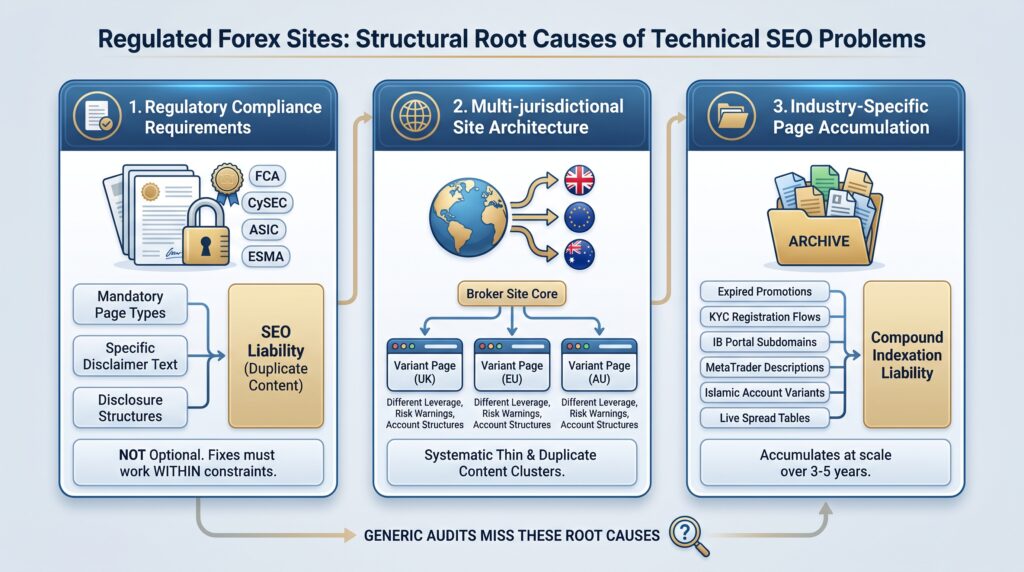
Regulatory compliance requirements. Regulators — FCA, CySEC, ASIC, ESMA — mandate specific page types, disclaimer text, and disclosure structures that create SEO liabilities. These are not optional. A broker cannot remove its regulatory disclaimers to resolve a duplicate content problem. Every fix in this guide works within the compliance constraint, not around it.
Multi-jurisdictional site architecture. Brokers operating under multiple licences or targeting multiple geographic markets create variant pages for each jurisdiction — different leverage limits, different risk warnings, different account structures. Each variant is nearly identical to the others, creating a systematic thin and duplicate content cluster that grows with every new market the broker adds.
Industry-specific page accumulation. Forex broker sites accumulate page types that no other industry has at scale — expired promotions, KYC registration flows, IB portal subdomains, MetaTrader platform descriptions, Islamic account variants, live spread tables. Each category carries a known indexation liability. Over three to five years of operation, the compound effect is significant.
The ten issues below cover the most common manifestations of these root causes. Each comes with the GSC signal that identifies it and a fix that resolves it within your regulatory constraints. Unresolved, these issues also extend your organic ranking timeline — the connection to how technical problems lengthen the authority-building cycle is covered in the forex broker SEO timeline breakdown.
The Ten Indexation Issues — Diagnosis and Fix
Each issue below follows the same structure: what it is, why regulated broker sites specifically have it, the GSC signal that identifies it, and the fix. Work through them in order — issues 1–5 are the most widespread and should be checked first.
| # | Issue | Root Cause | GSC Signal | Priority |
|---|---|---|---|---|
| 1 | Regulatory disclaimer duplicate content | Compliance | Crawled — not indexed | High |
| 2 | Geo-blocked pages — Googlebot access | Compliance | URL Inspection mismatch | High |
| 3 | Jurisdiction product page thin content | Multi-jurisdiction | Duplicate without canonical | High |
| 4 | KYC and account pages indexed | Page accumulation | Valid indexed — no organic value | High |
| 5 | MT4/MT5 platform page duplication | Industry standard | Crawled — not indexed | High |
| 6 | Expired promotion crawl budget waste | Page accumulation | Crawl budget overuse | Medium |
| 7 | Islamic/swap-free account variants | Multi-jurisdiction | Hreflang errors | Medium |
| 8 | Affiliate/IB portal subdomain indexed | Page accumulation | Separate GSC property / site: search | Critical |
| 9 | Regulatory disclosure PDFs indexed | Compliance | filetype:pdf site: search results | Medium |
| 10 | Live trading conditions index instability | Compliance + dynamic data | Volatile ranking positions | Long-term |
Issue 1: Regulatory Disclaimer Text Creating Duplicate Content
FCA, CySEC, ASIC, and ESMA require specific risk disclosure text to appear prominently on broker pages — “CFDs are complex instruments and come with a high risk of losing money rapidly due to leverage. [X]% of retail investor accounts lose money when trading CFDs with this provider.” This text, plus additional disclaimer paragraphs, appears in near-identical form across hundreds of pages. Google’s duplicate content detection flags this as a systematic thin-content signal across the domain.
Non-regulated sites do not have mandated disclaimer text. A CySEC-regulated broker’s risk warning cannot be rewritten freely — the exact wording is specified by the regulator, including the percentage figure which must be recalculated periodically based on client account performance data. The compliance requirement and the SEO problem are literally the same text.
GSC signal: Coverage report → “Crawled — currently not indexed” accumulating for pages where disclaimer content is dominant. Run a site crawl with Screaming Frog and filter by content similarity — pages showing 80–95% similarity across the domain will reveal the disclaimer duplication pattern.
The fix: Three-layer approach. First, implement disclaimer text in a structured block that contextualises it as regulatory disclosure — surrounding editorial content on each page must genuinely differentiate the page beyond the shared disclaimer. Second, ensure standalone disclaimer pages (e.g. /risk-disclosure/) are set to noindex — they must exist for compliance but do not need to be indexed as standalone content. Third, ensure the percentage figure in the disclaimer is updated simultaneously across all pages when the regulator requires recalculation — a stale figure in indexed disclaimer text creates a compliance risk on top of the SEO problem.
Issue 2: Geo-Blocked Pages and Googlebot Access
Many regulated brokers block access to certain pages for users in specific jurisdictions — US residents excluded from EU-regulated broker platforms, for example. When this geo-blocking is implemented via client-side JavaScript geo-detection (the most common and fastest implementation method), Googlebot cannot execute it. Googlebot crawls from US-based IP addresses by default and sees a different page than European users — or in some cases sees the full page that US users should be blocked from accessing.
The geo-blocking is not a preference — it is a legal compliance requirement. The technical implementation method (client-side vs. server-side) is what creates the SEO problem, not the compliance decision itself.
GSC signal: URL Inspection tool → “Test Live URL” will show you what Googlebot currently sees. If Googlebot sees a page that restricted jurisdiction users should not access, the implementation is client-side and needs correcting. You may also see indexation of pages that should be blocked from specific markets in the Coverage report.
The fix: Server-side geo-detection for compliance-restricted pages. Implement via CDN (Cloudflare Workers or AWS CloudFront are the most common routes) or server-side logic that returns the appropriate response before JavaScript loads. Use the Vary: Accept-Language header correctly alongside geo-detection to signal geo-variant content to Google’s crawler. Verify with GSC URL Inspection “Test Live URL” immediately after implementation.
Issue 3: Jurisdiction-Specific Product Pages and Thin Content
ESMA’s leverage restrictions (1:30 for EU retail traders) versus offshore leverage offerings (1:500) require brokers to create separate product pages per regulatory jurisdiction. An EU account page and a global account page are structurally identical — same platform, same instruments, same deposit methods — differing only in the leverage figure and the regulatory disclaimer variant. Google identifies these as near-duplicate thin content pages and either fails to index them or treats them as low-quality duplicates.
A non-regulated financial product site does not need to create jurisdiction-specific product variants. The leverage differentiation is created by regulatory fiat, not by product differentiation. Brokers add these pages to comply with ESMA and cannot remove them for SEO convenience.
GSC signal: “Duplicate without canonical tag” in Coverage report across product page pairs. Screaming Frog content similarity report showing near-100% similarity between jurisdiction variants of the same account type.
The fix: Two options. Option A (preferred): Differentiate the pages with genuinely unique content per jurisdiction — local payment methods available in each region, local regulatory protections specific to that jurisdiction, local language trading education. This converts a thin duplicate into a legitimately differentiated page. Option B (where A is not immediately feasible): Canonical the lower-authority jurisdiction variant to the primary page. Confirm with compliance counsel that canonical implementation does not create a “serving restricted content to restricted users” implication — canonical affects search indexing, not user access.
Issue 4: KYC and Account Opening Pages Indexed Accidentally
Broker KYC and account registration flows — registration forms, ID verification upload pages, proof of address screens, account funding steps — are frequently indexed by Google. These pages contain minimal readable content (form labels, upload instructions, progress indicators), generate thin content signals, consume crawl budget, and occasionally expose form field structures to public search results.
Regulated brokers have extensive KYC requirements mandated by AML regulations — multi-step identity verification, document upload flows, source-of-funds declarations. These flows can span 8–12 separate URL steps. A non-regulated site typically has a single account registration page. The regulatory KYC depth multiplies the accidental indexation surface area proportionally.
GSC signal: Search site:yourdomain.com/register or site:yourdomain.com/kyc or site:yourdomain.com/account in Google. Any results are indexed pages that should not be indexed. In Coverage report, these appear as “Valid” indexed pages producing zero organic traffic.
The fix: Add <meta name="robots" content="noindex"> to all registration, KYC, and account management pages. Add Disallow: /register/, Disallow: /kyc/, Disallow: /account/ directives to robots.txt as a secondary directory-level block. Handle URL parameters used in multi-step registration flows via GSC’s URL Parameters tool — session-based parameters can generate crawlable URL variants that multiply the indexation surface area further.
Issue 5: MT4 and MT5 Platform Page Duplication
Every forex broker site has a MetaTrader platform page. The default MetaQuotes marketing descriptions — “powerful charting tools, automated trading via Expert Advisors, 9 timeframes, 30 technical indicators, hedging support” — are replicated across hundreds of broker sites with minimal variation. Google’s duplicate content detection identifies your MT4/MT5 pages as near-identical to the same pages on dozens of your competitors’ domains simultaneously.
Unlike an ecommerce site describing a unique product, a broker describing MT5 is describing the same product every other broker also offers. The duplication is structural to the industry — MetaQuotes’ platform is the same product regardless of which broker provides access to it. The differentiation must come from the broker’s specific implementation, not the platform itself.
GSC signal: Platform pages appearing in “Crawled — currently not indexed” or with consistently low crawl priority relative to their position in the site architecture. Ahrefs Content Gap analysis across competitor domains will confirm near-identical platform page content at scale.
The fix: Replace generic MetaQuotes descriptions with broker-specific content that no other site can replicate: your actual spread figures on the platform, your execution speed data, your server infrastructure location, proprietary tools or indicators built on top of MT5 if any exist, and broker-authored tutorials for your specific account types. The goal is to make your platform page factually about your implementation of MT5 — not about MT5 in general. This also strengthens E-E-A-T by demonstrating operational specificity that generic agencies cannot fake.
Issue 6: Expired Promotion Pages Wasting Crawl Budget
Brokers run deposit bonuses, trading contests, referral campaigns, and seasonal promotions. These pages accumulate over years — a “50% deposit bonus” page from 2022 may still be indexed in 2026, consuming crawl budget, generating thin content signals, and for FCA-regulated brokers, constituting an active compliance breach under PS20/10 restrictions on financial incentives for retail CFD clients.
The combination of SEO liability and regulatory liability makes this the highest-urgency cleanup item for any regulated broker with legacy promotions content. An expired bonus page is not just an SEO inconvenience — depending on your regulator, it is a potential enforcement notice waiting to be discovered.
GSC signal: “Crawled — currently not indexed” accumulation filtered for URLs containing /promotion/, /bonus/, /contest/, /offer/. Filter the Coverage report by these URL patterns to identify the full scale of the problem — most brokers underestimate how many expired pages exist until they run this filter.
The fix: Audit the full promotions directory. For each expired page: if a current replacement exists, implement a 301 redirect to the active promotions hub; if no replacement exists, redirect to the homepage or trading conditions page. Remove all expired promotion URLs from your XML sitemap immediately. For FCA-regulated brokers: confirm with compliance counsel whether any live indexed promotion pages constitute a current breach of FCA PS20/10 before executing redirects — you may need compliance sign-off before touching the promotions directory structure.
Issue 7: Islamic and Swap-Free Account Page Variants
Many brokers publish Islamic (swap-free) account pages in multiple language and geographic variants — English, Arabic, Malaysian — each structurally near-identical, differing only in the language of the text and the regulatory disclaimer at the footer. Without proper hreflang and canonical structure, these pages generate both duplicate content signals and hreflang conflict errors in GSC simultaneously.
Islamic accounts require specific regulatory and Sharia compliance structuring that varies slightly by jurisdiction — DFSA in the UAE has different requirements from SC Malaysia or BNM. This creates multiple legitimate variants that nonetheless look like duplicates to Google’s crawler because the surface content is so similar.
GSC signal: International Targeting report → hreflang errors. Coverage report → “Alternate page with proper canonical tag” appearing for Islamic account URL variants — GSC is treating them as duplicates of each other rather than legitimate language variants.
The fix: Implement hreflang for language variants: hreflang="en", hreflang="ar", hreflang="ms" for English, Arabic, and Malay versions respectively. Use canonical tags for geo-variants within the same language where content is identical. Add a minimum of one genuinely differentiated content element per market: local Sharia board certification details, local payment method availability for Islamic accounts, local regulatory body name. This moves pages from “near-duplicate” to “legitimately localised” in Google’s assessment. The hreflang and multi-geo setup context is covered in more detail in the forex broker geo-targeting framework.
Issue 8: Affiliate and IB Portal Subdomain Indexation
Broker affiliate and introducing broker portals — partner.broker.com, ib.broker.com, affiliates.broker.com — are frequently accessible to Googlebot when they should be entirely blocked. These portals contain commission structure pages, partner login areas, marketing material libraries, and sub-affiliate tracking documentation — all thin B2B-facing content that degrades the primary domain’s quality signals when indexed.
Regulated brokers almost universally run IB and affiliate programmes as part of their distribution model. Every regulated broker has a partner portal. The indexation risk is universal and rarely addressed at the time of setup — the problem compounds silently until someone filters the Coverage report by domain and finds hundreds of thin portal pages in Google’s index.
GSC signal: Search site:partner.yourdomain.com in Google. Any results mean the partner subdomain is being indexed. This takes 30 seconds to check and is the single fastest-to-diagnose issue on this list.
The fix: Complete Disallow: / in robots.txt on the partner subdomain root. Add X-Robots-Tag: noindex HTTP header at the server level for the entire partner subdomain — this blocks indexation even when Googlebot does access pages. Set up a separate GSC property for the partner subdomain to monitor and manage its indexation independently from the main domain going forward. Verify that the partner portal login page does not redirect to a publicly accessible landing page that Googlebot follows through.
Issue 9: Regulatory Disclosure PDFs Indexed as Thin Content
Regulated brokers must publish financial statements, auditor reports, terms and conditions, privacy notices, and regulatory disclosure documents — typically uploaded as PDFs to the main domain. Google indexes these PDFs as standalone pages. They contain dense legal and compliance language with no search intent alignment, generate thin content signals, and consume crawl budget without producing any organic benefit.
Regulatory transparency requirements mandate public availability of these documents — a CySEC CIF must publish annual financial reports, an FCA-authorised firm must publish its ICAAP summary. The documents must be accessible to users and regulators. They do not need to be indexed by search engines.
GSC signal: Search site:yourdomain.com filetype:pdf in Google. Any results are indexed PDFs that should be blocked from indexation. In Coverage report, PDF URLs appear as “Valid” indexed pages with zero organic traffic and no link equity contribution.
The fix: Add X-Robots-Tag: noindex HTTP response header for all PDF files in /legal/, /documents/, /disclosure/, and /reports/ directories — Google reads this header on PDFs even when it cannot read meta robots tags on PDF content. Add Disallow directives for these directories in robots.txt as a secondary block. PDFs remain fully accessible via direct link for users and regulators — only search engine indexation is blocked.
Issue 10: Live Trading Conditions Data and Index Instability
Broker trading conditions pages — spreads, margin requirements, overnight rates — often display live or near-live data that changes throughout the trading day. Pages with dynamic data content are re-crawled frequently by Googlebot. Each crawl sees a technically different page, creating content freshness signals that trigger recrawl cycles, cause ranking instability, and create caching conflicts with CDN or caching plugins like LiteSpeed.
Regulators require brokers to display accurate, current trading conditions to clients. This transparency requirement creates a direct tension with SEO ranking stability: the page that compliance requires to show live data is the same page that benefits SEO from staying stable. This is the only issue on this list where the compliance requirement and the SEO requirement are actively in conflict with each other, rather than just creating parallel problems.
GSC signal: Trading conditions pages with volatile ranking positions — moving 5–15 positions up and down week-over-week without any strategy changes. Coverage report shows abnormally high recrawl frequency for these pages relative to their link equity.
The fix: Separate the static and dynamic content. Create a static “indicative spreads” page for SEO purposes — labelled clearly as indicative and not live — that Googlebot crawls and indexes stably. Implement the live spread widget via JavaScript that Googlebot cannot execute, keeping live data out of the indexed content layer. Canonical the live-data version to the static indicative-spreads version. This satisfies the compliance requirement (live data available to users via the JavaScript widget) and the SEO requirement (stable, consistent, indexable content for ranking purposes).
How to Audit Your Broker Site for These Issues
A practical four-step audit that can be completed without developer involvement. Each step identifies which of the ten issues are present on your specific site and to what extent.
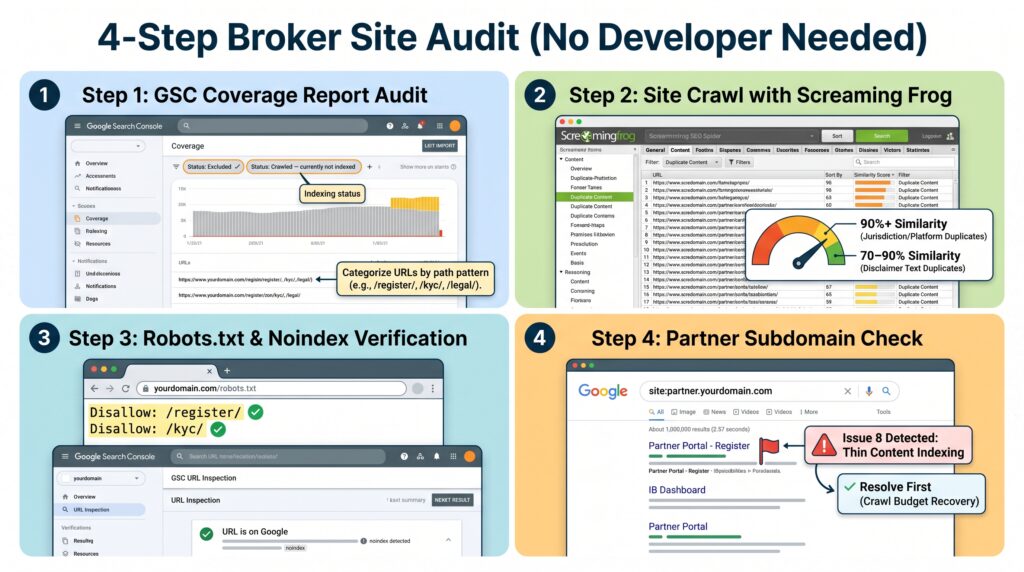
Step 1 — GSC Coverage report audit. Filter Coverage report by status: “Crawled — currently not indexed” and “Excluded.” Export the URL list. Categorise URLs by path pattern: /register/, /kyc/, /account/, /partner/, /promotion/, /legal/, /documents/, plus platform pages and account type pages. The distribution across these categories tells you which of the ten issues are most severe on your site and where to start.
Step 2 — Site crawl with Screaming Frog (free tier covers up to 500 URLs). Crawl the domain. Filter results by “Duplicate Content.” Sort by content similarity score. Pages above 90% similarity are the jurisdiction-specific variants and platform page duplicates from Issues 3 and 5. Pages in the 70–90% range are the disclaimer text duplicates from Issue 1. The volume at each threshold tells you how urgently each needs addressing.
Step 3 — robots.txt and noindex verification. Check your current robots.txt at yourdomain.com/robots.txt. Verify that /register/, /kyc/, /account/, /partner/ directories have Disallow directives. Use GSC URL Inspection to check any page you suspect should be noindexed — the tool shows the actual indexing status and the specific robots.txt or noindex signals Google is reading.
Step 4 — Partner subdomain check. Search site:partner.yourdomain.com or site:ib.yourdomain.com in Google. Any results mean Issue 8 is active. This is the single highest-volume thin content problem on most regulated broker sites and has the fastest fix. Resolve it before addressing any other issue — the crawl budget recovery from blocking a partner subdomain often produces visible GSC improvements within 2–4 weeks.
Implementation Priority — Fix in This Order
Not all ten issues require the same level of effort or produce the same SEO impact. Here is the sequence that maximises GSC improvement per hour of development time.
Quick wins — 1–2 weeks, minimal developer involvement. Partner/IB subdomain robots.txt disallow (Issue 8) — highest single-action impact, typically 30 minutes of developer time. KYC and account page noindex (Issue 4) — a meta tag addition, no structural change. Regulatory disclosure PDF X-Robots-Tag (Issue 9) — server configuration, typically under an hour. These three fixes alone resolve the highest-volume thin content problems and recover 20–40% of wasted crawl budget on a typical regulated broker site.
Medium term — 4–8 weeks, developer required. Expired promotion 301 redirects (Issue 6) — content audit required before implementation, compliance review essential for FCA-regulated brokers. Geo-blocking server-side implementation (Issue 2) — CDN or server configuration. Disclaimer standalone page noindex (Issue 1, partial) — meta tag addition on specific pages. These resolve the compliance-liability issues alongside the SEO liabilities.
Long term — 8–16 weeks, compliance and development coordination. Platform page content differentiation (Issue 5) — content production and technical implementation. Islamic account hreflang structure (Issue 7) — international SEO implementation requiring compliance input on Sharia compliance content per jurisdiction. Live trading conditions canonical architecture (Issue 10) — requires compliance sign-off and a coordinated technical architecture decision between SEO, development, and product teams. These fixes require the most cross-functional coordination but produce the most durable long-term indexation improvements.
Connecting This to Your Full Audit
The technical indexation issues above are the foundation layer of a regulated broker’s organic programme. The forex broker SEO audit framework covers how these technical findings feed into the full organic performance picture — content strategy, authority building, and geo-targeting all depend on a clean technical base. Fix the foundation first.
If you are seeing unexplained thin pages, crawl budget waste, or duplicate content warnings in your broker’s GSC account — the causes are almost always on this list. That diagnosis starts with an audit.
FAQ
What are the most common indexation issues on forex broker sites?
The five most common are: authenticated platform content that Googlebot cannot access, JavaScript-rendered trading data that never appears in Google’s index, cross-entity duplicate content across regulated subsidiary sites, accidentally indexed compliance and legal pages with thin boilerplate content, and hreflang errors on jurisdiction-specific pages. The first two are unique to broker sites and almost never appear in generic SEO audits.
Why does Googlebot struggle with forex broker platforms?
Most broker platforms render critical trading data — spread tables, instrument specifications, leverage conditions — via JavaScript. Googlebot processes JavaScript inconsistently, particularly at scale. The result is that the broker’s most commercially valuable content is technically on the page but invisible to Google’s index. From Google’s perspective, the page has no substantive trading condition data — regardless of what a human visitor sees.
How do I find indexation issues on my broker site in GSC?
Go to Google Search Console → Index → Coverage. Filter by “Crawled — currently not indexed” and “Excluded.” The most revealing segments for broker sites are: pages excluded due to duplicate content (signals cross-entity or thin content issues), pages crawled but not indexed (signals YMYL quality threshold not met), and submitted URLs with crawl anomalies (signals JavaScript rendering failures). Export the full list and cross-reference against your sitemap to identify gaps.
Does having content behind a client login hurt SEO?
Yes, indirectly. Googlebot cannot access authenticated content — trading tutorials, account specifications, instrument deep-dives, leverage tables. These pages represent significant topical authority potential that is completely invisible to Google. The fix is not to remove the login requirement, but to create public-facing equivalents of the most commercially valuable authenticated content — static trading condition pages, instrument specification pages, and platform feature pages that Googlebot can crawl freely.
How is duplicate content different for multi-entity forex brokers?
Standard duplicate content tools detect on-domain duplication. Multi-entity brokers often maintain near-identical site versions across regulated subsidiaries — the same trading conditions, platform descriptions, and educational content reproduced across separate domains for each regulatory entity. Standard tools miss this entirely because they only crawl one domain at a time. Cross-entity duplicate content suppresses authority for all entity sites simultaneously and requires a canonical strategy that most generic audits never address.