
Geo-Targeting Strategy for Forex Broker Paid Campaigns, where to start?
For a regulated forex broker, geo-targeting is not primarily a reach-maximization decision — it is a compliance boundary-setting decision, with performance optimization as a secondary layer operating only within that boundary.
The hierarchy matters: Layer 1 is which markets this campaign can legally target at all, based on the broker’s current regulatory authorisation. Layer 2 is, within that legal boundary, which specific regions or sub-national areas perform best. Most marketing advice treats geo-targeting purely as Layer 2 — a reach and performance lever to maximize. For a regulated entity, this is backwards: expanding geographic reach without first confirming regulatory authorisation is not volume optimization, it is the fastest route to unlicensed retail client solicitation at scale.
The geo-targeting decision I see made incorrectly most often for forex broker campaigns is treating certification jurisdiction and target market as the same thing — a CySEC licence does not automatically authorise running Google Ads to retail clients in every EU member state, and the campaign targeting rarely reflects that distinction.
This guide covers the complete compliance-first geo-targeting framework: certification consistency, cross-channel exclusion synchronization, the technical limits of platform-level targeting, localization as a compliance consideration, the periodic audit discipline, and a practical six-step decision sequence for any new market expansion.
Table of Contents
Why “More Reach” Is the Wrong Starting Question for a Regulated Broker
Some forex marketing guidance frames geo-targeting purely as a volume-maximization lever — broaden reach, capture more traffic, expand into adjacent markets for growth. This framing is not merely incomplete for a regulated forex broker; it is actively misaligned. A regulated entity cannot legally solicit retail clients in a jurisdiction where it holds no regulatory authorisation, regardless of how attractive that market’s traffic volume or conversion potential might appear. Geographic reach expansion that ignores this boundary does not “unlock high volume traffic” — it generates unlicensed retail client solicitation at the exact scale the expanded reach produces.
The correct starting question is not “how do I reach more people?” but “which markets am I legally authorised to reach, and how do I optimize performance within that boundary?” This reframing does not limit growth — it directs growth toward the markets where it is actually sustainable, rather than toward markets that generate short-term volume and longer-term regulatory exposure.
Certification-to-GEO Consistency Across Campaign Structure
Per the certification-to-campaign mapping established in the Google Ads account structure guide, a campaign’s geo-targeting settings must match its certification status exactly. A campaign certified for UK financial product advertising should target only UK geography. A campaign certified for EU markets should target only EU geography. Geo-targeting and certification represent two sides of the same compliance requirement and should never be configured independently of each other.
Geo-Targeting Strategy for Forex Broker Paid Campaigns-The common failure mode:
Certification is correctly scoped at campaign launch, but a campaign manager later broadens geo-targeting “to increase reach” without verifying whether the certification scope still matches the new targeting. This silently creates a compliance gap — the campaign is now running in markets the certification does not cover, with no automatic alert from the advertising platform itself.
The practical control: Any change to a campaign’s geo-targeting settings should trigger a check against the certification mapping document before the change goes live — not after. This is the same discipline that prevents the certification-market mismatch identified as a P1 finding in the audit checklist‘s Category 2.
Cross-Channel Exclusion Consistency — Prospecting and Retargeting Must Match
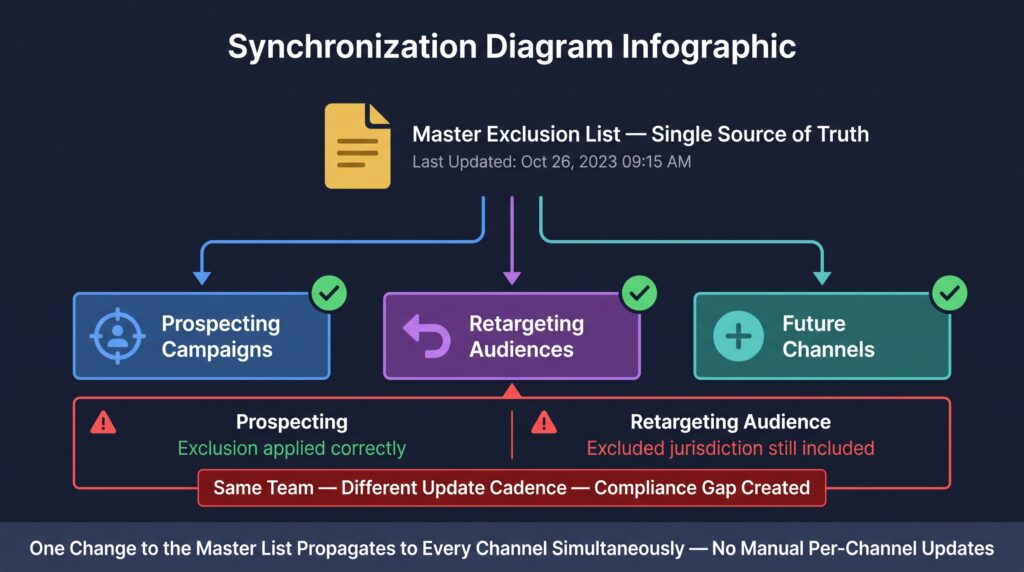
The regulatory exclusion list for prospecting campaigns and the exclusion list for retargeting audiences (covered in the retargeting strategy guide) represent the same underlying regulatory authorisation boundary and must be identical and synchronized.
The common gap: A broker correctly excludes an unauthorised jurisdiction from new prospecting campaigns, but the retargeting audience — built separately, often on a different update cadence, sometimes managed by a different team or tool — still includes users from that jurisdiction who registered before the exclusion was implemented or who were added to the audience through a different process entirely.
The practical control: Exclusion lists should be maintained as a single master document applied consistently across every campaign type and channel — prospecting, retargeting, and any future channel the broker adds. A change to the exclusion list (adding a new restricted jurisdiction, or removing an exclusion after obtaining new authorisation) should propagate to every channel simultaneously, not be updated independently per channel as a manual, error-prone process.
Sub-National Targeting Within Authorised Markets — The Legitimate Performance Layer
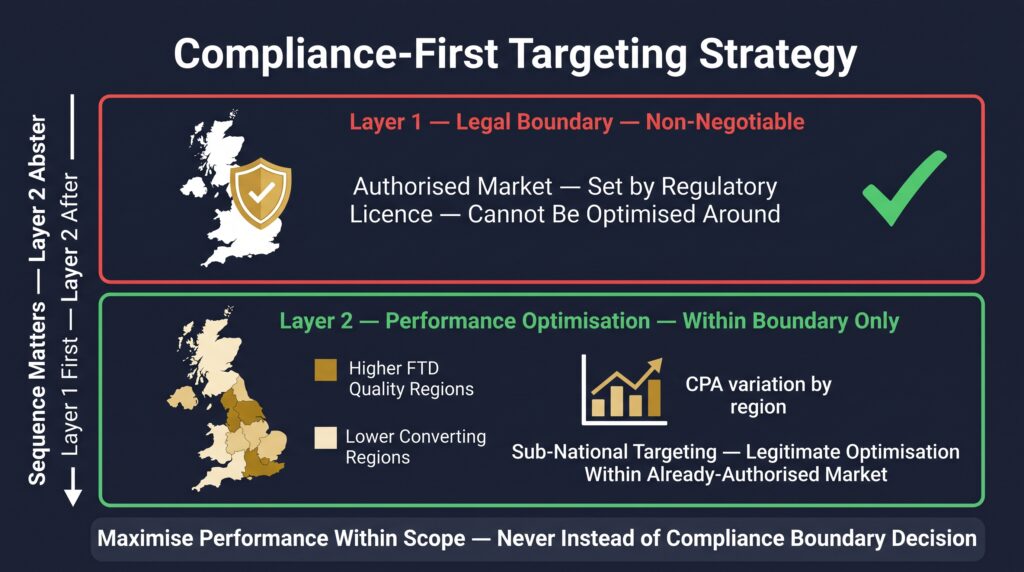
Once Layer 1 (legal market boundary) is resolved, Layer 2 optimization includes sub-national targeting decisions within the already-authorised market. Different cities or regions within an authorised country can produce meaningfully different CPA and FTD quality, informed by the benchmark data in the CPA benchmarks guide. For example, within an authorised UK campaign, certain regions may show systematically different conversion quality than others — a legitimate performance optimization that operates entirely within the legal boundary, distinct from the boundary-setting decision itself.
This is the correct place for “maximize performance within scope” thinking — it is simply sequenced after, not instead of, the compliance boundary decision.
IP-Based vs Declared Location — Why Platform Targeting Is Best-Effort, Not a Guarantee
Google Ads and Meta’s geo-targeting settings rely primarily on signals including IP address, device location services, and account settings — none of which are perfectly reliable indicators of a user’s actual regulatory jurisdiction. A user accessing the internet via a VPN, travelling temporarily, or using a corporate network with an IP address registered in a different country can receive ads outside the platform’s intended targeting scope.
WHY THIS MATTERS FOR COMPLIANCE DESIGN
Platform-level geo-targeting is a best-effort compliance layer, not a guarantee. This is precisely why the KYC-verified jurisdiction check established in the retargeting guide remains essential as a second compliance checkpoint — ad platform targeting determines who is likely to see the ad, but only KYC verification at registration confirms the user’s actual jurisdiction. A broker relying solely on platform geo-targeting as their complete compliance control has a gap precisely where VPN usage, travel, or corporate networking creates a mismatch between platform-inferred and actual location.
Language and Localization as a Compliance Consideration
Beyond geographic targeting itself, the language and localization of ad creative carries its own compliance dimension. A risk warning translated inaccurately or incompletely into a local language does not satisfy the prominence and clarity requirements established in the landing page compliance guide, which apply regardless of language.
A campaign targeting a non-English-speaking authorised market needs creative and landing pages with accurately translated, compliance-reviewed local-language risk warnings — not a machine-translated version of the English creative, which risks losing the precise regulatory wording required. This is most relevant for brokers expanding into new authorised non-English-speaking markets and less of a daily concern for brokers operating primarily within English-language jurisdictions.
The Periodic Exclusion List Audit — Markets Change, Settings Often Don’t
A broker’s regulatory authorisation map changes over time — new licences obtained, regulatory actions restricting existing authorisation, or voluntary market exits. Geo-targeting settings across every active campaign should be audited against the current authorisation map on a defined cadence — monthly or quarterly — not configured once at campaign launch and left unreviewed indefinitely.
This connects directly to the audit discipline established in the paid ads audit checklist’s Category 4 targeting audit. Geo-targeting accuracy is not a one-time setup task but an ongoing compliance maintenance responsibility — the same discipline that prevents a broker from discovering, during an unrelated compliance review, that campaigns have been running in a market the broker exited regulatory authorisation for eighteen months earlier.
The Practical Geo-Targeting Decision Sequence
A practical sequence for any new campaign or market expansion decision:
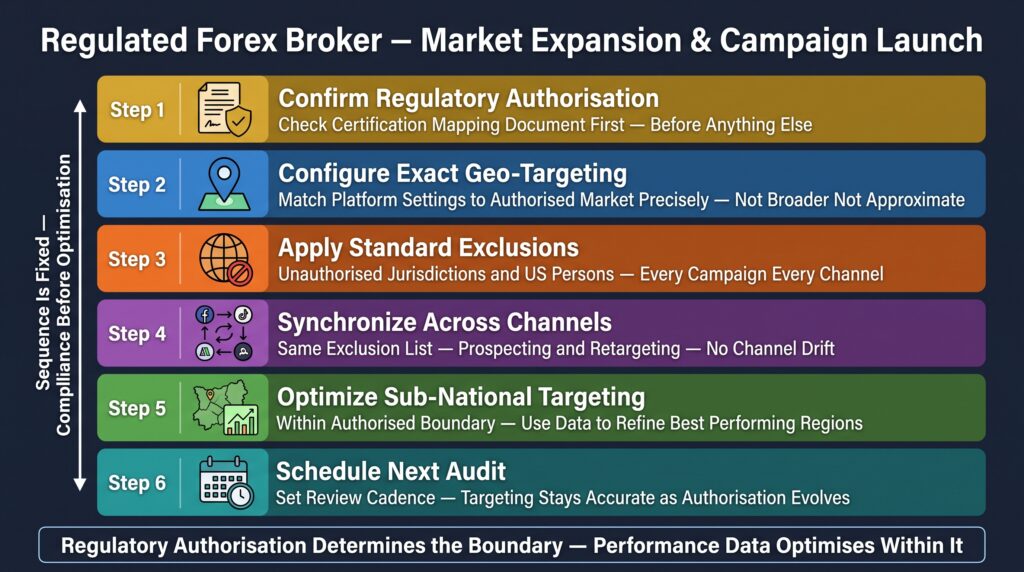
Steps 1–4 are compliance boundary-setting (non-negotiable, in order). Step 5 is performance optimization (only within the established boundary). Step 6 is ongoing maintenance. This sequence is never reversed.
If you want your current geo-targeting settings audited against your actual regulatory authorisation map — across every platform and every campaign — that audit is part of the diagnostic.
FAQ
Q1: What is the correct geo-targeting strategy for a regulated forex broker’s paid campaigns?
A regulated forex broker’s geo-targeting strategy should operate in two sequential layers. The first layer is the legal boundary: confirming which markets the broker is currently authorised to target based on its regulatory licences, since a regulated entity cannot legally solicit retail clients in a jurisdiction where it holds no authorisation regardless of that market’s traffic volume or conversion potential. The second layer is performance optimization within that boundary: once the legally authorised markets are established, sub-national targeting decisions such as which cities or regions produce the best cost per acquisition and deposit quality become the relevant question. Geo-targeting settings must be kept consistent with the broker’s certification status for each platform, exclusion lists must be synchronized across both prospecting and retargeting campaigns, and settings should be audited periodically against the broker’s current regulatory authorisation map rather than configured once at launch and left unreviewed. Treating geo-targeting primarily as a reach-maximization lever without first resolving the legal boundary is a common but mistaken approach for regulated financial services advertisers.
Q2: How does Google Ads certification status relate to geo-targeting settings for forex brokers?
A forex broker’s Google Ads certification status and geo-targeting settings must match exactly, since both represent the same underlying regulatory compliance requirement. A campaign certified for financial product advertising in the UK should target only UK geography, and a campaign certified for EU markets should target only EU geography. A common compliance failure occurs when certification is correctly scoped at campaign launch but geo-targeting is later broadened to increase reach without verifying whether the certification scope still matches the expanded targeting, creating a silent compliance gap that the advertising platform does not automatically flag. The practical control is to treat any change to a campaign’s geo-targeting settings as requiring a check against the certification mapping documentation before the change goes live, ensuring geo-targeting and certification status are never configured independently of each other.
Q3: Should retargeting and prospecting campaigns use the same geo-targeting exclusions?
Yes. The regulatory exclusion list for prospecting campaigns and the exclusion list for retargeting audiences represent the same underlying regulatory authorisation boundary and must be identical and synchronized across both campaign types. A common compliance gap occurs when a broker correctly excludes an unauthorised jurisdiction from new prospecting campaigns, but the retargeting audience, built separately and often on a different update cadence, still includes users from that jurisdiction who registered before the exclusion was implemented or who were added through a separate process. Exclusion lists should be maintained as a single master document applied consistently across every campaign type and advertising channel, with any update to the list, such as adding a newly restricted jurisdiction or removing an exclusion after obtaining new regulatory authorisation, propagating to every channel simultaneously rather than being updated independently and manually per channel.
Q4: Is Google Ads or Meta geo-targeting a reliable compliance guarantee for forex brokers?
No. Google Ads and Meta geo-targeting settings rely primarily on signals including IP address, device location services, and account settings, none of which perfectly indicate a user’s actual regulatory jurisdiction. A user accessing the internet through a VPN, travelling temporarily, or using a corporate network registered in a different country can receive ads outside the platform’s intended targeting scope. This means platform-level geo-targeting functions as a best-effort compliance layer rather than a guarantee, which is why KYC-verified jurisdiction confirmation at the registration stage remains an essential second compliance checkpoint for regulated forex brokers. Ad platform targeting determines who is likely to see an advertisement, but only KYC verification at registration confirms a user’s actual jurisdiction once they have signed up, and a broker relying solely on platform-level geo-targeting as a complete compliance control has a gap precisely where VPN usage, travel, or corporate networking creates a mismatch.
Q5: How often should a forex broker audit its geo-targeting settings?
A forex broker should audit geo-targeting settings across all active paid advertising campaigns against its current regulatory authorisation map on a regular defined cadence, such as monthly or quarterly, rather than configuring geo-targeting once at campaign launch and leaving it unreviewed indefinitely. This is necessary because a broker’s regulatory authorisation map changes over time as new licences are obtained, regulatory actions restrict existing authorisation, or the broker voluntarily exits certain markets, and geo-targeting settings configured under a previous authorisation status may no longer be accurate without an active update. This periodic audit discipline is the same principle underlying the targeting compliance check in a comprehensive paid ads audit checklist, treating geo-targeting accuracy as an ongoing compliance maintenance responsibility rather than a one-time campaign setup task.
Q6: What is the practical sequence for setting up geo-targeting for a new forex broker market?
The practical sequence for geo-targeting a new market follows six steps. First, confirm current regulatory authorisation for the target market through the certification mapping documentation maintained for advertising platform compliance. Second, configure platform geo-targeting to match the authorised market exactly rather than approximately or more broadly. Third, apply standard exclusions including unauthorised jurisdictions and United States persons, consistent with established regulatory exclusion practice. Fourth, synchronize the exclusion list with retargeting audience settings so the same exclusion boundary applies across both prospecting and retargeting channels. Fifth, within the now-established authorised boundary, optimize sub-national targeting using available performance data to identify which specific regions produce the best cost per acquisition and deposit quality. Sixth, schedule the next periodic exclusion audit to ensure the targeting remains accurate as the broker’s regulatory authorisation evolves. This sequence treats compliance boundary-setting as the first four steps and performance optimization as the fifth, never reversing that order.