
Meta Ads Policy for Forex Brokers, what changed?
Meta’s financial services advertising policy changed meaningfully in 2026 — and the most consequential updates are not the ones most rejection-avoidance checklists focus on.
Most existing Meta compliance content for forex advertisers focuses on avoiding specific ad rejections — prohibited claims, missing disclaimers, urgency tactics. These remain valid concerns, but 2026 introduced structural changes to the verification, audience, and partnership requirements that operate at a different layer than individual creative rejection reasons.
This article covers four specific verified changes and explains how each connects to the broker’s existing compliance infrastructure — certification mapping, consent management, and affiliate oversight — rather than treating Meta compliance as an isolated checklist.
Table of Contents
The March 2026 Identity Verification Requirement
Confirm the exact current wording of Meta’s identity verification requirement against their live Transparency Center financial services page. Policy language can be refined after initial rollout — confirm the “may be subject to review” language and the business/individual distinction are still accurate as written below.
As of March 2026, Meta’s financial services advertising policy added a new requirement: advertisers must verify both business and individual identity, separate from and in addition to demonstrating regulatory authorisation. Previously, Meta’s policy required only authorisation demonstration — a broker showed their FCA, CySEC, or equivalent licence and that satisfied the requirement.
The new language matters specifically: Meta’s updated policy states that any such authorisation “may be subject to review by Meta” — meaning Meta now reserves an active review right over a broker’s regulatory status, not just a one-time documentation check at account setup. This is a meaningfully higher compliance bar: a broker’s regulatory status can now be subject to ongoing scrutiny rather than a single point-in-time verification.
The practical action: Confirm both business and individual identity verification is complete for every active Meta advertising account, not just the regulatory authorisation documentation that may have satisfied the previous requirement.
*Financial services advertisers should also note that ongoing verification now includes annual licence attestation — a one-time setup is no longer sufficient. Verify current requirements directly at Meta’s Transparency Center before publication
The 38-Country Verification Expansion — What It Means for Multi-Market Brokers
Financial services advertiser verification on Meta now applies in approximately 38 countries, up from roughly 12 in 2024. For a multi-jurisdiction broker, per the regulatory tier framework in the forex broker licences guide, this means markets that previously required no special Meta verification may now require it.
The practical action: Audit active campaign markets against Meta’s current verification country list rather than assuming existing certification status remains sufficient. A market added to the verification list after a broker’s campaigns were already running there creates a compliance gap that did not exist when the campaigns launched — this requires active monitoring, not a one-time setup check.
Critical update July 2026: Google announced on June 23, 2026 that financial services advertiser verification now applies across all EU and EEA member states — 24 new countries added, bringing Google’s total to 42 verified markets with enforcement beginning July 23, 2026. Any broker with active EU campaigns who has not completed Google verification for the newly added markets has a 30-day window from notification to complete the process before financial services ads are restricted. This affects every CySEC-regulated broker running EU campaigns. Complete Google verification immediately — do not wait for the campaign restriction to trigger. Verify current country list and enforcement dates directly at Google Ads Help Centre.
Verification country lists are subject to ongoing expansion — check Meta’s Transparency Center and Google Ads Help Centre directly for current figures before publication.
Standardized Risk Warning Templates — A New Creative Constraint
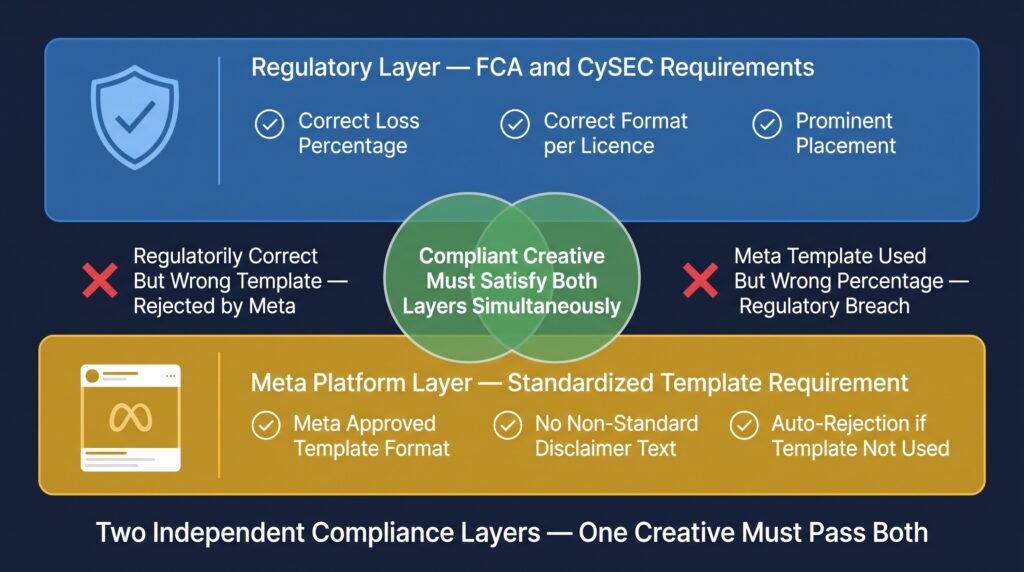
Any Meta ad referencing specific interest rates, investment returns, or yield percentages must now use Meta’s standardized risk warning templates — ads using non-standard disclaimer text are automatically rejected. This is directly relevant to forex CFD advertising, which frequently references leverage ratios and trading conditions.
How this layers on existing compliance: This connects directly to the risk warning prominence standard established in the landing page compliance guide. Meta’s template requirement is now a platform-specific implementation detail layered on top of the broker’s own FCA/CySEC risk warning obligations — compliant creative must now satisfy both the regulatory wording requirement (the correct percentage, the correct format per the broker’s licence) and Meta’s specific template format simultaneously. A risk warning that is regulatorily correct but does not use Meta’s template structure will be rejected on the platform layer even though it passes the regulatory layer.
The practical action: Audit all active creative referencing rates, returns, or leverage figures against Meta’s current standardized template — not just against the broker’s own regulatory risk warning requirements.
Lookalike Audience Consent — The Direct Connection to Your Retargeting Framework
Meta now requires updated data consent documentation for lookalike audiences built from financial product converters. This directly extends the GDPR marketing consent distinction established in the retargeting strategy guide — a lookalike audience built from a broker’s existing converted client base must now be supported by documented consent for that underlying seed data, not just consent for the retargeting use itself.
Why this matters specifically: A broker building a lookalike audience typically uses their existing funded client list as the seed data — the same registration-to-funded segment covered in the retargeting guide. If that seed data was collected for service delivery (a contractual lawful basis) rather than with separate marketing consent, using it to build a lookalike audience for prospecting compounds the original consent question into a new platform-specific requirement.
THE PRACTICAL ACTION
Before building or refreshing any lookalike audience from converted client data, verify that documented marketing consent exists for the underlying seed data — the same consent filtering process established for retargeting audiences should be applied to lookalike audience seed data as well.
Note: Meta is actively transitioning away from traditional lookalike audiences toward Advantage+ audience targeting. Verify lookalike audience availability directly in your Meta Ads Manager account before building new audiences — the format may have limited or no availability depending on your account and market. The consent documentation requirement applies regardless of which audience format is used.
Mandatory Partnership Ads Format — The Direct Connection to Affiliate Compliance
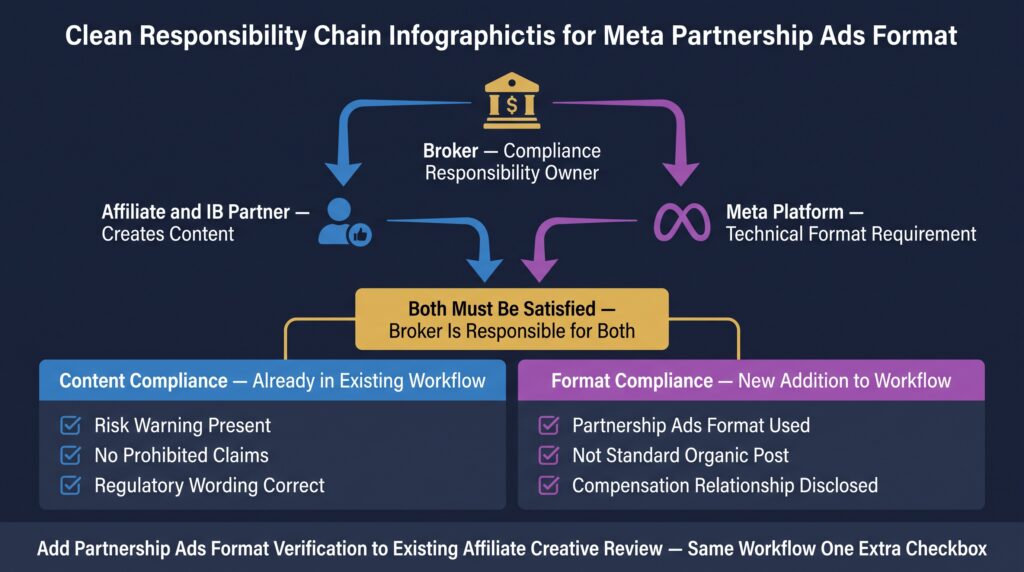
All influencer, creator, and affiliate-compensated content promoting a brand on Meta — through paid partnership, gifted product, affiliate commission, or any other compensation — must use Meta’s Partnership Ads format (formerly Branded Content Ads).
Why this extends your affiliate compliance responsibility: Per the compliance responsibility asymmetry established in the affiliate vs direct acquisition guide, a broker remains responsible for financial promotions distributed by its affiliates and IBs even though it did not produce that creative directly. This Meta-specific requirement adds a new, specific technical compliance item to that existing oversight responsibility: a broker whose affiliates or IBs are running Meta content promoting the broker must now also ensure those partners are using the correct Partnership Ads format, not just that the creative content itself is compliant.
The practical action: Add Partnership Ads format verification to the affiliate creative oversight process already established for general financial promotion compliance — this is a checkable, specific technical item that can be added to the same review workflow rather than requiring an entirely separate process.
Why These Changes Are Happening
Meta’s 2026 financial advertising policy tightening is driven by three converging forces: increased global regulatory coordination, with Meta’s policy explicitly referencing alignment with financial regulators in step with broader regulatory tightening trends; a surge in user complaints about misleading financial and health advertising that attracted regulatory attention in late 2025; and the broader industry response to AI-generated ad creative requiring new disclosure and verification mechanisms across the platform generally, not just in financial services specifically.
Understanding these driving forces helps a compliance team anticipate further tightening rather than treating each policy update as an isolated, unpredictable event — the direction of travel is consistently toward more verification, more documentation, and more platform-specific technical requirements layered on top of existing regulatory obligations.
Extending Your Certification Mapping to Include Meta
The certification-to-campaign mapping document established in the Google Ads account structure guide should be extended to include Meta’s identity verification status per market, tracked with the same renewal-date discipline already applied to Google Ads certification.
The practical structure: A broker’s mapping document should now have a Meta-specific column alongside the Google Ads certification column, since the two platforms’ verification timelines, renewal requirements, and country coverage are independent of each other. A market certified for Google Ads is not automatically verified for Meta, and the reverse is equally true — each platform’s verification status must be tracked separately within the same master document.
A Practical 2026 Compliance Update Checklist
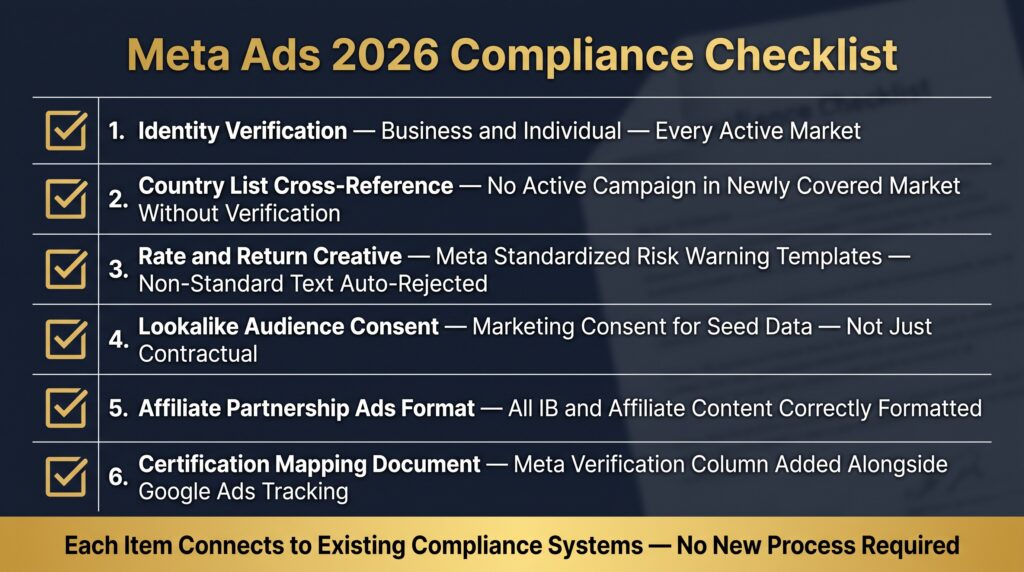
✓ Confirm identity verification — business and individual identity verified for every active Meta market, not just regulatory authorisation documentation.
✓Cross-reference markets against Meta’s current verification country list — confirm no active campaign runs in a newly-covered market without verification.
✓Audit rate/return creative against Meta’s standardized risk warning templates — non-standard disclaimer text triggers automatic rejection.
✓Confirm lookalike audience consent — documented marketing consent exists for seed data, not just contractual service consent.
✓Verify affiliate Partnership Ads format — all IB and affiliate-compensated Meta content uses the correct ad format.
✓Update certification mapping document — add a Meta-specific verification column alongside Google Ads certification tracking.
Each item connects to an existing compliance system already in place — none of these require building a parallel process from scratch.
If you want your Meta account audited against these specific 2026 changes — and integrated with your existing certification, consent, and affiliate compliance systems — that audit is part of the diagnostic.
FAQ
Q1: What is Meta’s new identity verification requirement for financial services advertisers in 2026?
As of March 2026, Meta’s financial services advertising policy introduced a new requirement that advertisers must verify both business and individual identity, in addition to demonstrating regulatory authorisation from the relevant financial regulator. Previously, Meta’s policy required only that advertisers demonstrate they were authorised by a recognized financial regulator. The updated policy language now states that any such authorisation may be subject to review by Meta, meaning the platform reserves an active ongoing review right over an advertiser’s regulatory status rather than relying solely on a one-time documentation check completed at account setup. This represents a meaningfully higher compliance bar for forex brokers and other financial services advertisers, requiring both business entity verification and individual account manager identity verification as a precondition for running financial product advertising on Facebook and Instagram. Brokers should confirm this verification is complete for every active Meta advertising account rather than assuming previously submitted regulatory documentation remains sufficient on its own.
Q2: How many countries now require Meta financial services advertiser verification?
Meta’s financial services advertiser verification requirement now applies in approximately 38 countries, a significant expansion from roughly 12 countries in 2024. This expansion means that forex brokers and other financial services advertisers operating across multiple jurisdictions should not assume their existing verification status from previous years remains comprehensive, as markets that previously did not require special financial services verification on Meta may now be included in the expanded coverage. Multi-jurisdiction brokers should audit their currently active advertising campaign markets against Meta’s current verification country list to identify any gaps, since a market added to the verification requirement after campaigns were already running there creates a compliance gap that did not exist when those campaigns originally launched. This audit should be treated as an ongoing monitoring task rather than a one-time setup verification, given the demonstrated pattern of continued expansion in coverage.
Q3: Does Meta require a specific risk warning format for forex broker ads in 2026?
Yes. As of 2026, any Meta advertisement referencing specific interest rates, investment returns, or yield percentages must use Meta’s standardized risk warning templates, and advertisements using non-standard disclaimer text are automatically rejected. This is directly relevant to forex and CFD advertising, which frequently references leverage ratios, spread conditions, and trading terms. This platform-specific requirement operates as an additional layer on top of a broker’s existing regulatory risk warning obligations under frameworks such as FCA COBS 4 or equivalent CySEC requirements. Compliant creative must now satisfy both the regulatory wording requirement, including the correct client loss percentage and prominence standard required by the broker’s regulator, and Meta’s specific template format simultaneously. A risk warning that is fully compliant from a regulatory perspective but does not use Meta’s required template structure will still be rejected at the platform policy layer.
Q4: Does Meta require special consent for lookalike audiences built from forex broker client data?
Yes. Meta now requires updated data consent documentation for lookalike audiences built from financial product converters, which includes audiences built from a forex broker’s existing funded client base. This requirement extends a broader data protection distinction: when a client registers and funds a trading account, their personal data is typically processed under a contractual lawful basis covering service delivery, such as identity verification and account communications. This contractual basis does not automatically extend to using that same client data to build an advertising audience for prospecting new clients. Meta’s requirement makes this distinction explicit at the platform level, meaning a broker building a lookalike audience from their converted client base must now have documented marketing consent for the underlying seed data, not merely a general justification for using the data for advertising purposes. Brokers should verify this consent documentation exists before building or refreshing any lookalike audience derived from client conversion data.
Q5: Do forex broker affiliates need to use a specific ad format on Meta in 2026?
Yes. As of 2026, all influencer, creator, and affiliate-compensated content promoting a brand on Meta, whether through a paid partnership, gifted product, affiliate commission, or any other form of compensation, must use Meta’s Partnership Ads format, formerly known as Branded Content Ads. For a regulated forex broker, this requirement adds a specific technical compliance item to the broker’s existing affiliate oversight responsibility, since brokers remain responsible for financial promotions distributed by their affiliates and introducing brokers even when they did not produce that creative directly. A broker whose affiliates or introducing brokers are running Meta content promoting the broker should verify those partners are using the correct Partnership Ads format, in addition to verifying that the underlying creative content itself complies with applicable financial promotion rules. This format requirement can be added to the same review workflow already used to verify general financial promotion compliance for affiliate-produced content.
Q6: Why has Meta tightened its financial services advertising policy in 2026?
Meta’s 2026 financial services advertising policy tightening reflects three converging forces. The first is increased global regulatory coordination, with Meta’s policy updates aligning with a broader trend of tightening financial services regulation internationally, including frameworks addressing cryptocurrency and digital markets. The second is a surge in user complaints about misleading financial and health advertising that attracted regulatory attention from authorities in late 2025, prompting platforms to strengthen verification and disclosure requirements proactively. The third is the broader industry response to AI-generated advertising creative, which has required new disclosure and verification mechanisms across Meta’s advertising platform generally, with financial services representing one of the categories receiving the most scrutiny given the potential for consumer harm from misleading financial claims. Understanding these underlying drivers helps a compliance team anticipate continued tightening rather than treating each individual policy update as an isolated and unpredictable event, since the consistent direction of travel has been toward more verification, more documentation, and more platform-specific technical requirements layered on top of existing regulatory obligations.