
When an FCA compliance reviewer examines a forex broker’s financial promotion landing page, they are not reading the regulatory rulebook — they are applying the inspection criteria refined through years of supervisory enforcement action.
The rules are public. COBS 4 requires that financial promotions are fair, clear, and not misleading. Risk warnings must be prominent. Leverage must not be marketed above retail client caps. These rules are identical for every FCA-regulated forex broker. What differs — and what separates brokers who pass supervisory review from those who receive regulatory action — is the specific practical threshold the inspection applies. What does “prominent” mean in practice? What does the reviewer see first? What specific claim failures have triggered action in the forex broker space?
This article covers eight inspection dimensions a forex broker’s marketing and compliance team should know before a regulator examines their landing pages first. The financial promotions approval workflow that the documentation review checks for is covered in the Google Ads account structure guide. The B2 audit checklist’s landing page category is the practical implementation of this inspection framework — see the forex broker paid ads audit checklist.
Table of Contents
The Inspection Sequence — What a Reviewer Looks at First
The inspection sequence is the structural frame for everything that follows. Knowing the order matters — above-fold failures are the highest-visibility issues and the most likely to trigger immediate regulatory attention.
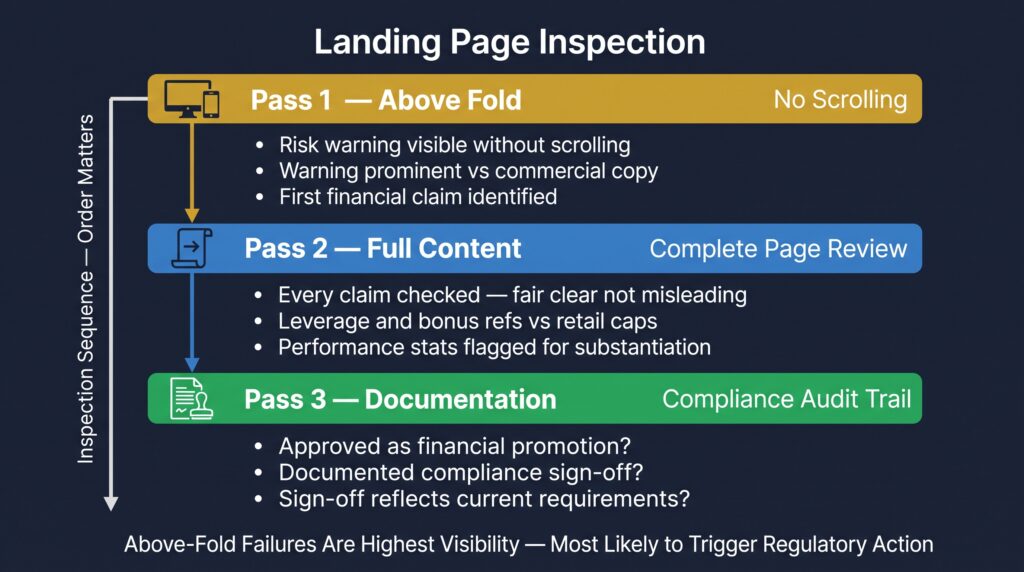
The first pass is the most consequential — it is what would be reproduced in an enforcement case as the visible landing page a retail client sees on arrival.
Why the sequence matters: Above-fold failures (Pass 1) are the highest-visibility issue and the one most likely to be cited first in any regulatory finding — because it is what every visitor sees regardless of whether they read the rest of the page. Full-content failures (Pass 2) require the reviewer to scroll, but they are systematically checked because they represent specific, citable rule breaches. Documentation failures (Pass 3) are procedural — a page can be substantively compliant in content while still failing the procedural requirement that it was approved before publication.
The Risk Warning Prominence Test — What “Prominent” Actually Means
The most important and most commonly failed inspection criterion. “Prominent” is the regulatory standard — here is what it means in practical inspection terms, across four dimensions.
Visual size relative to surrounding content. The risk warning must not be visually subordinated to the commercial headline or main marketing claim. A risk warning in a noticeably smaller font than the headline above it is technically present but not prominent — the commercial claim receives dramatically more visual weight than the risk disclosure.
Placement on the page. Above-the-fold placement is the strongest prominence indicator. Below-fold placement, where the user must scroll to see the risk warning, is consistently treated as a prominence failure in FCA supervisory practice. The test: if a user clicks the registration CTA without scrolling, have they seen the risk warning? If no, it is not prominent regardless of its formatting once found.
Contrast and readability. The risk warning text must have sufficient contrast against the background to be readable at normal viewing distance. A light grey warning on a white background may technically meet colour contrast accessibility ratios while remaining practically easy to miss in a normal browsing context.
Currency of the percentage. The risk warning percentage — the proportion of retail clients who lose money — must be current, derived from the broker’s most recently calculated client loss rate. An outdated percentage, even if prominently displayed, is a compliance failure because the promotion is not accurately representing current performance.
ALL FOUR DIMENSIONS MUST BE MET SIMULTANEOUSLY
A risk warning that satisfies size and contrast but is below the fold fails the prominence test. A warning that is above the fold but rendered in a barely-readable colour fails. Each dimension is independently capable of producing a non-prominence finding.
Mobile-First Inspection — Why Desktop Review Is Not Enough
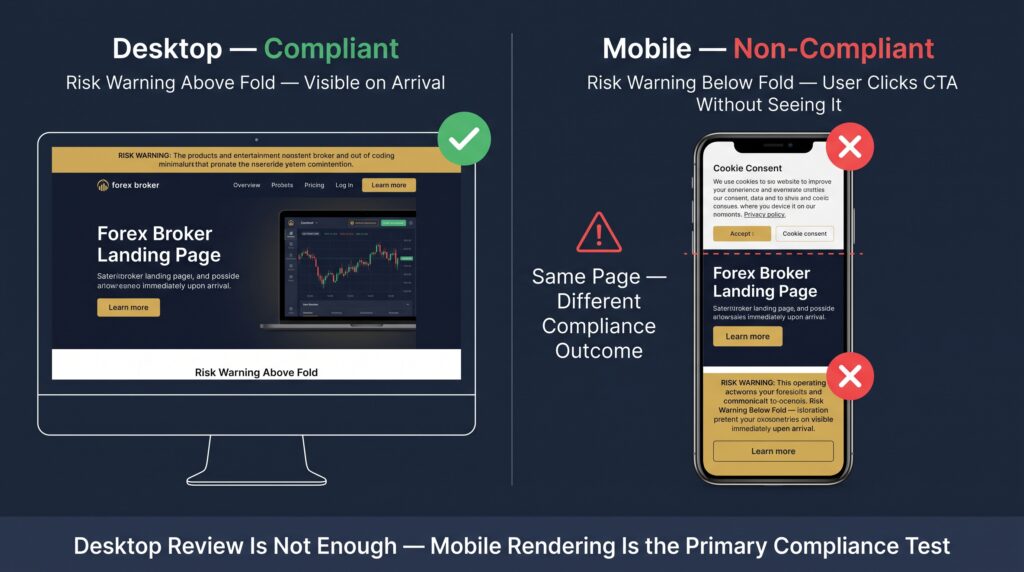
A risk warning above the fold on a desktop screen may be below the fold on a mobile screen. A font size that is readable on desktop may render smaller than expected on specific mobile devices due to browser font scaling. A sticky navigation element or cookie consent banner on mobile may obscure the risk warning that is visible on desktop.
The practical 5-minute test: Open the landing page on a physical mobile device — not a browser developer tools simulation, which can produce different viewport behaviour than a real device. Confirm without scrolling that the risk warning is visible. Confirm it is readable at arm’s length. Confirm no interface element is obscuring it on initial page load. This is the single most commonly failed landing page compliance check in forex broker paid programmes.
FCA’s supervision of digital financial promotions increasingly assesses the promotion as the retail client actually experiences it — and the retail client receiving a forex broker’s paid search or social ad is overwhelmingly likely to be on mobile. Mobile rendering is the primary consideration, not a secondary one.
Fair, Clear, and Not Misleading — The Inspection Criteria Applied
FCA COBS 4.2 requires that financial promotions are fair, clear, and not misleading. Applied to a landing page, this standard has three inspection dimensions.
Fair — balanced presentation of gains and risks. Does the page present potential gains and potential losses with equivalent prominence? A landing page whose above-fold hero section features trading opportunity language while placing risk disclosure below the fold fails the fairness test — commercial gain language is prominent, risk disclosure is not.
Clear — unambiguous product description. Does the page clearly describe the financial product being promoted? A landing page that promotes “trading” without specifying it involves leveraged derivatives with the possibility of losing more than the initial deposit fails the clarity standard.
Not misleading — no false impressions from statement, omission, or presentation. Three failure types: misleading statements (literally false or likely-to-be-misunderstood claims); misleading omissions (failure to disclose information a retail client would need — such as the full cost of the trading spread); and misleading presentation (true statements arranged to create a false overall impression, such as featuring best-case execution speed without disclosing that conditions vary significantly).
FOR CEOS — THE MOST OVERLOOKED CATEGORY
The misleading omission category is the most commonly overlooked. A technically truthful landing page that omits the overnight financing cost of holding leveraged positions is creating a false impression of the true cost of the product — even if every statement on the page is individually accurate. Ask your compliance team to review the page for what is not said, not just what is.
Claim Substantiation — What FCA Requires Brokers to Hold
FCA requires that any specific performance statistic or quantified benefit in a financial promotion can be substantiated by the broker at the time the promotion is approved and for as long as it remains live.
What this means in practice: Average spread figures must be supported by the broker’s own trading data for the relevant instrument over a representative recent period — not historic best-case figures. Execution speed claims must be based on actual measured server-side execution data, not the technology vendor’s benchmark figures. Award claims must be supported by verifiable, recently issued awards from named, reputable organisations. Risk warning percentages must reflect the broker’s own current client loss data.
The ongoing obligation: The broker must hold the underlying data at the time of compliance sign-off and retain it for the duration the landing page is live. A landing page whose spread claim was accurate when approved but is no longer accurate due to market structure changes should trigger a review and new compliance sign-off. Substantiation is an ongoing obligation, not a one-time approval gate.
The Pre-Publication Approval Requirement — Landing Pages as Financial Promotions
Under FCA COBS 4.4, a financial promotion communicated by an authorised person must be approved by an authorised person before communication. A landing page promoting a regulated broker’s financial products is a financial promotion — it must be approved before it goes live, not reviewed after.
What constitutes a material change requiring re-approval: Updating the risk warning percentage. Changing any specific performance claim (spread figures, execution speeds, award references). Adding or modifying any promotional offer. Changing the leverage level referenced. Modifying the product description. A visual design update that does not change the financial promotion content does not require re-approval. A CMS text update that changes a spread claim from one figure to another does — regardless of how minor the numerical change appears.
The compliance approval workflow described for ad creative in the Google Ads account structure guide applies equally to landing pages. Every live landing page should have a documented sign-off with a date, an approver name, and a specific reference to the financial promotion content approved — this is what the third pass of the inspection sequence checks for.
The Registration Flow — What Inspectors Check Beyond the Landing Page
FCA financial promotion supervision extends into the registration flow that follows the landing page.
Three registration flow inspection points: Any new promotional claim introduced during registration that was not on the landing page creates a financial promotion that was not part of the original compliance sign-off. Any leverage or product claim in the registration interface that differs from the landing page representation creates an inconsistency in the financial promotion chain. The terms and conditions presented during registration must accurately reflect the product described on the landing page.
The dynamic personalisation risk: Some registration flows use dynamic content — different terms or offers based on detected geography or referral source. Each dynamic variant constitutes a separate financial promotion requiring its own compliance approval. Dynamic personalisation creates a compliance administration challenge that is frequently underestimated by marketing teams optimising for conversion.
FCA vs CySEC — How the Two Inspection Frameworks Differ in Practice
ESMA requirements and FCA requirements share most substantive standards but differ in specific implementation details that matter for dual-licensed brokers.
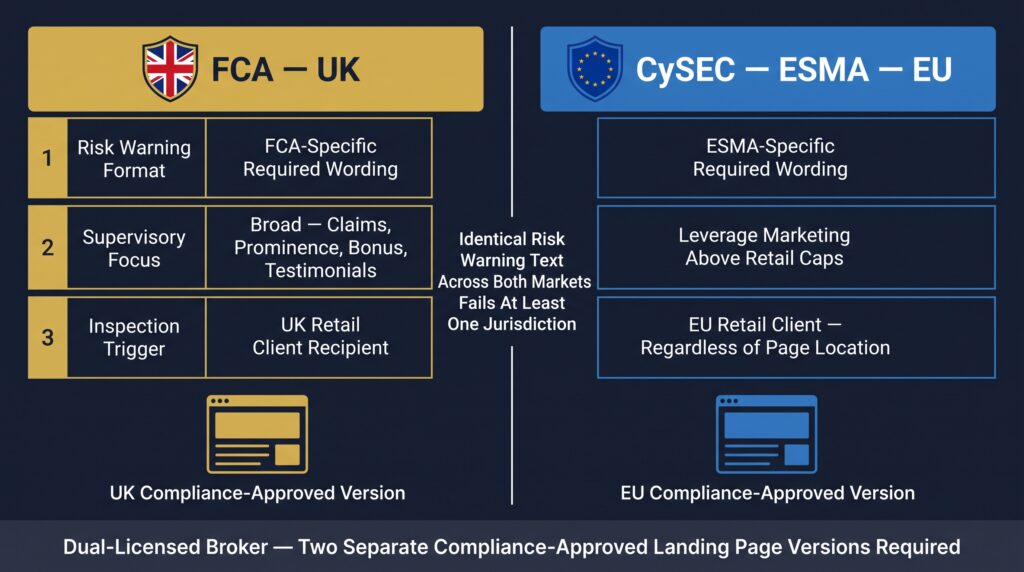
| Dimension | FCA (UK) | CySEC / ESMA (EU) |
|---|---|---|
| Risk warning format | FCA-specific required wording for loss percentage disclosure | ESMA-specific required wording — similar structure, different exact text |
| Primary supervisory focus | Broad — claim substantiation, prominence, bonus prohibition, testimonials | Particular focus on leverage marketing above retail caps |
| Inspection scope trigger | UK retail client recipient | EU retail client recipient — regardless of page hosting location |
A dual-licensed broker should maintain separate compliance-approved landing page versions for UK and EU audiences, each meeting the specific requirements of the applicable framework. Using identical risk warning text across both markets is a compliance failure for at least one jurisdiction.
The regulatory tier and licensing context that determines which inspection framework applies to which audience is covered in the forex broker regulatory tier guide. The YMYL quality rater assessment that considers landing page Trust signals as part of overall E-E-A-T evaluation is covered in the YMYL and E-E-A-T framework for forex brokers.
If you want your live landing pages reviewed against the specific inspection criteria FCA and CySEC compliance reviewers apply — before a regulatory review does it for you — that assessment is part of the diagnostic.
*Regulatory requirements correct as of July 2026. FCA financial promotion rules are subject to ongoing development — verify current requirements at fca.org.uk before publication
FAQ
Q1: What do FCA and CySEC compliance reviewers check on a forex broker landing page?
FCA and CySEC compliance reviewers examining a forex broker financial promotion landing page follow a three-pass inspection sequence. The first pass assesses the above-fold view on both desktop and mobile without scrolling: whether the risk warning is visible and prominent, what the first financial claim the user encounters is, and whether commercial benefit language is balanced by equivalent risk disclosure prominence. The second pass reviews the full page content: every financial claim is assessed against the fair, clear, and not misleading standard; performance statistics such as spread figures and execution speeds are noted for substantiation requirements; leverage references are checked against the retail client cap for the relevant market; bonus and promotional offer references are checked against the retail client promotion prohibition. The third pass is a documentation review: whether the landing page was approved as a financial promotion by an authorised person before it went live, whether there is a documented compliance sign-off with a date and approver, and whether the sign-off reflects current regulatory requirements. FCA supervisory practice increasingly prioritises mobile rendering in the first pass, because mobile is the primary device for forex broker paid acquisition and mobile rendering can differ materially from desktop in terms of above-fold risk warning visibility.
Q2: What does “prominent” mean for risk warnings on a forex broker landing page under FCA rules?
Under FCA financial promotion rules, a risk warning is considered prominent on a landing page when it meets four practical inspection criteria. First, visual size: the risk warning must not be visually subordinated to the commercial headline or main marketing claim, and a risk warning in noticeably smaller font than surrounding commercial claims fails this standard. Second, placement: above-the-fold placement, where the risk warning is visible without scrolling, is the strongest prominence indicator, while below-fold placement where a user must scroll to find it consistently appears in FCA supervisory reviews as a prominence failure. Third, contrast and readability: the risk warning text must have sufficient contrast against the background to be readable at normal viewing conditions, and a light-coloured warning on a light background fails even if technically present. Fourth, currency: the percentage figure in the risk warning, representing the proportion of retail clients who lose money, must reflect the broker’s most recently calculated client loss data and not an outdated historical figure. All four dimensions must be met simultaneously for the risk warning to satisfy the FCA prominence standard. Verify current FCA guidance on prominence standards with your compliance team as these requirements are subject to ongoing supervisory development.
Q3: Why does mobile rendering matter for forex broker landing page compliance?
Mobile rendering matters for forex broker landing page compliance because FCA financial promotion supervision increasingly assesses landing pages as the retail client actually experiences them, and the retail client for a forex broker receiving a paid search or social media ad is overwhelmingly likely to be on a mobile device. Mobile rendering can differ materially from desktop rendering in ways that affect compliance: a risk warning that is above the fold on a 1440 pixel desktop screen may be below the fold on a 390 pixel mobile screen, making it invisible to a user who clicks the registration call to action without scrolling. A font size that appears readable on desktop may render smaller than expected on specific mobile devices due to browser scaling. A sticky navigation element or cookie consent banner may obscure the risk warning position on mobile scroll. The practical test is to open the landing page on a physical mobile device rather than a browser simulation, confirm without scrolling that the risk warning is visible, confirm it is readable at arm’s length, and confirm no interface element is obscuring it on mobile load. This test takes five minutes and identifies the most commonly found landing page compliance failure in regulated forex broker paid programmes.
Q4: What does the fair, clear, and not misleading standard mean for forex broker landing pages?
The FCA COBS 4.2 standard that financial promotions must be fair, clear, and not misleading applies to forex broker landing pages in three distinct dimensions. Fair requires balanced presentation of gains and risks with equivalent prominence: a landing page that features trading opportunity language prominently above the fold while placing risk disclosure below the fold fails the fairness standard because the commercial benefit receives substantially greater visual weight than the risk disclosure. Clear requires unambiguous product description: a page that promotes trading without specifying it involves leveraged derivatives with the potential to lose more than the initial deposit fails the clarity standard because the retail client cannot understand the nature of the product from the page alone. Not misleading requires that no statement, omission, or presentation creates a false impression: this covers literally false claims, misleading omissions such as failing to disclose the full cost of the trading spread, and misleading presentation such as arranging true statements in a way that creates an overall false impression of typical trading conditions. FCA supervisory focus is particularly on misleading omissions, where technically accurate individual statements combine to create an overall impression inconsistent with the typical retail client experience of the product.
Q5: Does a forex broker landing page need compliance approval before going live?
Yes. Under FCA COBS 4.4, a financial promotion communicated by an FCA-authorised person must be approved by an authorised person before communication. A forex broker landing page that promotes regulated trading products is a financial promotion and must be approved before it goes live, not reviewed after. The approval requirement also applies to material changes to an existing landing page: updating the risk warning percentage when client loss statistics change, modifying a spread or execution speed claim, adding or changing a promotional offer, and altering the leverage level referenced all constitute material changes requiring a new compliance approval. A design update that does not change the financial promotion content does not require re-approval. The approval must be documented with a date, the identity of the approving authorised person, and a reference to the specific financial promotion content approved. This documentation is what FCA compliance reviewers check in the third pass of a landing page inspection, and its absence is treated as a procedural compliance failure independent of whether the landing page content itself is substantively compliant. Equivalent requirements apply to CySEC-regulated entities under MiFID II financial promotion rules.
Q6: How do FCA and CySEC landing page compliance inspections differ in practice?
FCA and CySEC landing page compliance inspections share the same substantive standards for most requirements but differ in three practical dimensions. The first is risk warning format: FCA requires the specific percentage of retail investor accounts that lose money with the broker using FCA’s required format and wording, while ESMA requires a similar but differently worded risk warning format for CySEC-regulated entities. A dual-licensed broker must use different risk warning texts for its UK-targeted and EU-targeted landing pages. The second is supervisory focus area: CySEC’s supervisory notice pattern reveals a particular focus on leverage marketing, with landing pages featuring leverage above the retail client cap or implying access to higher leverage being a primary CySEC inspection trigger, while FCA’s enforcement pattern is broader, covering claim substantiation, risk warning prominence, bonus prohibition, and testimonial disclaimer requirements more extensively. The third is inspection scope: CySEC’s inspection scope covers any landing page served to an EU retail client by a CySEC-regulated entity regardless of the page’s physical hosting location or domain country code, because the regulatory trigger is the recipient’s location rather than the page’s origin. A dual-licensed broker should maintain separate compliance-approved landing page versions for UK and EU audiences, each meeting the specific requirements of the applicable regulatory framework.