·
Forex Broker Licences Explained, how important are they?
Your regulatory licence is not just a compliance requirement — it is one of the most commercially significant marketing decisions your forex broker has made.
Most forex broker CMOs know their regulator’s name. Fewer understand what their regulatory tier means for which markets they can acquire clients in, which advertising platforms they can access, where they appear in comparison site listings, and what trust signal their brand carries in Google’s quality assessment for YMYL financial content. These are not abstract regulatory questions — they are direct determinants of acquisition cost, FTD volume, and average first deposit amount.
Practitioner Observation
In every regulatory strategy conversation I have had with a CySEC-regulated broker considering FCA authorisation, the decision comes down to one calculation that nobody has done properly: the FCA licence unlocks UK market access, comparison site premium placement, and Google Ads permissions for UK traffic — but the compliance infrastructure cost, the appointed representative overhead, and the capital adequacy requirements mean the incremental FTD volume needed to break even is higher than most marketing teams estimate before the conversation starts.
This article covers every major forex regulatory jurisdiction within a three-tier framework based on regulatory stringency, capital requirements, and marketing trust signal strength. Tier 1 (FCA, ASIC, MAS, BaFin) represents the highest-trust environments and the strongest marketing assets. Tier 2 (CySEC, FSCA, DFSA) provides solid regulated status with regional market access. Tier 3 offshore licences offer lower barriers with specific marketing constraints. Wherever your broker sits in this framework — and whether you hold one licence or several — what follows explains what that means commercially.
Table of Contents
Forex Broker Licences Explained— Every Major Forex Licence Categorised
The table below is the reference framework for A15 in its entirety. Every regulator that materially affects forex broker marketing is included. Capital figures are indicative — verify with the relevant regulatory body before any commercial decision. The marketing implications in the final two columns are the core of what follows in each section.
| TIER 1 — HIGHEST TRUST · STRONGEST MARKETING ASSET · HARDEST TO OBTAIN | |||||
| Regulator | Country | Key Markets Opened | Min Capital (indicative) | Google/Meta Ads Access | Comparison Site Tier |
|---|---|---|---|---|---|
| FCA | United Kingdom | UK retail market — highest avg deposit English-language market | €125K–€730K+ | ✓ Full UK access | Premium |
| ASIC | Australia | AU retail — high per-capita trading population, strong avg deposits | A$1M NTA | ✓ Full AU access | Premium |
| MAS | Singapore | Singapore + ASEAN HNW institutional segment | S$1M+ | ✓ SG market access | Premium |
| BaFin | Germany | EU passporting via German MiFID II entity (largest EU retail market) | €730K+ | ✓ Full EU access | Premium |
| JFSA | Japan | Japanese retail market — world’s largest retail forex by volume | ¥50M+ | ✓ JP market | Premium |
| TIER 2 — SOLID REGULATED · REGIONAL MARKET ACCESS · STRONG MARKETING CREDIBILITY | |||||
| Regulator | Country | Key Markets Opened | Min Capital (indicative) | Google/Meta Ads Access | Comparison Site Tier |
| CySEC | Cyprus (EU) | All 27 EU member states via MiFID II passporting — broadest single-licence coverage globally | €125K–€730K | ✓ EU markets | Standard |
| FSCA | South Africa | South African retail + broader Sub-Saharan Africa recognition | ZAR varies — solvency-based; ~ZAR 2–10M recommended in practice | ✓ SA market | Standard |
| DFSA | UAE (Dubai) | DIFC-based clients + GCC high-net-worth institutional segment | $500K+ | ✓ DIFC market | Standard |
| ADGM | UAE (Abu Dhabi) | Abu Dhabi Global Market + GCC institutional access | $500K+ | ✓ ADGM market | Standard |
| SCB | Bahamas | Americas region broker operations + Atlantic HNW clients | $300K+(Market Maker/Dealing as Principal licence. For Agent-only/STP model the requirement is lower) | Limited | Limited |
| FSC Mauritius | Mauritius | Africa + Indian Ocean region + emerging Asia-Pacific recognition | $50K–$250K(Discount Broker: ~$13K (MUR 600K) Broker: ~$15K (MUR 700K) Full Service Dealer (most common for retail forex): ~$22K (MUR 1M) Full Service incl. Underwriting: ~$220K (MUR 10M) | Limited | Limited |
| TIER 3 — OFFSHORE · LOWER BARRIER · SPECIFIC MARKETING CONSTRAINTS IN REGULATED MARKETS | |||||
| Regulator | Country | Primary Markets | Min Capital (indicative) | Google/Meta Ads Access | Comparison Site Tier |
| VFSC | Vanuatu | MENA, Southeast Asia, Pacific — unregulated markets | $50K | ✗ Restricted UK/EU/AU | Excluded or caveated |
| Seychelles FSA | Seychelles | MENA, Sub-Saharan Africa, parts of Southeast Asia | $100K | ✗ Restricted UK/EU/AU | Excluded or caveated |
| SVG FSA* | St. Vincent | *Business registration only — not a regulatory authorisation for forex | Minimal | ✗ Restricted | Generally excluded |
*SVG FSA does not provide forex regulatory oversight — SVG-registered entities are legally unregulated. All capital figures are indicative — verify with the relevant regulatory body before any commercial decision. Advertising access reflects general policy as of August 2026; verify current requirements directly with Google Ads and Meta Business Support.
*Capital figures indicative. Verify current requirements with your compliance team before publication. Last verified August 2026
Tier 1 — FCA, ASIC and MAS: The Marketing Advantages of the Highest Trust Licence
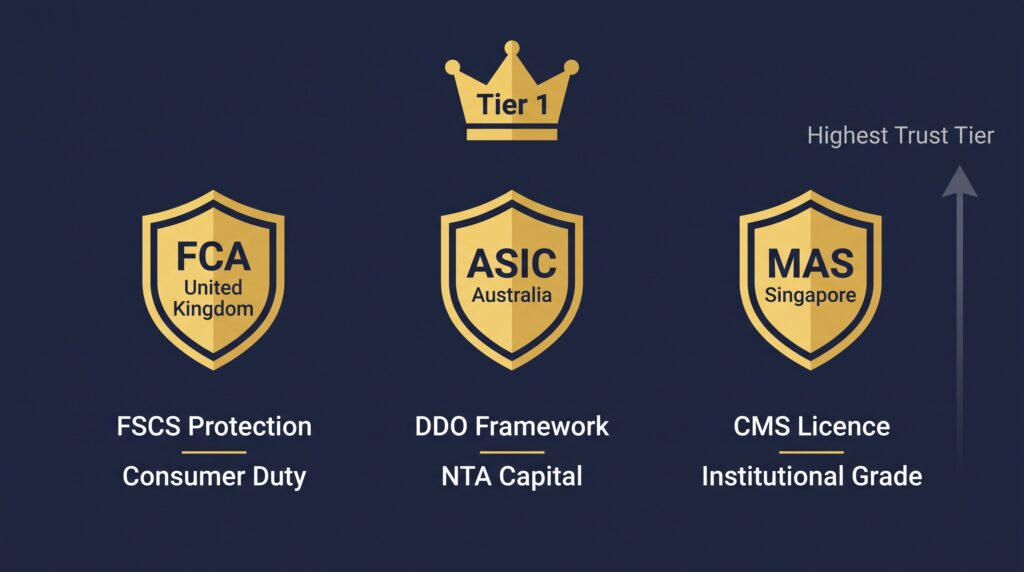
A Tier 1 regulatory licence is a marketing asset as much as a compliance requirement. The five advantages below apply to all Tier 1 regulators — with FCA being the most commercially impactful for English-language markets.
Advantage 1 — The regulatory register as trust signal. An FCA-regulated broker appears on the FCA Financial Services Register — a government-maintained public database confirming the entity is authorised to provide regulated financial services. As covered in the E-E-A-T framework for forex brokers, this register entry is the strongest available trust signal for YMYL financial content. Quality raters can verify the broker’s authority with one click. No backlink, no about page, and no industry award provides equivalent institutional trust confirmation.
Advantage 2 — Full paid advertising access. FCA-regulated entities can obtain Google Ads financial product certification for UK market campaigns and Meta Ads financial product access for UK and international audiences. The full digital paid acquisition stack — search, display, social, YouTube — is open. ASIC-regulated entities access the equivalent Australian advertising stack. This is the most commercially immediate difference between Tier 1 and Tier 3 licensing — the difference between a fully operational paid acquisition programme and one with significant platform restrictions.
Advantage 3 — Premium comparison site placement. Major forex comparison sites — ForexBrokers.com, BrokerChooser, FXEmpire — feature FCA-regulated brokers in premium review positions with full editorial coverage. For ASIC-regulated brokers, the equivalent applies in Australian market comparison sites. This organic referral channel delivers high-intent FTDs at lower CAC than most paid acquisition channels.
Advantage 4 — Geographic market access. FCA opens the UK retail market — the highest average first deposit market of any English-language retail forex geography. ASIC opens the Australian market. MAS opens Singapore and the ASEAN HNW client segment. The Japan market (JFSA) is the world’s largest retail forex market by volume — JFSA regulation is essentially required to operate meaningfully there.
Advantage 5 — IB and affiliate programme quality. The highest-quality UK-based IBs and regulated affiliate publishers require FCA counterparty status. An IB programme without FCA registration is structurally excluded from the top tier of UK IB relationships. ASIC provides the equivalent access in Australia.
The Tier 1 marketing constraints: FCA financial promotions require risk warnings disclosing the percentage of retail CFD clients who lose money, prohibition of bonus offers to retail clients under COBS rules, and leverage caps of 30:1 on major pairs. These are compliance constraints on marketing messaging — not restrictions on who you can reach, but on what you can say when you reach them.
Tier 2 — CySEC, FSCA and DFSA: Marketing Within the Regulated Framework
Tier 2 regulation is the everyday marketing reality for most CMOs at European, African, and Gulf-based forex brokers. CySEC in particular represents the regulatory framework most Cluster A readers are operating within.
CySEC — the EU passporting advantage. A single CySEC licence allows a broker to passport financial services to all 27 EU member states under MiFID II. This is the broadest geographic coverage per single licence of any regulatory jurisdiction globally — 450+ million potential clients accessible from one regulatory application and ongoing compliance framework. For a broker targeting EU retail traders, CySEC is the rational primary choice precisely because of this breadth.
The CySEC marketing toolkit: Google Ads and Meta Ads financial product advertising access for EU market audiences, standard comparison site placement across EU-focused forex review platforms, and EU affiliate and IB programme access. The ESMA constraints that apply under CySEC exactly mirror FCA constraints for retail clients: 30:1 leverage cap on major pairs, mandatory risk warning disclosures in all financial promotions, and prohibition on bonus offers to retail clients under ESMA guidelines. These constraints are not CySEC-specific — they are EU-wide requirements that apply to any MiFID II-regulated entity regardless of which EU regulator issued the licence.
POST-BREXIT NOTE FOR CYSEC-REGULATED BROKERS
CySEC regulation no longer covers UK retail client solicitation after Brexit. The UK-EU financial services passporting arrangement ended in January 2021. A CySEC-regulated broker cannot legally solicit UK retail clients under their CySEC licence alone. UK market access requires FCA authorisation — this is the primary commercial argument for CySEC + FCA multi-licence strategy for brokers targeting both EU and UK audiences.
FSCA — the African market gateway. South Africa has one of the most active retail forex trading communities in Africa, and FSCA regulation is the primary trust signal for South African client acquisition. FSCA is also increasingly recognised across broader Sub-Saharan African markets as the region’s benchmark regulatory framework. Google Ads financial product certification is available for FSCA-regulated entities in the South African market.
DFSA — the DIFC gateway. The Dubai Financial Services Authority governs financial services within the Dubai International Financial Centre (DIFC) free zone. DFSA regulation is the primary trust signal for DIFC-based client acquisition and high-net-worth GCC investors. It is distinct from regulation by the UAE’s mainland regulator (Central Bank of UAE) and from ADGM (Abu Dhabi Global Market). For brokers targeting GCC institutional and HNW clients through the DIFC ecosystem, DFSA positioning is the relevant credential.
Tier 3 — Offshore Licences, What They Mean and the Honest Marketing Framework
Tier 3 offshore licences are legal, commercially rational for specific markets, and used by a significant proportion of forex brokers globally. The marketing constraints are real and specific — not abstract compliance concerns but direct limitations on advertising access and comparison site positioning.
What Tier 3 licences are and are not. Vanuatu VFSC and Seychelles FSA provide actual regulatory frameworks — functioning financial services commissions with registration and compliance requirements, albeit with significantly lower capital thresholds and regulatory oversight than Tier 1 or Tier 2 bodies. SVG FSA (St. Vincent and the Grenadines) is a different category: SVG provides company registration, not regulatory authorisation. The SVG FSA does not supervise forex brokers’ financial activities — a broker “regulated” by SVG FSA is effectively unregulated. This distinction matters for honest marketing — describing SVG registration as regulatory authorisation equivalent to CySEC or FCA is factually inaccurate.
The honest marketing framework for Tier 3 brokers — four principles:
First — target markets where Tier 3 is commercially adequate. MENA retail traders in markets without strong domestic regulatory requirements, parts of Southeast Asia, Sub-Saharan Africa outside South Africa, and Latin America are markets where Tier 3 licences face fewer advertising restrictions and where comparison site exclusions are less commercially damaging. Operating in these markets with honest regulatory disclosure is a rational business decision.
Second — be transparent, not obscure. Sophisticated traders increasingly check regulatory status before depositing. A broker that buries its SVG or Vanuatu registration in footer text while implying institutional credibility is creating a trust gap that damages retention. Transparent disclosure of regulatory status — combined with honest explanation of the client fund protection measures the broker does provide — is more effective for long-term client relationships than regulatory obfuscation.
Third — focus messaging on service quality. Trading conditions, platform quality, spread competitiveness, execution speed, and customer service are messaging categories that do not depend on regulatory tier. These are areas where Tier 3 brokers can compete effectively without regulatory authority as the primary trust signal.
Fourth — plan the upgrade path. Tier 3 is a commercial starting point for many brokers, not a permanent strategy. The upgrade to CySEC (Tier 2, EU access, established regulatory framework) or FCA (Tier 1, UK access, highest trust signal) becomes commercially rational once base client volumes justify the investment. The commercial case for regulatory upgrade is covered in full in the section below.
Advertising Permissions and Restrictions by Regulatory Tier
The advertising access gap between regulatory tiers is one of the most commercially significant and least-discussed implications of regulatory choice. The difference between full Google Ads access and no Google Ads access is the difference between scalable paid acquisition and dependence on organic, affiliate, and IB channels.
| Platform | Tier 1 (FCA/ASIC) | Tier 2 (CySEC/FSCA) | Tier 3 (Offshore) |
|---|---|---|---|
| Google Ads — UK | ✓ Full (FCA cert required) | ✗ Post-Brexit excluded | ✗ Restricted |
| Google Ads — EU | ✓ Full | ✓ Full (CySEC cert) | ✗ Restricted |
| Google Ads — AU | ✓ Full (ASIC cert) | ✗ ASIC cert required — not eligible without it” | ✗ Restricted |
| Meta Ads — UK/EU | ✓ Full | ✓ EU full / UK limited | ✗ Restricted |
| Bonus promotions | ✗ Retail restricted (COBS/ESMA) | ✗ Retail restricted (ESMA) | ✓ No restriction |
| Leverage marketing (>30:1) | ✗ Restricted for retail | ✗ Restricted for retail | ✓ No restriction |
*Google Ads certification process moved in-account June 2026. Verify current platform policies directly before campaign launch.”
Advertising access is the most commercially immediate difference between regulatory tiers. The one Tier 3 advertising advantage (no bonus or leverage restrictions) is a marketing constraint trade-off — Tier 3 brokers can advertise bonuses but in markets where regulatory advertising access is already limited. Verify all policies directly with advertising platforms as of your publish date.
Geographic Client Acquisition — Which Licence Opens Which Market
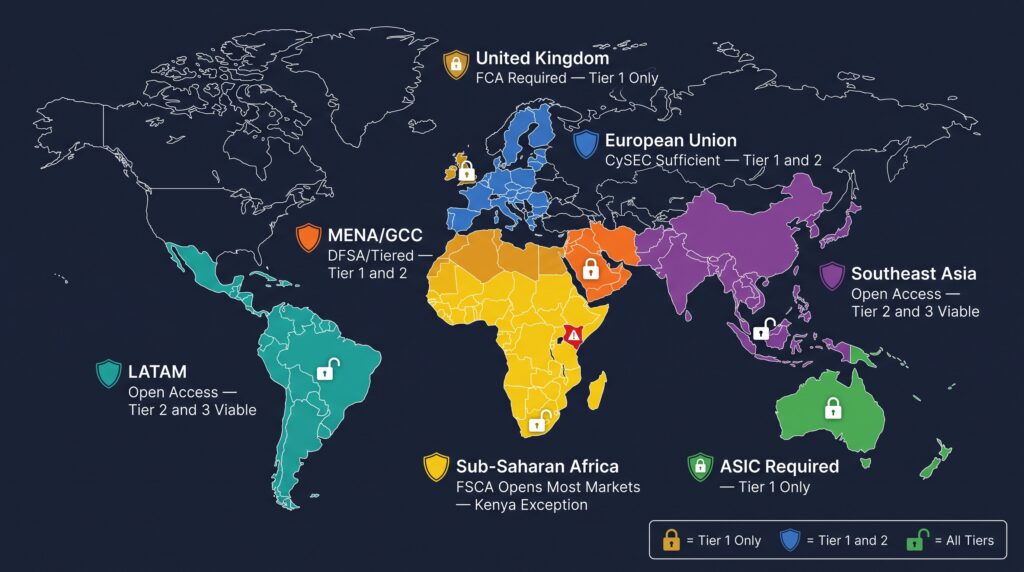
The regulatory licence determines geographic client acquisition access more directly than almost any other business decision. The licence-to-market mapping is not a legal abstraction — it determines the client segments available to the broker’s marketing team.
UK market — FCA required. CySEC-regulated brokers cannot legally solicit UK retail clients post-Brexit. UK access requires FCA authorisation. UK retail clients average the highest first deposit of any English-language market globally — a combination of regulatory trust threshold filtering (clients who research before depositing tend to deposit more) and general affluence. The average first deposit differential between FCA-regulated UK clients and CySEC-regulated EU clients makes UK market access a commercially significant revenue opportunity for brokers with the right client acquisition infrastructure.
EU markets — CySEC sufficient. All 27 EU member states are accessible through CySEC’s MiFID II passporting rights. This is CySEC’s defining commercial advantage — no other single licence provides equivalent EU breadth. Germany, France, Spain, Italy, Netherlands, and Poland are the highest-volume EU retail forex markets. CySEC covers all of them from one licence.
Australian market — ASIC preferred. ASIC regulation is the dominant trust signal for Australian retail forex client acquisition. Post-ASIC Product Intervention Order (2021), leverage restrictions apply to all Australian retail CFD clients regardless of broker jurisdiction — but ASIC registration is the trust signal for Australian comparison sites, affiliate programmes, and client due diligence. Without ASIC, acquiring Australian retail clients at scale through legitimate digital channels is significantly constrained.
MENA and GCC — tiered access. Within the DIFC in Dubai, DFSA regulation is the standard. For the broader UAE market outside DIFC, and across the GCC generally, Tier 2 licences (CySEC, FSCA, ADGM) are commonly accepted by local IBs and comparison site partners. In markets like Egypt, Jordan, and Iraq, Tier 3 licences face fewer obstacles — regulatory enforcement for retail forex is lower and comparison site coverage for these markets is less developed.
Southeast Asia — fragmented access. Each country has distinct regulatory requirements. Singapore requires MAS. Malaysia’s Labuan FSA is a borderline Tier 2-3 jurisdiction. Indonesia, Thailand, and Vietnam have domestic regulatory frameworks for forex that are separate from offshore licences — brokers operating in these markets typically do so through local IB networks rather than direct digital acquisition.
The Commercial Case for Regulatory Upgrade — When FCA Pays for Itself
The regulatory upgrade decision from CySEC (Tier 2) to FCA (Tier 1) — or adding FCA to an existing CySEC licence — is the most commercially significant regulatory strategy decision most European forex broker CMOs and CEOs will face. The five factors below determine whether the investment is commercially rational within an 18-month return horizon.
THE FIVE REVENUE FACTORS IN THE FCA UPGRADE DECISION
Factor 1 — UK Market Access
UK retail clients: highest avg first deposit of any English-language forex market. Quantify: what is the realistic incremental FTD volume from UK acquisition given current traffic mix?
Factor 2 — Comparison Site Premium
FCA unlocks premium comparison site placement for UK (ForexBrokers.com, BrokerChooser premium tier). Incremental organic FTD referrals at lower CAC than paid channels.
Factor 3 — Google Ads UK Market
FCA certification opens full Google Ads paid search for UK audiences. UK financial services CPC is high — but conversion intent is highest in any English-language market.
Factor 4 — IB Programme Quality
UK-based high-quality IBs and regulated affiliates require FCA counterparty. FCA addition opens the premium IB tier currently structurally excluded from the broker’s programme.
Factor 5 — E-E-A-T and Organic Content Value
FCA register entry is the strongest available trust signal for YMYL financial content per the E-E-A-T framework. FCA addition increases the quality rater assessment of every piece of content on the broker’s site — a compounding long-term organic value.
THE BREAK-EVEN QUESTION
FCA setup + year-1 cost: approximately 75,000–175,000 euro. Does incremental UK market FTD revenue from these five factors recover this within 18 months? For brokers with meaningful UK organic traffic, planned UK acquisition, or an existing IB programme — usually yes.
When the upgrade is not justified: A broker with zero UK acquisition intent, no existing UK organic traffic, and no UK IB relationships has no Factor 1, 2, or 4 revenue. The FCA cost is a pure compliance overhead without commercial return. For these brokers, optimising existing CySEC regulatory positioning (regulatory register prominence, author credentials, regulatory proof content — covered in A14) delivers better commercial return than the FCA addition cost.
FOR CEOS — THE ONE QUESTION BEFORE THE FCA DECISION
What percentage of your current organic traffic comes from UK visitors, and what is the average first deposit of any UK clients who have already FTD’d through non-direct channels? If UK traffic is 15%+ of total and existing UK FTDs average above your overall average, the FCA upgrade financial case is almost certainly positive within 18 months.
The Multi-Licence Strategy — Why Major Brokers Hold Multiple Regulatory Licences
Most major regulated forex brokers above a certain scale hold multiple licences simultaneously. The commercial logic is straightforward: no single licence provides global retail coverage at the trust tier required for premium market access in multiple regions.
The most common multi-licence combinations:
- CySEC + FCA: The dominant European combination. CySEC covers all 27 EU member states. FCA adds UK retail access, UK comparison site premium placement, and full UK paid advertising. The entity structure is typically two separate legal entities operating under the same brand — “XYZ Markets (CY) Limited” regulated by CySEC for EU clients, “XYZ Markets UK Limited” regulated by FCA for UK clients.
- CySEC + ASIC: EU plus Australia. Covers the two largest English-language retail forex markets outside the UK from two licences. Common for brokers with significant Southern European and Australian client bases.
- FCA + ASIC + CySEC: The “triple-regulated” positioning used by the largest retail forex brokers. Full UK, EU, and Australian market coverage with the premium trust signal in all three. Each licence requires its own entity, compliance team, and capital allocation — significant overhead that only scales commercially at high client volumes.
- CySEC + DFSA: EU plus DIFC Dubai. Common for brokers with significant GCC client acquisition through IB relationships.
The marketing complexity of multi-licence operation: Each entity and licence requires separate compliance-approved marketing assets. FCA marketing must include mandatory risk warnings showing the percentage of retail CFD clients who lose money. ESMA/CySEC marketing requires the same under EU rules. ASIC has equivalent Australian requirements. A marketing team managing CySEC + FCA + ASIC simultaneously must maintain three separate sets of approved advertising copy, three separate landing page variants, and three separate IB programme agreements — each compliant with the relevant regulatory context. This complexity is manageable with the right systems and justifiable at the revenue volumes these licence combinations unlock.
The commercial case for multi-licence operation follows the same five-factor framework as the single upgrade decision — applied iteratively as each new licence opens a new market with addressable FTD volume exceeding the marginal licence cost.
If you want to understand what your regulatory tier means specifically for your acquisition strategy — including whether a regulatory upgrade would pay for itself within your current channel mix — that analysis is part of an audit.
FAQ
Q1: What are the three regulatory tiers for forex brokers?
Forex broker regulatory licences are categorised across three tiers based on regulatory stringency, capital requirements, and the marketing trust signal they provide. Tier 1 regulators represent the highest scrutiny and the strongest marketing trust signals and include the FCA in the UK, ASIC in Australia, MAS in Singapore, BaFin in Germany, and JFSA in Japan. Tier 2 regulators provide solid regulated status with regional market access and include CySEC in Cyprus providing EU MiFID II passporting across all 27 member states, FSCA in South Africa, DFSA in Dubai, and ADGM in Abu Dhabi. Tier 3 comprises offshore jurisdictions with lower capital requirements and specific marketing constraints including VFSC in Vanuatu, Seychelles FSA, and entities registered in St. Vincent and the Grenadines. Each tier determines advertising access, comparison site placement, geographic client acquisition opportunities, and the regulatory trust signal the broker can use in its marketing communications.
Q2: What marketing advantages does FCA regulation provide for a forex broker?
FCA regulation provides five measurable marketing advantages for a forex broker. First, the FCA Financial Services Register entry is the strongest available trust signal for YMYL financial content in Google’s quality assessment framework. Second, FCA authorisation enables Google Ads and Meta Ads financial product certification for UK market advertising, opening the full digital paid acquisition stack. Third, FCA regulation provides access to the UK retail client market, which has one of the highest average first deposit amounts of any English-language forex market. Fourth, FCA-regulated brokers receive premium placement in major forex comparison sites including ForexBrokers.com and BrokerChooser. Fifth, the highest-quality UK and international Introducing Brokers and regulated affiliates require FCA counterparty status. FCA marketing constraints include mandatory risk warning disclosures in all financial promotions, restrictions on bonus offers to retail clients under COBS rules, and leverage caps of 30 to 1 on major currency pairs.
Q3: What marketing advantages does CySEC regulation provide for a forex broker?
CySEC regulation provides EU MiFID II passporting rights, allowing a CySEC-regulated broker to passport financial services to all 27 EU member states from a single Cypriot regulatory licence. This gives CySEC the broadest geographic coverage per single licence of any regulatory jurisdiction globally, enabling marketing and client acquisition across the entire EU retail forex market. Google Ads and Meta Ads financial product advertising is available for CySEC-regulated entities in EU markets. Standard comparison site placement on major forex review platforms. ESMA marketing constraints apply under CySEC: leverage caps of 30 to 1 on major pairs for retail clients, mandatory risk warnings in all financial promotions showing the percentage of retail CFD clients who lose money, and restrictions on retail client bonus offers under ESMA guidelines.
Q4: What advertising restrictions apply to offshore Tier 3 forex brokers?
Tier 3 offshore forex brokers regulated by Vanuatu VFSC, Seychelles FSA, or registered in St. Vincent and the Grenadines face significant restrictions on digital advertising in major regulated markets. Google Ads financial product advertising policies restrict promotion from entities not regulated by recognised financial authorities, and these offshore jurisdictions are generally not recognised as qualifying regulators for UK, EU, US, or Australian audience targeting. Meta Ads has equivalent restrictions. The practical consequence is that Tier 3 brokers face blocked or heavily restricted access to paid search and social advertising in regulated markets. Their primary acquisition channels are typically organic content, affiliate marketing, IB relationships, and paid advertising in markets with lower regulatory oversight. These constraints are a primary commercial argument for regulatory upgrade to Tier 2 or Tier 1 for brokers seeking to scale into regulated markets. Verify current Google Ads and Meta Ads policies directly as these are updated periodically.
Q5: When does it make commercial sense for a forex broker to upgrade from CySEC to FCA?
The commercial case for adding an FCA licence to an existing CySEC-regulated operation depends on five revenue factors: UK market access including the higher average first deposit profile of UK retail clients, comparison site premium placement that provides incremental organic referral traffic, Google Ads financial product certification for UK paid search campaigns, access to high-quality UK and international IBs that require FCA counterparty status, and the E-E-A-T trust signal advantage for organic content ranking. FCA authorisation setup and year-one costs are typically in the range of seventy-five thousand to one hundred and seventy-five thousand pounds. The break-even question is whether FCA-enabled incremental UK market FTD revenue from these five factors recovers this investment within twelve to eighteen months. For a broker with meaningful UK organic traffic, an existing IB programme, or planned UK market acquisition, the calculation frequently favours upgrade. For brokers with no UK acquisition intent, the cost is rarely justified.
Q6: Why do major forex brokers hold multiple regulatory licences?
Major forex brokers hold multiple regulatory licences because each licence opens a specific geographic market and client trust tier that cannot be adequately served by a single licence. CySEC provides EU passporting for 27 European markets. FCA adds the UK market and the highest global trust signal. ASIC adds Australian retail access. MAS adds Singapore and ASEAN high-net-worth clients. DFSA adds DIFC Dubai. No single licence provides global retail coverage at the trust tier required for premium market access in multiple regions simultaneously. As broker revenue scales, the ROI on additional licences improves because the fixed licence cost is spread across a larger client base. The multi-licence strategy becomes commercially rational once monthly FTD volumes from existing markets justify the incremental investment required to open new regulated markets. Each additional licence also requires separate compliance-approved marketing materials per regulatory context, which increases marketing team complexity and cost.