Google Ads Financial Services Certification, what forex brokers needs to do?
Google’s own advertising policy documentation explains what financial services certification requires — this guide covers what that actually looks like when a forex broker applies.
Google’s Advertising Policies Help Centre is the authoritative, continuously updated source for the policy itself, and we link to it directly throughout this article. What that documentation does not provide, because it covers every industry requiring certification rather than forex specifically, is the practitioner application experience: which documents a forex broker specifically needs, what a realistic timeline looks like, and the common mistakes that delay forex and CFD applications specifically.
The most common reason a forex broker’s certification application stalls isn’t the regulatory documentation itself — it’s a mismatch between the legal entity name on the licence and the legal entity name on the Google Ads billing account, something that’s easy to overlook in multi-entity broker structures.
This guide completes the certification thread referenced across the diagnostic framework, the account structure guide, and the geo-targeting sequence — explaining the application process those frameworks have assumed as a precondition.
Table of Contents
The Two-Step Process, Applied to a Forex Broker
Per Google’s own advertising policies documentation, the process has two distinct steps. Step one is general advertiser verification — confirming business identity, applicable to every Google Ads advertiser regardless of industry. Step two is industry-specific certification — the forex/CFD-specific application demonstrating regulatory authorisation to offer the advertised financial products.
What this looks like for a forex broker specifically: Step one requires standard business verification documentation (legal entity registration, billing details matching the business). Step two requires the broker’s specific regulatory licence documentation — FCA, CySEC, ASIC, or the equivalent authorisation for the markets being targeted — demonstrating the entity is authorised to provide the advertised financial products in those specific markets.
For the exact current requirements and documentation formats accepted, verify directly at Google’s Advertising Policies Help Centre, since these specifics are updated periodically.
Document Preparation Checklist Before You Apply
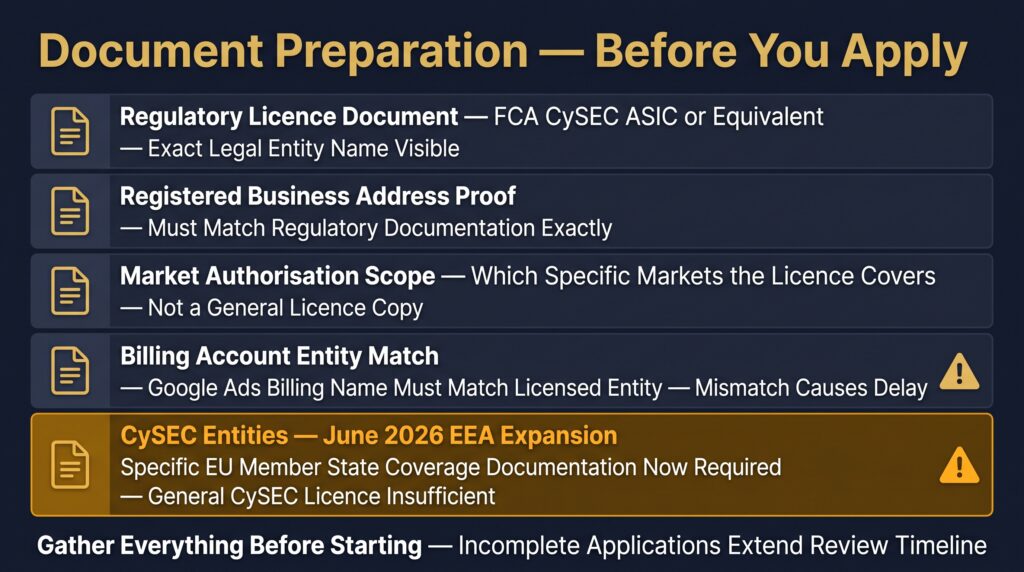
Before starting a certification application, gather:
- Current regulatory licence documentation (FCA, CySEC, ASIC, or equivalent) showing the exact legal entity name.
- Proof of the entity’s registered business address matching the regulatory documentation exactly.
- Clear documentation of which specific markets the licence authorises the entity to serve, connecting to the certification-to-market mapping principle established in the Google Ads account structure guide.
- Confirmation that the entity name on the Google Ads billing account matches the regulated entity exactly — a mismatch between billing entity and licensed entity is a commonly observed cause of application delay.
*For CySEC-regulated entities applying for EU market certification following the June 2026 EEA expansion: documentation showing specific EU member state coverage is commonly requested — a general CySEC licence document without market-specific authorisation detail has been observed causing additional review rounds.
Realistic Timeline Expectations
Financial services certification applications typically involve a longer review period than standard advertiser verification, given the additional regulatory documentation review involved. A broker should not assume certification will complete before a planned campaign launch date without building in buffer time.
The practical action: Apply for certification well in advance of any planned campaign launch — treating certification as a same-week formality rather than a process requiring lead time is the most common avoidable cause of launch delays. This is particularly important when entering a new market, where certification should be Step 1 of the practical decision sequence established in the geo-targeting strategy guide, completed before campaign creative and targeting are finalised, not in parallel with launch preparation.
Common Application Issues Specific to Forex and CFD Applicants
Commonly observed forex-specific certification issues:
- Entity mismatch. Submitting regulatory documentation for a related but legally distinct entity than the one actually running the Google Ads account — common in multi-entity broker structures where a holding company, an EU entity, and a UK entity may share branding but are legally separate.
- Scope mismatch. Applying for certification covering a broader market scope than the actual regulatory licence supports — for example, requesting certification for UK targeting using only a CySEC licence without separate FCA authorisation.
- Expiration runway. Submitting regulatory documentation that is valid but nearing expiration, which may not provide sufficient validity runway for the review process to complete comfortably.
Each of these connects to the certification-to-market mapping discipline established in the account structure guide and the regulatory authorisation verification emphasised in the geo-targeting guide — application issues often trace back to the same underlying documentation discipline gaps those frameworks are designed to prevent.
Certification Is Not a One-Time Event
Per the certification mapping discipline established in the account structure guide, certification status requires periodic verification and renewal tracking — not a one-time approval to file away. A broker should treat initial certification approval as the start of an ongoing compliance obligation, consistent with the periodic audit principle established for geo-targeting settings in the geo-targeting strategy guide.
THE PRACTICAL ACTION
Add the certification approval date and any known renewal requirements to the same certification mapping document already tracking Google Ads market-by-market status, ensuring renewal reminders are set well before any expiration to avoid a lapse that could pause active campaigns unexpectedly.
Multi-Entity and Multi-Market Application Sequencing
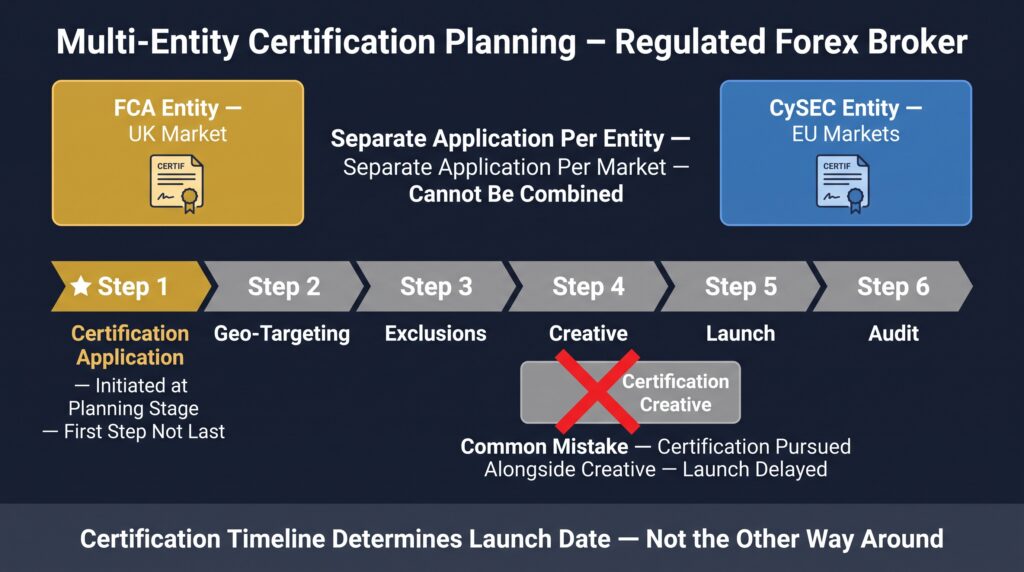
A broker with multiple regulated entities — for example, a CySEC entity and a separate FCA entity, per the multi-licence structure discussed in the regulatory tier guide — requires separate certification applications per entity and per market, since certification is tied to the specific advertising account and the specific regulatory documentation submitted for it.
The sequencing principle: Certification application should be planned to align with the market expansion sequence established in the geo-targeting strategy guide — certification confirmation is Step 1 of that six-step sequence, completed before geo-targeting configuration, not pursued in parallel with or after campaign creative development. A broker expanding into a new market should initiate certification at the earliest planning stage, well before creative production or launch date commitments are made.
A Practical Application Checklist
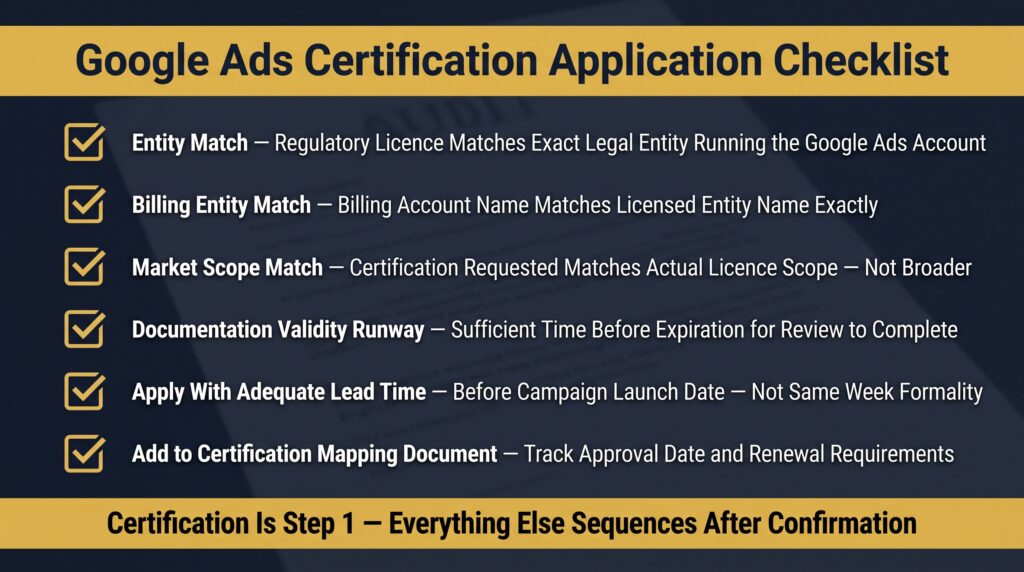
✓Confirm entity match — regulatory licence documentation matches the exact legal entity running the Google Ads account.
✓Confirm billing entity match — billing account name matches the licensed entity name exactly.
✓Confirm market scope match — certification requested matches the licence’s actual market scope, not a broader one.
✓Confirm documentation validity runway — sufficient time before expiration for the review process to complete.
✓Apply with adequate lead time — before any planned campaign launch date, not as a same-week formality.
✓Add to certification mapping document — track approval date and renewal requirements alongside Google Ads market status.
For the most current policy specifics and accepted documentation formats, always verify directly at Google’s Advertising Policies Help Centre.
If you want your certification status and application documentation reviewed against your current regulatory licences and campaign markets, that review is part of the diagnostic.
FAQ
Q1: What is the process for a forex broker to get Google Ads financial services certification?
The process has two distinct steps. The first is general advertiser verification, which applies to every Google Ads advertiser regardless of industry and confirms basic business identity. The second is industry-specific certification, which for forex and CFD advertisers requires demonstrating regulatory authorisation to offer the advertised financial products in the specific markets being targeted. For a forex broker, this means submitting regulatory licence documentation, such as FCA, CySEC, or ASIC authorisation, showing the broker is licensed to provide trading services in the relevant markets. Current requirements and accepted documentation formats should be verified directly at Google’s Advertising Policies Help Centre, as the specific requirements are updated periodically. The certification process is separate from and in addition to standard advertiser verification, meaning a forex broker must complete both steps before financial product advertising can run.
Q2: What documents does a forex broker need to apply for Google Ads financial services certification?
A forex broker preparing to apply for Google Ads financial services certification should gather current regulatory licence documentation, such as FCA, CySEC, or ASIC authorisation, showing the exact legal entity name that will be running the Google Ads account. The broker should also have proof of the entity’s registered business address matching the regulatory documentation exactly, and clear confirmation of which specific markets the regulatory licence authorises the entity to serve, since certification is typically market-specific. It is particularly important to confirm that the entity name on the Google Ads billing account matches the licensed regulatory entity name exactly, as a mismatch between the billing entity and the licensed entity is a commonly observed cause of application delay, especially for brokers operating multiple legal entities across different regulatory jurisdictions.
Q3: How long does Google Ads financial services certification take for a forex broker?
Financial services certification applications typically involve a longer review period than standard advertiser verification, given the additional regulatory documentation review involved in confirming a forex broker’s authorisation status. A broker should not assume certification will complete quickly enough to align with a same-week campaign launch and should build in buffer time when planning a new market entry or campaign launch. The practical recommendation is to initiate the certification application well in advance of any planned launch date, treating it as an early planning step rather than a final formality completed just before campaigns go live. This is particularly important when entering a new regulatory market, where certification confirmation should be the first step in the launch sequence, completed before campaign creative and targeting configuration are finalised.
Q4: What are common reasons a forex broker’s Google Ads certification application is delayed?
Several commonly observed issues delay forex and CFD certification applications. The first is submitting regulatory documentation for a related but legally distinct entity than the one actually running the Google Ads account, which frequently occurs in multi-entity broker structures where a holding company and regional entities share branding but are legally separate businesses. The second is applying for certification covering a broader market scope than the actual regulatory licence supports, such as requesting certification for a market where the broker holds no specific authorisation. The third is submitting regulatory documentation that remains technically valid but is close enough to its expiration date that it does not provide sufficient runway for the review process to complete comfortably. Each of these issues typically traces back to gaps in the same certification and entity documentation discipline that should already be maintained for general Google Ads account structure management.
Q5: Does Google Ads financial services certification need to be renewed?
Yes, certification status should be treated as requiring ongoing verification rather than a one-time approval. A forex broker should track certification approval dates and any known renewal requirements as part of the same documentation discipline used to track Google Ads account structure and market-specific certification mapping more broadly. Setting renewal reminders well in advance of any expiration date helps prevent a lapse in certification status from unexpectedly pausing active advertising campaigns. This ongoing maintenance approach is consistent with the broader principle that compliance-related account settings, including geo-targeting configuration and certification status, require periodic audit rather than a single setup check performed once and never revisited.
Q6: Does a forex broker with multiple regulated entities need separate Google Ads certifications?
Yes. A forex broker operating multiple regulated entities, such as a separate CySEC-regulated entity for European markets and a separate FCA-regulated entity for the United Kingdom, requires a separate certification application per entity and per market, since certification is tied to the specific Google Ads account and the specific regulatory documentation submitted for that account. Brokers planning to expand into a new regulatory market with a newly licensed entity should initiate the certification application as the first step in that market expansion, before campaign creative production or launch date commitments are finalised, rather than treating certification as a parallel task to be completed alongside other launch preparations. This sequencing reduces the risk of launch delays caused by certification review timelines that extend beyond initial campaign planning expectations.