
Bonus and Incentive Marketing Rules for Forex Brokers, what is allowed?
The rule sounds simple — no bonuses for forex brokers — but the actual regulatory language is more precise than that, and the precision matters for what you can still legally do.
Regulated forex brokers are prohibited from offering “cash or other inducements to encourage retail clients to trade” — this is narrower and more specific than a blanket “no incentives” rule. It targets inducements tied to the trading or account-opening action specifically, which is exactly the distinction that determines whether a given marketing structure is prohibited or potentially viable.
The bonus compliance question I get asked most often isn’t about the broker’s own marketing — it’s after a compliance officer discovers an IB has been personally offering clients cash to sign up, with no idea their broker is now exposed to the exact prohibited inducement they thought their own marketing carefully avoided.
This rule applies not just to the broker’s own marketing but to anyone promoting the broker — including affiliates who may independently offer incentives the broker never authorized or even knows about, a risk multiplication covered in full later in this guide.
Table of Contents
Bonus and Incentive Marketing Rules for Forex Brokers-The Actual Rule, Cited Directly
Per CySEC’s Policy Statement implementing the Cyprus National Product Intervention Measures — originally issued September 27, 2019, bringing ESMA’s prior temporary intervention measures into permanent national law — firms are explicitly prohibited from “offering cash or other inducements to encourage retail clients to trade.” This was introduced alongside specific leverage caps by asset class, mandatory margin close-out, and negative balance protection, forming a coherent retail investor protection package rather than an isolated rule.
A NOTE ON CURRENCY
This Policy Statement dates to 2019, though the underlying prohibition was implemented as permanent national law and almost certainly remains in force. Always verify current applicability against CySEC’s current published rulebook or your compliance team’s current regulatory tracking — this guide explains the principle and its practical application, not a substitute for current legal confirmation specific to your entity and market.
Equivalent or substantially similar restrictions apply under FCA rules in the UK and across other EU jurisdictions implementing the same ESMA-derived framework, though the precise wording and enforcement emphasis can vary by regulator.
Note: CySEC tightened CFD rules further in April 2026 — the bonus prohibition remains unchanged but the overall regulatory direction is toward stricter retail investor protection. The 2019 framework is the floor, not the ceiling.”
The Inducement Test — What Actually Makes Something Prohibited
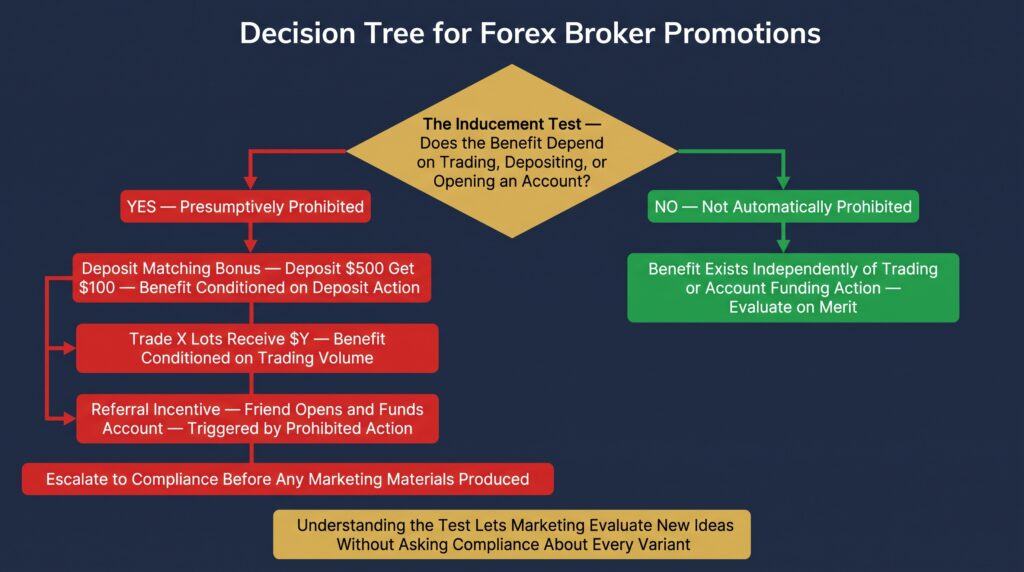
The prohibited category specifically targets incentives tied to the trading or account-opening action itself — not all forms of client benefit generally. The test: does the benefit depend on the client trading, depositing, or opening an account?
What clearly fails this test: A deposit-matching bonus (“deposit $500, get $100 free”) fails directly — the benefit is conditioned entirely on the deposit action. A “trade X lots, receive $Y” structure fails identically — the benefit is conditioned on trading volume. A referral incentive paid when the referred friend opens and funds an account fails the same test, since the payment is triggered by the prohibited inducement-adjacent action occurring.
Why precision matters here: Understanding the test, rather than just memorizing “no bonuses” as a blanket rule, is what allows a marketing team to evaluate a genuinely new promotional idea without needing to ask compliance about every single variant individually. Any structure where the benefit is contingent on the trading or account-funding action should be treated as presumptively prohibited and escalated for compliance review before any marketing materials are produced.
What Likely Remains Compliant — The Loyalty and Rebate Distinction
Structures that reward existing trading activity after the fact — a cashback or rebate program calculated retrospectively on trading volume already completed, rather than offered upfront as an inducement to trade more — sit in a different, generally more defensible category than an upfront bonus. The distinction rests on timing and framing: a reward calculated and paid after trading has already occurred, without being marketed as an incentive to trade more, is structurally different from a promise made in advance to encourage trading.
This distinction requires careful structuring and legal review, since a rebate program designed or marketed in a way that functions as a disguised trading inducement — for example, prominently advertising the rebate rate as a reason to trade more actively — would likely fail the same regulatory test the upfront bonus fails, regardless of the technical “after the fact” timing.
Generally clearer compliant alternatives: Educational resource access (premium market analysis, trading courses), platform tool tier upgrades, and account servicing perks (dedicated support, faster withdrawal processing) that are not tied to trading volume or deposit size at all represent the clearest compliant category, since they don’t condition any benefit on the prohibited inducement-adjacent action.
Every promotional structure under consideration — loyalty, rebate, or otherwise — should be reviewed by legal and compliance before launch, not assumed compliant based on general industry pattern-matching against what other brokers appear to be doing.
Note: CySEC’s 2026 Common Supervisory Action inspections — currently underway — specifically examine digital platform design and revenue-goal conflicts of interest. Rebate and loyalty structures that could be interpreted as incentivising trading volume are directly within scope of these inspections. Verify any such structure with your compliance team before launch and retain documented legal review.
Ad Creative Implications — Connecting to the Compliance Framework Already in Place
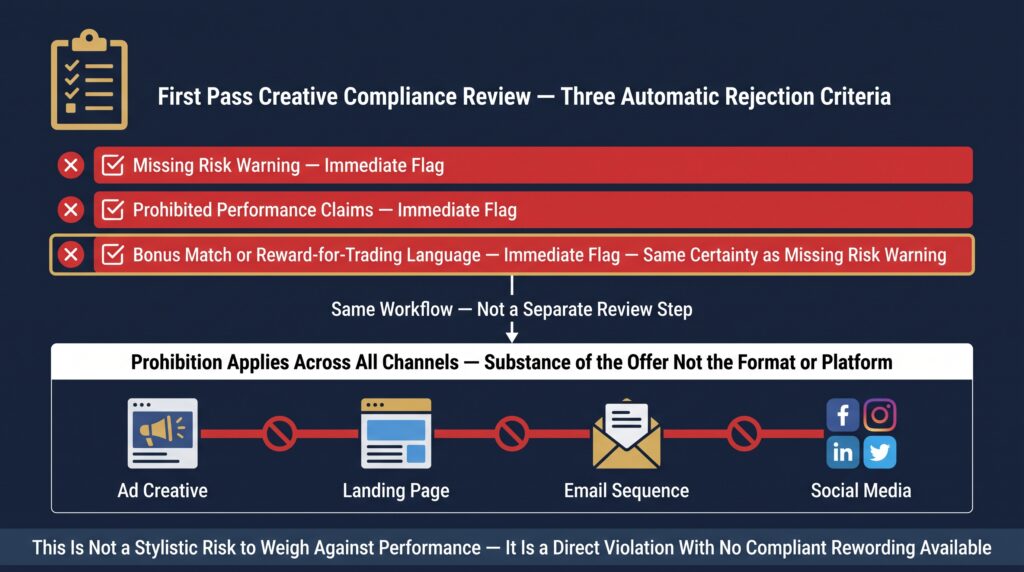
Per the financial promotion principles established in the paid ads diagnostic guide and landing page compliance guide, and the prohibited claims framework in the ad creative formats guide‘s format-compliance matrix, any ad creative referencing a bonus, deposit match, or “reward for trading” language fails compliance at the most basic level — this isn’t a stylistic risk to weigh against creative performance, it’s a direct violation of the inducement prohibition with no compliant version available through rewording.
The practical integration: This should be treated as an automatic first-pass rejection criterion in the same creative compliance review workflow already established for risk warnings and prohibited performance claims — not a separate or secondary consideration requiring its own review step. A creative reviewer checking ad copy for compliance should flag any bonus, match, or reward-for-trading language immediately, with the same certainty as flagging a missing risk warning.
This applies equally to landing page copy, email sequences (per the email sequences guide‘s financial promotion equivalence principle), and any other marketing channel — the prohibition is about the substance of the offer, not the specific format or platform it’s communicated through.
The Affiliate Incentive Risk — A Compliance Gap Most Brokers Don’t Monitor
Per the compliance responsibility asymmetry established in the affiliate vs direct acquisition guide, a broker remains responsible for financial promotions distributed by its affiliates and IBs, even when the broker did not produce or authorize that content. This extends directly and specifically to the inducement prohibition: an affiliate or IB independently offering a personal cash incentive — “sign up through my link and I’ll give you $50 from my own commission” — creates exactly the prohibited inducement the broker remains regulatorily exposed to, even though the broker’s own marketing materials never mention a bonus and the broker may have no direct knowledge this is happening.
WHY THIS IS GENUINELY UNDERAPPRECIATED
Most brokers’ compliance attention on affiliate oversight focuses on creative content review — checking that affiliate-produced ads and landing pages meet the same financial promotion standards as direct marketing. Far fewer brokers actively monitor for affiliates personally offering side incentives that never appear in any reviewable marketing material at all — a verbal promise, a private message, a personal commission-sharing arrangement — making this risk structurally harder to detect through standard creative compliance review alone.
The practical action: Affiliate agreements should explicitly prohibit personal incentive offers as a condition of the partnership, with clear consequences for violation. Periodic monitoring — reviewing affiliate communications where feasible, and responding decisively to any client report of an affiliate offering personal incentives — should be added to the affiliate oversight process, distinct from and in addition to standard creative compliance review.
FOR CEOS — THE ONE QUESTION TO ASK
Ask whether your affiliate agreements explicitly prohibit personal cash incentive offers, and whether there’s any monitoring mechanism beyond reviewing the affiliate’s official marketing materials. If the answer to the second question is no, your actual exposure to this risk is invisible to your current compliance process.
Leverage Caps as Context — Part of the Same Regulatory Package
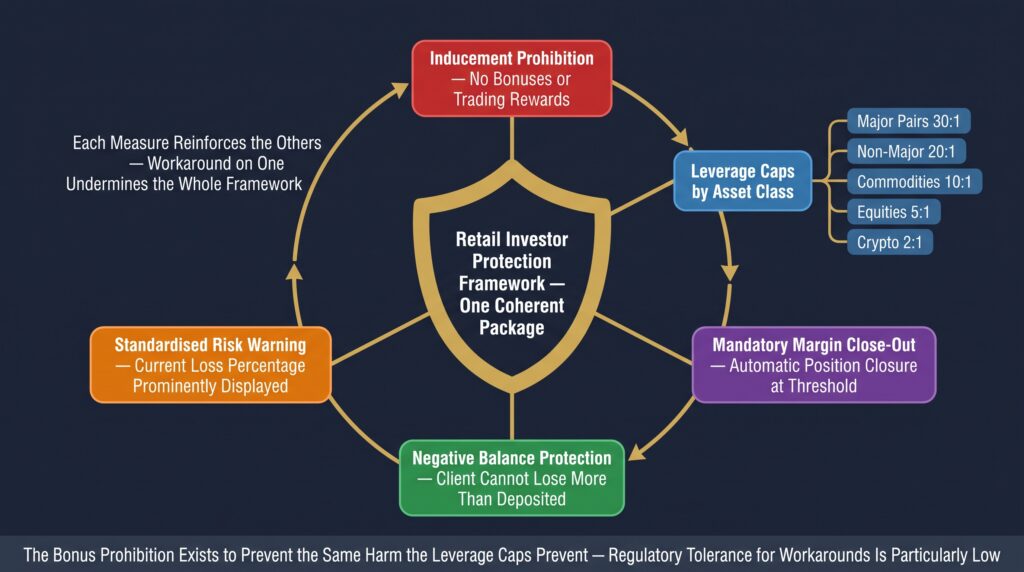
The inducement prohibition was introduced as part of the same regulatory package as specific leverage caps by asset class — historically including limits such as 30:1 for major currency pairs, 20:1 for non-major pairs/gold/major indices, 10:1 for other commodities, 5:1 for individual equities, and 2:1 for cryptocurrencies — alongside mandatory margin close-out and negative balance protection, forming a coherent retail investor protection framework where each measure reinforces the others.
Understanding the inducement prohibition as part of this broader package, rather than an isolated rule, helps explain why regulatory tolerance for creative workarounds is particularly low: the entire framework exists specifically to prevent brokers from using financial incentives to encourage retail clients into excessive trading risk, and a workaround on the bonus rule undermines the same protective intent the leverage caps serve.
Verify current leverage cap figures against CySEC’s current rulebook before citing specific numbers with confidence — these may have been refined since the original 2019 implementation.
Jurisdictional Variation — This Isn’t Universal
The inducement prohibition described here is specifically an EU/ESMA-derived rule, implemented in Cyprus via CySEC and in equivalent form across other EU jurisdictions, with the UK’s FCA applying a broadly similar approach. A broker operating in a Tier 3 or less-regulated jurisdiction, per the regulatory tier framework in the licences guide, may face a different or no equivalent restriction.
The practical implication: This rule’s applicability should be checked against the specific regulatory entity and market a given campaign targets, connecting directly to the certification-to-market mapping principle established in the account structure guide and its Meta-side equivalent in the Meta account structure guide. A promotional structure prohibited for an FCA or CySEC-regulated entity’s EU/UK campaigns may not face the identical restriction for the same broker’s entity operating in a different regulatory tier — though brand consistency and reputational considerations often argue for a uniform policy regardless of strict legal necessity in every market.
The Compliance Sign-Off Workflow for New Promotional Structures
Any new loyalty, rebate, or incentive structure under consideration should go through the same compliance sign-off workflow established in the account structure guide for ad creative — legal review of the structure itself before launch, not merely review of the marketing materials describing it after the structure is already designed and operationally committed to.
Why sequencing matters here specifically: Reviewing only the marketing materials after a promotional structure is already built and operationally live creates pressure to find a compliant way to describe a structure that may itself be non-compliant in substance, rather than catching a structural problem before significant investment has been made in building it. The structure’s compliance should be confirmed first; the marketing language describing it is a secondary, downstream review.
A Practical Decision Framework
A practical framework for assessing whether a specific promotional idea is likely compliant:
1 Does the benefit depend on trading, depositing, or opening an account? If yes, presumptively prohibited — escalate to compliance immediately.
2 If trading-related, is it calculated only after the activity occurred? Without being marketed as an upfront incentive — the loyalty/rebate distinction requiring careful legal structuring.
3 Has the structure itself been reviewed by legal/compliance? Before any operational commitment or marketing production begins — not just the marketing materials afterward.
4 Does the ad creative avoid bonus/match/reward-for-trading language? Per the same review standard applied to risk warnings and prohibited claims.
5 Is compliance status monitored across direct AND affiliate channels? Including non-creative risks like personal incentive offers, not just reviewed marketing materials.
Working through these five questions for any new promotional idea catches the majority of compliance issues before they become operational or reputational problems.
If you want your current promotional structures, loyalty programs, and affiliate incentive exposure reviewed against this rule specifically, that review is part of the diagnostic.
FAQ
Q1: What is the actual rule on bonuses for forex brokers?
Forex and CFD brokers regulated under EU and UK frameworks are prohibited from offering cash or other inducements to encourage retail clients to trade. This rule originates from European Securities and Markets Authority product intervention measures, implemented into permanent national law by regulators including Cyprus Securities and Exchange Commission and the UK Financial Conduct Authority. The rule was introduced alongside specific leverage caps by asset class, mandatory margin close-out requirements, and negative balance protection, together forming a coherent retail investor protection framework. This means a deposit-matching bonus, a reward for reaching a trading volume threshold, or similar incentives tied directly to trading or depositing are generally prohibited. Current applicability and specific details should always be verified against the relevant regulator’s current published rulebook, since the originating policy documents for this framework date back several years even though the underlying prohibition remains in force.
Q2: What is the inducement test for forex broker promotional offers?
The inducement test asks whether a promotional benefit depends on the client trading, depositing funds, or opening a trading account. If the benefit is conditioned on one of these actions, it is presumptively prohibited under the cash and inducement restriction applicable to regulated forex and CFD brokers. A deposit-matching bonus fails this test directly, since the benefit is conditioned entirely on the deposit action. A reward for reaching a specific trading volume fails the same test, since the benefit is conditioned on trading activity. A referral payment triggered when a referred client opens and funds an account fails identically. Understanding this specific test, rather than treating the rule as a vague blanket ban on all incentives, allows a marketing team to evaluate new promotional ideas by asking one consistent question rather than needing case-by-case compliance escalation for every variant.
Q3: Are loyalty and cashback programs compliant for forex brokers?
Loyalty and cashback programs calculated retrospectively on trading activity that has already occurred, rather than offered upfront as an incentive to trade more, sit in a different and generally more defensible category than an upfront bonus, though this distinction requires careful legal structuring rather than being a guaranteed safe harbor. The key factors are timing and framing: a reward calculated and communicated after trading has already taken place, without being marketed as a reason to trade more, is structurally different from a promise made in advance to encourage trading. However, a rebate program that is prominently marketed as a reason to increase trading activity would likely fail the same regulatory test that an upfront bonus fails, regardless of the technical after-the-fact calculation timing. Any such program should be reviewed by legal and compliance specialists before launch rather than assumed compliant based on similar programs observed elsewhere in the industry.
Q4: Can forex broker ad creative ever reference bonuses or deposit matches?
No. Any advertising creative referencing a bonus, deposit match, or reward conditioned on trading activity directly violates the prohibition on cash and trading inducements applicable to regulated forex and CFD brokers, and there is no compliant way to reword such an offer into acceptable advertising language, since the violation lies in the substance of the offer itself rather than its specific wording. This should be treated as an automatic rejection criterion in creative compliance review, applied with the same certainty as identifying a missing risk warning, rather than weighed as one creative consideration among several. This applies consistently across every marketing channel, including paid advertising, landing pages, and email communications, since the underlying prohibition concerns the nature of the offer being communicated rather than the specific platform or format used to communicate it.
Q5: Is a forex broker liable if an affiliate offers a cash incentive independently?
Yes. A regulated forex broker remains responsible for financial promotions distributed by its affiliates and introducing brokers, and this responsibility extends directly to the prohibition on cash and trading inducements. If an affiliate or introducing broker independently offers a client a personal cash incentive to sign up, such as promising money from their own commission in exchange for opening a funded account, this creates exactly the prohibited inducement the broker remains regulatorily exposed to, even though the broker’s own marketing materials never mention any bonus and the broker may have no direct knowledge the offer was made. This risk is structurally difficult to detect through standard affiliate creative compliance review alone, since such offers are often made verbally or through private communication rather than appearing in any reviewable marketing material, making explicit contractual prohibition and active monitoring necessary additions to standard affiliate oversight.
Q6: Does the bonus and inducement prohibition apply in every market a forex broker operates?
No, not necessarily. The cash and inducement prohibition described in this context originates from European Securities and Markets Authority intervention measures, implemented in EU jurisdictions such as Cyprus and across other European Union markets, with the United Kingdom’s Financial Conduct Authority applying a broadly similar approach. A forex broker operating through an entity regulated in a different, less restrictive jurisdiction outside this EU and UK framework may face a different or no equivalent restriction for that specific entity’s markets. This means the rule’s applicability should be checked against the specific regulatory entity and target market of any given marketing campaign, connecting to the broader principle that certification, compliance requirements, and regulatory restrictions should be mapped per entity and per market rather than assumed uniform across a broker’s entire global operation.