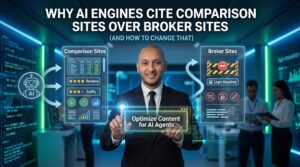
AI/GEO Visibility Audit for Forex Brokers, what is different than standard SEO?
A forex broker can hold the number one organic ranking on Google for its own brand name and still not exist, as far as ChatGPT, Perplexity, or Google’s own AI Overview is concerned — and that gap is precisely what an AI/GEO visibility audit is built to find.
This is not a hypothetical edge case. In the AI-visibility audits I run for regulated brokers, the most common finding is a brokerage that ranks cleanly on Google for its own name and core queries, but when you query the AI engines that a growing share of its prospects actually use to research brokers, the brokerage either doesn’t appear at all, or appears with incorrect information — the wrong license, a defunct entity, or a confident recommendation of three competitors instead.
In nearly every broker AI-visibility audit I run, the brokerage ranks perfectly well on Google for its own name — and then I show the CMO what ChatGPT actually says about their regulatory status, and the room goes quiet.
The reason this happens is structural. A traditional SEO strategy optimises for search engine rankings — for where your pages appear in a list of blue links. But a growing class of user queries never produces a list of blue links. They produce a synthesised answer, assembled by the engine from sources it has learned to trust, and delivered as prose. If your brokerage is not in that answer — or is in it, but incorrectly — your flawless SEO is irrelevant to that user.
This guide explains what an AI/GEO visibility audit for a forex broker actually checks, how it differs operationally from an SEO audit, and what the audit produces as a deliverable. It is written for CMOs and marketing leaders at regulated brokers who already have SEO in place and want to understand whether they have a parallel visibility gap in AI search.
Table of Contents
AI/GEO Visibility Audit for Forex Brokers, What the Audit Actually Checks
An SEO audit has a well-understood checklist: rankings, crawlability, index coverage, backlinks, Core Web Vitals, on-page signals. Most people in this industry have seen one. An AI/GEO visibility audit has a different checklist entirely, and it is worth naming it precisely, because the two are genuinely distinct exercises that diagnose different things.
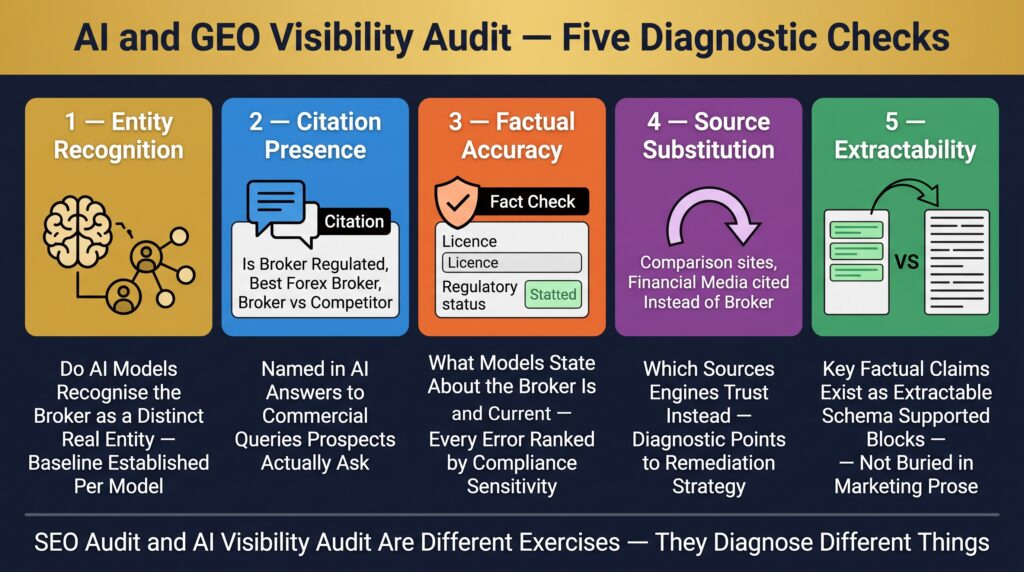
An AI/GEO visibility audit for a forex broker checks five things.
1. Entity recognition. Whether AI models — ChatGPT, Perplexity, Gemini, Google’s AI Overview, Claude — recognise the brokerage as a distinct, real entity at all. This sounds like a low bar, but it is not. A broker that operates multiple regulated entities under one brand name, or that shares a name with an unrelated company, or that faces same-name clone and scam sites, may find that AI models have an inconsistent or confused picture of what the brokerage actually is. The audit establishes the baseline: what each major model currently “knows” about the broker as an entity.
2. Citation presence. Whether the broker is named or cited when those models answer the commercial and informational queries that prospects actually ask. The core queries are the ones that matter most: “Is [broker] regulated?”, “What are [broker]’s spreads?”, “Best forex broker for [market]”, “[Broker] vs [competitor]”. A broker that appears in none of these answers, as of mid-2026, has a visibility gap that organic rankings are not solving.
3. Factual accuracy. Whether what the models state about the broker — its regulatory status, which entity holds which license, spreads, minimum deposit, which markets it serves — is correct and current. For a regulated broker, this is not merely a marketing concern. An AI model confidently stating the wrong license, or attributing offshore entity terms to a client who is actually dealing with the EU-regulated entity, is a compliance-adjacent exposure. The audit documents every factual error, ranked by compliance sensitivity.
4. Source substitution. Which sources the engines are citing instead of the broker, and for which queries. The answer to this question is usually some combination of comparison and review aggregators, financial media, and regulatory databases. Understanding which sources an engine trusts in preference to the broker’s own content is the diagnostic that points to the remediation strategy.
5. Extractability. Whether the broker’s own content is structured so an engine can lift accurate, clean answers from it. A broker the model trusts and recognises will not be cited if its content buries the factual answers inside marketing prose or interactive tools the model cannot parse. The audit checks whether key factual claims exist as extractable, schema-supported blocks.
| Check | What It Answers | Why It Matters for a Regulated Broker Specifically |
|---|---|---|
| Entity recognition | Does the model know who you are? | Multi-entity brands and same-name clone sites create confused model knowledge that cannot be fixed without first being measured. |
| Citation presence | Are you named in the answer at all? | A broker absent from AI answers loses prospects who never reach the search results page — they get their answer from the engine and move on. |
| Factual accuracy | Is what the model says about you correct? | Wrong regulatory information stated confidently by an AI is a compliance-adjacent risk, not just a reputation one. Regulators and prospects may both act on it. |
| Source substitution | Who gets cited instead of you, and why? | Understanding which sources the engine trusts over yours points directly to the remediation strategy — you cannot displace a source you have not identified. |
| Extractability | Can the engine lift clean answers from your content? | Even a trusted entity is not cited if its content cannot be parsed. Structural remediation is within a broker’s direct control — unlike third-party citation behaviour. |
These five checks produce the full picture: not just whether you are visible in AI search, but why you are not, which specific claims about you are wrong, and what can actually be done about it.
Why It Is Different From an SEO Audit — Operationally, Not Just in Theory
The difference between an SEO audit and an AI/GEO visibility audit is explained in most discussions as a theoretical one: SEO optimises for keyword rankings, GEO optimises for entity recognition and citation. That is true, but it does not answer the operational question that CMOs actually need answered — which is: if I already have SEO in place, what does the AI audit find that my SEO audit cannot?
The clearest way to answer it is this. An SEO audit asks: can users find my page? An AI/GEO audit asks: will the engine mention my brand — accurately — when it answers for the user? Those are different questions. Passing the first tells you nothing about the second.
The reason is that AI engines do not retrieve pages in the way search engines do. They synthesise answers from a combination of their training data (what they ingested during training, from the entire web as it existed at that time) and, in some cases, real-time retrieval from trusted sources. A broker’s well-optimised pages may rank perfectly in the search index while the model has learned about the broker primarily from third-party sources — reviews, forums, regulator databases, comparison sites — that the engine encountered during training and weighted more heavily than the broker’s own content.
| Dimension | SEO Audit Checks | AI/GEO Audit Checks |
|---|---|---|
| Unit of visibility | Page position in a ranked list of results | Brand presence inside a synthesised answer |
| Primary signal | Rankings, crawl health, backlink authority, on-page | Entity recognition, citation presence, source trust, extractability |
| What winning looks like | Page one position for target keywords | Named accurately in generated answers across priority engines and queries |
| Failure mode | Ranking below competitors; not indexed | Absent from answers; present but with wrong information; competitor cited instead |
| Tooling | Ahrefs, SEMrush, GSC, Screaming Frog | Manual query runs across engines, entity probing, citation mapping, structured content review |
The overlap is real: both SEO and GEO reward genuine authority, consistent information, and clear structure. A broker with a strong SEO foundation has a material advantage in AI visibility. But the overlap is not a guarantee — it is a head start. The gap between a strong SEO foundation and strong AI visibility still needs to be measured, because the factors that close it (entity clarity, structured self-description, third-party corroboration) are not the same as the factors an SEO audit focuses on.
Key Point
You cannot fix AI visibility you have not first measured. The audit is the diagnostic layer that establishes what each engine currently knows, states, and cites about your brokerage — before any remediation work begins.
Why AI Engines Cite Comparison Sites Instead of Your Brokerage
If you query ChatGPT, Perplexity, or Google’s AI Overview with “best forex broker for UK traders” or a similar commercial question, the answer you receive will almost certainly cite comparison and review aggregators — ForexBrokers.com, Investopedia, DailyForex, WikiFX, broker-review platforms — rather than any individual broker’s website. This is not random, and it is not a temporary limitation of early AI search. It is a structural bias, and it applies to most commercial broker queries as of mid-2026.
There are three reasons for it. First, comparison sites directly answer the comparative question being asked. A query asking which broker is best requires a multi-broker comparison, and a comparison site’s content is built to answer exactly that — presenting several brokers side by side with standardised criteria. An individual broker’s site describes only itself, which makes it a structurally poor source for a comparative answer. Second, comparison and review platforms carry a perceived third-party neutrality that AI models tend to treat as more citable than self-description. A broker recommending itself reads as self-interested to the model in a way that a third-party review does not, even when the broker’s own information is more accurate and more current. Third, a comparison page covers many brokers per source, giving the engine more synthesisable material per citation — from an efficiency perspective, one well-structured comparison page is a richer source than ten individual broker pages.
The practical implication for a regulated broker is that competing head-on with aggregators for commercial query citations is not the most direct path to AI visibility. The more tractable path is becoming the authoritative source for the factual, non-comparative queries about your specific brokerage — the queries where you genuinely are the best and only source. “Is [broker] regulated by CySEC?”, “What is [broker]’s minimum deposit?”, “Which regulated entity does [broker] use for UK clients?” — these are queries where a comparison site has no structural advantage, and where your own structured, schema-supported content should win the citation.
Pattern Observation — Mid-2026
The most common surprise in these audits is a broker discovering that the engine recommends three competitors by name for its core market query while never mentioning the broker at all — despite the broker having a stronger regulatory profile and better spreads than two of the three cited competitors. The engine is not evaluating quality. It is citing sources it trusts. That is the distinction remediation needs to address. Full analysis of this dynamic in why AI engines cite comparison sites over broker sites.
Regulatory-Entity Disambiguation — The Check Only Regulated Brands Need
Of the five checks in an AI/GEO visibility audit, this one has no equivalent in any other industry’s GEO work. It exists specifically because of how regulated forex brokers are structured, and because of what happens when AI models encounter that structure without adequate guidance.
Most established forex brokers operate several regulated entities under one brand name. A CySEC-regulated entity for EU clients, an FCA-authorised entity for UK clients, perhaps an ASIC-regulated entity for Australian clients, and an offshore entity in Saint Vincent or Mauritius for markets outside the regulated jurisdictions. Each entity carries a different license number, a different regulatory regime, different client-protection rules, and different leverage allowances. From a brand perspective, this is all “the same broker.” From a regulatory perspective, these are distinct legal entities with distinct obligations.
AI models do not reliably distinguish between these entities. In audits conducted across ChatGPT, Perplexity, and Google’s AI Overview, it is common to find that a model describing a broker’s regulatory status either attributes one entity’s terms to all markets, states an outdated or incorrect license number, or conflates entities entirely — giving the impression that the offshore entity’s conditions apply to EU clients who are actually dealing with the CySEC-regulated entity. Each of these errors is consequential: a prospect misled about the regulatory protection they would receive is both a business risk and a compliance-adjacent one.
The same-name problem compounds this. A well-known broker brand will often face clone or scam sites using similar or identical brand names, and AI models trained on large corpuses of web content may have ingested content from these clones alongside content from the legitimate broker. The audit checks whether models are correctly identifying the legitimate brand, or whether clone-site information is contaminating the model’s knowledge of the real broker.
The remedy for regulatory-entity confusion is structured, corroborated, self-describing content: each regulated entity described with its specific license number and jurisdiction, consistently, across the broker’s own site — and supported by schema markup and third-party corroboration from sources the model trusts (regulator public registers, financial media mentions, licensed broker directories). This is the E-E-A-T layer of the work, which the forex broker E-E-A-T signals guide covers in full. The audit establishes the current state of the model’s knowledge about each entity before that work begins.
Which Engines the Audit Covers — and Why They Disagree
A credible AI/GEO visibility audit runs across the engines that a broker’s prospects actually use: ChatGPT, Perplexity, Google’s AI Overview, Gemini, and Claude. This is not an exhaustive list of every AI product in existence — it is the set of engines that, as of mid-2026, materially influence how prospects research and evaluate forex brokers during the discovery and consideration phase.
The finding that consistently surprises CMOs when they first see an audit is that these engines disagree, often significantly, about the same broker. One engine names the broker as a top recommendation for a given market. A second omits the broker entirely from the same query. A third cites the broker but states an outdated license number or describes a product the broker no longer offers. These disagreements are not errors in the audit — they are the actual finding. They arise because each engine was trained on a different mix of sources, retrains on a different schedule, and weights recency and authority signals differently.
The practical implication is that checking a single engine — which most brokers do informally, usually ChatGPT, because it is the most visible — produces a dangerously partial picture. A broker that appears accurately in ChatGPT may be absent from Perplexity, which has a meaningfully different user base and source-citation model, or may appear with wrong regulatory information in Google’s AI Overview, which is the version a prospect sees without even opening a separate application.
The cross-engine variance is what produces the metric the audit ultimately tracks: Share of Model — how often, and how accurately, a broker appears across the set of priority engines for its priority queries. This is the AI-era successor to share of voice: a quantified measure of how present a brand is in the answers that matter, not just the rankings. The audit establishes the baseline Share of Model measurement. Full treatment of what this metric tracks and how to improve it is in Share of Model: the new metric forex brokers need to track.
Engines Covered in a Standard Audit
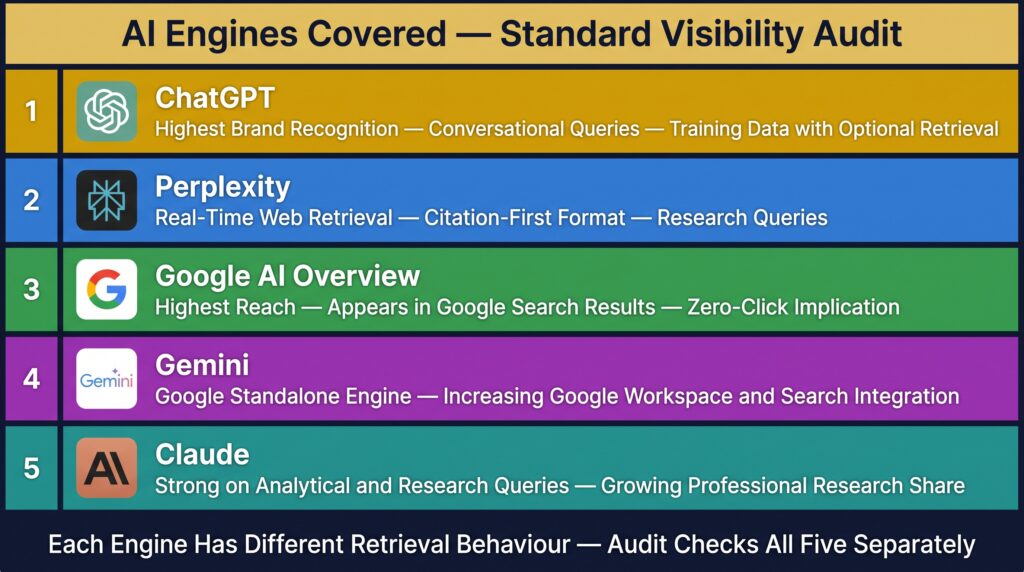
ChatGPT — highest brand recognition; conversational queries; training data up to cutoff with optional retrieval
Perplexity — real-time web retrieval; citation-first format; used heavily for research queries
Google AI Overview — highest reach; appears directly in Google search results; zero-click implication
Gemini — Google’s standalone engine; increasing integration with Google Workspace and Search
Claude — strong on analytical and research queries; growing share in professional research workflows
Extractability — Whether Your Content Can Even Be Cited
Entity recognition and trust are necessary conditions for being cited in an AI-generated answer. They are not sufficient. A broker that a model recognises and trusts will still not be cited if its content cannot be cleanly extracted and reproduced as an answer to a specific question.
AI engines lift labelled, self-contained answers. A direct, plainly stated answer to “is [broker] regulated and by whom” — as a clear sentence or structured block on the appropriate page — is far more likely to be cited than the same information buried three paragraphs into a “Why trade with us” section, mixed with marketing language, or locked inside an interactive comparison widget that the model cannot parse. The engine is looking for content that it can lift, attribute, and synthesise with minimal interpretation effort. Well-optimised SEO content does not automatically satisfy this requirement, because SEO copywriting is often designed to engage and persuade, while citation-optimised content is designed to state facts clearly and concisely.
The extractability check in the audit reviews the broker’s most important factual answer pages — the regulation page, the account conditions page, the entity structure page — against a simple criterion: if a model were to retrieve this page and look for a clean answer to a specific factual question, could it find it and lift it in context? If the answer is consistently no, the content needs restructuring — not rewriting for a different message, but restructuring for cleaner extraction. The method is in structuring forex broker content for AI citation, and the specific question of what FAQ schema actually does for AI visibility is addressed in does FAQ schema actually improve AI visibility.
Extractability is also the remediation priority the broker has the most direct control over. The comparison-site bias and the third-party source substitution require influencing sources the broker does not own. Extractability is a structural property of the broker’s own content — a change the marketing team can make without requiring any external action.
What the Audit Delivers — and Where AI/GEO Sits Relative to SEO Spend
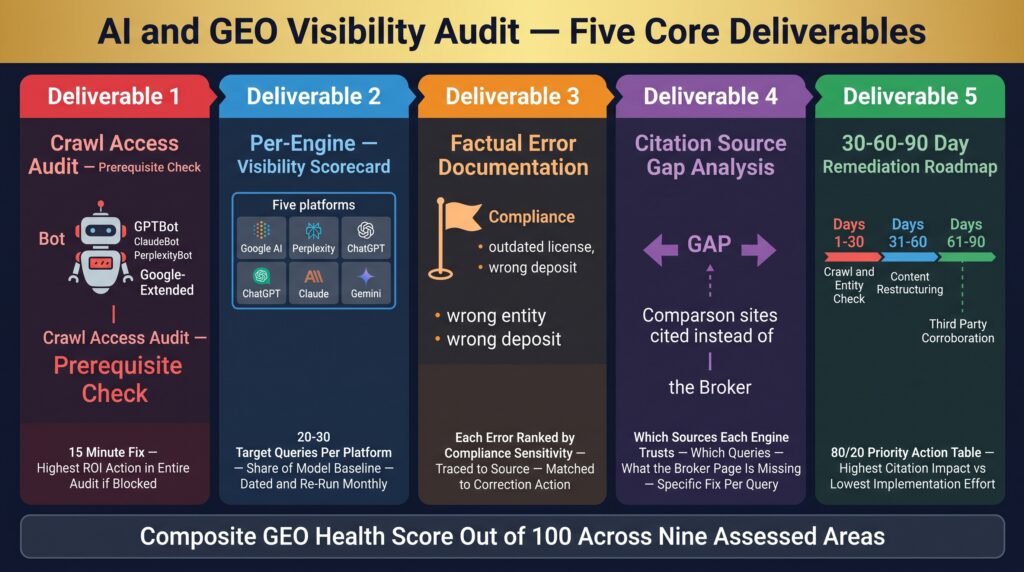
A forex broker AI/GEO visibility audit produces a composite GEO health score out of 100 across nine assessed areas, plus five core deliverables.
First, a crawl access audit — the prerequisite check before anything else. If AI bots are blocked at robots.txt or Cloudflare WAF level, every citation gap in the audit is partly explained by access denial rather than content quality. GPTBot, ClaudeBot, PerplexityBot, and Google-Extended are checked individually. A blocked bot cannot crawl, cannot index, and cannot cite — and unblocking access is typically a 15-minute fix with immediate impact across all five platforms. This section comes first because it is the highest-ROI action in the entire audit if it applies.
Second, a per-engine visibility scorecard across five platforms — Google AI Overviews, Perplexity, ChatGPT, Claude, and Gemini. Twenty to thirty target queries are run manually across all five: branded queries, product and service queries, competitor comparison queries, and generic category queries. Each result is recorded per platform and per query, categorised as: recognised and cited accurately; recognised but cited inaccurately; mentioned but not recommended; absent from the answer; or competitor cited instead. This is the Share of Model baseline — documented, dated, and re-run monthly to measure citation growth over the 90-day roadmap period.
Third, a documented list of factual errors currently stated by AI platforms about the brokerage, ranked by compliance sensitivity. This list often contains surprises — outdated licence numbers, incorrect entity descriptions, wrong minimum deposits, or characterisations pulled from competitor comparison pages that the model treats as fact. Each incorrect claim is traced to its source, assessed for regulatory risk, and matched to a specific correction action. Inaccurate AI responses create regulatory liability and brand trust damage even when the broker’s own content is correct.
Fourth, the citation-source gap — which specific sources each engine is citing for the broker’s priority queries, and why those sources are preferred over the broker’s own content. This tells a CMO not just that comparison sites are winning, but which comparison sites, on which queries, and what about those sources the engine trusts. The gap analysis maps who is cited, why they are cited, what the broker’s equivalent page is missing, and the specific fix required per query.
Fifth, a prioritised remediation roadmap structured across 30, 60, and 90 days, sequenced by impact and by whether the action is within the broker’s direct control. Days 1 to 30 address crawl access and entity infrastructure — the technical prerequisites that make all subsequent optimisation effective. Days 31 to 60 address content restructuring and YMYL prerequisites — reformatting priority pages for direct answer extraction, implementing FAQPage schema, adding named author credentials and primary regulatory source citations. Days 61 to 90 address third-party corroboration — the authority signals (LinkedIn programme, financial press coverage, directory listings) that build citation credibility on retrieval-based platforms over the medium term. The roadmap is accompanied by a priority action table ranked 80/20 by expected citation impact against implementation effort, so a marketing team knows exactly which action to take first.
On where AI/GEO sits relative to existing SEO spend: the honest answer is that it is additive, not a replacement. The same authority and structural foundations that support strong SEO support AI visibility. A broker with a well-built SEO programme has a meaningful head start. But the audit routinely finds brokers that rank well on Google while being invisible or misrepresented in AI search — which means the SEO investment is not fully translating into AI visibility without intentional incremental work. The question of where a broker with a finite budget should prioritise between the two is the subject of AI search vs traditional SEO for forex brokers. If your brokerage has not yet had a structured SEO audit either, the organic-side counterpart is the forex broker SEO audit — the two diagnostics are complementary, not alternatives, and together they give a complete picture of your search visibility across both the traditional and AI-generated answer layers.
How Often to Re-Audit — and the Honest Limits of GEO
A forex broker AI visibility audit is not a one-time exercise. AI model answers about a broker drift as models retrain, as the third-party sources they learn from change, and as competitors and comparison sites update the content the models use to form their picture of the market. A stale AI answer that states a defunct license or a misidentified entity is a compliance-adjacent risk that should be caught by scheduled re-auditing, not by a prospect who acts on wrong information.
The recommended cadence for a regulated broker is quarterly, faster than most content audit schedules but slower than social listening or paid campaign monitoring. The rationale is that model retraining events — which change the underlying knowledge base — tend to happen on quarterly-to-half-yearly timescales for the major engines, meaning an annual re-audit is too slow to catch meaningful drift. Trigger-based re-audits should also run on specific events: a new regulated entity launch, a rebrand, a license change, a regulatory action, or any discovered factual error in a current model answer. The full framework for maintaining accurate AI visibility over time is covered in how often forex brokers should update content for AI search freshness.
On the limits of GEO work, it is worth being direct about what the audit and the remediation work that follows it cannot do — because the service pages competing for this space are not always this candid.
GEO work cannot force an AI engine to recommend a broker it has assessed as high-risk, has seen described negatively in a significant volume of third-party sources, or that genuinely does not yet have the regulatory standing and client-protection framework the engine’s source material expects for the markets being targeted. It cannot manufacture authority that does not exist. It cannot guarantee that a broker will appear in a specific AI engine’s answer for a specific query — the engine’s behaviour is determined by its training and retrieval systems, not by a broker’s optimisation activity.
What it can reliably do is ensure that when a model does answer a query involving a broker, it answers accurately and can find the broker as a trusted, structured source. That is the realistic goal: not guaranteed AI recommendations, but the elimination of the gaps, errors, and omissions that currently prevent accurate representation. For a regulated broker operating at scale, that gap between “invisible or inaccurate in AI search” and “accurately represented and findable” is meaningful — and it is closeable.
If you want to know exactly what ChatGPT, Perplexity, Gemini, and Google’s AI Overview currently say about your brokerage — and where you are being cited, ignored, or misrepresented — that is what the AI/GEO visibility audit delivers.
All 6 required. Plain text only — no HTML, no bold, no bullets. Q1 is the extractable definition written for AI Overview citation capture. Q2 targets the title-promise Featured Snippet (“how is GEO different from SEO for forex brokers”) with zero forex competition. Q4 targets the high-interest, novel “why does ChatGPT recommend comparison sites” query.
FAQ
Q1: What does an AI/GEO visibility audit for a forex broker check?
An AI/GEO visibility audit for a forex broker examines five things that a traditional SEO audit does not. First, entity recognition: whether AI models such as ChatGPT, Perplexity, Gemini, and Google’s AI Overview recognise the brokerage as a distinct, real entity at all. Second, citation presence: whether the broker is named or cited when those models answer the core commercial and informational queries prospects actually ask, such as whether the broker is regulated or which broker suits a given market. Third, factual accuracy: whether what the models state about the broker, including its regulation, license, spreads, and minimum deposit, is correct and current, which for a regulated broker is a compliance-sensitive concern rather than only a marketing one. Fourth, source substitution: which sources the engines cite instead of the broker, and why. Fifth, extractability: whether the broker’s own content is structured so an engine can lift accurate answers from it. Together these reveal whether a broker that ranks well on Google is actually visible and accurately represented inside AI-generated answers.
Q2: How is an AI/GEO visibility audit different from an SEO audit for a forex broker?
An SEO audit checks where a broker’s pages appear in a list of search results, examining rankings, crawlability, index coverage, backlinks, page speed, and on-page optimisation. An AI/GEO visibility audit checks whether and how the broker appears inside a synthesised AI answer, examining entity recognition, citation presence within generated responses, factual accuracy of the model’s statements, and content extractability. The simplest way to express the difference is that an SEO audit asks whether users can find the broker’s page, while an AI/GEO audit asks whether the AI will mention the brand, and mention it accurately, when it answers on the user’s behalf. The two overlap because both reward genuine authority and clear structure, but they diagnose fundamentally different outcomes. A forex broker can pass an SEO audit cleanly and still fail an AI/GEO audit badly, because AI models often learn about a broker from third-party sources such as reviews, forums, regulator databases, and comparison sites rather than from the broker’s own well-optimised pages.
Q3: Can a forex broker rank well on Google but still be invisible in AI search?
Yes, and this is one of the most common findings in a forex broker AI visibility audit. A broker can hold strong or even top organic rankings for its own brand name and core keywords while an AI engine such as ChatGPT or Perplexity fails to mention it, or mentions outdated or incorrect information about it, when answering a user’s question. This happens because ranking in traditional search and being cited in a generated answer depend on different mechanisms. AI models synthesise answers from the sources they were trained on and the sources they retrieve and trust in the moment, which frequently include third-party comparison sites, review platforms, and regulator databases rather than the broker’s own pages. Strong SEO improves the odds a model has encountered a broker’s content, but it does not guarantee the model ingested it, trusted it, or attributed it correctly. Measuring the gap between search ranking and AI visibility is precisely what the audit is designed to do.
Q4: Why do AI engines recommend comparison sites instead of an individual forex broker?
AI engines tend to cite comparison and review sites rather than an individual broker’s own website when answering commercial questions such as which forex broker is best for a particular market, and this reflects a structural bias rather than a random outcome. There are three main reasons. First, comparison sites directly answer the comparative question being asked, presenting several brokers side by side, whereas an individual broker’s site describes only itself. Second, comparison and review platforms carry a perceived third-party neutrality that AI models tend to treat as more citable than a broker describing its own merits, which reads as self-interested on a best-broker query. Third, a comparison page covers many brokers at once, giving the engine more synthesisable material per source. The practical implication for a broker is that the path to AI visibility is not competing head-on with aggregators on best-broker queries, but becoming the authoritative source for the factual, non-comparative questions about the brokerage where it genuinely is the best source, and earning the third-party corroboration that AI models learn from.
Q5: Why does an AI visibility audit check multiple AI engines instead of just ChatGPT?
An AI visibility audit checks multiple engines, typically ChatGPT, Perplexity, Google’s AI Overview, Gemini, and Claude, because these engines frequently disagree about the same forex broker, and checking only one produces a dangerously partial picture. One engine may recommend a broker for a given market, another may omit it entirely, and a third may cite an outdated or incorrect license. This disagreement arises because each engine is trained on a different mix of sources, retrains on a different schedule, and weights recency and authority differently. A broker that appears accurately in one engine cannot assume it appears at all in the others. Auditing across the full set of engines that prospects actually use produces a metric sometimes called Share of Model, which measures how often and how favourably a broker appears across engines for its priority queries, and functions as the AI-era successor to share of voice. Establishing that cross-engine baseline is a core purpose of the audit.
Q6: What can an AI/GEO visibility audit realistically fix, and what can’t it?
An AI/GEO visibility audit and the remediation work that follows can realistically improve several things: it can correct factual errors that AI models state about a broker by giving the models an authoritative, well-structured source to learn from; it can improve whether and how accurately a broker is cited by making the broker’s content extractable and clearly self-describing; and it can clarify regulatory-entity information so models stop confusing a broker’s different licensed entities or a same-name clone. What it cannot do is equally important to state honestly. It cannot force an AI engine to recommend a broker the engine assesses as high-risk, it cannot manufacture a regulatory standing the broker does not actually hold, and it cannot deliver instant results, because AI models retrain on their own schedules rather than on demand. The realistic goal is that when a model does answer a question involving the broker, it answers accurately and can find the broker as a trusted source, rather than any guarantee of a top AI recommendation.