
Why AI Engines Cite Comparison Sites Over Broker Sites and what we need to do?
There is a SEMrush article that explains exactly why AI engines cite third-party sources instead of your website. It is well-researched, clearly written, and worth the sixteen minutes. Until recently, AI did not cite it — the irony was perfect and deliberate to use as an opening. It now appears in the AI Overview, which actually proves the same point more usefully: SEMrush earned that citation not through commercial authority or domain size, but through the third-party measurement data it referenced — Trustmary’s dataset of 35,000 AI search measurements documenting which source types actually determine AI citations. SEMrush, which sells an AI Visibility Toolkit, has a direct financial interest in AI visibility being important. The AI engine cited it anyway — because the data it referenced came from a neutral measurement source, not from SEMrush’s commercial interest in the claim. That distinction is the entire mechanism this article explains.
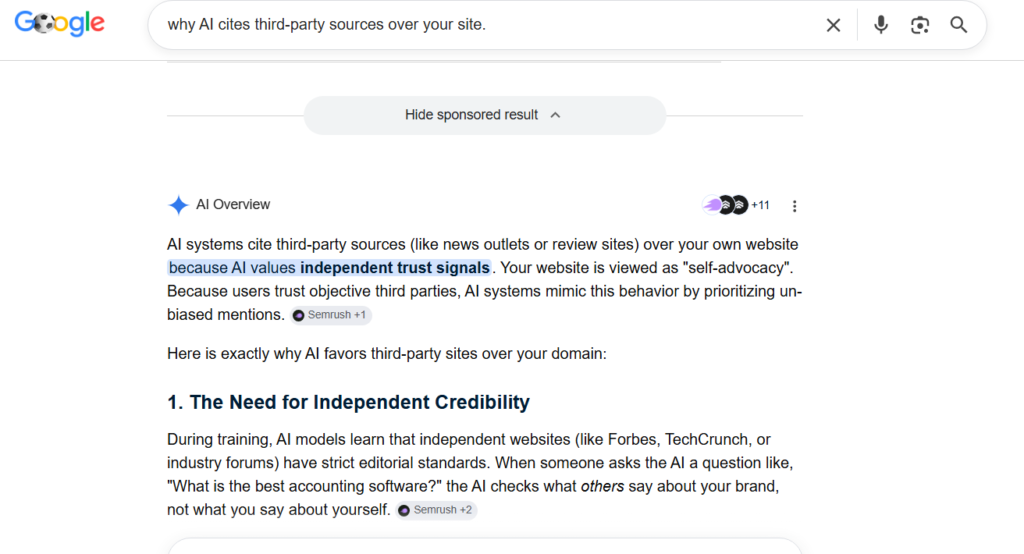
A forex broker’s own site faces the same structural dynamic. The broker has an obvious financial interest in being described as regulated, trustworthy, and competitively priced. AI engines discount self-description from commercial entities regardless of accuracy — and reach past the broker’s own content to neutral third parties making the same claim without the commercial motive. This is not a quality judgement. The broker’s content can be accurate, well-structured, and technically excellent. The citation still goes to the CySEC register, the Finance Magnates article, the Reddit thread, or the comparison platform — not the broker’s own regulation page. Understanding why this happens, which specific third-party sources the engine trusts instead, and what a regulated broker can actually do about it is the practical focus of this article. For the organic-search parallel where the same dynamic plays out in traditional SERP results, the forex broker SEO audit covers the equivalent diagnosis.
Table of Contents
The Real Data: Which Sources AI Engines Actually Cite
Before explaining the mechanism, it helps to establish what the data actually shows. Most discussions of AI citation treat “comparison sites” as the dominant third-party source. The data tells a more nuanced story.
According to Trustmary’s analysis of 35,000 AI search measurements across brand-specific queries, the source type breakdown is as follows:
| Source Type | Share of Citations | Forex Broker Equivalent |
|---|---|---|
| Review and experience platforms | ~48% | Trustpilot, Google Reviews, forex review platforms |
| Business registers and data services | ~24% | CySEC, FCA, ASIC public registers ← most important for a regulated broker |
| Consumer forums and communities | ~15% | Forex Factory, Forex Peace Army, Reddit |
| Social media and video platforms | ~9% | LinkedIn, YouTube |
| Industry portals and comparison sites | ~8% | ForexBrokers.com, Investopedia broker reviews, DailyForex |
| General knowledge sources | ~7% | Wikipedia (if a broker page exists) |
| Edited media | ~3% | Finance Magnates, FX Empire, Investing.com |
Source: Trustmary analysis of 35,000 AI search measurements, 2026
The strategic reframe from this data: comparison and industry portals account for approximately 8% of third-party citations — a much smaller share than most discussions of AI citation suggest. The dominant categories are review platforms (48%) and business registers (24%). For a regulated forex broker, “business registers” means CySEC, FCA, and ASIC public registers — the highest-trust sources for licensing claims, with no commercial interest in the information they present. The article’s title asks about comparison sites because that is the question broker CMOs have. The data shows that the regulator register is where the leverage actually is.
Three Reasons Comparison Sites Win “Best Broker” Queries — Structurally
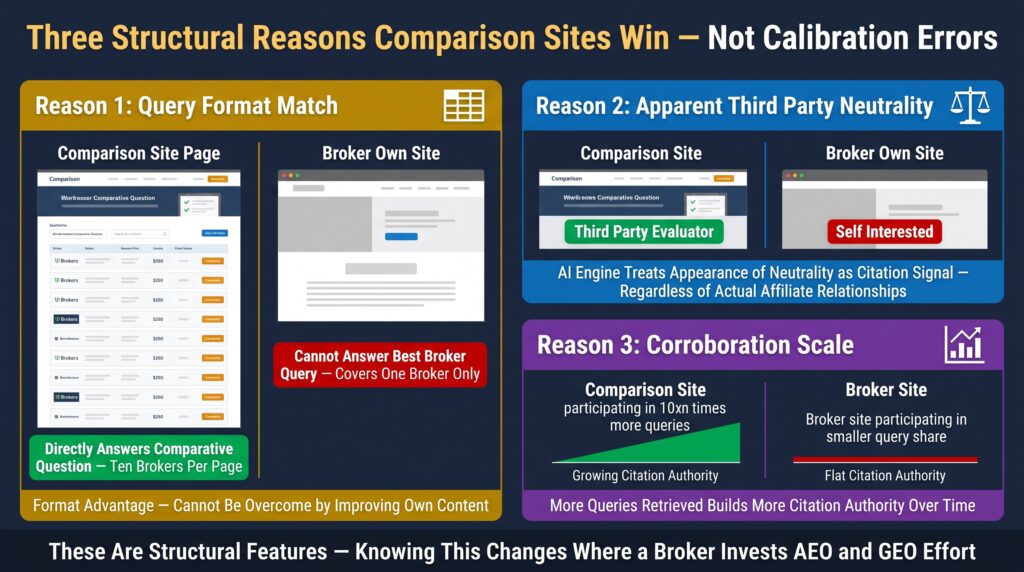
The 8% comparison-site share sounds low — but for the specific query type a broker CMO cares most about (“best forex broker for [market],” “most trusted broker for UK traders”), comparison sites do structurally dominate. Understanding why matters, because the reasons are structural features, not calibration errors, and knowing that changes where a broker invests its AEO/GEO effort.
Reason 1 — Query format match. “Best forex broker for [market]” is a comparative question requiring evaluation of multiple brokers. A comparison site covers ten brokers per page — it directly answers the comparative question asked. An individual broker’s site covers one broker. The engine uses the source that most directly answers the query structure, not the one with the most accurate self-description. This is a format advantage the broker cannot overcome by improving its own content.
Reason 2 — Apparent third-party neutrality. AI engines have learned that a brand describing its own excellence is structurally less reliable than a third party evaluating the brand. This neutrality is somewhat illusory — many comparison sites have affiliate relationships with the brokers they list — but the AI engine treats the appearance of neutrality as a citation signal. A broker’s own site is structurally self-interested by construction, in the same way that SEMrush writing about AI visibility is structurally self-interested regardless of content quality.
Reason 3 — Corroboration scale. A comparison site that mentions ten brokers participates in ten times as many queries as a broker site that mentions one. The more queries that retrieve a source, the more the engine reinforces its weighting of that source. The broker site participates in a much smaller share of the total query space and builds less citation authority over time as a result, even when its content on a per-query basis is better.
What Cannot Be Changed — and Why That Is Good News
The three reasons above are not problems to be solved. They are features of how AI engines evaluate sources, and they will not change through content improvement on a broker’s own site. A forex broker cannot win “best forex broker for UK traders” over ForexBrokers.com in AI answers through AEO/GEO tactics on its own pages — the comparative format advantage, apparent neutrality, and scale advantage that comparison sites hold are structural.
This is actually good news, because it clarifies the battlefield. Once a CMO stops trying to win the structurally unwinnable query, the resource allocation becomes clear. The queries where an individual forex broker can and should dominate AI citations are the branded factual queries where the broker is the only authoritative source and comparison sites have no structural advantage at all: “Is [broker] regulated?”, “[Broker] CySEC licence number”, “[Broker] minimum deposit for ECN account”, “Which entity does [broker] use for EU clients?” These are the queries where the broker’s own structured content, schema markup, and regulator register listings win by default — because the broker is the one entity that holds those specific facts.
This is also the compliance-critical layer. The branded factual queries are where AI inaccuracy has consequences — a wrong licence number, a confused regulated entity, a misquoted leverage limit. Winning this layer cleanly is both the tractable AEO/GEO goal and the compliance-adjacent obligation. The commercial comparison query presence follows from the corroboration and authority built by doing this correctly. For the full priority query sequence, see the AEO/GEO strategy for forex brokers.
The Third-Party Source Hierarchy for a Regulated Broker — Prioritised
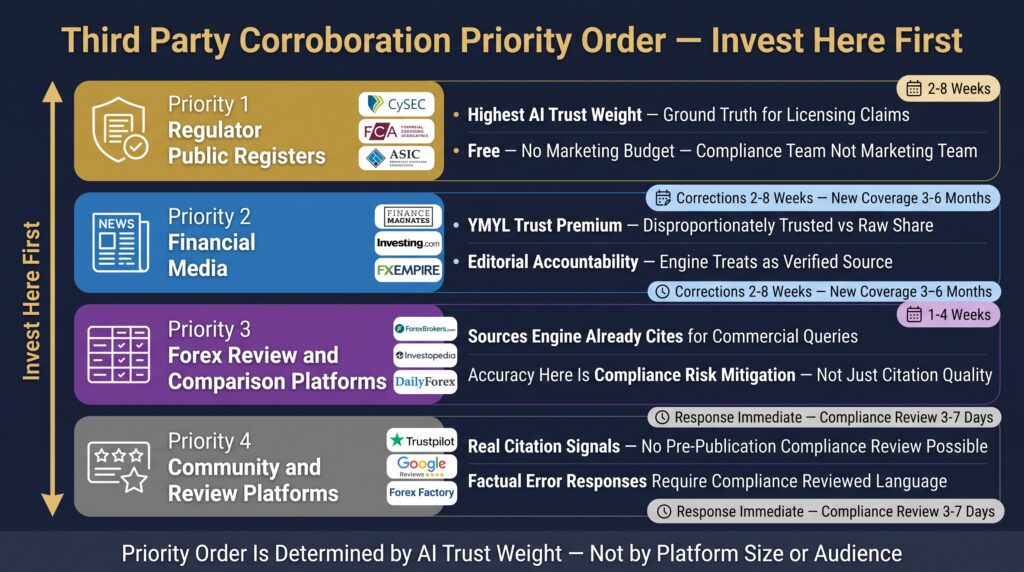
Given the Trustmary source breakdown and the structural reality above, here is where a regulated forex broker should invest its third-party corroboration effort — in priority order, with the compliance reality named at each step.
Priority 1 — Regulator public registers (the 24% “business registers” category).
CySEC’s public register, the FCA Financial Services Register, ASIC’s AFSL register. These are definitively authoritative sources for licensing claims — primary regulatory data with no commercial interest in what they state. An AI engine answering “is [broker] regulated?” treats a regulator register entry as the ground truth, more reliably than anything the broker’s own site states.
Ensuring the broker’s register listing is accurate — correct trading name, entity name, and any publicly available product descriptions — and consistent with what the broker’s own site says is free, requires no marketing budget, and has the highest AI trust weight of any third-party source available. Regulator register corrections should be submitted through the broker’s compliance team rather than the marketing team, as the correction request itself constitutes a regulated communication. Timeline: 2–8 weeks depending on regulator processing.
Priority 2 — Financial media (the 3% “edited media” category, but disproportionately trusted for YMYL).
Finance Magnates, Investing.com, FX Empire, Bloomberg or Reuters for larger brokers. Edited financial media carries a YMYL trust premium well above its 3% raw share — an AI engine is more likely to cite a Finance Magnates article confirming a broker’s CySEC licence than a Trustpilot review on the same topic, because the media source carries editorial accountability and a publication record the engine treats as verified. Existing incorrect mentions should be corrected through editorial outreach with compliance-reviewed correspondence. New coverage requires PR or content contribution relationships with the publications. Timeline: corrections 2–8 weeks; new coverage 3–6 months. See YMYL trust weight for financial content for the full treatment of why YMYL sources receive elevated AI trust.
Priority 3 — Forex review and comparison platforms (the ~8% category).
ForexBrokers.com, Investopedia broker reviews, DailyForex. These are the sources the engine already cites for commercial comparison queries. Ensuring the broker’s listing is accurate — correct licence, current conditions, correct entity — does not make the broker win commercial comparison queries, but it does ensure that when the engine cites a comparison source about the broker, the information is correct rather than outdated or wrong. This is a compliance-risk mitigation as much as a citation-quality action. Timeline: listing corrections typically 1–4 weeks.
Priority 4 — Community platforms and review sites.
Forex Factory, Forex Peace Army, Trustpilot, Google Reviews. These fall in Trustmary’s forum (15%) and review platform (48%) categories. For a regulated broker, Trustpilot and Google Reviews are real citation signals, but the broker has no ability to compliance-review user-generated content before it appears. Responding to reviews that contain factual errors about the broker’s regulatory status requires compliance-reviewed response language. Timeline: responses can be immediate but compliance review adds 3–7 days.
All of the above actions constitute the third-party corroboration work in Phase 3 of the 90-day AEO/GEO roadmap — the phase that builds the citation authority that makes commercial query presence possible over the longer term.
Why Original Data Beats Content Quality — The Full Lesson
Trustmary has a 35,000-measurement dataset with a named methodology documenting which source types determine AI citations across five major platforms. SEMrush published an article referencing that data — and SEMrush is now cited in the AI Overview for queries about AI citation mechanics, despite being a commercial entity with a direct financial interest in AI visibility being important and in being the tool that solves it. The lesson is not that neutral third parties always beat commercial entities. The lesson is more specific and more useful: SEMrush won the citation because it built its argument on verifiable, primary-source data from an independent measurement study. The AI engine cited the argument with the strongest evidentiary foundation — not the most neutral author. SEMrush’s commercial interest was visible and irrelevant, because the data it cited was real, named, and checkable. That distinction is the full lesson.
For a regulated forex broker, the equivalent of Trustmary’s 35,000 measurements is the original, proprietary, verifiable data the broker holds and no competitor or comparison site can manufacture. The exact CySEC licence number. The specific EUR/USD spread under ESMA retail leverage limits for the standard account. The minimum deposit for the ECN account. The ICF compensation amount for the broker’s Cyprus entity. The named regulated entity that holds each licence, matched to the jurisdiction it covers. These are specific, verifiable, primary-source facts — original data in the same functional sense as Trustmary’s measurements. A page that states them precisely, one per atomic block, clearly labelled, with outbound links to the primary regulatory sources that verify each claim, is providing exactly the kind of citable original data that earns AI citation regardless of whether the author is neutral or commercial. SEMrush proved that the source type matters less than the evidentiary quality of the claim.
No research study required. No survey methodology. No external validation from a neutral third party needed before publishing. The broker’s own verified regulatory conditions — stated precisely on the regulation and conditions pages, cited against the FCA register, the CySEC licence database, or the ASIC connect portal — are original data that no comparison site or editorial source can reproduce with the same authority, because only the broker holds the verified primary facts about its own regulatory status. This is the direct implementation path: anchor every regulatory claim to a primary source, state it in one atomic extractable sentence, and the content competes on evidentiary quality rather than source neutrality. The full structural implementation is covered in structuring content for AI citation.
No research study required. No survey methodology. The broker’s own verified regulatory conditions, stated precisely on the regulation and conditions pages, are original data that no comparison site or editorial source can reproduce. This is the direct implementation path — covered in full in structuring content for AI citation.
The broker pages I see cited most consistently in AI responses are not the ones with the most backlinks or the strongest domain authority — they are the ones that state one specific verifiable fact that no comparison site bothered to check: the exact licence number against the correct regulated entity, the exact leverage limit for the specific account type, the exact compensation amount for the specific jurisdiction. The comparison site says “regulated by CySEC.” The broker’s own page says “authorised by CySEC under licence number 178/12, held by [Entity Name], covering retail clients in Cyprus and the EEA.” One is citable. One is not.
“The fastest way to establish which sources are currently being cited instead of your brokerage — across all five priority engines — is the AI/GEO visibility audit.”
FAQ
Q1: Why do AI engines cite comparison sites instead of a forex broker’s own website?
AI engines cite comparison and review sites instead of a forex broker’s own website for three structural reasons. First, comparison sites directly answer the comparative question being asked, such as which broker is best for a given market, while an individual broker’s site describes only itself and cannot answer a comparative question. Second, comparison sites carry a perceived third-party neutrality that AI engines treat as a more reliable signal than a broker describing its own credentials, which the engine identifies as self-interested regardless of accuracy. Third, a comparison site covering multiple brokers participates in a much larger share of the total query space than a single broker site, building stronger citation authority over time through repeated retrieval. These are structural features of how AI engines evaluate sources, not calibration errors, and they apply to commercial comparison queries. They do not apply with the same force to branded factual queries where the broker is the only authoritative source, such as queries about the broker’s specific regulatory status, licence number, or account conditions.
Q2: What types of third-party sources do AI engines most commonly cite for forex broker queries?
According to Trustmary’s analysis of 35,000 AI search measurements, the dominant third-party citation sources in brand-specific searches are review and experience platforms at approximately 48 percent, business registers and data services at approximately 24 percent, consumer forums and communities at approximately 15 percent, and social media and video platforms at approximately 9 percent. Industry portals and comparison sites account for approximately 8 percent of citations, meaning they are a smaller share of the overall citation landscape than is commonly assumed. For a regulated retail forex broker, the most important translation of this data is that business registers, which includes financial services regulator public registers such as those maintained by CySEC, the FCA, and ASIC, represent a significant source of AI citations and carry the highest trust weight for regulatory claims. Regulator registers are primary sources with no commercial interest in the claim, making them among the most authoritative third-party sources available for a licensed broker.
Q3: Can a forex broker outrank comparison sites for “best broker” queries in AI search?
A forex broker cannot reliably outrank comparison sites for commercial comparison queries such as best forex broker for a given market through AEO or GEO content improvement on its own site, because the comparison site advantage is structural rather than a content quality issue. Comparison sites answer the comparative question format directly, carry perceived third-party neutrality, and participate in a larger share of relevant queries, all of which give them a structural citation advantage on commercial queries that individual broker sites cannot overcome through first-party optimisation alone. The path to appearing in answers to commercial comparison queries is to become accurately represented in the comparison sites and review platforms the AI engine already cites, which is a third-party corroboration strategy rather than a first-party content strategy, and typically takes at least 90 days to influence. In the meantime, the queries where a forex broker can reliably build AI citation presence are branded factual queries about its specific regulatory status, licence number, account conditions, and entity structure, where the broker is the only authoritative source and comparison sites have no structural advantage.
Q4: What is the most important third-party source a regulated forex broker should ensure is accurate for AI citation?
The most important third-party source for a regulated forex broker to maintain for AI citation purposes is the relevant financial services regulator’s public register, such as the CySEC register for Cyprus-licensed brokers, the FCA Financial Services Register for UK-authorised brokers, or the ASIC register for Australian-licensed brokers. Regulator public registers fall in the business registers category, which accounts for approximately 24 percent of third-party citations in AI brand searches according to Trustmary’s research, and they carry the highest trust weight for licensing claims because they are primary regulatory sources with no commercial interest in the information they present. Ensuring that the broker’s register listing accurately reflects its trading name, regulated entity name, and any publicly available product descriptions, and that this information is consistent with what the broker’s own website states, is the single highest-leverage AI citation action available to a regulated broker because it is free, is within the broker’s control through correction requests to the regulator, and produces the most trusted citation signal for the queries where accuracy matters most.
Q5: Why does a well-written article sometimes fail to get cited by AI even when it ranks well on Google?
A well-written article can rank highly on Google while failing to get cited in AI-generated answers for two main reasons. First, AI engines discount self-interested sources: an article published by a commercial entity whose business model benefits from the subject matter being important carries a structural self-interest signal that reduces its citation probability, regardless of content quality. This is why a tool vendor explaining why AI citations matter may not itself be cited by AI for that topic. Second, prose quality is a weaker citation signal than original proprietary data: AI engines prioritise sources with original, verifiable, non-reproducible data — such as primary research, proprietary benchmarks, or named-entity facts that cannot be found elsewhere — over well-organised prose covering the same subject matter without original data. For a forex broker, this means stating its exact licence number, specific regulatory entity name, and verified account conditions is more citable than a well-written page about its regulatory philosophy, because the specific facts are original data that no other source can replicate.
Q6: How long does it take to improve a forex broker’s third-party AI citation presence?
The timeline for improving a regulated forex broker’s third-party AI citation presence varies by source type. Regulator register corrections, such as updating a CySEC or FCA register listing with accurate trading name and entity information, typically take two to eight weeks depending on the regulator’s processing time, but once updated they represent the highest-trust citation signal a broker can control. Financial media corrections for inaccurate existing articles require editorial outreach and may take several weeks to several months. Earning new financial media mentions through PR or content contribution typically requires three to six months of consistent effort before AI engines begin to reflect the new mentions. Comparison and review platform listing updates are often faster, sometimes within days to weeks, but carry lower trust weight than regulator registers or financial media for regulated broker queries. AI model retraining schedules are outside any broker’s control and typically run on quarterly to semi-annual cycles, meaning that even correctly updated third-party sources may take three to six months to be reflected in AI answers after the update occurs.