
AEO/GEO for Forex Brokers: why The First 90 Days are the most important?
The most common reason a forex broker’s AEO/GEO programme stalls in the first three months is not lack of knowledge about what to do. It is doing things in the wrong order.
The three wrong-order mistakes appear in almost every implementation I observe. Starting with FAQ schema before the AI model’s understanding of the broker’s regulatory entity is correct — adding extractable content on a confused foundation the model will attribute to the wrong entity or the wrong license. Building comparison-page content before branded factual queries are accurate — trying to win category queries while the engine still states incorrect licensing information for the broker’s own core entity. And running content production without compliance review built into the timeline — discovering in Week 3 that every piece of structured content requires a legal sign-off that takes two weeks, collapsing the plan before Phase 1 is complete.
This guide sets out a 90-day implementation sequence specifically for regulated forex brokers. It is structured around a compliance reality that no generic GEO plan acknowledges: a regulated broker cannot publish content changes without compliance review, and that constraint changes which tasks are Week 1 versus Week 3, and which phase deliverables need two weeks of lead time rather than two days.
The implementation pattern I see most often when a broker skips the audit and goes straight to content production is four weeks of reformatting pages that were never the citation gap to begin with — because without the per-engine query log, nobody knew which pages AI systems were actually looking for.
The plan assumes the broker has completed, or is completing, the AI/GEO visibility audit that precedes it. The audit output — the per-engine scorecard, the factual error list, the citation-source gap — determines which tasks in Phase 1 are Week 1 priorities for that specific brokerage. Without the audit baseline, this plan is a generic checklist. With it, it is a sequenced remediation programme targeted at the broker’s actual gaps.
Table of Contents
What 90 Days Realistically Delivers — Setting the Right Expectations Before You Start
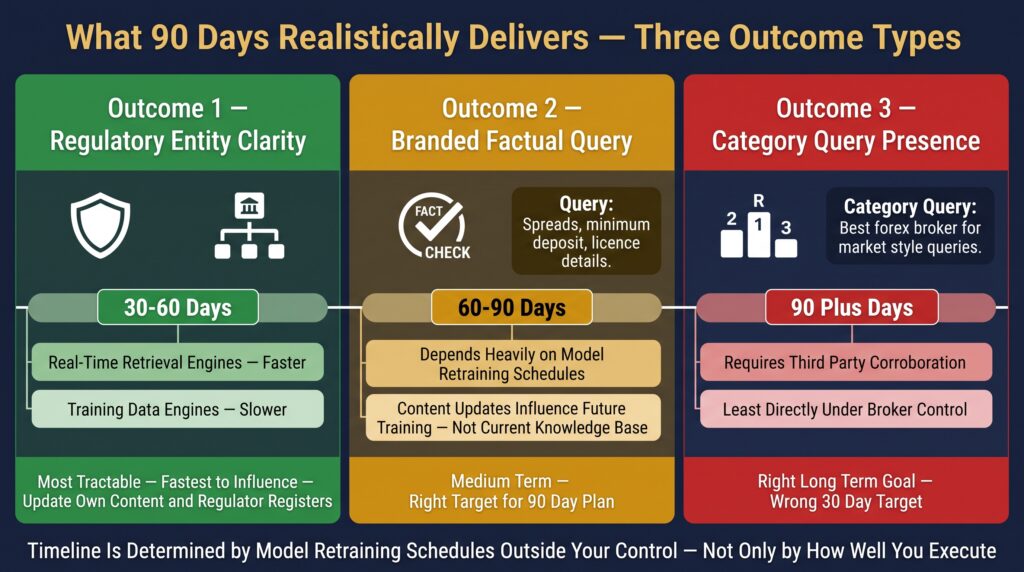
The 90-day framing is a useful planning horizon, but it creates implicit timeline promises that the plan should address openly before Phase 1 begins. The timeline for AI visibility improvements is not determined solely by how well the broker implements the plan — it is also determined by AI model retraining schedules that are entirely outside the broker’s control. Here is what the three outcome types look like in practice.
Regulatory entity clarity — what the model knows about the broker’s entity structure, licenses, and jurisdiction — is the most tractable outcome and typically the fastest to influence. If the broker’s own content is updated correctly and regulator register listings are current, meaningful improvement in how models describe the broker’s entity structure is observable within 30–60 days for engines that retrieve sources in real time. Training-data-dependent engines take longer.
Branded factual query accuracy — whether the model correctly states the broker’s conditions, spreads, minimum deposit, and license details in response to branded queries — typically takes 60–90 days and depends heavily on model retraining schedules. Content updates influence future training; they do not retroactively change the current model’s knowledge base.
Category query presence — whether the broker appears in answers to “best forex broker for [market]” style queries — is a 90+ day outcome that requires third-party corroboration from sources the engine trusts, and is the outcome least directly under the broker’s control. It is the right long-term goal and the wrong 30-day target.
Credibility Note
No AEO/GEO programme can guarantee specific placement in AI answers within a fixed timeline. Any service that promises otherwise is overselling a capability that does not currently exist — model retraining schedules are determined by OpenAI, Google, Anthropic, and Perplexity, not by the content you publish. If you want to explore what a structured programme looks like for your brokerage, the AI/GEO visibility audit is where it starts.
AEO/GEO for Forex Brokers-Phase 1 (Days 1–30): Entity Clarity — The Foundation Everything Else Depends On
Entity clarity comes before all else — before FAQ schema, before structured content, before comparison pages. The reason is structural: if the AI model currently conflates the broker’s CySEC entity with its offshore entity, or confuses the legitimate broker with a same-name clone site, then every piece of structured content published in Phase 2 is being attributed by the engine to a confused or incorrect entity picture. You are not building on a clean foundation; you are decorating a faulty one. The model will cite the content and may describe it as coming from the wrong entity, with the wrong license, or associate it with unrelated brand material.
Week 1–2 tasks:
Task 1: Run the full cross-engine entity check from the audit. For each priority engine, document: how does the model describe the broker’s regulatory structure? Which entity and license does it attribute? Is it conflating entities? Submit this documentation alongside the compliance review request for Task 2 — compliance needs to see what the model currently states before reviewing the correction.
Task 2: Update the broker’s own regulation page with the precise regulatory detail required for entity clarity: the exact license number linkable to the regulator’s public register, the specific jurisdiction and client-protection regime per entity (not a brand umbrella), the correct legal entity name for each regulated operation. Submit to compliance review on Day 1 or 2 — not after drafting is complete, but concurrent with drafting. Compliance review for substantive regulatory claims typically takes 7–10 business days. Initiating it on Day 1–2 means cleared content is ready to publish by Day 10–14 without the programme stalling.
In practice, compliance review timelines vary more than most implementation plans account for — substantive new regulatory claims typically take 7–21 business days depending on whether the broker routes through in-house compliance or external legal counsel, and whether multiple regulatory entities are involved. Reformatted existing content where no new claims are introduced moves faster, typically 3–7 business days. Building both ranges into the Phase 1 timeline prevents the most common implementation stall.
Task 3: Implement Organization schema on the homepage referencing the regulatory entity. Use legalName, areaServed, and where available identifier with the license number. For brokers with multiple regulated entities, a separate schema block per entity (or a subsidiary relationship in schema) is more useful to a model parsing the page than a single merged block that blurs entity distinctions.
Copy and paste this into your homepage functions.php file or Insert Headers and Footers plugin:
{ “@context”: “https://schema.org”, “@type”: “FinancialService”, “name”: “[Broker Name]”, “legalName”: “[Full Legal Entity Name]”, “identifier”: { “@type”: “PropertyValue”, “name”: “CySEC Licence”, “value”: “XXX/XX” }, “areaServed”: [“CY”, “EU”], “url”: “https://www.brokersite.com” }
For brokers with multiple regulated entities, create a separate block per entity with its own legalName, identifier, and areaServed values.
Week 3–4 tasks:
Task 4: Check regulator public registers — CySEC, FCA, ASIC as applicable — and confirm the broker’s listing matches the brand name and entity description on the broker’s own site. Discrepancies between what the regulator’s register shows and what the broker’s site says are a primary source of AI model confusion, because models treat the regulator’s own publication as a high-trust source. Where listings are inaccurate or incomplete, contact the regulator to request corrections.
Task 5 — Phase gate: Run the cross-engine entity check again at Day 28–30. Has the model’s description of the broker’s entity structure improved? Are the factual errors documented at Day 1 still present? If entity errors persist across multiple engines, extend Phase 1 before moving to Phase 2. The phase gate is the test; the calendar is not.
| Task | Compliance Review? | Timeline | Phase Gate |
|---|---|---|---|
| Cross-engine entity audit run | No | Day 1–2 | — |
| Regulation page update (submit to compliance Day 1) | Yes — 7–10 days | Publish Day 10–14 | — |
| Organization schema implementation | Yes — review schema claims | Day 14–18 | — |
| Regulator register check + correction requests | No | Day 15–21 | — |
| Phase gate — cross-engine entity recheck | No | Day 28–30 | Advance to Phase 2 only if entity errors reduced |
Phase 2 (Days 31–60): Extractability — Making Your Content Citable
Once the Phase 1 phase gate is passed — entity errors reduced, regulator register listings corrected, Organization schema live — Phase 2 builds extractable content. The objective is to ensure that every priority factual question a prospect might ask about the broker has a clean, structured, AI-liftable answer somewhere on the broker’s own site.
The extractability principle, based on how AI engines retrieve and synthesise answers: a direct statement of “Is [broker] regulated?” followed by a clean, plain-text answer stating the regulator, license number, and jurisdiction is far more likely to be cited than the same information embedded in three paragraphs of marketing prose. AI engines lift labelled, self-contained answers. They do not parse marketing copy for hidden facts. The gap between “our broker is regulated to the highest standard” and “Broker Name is authorised and regulated by the Cyprus Securities and Exchange Commission (CySEC), license number [X], under [entity name]” is the gap between content the engine ignores and content the engine cites.
Week 5–6 tasks — FAQ blocks on priority pages:
Task 1: Identify the five highest-traffic pages that currently answer factual questions — typically the regulation page, account types, spreads and conditions, about us, and homepage. Add 4–6 direct-answer FAQ blocks to each. Format: the question as a subheading, the answer in the first sentence (40–60 words), supporting detail in the following sentence or two. Submit to compliance before publishing. FAQ content that reformats existing approved claims takes approximately 5–7 business days for review; initiate on the same day the drafts are complete.
Task 2: Add FAQ schema to all pages updated in Task 1 via RankMath. Verify each with Google’s Rich Results Test before going live. Full method in structuring forex broker content for AI citation and the schema-specific question in does FAQ schema actually improve AI visibility.
Week 7–8 tasks — branded query pages:
Task 3: Create a dedicated standalone page answering “Is [broker] regulated?” — not embedded in an about page, but its own URL with a clear, extractable answer, schema markup, and internal links to the entity-specific regulatory pages from Phase 1. This is the single highest-value asset in the entire 90-day programme for capturing AI citations on branded regulatory queries. Compliance review required; submit before drafting is finalised, same parallel-track principle as Phase 1.
Task 4: Review and rewrite meta descriptions on the top 10 pages for snippet clarity. Each meta should open with a direct, citable claim, not a marketing promise. “Broker Name is regulated by CySEC (license [X]) and FCA (FRN [Y]), offering [core product] from [minimum deposit]” is more citeable than “Discover award-winning trading with Broker Name.”
Task 5 — Phase gate: Cross-engine check at Day 58–60. Are branded factual queries now returning more accurate answers? Is the broker’s own content being cited for any queries where it was previously absent? Document changes against the Day 30 baseline. Advance to Phase 3 only if extractability improvements are visible or if a clear structural reason explains the delay (a model that has not yet retrained is a known reason; an unchanged regulation page is not).
| Task | Compliance Review? | Timeline | Phase Gate |
|---|---|---|---|
| FAQ blocks on 5 priority pages | Yes — 5–7 days | Draft Day 31, publish Day 36–38 | — |
| FAQ schema via RankMath on updated pages | No (schema only, no new claims) | Day 38–42 | — |
| “Is [broker] regulated?” standalone page | Yes — 7–10 days | Draft Day 42, publish Day 50–52 | — |
| Meta description rewrite — top 10 pages | Yes — brief review | Day 52–57 | — |
| Phase gate — cross-engine extractability check | No | Day 58–60 | Advance to Phase 3 if citation improvement visible |
Phase 3 (Days 61–90): Third-Party Corroboration — Earning the Citations That Matter
Phase 3 is the least directly under the broker’s control, and the most commonly missequenced. Brokers that start GEO work here — going straight for financial media mentions and comparison site presence — waste the investment if Phase 1 entity clarity and Phase 2 extractability are not already in place. A trusted financial media citation pointing to a page with incorrect entity information reinforces the confusion rather than correcting it.
Third-party corroboration for a regulated forex broker is structurally different from the Reddit and Quora community-building that generic GEO plans recommend. The sources AI engines treat as high-trust for regulatory broker queries are: regulator public registers (already addressed in Phase 1, but worth confirming are updated), regulated financial media (Finance Magnates, FX Empire, Investing.com — publications with genuine editorial standards the engine has learned to trust), and established forex review and comparison platforms that currently occupy the comparison-site positions the engine cites for commercial queries. Getting the broker accurately described in those sources is Phase 3’s goal — not for SEO link-building, but for factual-accuracy corroboration that informs model knowledge.
Week 9–10 tasks:
Task 1: Audit existing financial media coverage. Which articles currently mention the broker by name, and do they state the correct entity, license, and conditions? An incorrect mention in a trusted financial media source is actively harmful to entity clarity — the model may weight that source heavily. Where wrong mentions exist, pursue corrections through editorial contact. This is a slow process; start it early in Phase 3.
Task 2: Confirm the broker is listed accurately in the primary forex directory and comparison platforms the engine currently cites for the broker’s target market queries. Accurate representation in these platforms — name, license, jurisdiction, key product details — is a higher GEO priority than any internal page optimisation, because these are the sources the engine already trusts and cites for commercial queries.
Week 11–12 tasks:
Task 3: For brokers with FCA, CySEC, or ASIC authorisation, confirm the regulator’s consumer-facing register shows the broker’s trading name, brand name, and key product descriptions accurately. Some registers allow licensees to update their own listing details; take advantage of this where available.
Task 4 — Day 90 programme review: Run the full cross-engine audit against the Day 1 baseline. Document across all five priority engines: entity errors corrected, factual accuracy improvements, new citations captured, queries where competitors are still cited instead. This comparison is the programme’s deliverable — the before-and-after record that shows what changed, what improved, and what remains for the ongoing maintenance phase. Build Month 4+ forward plan from this output, using the quarterly freshness cadence covered in how often forex brokers should update content for AI search freshness.
The Measurement Cadence That Runs Alongside All Three Phases
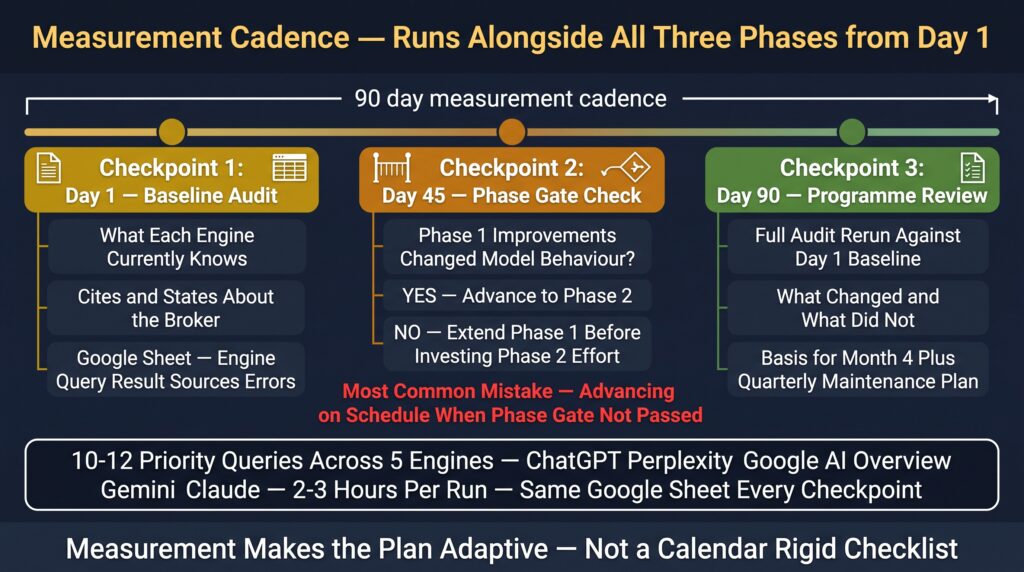
The measurement cadence is not a separate phase — it runs alongside the programme from Day 1 and is what makes the plan adaptive rather than a calendar-rigid checklist. Three scheduled check-ins structure the 90 days.
Day 1 — Baseline audit. The AI/GEO visibility audit deliverable. Documents what each engine currently knows, cites, and states about the broker. All subsequent measurements compare against this baseline. The format is a Google Sheet: engine, query, result (cited/absent/incorrect), sources cited instead, factual errors noted.
Day 45 — Phase gate check. The most underrated check in a 90-day programme. Run at the end of Phase 1 / start of Phase 2. If Phase 1 improvements have not yet changed model behaviour — entity errors still persist, license information is still wrong in engine answers — extend Phase 1 before investing Phase 2 effort. The most common implementation mistake is advancing on schedule when the phase gate has not been passed, then doing Phase 2 extractability work on a foundation that Phase 1 was supposed to correct. The Day 45 check prevents it.
Day 90 — Programme review. Full audit rerun against Day 1 baseline. Documents what changed and what did not. This output is the basis for the Month 4+ quarterly maintenance plan and connects to the Share of Model metric that tracks long-term cross-engine presence. The practical measurement for each check-in: run 10–12 priority queries across the five priority engines (ChatGPT, Perplexity, Google AI Overview, Gemini, Claude), document the results in the same Google Sheet, and compare against the prior checkpoint. Each measurement run takes 2–3 hours. Where Phase 3 corroboration work is underway in parallel, the Day 90 review also benchmarks whether third-party source mentions have begun to influence model answers — the longest-lag indicator in the programme, and the one that feeds into the strategic investment question covered in AI search vs traditional SEO for forex brokers.
Measurement Format
Google Sheet columns: Engine | Query | Result (Cited / Absent / Incorrect) | Sources Cited Instead | Factual Errors Noted | Change vs Prior Checkpoint. Each row is one query on one engine. 10–12 queries × 5 engines = 50–60 rows per check-in. This is the client-facing deliverable format — documented, dated, comparable across checkpoints.
Which Queries to Prioritise — and Which to Deprioritise for the First 90 Days
Most brokers try to optimise for everything at once. The 90-day plan should target query types in a clear priority order, because the effort and timeline for each type differs significantly and the wrong starting point wastes Phase 1 and Phase 2 budget.
| Priority | Query Type | Example Queries | Phase Target | What Moves the Needle |
|---|---|---|---|---|
| 1 — Highest ROI | Branded factual | “Is [broker] regulated?”, “[Broker] license number”, “[Broker] minimum deposit” | Phase 1 + 2 | Entity clarity + extractable content + compliance-cleared regulatory page |
| 2 — Medium ROI | Competitive positioning | “[Broker] vs [competitor]”, “Is [broker] better than [competitor]?” | Phase 2 only after Day 45 gate | Entity clarity prerequisite + extractable comparison-adjacent content |
| 3 — Long-term target | Category/commercial | “Best forex broker for [market]”, “Most trusted regulated broker [region]” | Phase 3 plants seeds — 90+ day harvest | Third-party corroboration in sources engine already trusts |
The instinct most CMOs have is to start with Priority 3 — the category queries with the largest potential audience. This is the wrong sequencing for two reasons. Category queries require third-party corroboration that takes 90+ days to influence and is outside the broker’s direct control. And winning a category query citation while the engine still states wrong license information for the broker’s branded queries creates a worse problem than invisibility — a prospect who finds the broker via a category citation and then asks a follow-up branded question gets contradictory information.
What Generic GEO Plans Get Wrong for Regulated Brokers
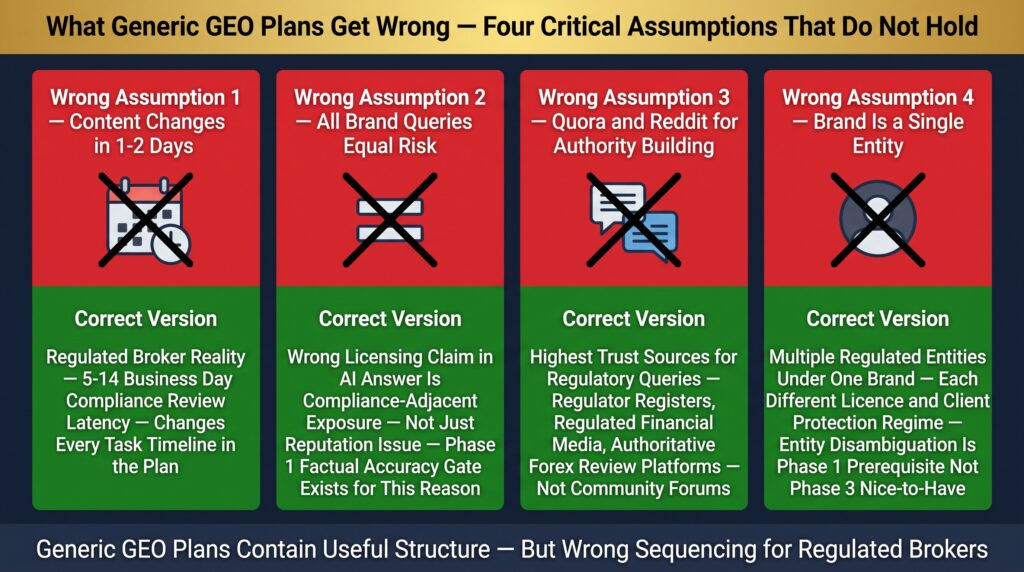
Generic AEO/GEO plans — the horizontal B2B guides that dominate search results for this topic — contain genuinely useful structural insights. But they embed assumptions that do not hold for a regulated forex broker, and applying them uncritically leads to the wrong sequencing errors described in this article’s opening.
Generic plans assume the business can publish content changes in 1–2 days. A regulated broker cannot — compliance review is a structural latency of 5–14 business days for any content touching regulatory claims. This single difference changes every task timeline in the plan.
Generic plans treat all brand queries as equivalent in risk. For a regulated broker, a wrong licensing claim in an AI answer is a compliance-adjacent exposure, not just a reputation issue. The factual accuracy phase gate in Phase 1 exists specifically because of this elevated risk.
Generic plans recommend Quora and Reddit for third-party authority building. For a regulated broker, the engine’s highest-trust sources for regulatory queries are regulator registers, regulated financial media, and authoritative forex review platforms — not community forums. The corroboration targets in Phase 3 reflect this distinction.
Generic plans treat the brand as a single entity. Most established forex brokers operate several regulated entities under one brand name, each with a different license and client-protection regime. Entity disambiguation is not a Phase 3 nice-to-have; it is the Phase 1 prerequisite that all subsequent work depends on.
The forex broker SEO audit shares some of these same regulated-finance-specific constraints on the organic side — the parallel is intentional. Both the SEO and AEO/GEO disciplines require more careful sequencing for a regulated broker than for an unregulated B2B business, and both reward getting the entity and compliance foundations right before building content infrastructure on top of them.
Before the 90-day plan can be sequenced correctly for your specific brokerage, you need the baseline the AI/GEO visibility audit produces — it tells you which phase to start in, which factual errors in the model need correcting first, and which query types are the most compliance-sensitive for your specific entity structure.
Q1: What should a forex broker prioritise first in a GEO or AEO programme?
The first priority in a forex broker AEO or GEO programme is regulatory entity clarity, not content production. Before publishing any structured content or FAQ schema, the broker needs to ensure that AI models accurately recognise which entity holds which license, under which regulator, and which entity a client in a given jurisdiction is actually dealing with. This matters because AI models learn from many sources and frequently conflate a broker’s multiple regulated entities, or confuse the legitimate broker with a same-name clone site. Any FAQ content or structured answers published while the model still has a confused understanding of the broker’s entity structure will be attributed to the wrong entity, making the content investment counterproductive. Regulatory entity clarity is the foundation on which everything else in the programme depends, which is why it comes first regardless of what other optimisation tactics a generic GEO plan might recommend starting with.
Q2: What does a 90-day AEO/GEO programme for a forex broker actually look like?
A structured 90-day AEO and GEO programme for a forex broker follows three sequential phases. Phase one, covering days one to thirty, focuses on regulatory entity clarity: ensuring that the broker’s own site, regulator public registers, and AI model knowledge all consistently reflect the correct entity name, license number, and jurisdiction for each regulated entity the broker operates. Phase two, covering days thirty-one to sixty, focuses on extractability: adding direct-answer FAQ blocks to priority pages, implementing FAQ schema, and creating standalone pages answering the highest-priority branded factual queries such as the broker’s regulatory status. Phase three, covering days sixty-one to ninety, focuses on third-party corroboration: ensuring the broker is accurately described in the financial media and forex directory sources that AI engines already treat as authoritative. Each phase concludes with a cross-engine verification check before the next phase begins, making the plan adaptive rather than calendar-rigid.
Q3: Why does a forex broker need compliance sign-off before publishing AEO/GEO content?
A forex broker operating under a financial services license is required to have compliance approval for any published content that makes regulatory claims, including content created specifically for AEO or GEO optimisation. This matters for a GEO programme specifically because the highest-value content for AI citation purposes, including direct-answer pages about the broker’s regulatory status, structured FAQ blocks answering whether the broker is regulated, and entity-clarity pages describing which license covers which clients, all contain regulatory claims that must be reviewed. This compliance review typically adds seven to ten business days to content that makes substantive regulatory claims and five to seven business days to content that reformats existing approved claims into a new structure. GEO implementation plans that do not account for this latency routinely stall in their first month because content that appeared ready to publish requires legal review before it can go live. Building compliance review into the plan from day one, as a parallel track rather than a sequential step after drafting, is the primary operational difference between a 90-day plan that works for a regulated broker and one that works for an unregulated business.
Q4: How do you measure AEO/GEO progress for a forex broker?
AEO and GEO progress for a forex broker is measured through scheduled cross-engine query runs, not through search ranking trackers or keyword position tools. The measurement method is to run a fixed set of ten to twelve priority queries across the five main AI engines, specifically ChatGPT, Perplexity, Google AI Overview, Gemini, and Claude, documenting for each query whether the broker is cited or absent, whether the information stated is accurate, and which sources the engine cites instead of the broker. This documentation is compared against a baseline audit from before the programme began. Three scheduled measurement points structure a 90-day programme: the baseline audit before day one, a mid-point cross-engine check at day forty-five to determine whether Phase 1 improvements have taken effect, and a full rerun at day ninety to compare against the baseline. The day forty-five check functions as the phase gate that determines whether the programme should advance to Phase 2 or extend Phase 1. Standard SEO rank-tracking tools only cover Google AI Overviews and cannot be used to measure progress across the other AI engines.
Q5: How long does it take for GEO improvements to change what AI engines say about a forex broker?
The timeline for AEO and GEO improvements to change AI engine behaviour varies by outcome type. Regulatory entity clarity improvements, meaning corrections to the specific license, entity name, and jurisdiction information the engine states, typically take thirty to sixty days to reflect in model answers if the broker’s own content is updated and regulator register listings are corrected, because some AI engines retrieve information in real time from trusted sources. Branded factual query accuracy, meaning whether the engine correctly states the broker’s conditions and product details, typically takes sixty to ninety days and depends on AI model retraining schedules that are outside the broker’s control. Category query presence, meaning whether the broker appears in answers to commercial queries such as best forex broker for a given market, is a ninety-plus-day outcome that requires the broker to earn third-party corroboration from the sources the engine already trusts. No GEO programme can guarantee specific placement in AI answers within a fixed timeline, because model retraining schedules are determined by the AI companies, not by the content published.
Q6: Can a forex broker implement AEO/GEO without running an audit first?
Technically yes, but doing so significantly reduces the probability of the programme being sequenced correctly. The audit baseline serves two functions. First, it establishes what each AI engine currently knows, states, and cites about the broker, which determines whether Phase 1 entity clarity work is needed or whether the engine already has the entity structure correct and the programme can begin at Phase 2. Second, it identifies which specific factual errors the model is currently stating about the broker, ranked by compliance sensitivity, which determines which content updates are the highest-priority Week 1 tasks rather than generic tasks that might not address the broker’s actual gaps. A 90-day GEO plan without an audit baseline is a generic checklist applied without knowing which items on the checklist are actually problems for that specific broker. The most common result is spending Phase 1 fixing entity issues that did not exist, while the real compliance-sensitive errors in the model’s answers go unaddressed until Phase 2 or later.