AEO/GEO for Forex Brokers: How to Get Cited by AI Search and from where you need to start?
If you searched for “GEO for Forex Brokers” recently and got results about why Cyprus is a great place to register a brokerage, you have just experienced the information gap this article is here to fill.
“GEO” means two different things in a forex context. The first is geographic location strategy — where brokers incorporate, which regulatory jurisdictions offer the best operational conditions. That is what the search results reflect. The second is Generative Engine Optimization, or GEO — the practice of structuring a brand’s content and digital presence so that AI engines cite it in generated answers. “AEO” (Answer Engine Optimization) is the older, unambiguous term for the same discipline. The two are used interchangeably in this article, and together they refer to AI citation strategy, not geography.
For a regulated forex broker in 2026, this is a live business problem. A growing share of high-intent research now ends inside an AI engine’s answer. A prospect who asks ChatGPT “is [broker] regulated and safe for UK clients?” either finds the broker in the answer or finds a competitor. That gap is what AEO/GEO addresses — and for most regulated brokers, it is a gap that has not yet been deliberately closed.
Why AI Citations Matter More Than Organic Rankings for Regulated Brokers
The shift is structural, not a trend. When a prospect types a research question into an AI engine, they receive a synthesised answer — not a list of pages to click through. The engine has already done the research, evaluated sources, and formed a recommendation. If the broker is not in that answer, the prospect may never see the broker’s pages at all, regardless of how well those pages rank.
For a regulated broker, this creates two distinct risks. The first is a visibility risk: the broker is absent from AI answers for queries its prospects ask, effectively handing pre-qualified leads to whichever competitors the engine does cite. The second, and more serious, is an accuracy risk: the broker appears in AI answers with incorrect regulatory information — the wrong license, a confused entity, an outdated jurisdiction. For a regulated brand, a confident AI misstatement about licensing is not a marketing inconvenience; it is a compliance-adjacent exposure that may reach regulators as well as prospects.
The pre-qualification point is worth naming for any CMO building a board case: a prospect who finds a broker through a ChatGPT answer to “is [broker] regulated and safe?” has already been told the broker is credible. They arrive with more intent than a cold click from a paid ad or an organic search result. AEO/GEO investment operates in a layer where most brokers have yet to invest — which is why the opportunity is real and the window of early-mover advantage is open now.
The brokers appearing in AI citations in mid-2026 are not necessarily the largest or best-known — they are the ones whose content gives AI engines something specific and accurate to work with: a direct answer in the first paragraph, a named author, a licence number cited against a regulator, a risk warning in the right place.
This is distinct from, though complementary to, traditional SEO. A broker can pass a forex broker SEO audit cleanly and still fail an AEO/GEO check badly, because the two systems diagnose different things. SEO measures where pages rank; AEO/GEO measures whether and how a brand appears inside generated answers. Both reward genuine authority and clear structure, but the specific gaps require a different diagnostic to surface.
Table of Contents
AEO/GEO for Forex Brokers: How to Get Cited by AI Search-The Five Factors That Determine Whether a Forex Broker Gets Cited
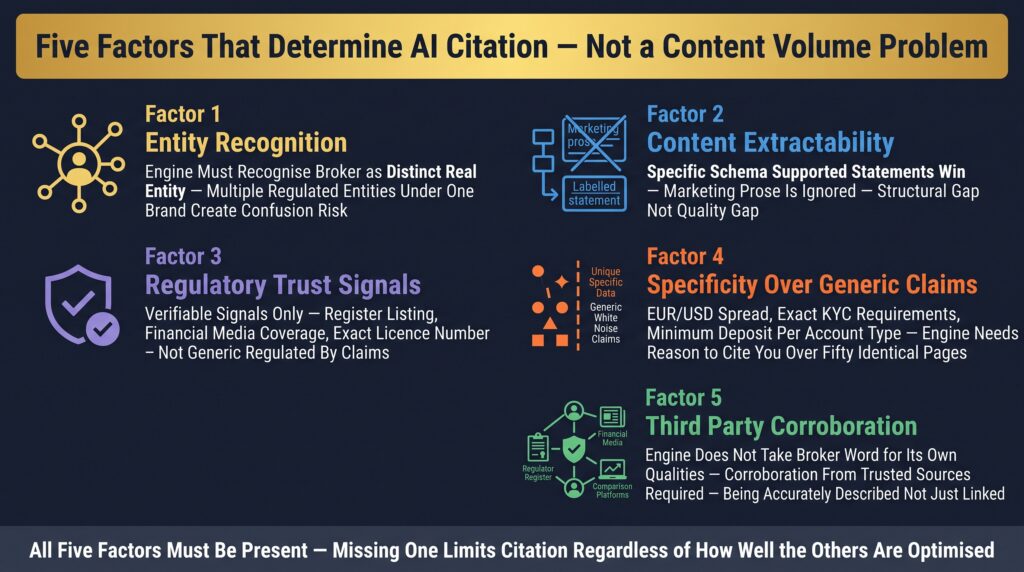
Most brokers approach AI visibility as a content production problem — write more, add more FAQ sections, use more keywords. The reality is more specific. Five distinct factors determine whether a regulated forex broker gets cited in AI-generated answers, and they require different actions to improve.
Factor 1 — Entity recognition. Before a broker can be cited, the AI engine must recognise it as a distinct, real entity. This sounds like a low bar, but it is not. A broker operating multiple regulated entities under one brand name — a CySEC entity for EU clients, an FCA entity for UK clients, an ASIC entity for Australian clients — is vulnerable to entity confusion. The model may conflate these entities, attribute one entity’s terms to another market, or confuse the legitimate broker with a same-name clone site. If the engine does not clearly understand what the broker is and which entity it is talking about, no amount of structured content generates accurate citations.
Factor 2 — Content extractability. AI engines lift labelled, self-contained answers. “We are regulated to the highest standard” is not extractable — it is a claim with no specific information the engine can work with. “Broker Name is authorised and regulated by CySEC (license number [X]) for EU clients, and by the FCA (FRN [Y]) for UK clients” is extractable — the engine can lift it as a complete, verifiable answer to a specific question. The gap between content an engine ignores and content it cites is almost always a structural gap, not a quality gap. Plain, specific, schema-supported statements win; marketing prose does not.
Factor 3 — Regulatory trust signals. Financial services content sits in YMYL (Your Money or Your Life) territory. AI engines apply heightened scrutiny before citing financial claims from any source, including from a broker’s own pages. For a regulated broker, the trust signals that move the needle are verifiable ones: the regulator’s public register listing the broker’s trading name consistently, financial media referencing the license accurately, and the broker’s own site stating the exact license number rather than a generic “we are regulated by” claim. These signals tell the engine the regulatory claim is safe to cite. Full treatment in forex broker E-E-A-T signals AI models actually weigh.
Factor 4 — Specificity over generic claims. The most common reason regulated forex brokers are absent from AI answers for competitive queries is undifferentiated messaging. “Competitive spreads, regulated, dedicated account manager” is the content equivalent of white noise — the engine cannot use it to distinguish the broker from the fifty others making identical claims on identical pages. Specific answers to specific questions give the engine a reason to cite one broker over another: the EUR/USD spread under ESMA leverage limits, the exact KYC documentation required, the minimum deposit per account type. Specificity is both the citation signal and the differentiation signal.
Factor 5 — Third-party corroboration. AI engines do not take a broker’s word for its own qualities. They look for corroboration from sources they have learned to trust. For a regulated retail CFD broker, the highest-trust corroboration sources are: the regulator’s own public register (CySEC, FCA, ASIC), established financial media that has covered the broker by name, and the comparison and review platforms the engine already cites for commercial queries. Being accurately described in those sources — not just linked from them — is what shifts the engine from treating the broker as an uncorroborated self-description to treating it as citable.
| Factor | What It Means for a Regulated Forex Broker | Fastest Action to Improve It |
|---|---|---|
| 1. Entity recognition | The model correctly identifies which regulated entity serves which market under which license — not a generic brand name. | Update the regulation page to name each entity explicitly with its license number and jurisdiction. Add Organization schema. |
| 2. Content extractability | Key factual claims are stated in plain, labelled, self-contained sentences the engine can lift — not buried in marketing prose. | Add direct-answer FAQ blocks to the regulation page, account conditions page, and homepage. Add FAQ schema via RankMath. |
| 3. Regulatory trust signals | The license claim is verifiable — the regulator’s public register, the broker’s own pages, and financial media all state it consistently. | Check regulator register listings for accuracy. Confirm financial media mentions state the correct license. Fix discrepancies. |
| 4. Specificity | Pages answer specific questions with specific data, not generic claims identical to every competitor. | Identify the 10 most common questions prospects ask about the broker. Ensure each has a clear, direct answer on the site. |
| 5. Third-party corroboration | Trusted external sources — financial media, regulator registers, comparison platforms — accurately describe the broker. | Audit existing financial media mentions for factual accuracy. Ensure regulator public register listing matches the broker’s own site. |
Why “Best Forex Broker” Queries Will Not Cite Your Site Directly — and Which Queries Will
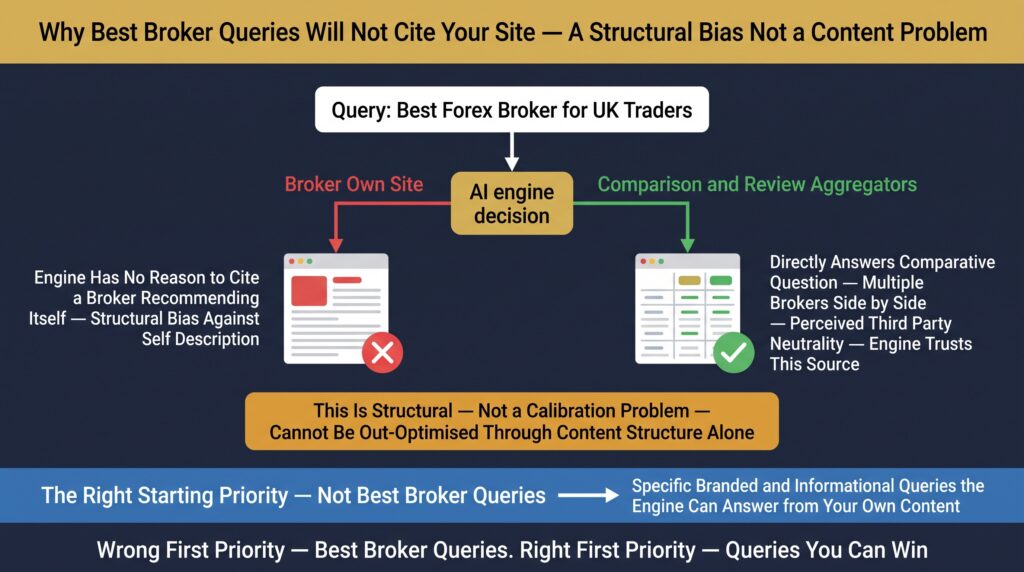
The most common instinct among broker CMOs who discover AEO/GEO is to optimise for the commercial comparison queries: “best forex broker for UK traders,” “most trusted regulated broker for [market],” “which forex broker should I use.” These are the queries with the largest potential audience. They are also the hardest to win via AEO/GEO tactics and the wrong starting priority.
AI engines resolve commercial comparison queries from the sources they already trust for those queries: comparison and review aggregators. This is a structural bias, not a calibration problem. Aggregators directly answer the comparative question asked, present multiple brokers side by side, and carry a perceived third-party neutrality that the engine treats as more citable than a broker describing its own merits. An individual broker cannot out-optimise a comparison aggregator on a “best broker” query through content structure alone — the engine has no reason to cite a broker recommending itself when a neutral multi-broker source exists.
The correct starting priority is the inverse: the branded factual queries where the broker is the only authoritative source and comparison sites have no structural advantage. “Is [broker] regulated by CySEC?”, “[Broker] minimum deposit per account type”, “[Broker] FCA licence number”, “What entities does [broker] operate under?” — these are queries where the broker’s own structured, extractable content should win every citation. They are also the queries with the highest compliance risk if the AI states incorrect information, which is a second reason to start here.
Win the branded factual layer first. The comparison query presence follows from the authority and corroboration built by doing the fundamentals correctly — not the other way around. The structural dynamics behind the comparison-site advantage are covered fully in why AI engines cite comparison sites over broker sites.
Priority Sequence — Observed Mid-2026
Start here: Branded factual queries (entity, licence, conditions) — fastest to fix, highest compliance risk if wrong, within the broker’s direct control.
Then: Competitive positioning queries (“[broker] vs [competitor]”) — requires entity clarity first.
Long-term: Category/commercial queries (“best broker for [market]”) — requires third-party corroboration that takes 90+ days to build. Wrong starting point.
How Different AI Engines Treat Forex Broker Citations
The five priority AI engines that forex broker prospects use for research — ChatGPT, Perplexity, Google AI Overview, Gemini, and Claude — behave differently, and as of mid-2026 they frequently disagree about the same broker. A broker that appears accurately in one engine may be absent or incorrectly described in another. Checking only ChatGPT, because it is the most visible, produces a dangerously partial picture.
Perplexity uses real-time web retrieval and is the fastest to reflect correctly structured, freshly published factual content. For a broker that has improved its extractability (Factor 2), Perplexity is often the first engine to show it. Google AI Overview draws heavily from pages already in the top-10 organic results, making SEO and GEO more tightly linked here than on other engines — strong organic performance is a functional prerequisite for Google AI Overview citation. ChatGPT is predominantly training-data-dependent, reflecting what the model knew at its last training cutoff; it is the slowest to reflect content changes but has the highest consumer reach. Gemini is increasing its integration with Google Search and Workspace, rewarding entity clarity and structured content. Claude is growing in significance for professional and B2B research workflows, including regulated broker due diligence.
These engines disagree because each trains on a different source mix, retrains on a different schedule, and weights recency and authority differently. The cross-engine variance is what makes single-engine checks unreliable and what produces the metric worth tracking long-term — Share of Model: how often and how accurately a broker appears across the full set of engines for its priority queries. The AI/GEO visibility audit establishes that baseline across all five.
Three Things You Can Do Before Spending Anything
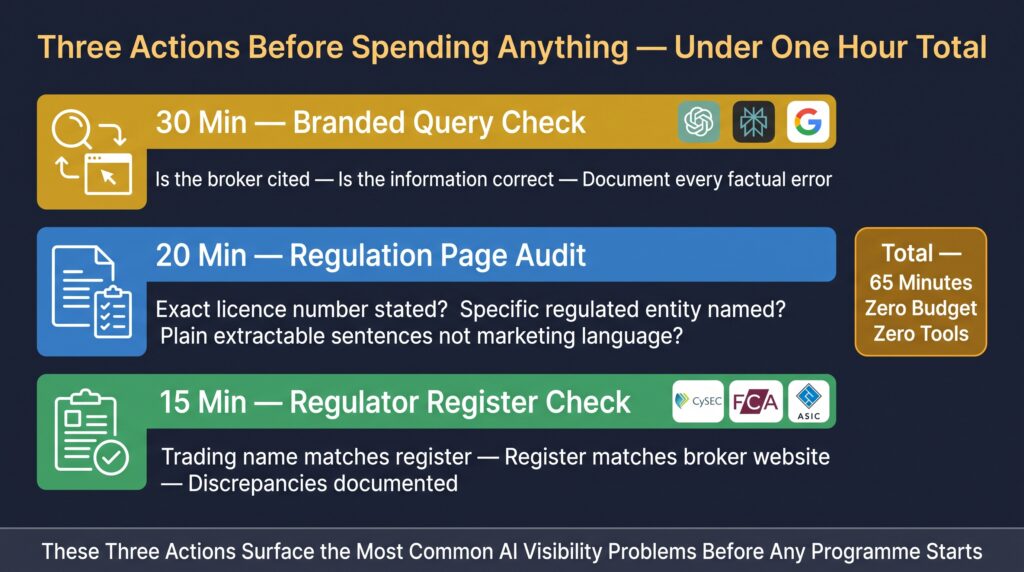
A full AEO/GEO programme starts with an audit baseline, a phased implementation plan, and consistent measurement. But the three actions below take under an hour, require no tools or budget, and reliably surface the most common AI visibility problems for a regulated broker. They are the right starting point for any broker with no GEO work in place.
Action 1 — Run the branded query check (30 minutes). Open ChatGPT, Perplexity, and Google AI Overview. Run these queries for the broker: “Is [broker] regulated?”, “[Broker] licence number”, “[Broker] minimum deposit”, “[Broker] vs [main competitor].” Screenshot every answer. For each result, note: is the broker cited? If yes, is the information correct — right entity, right licence number, right jurisdiction? Write down every factual error. This is the first 30 minutes of a proper audit, and it costs nothing.
In the branded query checks I run as a first step, the question is never whether there are factual errors — it is how many, and which platform states the most damaging one.
Action 2 — Audit the regulation page (20 minutes). Open the broker’s regulation page. Three questions: Does it state the exact licence number, or only the regulator’s name? Does it name the specific regulated entity — not the brand umbrella — that holds each licence? Is it written in plain, extractable sentences (“Broker Name is authorised by CySEC, licence number [X]”) or in marketing language (“We are proudly regulated to the highest standards”)? If any answer is no, fixing the regulation page is the single highest-ROI AEO/GEO action available. It requires a content edit and a compliance review — nothing more.
Action 3 — Check the regulator’s public register (15 minutes). Go to the CySEC, FCA, or ASIC register and look up the broker by name. Does the listing show the trading name the broker uses with clients? Does it match what the broker’s own website states? Discrepancies between what the regulator’s official record shows and what the broker’s site describes are a primary source of AI entity confusion — and they are entirely within the broker’s power to request corrected, at no cost.
These three actions establish whether there is a problem. The AI/GEO visibility audit establishes exactly how bad the problem is across all five priority engines, and the 90-day AEO/GEO implementation roadmap sets out what to do about it in the right order.
The fastest way to find out where your brokerage actually stands across ChatGPT, Perplexity, Gemini, and Google AI Overview is the AI/GEO visibility audit — it tells you which of these five factors is your biggest gap.
FAQ
Q1: What is AEO/GEO for a forex broker?
AEO stands for Answer Engine Optimization and GEO stands for Generative Engine Optimization. The two terms refer to the same discipline: the practice of structuring a brand’s content, entity information, and digital presence so that AI engines such as ChatGPT, Perplexity, Google AI Overview, Gemini, and Claude cite the brand in their generated answers. For a regulated forex broker, AEO and GEO are distinct from traditional SEO, which optimises for page rankings in a list of search results. AEO and GEO optimise for appearing inside a synthesised AI answer that a prospect receives instead of, or before seeing, a list of results. The term GEO is sometimes confused with geographic optimization, which is an entirely different practice referring to showing different content to users based on their location. In the context of forex broker marketing in 2026, AEO and GEO always refer to AI answer engine visibility, not geographic targeting.
Q2: What are the five factors that determine whether a forex broker gets cited by AI search?
Five factors determine whether a regulated forex broker gets cited in AI-generated answers. The first is entity recognition: AI models must recognise the broker as a distinct, real entity and not confuse it with a same-name competitor, an offshore clone, or a different regulated subsidiary. The second is content extractability: the broker’s key factual information, including its regulatory status, license numbers, and account conditions, must be stated in plain, structured sentences that an AI can lift cleanly, not buried in marketing prose. The third is regulatory trust signals: for YMYL financial services content, the broker’s license information should be verifiable, consistently referenced, and corroborated by the regulator’s own public register. The fourth is specificity: generic claims such as competitive spreads and regulated by the FCA give AI engines nothing to differentiate the broker from dozens of competitors making identical claims. Specific, answerable content wins citations. The fifth is third-party corroboration: AI engines look for confirmation from sources they trust, including financial media, regulator registers, and established review platforms, before citing an individual broker’s self-description.
Q3: How is AEO/GEO different from SEO for a forex broker?
Traditional SEO optimises for where a broker’s pages appear in a ranked list of search results, using signals such as backlinks, keywords, and technical site health. AEO and GEO optimise for whether a broker appears inside a synthesised AI answer that a user receives without necessarily seeing a results page at all. The practical difference is that a broker can rank well on Google for its own brand name while being completely absent from, or actively misrepresented in, AI-generated answers, because the two systems draw on different signals. SEO success does not guarantee AEO or GEO success. Both share a foundation in genuine authority and structured content, but an AI visibility audit checks entity recognition, citation presence, and factual accuracy across AI engines, none of which appear in a standard SEO audit. A broker with strong SEO has a head start in AEO and GEO because authority and structured content help both, but the specific gaps require a different diagnostic to surface
Q4: Why can’t a forex broker just optimise its way into AI answers for “best broker” queries?
AI engines answer commercial comparison queries such as best forex broker for UK traders primarily by citing comparison and review aggregators rather than individual broker websites, and this is a structural bias that AEO and GEO tactics cannot easily override. The reason is that comparison sites directly answer the comparative question being asked, carry a perceived third-party neutrality that AI engines treat as more citable than a broker recommending itself, and cover multiple brokers per page which gives the engine more synthesisable material per citation. An individual broker describing its own merits reads as self-interested to the AI on a best-broker query, regardless of how well the content is structured. The correct AEO and GEO priority for a forex broker is the branded factual queries where the broker is the only authoritative source, such as its specific regulatory status, license number, and account conditions. These are the queries a broker can win consistently through structured, extractable content, and they are also the queries with the highest compliance risk if the AI states incorrect information.
Q5: Which AI engines should a forex broker focus on for AEO/GEO?
A regulated forex broker should prioritise visibility across five AI engines that its prospects actively use for research: ChatGPT, which has the highest brand recognition and general consumer reach but is predominantly training-data-dependent and slow to reflect recent content changes; Perplexity, which uses real-time web retrieval and rewards freshly structured factual content most directly; Google AI Overview, which appears directly in Google search results and is tightly linked to organic search rankings; Gemini, which is increasing its integration with Google Workspace and Search; and Claude, which is growing in significance for professional and analytical research queries. These engines frequently disagree about the same broker because they train on different source mixes and retrain on different schedules, meaning a broker that appears accurately in one engine may be absent or incorrectly described in another. Checking only one engine, typically ChatGPT because it is the most visible, provides an incomplete picture and may miss serious factual errors in the engines a specific prospect segment is more likely to use.
89 words. The multi-engine scope answer — reinforces E1’s cross-engine measurement principle at MOFU level.
Q6: What is the fastest way for a forex broker to start improving its AI search visibility?
The three fastest starting actions for a forex broker with no existing AEO or GEO programme all take under an hour and require no tools or budget. The first is running a branded query check: querying “is [broker] regulated,” “[broker] licence number,” and “[broker] versus a main competitor” across ChatGPT, Perplexity, and Google AI Overview, and documenting every factual error in the results. The second is auditing the regulation page: confirming that it states the exact licence number, the specific regulated entity name, and the jurisdiction in plain extractable sentences rather than marketing language. The third is checking the regulator’s public register, such as the CySEC, FCA, or ASIC register, to confirm the broker’s listing matches what its own website describes. These three checks reliably surface the most common AI visibility problems, cost nothing, and establish the baseline that any further AEO or GEO work needs to build on. A full audit across all five priority engines provides the complete picture of what each engine currently knows, states, and cites about the brokerage.