
This glossary defines the challenge terms, evaluation concepts, and SEO vocabulary that prop firm marketing teams encounter most often — and that shape content strategy, keyword planning, and SEO programme decisions. It is not a trader’s guide to challenge rules; thorough trader-facing glossaries are available elsewhere. It is a marketer’s reference: each term below includes a standard definition followed by a marketing significance note explaining what the term means for content, keywords, or the firm’s competitive SERP position. Terms that map to specific articles in this SEO blog are linked to their full treatment. Use this glossary as an internal reference when briefing content teams, reviewing keyword lists, or aligning on challenge feature language with SEO partners.
Table of Contents
Prop Firm Glossary, which are the most important one?
Challenge Structure Terms
One-Step Challenge
A one-step challenge is a prop firm evaluation format requiring traders to complete a single evaluation phase — meeting a profit target within a set drawdown limit and minimum trading day requirement — before receiving access to a funded account. There is no separate verification phase; passing the challenge moves the trader directly to funded status.
Marketing Significance
One-step challenge is a high-volume keyword cluster and primary challenge format category that should organise the firm’s site architecture. Prop firms offering one-step challenges should maintain a dedicated category landing page (/challenges/one-step/) that ranks for format-level queries, with individual tier pages beneath it. The one-step vs two-step distinction is the primary comparison axis traders use in evaluation-intent searches.
Two-Step Challenge
A two-step challenge is a prop firm evaluation format requiring traders to pass two sequential phases — a challenge phase and a verification phase — each with separate profit targets and drawdown limits before funded account access is granted. The two-phase structure is designed to verify that a trader’s performance is consistent rather than the result of a single fortunate period.
Marketing Significance
Two-step challenge is the traditional prop firm evaluation format and carries the highest search volume within challenge format queries. An own-tier comparison page — “[Firm] one-step vs two-step challenge” — is one of the highest-priority Category B content types for any prop firm offering both formats, since the firm is the only authoritative source for its own format comparison.
Instant Funding
Instant funding is a prop firm account model where a trader receives a funded account immediately upon payment — without completing an evaluation phase. The trader begins trading from day one, typically under stricter ongoing drawdown limits compared to challenge-based funded accounts.
Marketing Significance
“Instant funding prop firm” is a high-converting evaluation-intent keyword — traders searching for this feature have a specific requirement and are close to purchase. Feature-specific landing pages confirming the instant funding option should appear in the site architecture alongside, not instead of, challenge-based tier pages.
Simulated Funded Account
A simulated funded account (also called a demo funded account) is a prop firm account that mirrors real market conditions but uses simulated capital — meaning the trader operates on real price feeds but the money is not real. Most prop firm “funded accounts” are simulated; payouts to traders come from the firm’s revenue rather than actual trading profits.
Marketing Significance
Whether the funded account is simulated or live is one of the most common trust-verification questions from cautious traders. Proactively addressing this on the challenge tier page — in the FAQPage schema rules section — reduces trader confusion, prevents negative surprise post-purchase, and reduces chargeback risk. Transparent account-type disclosure is both a trust signal and a content strategy decision.
Evaluation Period
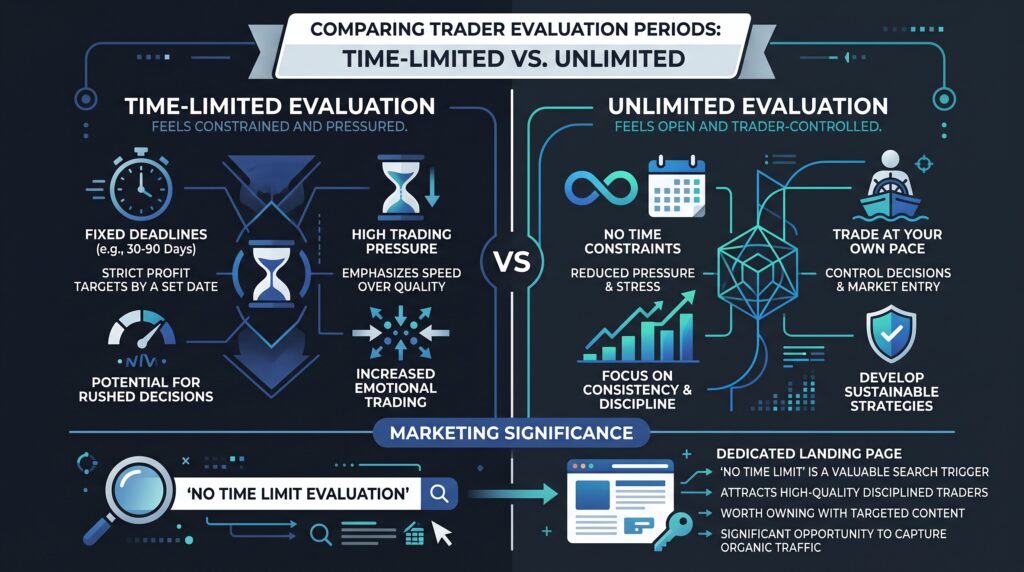
The evaluation period is the time window within which a trader must meet the profit target in a challenge phase, measured in calendar days from the first trade. Some prop firms impose a maximum evaluation period (e.g. 30 days); others impose no time limit, allowing traders to trade until the profit target is met or a drawdown limit is breached.
Marketing Significance
Whether a prop firm imposes a time limit on the evaluation period is a feature-level evaluation trigger — “prop firm no time limit evaluation” is a specific search indicating the trader has this as a requirement. Firms with no time limit should build a feature-specific confirmation page targeting this query.
Verification Phase
The verification phase is the second evaluation stage in a two-step challenge, following successful completion of the challenge phase. It typically carries a lower profit target than the challenge phase (e.g. 5% vs 8%) and is designed to confirm that the trader’s challenge phase performance was consistent rather than a statistical outlier.
Marketing Significance
Clear educational content about the verification phase structure reduces breach rates — traders who understand both phases prepare more appropriately. Including specific verification phase parameters in the two-step challenge page FAQPage schema captures the pre-purchase query “what happens after passing the challenge phase.”
Scaling Plan
A scaling plan is a prop firm programme that increases a funded trader’s account size when they meet specific ongoing performance criteria — such as achieving a defined profit percentage over a set number of trading days. Scaling plans allow successful traders to manage progressively larger capital amounts without purchasing additional challenges.
Marketing Significance
Scaling plan details are a high-value retention content topic — funded traders searching for scaling information are the firm’s best performers. Dedicated content about scaling criteria, timelines, and maximum account sizes serves both SEO and trader retention simultaneously, targeting the post-funding query stage.
Challenge Fee
The challenge fee is the upfront payment a trader makes to access a prop firm evaluation challenge. Fees typically range from $50 to $800 depending on account size and challenge format, and are often refundable upon the trader’s first successful payout from a funded account.
Marketing Significance
Challenge fee refundability is a conversion-relevant trust signal — whether and when fees are refunded is one of the most common pre-purchase questions. Including fee refund policy in the challenge tier’s FAQPage schema targets PAA positions for this query and reduces purchase hesitation at the moment of highest commercial intent.
Reset
A reset is the option for a trader who has breached their drawdown limit to restart a failed challenge — typically for a discounted fee compared to purchasing a new full challenge. Resets allow traders to continue their evaluation without paying full challenge price again.
Marketing Significance
Including reset pricing and availability in the challenge tier FAQ section captures “prop firm reset cost” and “challenge reset option” queries from traders in active evaluation — a secondary conversion driver that can tip hesitant traders toward purchase.
Profit Split
The profit split is the percentage of trading profits that a funded trader receives upon a successful payout request, with the remainder retained by the prop firm. Standard profit splits range from 70% to 95%, and the specific split often depends on the challenge tier and whether a scaling plan is active.
Marketing Significance
“Prop firm highest profit split” and “prop firm 90% profit split” are evaluation-intent keywords traders use to compare firms on this metric. Including the exact profit split percentage in Product schema offers and in the challenge tier FAQ targets both feature-specific keyword ranking and rich result eligibility.
Risk and Rule Terms
Daily Drawdown Limit
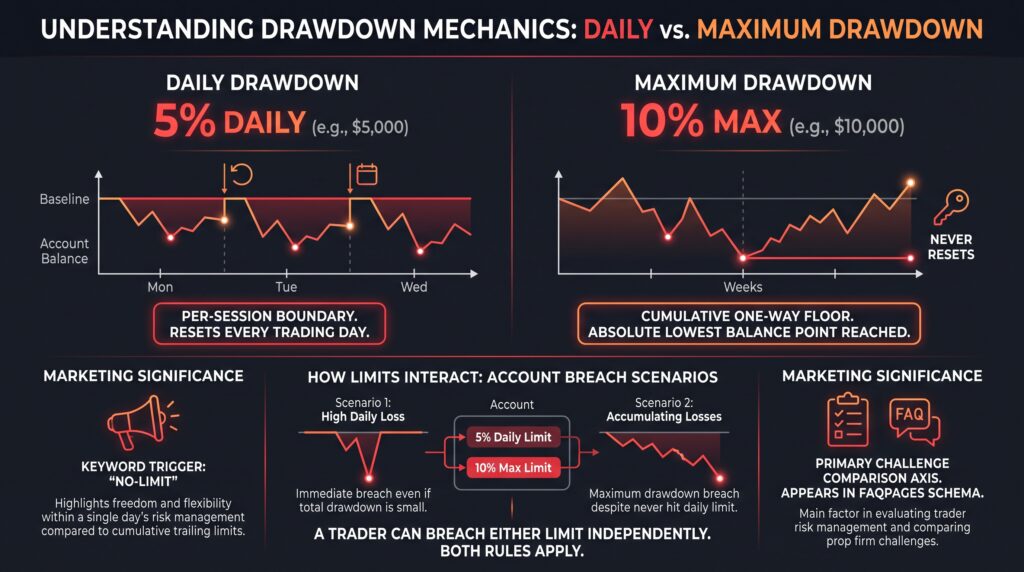
The daily drawdown limit is the maximum amount a trader’s account can lose within a single trading day before the account is automatically closed or paused — typically expressed as a percentage of the initial account balance (e.g. 5%) and resetting each trading day.
Marketing Significance
“Prop firm no daily drawdown limit” is a specific evaluation-intent keyword for firms that don’t impose per-day loss limits. Whether or not the firm has a daily drawdown limit is a primary feature-comparison axis that should appear in the challenge tier FAQPage schema and in a dedicated feature-specific landing page if the firm offers a no-daily-drawdown format.
Maximum (Total) Drawdown
The maximum drawdown (also called total drawdown or overall drawdown) is the largest cumulative loss a trader’s account can sustain from its starting balance before the account is closed. Unlike daily drawdown, this limit applies across the entire challenge or funded period rather than resetting each day.
Marketing Significance
Maximum drawdown percentage leads most prop firm comparison tables. Including it in Product schema attributes and in challenge tier FAQPage schema maximises the firm’s visibility in structured AI responses and feature-comparison searches.
Trailing Drawdown
Trailing drawdown is a drawdown limit type where the maximum loss threshold follows the account’s peak balance upward but never moves down — meaning the loss floor rises with profits rather than resetting to the initial balance. A trader who reaches a new equity high will have a stricter absolute floor than when they started the challenge.
Marketing Significance
Trailing drawdown is one of the most searched-for rule distinctions in prop firm SEO — “trailing drawdown vs static drawdown” and “prop firm trailing drawdown explained” are informational queries that attract traders in active evaluation. A dedicated explainer builds topical authority and links naturally to the challenge tier page where the rule applies.
Consistency Rule
A consistency rule is a prop firm challenge requirement that no single trading day’s profit may exceed a defined percentage of the trader’s total profits across the evaluation period — typically 30% to 50%. It is designed to prevent a single lucky session from satisfying the profit target, requiring the trader to demonstrate consistent performance across multiple trading days.
Marketing Significance
“No consistency rule prop firm” is a high-converting evaluation-intent keyword — traders searching for this absence have a specific requirement and are close to purchase. Firms that do not impose a consistency rule should build a feature-specific confirmation page targeting this query. See the prop firm keyword conversion analysis for the full evaluation-intent keyword framework.
Profit Target
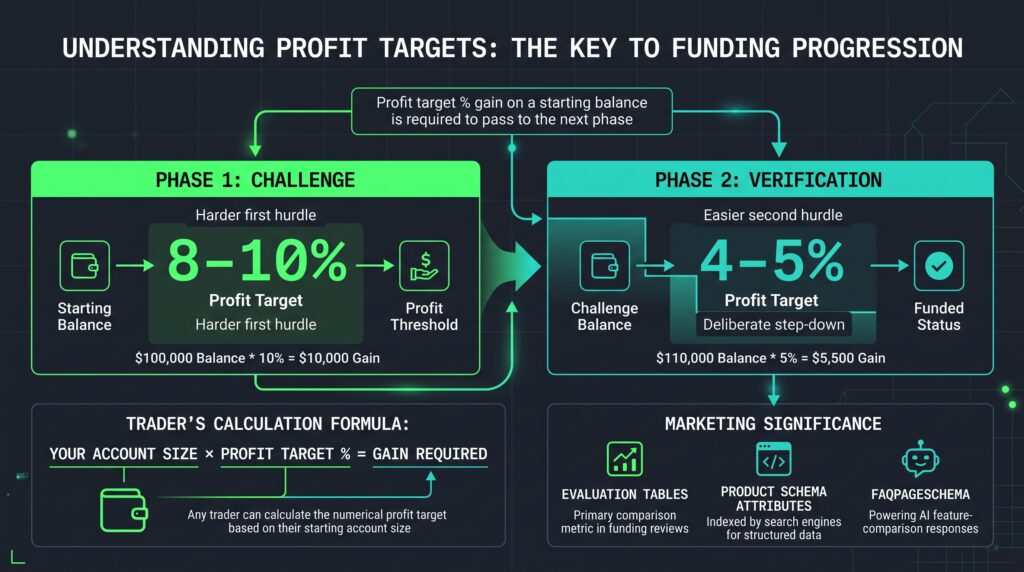
The profit target is the minimum percentage gain a trader must achieve on their starting account balance during an evaluation phase to pass it. A typical challenge phase profit target is 8–10% of the starting balance; a verification phase profit target is lower at 4–5%.
Marketing Significance
Profit target percentage is a primary comparison metric in every prop firm evaluation table. Including specific figures in Product schema attributes and challenge tier FAQPage schema improves structured data accuracy and positions the firm in feature-comparison AI responses.
Breach
A breach is the event of a trader exceeding their drawdown limit — daily or maximum — resulting in automatic closure of the challenge or funded account. A breach terminates the current evaluation or funding relationship; the trader must purchase a new challenge or reset to continue.
Marketing Significance
Publishing accurate breach rate data on the challenge tier page or transparency page is a trust signal — proactive disclosure of challenge difficulty demonstrates honesty and differentiates the firm against those that don’t disclose this data. It is also a content differentiation element that feeds the trust-verification keyword category.
Minimum Trading Days
Minimum trading days is the required number of calendar or trading days on which a trader must make at least one trade during an evaluation phase. Some firms require 5 minimum trading days to prevent traders from making a single large-risk trade to satisfy the profit target.
Marketing Significance
Firms with low or no minimum trading day requirements should include this in their feature-specific evaluation pages — “prop firm no minimum trading days” is an evaluation-intent query for traders who trade infrequently (swing traders, position traders). This is a Category B feature confirmation query the firm uniquely owns if it meets the criterion.
News Trading Restriction
A news trading restriction is a prop firm rule that prohibits or limits trading during major economic news releases — such as Non-Farm Payrolls, interest rate decisions, or central bank announcements — due to the high volatility and price slippage these events produce. Firms either prohibit positions during news windows or require existing positions to be closed before the release.
Marketing Significance
“Prop firm that allows news trading” is a high-converting evaluation-intent query for firms without this restriction. Traders who trade news events have a clear requirement and are searching for specific confirmation — a feature-specific landing page confirming news trading is permitted is one of the most direct conversion paths for this trading segment.
Violation
A violation is the breach of a prop firm rule other than the primary drawdown limits — such as using prohibited trading strategies (high-frequency trading, arbitrage, copy trading), holding positions over restricted times (weekends, news events), or exceeding maximum position size per trade. Violations typically result in challenge or account termination equivalent to a drawdown breach.
Marketing Significance
A dedicated “what is not allowed” section in the challenge page FAQPage schema directly targets pre-purchase due-diligence searches for traders using borderline strategies. Clarity on violation rules reduces post-purchase disputes and demonstrates the operational transparency that differentiates credible prop firms from those with ambiguous rule enforcement.
Payout and Trust Terms
Payout Proof
Payout proof is documented evidence that a prop firm has successfully processed withdrawal payments to funded traders — typically consisting of transaction screenshots, payment confirmation records, or account statements showing credited funds with dates and amounts. Payout proof is published by prop firms themselves or shared publicly by traders as evidence of legitimate operations.
Marketing Significance
“[Firm] payout proof” is a Category B trust-verification keyword — the firm itself is the only source of genuine, current, verifiable payout evidence. Payout proof content should begin accumulating from the firm’s first successful withdrawal; evidence age matters as much as evidence volume for trust-verification query rankings. This is the highest-priority content type in the Category B build sequence. Full treatment in the prop firm aggregator SEO article.
Payout Schedule
The payout schedule defines how frequently and when funded traders can request withdrawals of their trading profits — typically structured as weekly, bi-weekly, or monthly cycles from the first successful payout request. Some firms allow on-demand payouts without fixed cycles.
Marketing Significance
Including precise payout schedule data in Product schema and FAQPage schema — not “regular payouts” but “every 14 calendar days from first payout request” — improves structured data accuracy and reduces pre-purchase hesitation from traders comparing withdrawal terms across firms.
Withdrawal Cycle
The withdrawal cycle is the total elapsed time from a funded trader’s payout request to the receipt of funds — combining the firm’s internal processing time and any external payment method transfer delay. Withdrawal cycles may range from hours (cryptocurrency) to several business days (bank transfer).
Marketing Significance
“[Firm] withdrawal speed” and “[firm] payout time” are trust-verification queries where the firm’s documented evidence is the most credible source. Publishing specific average and maximum withdrawal cycle times — rather than vague assurances — is both a trust content investment and a Category B keyword targeting decision.
Trust Deficit
Trust deficit refers to the generalised scepticism among prop firm traders resulting from the high rate of prop firm exits, rule changes, and delayed payouts that occurred in 2024–2025, when an estimated 80–100 prop firms exited the market. Traders now apply higher trust thresholds before purchasing challenges from firms without an established withdrawal history.
Marketing Significance
Trust deficit is the structural context that makes payout proof content, third-party review presence, and transparency pages non-optional for new or unestablished prop firms. It also explains why trust-verification keywords convert at high rates when satisfied — traders who overcome the trust barrier through genuine evidence enter purchase with high conviction. See the prop firm SEO timeline for the trust velocity constraint this creates on the programme.
Funded Trader Testimonial
A funded trader testimonial is a statement or record from a trader who has passed a prop firm challenge and received payout, sharing their experience of the evaluation and payout process. Testimonials are most credible when verifiable through the trader’s social media presence or account screenshots.
Marketing Significance
Funded trader testimonials on the firm’s own website do not earn Google review snippets (due to the Organisation schema limitation discussed in the technical SEO article) but serve as editorial trust signals. Verifiable testimonials with social links carry significantly more trust weight than anonymous statements — prioritise verifiability over volume.
Third-Party Review Platform
A third-party review platform is an independent service — such as Trustpilot, Google Business Reviews, or PropFirmMatch — that collects and displays trader reviews of prop firms outside of the firm’s own website. Reviews on third-party platforms are considered editorially independent and carry more trust weight with both traders and Google than reviews hosted by the reviewed firm.
Marketing Significance
Third-party review presence is non-optional for earning Google review snippets (star ratings in SERP results) — Google’s schema guidelines exclude review snippets for Organisation schema when the business controls the reviews on its own site. Trustpilot and Google Business profiles are the only path to the visual trust signal layer in search results for trust-verification queries.
Challenge Pass Rate
The challenge pass rate is the percentage of traders who successfully complete an evaluation challenge and receive funded account status, out of all traders who attempt the challenge. Industry data suggests this figure is typically below 20% for most funded trader programs.
Marketing Significance
Proactively disclosing the challenge pass rate is a counterintuitive trust signal — traders in a high-scepticism market interpret voluntary risk disclosure as evidence of honesty. A firm that publishes its actual pass rate alongside genuine payout evidence demonstrates operational transparency that structurally cannot be matched by firms without disclosed figures.
Prop Firm Exit
A prop firm exit is the closure or sudden discontinuation of a prop firm’s operations, typically involving the cessation of payout processing and deactivation of active challenge accounts. An estimated 80–100 prop firms exited the market between 2024 and 2025, contributing significantly to the current trader trust deficit.
Marketing Significance
A firm that operated continuously through the 2024–2025 exit wave and continued processing payouts throughout holds a significant credibility advantage over newer entrants. This continuity should be documented in the transparency page with dated payout evidence spanning the exit period — the most powerful available trust signal for traders researching firm longevity.
SEO and Keyword Terms
Evaluation-Intent Keyword
An evaluation-intent keyword is a search query typed by a prop firm trader who is actively comparing challenge options and has not yet made a purchase decision. These queries indicate the trader is in a final evaluation window — checking whether a specific firm meets a feature requirement or comparing two specific firms — rather than gathering general information.
Marketing Significance
Evaluation-intent keywords convert to challenge purchases at significantly higher rates than informational keywords despite lower search volumes — making them the highest commercial-return keyword category per content piece produced. Feature-specific landing pages and own-tier comparison pages are the primary content types targeting this category. Full framework in the prop firm keyword conversion analysis.
Trust-Verification Keyword
A trust-verification keyword is a search query used by a trader who has already identified a specific prop firm of interest and is conducting pre-purchase due diligence to confirm its legitimacy before committing. Examples: “[firm] legit 2026,” “[firm] payout proof,” “[firm] scam or not.”
Marketing Significance
Trust-verification keywords convert at counterintuitively high rates when satisfied — traders who actively sought and found genuine payout evidence enter purchase with higher conviction than passive discovery channels. These are Category B queries the firm uniquely owns; aggregators cannot produce the primary evidence that satisfies this search intent. See both the keyword conversion analysis and the aggregator SEO article.
Post-Purchase Information Keyword
A post-purchase information keyword is a search query typed by a trader who has already bought a prop firm challenge and is seeking help to pass it. Examples: “how to pass a prop firm challenge,” “prop firm risk management tips,” “prop firm trading rules explained.”
Marketing Significance
Post-purchase information keywords generate significant search volume but systematically low direct challenge purchase conversion rates — most searchers have already bought from a competitor. Ranking for these keywords builds brand familiarity for future challenges but should not be the primary content investment for new-domain prop firms seeking near-term commercial returns. Full treatment in the prop firm keyword conversion analysis.
Category A Query
A Category A query is a search term where established aggregator and review sites hold a structural ranking advantage over individual prop firm websites — due to domain authority asymmetry, the independence signal, and content breadth advantage. Category A queries typically include generic “best of” searches and multi-firm comparison queries.
Marketing Significance
Competing for Category A queries with new-domain prop firm content is resource-destructive — the authority gap makes top-three rankings effectively unreachable without 2–5 years of domain authority building. Content budget directed at Category A queries is better reallocated to Category B queries where the firm has structural authority advantages. Full decision framework in why prop firms get outranked by review sites.
Category B Query
A Category B query is a search term where the prop firm itself is the most authoritative available source — because the query requires specific knowledge that only the firm possesses about its own challenge structure, payout history, or feature set. Examples: branded trust-verification searches, own-format comparisons, feature-specific confirmation queries.
Marketing Significance
Category B queries are the firm’s natural competitive territory regardless of domain authority — aggregators structurally cannot replicate the firm’s authority for queries about its own genuine payout data, its own challenge format details, or its own feature confirmation. Building Category B content first is the correct priority sequence for any new-domain prop firm. Full decision framework in why prop firms get outranked by review sites.
Topical Authority
Topical authority is the measure of how comprehensively a website covers a specific subject area, as assessed by search engines. A domain with high topical authority for prop firm SEO has published well-linked content across all major subtopics — challenge structures, keyword strategy, technical SEO, aggregator competition — rather than a few isolated pages.
Marketing Significance
Topical authority is why content cluster strategy outperforms isolated page publishing — each article in a cluster builds the authority of all others through internal linking. A well-linked glossary page like this one contributes to the topical authority of every F-cluster article it links to, making it one of the highest-leverage individual investments in a cluster content programme.
Affiliate Cannibalization
Affiliate cannibalization in prop firm SEO occurs when affiliate review sites rank for a prop firm’s own branded queries — particularly trust-verification and comparison searches — and then direct the traffic to whichever competing firm offers the highest affiliate commission at that moment, rather than to the firm the trader was originally researching.
Marketing Significance
Building Category B content — own-tier comparisons, trust-verification pages, feature-specific landing pages — is the primary defensive strategy against affiliate cannibalization of branded search queries. Full treatment in why prop firms get outranked by review and aggregator sites.
Affiliate-Bypass Content
Affiliate-bypass content is content published on the prop firm’s own website that captures search traffic for queries where affiliates would otherwise intercept the trader — particularly own-format comparison pages, trust-verification pages with genuine evidence, and feature-specific landing pages that provide information traders would otherwise seek from a third-party summary.
Marketing Significance
Affiliate-bypass content captures traders who are already specifically interested in the firm — the highest-conviction audience segment — at the moment they seek confirmation rather than discovery. Conversion rates are structurally higher than for general acquisition content because the audience is pre-selected and the firm is the authoritative source.
YMYL — Your Money Your Life
YMYL (Your Money Your Life) is Google’s classification for content that could significantly impact a person’s financial situation, health, safety, or wellbeing — and therefore requires higher evidence of Expertise, Experience, Authoritativeness, and Trustworthiness (E-E-A-T). Prop firm and funded trader content falls under YMYL classification because traders are making financial decisions based on it.
Marketing Significance
YMYL classification means prop firm content must meet a higher evidence bar than standard content marketing. Claims about challenge pass rates, payout timelines, and regulatory status require documentable support rather than assertion — which is exactly why trust-verification content with genuine evidence outranks marketing-language-only content for prop firm trust queries.
Technical Terms
Challenge Tier Canonical
A challenge tier canonical is a canonical tag implemented on variant challenge tier pages — such as the $10K, $25K, and $50K versions of the same one-step challenge format — that signals to Google which URL is the primary page for that tier family, preventing near-identical variant pages from competing with each other for ranking authority.
Marketing Significance
Challenge tier canonical implementation is the highest-priority technical SEO task for most prop firm sites, introduced as a Week 1 Foundation Phase priority in the prop firm SEO timeline. Without canonical tags, a firm with 15+ tier variant pages distributes ranking authority across all variants rather than concentrating it on the primary tier page. Full audit process in the prop firm technical SEO article.
Schema Markup (Challenge Context)
Schema markup for prop firm challenge pages is structured data code that signals to Google the page’s content type, pricing, and features in machine-readable format. Relevant schema types include Product schema with PriceSpecification (challenge price and attributes), FAQPage schema (challenge rules and pre-purchase questions), and BreadcrumbList schema (tier hierarchy confirmation).
Marketing Significance
Product schema supports price display in search results; FAQPage schema targets PAA positions for pre-purchase trader queries; BreadcrumbList generates breadcrumb trails in SERP results. Note: review schema on the firm’s own site cannot earn review snippets — those require third-party review platform presence. Full schema implementation guide in the prop firm technical SEO article.
INP — Interaction to Next Paint (Challenge Purchase Path)
INP (Interaction to Next Paint) is a Core Web Vitals metric measuring the responsiveness of all user interactions on a page throughout the visit. On prop firm challenge purchase pages, the most commercially critical INP event is the “Buy Challenge” CTA button click — an INP score above 500ms means the page visibly freezes when a trader clicks to purchase.
Marketing Significance
The challenge purchase page is typically the most script-heavy page on a prop firm site — payment processors, affiliate tracking, analytics, and retargeting pixels all execute at the exact moment of commercial commitment. Poor INP at the CTA is both a Core Web Vitals ranking signal and a direct conversion barrier. Priority fixes and diagnostic approach in the prop firm technical SEO article.
URL Hierarchy (Challenge Tiers)
URL hierarchy for challenge tier pages refers to the directory structure of URLs that signals to Google the relationship between challenge format categories and specific account size tiers. A format-first hierarchy (/challenges/one-step/25k/) signals that challenge format is the primary category and account size is the subcategory within it.
Marketing Significance
A format-first URL hierarchy enables format-level category pages to rank for format queries (“one-step prop firm challenge”) while tier pages rank for size-specific queries — creating two ranking layers from the same content cluster. Most prop firm sites use flat URL structures that forego this hierarchical advantage. Full implementation guidance in the prop firm technical SEO article.
Independence Signal
The independence signal refers to the higher trust weight Google assigns to content published by entities independent of the subject being reviewed or compared — such as third-party review sites evaluating prop firms — compared to content published by the firm about itself. The independence signal is the structural reason aggregator review sites outrank prop firm pages for comparison and review queries.
Marketing Significance
Understanding the independence signal explains why Category A comparison content on a prop firm’s own site is structurally disadvantaged regardless of content quality — and why Category B content avoids this disadvantage: the firm IS the independent source for information about itself that no third party can authoritatively provide. Full framework in why prop firms get outranked by review sites.
Commercial and Market Terms
Organic CVR (Challenge Pages)
Organic CVR (conversion rate) for challenge pages is the percentage of organic search visitors who complete a challenge purchase, calculated separately from paid traffic CVR and most meaningfully measured by keyword category rather than as a total organic average — since evaluation-intent and trust-verification keywords convert at significantly different rates than informational keywords.
Marketing Significance
Measuring total organic CVR as a single number masks the conversion rate differences between keyword categories. The four-step keyword conversion audit in the prop firm keyword conversion analysis segments organic CVR by keyword category to reveal which content types are actually driving challenge purchases versus which are generating non-converting traffic volume.
Trust Velocity
Trust velocity refers to the rate at which a prop firm accumulates genuine trust evidence — payout records, funded trader testimonials, third-party reviews — over time. Unlike domain authority, which can be accelerated through link building, trust velocity is constrained by the actual pace at which traders complete challenges, receive payouts, and publicly document their experience.
Marketing Significance
Trust velocity is the key timeline constraint that distinguishes prop firm SEO from other financial services verticals — and the reason payout proof content must begin accumulating from day one of the SEO programme. The prop firm SEO timeline covers how trust velocity creates a different phase structure for trust-verification query rankings vs evaluation-intent query rankings.
Domain Authority / Domain Rating
Domain Authority (Moz’s metric, abbreviated DA) and Domain Rating (Ahrefs’ metric, abbreviated DR) are third-party numerical scores measuring a website’s overall link authority — the quality and quantity of inbound links — on a scale of 0 to 100. Higher scores indicate greater authority and stronger ranking potential for competitive search queries.
Marketing Significance
Domain authority asymmetry — the gap between a new prop firm’s DR 5–20 and an established aggregator’s DR 40–70+ — is the primary structural reason Category A queries belong to aggregators. Understanding this metric clarifies why content quality alone cannot overcome the authority gap for generic comparison queries, making Category B content strategy the correct approach for new-domain prop firms. Full context in why prop firms get outranked by review sites.
Education-First Content Strategy
Education-first content strategy is a prop firm SEO approach that prioritises educational content — challenge rule explainers, risk management guides, funded trader journey content — as the primary content investment before building comparison or commercial pages. Education-first builds the topical authority and trust signals that make later comparison content rank and convert effectively.
Marketing Significance
Education-first is the recommended starting approach for most prop firms with low domain authority or insufficient payout proof — educational content can rank at DR 15–25 where comparison content cannot. The transition from education-first to comparison-dominant content typically occurs at months 6–18 when evaluation-intent keywords begin producing organic challenge purchase traffic. Full decision framework in the prop firm content strategy article.
Authority Flow Pattern
The authority flow pattern is a prop firm internal linking architecture where educational hub pages — which earn ranking authority through informational queries and inbound links — are systematically linked to challenge purchase pages, transferring accumulated authority from educational content to the commercial pages where challenge purchases happen.
Marketing Significance
Without deliberate internal links implementing the authority flow pattern, educational content earns authority that stays siloed and never reaches challenge tier pages. Quarterly internal linking audits map the highest-authority educational pages to the most authority-starved challenge pages by topical relevance. Full pattern specification and audit process in the prop firm internal linking strategy article.
FAQ
Q1: What is a prop firm challenge?
A prop firm challenge is an evaluation period during which a trader must demonstrate consistent profitability within defined risk parameters — typically a profit target, a maximum drawdown limit, and a minimum trading day requirement — before receiving access to a funded trading account. Passing the challenge means the prop firm provides real or simulated capital for the trader to manage, with profits split between the trader and the firm according to the programme’s profit share terms.
Q2: What does drawdown mean in a prop firm evaluation?
Drawdown in a prop firm evaluation measures how much a trading account has declined from its peak value. Two types apply: maximum drawdown, which is the total allowable loss from the starting account balance before the challenge is failed, and daily drawdown, which limits how much can be lost within a single trading day. Exceeding either limit typically results in immediate challenge failure regardless of overall account performance. Understanding both limits is the first step in building a viable challenge trading strategy.
Q3: What is a funded trader account?
A funded trader account is a trading account provided by a prop firm to a trader who has successfully passed the firm’s evaluation challenge. The firm allocates capital — real or simulated depending on the programme structure — and the trader keeps a percentage of the profits generated, typically between 70% and 90%. The trader risks no personal capital beyond the initial challenge fee, making funded trader programmes an alternative to self-funded retail trading for traders who can demonstrate consistent performance under evaluation conditions.
Q4: What is the difference between a one-step and two-step prop firm challenge?
A one-step challenge requires passing a single evaluation phase — hitting a profit target within the drawdown and time limits — before receiving a funded account. A two-step challenge requires passing two sequential evaluation phases, each with its own profit target, before funding. One-step challenges typically have higher profit targets or stricter risk parameters than the first phase of a two-step challenge, reflecting the reduced evaluation period. Two-step challenges generally produce a longer evaluation period with lower targets per phase, which some traders find more consistent with their trading style.
Q5: What does consistency rule mean in prop firm trading?
A consistency rule requires that no single trading day produces a disproportionately large share of the total profits earned during the evaluation period — typically no more than 30% to 50% of total profit in any one day. The rule is designed to identify traders who rely on occasional large winning days rather than consistent risk-managed performance. Some prop firms apply the consistency rule only during the challenge phase; others apply it to the funded account as well. Checking whether a consistency rule applies — and at what threshold — is an essential step before selecting a challenge programme.