
The standard SEO timeline advice — “expect results in three to six months” — was written for a different type of website in a different type of market. A prop firm is neither. Three factors make the funded trader program SEO timeline structurally different from both generic SEO timelines and forex broker SEO timelines.
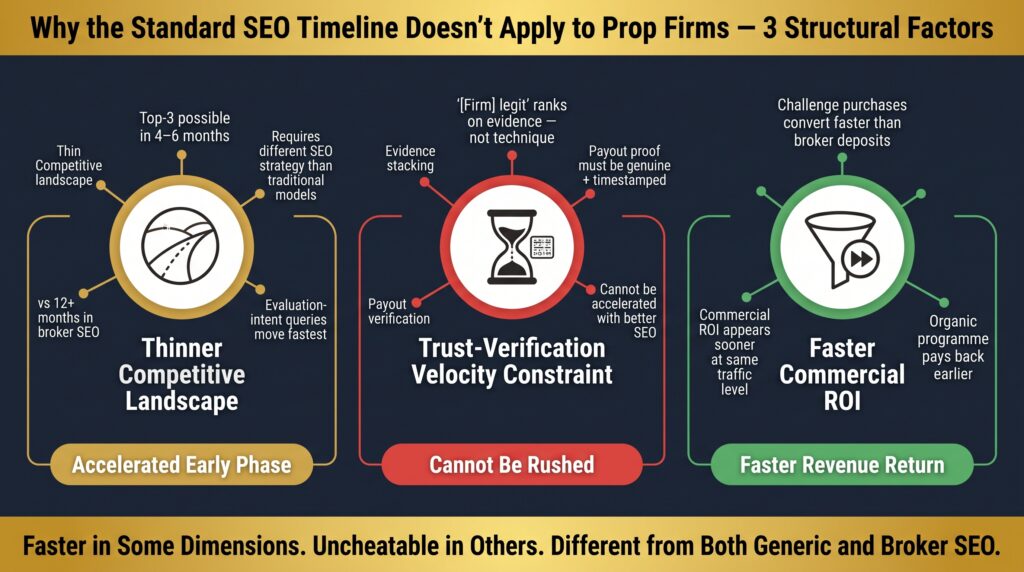
Factor 1 — The competitive landscape is thinner. The prop firm SEO market is significantly less developed than forex broker SEO. Some challenge-funnel keyword clusters can reach top-three in four to six months — a timeline that would take twelve months or more in mature broker SEO. This accelerates the early phases for evaluation-intent queries.
Factor 2 — Trust-verification queries have a velocity constraint. “[Firm] legit 2026” and “[firm] payout proof” queries rank partly based on evidence accumulation, not just content optimisation. Payout proof content can be published in week one but cannot rank competitively until the evidence base is genuine and timestamped across several months. You cannot accelerate this with better SEO technique.
Factor 3 — Challenge purchases convert faster than broker deposits. When organic evaluation-intent traffic arrives, it converts to challenge purchases faster than equivalent broker traffic converts to account deposits. Commercial ROI from the organic programme tends to appear sooner in absolute terms than in broker SEO equivalents at the same traffic level.
Before the timeline, the foundation: the prop firm SEO audit establishes where the work starts — which of the eight audit components are gaps, and which phase the programme is actually entering. This article assumes the audit has been done and the programme is starting from a defined baseline.
The prop firm SEO timeline runs across three phases. Days 1–90 (Foundation): technical infrastructure, indexation hygiene for challenge tier pages, payout proof content creation — no commercial ranking gains expected. Days 90–180 (Traction): first challenge-funnel keywords enter the top 20, branded trust-verification queries begin ranking, organic sessions to challenge pages start arriving at low volume. Days 180–365 (Competitive Positioning): top-three rankings for primary challenge-funnel clusters, affiliate cannibalization gaps closing, PAA ownership for trust-verification queries establishing. Challenge purchases from organic traffic typically begin at 120–150 days, with full commercial ROI from organic typically arriving at months nine to twelve.
Table of Contents
Days 1–90: The Foundation Phase
The consistent pattern at the 90-day mark of a prop firm SEO programme is the same internal pressure every time — the marketing team wants to see rankings, the CMO wants to see challenge purchases, and the SEO work has produced neither yet. What it has produced is canonical implementation across 20 challenge tier pages, zero crawl errors, and four published payout proof articles with 90 days of index maturity. Those are the Foundation Phase outputs. The firms that understand that distinction are on a different commercial trajectory from the ones that cancel at day 90 looking for rankings that were never going to be there yet.
The Foundation Phase produces no commercial results and should not be measured against rankings or traffic. This is the phase where the infrastructure is built — and expecting challenge purchases from organic at 60 days is the most common prop firm SEO mistake, and the most common reason programmes are cancelled before the investment has had time to compound.
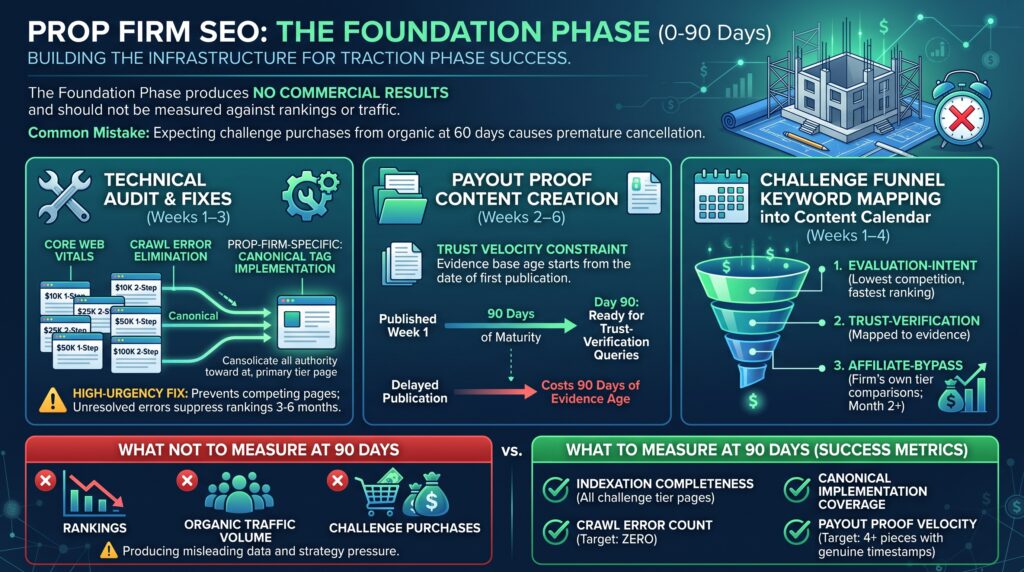
Technical audit and fixes (Weeks 1–3). Core Web Vitals, crawl error elimination, and — the most prop-firm-specific technical priority — canonical tag implementation for challenge tier variant pages. A typical funded trader program has 10–20 challenge tier pages: $10K, $25K, $50K, $100K challenges in one-step and two-step formats, each with minor rule variations. Without canonical tags, these pages compete with each other for ranking authority rather than consolidating it toward the primary tier page. This indexation error is the highest-urgency Foundation Phase fix — unresolved, it can suppress all challenge page rankings for three to six months, which means every week it goes unfixed is a week of Foundation Phase wasted.
Payout proof content creation (Weeks 2–6). The trust velocity constraint means payout proof content must begin accumulating immediately — not because it will rank in 90 days, but because evidence base age starts from the date of first publication. A payout proof article with documented withdrawals published in week one has 90 days of evidence age and index maturity by day 90 — when trust-verification queries start responding, that 90-day head start is the difference between ranking at month six versus month nine. Delaying publication to month three costs the programme 90 days at the most critical evidence accumulation stage.
Challenge funnel keyword mapping into content calendar (Weeks 1–4). The keyword gap analysis from the SEO audit is actioned into a structured content calendar. Evaluation-intent keywords are prioritised first — lowest competition, fastest to rank. Trust-verification keywords are mapped to content requiring evidence before publication. Affiliate-bypass content (the firm’s own independent tier comparisons) is scheduled for month two onwards.
What NOT to measure at 90 days: Rankings, organic traffic volume, and challenge purchases. None of these are Foundation Phase metrics. Measuring them at 90 days produces misleading data and pressure to change strategy before the programme has had time to build the infrastructure the Traction Phase depends on.
What to measure at 90 days: Indexation completeness for all challenge tier pages, crawl error count (target: zero), canonical implementation coverage, and payout proof content publication velocity (target: four or more pieces with genuine timestamps).
Days 90–180: The Traction Phase
The Traction Phase is where Foundation Phase work becomes visible in data. Rankings begin appearing — not for the primary head terms, but for the long-tail evaluation-intent and feature-specific queries targeted in the months-one-to-three content calendar.
First challenge-funnel rankings (Days 90–120). Long-tail evaluation-intent keywords enter the top 20. “Prop firm with no consistency rule,” “funded trader program for news traders,” “two-step challenge with ten percent drawdown” — these are the queries that rank first because competition is thinnest. They carry low individual traffic volume but are high commercial intent. A trader searching for a specific challenge feature is much closer to purchase than a trader searching “best prop firms 2026.”
Branded trust queries beginning to respond (Days 120–150). “[Firm] review” and “[firm] challenge rules” branded queries begin ranking for the prop firm’s own pages as Foundation Phase content matures and accumulates index age. These are the earliest commercial signals — a trader searching “[firm] review” is evaluating, not discovering. Trust-verification queries (“[firm] legit,” “[firm] payout proof”) are still in their evidence accumulation phase and will not rank competitively at this stage — that is expected, not a failure.
First organic challenge purchases (typically Days 120–150). Challenge purchases from organic search begin arriving — small in absolute volume, but commercially significant because they confirm the programme is converting, not just driving traffic. These arrive from long-tail evaluation-intent traffic that began appearing at days 90–110. Volume builds through months five to nine as primary challenge-funnel keywords reach top-three positions.
Content compounding begins. Challenge walkthrough content, comparison guides, and educational content published in months one to three begins accumulating inbound links from trader community sites and social sharing. Each piece linking to related pieces in the content cluster builds topical authority signals that improve all F-cluster article rankings simultaneously. The cluster effect — the reason the F-cluster publishing cadence matters — starts compounding here.
What to measure at 180 days: Keywords entering top 20 for evaluation-intent queries; branded trust query position trends; organic sessions to challenge pages (direction matters, not absolute volume); and the first organic challenge purchase count. If challenge purchases from organic have not appeared by day 180, run a diagnostic against the three stalls described in H2 #4.
Days 180–365: Competitive Positioning
The Competitive Positioning Phase is where the prop firm transitions from ranking in thin competitive spaces to competing for the primary challenge-funnel head terms and reclaiming branded queries from affiliate aggregators. This is also where the trust velocity constraint begins to resolve — payout proof content published in months one to three now has six to nine months of evidence age and genuine accumulated withdrawal history.
Primary challenge-funnel keywords reaching top three (Days 180–270). The evaluation-intent head terms — “best prop firm for swing traders,” “funded trader program no daily loss limit,” “one-step prop firm challenge” — begin reaching top three for programmes with properly structured content clusters. The thinner competition factor means these rankings arrive faster than equivalent forex broker head terms, but they require the full content depth built in phases one and two to hold the position.
Trust-verification queries responding (Days 210–365). “[Firm] legit,” “[firm] payout proof,” and “[firm] withdrawal speed” queries begin ranking for the firm’s own pages as the payout proof evidence base reaches the level where Google can confidently place the firm’s own transparent, documented content above the affiliate and forum content that currently dominates these queries. This is the trust velocity constraint resolving on its natural schedule — it cannot be materially accelerated, but it can be significantly delayed if payout proof content was not started in Foundation Phase.
Affiliate cannibalization gaps closing (Days 240–365). Comparison content and independent review content built in the content calendar begins competing with affiliate aggregator pages for commercial queries where the firm should own the narrative. The firm’s own “[Firm A] vs [Firm B]” comparison pages and challenge rule breakdowns rank alongside or above affiliate content for the highest-intent commercial queries.
PAA ownership establishing. As the content cluster matures and FAQPage schema accumulates performance data, the firm’s own FAQ answers begin appearing in People Also Ask for trust-verification and evaluation-intent questions. PAA ownership for “[firm] withdrawal rules” and “[firm] challenge pass rate” is the competitive positioning signal that confirms the firm has established editorial depth in its vertical.
Commercial ROI typically arriving at scale (Days 270–365). Challenge purchases from organic at a volume that consistently offsets the monthly SEO investment arrive in months nine to twelve for most funded trader programs starting from no existing organic presence. This is faster than equivalent forex broker SEO timelines — typically twelve to eighteen months to commercial ROI — because of the thinner competition and challenge conversion speed factors outlined in the intro.
| Phase | What to Measure | What NOT to Measure Yet | Target Signal |
|---|---|---|---|
| Days 1–90 Foundation Phase |
Indexation completeness for all challenge tier pages. Crawl error count (target: zero). Canonical tag implementation coverage across all tier variants. Payout proof content publication velocity — target four or more pieces with genuine timestamps and documented withdrawal evidence. | Rankings. Organic traffic volume. Challenge purchases. None of these are Foundation Phase outputs. Measuring them at 90 days produces misleading data and pressure to change strategy before infrastructure is in place. | All challenge tier pages indexing correctly with no cannibalisation. Payout proof evidence base accumulating with index maturity. Zero crawl errors. Technical foundation confirmed. |
| Days 90–180 Traction Phase |
Evaluation-intent keywords entering top 20. Branded query position trends. Organic sessions to challenge pages — direction of movement, not absolute volume. First organic challenge purchases appearing in attribution. | Affiliate-bypass rankings. Trust-verification head terms. Full commercial ROI. These require the evidence base maturity built in the Foundation Phase to compete — measuring them at 90 days shows nothing useful. | 5–15 evaluation-intent keywords in top 20. Organic sessions to challenge pages trending upward. First organic challenge purchases confirmed in attribution — the proof of concept moment for the programme. |
| Days 180–365 Positioning Phase |
Primary challenge-funnel keywords in top 3. Organic CVR trending toward paid CVR benchmark — target parity by month 12. People Also Ask ownership for branded and evaluation queries. Brand search health ratio — positive brand queries vs trust-verification queries. | Nothing — all metrics are live by this phase. Full commercial ROI measurement is appropriate from month six onwards once Traction Phase proof of concept is established. | Top 3 for primary challenge-funnel keyword clusters. PAA ownership for 3+ branded trust-verification questions. Commercial ROI established and trackable. Organic CVR approaching paid CVR — the signal that organic has reached channel maturity. |
What Accelerates and What Stalls the Timeline
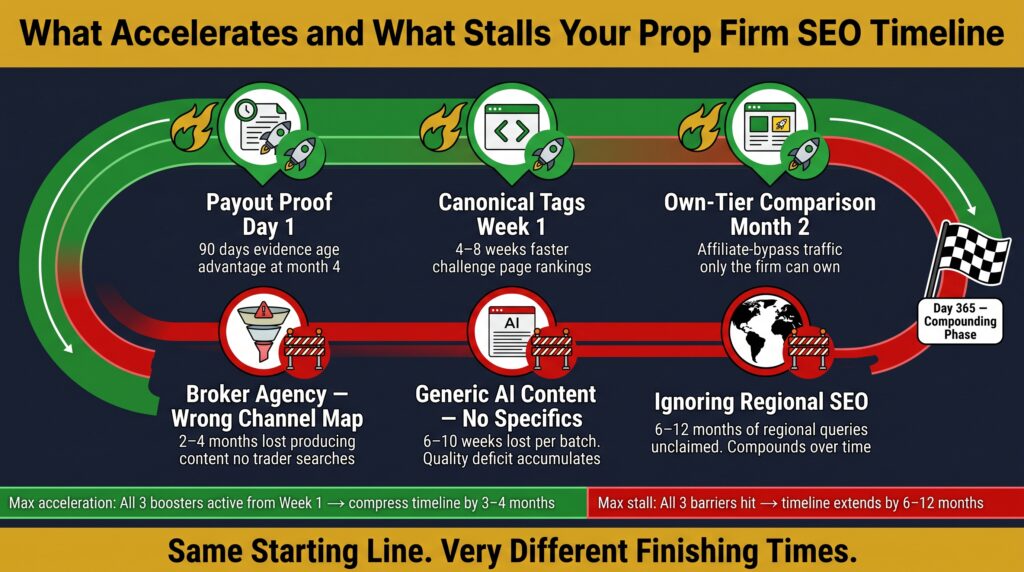
The 90/180/365 timeline above applies to a prop firm with no existing organic presence and competent SEO execution. Three specific factors accelerate it; three specific factors stall it — sometimes by months.
Accelerator 1 — Payout proof content from day one. Every week payout proof publication is delayed is a week of evidence age lost at the point when trust-verification queries start responding. A firm that begins publishing timestamped individual withdrawal documentation in week one has 90 days of additional evidence maturity at the four-month mark compared to a firm that waits until month two. Given that trust-verification rankings are partly driven by evidence age, that 90-day difference can translate to a 30–60 day acceleration in the queries that matter most to post-purchase confidence.
Accelerator 2 — Challenge tier indexation fixed in Week 1. Every week canonical tags are absent from challenge tier variant pages, ranking authority is split across variants rather than concentrated on the primary page. Firms that fix this in week one typically accelerate challenge page rankings by four to eight weeks compared to firms that identify and resolve it at month three or four. This is the highest-urgency technical task in the entire prop firm SEO programme and the one most commonly deferred.
Accelerator 3 — Own-tier comparison content published in month two. A prop firm that publishes “[Firm] one-step vs two-step challenge comparison” and “[Firm] challenge tier guide: $25K vs $50K” pages captures affiliate-bypass intent traffic that is uniquely available to the firm itself — it is the only non-affiliated source of information about its own challenge formats. This content typically ranks faster than comparison content about competing firms, converts at higher rates because the visitor is already considering the firm, and builds the internal link equity that accelerates all other challenge page rankings.
Stall 1 — A broker SEO agency with no prop firm channel knowledge. An agency that maps the prop firm’s keyword strategy to account-acquisition intent will spend months one to four producing content for queries that no funded trader searches. The Foundation Phase appears complete; the Traction Phase produces no evaluation-intent traffic because the content addresses a different funnel. Identifying and correcting this typically costs two to four months of the timeline — the worst stall in this list because it is invisible until the Traction Phase fails to appear.
Stall 2 — Publishing generic AI-generated content without specific challenge parameters. Content about challenge rules that does not specify actual drawdown limits, actual profit targets, actual evaluation windows, and actual payout timelines ranks briefly and drops when Google’s quality filters identify it as insufficiently specific for the YMYL standard prop firm content must meet. The ranking drop and recovery cycle costs six to ten weeks per batch of thin content — and each batch that fails accumulates a quality signal deficit that slows subsequent genuine content.
Stall 3 — Ignoring regional SEO. A prop firm targeting UK, UAE, and LATAM traders with one global page leaves regional evaluation-intent queries unclaimed for six to twelve months longer than a firm with regional landing pages. Regional SEO for funded trader programs is both lower competition and higher conversion rate than global head terms — a UK trader searching “best prop firm UK” has higher purchase intent than a trader searching “best prop firm 2026” globally. This stall compounds the longer it persists because regional queries are growing faster than global queries as prop firm adoption expands geographically.
The timeline above assumes the programme begins with a clear picture of current state. The prop firm SEO audit provides that baseline — establishing which of the eight audit components are gaps before the 90/180/365 clock starts. For the AI visibility layer that runs in parallel: the AI visibility audit covers how Perplexity, ChatGPT, and Google AI Overview are currently describing and recommending the funded trader programme — a channel with different timeline dynamics (Perplexity reflects content changes in 24–48 hours rather than weeks) that complements the organic programme at every phase.
More in the prop firm SEO series: what a prop firm SEO audit checks, prop firm SEO keywords, prop firm technical SEO, prop firm content strategy, internal linking for prop firms, why prop firms get outranked by review sites.
FAQ
Q1: How long does prop firm SEO take?
Prop firm SEO typically produces the first commercial results — organic challenge purchases — at 120 to 150 days, with full commercial ROI from the organic programme arriving at 9 to 12 months for a prop firm starting from no existing organic presence. This is faster than equivalent forex broker SEO timelines, primarily because the prop firm SEO competitive landscape is significantly less developed and evaluation-intent keywords face thinner competition. However, trust-verification queries take longer — typically 9 to 18 months — because they require genuine accumulated payout evidence rather than well-optimised content alone.
Q2: What should I expect from prop firm SEO in the first 90 days?
In the first 90 days of a prop firm SEO programme, expect no commercial results and no meaningful ranking improvements. The Foundation Phase covers technical infrastructure: fixing indexation errors for challenge tier variant pages, implementing canonical tags to consolidate ranking authority, and beginning publication of payout proof content that will take several additional months to mature. The most important 90-day deliverable is confirming that all challenge tier pages are indexing correctly without cannibalization — an error that, unresolved, can suppress all challenge page rankings for three to six months.
Q3: When does prop firm SEO start generating challenge purchases from organic search?
Challenge purchases from organic search typically begin appearing at 120 to 150 days for most funded trader programs, arriving first from long-tail evaluation-intent queries where competition is thinnest. These initial organic purchases are low in absolute volume but confirm the programme is converting, not just driving traffic. Volume builds through months five to nine as primary challenge-funnel keywords reach top-three positions and trust-verification queries begin responding. Commercial ROI from the organic programme typically fully offsets the monthly SEO investment by months nine to twelve.
Q4: Why do trust-verification queries take longer to rank for than challenge queries?
Trust-verification queries like “[firm] legit 2026” and “[firm] payout proof” rank based partly on evidence accumulation rather than content optimization alone. A well-structured payout proof page published in week one will not outrank an affiliate aggregator for trust-verification queries until it has accumulated genuine, timestamped withdrawal evidence over several months. This trust velocity constraint is unique to prop firms — it has no equivalent in forex broker SEO, where trust is primarily demonstrated through regulatory licence credentials that can be structured and optimised immediately.
Q5: What accelerates prop firm SEO results?
Three factors consistently accelerate prop firm SEO timelines. First, publishing timestamped payout proof content immediately from programme launch rather than waiting — every week delayed means a week of evidence age missing when trust-verification queries begin responding. Second, fixing challenge tier variant page indexation in the first week rather than discovering it later — this single technical fix can accelerate challenge page rankings by four to eight weeks. Third, publishing comparison content for the firm’s own challenge tiers early, which captures affiliate-bypass intent traffic at high conversion rates and is uniquely available to the prop firm as the only non-affiliated source.
Q6: How is prop firm SEO timeline different from forex broker SEO?
Prop firm SEO has a faster timeline than forex broker SEO for evaluation-intent keywords because the competitive landscape is significantly less developed — queries that would take twelve months to reach top three in forex broker SEO can reach top three in four to six months in prop firm SEO. However, trust-verification queries take longer in prop firm SEO because they require accumulated payout evidence rather than regulatory licence credentials. And prop firm SEO commercial ROI tends to appear sooner in absolute terms because challenge purchases convert faster than broker account deposits at equivalent organic traffic levels.