A prop firm SEO audit is not a forex broker SEO audit with different branding. The challenge funnel — the sequence from challenge purchase through evaluation phase to funded account — creates keyword clusters, content requirements, trust signals, and SERP environments that a broker-trained SEO team will not naturally identify. An audit that starts from broker-SEO assumptions produces findings mapped to the wrong funnel type and misses the prop firm’s most commercially significant organic gaps.
In a market where 80–100 prop firms exited in 2024 and search volume for funded trader programs grew over 600% in the preceding four years, the SEO environment is more competitive and more trust-sensitive than any stage the industry has operated in before. The audit framework below covers what a prop firm SEO audit specifically includes — and why the challenge funnel’s keyword structure requires a different analytical lens than the broker acquisition funnel it superficially resembles.
Table of Contents
What’s Included in a Prop Firm SEO Audit
The consistent pattern in prop firm keyword strategies is that they were built by teams with broker experience — and it shows. The content targets acquisition intent where it should target evaluation intent, and the trust-verification query layer — “[firm] legit,” “[firm] withdrawal proof,” “[firm] payout time” — is almost always unaddressed entirely, despite being the queries that determine whether a trader moves from awareness to purchase.
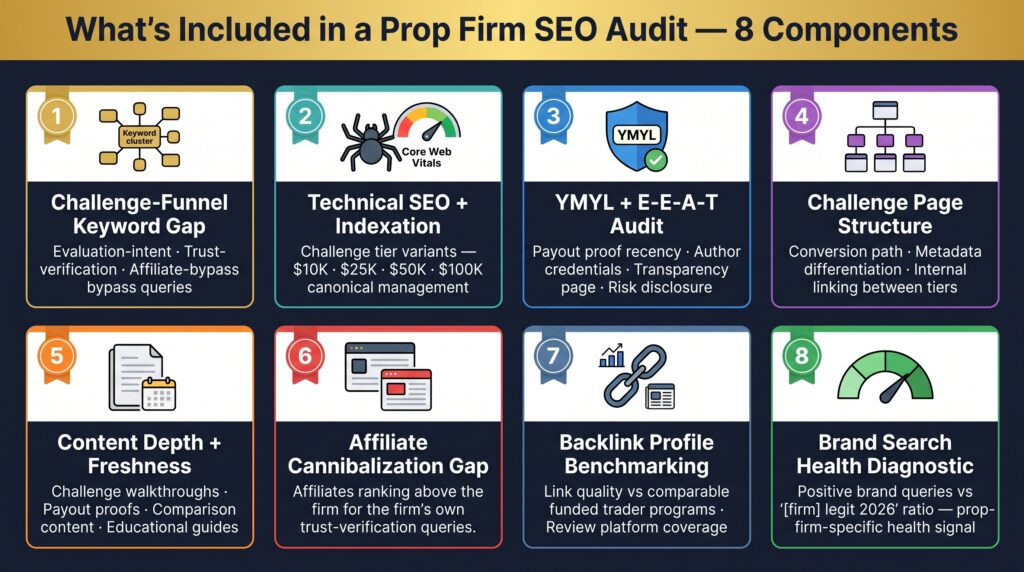
A prop firm SEO audit covers eight components. Each produces specific findings and a prioritised action list for the marketing team:
- Challenge-funnel keyword gap analysis — mapping current keyword coverage against evaluation-intent, trust-verification-intent, and affiliate-bypass-intent query clusters that define how traders find and vet funded trader programs.
- Technical SEO and indexation hygiene — Core Web Vitals, crawlability, and specifically indexation management for challenge tier variants ($10K, $25K, $50K, $100K) that commonly cannibalize each other’s ranking potential when canonical tags are absent or misconfigured.
- YMYL and E-E-A-T trust signal audit — payout proof content presence and recency, author credential pages, transparency page completeness, ownership disclosure, and risk disclosure placement on challenge pages.
- Challenge page structure assessment — conversion path analysis for each funded account tier, including metadata differentiation, internal linking between tiers, and whether the page architecture supports ranking for tier-specific queries.
- Content depth and freshness audit — challenge walkthrough content, publicly documented payout proofs, independent comparison content, and educational guides covering risk management and challenge rules.
- Affiliate cannibalization gap analysis — identifying queries where affiliate aggregators rank above the prop firm’s own pages for the firm’s own commercial and trust-verification queries.
- Backlink profile and finance-niche benchmarking — link quality relative to vertically comparable funded trader programs, review platform coverage, and editorial finance-media presence.
- Brand search health diagnostic — the ratio of positive brand queries (“best prop firm challenge”) to trust-verification queries (“[firm] legit 2026,” “[firm] withdrawal proof”), which is the prop-firm-specific health indicator absent from any standard broker SEO audit.
Most prop firm SEO audits produced by generalist agencies cover components 2, 5, and 7 adequately. Components 1, 3, 6, and 8 are where the prop-firm-specific analysis differs categorically from a broker audit — and where the most commercially significant gaps consistently appear.
Why Challenge Funnels Need Different Keywords Than Brokers
The practical confusion happens because both prop firms and forex brokers operate in financial services, both target retail traders, and both have significant overlap in vocabulary. A prop firm CMO who previously managed SEO for a broker — or who hired an agency with broker experience — will carry across a keyword strategy built for account-acquisition intent. That is the wrong funnel.
A forex broker’s conversion journey is an account-acquisition funnel: a trader decides to open a funded account and searches for the best place to deposit. The dominant keyword categories are acquisition-intent (“open a forex trading account,” “best forex broker for scalping,” “zero-commission forex broker”) and comparison-intent (“IG vs OANDA,” “best forex broker UK 2026”). The trader is choosing a custody relationship for capital they already have.
A prop firm’s conversion journey is an evaluation funnel: a trader decides to attempt a challenge to access funding they don’t yet have. The dominant keyword categories are different in type, not just in vocabulary:
Evaluation intent — the trader is assessing the challenge’s feasibility and terms before purchasing: “pass a prop firm challenge,” “best prop firm for swing traders,” “prop firm 10% maximum drawdown,” “prop firm no daily loss limit.” The content these queries demand is challenge walkthroughs, rule comparisons, and feasibility analysis — not product landing pages.
Trust-verification intent — following the 2024 exits, a significant proportion of funded trader program research is explicitly sceptical: “is [firm] legit 2026,” “[firm] payout proof Reddit,” “[firm] withdrawal speed,” “[firm] scam check.” These queries have no meaningful equivalent in broker SEO. A broker’s trust is primarily regulatory (CySEC or FCA licence, ICF protection). A prop firm’s trust is demonstrated through accumulated evidence of actual payouts to actual traders. The content that ranks for trust-verification queries is payout proof, withdrawal documentation, and third-party trader testimonials — not regulatory disclosures.
Affiliate-bypass intent — because most visible prop firm content is affiliate-produced (the affiliates outrank the brands for many commercial queries), a proportion of sophisticated trader searches explicitly seek non-affiliate views: “[firm A] vs [firm B] independent comparison,” “prop firm review not affiliate,” “prop firm community not sponsored.” This is a query category that does not exist in broker SEO and represents a content opportunity uniquely available to the prop firm’s own site — which is, by definition, the only non-affiliated source of information about itself.
| Intent Type | Broker Funnel Example | Challenge Funnel Example | Content Type Needed |
|---|---|---|---|
| Acquisition / Evaluation | “open a forex trading account” | “pass a $100K prop firm challenge” | Broker: Product page with conditions, spreads, and regulatory credentials. Prop firm: Challenge walkthrough guide covering rules, feasibility, pass rate expectations, and what happens after passing. |
| Regulatory Trust | “FCA regulated forex broker” | “is [prop firm] legit 2026” | Broker: Regulatory disclosure page — licence number, entity name, regulator register link, client fund protection regime. Prop firm: Payout proof documentation, transparency page with ownership disclosure, independently verified withdrawal evidence. |
| Comparison | “[broker A] vs [broker B] spreads” | “[firm A] vs [firm B] payout rules” | Broker: Conditions comparison — spreads, commissions, execution model, leverage limits. Prop firm: Independent rule comparison with payout evidence — drawdown limits, scaling terms, consistency rules, withdrawal processing time. |
| Feature-Specific | “no commission forex broker” | “prop firm no daily drawdown limit” | Broker: Feature landing page — specific condition stated, validated against account type, linked to live conditions page. Prop firm: Rule specification page with challenge feasibility analysis — what the rule means in practice for different trading styles, with pass rate context. |
An audit of a prop firm’s keyword strategy that doesn’t distinguish between these three challenge-funnel intent categories will consistently misclassify gaps: it will recommend more acquisition-intent content (“why choose our funded programme”) when the actual gap is in trust-verification content (“[firm] payout proof documentation”) and affiliate-bypass content (independent comparison pages the firm can legitimately own).
The Trust Deficit Audit — Post-Shutdown Checkpoints
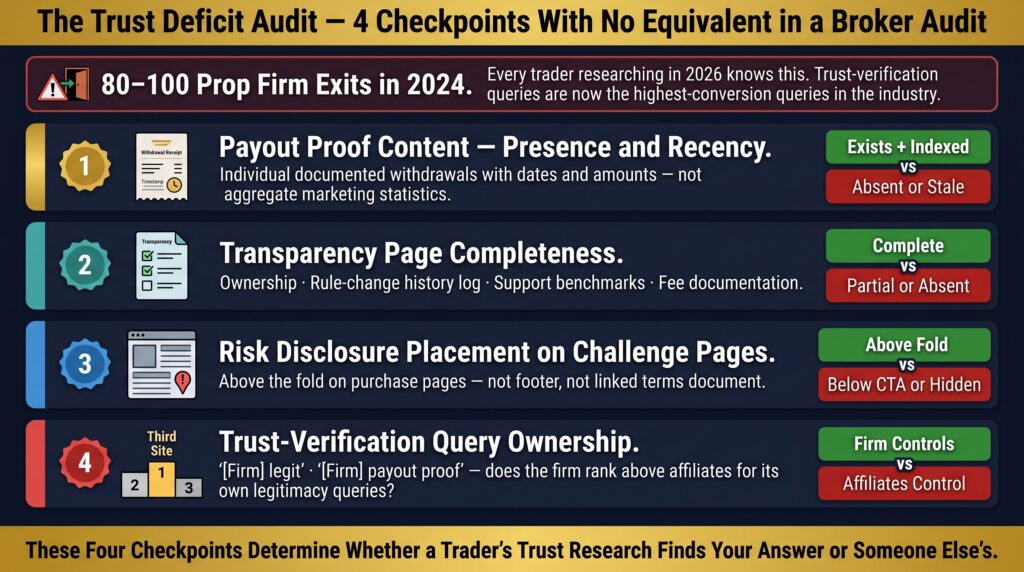
The 80–100 prop firm exits in 2024 created a structural trust deficit across the entire industry — including firms that did not exit. A trader researching a funded trader program in 2026 does so in a context where the most prominent recent industry news involves firms that stopped paying traders. This affects SEO directly: the trust-verification intent queries described above have higher search volume and higher conversion significance than at any previous point in the industry’s history.
A prop firm SEO audit includes four trust deficit checkpoints with no equivalent in a broker audit:
Payout proof content presence and recency. Does the prop firm have publicly accessible, timestamped evidence of actual trader payouts? Not a “Traders Made $X in Payouts” aggregate statistic on a marketing page — but individual documented withdrawals with dates, amounts, and verifiable trader identities (even anonymised with consent). This is the content that ranks for “[firm] withdrawal proof” and “[firm] payout proof Reddit” queries. The audit establishes whether this content exists, how recent the most recent documented payout is, and whether it is indexed and rankable.
Transparency page completeness. Does the prop firm have a dedicated transparency page covering: ownership structure and company registration, rule-change history (a log of every change to challenge rules with dates and explanations), current support response time benchmarks, and fee structure documentation? Transparency pages have become a ranking signal for trust-verification queries specifically because they are the content type that distinguishes genuinely transparent firms from firms that describe themselves as transparent. The audit scores the transparency page against a benchmark checklist.
Risk disclosure placement on challenge pages. YMYL standards require prominent risk disclosure on financial product pages. For prop firms, the specific audit checkpoint is whether the risk disclosure appears above the fold on challenge purchase pages — not buried in the footer or a linked terms document. A risk disclosure that requires scrolling past the purchase CTA to find is both an E-E-A-T signal gap and a regulatory exposure.
Trust-verification query ownership. The audit maps which entity currently ranks for “[firm name] legit,” “[firm name] payout proof,” and “[firm name] withdrawal review” queries. If third-party aggregators, affiliate sites, or forum threads rank above the prop firm’s own content for these queries about the firm’s own legitimacy, the firm has ceded control of its most decision-critical content to sources it cannot update, correct, or respond to. The remediation priority is creating optimised, credible, evidenced content that the firm can control — not attempting to de-index third-party results.
The Affiliate Cannibalization Gap Analysis
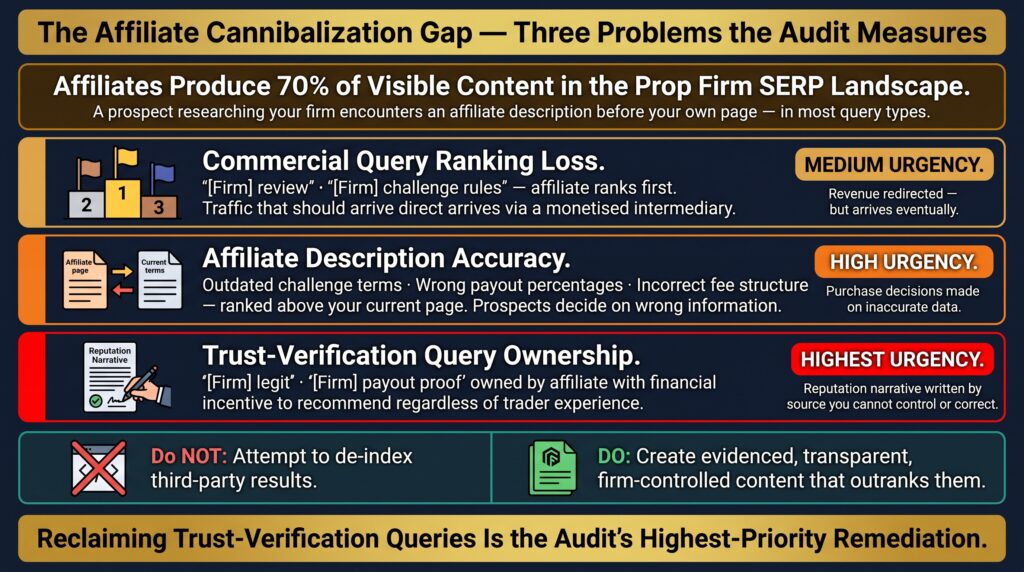
Affiliate publishers produce 70% of the visible content in the prop firm SERP landscape. For many commercial and comparison queries, affiliates outrank the brands they are promoting — which means a prospective trader researching a prop firm is likely to encounter an affiliate description before encountering the firm’s own page. This creates two problems the audit measures separately.
Commercial query ranking loss. The audit identifies which queries the prop firm’s primary commercial pages should own but currently rank below affiliated content. “Best prop firm for [specific trading style],” “[firm name] review,” and “[firm name] challenge rules” are commercial queries where the prop firm should rank first. When an affiliate aggregator ranks first, the firm’s marketing investment in acquiring organic traffic is being partially captured by the affiliate’s commission model — traffic that should arrive directly is arriving via a monetised intermediary.
Affiliate description accuracy. Because affiliates produce content independently and update it at their own cadence, the affiliate description of a prop firm’s challenge rules, payout percentages, and fee structure may be outdated or inaccurate. When an affiliate page describing outdated challenge terms ranks above the firm’s own current terms page, prospects are making purchase decisions based on wrong information. The audit identifies the most-trafficked affiliate pages about the firm and flags any description inaccuracies that require outreach to correct.
Trust-verification query ownership. The highest-urgency affiliate cannibalization finding is when a third-party aggregator or forum thread owns “[firm name] legit” or “[firm name] payout proof” above the firm’s own content. Unlike commercial query ranking loss (where affiliate traffic is redirected but arrives eventually), trust-verification query loss means the firm’s reputation narrative is written by a source that has a financial incentive to recommend the firm regardless of trader experience. Reclaiming these queries with the firm’s own evidenced, transparent content is the audit’s highest-priority remediation recommendation.
Audit Priority Framework
The eight audit components do not carry equal weight. For most prop firms audited in the current market environment, the priority order is: (1) trust-verification query ownership — this is where purchase decisions are lost most silently; (2) challenge-funnel keyword gap — the mismatch between current content and evaluation-intent queries; (3) affiliate cannibalization of branded queries; (4) indexation hygiene for challenge tier variants; (5) remaining technical and content components. A prop firm that resolves items 1–3 will typically see measurable organic improvement within one publishing cycle before the technical audit items compound the gains.
The SEO audit covers the organic search layer. A full picture of a prop firm’s online visibility also requires auditing how AI engines — Perplexity, ChatGPT, Google AI Overview, Gemini, and Claude — are currently describing and recommending the firm to prospective traders researching funded trader programs. The AI visibility audit runs alongside the SEO audit and covers the challenge-funnel AI citation gaps that organic rankings do not capture.
More in the prop firm SEO series: prop firm SEO keywords, how long prop firm SEO takes, prop firm technical SEO, prop firm content strategy, internal linking for prop firms, why prop firms get outranked by review sites.
FAQ
Q1: What does a prop firm SEO audit include?
A prop firm SEO audit covers eight components: challenge-funnel keyword gap analysis mapping evaluation-intent, trust-verification-intent, and affiliate-bypass-intent query clusters; technical SEO and indexation hygiene for challenge tier variant pages; YMYL and E-E-A-T trust signal audit covering payout proof content and transparency documentation; challenge page structure assessment for each funded account tier; content depth and freshness audit; affiliate cannibalization gap analysis for branded and commercial queries; backlink profile benchmarking against comparable prop firms; and brand search health diagnostic measuring the ratio of positive brand queries to trust-verification queries. Most generalist audits cover only the technical and backlink components.
Q2: How is a prop firm SEO audit different from a forex broker SEO audit?
A prop firm SEO audit differs from a forex broker SEO audit in three structural ways. First, the keyword strategy maps to challenge-funnel intent — evaluation, trust-verification, and affiliate-bypass query types — rather than the account-acquisition intent that broker SEO optimises for. Second, the trust signal framework is payout-proof-based rather than regulatory-licence-based, requiring audit checkpoints for withdrawal documentation and transparency pages rather than CySEC or FCA disclosure compliance. Third, affiliate cannibalization of branded trust-verification queries is a specific audit dimension with no equivalent in broker SEO.
Q3: Why do challenge funnels need different keywords than broker funnels?
Challenge funnels and broker funnels have different conversion mechanics requiring different keyword strategies. A broker funnel converts traders choosing where to deposit capital — the dominant keyword intent is acquisition-based. A challenge funnel converts traders evaluating whether to purchase access to a funded account evaluation — the dominant intents are evaluating challenge feasibility, verifying the firm’s legitimacy after industry exits, and finding independent comparisons outside the affiliate ecosystem. A prop firm using broker-style acquisition keywords targets the wrong decision stage and misses the evaluation and trust-verification stages where organic visibility drives challenge purchases.
Q4: What is the affiliate cannibalization gap in a prop firm SEO audit?
Affiliate cannibalization in a prop firm SEO audit refers to affiliate publishers ranking above the prop firm’s own pages for the firm’s branded and commercial queries. Because affiliates produce the majority of visible prop firm content and update it independently, they frequently outrank the brands they promote for queries like “[firm name] review,” “[firm name] challenge rules,” and critically “[firm name] legit” or “[firm name] payout proof.” The audit identifies which branded queries are owned by affiliate sources rather than the firm’s own content and prioritises reclaiming trust-verification queries first.
Q5: How should a prop firm approach SEO after the 2024 industry exits?
After the 80 to 100 prop firm exits in 2024, trust-verification queries carry more search volume and purchase intent than at any previous point in the industry. A prop firm’s SEO strategy should treat payout proof content, transparency pages, and challenge withdrawal documentation as primary SEO assets. This means publishing timestamped, individually documented withdrawal evidence rather than aggregate payout statistics; maintaining a transparency page with a dated rule-change log; and optimising for “[firm name] legit,” “[firm name] payout proof,” and “[firm name] withdrawal speed” queries with the firm’s own evidenced content before those queries are claimed by third-party aggregators.
Q6: What is the brand search health diagnostic in a prop firm SEO audit?
The brand search health diagnostic measures the ratio of positive brand queries to trust-verification brand queries for a funded trader program. Positive queries include “[firm name] challenge” and “[firm name] funded account,” signalling traders actively seeking the firm. Trust-verification queries include “[firm name] legit 2026” and “[firm name] payout proof,” signalling awareness paired with scepticism. A healthy ratio shows positive brand queries growing faster than trust-verification queries, indicating awareness converts to intent rather than doubt. A deteriorating ratio — trust-verification queries rising faster — signals that brand reputation requires active content intervention before it affects conversion rates.