
Most prop firm SEO strategies are built around competing for queries that review sites and aggregators are structurally positioned to win — regardless of the prop firm’s content quality or production volume. The problem is not execution. It is target selection.
The prop firm SEO landscape has an estimated 2,600 to 3,700 firms competing for trader attention in a market that has grown approximately 600% in search volume over four years. 80 to 100 of those firms exited in 2024 alone. In this environment, affiliates and aggregator review sites capture a disproportionate share of the high-intent organic search traffic — and roughly 78% of affiliate marketers in the prop firm space rely on SEO as their primary traffic driver.
The strategic challenge is not to out-produce aggregators. It is to stop competing with them for queries they are structurally built to own, while building aggressively for the queries the firm uniquely controls. The education-first vs comparison-first content strategy tells you how to sequence content production. This article tells you where the competitive boundary sits — which queries belong to aggregators by structure and which belong to the firm by right of being the only authoritative source.
Table of Contents
Three Structural Reasons Aggregators Outrank Prop Firms
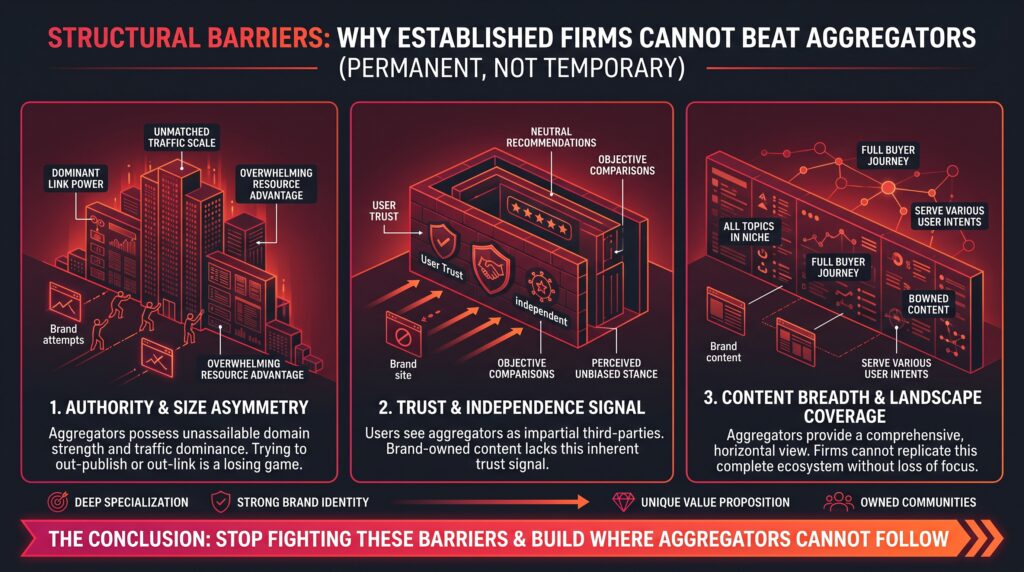
Aggregators outrank prop firms for comparison and review queries for three structural reasons the firm’s own content cannot overcome directly. First, domain authority asymmetry: established review sites have accumulated DR 40–70+ through years of affiliate partnerships and content compounding, while a new prop firm domain starts at DR 5–20. Second, the independence signal: Google structurally trusts independent review content more than the reviewed entity’s own claims — confirmed in Google’s schema guidelines, which exclude review snippets for Organisation and LocalBusiness schema when the business controls the reviews. Third, content breadth: aggregators covering 50 or more prop firms build topical authority across the entire landscape that the individual firm cannot replicate by covering only itself.
In most prop firm SEO reviews I conduct, the content calendar includes “best prop firms 2026” style content as a priority. When I ask why, the answer is usually “because that’s where the traffic is.” The traffic is there. The ranking isn’t — and it won’t be for at least two to three years on a new domain. The firms that gain organic traction fastest are the ones that stop fighting the DR 60 aggregators for volume keywords and build the queries the aggregators can’t own.
Reason 1 — Domain authority asymmetry. Established prop firm review sites have accumulated DR 40–70+ through years of affiliate partnerships, inbound links from trader communities, and content compounding. A new prop firm launching in 2024 or 2025 starts at DR 0–20. This gap is real and not closable through content quality alone. A prop firm publishing “Best Prop Firms 2026” on a DR 15 domain is competing against the same query on a DR 55 domain — the content quality is largely irrelevant to the ranking outcome at that authority disparity. Google resolves approximately tied content signals in favour of the higher-authority domain.
Reason 2 — The independence signal. Google structurally trusts independent review and comparison content more than the reviewed entity’s own claims. A prop firm saying “we’re the best option for swing traders” is evaluated against the firm’s commercial interest in the statement. An aggregator saying the same thing is evaluated as independent editorial content. The same factual statement carries a different trust weight depending on who publishes it — and Google’s systems are designed to reflect that weight in ranking signals.
Reason 3 — Content breadth advantage. An aggregator covering 50 or more prop firms simultaneously builds topical authority across the entire prop firm landscape. It answers “[Firm A] vs [Firm B],” “[Firm A] vs [Firm C],” “best prop firm for scalpers,” and “top ten prop firms for UK traders” — all from one domain. The individual prop firm covering only itself cannot build equivalent topical breadth. Google’s topical authority model rewards domains demonstrating comprehensive expertise across a topic cluster. Aggregators have this by design; individual prop firms have it only for queries specifically about themselves.
The conclusion: Competing with established aggregators for generic comparison and “best of” queries is not an SEO failure — it is a structural impossibility for a domain below approximately DR 35–40 with fewer than three to four years of authority building. The strategic question is which queries the firm can win without needing aggregator-level authority. That answer is in H2 #3.
The Schema Limitation: Why Prop Firms Cannot Earn Review Star Ratings from Their Own Site
Google’s rich results guidelines state explicitly that review snippets — the star ratings visible in search results — are not shown for LocalBusiness and Organisation schema when the business controls the reviews on its own site. A prop firm that invests in Organisation schema and review markup on its own website will never earn Google’s review snippet SERP feature from that content, regardless of how many positive reviews it collects on-site or how well the schema is technically implemented.
Why this matters for competitive SERP strategy. For trust-verification queries (“[firm] review,” “[firm] legit”), the SERP result with a gold star rating from a third-party review platform appears alongside the firm’s own plain organic result. The firm that has invested in Trustpilot review volume earns a visual trust signal in the search results that the firm relying only on on-site review markup cannot produce. For a trader evaluating two prop firms with near-identical organic rankings, the star rating in the search result is the differentiating signal.
Where schema investment actually delivers on prop firm pages. Schema investment on the firm’s own challenge pages remains valuable — but for FAQPage schema (challenge rules appearing in PAA positions), BreadcrumbList schema (breadcrumb trails in SERP results improving click-through rates), and Product schema with PriceSpecification (challenge pricing rich results). These schema types produce SERP features that are available from the firm’s own website. Review schema attempting to generate star ratings is not in this category — those require third-party review platform presence.
The third-party review implication. Trustpilot held 361 million active reviews as of December 2025 and removed 7.8 million fake reviews in 2025 — confirming both the scale of the legitimate review infrastructure and the active monitoring of manipulation. Prop firms attempting to game Trustpilot through bulk or incentivised review acquisition face increasing detection risk. Genuine review accumulation through real trader experience is the only durable route to the review SERP feature layer that the firm’s own schema cannot produce — making third-party review profile investment a non-optional SEO component, not a reputation management nice-to-have.
The Query Ownership Decision Matrix: Category A vs Category B
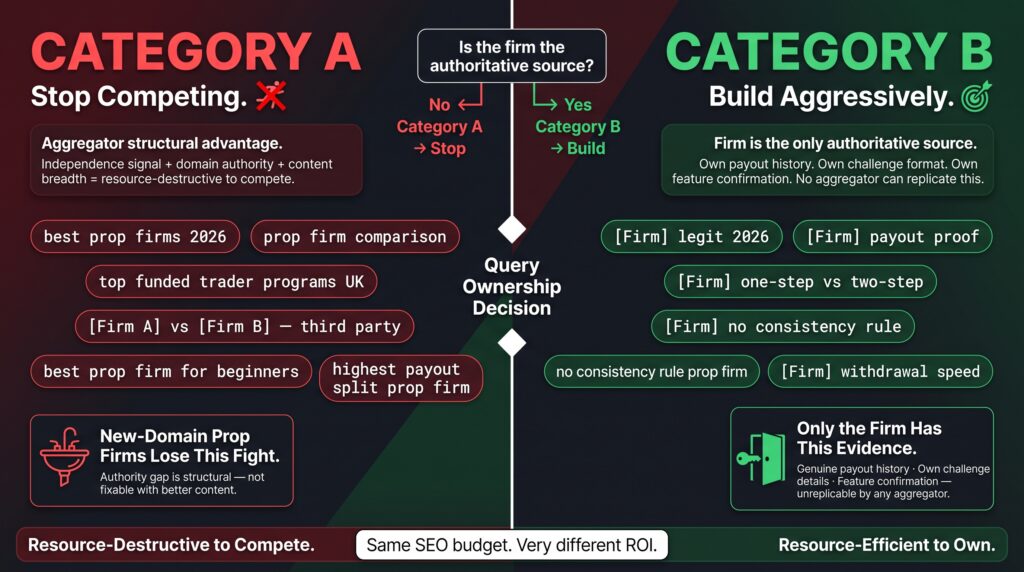
Two query categories determine whether a prop firm should compete directly for a search query or build a different response. Category A queries — best prop firms 2026, prop firm comparison, top funded trader programs — belong to aggregators by structural advantage: independence signal, domain authority, and content breadth make direct competition resource-destructive for new-domain prop firms. Category B queries — the firm’s own trust-verification queries backed by genuine evidence, own-tier challenge format comparisons, and feature-specific evaluation queries where the firm meets the requirement — belong to the firm by right of authoritative source. The firm is the only entity with access to its own genuine payout history, its own challenge format details, and its own feature confirmation.
Category A — Stop Competing (Aggregator Structural Advantage)
“Best prop firms 2026” · “prop firm comparison” · “top funded trader programs UK” · “[Firm A] vs [Firm B]” on third-party terms · “best prop firm for beginners” · “safest prop firms” · “which prop firm has the highest payout split” (multi-firm comparison) · “best instant funding prop firm” (generic)
Category B — Build Aggressively (Firm Is the Authoritative Source)
“[Firm] legit 2026” · “[Firm] payout proof” · “[Firm] scam or not” · “[Firm] withdrawal speed” · “[Firm] one-step vs two-step challenge” · “[Firm] no consistency rule challenge” · “no consistency rule prop firm” (when firm meets the requirement) · “instant funding prop firm” (when firm offers this specifically) · “[Firm] vs [Firm]” (branded comparison where firm is one party with genuine evidence)
The decision rule is structural rather than strategic: if the query requires knowing something that only the firm can know about itself — its own payout history, its own challenge format details, its own rule structure — the firm owns it and should build it. If the query requires comparing the firm to other firms it doesn’t control, that query belongs to aggregators who cover all parties. The prop firm keyword conversion analysis confirms that Category B evaluation-intent and trust-verification keywords also convert to challenge purchases at significantly higher rates than the high-volume generic queries in Category A — making Category B not just more achievable but more commercially productive per piece of content produced.
The affiliate cannibalization risk within Category B. When affiliates rank for the firm’s own branded trust-verification queries — “[Firm] vs alternative,” “[Firm] review” — they may direct traders to whichever competing firm offers the highest affiliate commission at that moment. A prop firm that hasn’t built its own Category B content is ceding its branded query traffic to affiliates who then monetise that trust. Building Category B content first is the reclaim strategy: own the queries the firm has earned through its actual trading history and challenge structure before affiliates capture them through comparison aggregation.
The Trader Search Journey Mapped to Firm Content vs Aggregator Content
The six-stage trader search journey framework was identified in Alex Firdaus’s analysis of prop firm trader research behaviour — mapped here to show which stages the firm’s own content can intercept and which belong to aggregator and third-party content.
| Stage | Query Examples | Content That Wins | Strategic Note |
|---|---|---|---|
| Stage 1 Category Discovery | “best prop firms 2026,” “top funded trader programs” | Aggregator content | Category A. Do not compete on a new domain. Educational content builds brand awareness that feeds into later stages. |
| Stage 2 Feature Evaluation | “prop firm no consistency rule,” “instant funding prop firm,” “prop firm no daily drawdown” | Firm content | Category B — highest build priority after trust-verification. Feature landing pages where the firm genuinely meets the requirement convert well. The firm’s confirmation is the most authoritative available answer. |
| Stage 3 Comparison | “FTMO vs [Firm]” (third-party) / “[Firm] one-step vs two-step” (own format) | Split — see note | Third-party comparisons → Category A (aggregators). Own-format comparisons → Category B (firm). Build own-format comparison pages; let aggregators own third-party comparisons for now. |
| Stage 4 Trust Validation | “[Firm] review,” “[Firm] trustpilot” | Third-party presence essential | Google review snippets (star ratings in SERP) require Trustpilot or Google Business presence — the firm’s own schema cannot produce them. Third-party review investment is non-optional for this stage. Firm’s trust-verification content supplements but does not replace. |
| Stage 5 Risk Verification | “[Firm] scam,” “[Firm] legit 2026,” “[Firm] real or fake” | Firm content | Category B. Transparency page with genuine payout evidence, regulatory status, challenge pass rate data. Proactive risk disclosure is a trust signal. Firm is the most authoritative source for its own legitimacy evidence. |
| Stage 6 Final Validation | “[Firm] payout proof,” “[Firm] withdrawal time,” “[Firm] payout speed” | Firm content — highest priority | Category B — build first. The firm is the ONLY source of its own genuine payout evidence. Converts at highest rates when satisfied. Payout proof content must begin accumulating immediately — evidence age matters as much as evidence volume. |
The pattern the map reveals: firm content is strongest in the later stages — feature evaluation (Stage 2), risk verification (Stage 5), and final validation (Stage 6). These are also the highest-converting stages in the trader search journey — the trader who reaches Stage 5 or 6 is within one or two steps of purchase. Aggregator content dominates Stage 1 (discovery) and Stage 4 (review validation). Stage 3 is split: third-party comparisons belong to aggregators; own-format comparisons belong to the firm. An aligned content strategy invests in the firm’s natural advantage — the later-stage, high-intent queries where being the subject of the search is itself the credential.
The Four Category B Content Types to Build
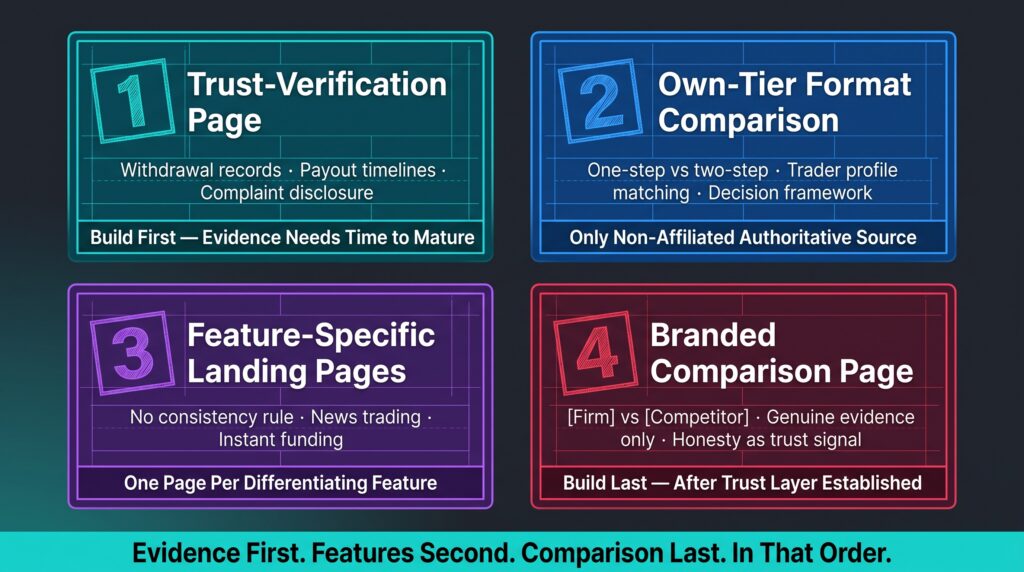
The query ownership matrix identifies which queries belong to the firm. These four content types convert the matrix into a specific build order — starting with the content that requires the most accumulated evidence and working toward the content that requires the most competitive positioning.
Content Type 1 — Trust-verification and transparency page (build first). A single page addressing “[firm] legit,” “[firm] payout proof,” and “[firm] scam” queries simultaneously. The content: documented withdrawal records with dates, amounts, and anonymised trader identifiers in a format verifiable by the recipient; payout timeline data showing average and range processing times; challenge pass rate transparency; regulatory status with specific licence numbers where applicable; and proactive disclosure of known complaints and their resolutions. This content type targets Stages 5 and 6 of the trader search journey with the firm as the only authoritative source. Build it first because payout evidence must accumulate over time — publication in month one produces more mature evidence by month six than publication in month three would.
Content Type 2 — Own-tier format comparison page. “[Firm] one-step vs two-step challenge: which is right for your trading style?” is comparison content the firm is the only non-affiliated entity capable of producing authoritatively. The content: side-by-side format comparison covering evaluation structure, drawdown limits, profit targets, evaluation window, payout timeline, and price difference between the two formats; trader profile guidance mapping which format suits which trading style or experience level; and a clear decision framework for choosing between the formats. This page captures the trader who has already decided to buy from the firm and is selecting their entry point — the highest-conviction conversion segment after trust-verification buyers.
Content Type 3 — Feature-specific evaluation landing pages. Pages confirming specific challenge features traders search for: “no consistency rule,” “instant funding option,” “allow news trading,” “no daily drawdown limit,” “high profit split.” Each page does three things: states the feature clearly and specifically (not “yes, we offer this” but exactly how the feature works in the challenge context with the actual parameter values), answers the natural follow-on questions the trader will have after feature confirmation (what other rules apply, what the challenge price is, what the payout structure looks like), and links to the challenge purchase page with conversion-intent anchor text. Feature-specific pages target Stage 2 of the trader search journey at the moment of highest feature-match purchase intent — the trader is already in evaluation mode and searching specifically for confirmation. Build one page per significant differentiating feature before building any Category A adjacent content.
Content Type 4 — Branded comparison page (build last, with caution). “[Firm] vs [top competitor]” when the firm has sufficient payout documentation and factual evidence to produce the comparison credibly. Unlike an aggregator comparison, the firm-authored branded comparison can provide depth no aggregator can replicate: the exact rule differences as they actually operate in practice, genuine trader testimonials on both sides, and transparent acknowledgement of where the firm is weaker than the competitor. Honesty in a comparison is a trust signal — traders recognise when a comparison reads as marketing copy vs as genuine evaluation, and proactive acknowledgement of a competitor’s strength while explaining why the firm’s structure is better for a specific trader type is more credible than a one-sided pitch. This content type requires the most caution: competitor information must be verified before publication, and the comparison must remain factually current as both firms’ challenge structures evolve. Build content types 1–3 first; add branded comparison pages once the trust and feature layers are established.
The Category B content build starts from the firm’s current diagnostic position — which trust-verification queries the firm doesn’t own, which feature-specific pages are missing, how much payout evidence is available to anchor the transparency page, and how the challenge format comparison is currently positioned. The prop firm SEO audit maps all four content type gaps as part of its trust-deficit audit checkpoint — establishing where the firm actually is in the Category B build before the content programme begins.
If you’d rather have this done for you, here’s my SEO for prop firms service.
More in the prop firm SEO series: what a prop firm SEO audit checks, prop firm SEO keywords, how long prop firm SEO takes, prop firm technical SEO, prop firm content strategy, internal linking for prop firms.
FAQ
Q1: Why do prop firms get outranked by review and aggregator sites?
Prop firms get outranked by aggregator and review sites for three structural reasons. First, established review sites have domain authority of DR 40–70+ built over years, while most prop firms start at DR 5–20 — the authority gap is not closable through content quality alone. Second, Google structurally trusts independent review content more than the reviewed entity’s own claims, which is confirmed in Google’s schema guidelines. Third, aggregators covering 50 or more prop firms simultaneously build topical authority across the entire landscape that the individual firm cannot replicate by covering only itself.
Q2: Can a prop firm outrank aggregator sites on SEO?
A prop firm can outrank aggregator sites for specific query types where the firm is the only authoritative source — but not for generic comparison and review queries where aggregators have structural advantages. Queries the firm can win include its own trust-verification queries with genuine payout evidence, its own challenge format comparison pages, and feature-specific evaluation queries where the firm meets the specific requirement. These Category B queries belong to the firm by right of authoritative source. Generic “best prop firms” and third-party comparison queries belong to aggregators and should not be competed for directly with new-domain prop firm content.
Q3: What comparison content can a prop firm actually rank for?
Prop firms can rank effectively for two types of comparison content. First, own-tier format comparisons: “[Firm] one-step vs two-step challenge” is comparison content only the firm can produce authoritatively, covering the exact rule differences, evaluation structures, and pricing between its own challenge formats. Second, branded comparison pages where the firm is one of the two parties and has genuine evidence differentiating its offering — though these require sufficient domain authority and verified competitor information. Generic “best prop firms” and multi-firm independent comparison pages belong to aggregators and are not realistic ranking targets for new-domain prop firms.
Q4: Why can’t prop firms show review star ratings in Google search results?
Google’s review snippet guidelines exclude star rating displays in search results for Organisation and LocalBusiness schema when the business controls the reviews on its own site. This means prop firms cannot earn review snippet SERP features from their own website regardless of how many positive reviews they collect on-site or how well the schema is implemented. Review snippets require third-party review presence — Trustpilot, Google Business Reviews, or independent review site coverage. This makes third-party review profile management a non-optional SEO investment for any prop firm that wants the trust signal layer visible in SERP results.
Q5: How does affiliate cannibalization affect prop firm SEO?
Affiliate cannibalization in prop firm SEO occurs when affiliates rank for the firm’s own branded queries — particularly comparison and trust-verification queries — and then direct traders to whichever competing firm offers the highest affiliate commission at that moment. A trader searching “[Firm] vs alternative” who lands on an affiliate comparison page may be redirected to a competitor. The firm loses a branded query to an affiliate who monetises the trust the firm built. The reclaim strategy involves building Category B content the firm uniquely owns: own-tier comparison pages, trust-verification pages with genuine evidence, and feature-specific confirmation pages that capture the trader before the affiliate page does.
Q6: What is the six-stage trader search journey for prop firm evaluation?
The trader search journey for prop firm evaluation follows six stages: category discovery, where the trader searches broadly for prop firm options; feature evaluation, where they search for firms meeting specific requirements; comparison, where they compare two or three firms; trust validation, where they search for reviews and ratings; risk verification, where they search for scam or legitimacy signals; and final validation, where they search for payout proof before committing. The firm’s own content is most powerful in the later stages — feature evaluation, risk verification, and final validation — where it is the most authoritative available source. Aggregator content dominates the earlier stages.