
Prop Firm Technical SEO, what we need to know?
A prop firm’s challenge and pricing pages are the most commercially critical pages on the site — and technically the most problematic. They are the pages where challenge purchases happen, where search rankings directly connect to revenue, and where the most common technical SEO issues in the prop firm category are concentrated.
The reasons are structural. Challenge pages exist in families — multiple account sizes across multiple challenge formats — which creates variant proliferation that standard content pages don’t have. They often display dynamic pricing and rules rendered via JavaScript, creating indexation risks that static content pages don’t face. They carry the heaviest third-party script load of any page type due to payment processor integrations. And their URL structure typically evolved as the challenge catalogue grew rather than by architectural design.
Five specific technical issues follow from this structure. Each has a diagnostic and a fix.
Table of Contents
Issue 1: Challenge Tier Canonical Consolidation
The most common technical SEO issue on prop firm challenge pages is canonical tag absence across tier variants. A prop firm with two challenge formats and four account sizes can accumulate 15 to 20 near-identical tier URLs competing with each other for ranking authority rather than consolidating it on the primary tier page. The fix requires a five-step canonical audit: crawl all challenge tier URLs, group by format family, designate the canonical URL for each family, verify canonical tag implementation using Screaming Frog, and confirm Google’s selected canonical in Search Console’s URL Inspection tool.
Canonical tag errors on challenge tier pages are the most consistent technical finding across prop firm SEO audits. The pattern is always the same: the site launched with three or four challenge pages, added new account sizes over time, and ended up with a cluster of near-identical variant pages — none of which has a canonical tag because canonical tags weren’t in the original brief. Each variant competes with every other variant for the same search query, and none of them ranks as well as the primary tier page would if the authority were consolidated.
Step 1 — Crawl and inventory all challenge tier URLs. In Screaming Frog, set a custom filter for URLs containing your challenge page pattern (/challenge/, /funded/, /evaluation/, or equivalent). Export the full list. This is the variant inventory — all the pages that need canonical designation before any other technical work proceeds.
Step 2 — Group by tier family and designate the canonical URL. Organise the URL list into families: all one-step variants together, all two-step variants together. Within each family, identify the page with the most complete content — most detailed rules section, most payout proof integration, highest existing inbound link count — as the canonical candidate. This is the page that should rank for the primary tier query and the URL that all other family members should reference.
Step 3 — Verify canonical tag implementation. In Screaming Frog’s canonical column, confirm every variant page carries a canonical tag pointing to the designated primary URL. Watch for canonical chains — where variant A canonicalises to page B which canonicalises to page C. Google may not follow a canonical chain beyond one hop, leaving the original variant unresolved. The canonical on a variant must point directly to the final canonical URL, not to an intermediate redirect.
Step 4 — Verify URL consistency in canonical tags. Canonical URLs must match exactly: same www/non-www preference, same https scheme, same trailing slash convention. A canonical pointing to https://www.example.com/challenges/one-step/ is not equivalent to https://example.com/challenges/one-step/ without the www. Screaming Frog surfaces these mismatches in the canonical tag column.
Step 5 — Confirm in GSC URL Inspection. For each variant URL, run URL Inspection in Google Search Console and check “Google’s selected canonical.” If it shows the correct primary URL, consolidation is working. If Google has overridden the canonical signal and selected a different URL, investigate — this typically occurs when Google considers the designated canonical thinner or less representative than a variant it prefers, which means the canonical page itself needs content strengthening before the signal will be respected.
Canonical consolidation and internal linking are paired fixes — introduced as the Week 1 Foundation Phase priority in the prop firm SEO timeline and developed together in the internal linking strategy. After verifying canonical tags, audit internal links from educational content to confirm they point to the canonical URL rather than to variant pages.
Issue 2: Schema Markup for Challenge and Pricing Pages
Most prop firm challenge pages implement no structured data despite being functionally equivalent to ecommerce product pages with a price, defined service period, and purchase CTA. Three schema types are required: Product schema with PriceSpecification for the challenge price and account attributes, FAQPage schema for the challenge rules section targeting PAA positions for pre-purchase trader queries, and BreadcrumbList schema to confirm the tier hierarchy to Google and generate breadcrumb trails in SERP snippets. A schema drift risk exists when JavaScript-rendered pricing diverges from the static JSON-LD block — fix by generating schema server-side from the same data source as the visible pricing.
Product schema with PriceSpecification. A challenge tier page is a purchased evaluation service — it has a price, a defined evaluation period, specific performance criteria, and a CTA that initiates a commercial transaction. The schema structure: @type: "Product" (or "Service" for evaluation-based programmes with monthly fees), with name (the challenge tier name), description (one sentence including the key differentiating rule — profit target percentage, drawdown structure, or evaluation format), and offers containing a PriceSpecification with price, priceCurrency, and eligibleRegion if the firm restricts certain challenge types by geography. Product schema eligibility for rich SERP features (price display in search results) is a direct commercial benefit beyond the topical authority signal.
FAQPage schema for the challenge rules section. Every challenge tier page should have a rules or conditions section structured as FAQPage schema. The questions target exactly what traders search before purchasing: “What is the profit target for this challenge?”, “What is the maximum daily drawdown?”, “How long is the evaluation period?”, “Can I trade news events?”, “What is the payout split after funding?” FAQPage schema puts the firm’s own specific answers in the PAA positions before aggregator or forum answers appear — converting a trust-verification search into a direct answer from the primary source.
BreadcrumbList schema. Discussed fully in H2 #5 (URL hierarchy), but noted here as a schema element: BreadcrumbList confirms the challenge tier page hierarchy to Google’s structured data parser and generates breadcrumb trails in SERP results. Implement alongside the URL hierarchy recommendation rather than as a separate afterthought.
Schema drift risk. If challenge pricing is displayed via JavaScript but the JSON-LD schema block is a static HTML element, visible price and structured data price can diverge when pricing is updated. Google flags price discrepancies between visible content and structured data as reliability signals that suppress rich snippet eligibility. Fix: generate the JSON-LD block server-side from the same database or CMS field as the visible pricing, not as a manually maintained static script. Verify using the Google Rich Results Test after any pricing change.
Issue 3: JavaScript Rendering of Challenge Pricing
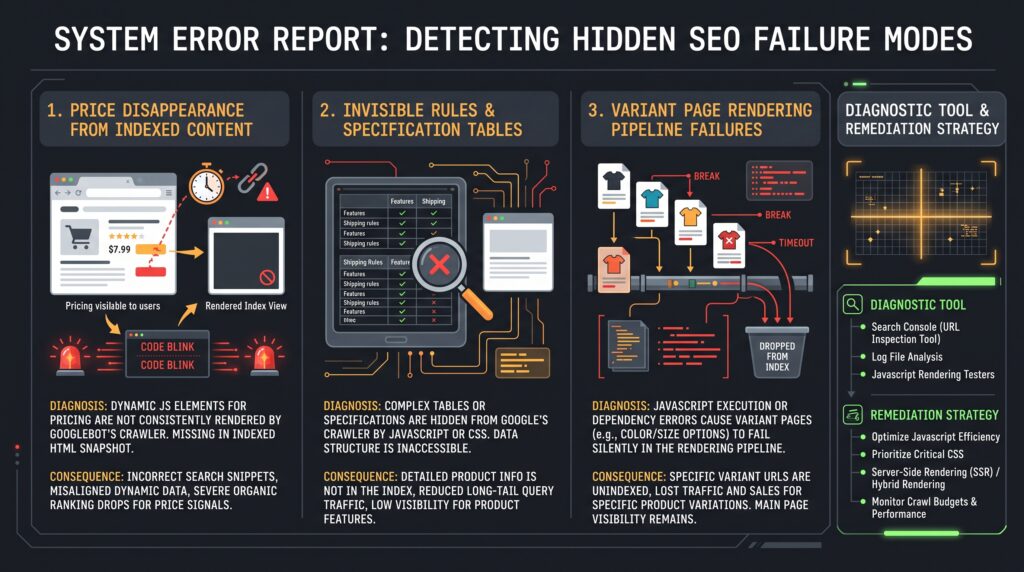
Many prop firm challenge pages render pricing and rules via client-side JavaScript, creating an indexation risk where Google may index the initial HTML shell — with no pricing or rule details — rather than the fully rendered page. The diagnostic is Google’s URL Inspection tool: compare the rendered HTML to the raw source HTML for a challenge tier page; any content present in the rendered version but absent in the source is JavaScript-rendered and subject to indexation delays. The recommended fix is Server-Side Rendering or Incremental Static Regeneration for challenge tier and pricing pages, ensuring content is available in the HTML response without requiring JavaScript execution.
Three specific failure modes are most common on prop firm challenge pages:
Failure mode 1 — Pricing rendered after initial HTML load. If challenge pricing is fetched from an API and injected into the DOM after the initial HTML response, Google may index the initial HTML state — a template with empty pricing fields, no purchase CTA, and no challenge parameters visible. The indexed page appears thin. This is why some prop firm challenge tier pages rank briefly for challenge queries and then drop — the initial ranking was based on URL signals and page metadata; the subsequent drop reflects Google’s quality assessment of the thin indexed content.
Failure mode 2 — Rules tables generated from CMS API calls. Challenge rules displayed via JavaScript API calls — fetching rules from a headless CMS or rules database — may not exist in the server response at all. Google sees the page shell; the rules content is absent from the rendered snapshot if the API call fails or times out during the rendering queue. Use the URL Inspection “Test Live URL” function in GSC and compare the rendered screenshot to the expected page — missing rules tables in the rendered view confirm this failure mode.
Failure mode 3 — Variant pages excluded from rendering. Pages returning non-200 status codes at crawl time may be excluded from the rendering queue. If any challenge tier variant returns a redirect chain before resolving to its destination, the rendering pipeline may not follow the chain and may exclude the variant from rendering entirely — leaving it neither properly indexed nor properly canonicalised.
Fix hierarchy: (1) Implement Server-Side Rendering for challenge tier and pricing pages — content is in the HTML response regardless of JavaScript execution, the most reliable solution. (2) If full SSR migration is not feasible, use Incremental Static Regeneration — pages are pre-rendered at build time and regenerated on defined intervals when pricing changes, producing static HTML responses with no rendering delay. (3) If neither SSR nor ISR is feasible: ensure the initial HTML response contains at minimum the challenge price, key rules summary, and purchase CTA as plain HTML text — reserve JavaScript for interactive elements only (currency toggler, tier comparison switcher) and not for primary content delivery.
Issue 4: Core Web Vitals on the Challenge Purchase Path
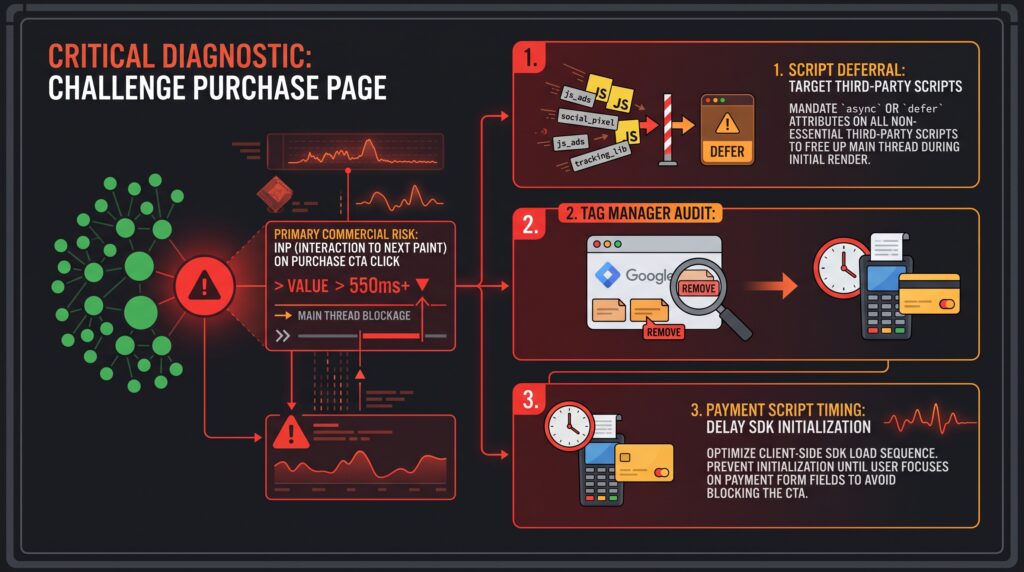
The challenge purchase page is typically the most script-heavy page on a prop firm site — payment processor integration, affiliate tracking, analytics event triggers, and retargeting pixels all execute on the main thread on the exact page where the commercial transaction happens. INP (Interaction to Next Paint) on the purchase CTA button is the most commercially relevant Core Web Vitals metric on the site: an INP score above 500ms means the page freezes visibly when a trader clicks “Buy Challenge.” Diagnose using CrUX data filtered to the challenge purchase URL specifically; fix by deferring non-essential third-party scripts and conducting a quarterly Tag Manager audit to remove inactive tracking tags.
Why the purchase page is the highest-risk CWV page. INP measures responsiveness throughout the entire page visit — not just initial load. On a standard content page, scripts accumulate but interactions are limited to navigation and scroll. On a challenge purchase page, the primary interaction is the “Buy Challenge” CTA click — the moment the trader commits commercially. Every script executing on the main thread during that interaction competes with the browser’s ability to register and respond to the click. Payment processor scripts (Stripe.js, PayPal SDK) are typically the heaviest single contributors because they load and initialise on page load to prepare for the eventual payment step.
Diagnostic. Run PageSpeed Insights on the challenge purchase URL specifically — not the homepage, which typically scores far better because it carries a fraction of the script load. Check the CrUX data tab for real-user INP data on that specific URL. If CrUX data isn’t available for the specific URL (insufficient traffic volume), use the lab-based INP measurement in the Performance panel of Chrome DevTools — record a session that includes a CTA click and examine the interaction delay in the flame chart.
Fix priority order:
Priority 1 — Defer non-essential third-party scripts. Any script that doesn’t contribute to the purchase flow — heatmap tools, social share widgets, live chat initialisers — should load after the first user interaction using the async or defer attribute, or via Tag Manager trigger set to “Window Loaded” rather than “Page View.” Scripts that fire on Page View load immediately and block the main thread before the trader has interacted.
Priority 2 — Quarterly Tag Manager audit. Tag Manager containers accumulate tracking tags over campaigns. A tag added for a Q1 paid campaign is rarely removed when the campaign ends. Each inactive tag adds main thread blocking time on every page load. Audit the challenge purchase page trigger in Tag Manager quarterly: fire each tag individually in preview mode and measure INP before and after. Remove or pause tags that are no longer active campaign requirements. This is the highest-return, lowest-technical-effort CWV improvement on most prop firm sites.
Priority 3 — Load payment scripts at the payment step, not earlier. If the checkout is a multi-step flow (choose challenge → enter details → payment), load payment processor scripts only when the trader reaches the payment step — not on the initial challenge selection page. This concentrates script weight on the step that requires it and reduces INP risk on the earlier steps where purchase intent is being formed.
Issue 5: URL Structure and Breadcrumb Hierarchy for Challenge Tiers
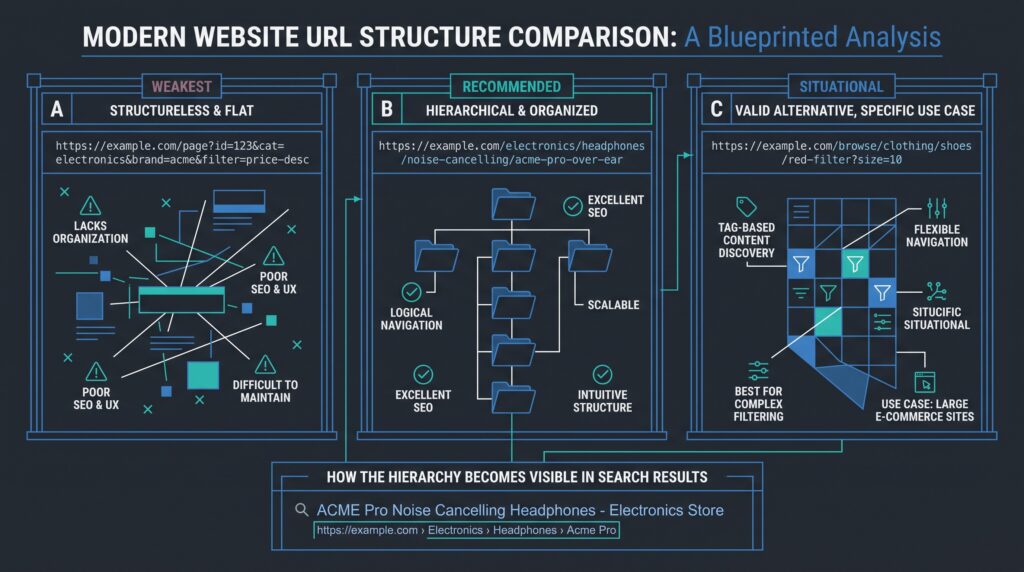
Most prop firm challenge tier pages use a flat URL structure where all tier variants sit at the same directory depth, providing no hierarchy signal to Google about the relationship between challenge formats and account sizes. The recommended structure is format-first hierarchy: /challenges/one-step/25k/ and /challenges/two-step/25k/ signal that challenge format is the primary category and account size is the subcategory. BreadcrumbList schema reinforces this hierarchy explicitly and generates breadcrumb trails in SERP results, distinguishing the firm’s structured challenge pages from aggregator listings that show only flat URLs.
The three URL patterns in the wild and their SEO implications.
Pattern A — Flat structure (most common, weakest signal): /25k-one-step-challenge/, /50k-one-step-challenge/, /25k-two-step-challenge/. All tier pages at the same depth, no hierarchy signal. Google must infer the relationship between formats from content rather than URL structure. The canonical consolidation from H2 #1 still works, but the URL structure provides no supporting hierarchy signal and no category-level page exists to rank for format-level queries like “one-step prop firm challenge.”
Pattern B — Format-first hierarchy (recommended): /challenges/one-step/25k/, /challenges/one-step/50k/, /challenges/two-step/25k/. The /challenges/ root becomes a challenge overview or comparison page. Each format directory (/challenges/one-step/) becomes a category landing page targeting “one-step prop firm challenge” queries. Individual tier pages sit at depth three — structurally equivalent to ecommerce product pages within a category. This structure supports the canonical consolidation from H2 #1 (all one-step variants canonicalise to the primary one-step tier within the same directory) and the internal linking from the F-cluster (educational content links to format category pages as well as to individual tier pages).
Pattern C — Size-first hierarchy: /challenges/25k/one-step/, /challenges/25k/two-step/. Signals that account size is the primary purchase driver. Less common; appropriate when trader data shows account size is the primary decision variable rather than challenge format. Choose based on which dimension traders search first — format (“one-step challenge”) or size (“$25K funded account”).
BreadcrumbList schema implementation. Regardless of URL pattern, BreadcrumbList schema explicitly confirms the hierarchy to Google. For a $25K one-step challenge page in Pattern B: Home > Challenges > One-Step Challenges > $25K One-Step Challenge. This four-level breadcrumb appears as a trail in the SERP result — a structured, professional appearance that distinguishes the firm’s own challenge pages from aggregator results showing only a flat URL. Implement BreadcrumbList schema on every challenge tier page and verify it using the Google Rich Results Test.
The five issues above map to the technical audit components of the prop firm SEO audit — which establishes which issues are present on the site, which challenge tier pages are most affected, and the priority order for fixing them before the content programme begins compounding on technically sound foundations.
Want this applied to your business? See how I approach SEO for prop firms.
More in the prop firm SEO series: what a prop firm SEO audit checks, prop firm SEO keywords, how long prop firm SEO takes, prop firm content strategy, internal linking for prop firms, why prop firms get outranked by review sites.
FAQ
Q1: What are the most common technical SEO issues on prop firm challenge pages?
Five technical SEO issues are most common on prop firm challenge pages: canonical tag absence across tier variants allowing near-identical pages to compete with each other rather than consolidating authority; missing structured data despite challenge pages being functionally equivalent to product pages with prices and features; JavaScript rendering of challenge pricing causing indexation of thin page shells without content; poor Core Web Vitals on purchase pages due to payment processor script accumulation; and inconsistent URL structures with no hierarchy signal between challenge formats and account sizes.
Q2: How should prop firms implement canonical tags for challenge tier pages?
Prop firms should implement canonical tags through a five-step audit: crawl all challenge tier URLs using Screaming Frog, group them by format family (one-step, two-step), designate the canonical URL for each family as the page with the most complete content and strongest inbound links, verify that canonical tags on variant pages point directly to the canonical URL without chains, and confirm Google is honouring the canonical signal using the URL Inspection tool in Search Console. Canonical tags must also be paired with internal links pointing to the canonical URL rather than to variant pages.
Q3: What schema markup should prop firms add to challenge pages?
Three schema types are recommended for prop firm challenge pages. First, Product schema or Service schema with PriceSpecification for the challenge price, evaluation period, and key account attributes. Second, FAQPage schema for the challenge rules section — covering profit targets, drawdown limits, evaluation periods, and payout splits — which targets People Also Ask positions for pre-purchase trader queries. Third, BreadcrumbList schema to confirm the challenge tier hierarchy to Google and generate breadcrumb trails in search results. All three should be generated server-side to prevent schema drift when pricing updates via JavaScript.
Q4: Does JavaScript rendering affect prop firm challenge page indexation?
Yes — challenge pages that render pricing and rules via client-side JavaScript risk being indexed as thin pages if Google indexes the initial HTML before JavaScript executes. The diagnostic is Google Search Console’s URL Inspection tool: compare the rendered HTML to the raw source HTML for a challenge page; any content in the rendered version but absent in the source is JavaScript-rendered and subject to indexation delays. The recommended fix is Server-Side Rendering or Incremental Static Regeneration for challenge tier pages, ensuring pricing and rules appear in the HTML response without requiring JavaScript execution.
Q5: How do Core Web Vitals affect prop firm challenge page performance?
Challenge purchase pages are typically the highest Core Web Vitals risk on a prop firm site because they carry the heaviest third-party script load — payment processors, affiliate tracking, analytics events, and retargeting pixels all executing on the page where purchase decisions happen. INP (Interaction to Next Paint) on the buy CTA button is the most commercially relevant metric: an INP above 500ms means the page freezes when clicked. Diagnose using CrUX data filtered to the purchase page URL; fix by deferring non-essential scripts and auditing Tag Manager for inactive tracking tags that accumulate over time.
Q6: What URL structure should prop firm challenge tier pages use?
The recommended URL structure for prop firm challenge tier pages is format-first hierarchy: /challenges/one-step/25k/ and /challenges/two-step/25k/ rather than flat structures like /25k-one-step-challenge/. Format-first hierarchy signals to Google that challenge format is the primary category and account size is the subcategory, enabling category-level pages to target format queries and tier pages to target specific account size queries. BreadcrumbList schema should reinforce this hierarchy explicitly, generating breadcrumb trails in search results and confirming the relationship between the challenge overview page, format category pages, and individual tier pages.