
Prop Firm Internal Linking Strategy, from where to start?
A prop firm SEO programme can produce strong educational content rankings and still see underwhelming challenge purchase growth from organic — and internal linking is usually the reason. Educational content earns authority through rankings and inbound links from trader communities. Without deliberate internal links from those educational pages toward challenge purchase pages, that authority stays on the educational pages. The challenge tier pages that need authority to rank for commercial queries never receive it.
The education-first content strategy produces the authority. Internal links are the transfer mechanism. Three specific linking patterns govern how authority moves through a prop firm site — from where it’s earned to where it needs to be commercially.
Three internal linking patterns direct authority toward challenge pages in a prop firm site:
- The authority flow pattern — educational hub pages link to challenge purchase pages, transferring the authority earned from informational rankings to the commercial pages where conversions happen.
- The trust-verification bridge — payout proof pages link to challenge purchase pages with conversion-intent anchor text, directing high-conviction visitors toward the purchase step immediately after their objection is resolved.
- The challenge tier consolidation pattern — internal links from educational content point to the canonical challenge tier page rather than distributing authority across variant pages, concentrating ranking signal on the primary tier target.
Table of Contents
Pattern 1: The Authority Flow
In most prop firm sites I audit, the educational content cluster and the challenge purchase pages exist in parallel without connecting. The blog ranks for informational queries. The challenge pages rank for branded queries. The authority earned by the educational content never reaches the pages that need it commercially. The audit that reveals this takes about 20 minutes and typically surfaces five to ten high-authority educational pages with zero internal links to any challenge tier page — authority siloed in the section that generates traffic, absent from the section that generates revenue.
Educational hub pages — challenge rules explainers, risk management guides, funded trader journey content, drawdown calculation tools — earn authority through two channels: organic rankings for informational queries that attract inbound links from trader forums and SEO blogs, and social shares and brand citations that accumulate page-level authority over time. This authority is one of the most significant ranking signals for related commercial pages on the same domain — but only if internal links transfer it.
The authority silo problem. A prop firm that builds 15 educational articles and earns 30 or more referring domains to that content cluster has accumulated meaningful authority. If those 15 articles have no internal links to the challenge purchase pages, that authority is siloed in the educational section. The challenge tier pages — $25K one-step, $50K two-step, $100K instant funding — receive no authority transfer from the strongest pages on the site. They rank on their own signals alone, without the boost from the educational content cluster that surrounds them. This is why evaluation-intent keywords sometimes rank lower than expected even when educational content on the same site is performing well.
How to implement Pattern 1. Every educational article should contain at least one internal link to the specific challenge tier page most relevant to its content. A challenge rules explainer links to the challenge tier page that enforces those exact rules. A risk management guide written around a specific drawdown structure links to the challenge page with that drawdown configuration. A funded trader journey article links to the starting-point challenge page a new trader would enter. The link appears in body context — where the educational topic naturally connects to the commercial offering — not as a footer CTA appended after the article’s final sentence.
Distribution across tiers. Not every educational article links to the same challenge page — authority distributes across tiers based on topical relevance. A “how to pass a two-step challenge” article links to the two-step challenge tier page. A “one-step vs two-step comparison” article links to both tier pages, with the primary CTA pointing toward the tier the comparison recommends for the reader’s trading profile. The linking map follows topical logic, not volume optimisation — the most relevant educational page for each tier is the most valuable origin point for that tier’s authority.
Pattern 2: The Trust-Verification Bridge
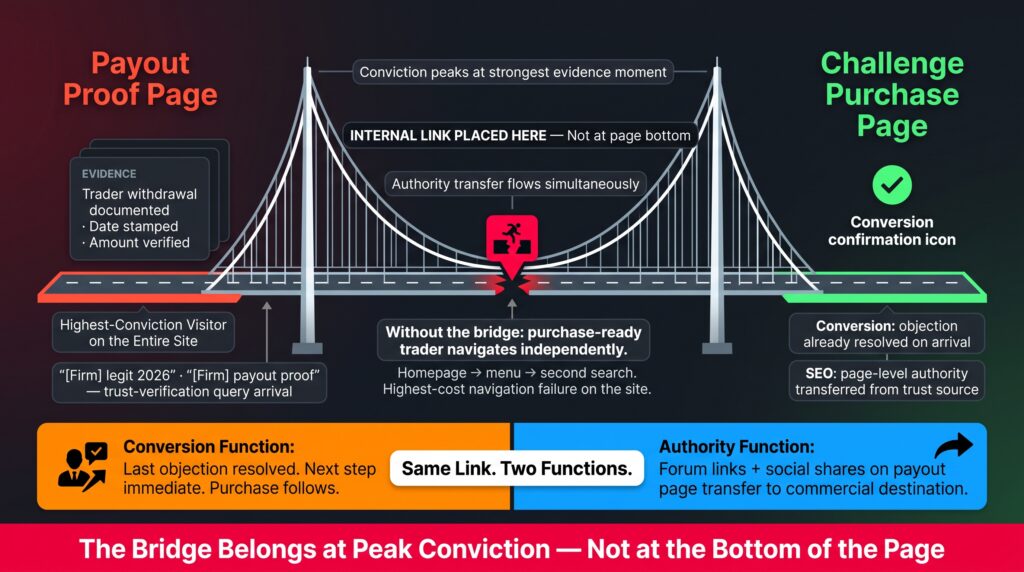
A trader who lands on a payout proof page from a “[firm] legit 2026” or “[firm] payout proof” search query is in the final pre-purchase step — they’ve heard about the firm, they’re interested, and they’re verifying before committing. Per the prop firm keyword conversion analysis, trust-verification visitors convert at counterintuitively high rates when the content satisfies their evidence requirement. The payout proof page carries the highest-conviction visitor on the entire prop firm site.
The problem without the bridge. A trust-verified visitor who finishes reading the payout proof page and is satisfied has resolved their last objection. Without an internal link to the challenge purchase page, they must navigate independently — back to the homepage, through the navigation menu, or via a second search. Each additional step loses a percentage of visitors at the moment their purchase conviction is highest. The purchase-ready trader who resolved their objection on the payout proof page and then encountered no structured next step is the highest-cost navigation failure in a prop firm site.
How to implement Pattern 2. The payout proof page should contain a direct internal link to the challenge purchase page — placed after the most compelling evidence section, not at the bottom of the page. Placement logic: the trader’s conviction peaks at the moment the strongest evidence is presented. The internal link belongs at that moment, not 400 words later after the impact has diluted. Anchor text is critical here — see H2 #4 for the specific language that signals purchase intent rather than continued research.
The authority dimension. Beyond conversion, the payout proof page → challenge purchase page link is also an authority signal. Payout proof pages that earn trust-verification query traffic accumulate page-level authority through inbound links from trader forums and social shares. An internal link from a high-traffic payout proof page toward the challenge purchase page transfers that authority to the commercial destination — the same mechanism as Pattern 1, from a trust-verification source. The conversion function and the SEO authority transfer happen through the same link.
Pattern 3: Challenge Tier Consolidation
Challenge tier variant pages — $10K one-step, $25K one-step, $50K one-step, $10K two-step, and their equivalents — are structurally similar pages that compete with each other for ranking authority without canonical tag consolidation. The canonical tag fix was introduced in the Foundation Phase of the prop firm SEO timeline as the highest-priority Week 1 technical task. Most prop firm sites implement canonical tags and stop there — leaving the consolidation incomplete.
Why canonical tags alone are insufficient. A canonical tag on a variant page tells Google which URL is the preferred indexation target. But if educational content links to the $10K one-step page from one article and to the $25K one-step page from another, the authority is still split across variants despite the canonical signals. The canonical tag concentrates the indexation signal; internal links concentrate the authority and crawl budget allocation. Both are required for consolidation to work fully.
How to implement Pattern 3. Audit all internal links across educational content pointing to challenge tier pages. For each tier family (one-step, two-step, instant funding), identify the canonical URL designated as the primary. Update internal links from educational pages to point to the canonical URL rather than to variant pages. Practical check: if a challenge rules explainer links to the $10K one-step page and a risk management guide links to the $25K one-step page, the authority is split between two variants when it should consolidate on the primary one-step tier page. The fix: both articles link to the canonical one-step challenge page; a tier-selection section within that page directs the visitor to the specific account size that matches their trading capital. The canonical tag handles the indexation consolidation; the directed internal link handles the authority consolidation.
Anchor Text for Each Pattern
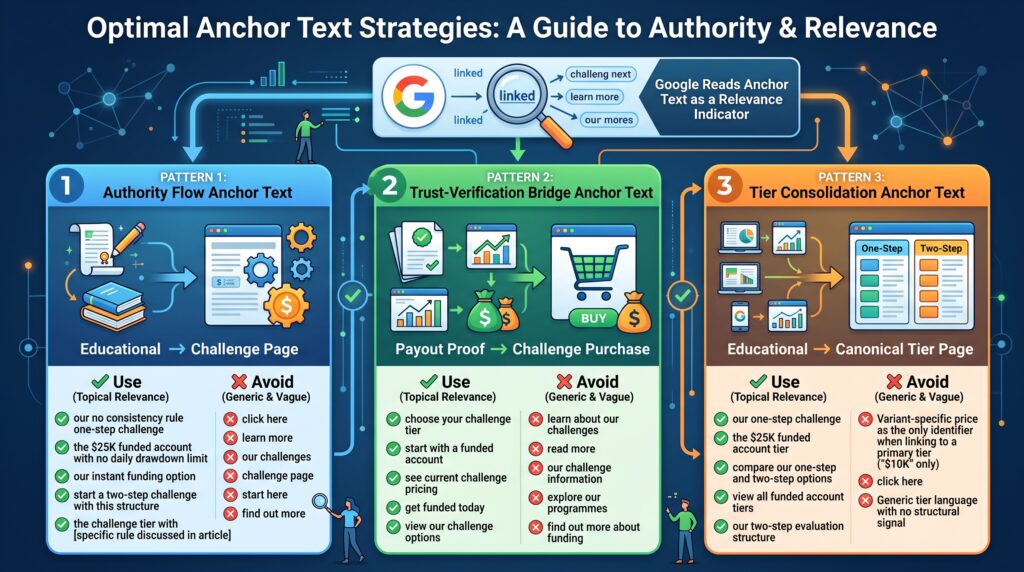
Generic anchor text (“click here,” “learn more,” “our challenges”) passes authority between pages but provides no topical relevance signal for the destination. Google reads anchor text as a relevance indicator for the linked page — feature-specific anchor text on a Pattern 1 link tells Google what the challenge page is about, not just that it exists. Each pattern requires different anchor text logic.
Pattern 1 — Authority Flow Anchor Text (Educational → Challenge Page)
✓ Use: “our no consistency rule one-step challenge” · “the $25K funded account with no daily drawdown limit” · “our instant funding option” · “start a two-step challenge with this structure” · “the challenge tier with [specific rule discussed in article]”
✗ Avoid: “click here” · “learn more” · “our challenges” · “challenge page” · “start here” · “find out more”
Pattern 2 — Trust-Verification Bridge Anchor Text (Payout Proof → Challenge Purchase)
✓ Use: “choose your challenge tier” · “start with a funded account” · “see current challenge pricing” · “get funded today” · “view our challenge options”
✗ Avoid: “learn about our challenges” · “read more” · “our challenge information” · “explore our programmes” · “find out more about funding”
Pattern 3 — Tier Consolidation Anchor Text (Educational → Canonical Tier Page)
✓ Use: “our one-step challenge” · “the $25K funded account tier” · “compare our one-step and two-step options” · “view all funded account tiers” · “our two-step evaluation structure”
✗ Avoid: Variant-specific price as the only identifier when linking to a primary tier (“$10K” only, implying that’s the only option) · “click here” · Generic tier language with no structural signal
The Four-Step Internal Linking Audit

The three patterns above describe what the architecture should look like. The audit below identifies what it currently looks like — and which links to add first for maximum authority transfer to the most commercially under-supported pages.
Step 1 — Identify the authority-earning educational pages. In Google Search Console, sort pages by organic impressions. The top 10–15 pages by impression volume are the site’s authority-earning pages. If these are educational pages rather than challenge tier pages, they are Pattern 1 origin-point candidates.
Step 2 — Check how many link to challenge tier pages. In Ahrefs or Semrush, pull internal links for each top educational page. Count links pointing to challenge purchase pages. An educational page with high impressions and zero internal links to any challenge tier page is an authority silo — it earns authority and doesn’t transfer any of it.
Step 3 — Identify authority-starved challenge pages. Using the same tool, identify challenge tier pages by their internal link count from other pages on the same domain. The lowest internal link count indicates the most authority-starved commercial page — Google has the least basis to understand its relationship to the rest of the site and distributes the least authority to it.
Step 4 — Map and implement by topical relevance. Match the highest-authority educational pages (Step 1) to the most under-linked challenge pages (Step 3) by topical relevance — not by arbitrary priority. Add the internal link with feature-specific anchor text from Pattern 1. This is a quarterly exercise as new educational content enters the cluster and new linking opportunities emerge. Authority-earning pages that are published without internal links to challenge pages are immediate audit findings at the next cycle.
The authority-earning pages and authority-starved challenge pages the audit identifies in Steps 1 and 3 are two of the eight components mapped in the prop firm SEO audit before the content programme begins. The audit is the baseline diagnostic; the three patterns above are the architecture; the quarterly internal linking audit is the ongoing maintenance that keeps authority flowing toward challenge pages as the content cluster grows.
For hands-on help, see SEO for prop firms.
More in the prop firm SEO series: what a prop firm SEO audit checks, prop firm SEO keywords, how long prop firm SEO takes, prop firm technical SEO, prop firm content strategy, why prop firms get outranked by review sites.
FAQ
Q1: How should a prop firm structure its internal linking strategy?
A prop firm internal linking strategy follows three patterns: the authority flow pattern links educational hub pages to challenge purchase pages, transferring authority earned from informational rankings to commercial pages; the trust-verification bridge links payout proof pages to challenge purchase pages with conversion-intent anchor text, directing high-conviction visitors toward purchase; and the challenge tier consolidation pattern links educational content to canonical challenge tier pages rather than distributing authority across variant pages. Together, these three patterns ensure that authority earned anywhere on the site flows toward the pages that generate challenge purchases.
Q2: What pages should link to challenge purchase pages on a prop firm site?
Two page types are the highest-value internal linking origin points for challenge purchase pages. First, educational hub pages — challenge rules explainers, risk management guides, funded trader journey content — that earn authority through informational rankings and inbound links from trader communities. Second, payout proof pages, which carry the highest-conviction visitors on the entire site — traders who have specifically searched for trust evidence before committing to a purchase. Both types should link to challenge purchase pages, but with different anchor text: feature-specific language from educational pages, conversion-intent language from payout proof pages.
Q3: Why are payout proof pages important for prop firm internal linking?
Payout proof pages carry the highest-purchase-intent visitors on a prop firm site — traders who searched for trust evidence before committing. When a trust-verification visitor finishes reading the payout proof page and is satisfied, they have resolved their last objection. An internal link from the payout proof page to the challenge purchase page with conversion-intent anchor text converts this high-conviction visitor directly rather than requiring independent navigation to find the purchase option. Without this link, the purchase-ready visitor who resolved their objection on the payout proof page has no immediate structured path to the commercial action.
Q4: What anchor text should prop firm internal links use?
Anchor text for prop firm internal links differs by pattern. Educational pages linking to challenge pages should use feature-specific anchor text that names the rule or characteristic discussed — “our no consistency rule challenge” rather than “click here” or “our challenges.” Payout proof pages linking to challenge purchase pages should use conversion-intent anchor text that signals the next step is action — “choose your challenge tier” rather than “learn more about our challenges.” Challenge tier consolidation links should use navigation-intent anchor text that names the tier clearly — “our one-step challenge” or “compare one-step and two-step options.”
Q5: How do canonical tags and internal links work together for challenge tier pages?
Payout proof pages carry the highest-purchase-intent visitors on a prop firm site — traders who searched for trust evidence before committing. When a trust-verification visitor finishes reading the payout proof page and is satisfied, they have resolved their last objection. An internal link from the payout proof page to the challenge purchase page with conversion-intent anchor text converts this high-conviction visitor directly rather than requiring independent navigation to find the purchase option. Without this link, the purchase-ready visitor who resolved their objection on the payout proof page has no immediate structured path to the commercial action.
Q6: How do I audit internal linking on a prop firm site?
A prop firm internal linking audit runs in four steps. First, identify the top authority-earning educational pages using Google Search Console organic impression data. Second, check how many of those pages link internally to challenge tier pages using Ahrefs or Semrush — pages with high impressions and zero challenge page links are authority silos. Third, identify the most authority-starved challenge pages by their internal link count — lowest count indicates least authority transfer. Fourth, map the highest-authority educational pages to the most underlinked challenge pages by topical relevance and add feature-specific internal links. Run quarterly as new content is published.