
AI Search vs Traditional SEO for Forex Brokers, which is more important?
Every article on AI search vs traditional SEO ends with the same recommendation: invest in both. That is not a decision — it is a deferral.
This article is for regulated forex broker CMOs who need to prioritise one channel first given a specific budget, a compliance review constraint, and existing organic infrastructure that may or may not be working. If you need the channel explanation first — what AI search is, how it differs from traditional SEO, and what AEO/GEO mean — start with the AEO/GEO strategy overview for forex brokers. This article assumes you have done that research and are ready to make the investment decision.
Table of Contents
Why the Generic Answer Doesn’t Apply to a Regulated Forex Broker
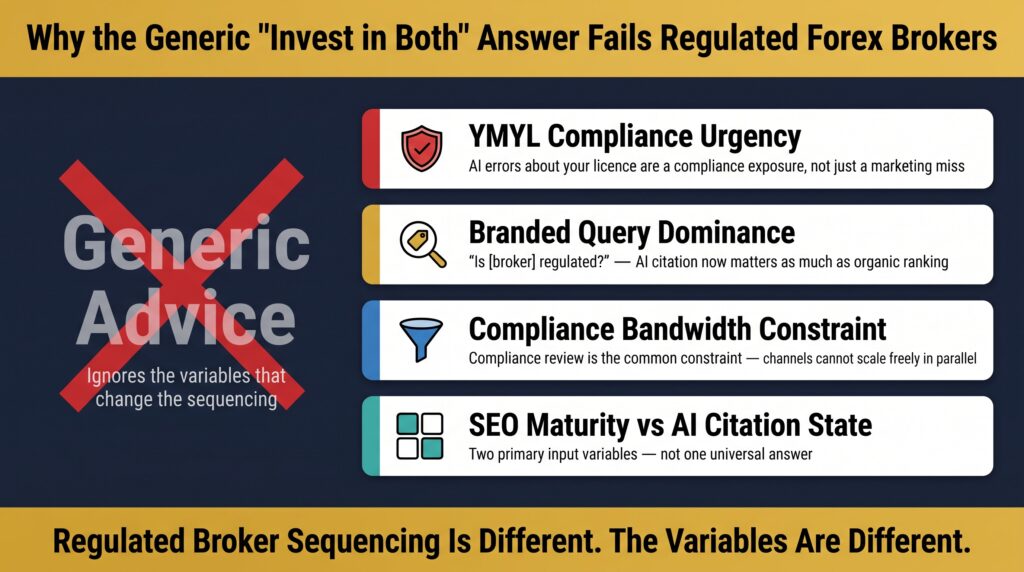
The “invest in both” answer fails for regulated forex brokers because it ignores the variables that make the sequencing different. There are five dimensions specific to regulated forex brokers that change the investment calculus from the generic recommendation.
YMYL compliance urgency. For a regulated broker, the AI visibility investment is not purely a growth decision — it is partly a compliance risk management decision. As documented in the AI visibility audit findings, AI engines frequently state factually wrong information about regulated forex brokers: wrong licence numbers, confused entities, outdated leverage limits. A broker that invests only in traditional SEO while ignoring AI visibility is not just missing a marketing channel — it is leaving an unmanaged exposure. A financial services regulator conducting a supervision review, a journalist fact-checking a broker profile, or a prospect making a regulated product decision may all encounter AI-generated descriptions that contradict the broker’s actual regulatory credentials.
Branded query dominance. For a regulated broker, the highest-value queries are branded: “is [broker] regulated?”, “[broker] CySEC licence number”, “[broker] vs [competitor]”. These are the research-phase queries prospects ask before making a regulated financial decision. AI engines are increasingly the first stop for these queries. Traditional SEO rankings matter for them, but AI citation for the same queries now matters equally — and the two require different optimisation approaches.
Compliance bandwidth constraint. Both SEO content production and AI visibility structural work require compliance review for regulated content. This constrains total content throughput regardless of which channel you prioritise. The channels are not freely scalable in parallel — the compliance team is the common constraint.
SEO maturity and AI citation current state are the two primary input variables for the decision matrix below.
AI Search vs Traditional SEO for Forex Brokers-The Four Variables That Determine the Right Answer for Your Broker
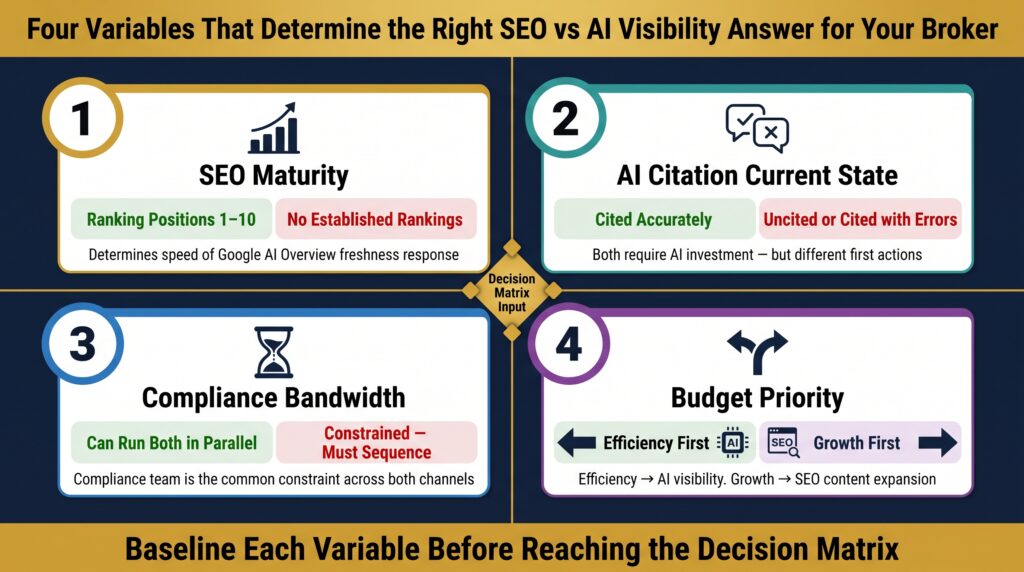
Before reaching the decision matrix, each variable needs a baseline. The matrix produces different recommendations depending on where your broker sits on each dimension.
Variable 1 — SEO Maturity. Does the broker rank in positions 1–10 organically for its own brand terms and key informational queries? Strong organic rankings are a prerequisite for Google AI Overview to pick up content freshness updates quickly — as established in E9’s engine-specific timing analysis, Google AI Overview freshness response depends on organic ranking strength. A broker without established organic rankings gets slower Google AI Overview benefit from structural AI visibility work. Diagnostic tool: forex broker SEO audit.
Variable 2 — AI Citation Current State. Is the broker currently cited by ChatGPT, Perplexity, and Google AI Overview for branded regulatory queries? Are those citations accurate? An uncited broker is invisible in the pre-decision research phase. A broker cited with factual errors faces the compliance risk described above. Both are arguments for AI visibility investment, but they require different first actions. Diagnostic tool: AI/GEO visibility audit.
Variable 3 — Compliance Bandwidth. Can the compliance team support both ongoing SEO content reviews and a structural AI visibility implementation simultaneously? The structural AI visibility work requires one compliance review cycle for changes that produce durable benefit. High-volume SEO content production requires an ongoing per-piece compliance review. A constrained compliance team should sequence rather than run both in parallel.
Variable 4 — Budget Priority. Is the immediate objective efficiency (maximum AI citation improvement per compliance-review hour) or growth (maximum new organic traffic acquisition)? Efficiency-first points to AI visibility structural work; growth-first points to SEO content expansion.
The Investment Decision Matrix — Four Situations, Four Explicit Recommendations
Based on the four variables, four situations cover the majority of regulated forex broker marketing programmes. The matrix maps each situation to an explicit sequencing recommendation. These are starting points — the AI/GEO visibility audit and forex broker SEO audit together provide the precise inputs the matrix requires for your broker specifically.
| Situation | SEO Maturity | AI Citation State | Compliance Bandwidth | Investment Priority | First Action |
|---|---|---|---|---|---|
| A | Weak — limited rankings, thin authority | Uncited across all engines | Any | SEO Foundation First — AI citation requires the organic authority layer that SEO builds. Investing in AI visibility before SEO is established produces limited returns. | Start with the forex broker SEO audit |
| B | Established — ranking for core queries, domain authority built | Uncited — SEO investment not translating into AI citations | Any | AI Visibility First — organic authority exists but AI citation signals are missing. Content restructuring and entity establishment produce fast citation gains. | Start with the AI/GEO visibility audit |
| C | Established | Already cited accurately | Constrained | AI Visibility Maintenance Only — citations are working. Protect the position with a content freshness programme rather than structural change that could disrupt existing citations. | Start with a quarterly content freshness review — regulation page, conditions page, FAQ page |
| D | Any | Cited inaccurately — wrong entity, wrong licence, wrong regulatory status | Any | Fix AI Errors Immediately — Compliance Risk — inaccurate AI citations about regulatory status are a compliance-adjacent exposure. This takes priority over all other investment decisions regardless of SEO maturity. | Start with the AI/GEO visibility audit — urgent |
Situation A — Weak SEO + Uncited → SEO foundation first. Without organic rankings, the Google AI Overview component of AI visibility benefit arrives slowly regardless of how well the regulation page is structured — Google AI Overview freshness speed depends on organic ranking strength. Build the SEO foundation first over 3–6 months, prioritising the regulation page and conditions page as dual-benefit pages that produce both organic ranking signals and AI visibility prerequisites simultaneously. Return to the structural AI visibility investment once organic rankings are established.
Situation B — Established SEO + Uncited → AI visibility structural investment first. The organic foundation is in place. Google AI Overview can pick up freshness updates quickly. The gap is AI citation — the broker ranks in Google but is invisible or inaccurately described in ChatGPT, Perplexity, and Google AI Overview for branded regulatory queries. Invest in the structural AI visibility work: Organisation schema, regulation page atomics, FAQPage schema, regulator register accuracy check. One compliance review, durable improvement.
Situation B is the most common profile I encounter when a broker first asks about AI visibility — an established organic presence, years of SEO investment, reasonable domain authority, and then the first branded query check across ChatGPT and Perplexity shows the broker either absent or described incorrectly. The SEO work built the authority layer. Nobody built the AI citation layer on top of it. The gap exists not because the SEO failed but because AI citation requires a different set of signals that the SEO programme was never asked to produce.
Situation C — Established SEO + Already cited + Constrained bandwidth → AI visibility maintenance only. The broker has the organic foundation and is being cited accurately. Focus is quality and accuracy maintenance, not reach expansion. The quarterly freshness programme with a compliance calendar built in. No new content creation pressure — the compliance bandwidth goes to keeping existing content current rather than building new assets.
Situation D — Cited inaccurately → Fix AI errors immediately, regardless of SEO maturity. This is the only situation that justifies treating the AI visibility investment as urgent rather than strategic. If AI engines are describing the broker’s regulatory credentials incorrectly, that is an active compliance-adjacent risk — not a marketing KPI gap. Fix the AI accuracy errors as the first action (one compliance review, targeted correction), then return to the matrix to determine the longer-term channel investment sequencing.
Why the Channels Are Partially Sequential, Not Parallel Alternatives
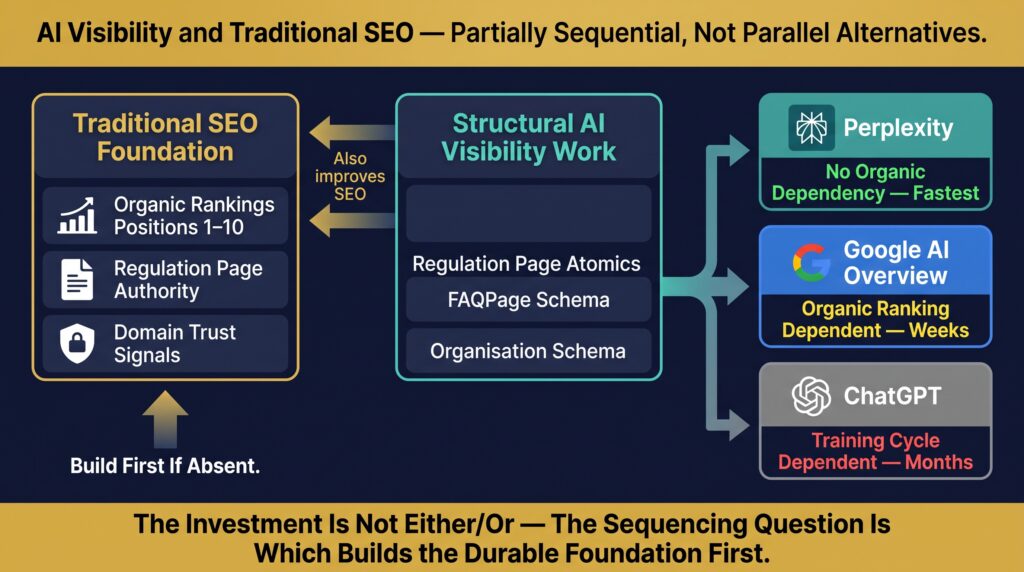
AI search visibility and traditional SEO are not parallel alternatives where you choose one and abandon the other. They are partially sequential — SEO builds the organic foundation that certain AI visibility mechanisms depend on, and the structural AI visibility work produces benefits for traditional SEO simultaneously.
The dependency that determines sequencing: Google AI Overview’s freshness response speed depends on organic ranking strength. A regulation page that has been atomically restructured and schema-marked produces faster Google AI Overview citation improvement if it already ranks organically for the relevant branded queries. Without organic rankings, the Google AI Overview benefit from structural AI visibility work still arrives — but more slowly, because Google AI Overview prioritises content already in its organic index for the relevant queries. Perplexity and ChatGPT do not have this organic dependency, which is why Perplexity is the fastest freshness validation signal regardless of organic ranking state.
The overlap that produces dual benefit: The structural AI visibility work — regulation page atomics, FAQPage schema, Organisation schema — is simultaneously beneficial for traditional SEO. Atomic blocks with direct-answer leads improve featured snippet eligibility. FAQPage schema generates rich results in traditional search. Organisation schema reduces entity confusion for Google’s knowledge graph. The investment is not either/or. The sequencing question is which produces the durable foundation that makes the other more effective, given the broker’s current state — which is what the matrix above answers.
What “Investing in AI Visibility” Actually Involves for a Regulated Broker
The AI visibility investment for a regulated forex broker is more defined and bounded than most CMOs expect. It is not a continuous content production programme with ongoing compliance review requirements — it is a structural implementation done once, maintained quarterly.
The one-time structural implementation — requiring one compliance review cycle — covers: atomically restructuring the regulation page so entity name, licence number, and regulatory status appear in the first sentence of each relevant block rather than embedded in formal disclosure prose; adding Organisation schema declaring the legal entity name, licence number, and regulated subsidiaries for each jurisdiction; adding FAQPage schema to the regulatory Q&A section; checking the regulator register for consistency with the broker’s current website description. Full implementation guide in structuring content for AI citation and E-E-A-T signal maintenance.
The quarterly maintenance follows the content freshness programme — quarterly regulation page and conditions page review on a compliance calendar rather than a content calendar, Perplexity validation after each update as the fastest feedback loop, Google AI Overview check approximately four weeks after each update.
The ongoing monitoring — monthly five-engine branded query check, annual reaudit, biannual third-party source accuracy review — is covered in the 90-day roadmap Phase 3 monitoring framework.
“Before the decision matrix is personally applicable, you need a baseline on both channels. The AI/GEO visibility audit and the forex broker SEO audit together give you the four input variables the matrix requires.”
FAQ
Q1: Should a forex broker invest in AI search visibility or traditional SEO first?
The investment priority for a regulated forex broker depends on four variables: current SEO maturity, AI citation current state, compliance team bandwidth, and budget priority. For a broker with weak organic rankings, traditional SEO investment should come first because strong organic rankings are a prerequisite for Google AI Overview to pick up content updates quickly — without them, the Google AI Overview benefit from structural AI visibility work arrives more slowly. For a broker with established organic rankings but poor or inaccurate AI citation, AI visibility structural investment produces higher immediate ROI — the organic foundation is in place, and the AI citation layer is the next gain. For a broker whose AI engines are currently stating factually wrong information about its regulatory credentials, AI visibility correction is not optional regardless of SEO maturity, because inaccurate AI citation of a regulated broker’s licence number or entity structure carries compliance-adjacent risk. For most regulated forex brokers with established organic rankings, the marginal return on AI visibility investment is now higher than the marginal return on additional SEO content production in mid-2026.
Q2: How is AI search different from traditional SEO for a regulated forex broker specifically?
For a regulated forex broker, the distinction between AI search and traditional SEO goes beyond ranking signals. Traditional SEO produces organic rankings in Google through keyword optimisation, backlinks, and technical performance. AI search visibility produces citations in ChatGPT, Perplexity, Google AI Overview, Gemini, and Claude through structured entity declarations, atomic content blocks, explicit regulatory credentials, and third-party source accuracy. The critical forex-broker-specific difference is that traditional SEO cannot address what AI engines say about a broker’s regulatory credentials for branded research queries. A broker may rank in position one on Google for its own brand name while AI engines simultaneously describe its regulatory status incorrectly — a compliance-adjacent risk that traditional SEO optimisation does not resolve. Additionally, AI search is increasingly where regulated product research happens before a prospect reaches a search results page, making AI citation for branded factual queries as commercially important as organic rankings for the same queries.
Q3: What four factors determine whether a forex broker should prioritise AI visibility or traditional SEO?
Four variables determine the investment priority for a regulated forex broker. First, SEO maturity: does the broker have established organic rankings for its brand terms and key informational queries? Strong organic rankings accelerate Google AI Overview freshness response — without them, the Google AI Overview component of AI visibility benefit arrives slowly. Second, AI citation current state: is the broker currently cited by AI engines, and are those citations accurate? Inaccurate citations of regulatory credentials carry compliance risk regardless of SEO maturity. Third, compliance bandwidth: can the compliance team support both ongoing SEO content reviews and structural AI visibility implementation simultaneously, or must resources be sequenced? The structural AI visibility investment requires one compliance review cycle; high-volume SEO content production requires ongoing per-piece reviews. Fourth, budget priority: is the immediate objective efficiency, meaning maximum AI citation improvement per compliance-review hour, or growth, meaning maximum new organic traffic acquisition? Efficiency-first points to AI visibility structural work; growth-first points to SEO content expansion.
Q4: Does investing in traditional SEO improve a forex broker’s AI search visibility?
Traditional SEO investment partially improves AI search visibility through one specific mechanism: strong organic rankings accelerate how quickly Google AI Overview picks up content freshness updates. A regulation page that has been restructured for AI extraction produces faster Google AI Overview citation improvement if it already ranks organically for the relevant branded queries than if it does not. However, this dependency applies only to Google AI Overview — Perplexity uses real-time web retrieval with no organic ranking dependency, and ChatGPT relies on training data with no organic ranking dependency either. Traditional SEO also does not directly address the entity schema, atomic content structure, and regulator register accuracy that determine AI citation quality across all five engines for branded factual queries. The structural AI visibility work — Organisation schema, regulation page atomics, FAQPage schema — is simultaneously beneficial for traditional SEO through improved featured snippet eligibility, rich results generation, and entity clarity in Google’s knowledge graph. The most efficient investment for a regulated broker is the structural AI visibility work that produces benefits for both channels simultaneously.
Q5: What does investing in AI search visibility actually involve for a regulated forex broker?
The AI visibility investment for a regulated forex broker consists of a one-time structural implementation and an ongoing quarterly maintenance programme. The structural implementation, which requires one compliance review cycle, covers atomically restructuring the regulation page so entity name and licence number appear in the first sentence of each relevant block, adding Organisation schema declaring the entity name, licence number, and suborganisations for each regulated entity, adding FAQPage schema to the regulatory question-and-answer section, and checking the regulator register for consistency with the broker’s own website description. This one-time structural work produces durable AI citation improvement across Perplexity, Google AI Overview, and over time in ChatGPT. The quarterly maintenance programme follows the freshness protocol: reviewing and updating the regulation page, conditions page, and FAQ regulatory section on a compliance calendar rather than a content calendar, validating updates against Perplexity as the fastest feedback loop, and checking Google AI Overview approximately four weeks after each update. The total compliance team time required for the structural implementation is comparable to a single thorough regulatory disclosure review — it is not a continuous content production programme.
Q6: How do compliance requirements affect the AI search vs SEO investment decision for a regulated forex broker?
Compliance requirements affect the investment decision for a regulated forex broker in two specific ways. First, they create a throughput constraint: both SEO content production and AI visibility structural work require compliance review for regulated content, limiting the total amount of content that can be published per quarter regardless of which channel is prioritised. A compliance team that can review three to four pieces of regulated content per month cannot simultaneously scale a high-volume SEO content programme and complete a structural AI visibility implementation. Second, the compliance economics favour the AI visibility structural investment for a constrained compliance team because it requires one review cycle for changes that produce durable benefit, whereas ongoing SEO content production requires a compliance review for every new piece of regulated content. For a broker with a small or capacity-constrained compliance team, the structural AI visibility investment produces more AI citation improvement per compliance-review hour than an equivalent volume of new SEO articles, making it the more efficient allocation of scarce compliance resources in the near term.