
Last reviewed: June 2026 by Hristo Hristov
Growth Consultant · Fintech, Forex & Prop Firms
A forex broker CMO came to me six months after receiving a 53-page SEO audit from their previous agency. The report was thorough by standard measures — Core Web Vitals passing, redirects clean, schema present, page titles optimised. The site scored 73 out of 100. The recommendation was to continue building content and acquiring links. Six months later, the site still ranked below three comparison aggregators for every commercial term that mattered. Nothing in the audit had explained why.
The audit found nothing wrong because it had been checking the wrong things.
A generic SEO audit is a valid instrument for most websites. For a forex broker operating under FCA or CySEC regulation, serving multi-jurisdiction audiences, competing against affiliate comparison sites, and subject to Google’s YMYL quality framework — a generic audit misses six layers that determine whether a regulated broker site actually ranks. I’ve structured those six layers below, alongside what a full forex-specific audit covers, so you can evaluate whether what you’ve received (or are considering commissioning) addresses the real problem or just measures around it.
Table of Contents
Why Generic SEO Audits Are Built for the Wrong Site
A standard SEO audit checks whether your website can be found, understood, and ranked by search engines. It covers technical infrastructure — Core Web Vitals, crawlability, indexation, redirects, schema. It covers on-page fundamentals — title tags, meta descriptions, header structure, keyword alignment. It covers authority signals — backlink profile, domain rating, toxic link exposure. For the majority of websites, these checks cover the territory that determines rankings.
A forex broker site operates in a different territory.
Google classifies CFD trading and forex content as YMYL — Your Money, Your Life. These are topics where incorrect, misleading, or low-trust information can cause direct financial harm. Google holds YMYL content to a materially higher standard than general content, and deploys human quality raters who evaluate sites against a detailed set of criteria that extend well beyond whether your page loads in under 2.5 seconds.
The agencies producing generic audits are not cutting corners. They are using instruments built for a different environment. I have audited forex broker sites that passed every standard technical check and still could not rank for a single commercial term. The technical foundation was not the problem. The problem was six things that never appeared in any audit they had previously received.
What Generic Audits Check vs What Forex Audits Check
The diagram below shows the structural difference. The left column is what any audit covers. The right column shows the six additional layers a forex-specific audit adds — the layers that determine YMYL ranking eligibility.
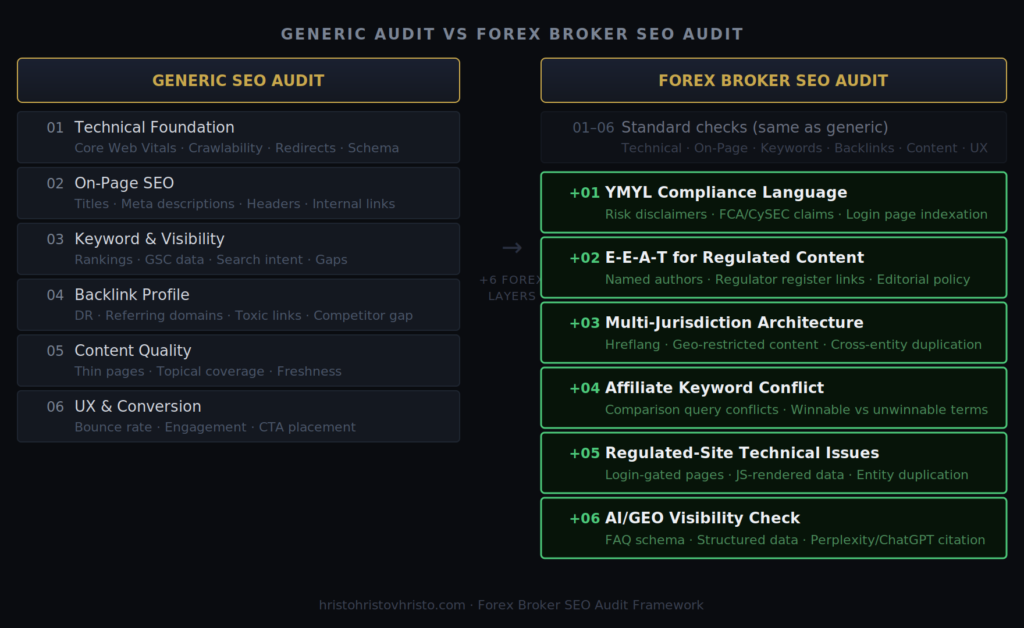
The 6 Layers a Forex Broker SEO Audit Adds
Each layer below is absent from a standard audit framework. Together they explain why technically sound forex broker sites rank below comparison aggregators, affiliate review sites, and occasionally their own content assets — regardless of how much SEO budget they spend.
Layer 1 — YMYL Compliance Language Audit
Google quality raters are trained to evaluate whether financial content could have a direct and significant impact on the financial stability or safety of the person reading it. For a forex broker, this means every page containing a financial claim — spread comparisons, leverage ratios, platform feature descriptions, trading condition data — is evaluated not just for technical quality but for whether it meets YMYL trust standards.
The practical implication: risk disclaimer language is not only a legal requirement. It is a quality signal quality raters use to assess YMYL compliance. A page comparing ECN broker spreads without a prominent risk disclaimer does not just create FCA enforcement exposure — it actively reduces the page’s quality rater score. And quality rater scores feed into algorithmic ranking signals for YMYL content.
What I check in this section: risk disclaimer presence on every page containing a financial claim, placement quality (footer-only disclaimers at 9px score differently from contextual disclaimers near the claims), FCA/CySEC-compliant language on platform feature pages, and whether pages inside the authenticated client portal are accidentally indexed without compliance framing.
A financial promotion must contain the risk warning in a way that is prominent — meaning a reasonable person notices it in context with the financial claim. The FCA’s own guidance states that risk warnings buried in footers do not satisfy the prominence requirement when the financial claim appears in the body content.
Specific FCA language: the warning must be displayed “as prominently as the most prominent element of the financial promotion.” If the spread comparison table is the dominant element on the page, the risk warning must be equally prominent — not in a footer at 10px after three CTAs.
CySEC has the same standard — disclosure must be “clear, fair and not misleading” and proportionate to the prominence of the claim.
🔍 REAL AUDIT FINDING — CySEC BROKER, 2026
In a recent audit of a CySEC-regulated broker targeting UK and MENA clients, I found risk disclaimers present on fewer than 20% of the site’s content pages. Their spread comparison page — the highest-traffic commercial page on the site — contained leverage ratios and ECN spread claims with no risk framing anywhere above the fold.
A footer disclaimer existed, but at 10px font buried beneath three CTA sections. The generic audit they had received six months earlier scored the site 71/100 and flagged zero compliance issues. The spread comparison page was listed as “fully optimised.”
⚠ A footer disclaimer satisfies existence — not prominence. FCA COBS 4 requires the risk warning to be as prominent as the financial claim itself. A spread comparison table in the body with the risk warning in the footer fails this standard regardless of whether the disclaimer is technically present on the page.
WHAT THIS MEANS FOR RANKINGS
The fix is content-level, not technical — no development resource required. But it requires knowing what quality raters are looking for, and that knowledge is not embedded in any standard audit tool or crawl report.
Layer 2 — E-E-A-T for Regulated Financial Content
E-E-A-T — Experience, Expertise, Authoritativeness, Trustworthiness — appears in almost every SEO discussion. What generic audits miss is that E-E-A-T means something specific and different for regulated financial content. The signals that satisfy a quality rater evaluating a forex broker are not the same signals that work for a B2B SaaS product or a financial news publication.
What I check: named author attribution on all content pages — not just blog posts, but every page containing financial analysis, platform comparisons, or trading condition information. Author credential verifiability (are credentials checkable, not just stated?). Methodology page presence and specificity. Editorial policy publication. And critically: whether regulatory licence numbers link to live regulator registers.
That last point matters more than most audits acknowledge. A CySEC licence number with a live link to the Cyprus Securities and Exchange Commission’s public register is a verifiable trust signal. The same number without the link is an unverifiable claim. Quality raters are explicitly instructed to verify regulatory claims — if the verification requires leaving the site to search independently, that is a friction point the quality rater records.
🔍 REAL AUDIT FINDING — E-E-A-T PATTERN ACROSS BROKER SITES
The majority of broker sites I audit have named authors on market news and analysis — but anonymous “Trading Team” attribution on everything else. That includes their most commercially important pages: account types, platform features, trading conditions, and spread comparisons.
These are precisely the pages where author credibility matters most to a quality rater. A named journalist on a market recap earns nothing with Google’s quality systems. A named, credentialled analyst on a leverage and margin conditions page — with a verifiable background in regulated derivatives — is what actually moves the E-E-A-T score.
The second pattern: licence numbers that link to the broker’s own About page rather than the live FCA or CySEC register. The number exists. The verification step is broken. A quality rater attempting to verify the regulatory claim hits a dead end inside the same site they are evaluating — which is not verification.
⚠ The fix costs nothing. Adding named authors with verifiable credentials to the 20 most commercially important pages takes a content editor one working day. Updating licence number links to the live FCA register takes 20 minutes. These are the two highest-impact E-E-A-T improvements per hour invested — and neither requires a developer.
Layer 3 — Multi-Jurisdiction Architecture
Most forex brokers operating internationally hold multiple regulatory licences simultaneously — FCA for UK retail clients, CySEC for EU clients under ESMA leverage rules, ASIC for Australian clients, FSCA for South African markets. Each jurisdiction requires different product availability, different risk disclaimer language, and sometimes an entirely separate site version or subdomain.
When this is structured incorrectly for SEO, the consequences are specific and measurable. Jurisdiction-specific pages compete against each other for the same global keywords. A broker’s UK-specific page targeting “best forex broker” and their global equivalent targeting the same keyword cannibalise each other’s ranking authority. Content duplication across regulated entity sites creates thin content signals that suppress both versions.
What I check: hreflang implementation completeness and bidirectionality — it is frequently present on the homepage but absent from product pages, trading instrument pages, and educational content, precisely where multi-jurisdiction signals matter most. Whether geo-restricted content is correctly signalled to Googlebot. Whether jurisdiction-specific compliance pages have been inadvertently duplicated across entity domains.
COMMON FINDING
Hreflang implemented on the homepage and about pages — missing from every commercial page. The site’s most important ranking pages are sending no jurisdiction signals to Google at all.
Layer 4 — The Affiliate Keyword Conflict
This is the layer that explains why brokers rank below ForexPeaceArmy, BrokerChooser, and Investopedia for commercial comparison queries — even when their technical SEO is clean, their content is well-produced, and their domain authority is competitive.
Google’s quality systems treat comparison queries — “best ECN broker,” “lowest spread forex broker,” “safest regulated forex broker” — as searches where editorial independence adds credibility. A broker’s page titled “Best ECN Broker” is structurally less credible to Google for that query than an independent comparison site evaluating multiple brokers including that broker. This is not a bias or an error. It is a logical quality signal.
This is not fixable through better on-page optimisation. What an SEO audit should identify: which of the broker’s current target keywords are affiliate-dominated comparison queries they structurally cannot win with first-party content, and which commercial queries they can rank for — platform-specific queries, regulated-market queries, trading condition queries where independent comparison adds no ranking value.
WHAT I TYPICALLY FIND
Brokers investing significant content budget into comparison category keywords they cannot structurally win, while their winnable queries — proprietary platform deep-dives, regulatory transparency content, trading condition specifications — receive no internal link support and no dedicated content investment.
Layer 5 — Technical Issues Unique to Regulated Trading Sites
The technical layer of a forex broker audit is not the same as a standard technical audit. The issues that determine rankings are specific to the platform infrastructure brokers use and the regulatory context they operate in. Three issues appear consistently and consistently go unchecked in generic audits:
Platform pages behind authentication. Most broker sites have between 20 and 70 pages inside the client portal — trading conditions, account specifications, instrument lists, leverage tables, platform tutorials. These pages contain the broker’s most detailed product information and represent significant topical authority potential. They are entirely invisible to Google because they require login to access. A generic technical audit reports a clean crawl. The authenticated content gap never appears in the findings.
JavaScript-rendered trading data. Spread comparison tables, live pricing widgets, and instrument specification tables — the most commercially valuable data on a broker site — are typically rendered via JavaScript. Googlebot handles JS-heavy financial widgets inconsistently, particularly at scale. These tables are what traders search for and what quality raters look for as evidence of genuine trading conditions. If they are invisible to Googlebot, the page has no substantive commercial content from Google’s perspective, regardless of how comprehensive the surrounding editorial copy is.
Cross-entity duplicate content. Brokers operating multiple regulated entities sometimes maintain near-identical site versions for each entity. Standard duplicate content tools detect on-domain duplication. Cross-domain duplication between related entity sites is invisible to these tools — and creates a thin content signal that suppresses authority for all entities simultaneously.
Layer 6 — AI/GEO Visibility Check
In 2026, a material share of trader research happens inside AI search interfaces before the trader visits any brokerage website. When a trader asks ChatGPT which forex broker has the tightest spreads, or queries Perplexity for FCA-regulated forex brokers for UK residents, the brokers cited are not determined by Google ranking position. They are determined by whether the broker’s content structure makes it eligible for AI citation.
A forex broker can pass every standard SEO check and be completely invisible to AI search — not because of a technical failure, but because AI citation eligibility requires content signals that standard audits never check for.
What I check: FAQPage schema on commercial pages (the primary mechanism for Google AI Overview citation eligibility), structured data completeness, content format — whether the site uses direct-answer Q&A structures that AI extraction systems prioritise — and live query testing against Perplexity and ChatGPT for the broker’s core target queries to assess current citation status versus competitors.
WHAT I TYPICALLY FIND
Zero FAQ schema on any page other than, occasionally, a help centre. No Q&A format content on trading condition or platform comparison pages. The broker is structurally invisible to AI search — and since no previous audit included this check, no one had flagged it.
The fix is not technically complex. Adding FAQPage schema to five commercially important pages and restructuring those pages to include three to five direct-answer questions takes a content editor approximately two hours. The impact on AI Overview appearance and Perplexity citation can be measured within 30 days of implementation. In the audits I have run, AI citation eligibility is the most consistently absent element — and relative to its impact on trader research behaviour in 2026, among the most important to address.
What a Full Forex Broker SEO Audit Actually Covers
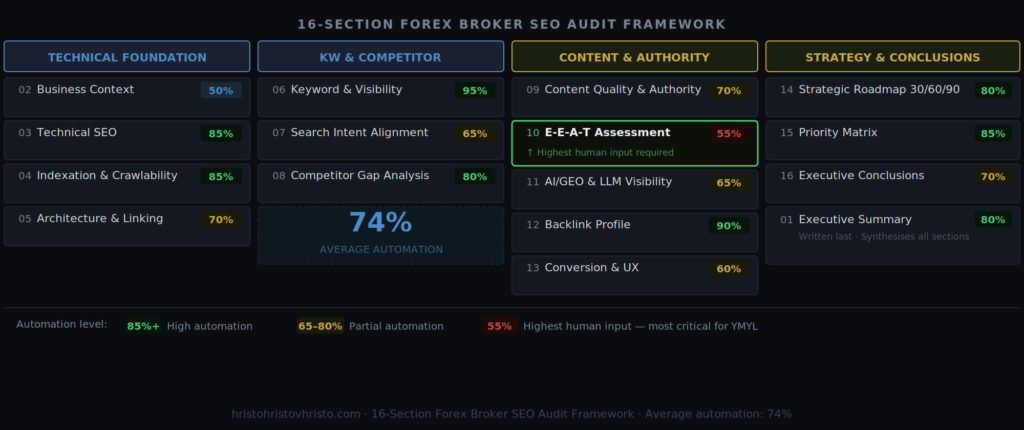
The six layers above are additions to a standard audit framework, not replacements for it. A complete forex broker SEO audit covers 16 sections across four categories. I am publishing this framework because the most common problem I encounter is CMOs commissioning audits without knowing what a thorough one should include — which means they have no way of evaluating whether what they receive is complete.
Technical Foundation (Sections 2–5): Business context and organic growth goals, technical SEO with full Core Web Vitals and infrastructure assessment, indexation and crawlability including the broker-specific issues in Layer 5 above, and site architecture with internal linking analysis.
Keyword and Competitor Intelligence (Sections 6–8): Full keyword and visibility analysis from real GSC data, search intent alignment assessing whether current page types match what Google’s quality systems are rewarding, and competitor gap analysis identifying which opportunities the broker’s actual SERP competitors leave genuinely open.
Content and Authority (Sections 9–11): Content quality and topical authority assessment, E-E-A-T evaluation at the YMYL depth described in Layer 2 — the highest human-input section in the audit — and AI/GEO visibility as a standalone section with live manual query testing.
Strategy and Conclusions (Sections 12–16): Backlink profile with forex-specific link building opportunity mapping, conversion and UX findings calibrated to broker-specific funnel metrics, a 30/60/90 day strategic roadmap sequenced by impact and dependency, priority matrix ranking all findings by effort versus ranking impact, and executive conclusions written for CMO-level briefing.
74% of this audit can be completed through automated analysis with the right data inputs — GSC export, Ahrefs export, site crawl. The 26% that requires human judgment is where the real value lives. The E-E-A-T section carries the highest human input requirement because it requires assessing whether signals would satisfy a quality rater — not just whether they exist. That distinction is the entire difference between a box-checking audit and one that actually explains why a site ranks where it does.
What to Do With an Audit Once You Have One
An audit is a diagnostic. Its value is determined entirely by what follows it — not by the score on the cover page.
The sequencing for a forex broker site is different from a standard post-audit roadmap, because the YMYL compliance and E-E-A-T layer is a prerequisite for everything else. A site with structural E-E-A-T gaps will not rank for commercial terms regardless of how clean the technical foundation is. Quality raters suppress YMYL pages that lack verifiable trust signals — and that suppression applies site-wide, not just to the pages with the specific gaps.
Days 1–30: Foundation first. Address every E-E-A-T and compliance issue before touching anything else. Named authors on all content pages. Live regulator register links on every licence mention. Methodology page published. Risk disclaimers on every page containing a financial claim. These changes require zero development resource. They are the highest-impact-per-hour initiatives in the entire audit.
Days 31–60: Targeted technical. Address only the technical issues causing indexation or crawlability failures — the JS-rendering gap for trading data, accidentally indexed compliance pages, multi-jurisdiction hreflang gaps on commercial pages. Do not spend development resource on cosmetic technical debt at this stage.
Days 61–90: Content and AI/GEO. Launch the first content cluster with proper internal linking architecture. Add FAQPage schema to the five most commercially important pages. Restructure those pages to include direct-answer Q&A sections. At this point the site is YMYL-eligible — good work starts compounding rather than being suppressed.
For a realistic breakdown of what the ranking timeline looks like after this foundation is in place, see How Long Does Forex Broker SEO Actually Take to Show Results.
If any of this maps to where your site is right now — technically sound but not ranking for what matters — let’s talk.
Frequently Asked Questions
How is a forex broker SEO audit different from a standard SEO audit?
A standard SEO audit covers the technical, on-page, and authority factors that determine rankings for most websites. A forex broker audit adds six layers specific to regulated financial content: YMYL compliance language, E-E-A-T for regulated content, multi-jurisdiction architecture, affiliate keyword conflict analysis, regulated-site technical issues (platform content behind login, JS-rendered trading data), and AI/GEO visibility. Generic audits assess whether the site can be crawled and ranked. Forex audits assess whether the site satisfies Google quality raters for YMYL financial content. Those are different questions with different answers for the same site.
What data does a forex broker need to provide for an SEO audit?
Google Search Console export covering a minimum of 90 days — keyword positions, clicks, impressions, and crawl errors. An Ahrefs or Semrush export covering domain rating, referring domains, and keyword ranking data. A list of three to five primary competitors being benchmarked against. Confirmation of regulatory jurisdictions and applicable regulators. Site crawl access. The audit cannot be completed accurately without real GSC data — estimates from third-party tools do not meet the precision standard required for a YMYL audit.
How long does a professional forex SEO audit take?
With AI-assisted analysis and the correct data inputs, a full 16-section forex broker SEO audit takes 1.5 to 2 hours of analyst time. Fully manual, the same scope requires 8 to 12 hours. The difference is in the automation of data processing — GSC analysis, backlink profile assessment, and competitor gap tables are automated. The strategic judgment layer — E-E-A-T evaluation, YMYL compliance assessment, roadmap sequencing — requires the same human time either way. The automation reduces cost and time-to-delivery, not quality.
How often should a forex broker run an SEO audit?
Full audit: every six months at minimum, or immediately following any major Google core update affecting YMYL rankings. E-E-A-T and compliance layer specifically: quarterly, since regulatory requirements and site content change faster than a six-month cycle captures. Technical layer: continuous monitoring via Google Search Console — crawl errors and indexation issues should surface in real time, not in a scheduled audit four months later when the damage is already priced into rankings.
What is the most common SEO issue found in forex broker sites?
Anonymous authorship across commercial and educational content — “Trading Team” bylines where named, credentialled authors are required for YMYL quality rater standards. This is consistently the highest-impact finding relative to fix cost: replacing anonymous attribution with named, verifiable authors on the 20 most commercially important pages costs a content editor approximately one working day and delivers the strongest E-E-A-T improvement per hour invested. The second most common issue is JavaScript-rendered trading data — spread tables and instrument specifications that are visible to users but invisible to Googlebot — where the broker’s primary commercial data is entirely absent from Google’s index.