
Forex Broker Content Freshness, how often AI engines wants the content to be update?
According to Ahrefs’ 2025 freshness study, 50% of AI-cited content was published or updated within the past 13 weeks. For most content publishers, this means update more often. For a regulated forex broker, it means something more specific — because you cannot publish a regulatory content update the same day you decide to make it.
The data sets a clear benchmark. The compliance sign-off requirement sets the real constraint. This article maps the freshness data onto a regulated broker’s actual operating workflow — what quarterly updates look like in practice, which pages to prioritise, and which AI engines respond fastest so you know where to validate the effort first. The structural prerequisite: freshness investment works best when the regulation page is already built for AI extraction. If you haven’t done that work yet, structuring content for AI citation is where to start.
Table of Contents
What the Data Actually Says — The Full Freshness Benchmark
The freshness signal in AI search operates differently from traditional SEO. Google’s QDF (Query Deserves Freshness) algorithm is one factor among many for organic rankings — a strong backlink profile can maintain positions for years without frequent content updates. For AI citation, freshness is more direct: AI engines are designed to avoid citing outdated information in generated answers. Recency is treated as a proxy for accuracy. An out-of-date regulation page describing leverage limits or entity structures that changed 18 months ago may be factually wrong — and the engine weights that possibility against citing it.
The research data on AI search freshness is consistent across multiple sources:
| Finding | Figure | Source |
|---|---|---|
| AI-cited content published or updated within 13 weeks | 50% | Ahrefs, 2025 |
| AI-cited content fresher than standard Google organic results | 25.7% fresher | Ahrefs, 2025 |
| AI bot crawl activity targeting content from last 12 months | 65% | BrightEdge, 2025 |
| More likely to retain AI citations with quarterly vs stale updates | 3× more likely | Quattr, 2026 |
| Brands remaining visible across consecutive AI-generated answers | Only 30% | Profound AI, 2025 |
*Sources: Ahrefs (2025), BrightEdge (2025), Quattr (2026), Profound AI (2025)
The Quattr 3× retention figure sets the cadence benchmark: pages updated quarterly are three times more likely to retain AI citations than stale pages. For a general content publisher, “quarterly” is a content calendar decision. For a regulated forex broker, it is a compliance calendar decision — and that is what the rest of this article is about.
What “Fresh Content” Actually Means for a Regulated Broker
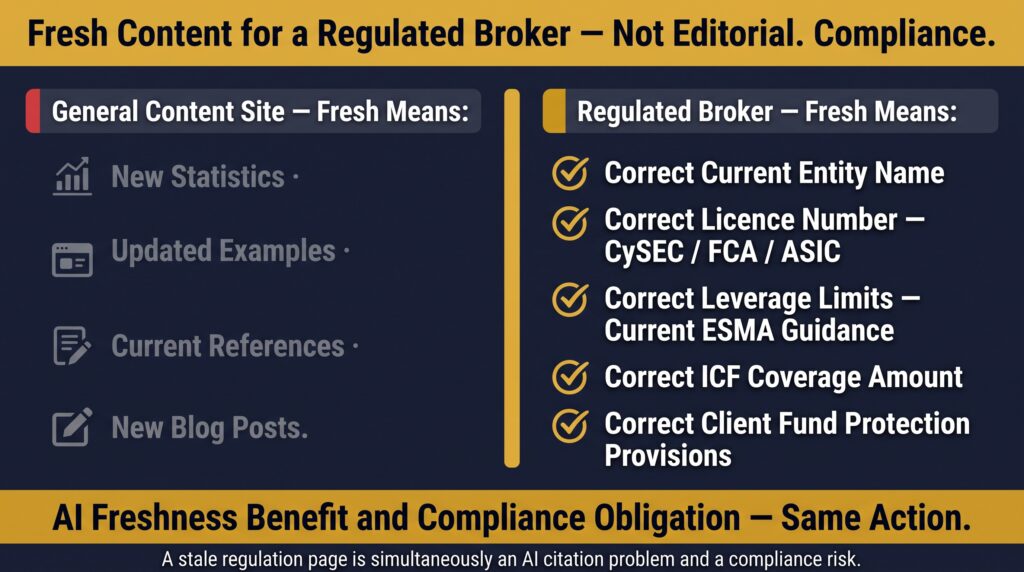
For a general content site, “fresh” means new statistics, updated examples, current references. For a regulated forex broker’s regulation and conditions pages, fresh means something structurally different: the correct current entity name after any rebranding or restructuring, the correct current CySEC or FCA licence number, the correct current leverage limits under current ESMA guidance, the correct current ICF coverage amount, and the correct current client fund protection provisions.
These are not editorial updates — they are compliance updates. And here is the insight that changes how a regulated broker marketing team should frame its freshness programme to compliance: the AI freshness benefit and the compliance obligation are the same action. A regulation page that hasn’t been updated since the broker’s original authorisation is simultaneously stale for AI citation purposes and potentially non-compliant if the broker’s regulatory situation has changed since then. Content freshness is not a separate digital marketing initiative for a regulated broker — it is a byproduct of keeping regulatory disclosures current, which the compliance team already has an obligation to do.
The regulation page that has not been updated since the broker’s original authorisation is not an edge case — it is the default. The compliance team reviewed it at launch, approved the content, and moved on. The marketing team does not update it because it is compliance-owned. The compliance team does not update it unless a regulatory change forces a revision. The result is a page that may be years old, reflecting a regulatory status, entity structure, or protection regime that has since changed — simultaneously stale for AI citation and potentially inaccurate as a current disclosure.
Framing the freshness programme as a compliance workflow improvement — rather than a content marketing initiative — is how marketing teams earn compliance buy-in for the quarterly review cycle. The AI citation benefit is the secondary gain from doing the compliance job correctly. This connection also runs through E-E-A-T signal maintenance: content freshness is a Trustworthiness dimension — an accurate, current regulation page signals to AI engines that the regulatory claims are maintained and verifiable, not frozen at the broker’s authorisation date.
Page Priority Order — Where the Freshness Investment Actually Belongs
Generic content freshness guides recommend updating highest-traffic pages first. For a regulated forex broker, highest-traffic does not equal highest AI citation value. The correct priority order is almost the inverse of how most broker marketing teams currently invest their editorial effort:
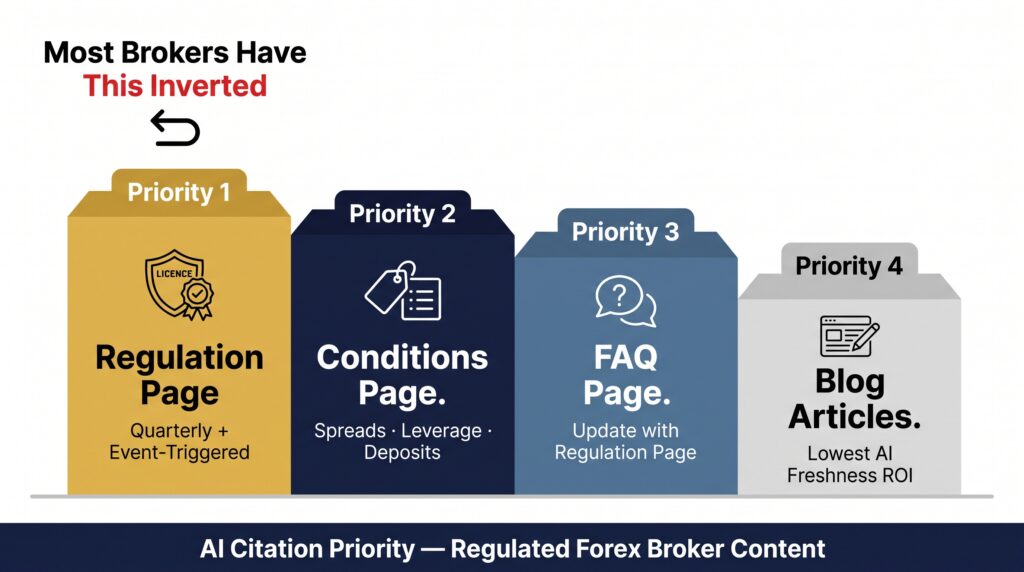
Priority 1 — Regulation page. Highest AI citation value (the branded regulatory queries every prospect asks), highest compliance sensitivity, and typically the least frequently updated page on the site. Quarterly review at minimum: verify entity names, licence numbers, client protection amounts, and regulator register consistency. Event-triggered update — mandatory regardless of the quarterly calendar — whenever: new ESMA or regulator guidance changes leverage limits or disclosure requirements; entity structure changes; rebranding affects entity name presentation; a regulator register discrepancy is identified; any product change affects a disclosed condition.
Priority 2 — Conditions page. Spreads, leverage limits, minimum deposits, account types. These conditions change with product updates and carry high AI citation value for prospect research queries. Stale conditions pages are a consistent source of the “AI says something wrong about the broker” finding documented in AI visibility audit findings.
Priority 3 — FAQ page. The regulatory Q&A section specifically. Should be updated whenever the regulation page is updated. FAQPage schema must be re-validated after any substantive change — a schema declaration that references stale content creates a mismatch between the structured data and the HTML.
Priority 4 — Blog articles. Update for accuracy and relevance, but this is the lowest AI freshness ROI for a regulated broker’s core branded queries. Most brokers have this priority inverted: the blog gets quarterly updates because it drives organic traffic; the regulation page, which drives AI citation quality for branded regulatory queries, is left unchanged for years.
The Real Quarterly Cadence — Building the Compliance Calendar Into the Content Calendar
The Quattr benchmark of quarterly updates producing 3× citation retention sets the target. For a general content publisher, achieving this is a content planning question. For a regulated forex broker, achieving this requires a different workflow — one that accounts for the compliance review gate between “identify what needs updating” and “publish.”
Step 1 — Content review (Days 1–3). Marketing or SEO identifies what needs updating across the regulation page, conditions page, and FAQ regulatory section. Produces a draft of all proposed changes with a clear record of what changed and why: new entity added, ESMA guidance update, conditions change, regulator register correction. The draft should note which schema fields will also need updating alongside the HTML content.
Step 2 — Compliance submission (Days 3–5). Draft submitted to compliance with a brief explaining that the updates are to regulatory claim content that will be schema-marked and AI-cited. Review timeline: 5–7 business days for reformatted existing approved content; 7–14 business days for new regulatory claim statements. Consistent with the compliance workflow in the 90-day roadmap.
Step 3 — Revision and re-review if needed (Days 10–18). If compliance requests language changes, revise and resubmit. Add 3–5 business days for minor revisions. Major revisions may restart the review cycle — factor this into the schedule for time-sensitive regulatory updates.
Step 4 — Publish, update schema, validate (Days 18–22). After compliance clearance: publish the updated content, re-validate FAQPage schema via the Rich Results Test, update the dateModified in Article schema, purge cache, submit to GSC. Run the Perplexity branded query check within 48 hours of publish as the first freshness validation signal.
The Calendar Implication
Total elapsed time for a standard quarterly regulation page update: 2–4 weeks. A broker targeting quarterly AI freshness updates must begin the compliance review process 4–6 weeks before the target publish date. Q3 updates start in early Q2. The compliance calendar is the content calendar — and marketing teams that try to run a “quarterly content refresh” on a content-first timeline consistently miss the cadence because they have not built the compliance lead time into the schedule.
Engine-Specific Freshness Response — Perplexity Is the First Signal, ChatGPT Is the Last
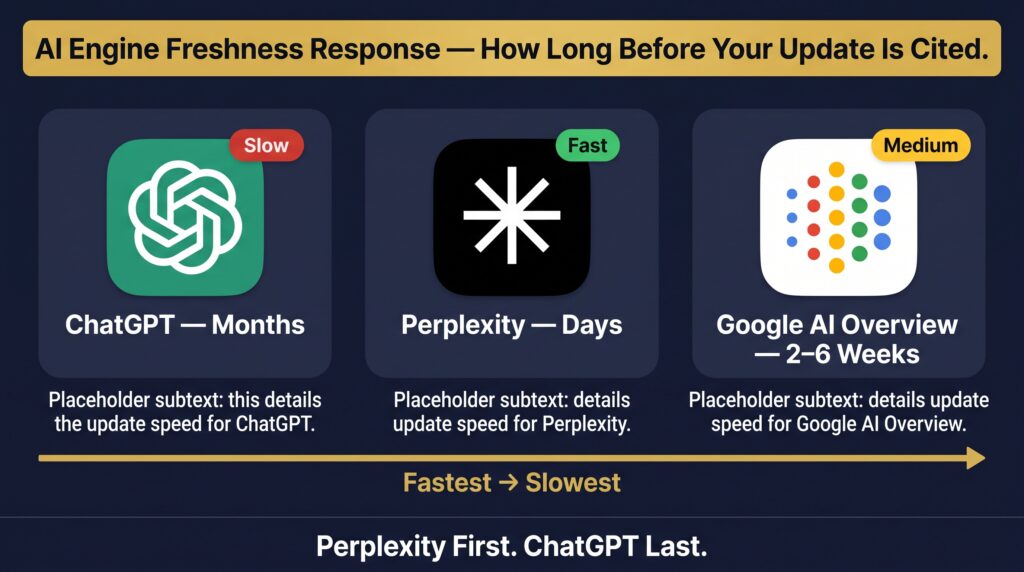
Not all AI engines respond to content freshness updates at the same speed. The difference is structural — it reflects how each engine retrieves and weights content — and understanding it changes how a broker sequences its freshness validation and manages stakeholder expectations.
Perplexity — response time: days. Perplexity uses real-time web retrieval, meaning updated content on the regulation page can appear in Perplexity answers within days of publication. Perplexity is therefore the first validation checkpoint after every regulation or conditions page update: run the branded query check — “is [broker] regulated?”, “[broker] CySEC licence number”, “[broker] minimum deposit” — within one to two weeks of publish. If the Perplexity answer reflects the updated content, the update has been indexed and is being cited. If it still shows outdated information after two weeks, check that the page is accessible to crawlers and not behind a JavaScript gate or authentication wall. The forex broker SEO audit and the AI/GEO visibility audit address these issues from complementary angles — SEO audit checks crawlability; AI audit checks citation accuracy.
Google AI Overview — response time: weeks. Google AI Overview typically updates within 2–6 weeks for pages already ranking in the top-10 organic results. The stronger the page’s organic authority, the faster Google AI Overview picks up freshness updates — which is why the two audits are complementary rather than alternatives. Check Google AI Overview approximately four weeks after each regulation page update as the second validation checkpoint.
ChatGPT — response time: months. ChatGPT’s training cutoffs typically run quarterly to semi-annually, meaning a regulation page updated today may not appear in ChatGPT answers for several months. For ChatGPT-targeted freshness improvement, third-party source accuracy — particularly the regulator’s public register and financial media mentions — produces faster results than direct page-level content updates, because these external sources are more likely to be incorporated into training data cycles.
Perplexity has become the first platform I check after any regulation page update — not because it is the most important platform for a broker’s AI visibility, but because it is the fastest feedback loop. If the updated content appears in a Perplexity answer within two weeks, the page is crawlable, indexed, and being retrieved correctly. If it doesn’t appear, the problem is technical — a crawler block, a JavaScript gate, a redirect issue — and catching it on Perplexity in week two is better than discovering it on Google AI Overview in week six or on ChatGPT never.
Update vs Create — Why Updating Almost Always Wins for a Regulated Broker
Content strategies typically prioritise new article creation. For a regulated broker with compliance sign-off requirements on every piece of regulatory content, the economics of creating versus updating look materially different.
Updating existing approved content requires a shorter compliance re-review — 5–7 business days for reformatted existing content rather than 7–14 days for new regulatory claim statements. The updated page inherits existing URL authority and internal link equity. Existing schema is re-validated rather than rebuilt from zero. AI freshness benefit arrives faster from an established indexed URL than from a new one still building authority. For a page already receiving AI citation traffic, an update compounds existing authority rather than starting from zero.
Creating new regulatory content requires a full compliance review of all new claims (7–14 days minimum), a new URL that must build authority from zero, a new internal linking structure, and new schema implemented from scratch. The compliance overhead is higher, the time-to-AI-citation-impact is longer, and the freshness benefit accumulates later.
The default for a regulated broker’s AI freshness programme: update existing high-value pages first. Create new content only for genuine query gaps — a specific question the broker’s prospects ask that no existing page addresses. For a broker with a complete content cluster covering its core AEO and GEO topic areas, genuine gaps requiring new content are relatively rare. The quarterly freshness cycle defaults to: update the regulation page, update the conditions page, re-validate FAQ schema, and check the regulator register for consistency. That sequence produces more AI citation improvement per hour of compliance team time than publishing new articles with new regulatory claims.
“The AI/GEO visibility audit identifies which of your broker’s pages have freshness gaps that are costing you AI citations — and which ones should be prioritised for the next compliance review cycle.”
FAQ
Q1: How often should a forex broker update its content for AI search freshness?
According to Ahrefs’ 2025 freshness research, 50 percent of AI-cited content was published or updated within the past 13 weeks, and pages updated quarterly are approximately three times more likely to retain AI citations than stale pages according to Quattr’s 2026 analysis. For a regulated forex broker, the recommended minimum cadence is quarterly for the regulation page, conditions page, and FAQ regulatory section, with event-triggered updates whenever regulatory status changes, entity structure changes, ESMA or regulator guidance changes, or trading conditions are updated. However, the practical update timeline for a regulated broker is longer than for a general content publisher because regulatory content updates require compliance review before publication, typically taking five to seven business days for reformatted existing approved content or seven to fourteen business days for new regulatory claim statements. A broker targeting quarterly AI freshness updates should begin the compliance review process four to six weeks before the target publish date to account for the review cycle, meaning Q3 updates should start in early
Q2: Why does content freshness matter more for AI search than for traditional Google rankings?
AI search engines weight content freshness more heavily than traditional Google rankings because AI engines are specifically designed to avoid providing outdated information in generated answers, treating recency as a proxy for accuracy. According to Ahrefs’ 2025 research, AI-cited content is 25.7 percent fresher on average than standard Google organic search results, and according to BrightEdge’s 2025 data, 65 percent of AI bot crawl activity targets content published within the last 12 months. Traditional SEO can maintain strong rankings for years with a robust backlink profile even without frequent content updates. AI citation favours recently updated content because the engine infers that a recently updated page is more likely to reflect current regulatory requirements, market conditions, and product specifications — all of which are particularly important for YMYL financial services content where outdated information could mislead prospects or misrepresent the broker’s current regulatory status. For a regulated forex broker, content freshness is therefore simultaneously an AI visibility requirement and a compliance obligation for keeping regulatory disclosures current.
Q3: What is the actual content update workflow for a regulated forex broker given compliance requirements?
The actual content update workflow for a regulated forex broker is determined by its compliance review calendar rather than its content marketing calendar. A quarterly regulation page update requires four steps: identifying what needs changing and drafting the updates in the first three days; submitting the draft to compliance with five to seven business days for reformatted existing content or seven to fourteen business days for new regulatory claim statements; completing any revision and re-review if compliance requests changes, adding three to five additional business days; and publishing after clearance with schema re-validation, cache purge, and GSC submission. The total elapsed time for a standard quarterly regulation page update is typically two to four weeks, which means a broker targeting quarterly AI freshness updates needs to begin the compliance review process four to six weeks before the intended publish date. The practical implication is that the Q3 freshness update cycle should start in early Q2, not at the start of Q3 — the compliance calendar is the content calendar for regulated broker AI search freshness.
Q4: Which AI engines respond fastest to content freshness updates on a forex broker’s regulation page?
Perplexity responds fastest to content freshness updates because it uses real-time web retrieval rather than training data, meaning updated content on a regulation or conditions page can appear in Perplexity answers within days of publication. Perplexity is therefore the recommended first validation checkpoint after each regulation page update — running the branded query check within one to two weeks of publishing confirms whether the updated content is being indexed and cited. Google AI Overview typically responds within two to six weeks for pages already ranking in the top ten organic results, making organic search ranking a prerequisite for rapid Google AI Overview freshness benefit. ChatGPT is the slowest to reflect regulation page updates because it depends primarily on training data with cutoffs typically running on quarterly to semi-annual cycles, meaning a page updated today may not appear in ChatGPT answers for several months. For ChatGPT-targeted freshness improvement, third-party source accuracy — particularly the regulator’s public register and financial media mentions — produces faster results than direct page-level content updates because these sources are more likely to be incorporated into training data cycles.
90 words. The engine-specific timing answer — the practical sequencing insight absent from all competitors.
Q5: Which pages should a forex broker prioritise for AI content freshness updates?
A regulated forex broker should prioritise content freshness updates in the inverse order of how most brokers currently invest their editorial effort. The regulation page should be first because it carries the highest AI citation value for branded regulatory queries, the highest compliance sensitivity, and typically receives the least frequent editorial attention — often written by the legal team at original authorisation and rarely reviewed systematically since. The conditions page covering spreads, leverage limits, and minimum deposits is second because trading conditions change with product updates and represent high AI citation value for prospect research queries, and stale conditions pages are a consistent source of AI factual errors about the broker. The FAQ page’s regulatory question-and-answer section is third, updated whenever the regulation page is updated with FAQPage schema re-validated after each substantive change. Blog articles have the lowest AI freshness ROI for the core branded queries that matter most for a regulated broker’s AI visibility, despite typically receiving the most frequent editorial updates.
Q6: When should a forex broker create new content rather than update existing pages for AI search freshness?
A regulated forex broker should default to updating existing high-value pages rather than creating new content for AI search freshness because updating existing approved regulatory content requires a shorter compliance review cycle than creating pages with new regulatory claims, existing pages inherit URL authority and internal link equity that new URLs must build from zero, and AI freshness benefits arrive faster from updating an established indexed page than from establishing a new URL. Updating existing content that has been reformatted requires five to seven business days of compliance review, while creating new pages with new regulatory claim statements requires seven to fourteen business days plus the time for the new URL to accumulate sufficient authority to be cited. New content should be created only when there is a genuine query gap that no existing page addresses — a specific question the broker’s prospects ask that the current content does not answer. For a broker with a complete content cluster covering its core AEO and GEO topic areas, genuine query gaps requiring new content are relatively rare, making updates the higher-ROI default for most AI freshness objectives.