
Forex Broker Google Ads Account Structure, from where to start?
When a regulated forex broker’s Google Ads account is structured incorrectly, compliance failures are not exceptions — they are the default outcome of the architecture.
A campaign set that mixes UK retail client audiences (requiring FCA certification and COBS-compliant creative) with EU retail client audiences (requiring CySEC certification and ESMA-compliant creative) cannot be managed in compliance with either regulatory requirement simultaneously. Every campaign management decision made inside a structurally compromised account inherits the compliance conflict. The account structure is not a performance question — it is a compliance prerequisite.
Practitioner Observation
The most common structural failure I encounter when reviewing a regulated forex broker’s Google Ads account is not missing certification — it is certification present for the account but campaigns targeting markets for which that specific certification does not apply, typically because market targeting was expanded after certification without updating the certification scope.
There are two approaches to managing the compliance challenge in forex Google Ads. The first involves attempting to bypass Google’s financial product review system by showing different content to review bots than to actual users. For a regulated broker, this creates three simultaneous risks: Google Terms of Service violation leading to account suspension, potential FCA financial promotion compliance breach in the content shown to actual users, and regulatory willful non-compliance aggravation if discovered in a supervision review. The second approach — the one this article covers — builds compliance into the account architecture from the start, so that certification status, creative approval, and market targeting are managed systematically.
This article covers the seven components of a compliance-safe Google Ads account for a regulated forex broker. The audit checklist for identifying structural failures in an existing account is in the Forex broker paid ads audit checklist. The diagnostic framework that identifies why compliance failures occur is in the forex broker paid ads diagnostic guide.
Table of Contents
The Regulatory Market Segmentation Principle — The Non-Negotiable Starting Point
Regulatory market segmentation is the foundational structural decision. Every other component — certification mapping, naming conventions, ad group architecture, approval workflows — builds on this principle being correct first.
Why separate campaign sets per regulatory market are non-negotiable: FCA COBS 4 applies to UK retail client campaigns. ESMA requirements (implemented by CySEC) apply to EU retail client campaigns. These two regulatory frameworks require different creative compliance standards at every level — different risk warning formats, different leverage restriction messaging, different claim prohibition thresholds. A campaign set serving both UK and EU audiences simultaneously cannot apply both frameworks without creating compliance conflict in at least one market. The only compliant solution is separate campaign sets per regulatory jurisdiction.
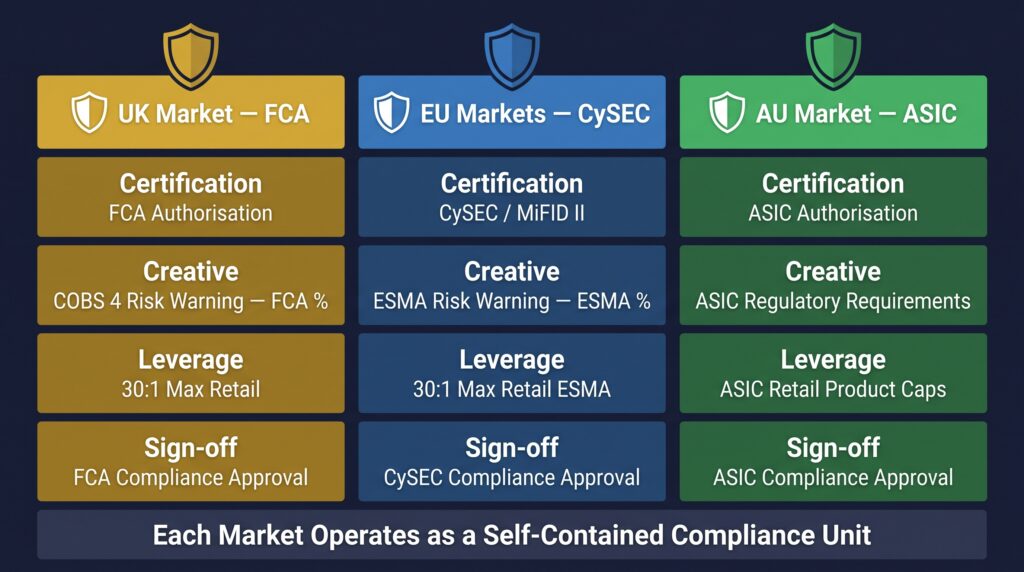
Each regulatory market operates as a self-contained compliance unit. Changing the creative compliance standard in one market does not affect the others. A broker with only CySEC builds one EU column and an unregulated markets column — the structure scales to the licences held.
The single-licence simplification: A broker holding only CySEC builds one EU market campaign structure and, where applicable, a separate structure for markets where they can legally accept clients without specific regulatory authorisation (subject to those markets’ own laws and Google’s general financial product policy). The structure scales directly with the number of licences held — adding FCA adds the UK column, adding ASIC adds the AU column. The regulatory tier determining which licences are available and their commercial implications is covered in the forex broker regulatory tier guide.
Performance Max verdict — add this paragraph (copy and paste ready):
Performance Max campaigns are not compatible with compliance-safe regulatory market segmentation for regulated forex brokers. PMax uses machine learning to allocate budget automatically across Search, Display, YouTube, Gmail, and Discover — removing the granular creative and geographic control that market-specific compliance requires. Specifically: Google’s AI assembles ad creatives dynamically from individual assets, meaning a headline approved for EU audiences may be combined with a description approved for a different market context, creating an unapproved combination that no compliance officer reviewed. Brand safety and placement controls in PMax are materially more limited than in standard campaigns. Performance Max campaigns should not be used as the primary campaign type in a compliance-safe regulated broker account — standard Search, Display, and Video campaigns allow the granular market targeting, creative segmentation, and asset-level compliance sign-off that regulatory frameworks require. If PMax is used at all, every individual asset must be independently compliance-approved on a standalone basis, and the landing page must carry all required disclosures as the primary compliance backstop.
Google Financial Services Verification — EEA expansion effective 23 July 2026. Google has introduced new financial services advertiser verification requirements for 24 EEA markets including Austria, Belgium, Bulgaria, Croatia, Cyprus, Czechia, Denmark, Estonia, Finland, Greece, Hungary, Iceland, Latvia, Liechtenstein, Lithuania, Luxembourg, Malta, Netherlands, Norway, Poland, Romania, Slovakia, Slovenia, and Sweden. Enforcement begins 23 July 2026. The process requires two steps: first, obtain verification through Google’s third-party compliance partner G2; second, apply for financial services verification in-account using the G2 verification code. Agencies managing campaigns on behalf of financial services clients must also complete verification for affected accounts — the requirement applies to the agency account, not just the advertiser. Unverified advertisers will lose the ability to serve financial services ads in affected markets from the enforcement date. Any broker with active EU campaigns must complete this process immediately.
Certification-to-Campaign Mapping — Before the First Campaign Goes Live
Confirm whether Google Ads financial services certification is transferable when a broker restructures its legal entities — for example, when a CySEC entity sets up a separate FCA entity for the UK market. Does the new FCA entity need to apply for certification independently, or does the existing certification carry over? This is a common scenario for dual-licensed brokers and the answer affects the market expansion sequencing advice in this section. Add the confirmed answer to the “market expansion sequencing” paragraph. Source: Google Ads Help Centre or direct inquiry to Google Ads financial services support.
Certification is the access gate. No campaign should run in a regulatory market without confirmed Google Ads financial services certification for that market. The mapping document makes this relationship explicit, auditable, and maintainable.
Building the mapping document: Create a simple reference document — a spreadsheet or shared document accessible to both the marketing team and compliance — with one row per regulatory market. Columns: Market, Regulatory Licence, Certification Status (Confirmed/Pending/Lapsed), Certification Date, Renewal Date, Responsible Owner. Before any campaign is created for a new market, the corresponding row in this document must show “Confirmed” status. If the certification row shows Pending or does not exist, the campaign is not created — regardless of any other business pressure to launch.
The renewal trigger: The mapping document also drives renewal management. When a certification renewal date is within 30 days, a calendar reminder fires for the responsible owner to initiate renewal. The renewal is completed before the existing certification expires — not reactively after lapse. The lapsed certification discovered during a B2 Category 2 audit is almost always the result of a missing renewal trigger rather than deliberate neglect. The document with renewal dates prevents this.
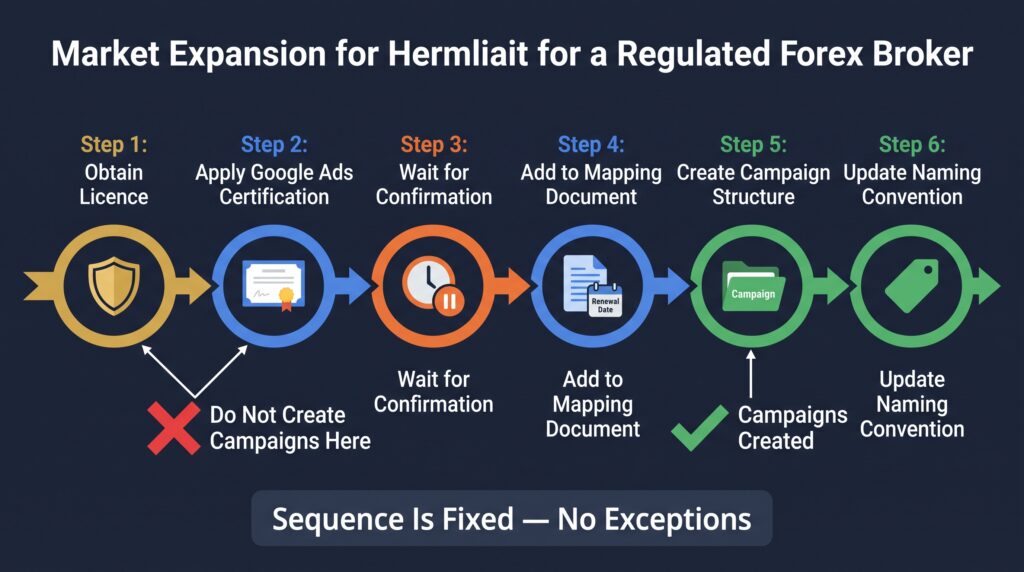
Market expansion sequencing: When a broker obtains a new regulatory licence, the sequence is fixed: (1) obtain the licence; (2) apply for Google Ads certification for the new market; (3) wait for certification confirmation; (4) add the confirmed certification row to the mapping document with renewal date; (5) create campaign structure for the new market; (6) update the campaign naming convention to include the new market code. Campaigns for the new market are not created at step 1 or 2 — only at step 5, after certification is confirmed.
Multi-platform note: The certification-to-campaign mapping applies independently to each advertising platform. Google Ads certification does not confer Meta authorisation. Maintain separate mapping sections per platform in the same master document.
Forex Broker Google Ads Account Structure — Making Compliance Visible in the Account
A compliance-tracking naming convention encodes the information needed to assess compliance context at a glance, without opening any campaign settings or checking any external document.
The recommended structure:
CAMPAIGN NAMING CONVENTION — DECODED
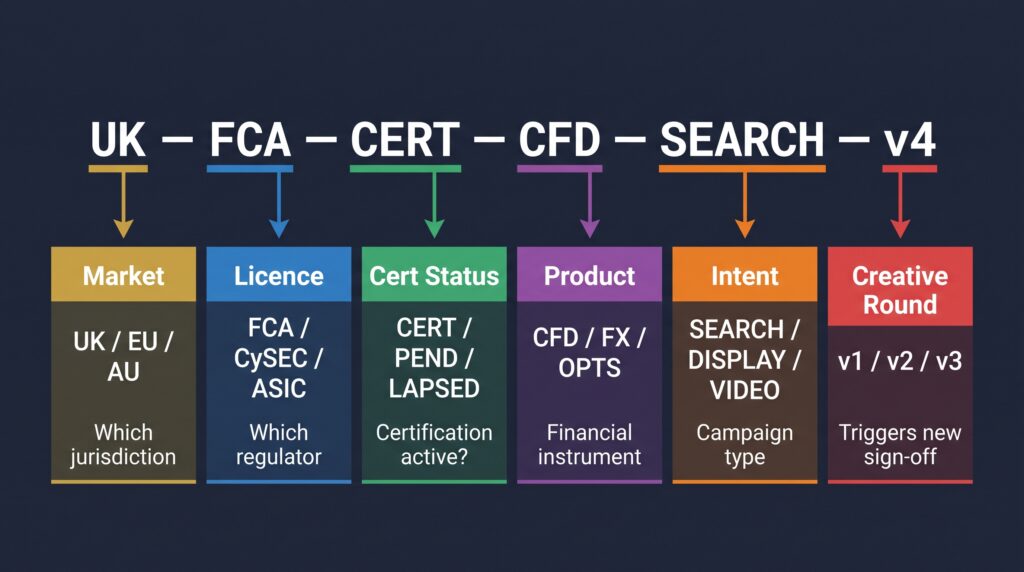
Why each element matters operationally: The Cert Status field is the most practically valuable for ongoing compliance management — a campaign showing LAPSED is immediately visible in the campaign list without opening any settings or checking the mapping document. The Creative Round field ensures that when creative is updated, the version number increments — which triggers a new compliance sign-off requirement rather than allowing a routine update to go live without review. A creative moving from v3 to v4 requires a new approval; the naming convention makes this requirement visible and enforceable.
THE AUDIT SHORTCUT THIS CREATES
The B2 Category 2 certification audit (15 minutes) becomes faster with this convention. Instead of opening each campaign’s settings to check certification applicability, scan the campaign list for any PEND or LAPSED in the third name segment. Any campaign showing a non-CERT status is a priority flag. This turns a settings-check audit into a visual list scan.
Ad Group Architecture Within Each Regulatory Market
Within each regulatory market campaign set, ad groups are structured by intent stage and compliance review intensity — creating a tiered review process that applies the right level of compliance scrutiny to each creative type without overloading the compliance team on lower-risk content.
The four ad group types and their compliance review tier:
| Ad Group Type | Keyword Intent | Compliance Review | Why This Level |
|---|---|---|---|
| Brand | Broker brand name, competitor brand terms | Full sign-off | Highest commercial intent — every impression is a brand promise. Full FCA COBS 4 financial promotion review required. |
| Product | CFD trading, forex spread, account types, execution models | Full sign-off | Direct financial product promotion — mandatory risk warning format, leverage restrictions, and claim prohibitions all apply. |
| Educational | What is forex trading, how CFD works, forex regulation explained | Claims review | Information intent without direct product promotion — lighter review confirms no inadvertent financial promotion invitation in the copy. |
| Remarketing | Previous site visitors, registered non-funded clients | Full sign-off + audience check | COBS applies equally to retargeting creative. Additionally, audience list construction requires GDPR consent compliance review before the audience is used. |
Brand and Product ad groups trigger full compliance team sign-off before any creative goes live. Educational ad groups require a lighter claims review — confirming no inadvertent financial promotion invitation. Remarketing requires full creative compliance plus audience construction review. This tiered framework reduces total compliance workload without creating coverage gaps.
For landing page compliance requirements that correspond to each ad group type — specifically which landing pages require above-fold mobile risk warning visibility — see the forex broker landing page compliance guide.
Negative Keyword Strategy for Compliance Protection
Negative keywords serve two distinct functions in a compliance-safe forex Google Ads account. Standard performance negatives exclude irrelevant queries that waste budget — this is covered in any Google Ads guide. Compliance-protective negatives are unique to regulated financial advertisers and require compliance team input before implementation.
Compliance-protective negatives — four categories applied at account level:
- Leverage terms above retail client caps. Negative: “1000:1 leverage”, “500:1 leverage”, “maximum leverage”, “high leverage trading”. These attract audiences seeking leverage levels that the broker cannot legally provide to retail clients in FCA or CySEC-regulated markets. Serving ads to these queries creates a mismatch between what the audience expects and what the regulated product offers — reducing FTD quality and creating potential misleading impression claims.
- Non-compliance signals. Negative: “unregulated broker”, “no FCA”, “offshore forex broker”, “no regulation required”. Audiences explicitly seeking unregulated alternatives are not the target market for a regulated broker’s campaigns. Appearing on these queries creates brand association with the unregulated market segment — a reputational risk independent of the commercial waste.
- Prohibited claim terms. Negative: “guaranteed profit forex”, “risk-free trading”, “no risk CFD”, “guaranteed returns”. Audiences searching for guaranteed-return products are seeking something the regulated broker cannot provide under FCA or ESMA rules. Serving impressions on these queries may also create an inadvertent association between the broker’s brand and the prohibited claim type.
- US-specific terms (for brokers without CFTC registration). Negative: “US forex broker”, “CFTC regulated trading”, “NFA forex”. For brokers without CFTC registration, these queries attract US persons — exposure to whom constitutes potential US regulatory risk regardless of physical location. Apply these as account-level negatives across all campaign markets.
The compliance-protective negative keyword list above is illustrative. Before implementing account-level negatives, have the compliance team review the list and confirm it covers all prohibited claim categories and exclusion requirements under the broker’s specific regulatory conditions. Some regulatory conditions may require additional exclusions beyond those listed. Update the list quarterly as regulatory guidance evolves.
The Financial Promotions Approval Workflow — Built Into the Account
The compliance approval workflow is not a separate process that runs alongside the account — it is integrated into the account management process as a structural gate. No new ad creative goes live without a compliance sign-off record. This single rule prevents the most common financial promotion compliance failure in agency-managed forex broker accounts.
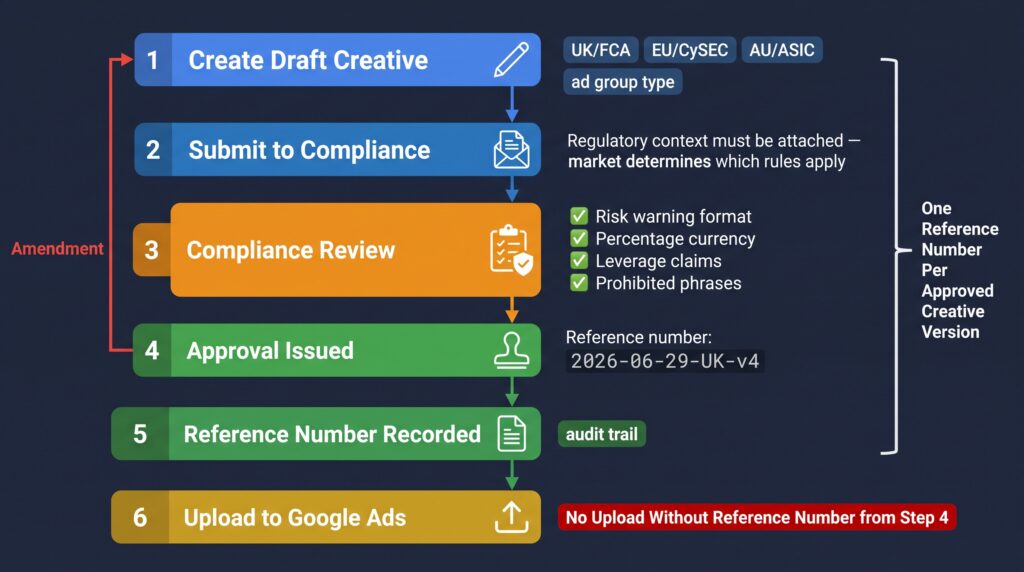
The six-step workflow:
Step 1. Marketing team or agency creates draft creative with regulatory market context noted (UK/FCA, EU/CySEC, AU/ASIC) and ad group type (Brand/Product/Educational/Remarketing).
Step 2. Draft submitted to compliance team via agreed channel (email, shared document, dedicated Slack channel) with the regulatory context attached. The compliance team cannot assess without knowing which market’s regulatory requirements apply.
Step 3. Compliance team reviews against the applicable regulatory requirements — FCA COBS 4 for UK/FCA campaigns, ESMA guidelines for EU/CySEC campaigns. Risk warning format, percentage currency, leverage claims, and prohibited phrases are all checked.
Step 4. Approval issued with a reference number (or specific amendments requested). The reference number format: [Date]-[Market]-[Creative-Round] — e.g., 2026-06-29-UK-v4.
Step 5. Reference number recorded in the campaign management document against the specific creative. This creates the audit trail that B2’s Category 3 sign-off check requires.
Step 6. Creative uploaded to Google Ads. The campaign naming convention’s creative round element is updated to match the approved version (v3 → v4). No upload without the reference number from Step 4.
THE QUESTION TO ASK YOUR AGENCY
Ask to see the compliance sign-off log for the last three creative updates across any active campaign. If no log exists, creative has been going live without compliance review — the most common FCA financial promotion compliance failure in forex broker accounts managed by generalist agencies. The log should show a reference number, date, market context, creative round, and approver for every creative change in the last 12 months.
Quality Score Under Compliance Constraints — and Why the Bypass Approach Fails
Compliance-constrained creative — mandatory risk warnings, measured language replacing promotional claims, absence of guarantee assertions — produces lower click-through rates than unconstrained creative. This is not avoidable for a regulated broker. The compliance requirement is non-negotiable. The Quality Score management strategy focuses on the two components that remain fully optimisable within compliance constraints.
Component 1 — Landing page experience (fully optimisable within compliance). Fast page load speed (Core Web Vitals), above-fold risk warning visibility on mobile (which also satisfies the compliance requirement simultaneously), strong landing page-to-keyword relevance, intuitive registration flow. The landing page experience score rewards exactly the characteristics that a compliance-aware broker should be building anyway. A fast, mobile-optimised, highly relevant landing page with a prominent risk warning achieves both compliance and Quality Score objectives simultaneously — the compliance requirement is additive to the performance objective, not in conflict with it.
Component 2 — Ad relevance (fully optimisable within compliance). Tight thematic alignment between keywords, ad copy, and landing page. Tightly themed ad groups where every keyword, headline, and landing page reflects the same specific intent. This is achievable within compliance constraints — the compliance restriction is on claims (guaranteed returns, excessive leverage), not on relevance architecture. A highly relevant, tightly structured ad group with compliant copy outperforms a loosely structured ad group with non-compliant claims on Ad Relevance score.
Why approaches that bypass Google’s review system fail for regulated brokers specifically. Some services offer to help forex advertisers circumvent Google’s financial product review process — showing different content to review bots than to actual users. For a regulated broker, this creates three simultaneous risks that compound over time:
- Google Terms of Service violation. Account suspension is the standard outcome when cloaking is detected. Google’s detection capability has improved significantly and continues to improve. An account suspension for a regulated broker using a bypass service is not a manageable outcome — rebuilding account history and certification status after suspension can take months.
- FCA financial promotion compliance breach. The landing page content shown to actual users (not the compliant version shown to review bots) may violate FCA COBS 4 financial promotion requirements independently of the Google account status. The financial promotion breach exists regardless of whether Google detects the cloaking — creating regulatory exposure that persists after the Google account issue is resolved.
- Regulatory willful non-compliance aggravation. If an FCA supervision review discovers that the broker was deliberately showing different content to their reviewers than to actual users, this is classified as willful non-compliance rather than inadvertent error. Willful non-compliance carries significantly higher regulatory consequences than equivalent inadvertent breaches — fines, public censure, and trading restrictions are all more likely outcomes.
The architecture B3 describes eliminates all three risks at the cost of slightly lower CTR, which is managed through the landing page experience and ad relevance optimisation described above. The compliance-safe architecture is not harder than the bypass approach — it is a one-time structural investment that does not require ongoing risk management.
If you want your Google Ads account architecture reviewed against both compliance layers — and a structure built that makes compliance systematic rather than reactive — that assessment is part of the diagnostic.
FAQ
Q1: What is the compliance-safe Google Ads account structure for a regulated forex broker?
A compliance-safe Google Ads account structure for a regulated forex broker is built on seven components applied in sequence. The foundational component is regulatory market segmentation: campaigns for each regulatory jurisdiction (UK under FCA, EU under CySEC, Australia under ASIC) are separated into distinct campaign sets, because each regulatory market requires different creative compliance standards and certification status that cannot be applied simultaneously within a single mixed-market campaign set. The second component is certification-to-campaign mapping: a documented record confirming that Google Ads financial services certification is active for each market before any campaign in that market is created or run. The third component is a compliance-encoded campaign naming convention that embeds the regulatory market, licence, certification status, product, campaign type, and creative round directly in the campaign name for immediate compliance visibility. The fourth component is ad group architecture by compliance review intensity: brand and product ad groups require full compliance team sign-off, educational ad groups require a lighter review, and remarketing ad groups require full creative compliance plus audience construction compliance review. The fifth component is compliance-protective negative keywords excluding queries associated with non-compliant products, leverage above retail client caps, and audiences explicitly seeking unregulated alternatives. The sixth component is a financial promotions approval workflow integrated into the account management process, requiring compliance sign-off before any creative is uploaded. The seventh component is Quality Score management under compliance constraints, focusing on landing page experience and ad relevance to compensate for the CTR reduction caused by mandatory risk warning inclusion in compliant creative.
Q2: How should a regulated forex broker segment Google Ads campaigns by regulatory market?
A regulated forex broker should create separate campaign sets for each regulatory market in which they hold an active licence and confirmed Google Ads financial services certification. UK campaigns targeting retail clients run under FCA certification with FCA COBS 4 creative compliance requirements, EU campaigns targeting retail clients run under CySEC or MiFID II certification with ESMA compliance requirements, and Australian campaigns run under ASIC certification with Australian regulatory requirements. These market-specific campaign sets cannot be combined because each regulatory context requires different creative compliance standards: UK-specific FCA risk warning format requirements and EU-specific ESMA requirements cannot both be applied to a single campaign serving both markets without compliance conflict. A broker with a single licence, such as CySEC only, builds one primary regulated market campaign set for EU audiences and a separate unregulated market campaign set for jurisdictions where the broker can legally accept clients without specific regulatory authorisation. Market expansion to a new regulatory market follows a fixed sequence: obtain the regulatory licence, apply for Google Ads certification for the new market, confirm certification before creating any campaigns for that market, and update the certification-to-campaign mapping document.
Q3: What naming convention should forex broker Google Ads campaigns use for compliance tracking?
A compliance-tracking Google Ads campaign naming convention for regulated forex brokers encodes five elements in a standardised format: market, licence, certification status, product, campaign type, and creative round. An example structure is market code followed by licence code, certification status, product type, intent or campaign type, and creative version number. A campaign named with UK market, FCA licence, confirmed certification, CFD product, Search campaign type, and the fourth creative iteration would appear as UK-FCA-CERT-CFD-SEARCH-v4 in the account. The certification status field is the most operationally valuable element: a campaign showing a lapsed or pending certification status is immediately visible in the campaign list without requiring anyone to open campaign settings or check a separate document. The creative round element ensures that when creative is updated, the version number increments, which triggers a new compliance sign-off requirement rather than allowing a minor creative update to go live without compliance review. This naming convention makes the B2 certification status audit significantly faster and prevents the most common creative compliance failure in regulated broker Google Ads accounts.
Q4: How does the financial promotions approval workflow integrate into Google Ads campaign management?
The financial promotions approval workflow for a regulated forex broker’s Google Ads account requires that no new ad creative is uploaded without a compliance sign-off record. The practical workflow sequence is: the marketing team or agency creates a draft creative, the draft is submitted to the compliance team with the regulatory market context and ad group type, the compliance team reviews against the applicable regulatory requirements such as FCA COBS 4 for UK campaigns, an approval reference number is issued and recorded in the campaign management document against the specific creative, and the creative is then uploaded to Google Ads with the creative round in the campaign name updated to reflect the new compliance-approved version. For accounts managed by agencies without direct compliance team access, the agency cannot upload creative without receiving the compliance reference number from the broker’s compliance team. This gate prevents the most common financial promotion compliance failure in agency-managed forex broker accounts: creative being updated or replaced without triggering a new compliance review because the change appeared minor or routine. The campaign naming convention’s creative round element supports this workflow by making each new creative version visible as a distinct entity requiring its own compliance approval.
Q5: What negative keywords should a regulated forex broker use for compliance in Google Ads?
A regulated forex broker should maintain two categories of negative keywords in their Google Ads account: standard performance negatives and compliance-protective negatives. Compliance-protective negatives are the category unique to regulated financial advertisers and should be applied at account level to affect all campaigns. They exclude four types of queries: leverage terms above the retail client cap such as high leverage or maximum leverage amounts that exceed the regulatory limit for the target market, because these attract audiences seeking products the broker cannot legally provide to retail clients; non-compliance signals such as unregulated broker, offshore forex, or no FCA, because audiences explicitly seeking unregulated alternatives are not the target market and association with these queries creates brand positioning risk; prohibited claim terms such as guaranteed profit or risk-free trading, because audiences searching for guaranteed returns are seeking something the regulated broker cannot provide; and US-specific terms for brokers without CFTC registration, because any impression on these terms creates US person exposure. These compliance-protective negatives should be reviewed by the compliance team before implementation and updated when regulatory guidance changes. Standard performance negatives exclude irrelevant queries that waste budget and are managed as in any Google Ads account without regulatory-specific considerations.
Q6: How does a regulated forex broker manage Quality Score under compliance creative constraints?
A regulated forex broker managing Quality Score under compliance creative constraints faces a structural disadvantage on the expected click-through rate component of Quality Score, because compliance-constrained creative including mandatory risk warnings and measured language produces lower click-through rates than unconstrained creative. This disadvantage is not avoidable for a regulated broker because the compliance requirement is non-negotiable. The Quality Score management strategy focuses on the two components that compliance-constrained brokers can fully optimise: landing page experience, which rewards fast, mobile-optimised, and highly relevant landing pages with strong Quality Score contributions that partially offset the CTR disadvantage; and ad relevance, which rewards tight thematic alignment between keywords, ad copy, and landing page content and is achievable within compliance constraints through well-structured ad groups. Approaches that attempt to circumvent Google’s financial product review system by showing different content to review bots than to actual users create three simultaneous risks for a regulated broker that compound over time: Google Terms of Service violation leading to account suspension, potential FCA financial promotion compliance breach in the content shown to actual users, and regulatory willful non-compliance aggravation if discovered in a supervision review. These risks make the bypass approach unsuitable for regulated entities regardless of the Quality Score disadvantage it might temporarily mitigate.