Last reviewed: June 2026 · Author: Hristo Hristov
Forex Broker Paid Ads Audit Checklist what we need to know?
Before a forex broker increases paid advertising budget, one question determines whether that investment is safe to scale: has the programme been audited for both performance quality and compliance risk?
Scaling a non-compliant paid programme scales the compliance risk proportionally. Every additional £10,000 allocated to a campaign with a missing FCA risk warning generates that much more in non-compliant financial promotions. Every budget increase to a campaign targeting a jurisdiction where the broker holds no regulatory authorisation increases the volume of unlicensed retail client solicitation. The compliance audit must precede the budget decision — not follow it.
Practitioner Observation
The most common finding when I complete this checklist for a regulated forex broker is not in creative compliance — it is in certification status. Specifically: a Google Ads certification obtained for one market that was never extended to additional markets as the broker expanded geographically, or a certification that lapsed without anyone in the account noticing. As of June 2026, Google moved certification applications in-account — navigate to Admin → Policy → Account in your Google Ads interface. Certifications are per-market. A UK certification does not cover Australia, UAE, or any other market. Each active market requires its own application.
This checklist covers seven audit categories for a regulated forex broker’s paid acquisition programme. Not all items take the same time: the certification status check (Category 2) takes 15 minutes. The creative compliance audit (Category 3) takes 2–4 hours depending on the number of active creatives. The tracking audit (Category 6) may require a developer. Each category includes specific checklist items — binary, actionable, ordered by remediation priority. The diagnostic framework this checklist implements is in the forex broker paid ads diagnostic guide. STEP 1 Compliance Audit STEP 2 Budget Decision STEP 3 Performance Optimisation STEP 4 Scale
The correct sequence: compliance audit before budget decision, not after. P1 findings block Step 2 entirely until resolved.
The Complete Checklist — All Seven Categories at a Glance
Use this table as your working reference during budget review meetings. P1 items must be resolved before any budget increase. P2 and P3 can be managed in parallel with campaign operations.
| Category | Key Audit Items | Priority | Est. Time |
|---|---|---|---|
| 1 — Account Structure | Campaigns segmented by regulatory market · Documented compliance sign-off workflow · Agency has direct compliance team access · Campaign naming identifies regulatory context · Legacy campaigns reviewed | P2 | 30–60 min |
| 2 — Certification Status | Google Ads cert active for all active markets · Cert matches current regulatory licence · Renewal date not lapsed · Meta financial product approval current · Cert-to-market alignment verified | P1 | 15 min |
| 3 — Creative Compliance | Risk warning present + prominent in all active creative · Percentage is current (not outdated) · No prohibited leverage claims · No retail bonus references · Compliance sign-off documented for each creative | P1 | 2–4 hrs |
| 4 — Targeting & Audience | GEO exclusions match regulatory authorisation · US person exclusion active in all campaigns · Custom audiences built from GDPR-consented data · Lookalike seed audiences are compliant · GEO exclusions applied at campaign level | P1 | 45–90 min |
| 5 — Landing Page Chain | Risk warning visible above fold on mobile for every landing page · Warning prominent and correctly sized · No misleading claims vs ad creative · Registration flow consistent with landing page promise | P2 | 1–2 hrs |
| 6 — Tracking & Attribution | CMP correctly configured for ad consent signals · Consent Mode v2 active for EU traffic · Pixels fire only within consented sessions · Conversion tracking not double-counting · Attribution model reviewed | P2 | 2–4 hrs (dev) |
| 7 — Budget & Bidding | CPA per market benchmarked against regional norms · Smart Bidding operating on clean consented data · Zero budget to uncertified markets · Non-performing campaigns identified for pause · Below-benchmark CPA campaigns investigated | P3 | 1–2 hrs |
P1 = resolve before any budget increase · P2 = resolve within one week · P3 = resolve within one month. Each category is detailed below with specific verification steps.
Table of Contents
Category 1 — Account Structure Audit
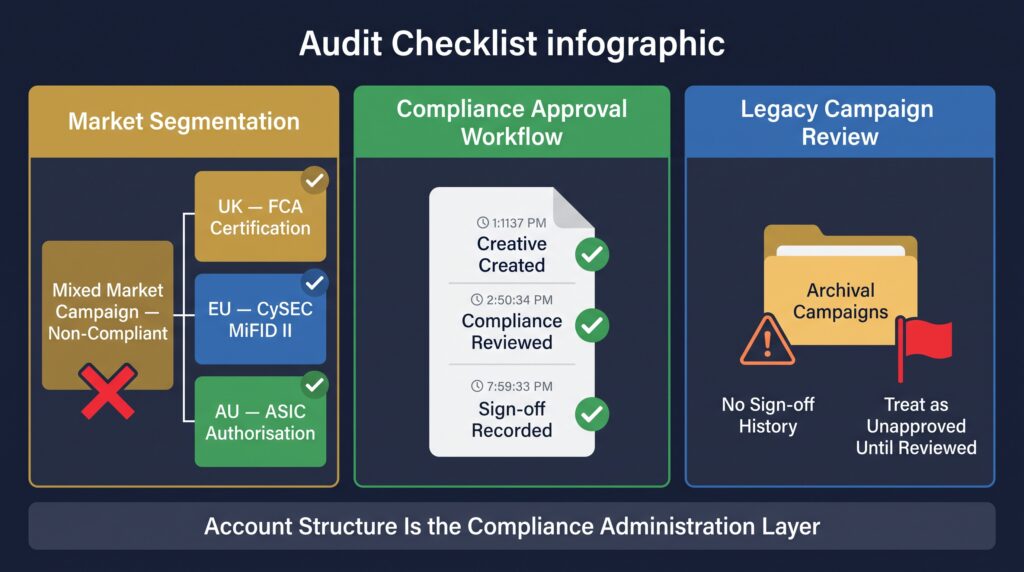
Account structure is the compliance administration layer — how campaigns are organised determines whether compliance checks can be applied consistently across markets. This is a documentation review, not a campaign rebuild.
Are campaigns segmented by funnel stage? Prospecting campaigns targeting cold audiences, retargeting campaigns targeting registered non-depositors, and branded campaigns targeting users searching the broker’s name have fundamentally different objectives, different bid strategies, and different creative requirements. Running all three from a single campaign set means the algorithm cannot optimise correctly for any of them — a prospecting campaign optimised for awareness reach will underperform on branded queries, and a retargeting campaign mixed with cold prospecting dilutes the audience signal that makes retargeting effective. The compliance dimension: retargeting campaigns targeting registered non-depositors require different creative to prospecting campaigns — the audience has already seen the initial financial promotion and is now in a different stage of the decision process. Separate campaign sets per funnel stage is both a performance decision and a compliance-aware creative management decision.
Does a documented compliance approval workflow exist? Every live ad creative should have a documented sign-off record — who reviewed it, when, and against which regulatory requirements. If no record exists for a currently-running creative, that creative has no documented compliance history. This is both a compliance gap and a practical problem: when a regulator asks which creatives were approved and when, undocumented approvals cannot be demonstrated.
Legacy campaign review. Campaigns inherited from a previous agency, or launched before a structured compliance workflow was in place, may have no compliance sign-off history at all. Identify any legacy campaigns, flag them for Category 3 creative review, and treat them as unapproved until the review is complete.
Category 2 — Certification Status Audit (15 Minutes)
🔴 VERIFY GOOGLE ADS NAVIGATION PATH — Before publish
Confirm the current exact navigation path for financial services certification status in Google Ads — the interface updates periodically. The instruction in this section (“Google Ads → Tools → Certification Status”) must match the current Google Ads UI. If the path has changed, update before publishing. A checklist that sends readers to the wrong menu immediately damages credibility.
This is the fastest and highest-priority category — 15 minutes, three checks, immediate action if any fail.
Check 1 — Google Ads certification status. Check 1 — Google Ads certification status. Open Google Ads → Admin → Policy → Account → Certification Status. If the “Apply for certification” button is not visible, the rollout has not yet reached your account — contact Google support directly. Confirm: (a) financial services certification is active for every market where campaigns are currently running — not just markets where campaigns were running when the certification was first obtained; (b) the regulatory authorisation document used for certification matches the entity that is currently advertising — a certification obtained under a previous licence or a related entity may not cover the current advertising entity; (c) the certification renewal date has not lapsed. A lapsed certification is a silent policy breach — campaigns continue serving without any automatic alert to the account team or agency
Check 2 — Meta financial product advertising approval. Meta requires separate account-level approval for financial product advertising in specific markets. Verify this approval is current and covers all markets where Meta campaigns are active. Meta’s process is independent of Google’s certification — each platform requires its own authorisation review.
Check 3 — Certification-to-market alignment. Cross-reference certified markets against active campaign targeting settings. If UK campaigns are running and FCA financial services certification is not confirmed active, the finding is P1 — pause UK campaigns immediately until certification is verified or reinstated. Regulatory authorisation for client-facing advertising must be confirmed before campaigns run.
For the full compliance-safe account structure that organises campaigns by certification status, see the Google Ads account structure guide for forex brokers.
THE QUESTION TO ASK YOUR AGENCY TODAY
“Show me the current Google Ads financial services certification status for each market our campaigns are targeting.” If your agency cannot show this immediately, the certification audit has not been done. This is a 15-minute check — the answer should be available in seconds.
Category 3 — Creative Compliance Audit (2–4 Hours)
The creative compliance audit is the most time-intensive category — pull every active creative across all platforms and check against the dual compliance layer. This extends the creative restriction guidance most compliance checklists provide by applying it to live running creative, not new campaign setup.
The live creative audit process: Export all active ad creative from Google Ads, Meta Ads Manager, and any other active platforms. For each creative, check three elements:
- Risk warning check: Is the FCA-required risk warning present? Is it prominent — not in footnote text, not at a font size that renders it unreadable in the creative format, not obscured by design elements? Is the percentage current — does it reflect the broker’s most recently calculated client loss rate, not the figure from 12–18 months ago when the creative was first approved?
- Copy compliance check: Does any copy reference leverage levels above the retail client cap for the target market? Are there any implied return guarantees or performance statistics that cannot be substantiated? Are there any bonus references that constitute prohibited bonus offers for retail clients under FCA or ESMA rules?
- Compliance sign-off check: Does a documented compliance sign-off exist for this creative? When was it issued? If the sign-off is more than 6 months old, has the creative been re-reviewed since any regulatory guidance updates?
The most common creative compliance failure: An outdated risk warning percentage. Brokers calculate their client loss statistics periodically. Ad creative is often approved once and then runs for 12–18 months without the risk warning percentage being updated to reflect current data. A risk warning showing an outdated percentage is a compliance breach even if the format and prominence are otherwise correct. Verify the required update frequency with your compliance team and schedule creative refreshes on that cadence regardless of other audit findings.
Category 4 — Targeting and Audience Audit
Audience targeting compliance is a regulatory requirement, not just a performance optimisation decision. The targeting audit checks that the programme’s reach is legally appropriate before it is commercially optimised.
Geographic exclusion audit. Download the current geographic targeting and exclusion settings for all active campaigns. Compare against the broker’s current regulatory authorisation map — every jurisdiction where the broker holds no retail client authorisation must be excluded. Two exclusions apply to every regulated forex broker regardless of their specific licences: United States persons must be excluded across all campaigns (CFTC requirements apply globally to US citizens regardless of physical location); and any FATF-designated jurisdictions or markets specifically restricted under the broker’s regulatory conditions must be excluded. For a CySEC-regulated broker without FCA authorisation: UK audiences must be excluded from all retail client-targeted campaigns — post-Brexit, CySEC passporting no longer covers UK retail clients.
Exclusion list currency check. When was the exclusion list last reviewed? Was it configured at campaign launch and never updated since? If the broker has obtained a new regulatory licence since the exclusions were set (adding a new market, removing a previous restriction), the exclusion list must be updated to reflect the current authorisation. The list is a living document, not a one-time setup step.
Custom audience compliance audit. For every custom audience list used in retargeting and lookalike campaigns: what is the data source? Was the data collected with GDPR-compliant advertising consent? Is there documented lawful basis for processing this data for advertising purposes? Purchased data lists used for custom audiences are a common GDPR compliance failure — and a corrupted audience list produces corrupted lookalike audiences, degrading both compliance and performance simultaneously.
Platform-level exclusion application check. Confirm geographic exclusions are applied at the campaign level, not only at the ad set level. Some platforms allow ad set-level GEO settings that can override or conflict with campaign-level exclusions, potentially allowing impression delivery in excluded markets.
Category 5 — Landing Page Compliance Chain Audit
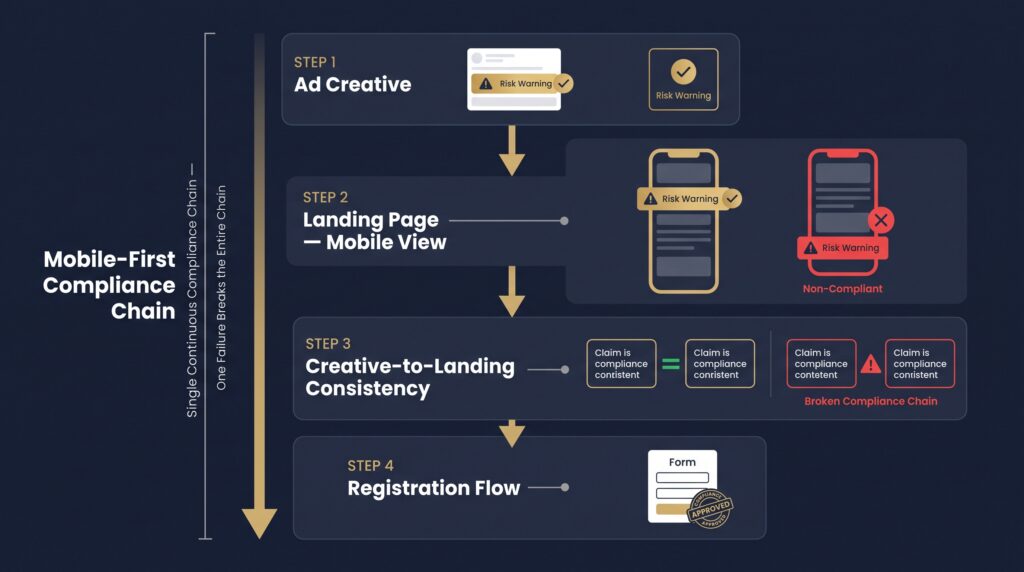
The compliance chain from ad click to registration is a single continuous audit — not three separate checks. A compliant ad linking to a non-compliant landing page creates a broken compliance chain regardless of how the individual elements score in isolation.
Landing page risk warning audit. For each unique landing page currently receiving paid traffic: is the risk warning visible above the fold on mobile without scrolling? Mobile is the primary device for forex broker paid traffic in most markets — a risk warning that requires scrolling to find does not meet the FCA prominence requirement for a web page financial promotion. Is the warning at a readable font size on a mobile screen? Is the percentage current and matching the live ad creative percentage?
Creative-to-landing-page consistency check. Is there any claim on the landing page that is inconsistent with the ad creative that drove the traffic? A landing page making a different leverage claim or return implication than the ad that delivered the click creates a misleading commercial journey — both elements may be individually compliant while the combination is not.
Registration flow review. Does the registration form and confirmation page introduce any new promotional claims, bonus offers, or product representations that the compliance team has not approved as a financial promotion? The registration flow is part of the financial promotion chain — COBS obligations do not end at the landing page.
The mobile rendering check. Open each landing page on a mobile device (or mobile simulation in browser developer tools). This is the single most commonly failed landing page compliance check in forex broker paid programmes — and it takes 10 minutes to complete.
Full landing page compliance requirements — what regulators check, what passes, and what fails — are covered in the forex broker landing page compliance guide.
Category 6 — Tracking and Attribution Audit
This is the technical audit category. Depending on the broker’s internal capabilities, it may require a developer or tracking specialist. It determines both the legal compliance of the tracking implementation and the quality of the data that Smart Bidding uses to optimise spend.
Consent Management Platform (CMP) audit. Is the CMP correctly configured to capture advertising consent signals? Do Google Ads and Meta pixels fire only within sessions where the user has explicitly consented to advertising cookies? Is Google Consent Mode v2 implemented for EU traffic? Consent Mode v2 is required for EU-origin traffic — without it, Smart Bidding for EU campaigns is operating on incomplete conversion data and may be miscalibrating bid targets as a result. Run a consent verification test: accept all cookies, verify Google Ads tag and Meta Pixel fire. Decline advertising cookies, verify they do not fire.
Conversion tracking audit. Are all conversion events — registration, document upload, deposit — firing correctly and not double-counting? Double-counted conversions produce inflated conversion rates that cause Smart Bidding to over-bid on audiences that appear to convert at higher rates than they actually do. Verify conversion events in Google Ads Diagnostics and Meta Events Manager. Any duplicate conversion events should be resolved in Category 6 before budget is increased in Category 7.
Attribution model review. Last-click attribution undercounts the contribution of organic content touchpoints in a multi-touch journey. For a broker with a content cluster (the articles in Cluster A and B covering forex broker marketing strategy), organic research touchpoints precede many paid conversions without receiving credit. Data-driven attribution (available in Google Ads for accounts with sufficient conversion volume) distributes credit more accurately. Confirm whether the account’s conversion volume qualifies for data-driven attribution and whether it has been enabled.
Category 7 — Budget and Bidding Audit
The final audit category before the budget decision. This is where the compliance findings from Categories 1–6 directly inform the commercial decision about where to allocate additional spend.
CPA benchmark comparison. Calculate actual CPA per market and compare against regional benchmarks. Forex broker paid acquisition CPA ranges from approximately $150 to $450+ depending on region, channel, and regulatory tier — the full breakdown is in the forex broker CPA benchmarks guide. A CPA significantly below the regional benchmark signals one of three compliance-adjacent issues identified in the diagnostic framework: non-compliant creative overclaiming, GEO targeting errors acquiring lower-value markets, or problematic placement inventory. Do not increase budget to below-benchmark CPA campaigns before investigating the underlying cause.
Smart Bidding data quality check. Smart Bidding optimises on conversion data. If that data includes non-consented sessions (GDPR issue from Category 6) or double-counted conversions (tracking issue from Category 6), Smart Bidding is optimising on corrupted data — and will continue to do so at higher spend if budget is increased. Resolve all Category 6 tracking issues before increasing any Smart Bidding campaign budget.
Budget allocation by certification status. Zero budget should be allocated to markets where financial product certification has not been obtained (identified in Category 2). Any campaign targeting an uncertified market is removed from the budget increase consideration entirely until certification is confirmed or reinstated.
Zero-based campaign review. Every active campaign should have a documented performance rationale. Any campaign that is active but generating no measurable conversion volume, with no specific awareness or brand objective justifying the spend, should be paused before budget is reallocated. Non-performing campaigns add audit complexity and drain budget that should be redeployed to the campaigns with demonstrated return.
Remediation Priority Framework — What to Fix First
Not all audit findings have the same urgency. This framework determines which findings block the budget decision, which can be managed in parallel with ongoing operations, and which are medium-term improvements.
| Priority | Timeline | Key Actions | Budget Decision |
|---|---|---|---|
| P1 — Immediate | Before any budget increase | Pause campaigns in uncertified markets · Activate US person exclusion where missing · Pause non-compliant creative with missing or non-prominent risk warnings · Document any jurisdiction where impressions served without authorisation and notify compliance team | BLOCKED until P1 resolved |
| P2 — One Week | Within 7 days of audit completion | Fix GDPR consent tracking (Consent Mode v2, pixel consent configuration) · Remove non-consented custom audience lists and rebuild from consented data · Update outdated risk warning percentages in all creative · Re-submit legacy creative for compliance sign-off · Restructure mixed-market campaigns into regulatory-market-specific sets | CAN PROCEED with P2 in parallel |
| P3 — One Month | Within 30 days of audit completion | Allow Smart Bidding to recalibrate on clean data after P2 tracking fixes · Investigate below-benchmark CPA campaigns for root cause · Evaluate data-driven attribution eligibility and enable if qualified · Pause non-performing campaigns and reallocate budget · Review attribution model for multi-touch accuracy | Ongoing optimisation |
P1 findings create direct regulatory exposure that scales with every budget increase. They are non-negotiable preconditions for any budget decision. P2 and P3 findings affect performance quality and medium-term compliance posture — important but not immediate blockers. For what happens when P1 findings are not caught before campaign launch, see the forex broker ad account suspension guide.
If you want the full compliance-aware diagnostic conducted on your programme — both compliance layers, all seven categories, across every platform you use — that is what the diagnostic covers.
FAQ
Q1: What does a forex broker paid ads audit checklist include?
A comprehensive forex broker paid ads audit checklist covers seven categories that must be completed before any budget increase decision. Category 1 is account structure: whether campaigns are segmented by regulatory market and whether documented compliance approval workflows exist for each live creative. Category 2 is certification status: whether Google Ads financial services certification is current, matches the broker’s regulatory licences, and covers every market where campaigns are running, plus whether Meta financial product advertising approval is active. Category 3 is creative compliance: whether every active ad creative includes the current FCA risk warning percentage at the required prominence for the creative format, and whether all copy complies with ESMA leverage restrictions and bonus prohibitions for retail clients. Category 4 is targeting and audience: whether geographic exclusions correctly reflect the broker’s regulatory authorisation, whether US person exclusion is active, and whether custom audience lists are built from GDPR-consented first-party data. Category 5 is the landing page compliance chain: whether the risk warning is prominent above the fold on mobile for every landing page receiving paid traffic. Category 6 is tracking and attribution: whether Consent Mode v2 is implemented, whether pixels fire only within consented sessions, and whether conversion tracking is accurate. Category 7 is budget and bidding: whether CPA per market aligns with regional benchmarks and whether Smart Bidding campaigns are operating on clean consented conversion data.
Q2: Why should a forex broker audit their paid programme before increasing budget?
Scaling a non-compliant paid advertising programme scales the compliance risk proportionally with the budget. A campaign with a missing or non-prominent FCA risk warning in its ad creative generates additional non-compliant financial promotions for every pound of additional budget allocated to it. A campaign targeting a jurisdiction where the broker holds no regulatory authorisation generates additional unlicensed retail client solicitations with every budget increase. The compliance audit must precede the budget decision, not follow it, because the findings of the audit determine whether the programme is in a condition where scaling is legally appropriate. Specifically, Priority 1 audit findings must be resolved before any budget increase: these include certification gaps, US person exclusion failures, and active non-compliant creative with missing risk warnings. A programme that passes the full seven-category compliance audit is in a position to scale performance aggressively without the compliance exposure that would otherwise grow proportionally with spend.
Q3: What is the certification status audit for a forex broker Google Ads account?
The certification status audit for a forex broker Google Ads account has three checks that take approximately 15 minutes to complete. The first check is whether Google Ads financial services certification is active for every market where campaigns are currently running, which requires verifying certification status in the Google Ads account settings against the list of active campaign markets. The second check is whether the regulatory authorisation documentation used for the certification matches the entity currently advertising, because a certification obtained using a previous regulatory licence or a related entity may not cover the current advertising entity. The third check is whether the certification renewal date has not lapsed, as certifications require periodic renewal and lapsed certifications allow campaigns to continue running without automatic disapproval while creating account-level policy risk. Meta’s financial product advertising approval requires a separate verification step, as each platform requires independent authorisation review. Current Google Ads certification requirements and navigation paths should be verified directly in the Google Ads Help Centre as the process has been updated multiple times.
Q4: What should the creative compliance audit for a regulated forex broker cover?
The creative compliance audit for a regulated forex broker requires pulling every active ad creative across all platforms and checking three elements for each. First is the FCA risk warning: whether the warning is present, whether it meets the prominence requirement for the specific creative format, and whether the percentage of retail investor accounts that lose money is current and reflects the broker’s most recently calculated client loss statistics rather than an outdated figure from when the creative was first approved. Second is copy compliance: whether any creative references leverage levels above the retail client cap for the target market, whether any copy contains implied return guarantees or performance statistics that cannot be substantiated, and whether any bonus references constitute prohibited bonus offers for retail clients under FCA or ESMA rules. Third is compliance sign-off documentation: whether each live creative has a documented approval from the compliance team and whether that approval is recent enough to cover any regulatory guidance updates that have occurred since it was issued. The most common creative compliance failure is an outdated risk warning percentage, as the client loss statistics change quarterly and creative often runs for twelve to eighteen months without the percentage being updated.
Q5: What should the targeting compliance audit cover for a regulated forex broker paid campaign?
The targeting compliance audit for a regulated forex broker paid campaign covers three areas. The geographic exclusion audit requires downloading the current targeting and exclusion settings for all active campaigns and comparing them against the broker’s regulatory authorisation map, ensuring every jurisdiction where the broker holds no retail client authorisation is excluded. Regardless of which licences the broker holds, US person exclusion must be active in all campaigns because CFTC requirements apply to US citizens globally. For a CySEC-regulated broker without FCA authorisation, UK audiences must be excluded from all retail client-targeted campaigns. The custom audience compliance audit requires reviewing all audience lists used for retargeting and lookalike campaigns to confirm each list is built from GDPR-consented first-party data, with documented lawful basis for processing the data for advertising purposes. Purchased data lists used in custom audiences are a common GDPR compliance failure that simultaneously degrades audience quality and creates regulatory risk. The interest and keyword targeting review confirms that geographic exclusions are applied at the campaign level and not overridden by ad set-level settings that could allow impression delivery in excluded markets.
Q6: How should audit findings be prioritised for remediation in a forex broker paid programme?
Audit findings in a forex broker paid programme should be prioritised across three tiers based on regulatory exposure severity and the sequencing requirement relative to budget decisions. Priority 1 findings must be resolved before any budget increase and include certification gaps where campaigns are running in markets without Google Ads financial services certification, US person exclusion failures, and active non-compliant creative with missing or non-prominent risk warnings. These findings create direct regulatory exposure that scales proportionally with budget increases and represent the most immediate account and licence risk. Priority 2 findings should be resolved within one week and include GDPR consent tracking failures such as incorrect Consent Mode v2 configuration, custom audience lists using non-consented data, outdated risk warning percentages in live creative, and lapsed compliance sign-offs for active ad creative. Priority 3 findings should be resolved within one month and include Smart Bidding data quality remediation after tracking corrections, CPA benchmark variance investigation for below-benchmark campaigns, attribution model evaluation, and zero-based campaign review to pause non-performing active campaigns. Budget increase decisions can proceed after Priority 1 items are resolved, with Priority 2 and 3 items managed in parallel with ongoing campaign operations.