
This article is about tracking whether AI-powered search engines — Perplexity, ChatGPT, Google AI Overview, Gemini, and Claude — are recommending your regulated forex brokerage to prospective clients. It is not about AI trading algorithms, AI trading signals, or AI-powered trade execution.
Every forex broker marketing team has a version of the same gap. GA4 shows sessions, rankings show positions, paid media dashboards show impressions. None of these shows what happened before the session started. A prospective client who asked Perplexity “best regulated forex brokers for EU clients” and received a generated shortlist that did not include your broker — that exclusion is invisible. No impression was tracked. No click was lost. No position declined. AI Overviews now appear in more than half of Google searches, and 52% of US adults use large language models regularly. The broker that is not in the generated answer is not losing a metric. It is losing prospects who were never counted.
This is the monthly protocol a regulated forex broker marketing team runs to find out where it actually stands across the five major AI engines — and what to do about each outcome. For the strategic context behind why this matters: how AI search is changing trader discovery.
Table of Contents
The Five-Query Manual Tracking Protocol
The consistent pattern across regulated broker marketing teams is that AI engine visibility is measured anecdotally — “I searched and we didn’t appear” — rather than systematically. The protocol below replaces the anecdote with a process.
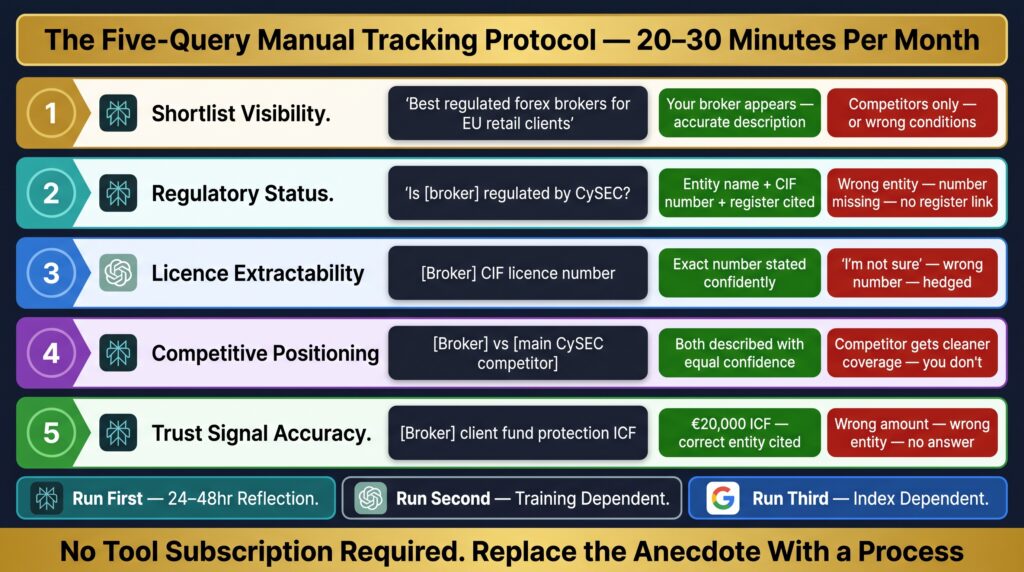
The manual protocol requires no tool subscription and takes 20–30 minutes per month. Run these five queries in Perplexity first — Perplexity uses live web retrieval and reflects recent content changes within 24–48 hours, making it the fastest of the five engines to show you whether a content fix has taken effect. Then run the same queries in ChatGPT and Google AI Overview to check for consistency across the three engines your prospects use most.
Query 1 — Shortlist visibility: Run “Best regulated forex brokers for EU retail clients” in Perplexity. A correct result names your broker in the generated shortlist with an accurate regulated description and a citation to a credible source. An incorrect result returns your broker with wrong conditions, or returns only competitors.
Run this exact query in Perplexity: “Best regulated forex brokers for EU retail clients.” Screenshot the full generated answer — showing which brokers appear, in what order, with what descriptions and source citations. Use a well-known CySEC broker as a demonstration example, or anonymise if needed. Insert the screenshot here. Alt text: “Perplexity-generated shortlist of regulated forex brokers for EU clients — the primary shortlist visibility check.” Caption: “What Perplexity returns for the primary shortlist query. Your broker should appear here with accurate regulated description and a citation to a credible review or comparison source.”
Query 2 — Regulatory status: Run “Is [your broker name] regulated by CySEC?” in Perplexity. A correct result states your full legal entity name, your exact CIF licence number, and cites the CySEC public register directly as the source. An incorrect result omits the licence number, states the wrong entity, or cites only a comparison platform rather than the primary register.
Run this exact query in Perplexity: “Is [well-known CySEC broker name] regulated by CySEC?” — use a known broker as a demonstration or anonymise. Screenshot the full result showing how Perplexity cites (or fails to cite) the CySEC register, whether the CIF licence number is stated, and whether the entity name is correct. Insert here. Alt text: “Perplexity regulatory verification result for a CySEC-regulated forex broker — showing whether the CIF licence is correctly cited.” Caption: “A correct result cites the CySEC register directly with the exact licence number. An incorrect or missing result is a content structure problem — fixable by restructuring the regulation page.”
Query 3 — Licence extractability: Run “[your broker name] CIF licence number” in ChatGPT. A correct result states the exact licence number confidently with no hedging. An incorrect result returns “I’m not sure,” a wrong number, or the correct number buried in a disclaimer paragraph.
Query 4 — Competitive positioning: Run “[your broker name] vs [your primary CySEC competitor]” in Perplexity. A correct result shows both entities described accurately with comparable detail. An incorrect result describes your conditions inaccurately or gives the competitor disproportionately more confident coverage due to cleaner content structure on their side.
Query 5 — Trust-signal accuracy: Run “[your broker name] client fund protection ICF” in Perplexity. A correct result cites €20,000 ICF coverage attributed to your specific CySEC-regulated entity. An incorrect result attributes the wrong amount, the wrong entity, or returns no answer.
Tracking Format
Record results in a simple spreadsheet: Query | Engine | Date | Result (A / B / C) | Notes. Result A = appeared correctly. Result B = did not appear. Result C = appeared with incorrect information. The three-scenario framework below maps each code to a response protocol.
Interpreting What You Find: Three Scenarios and What to Do About Each
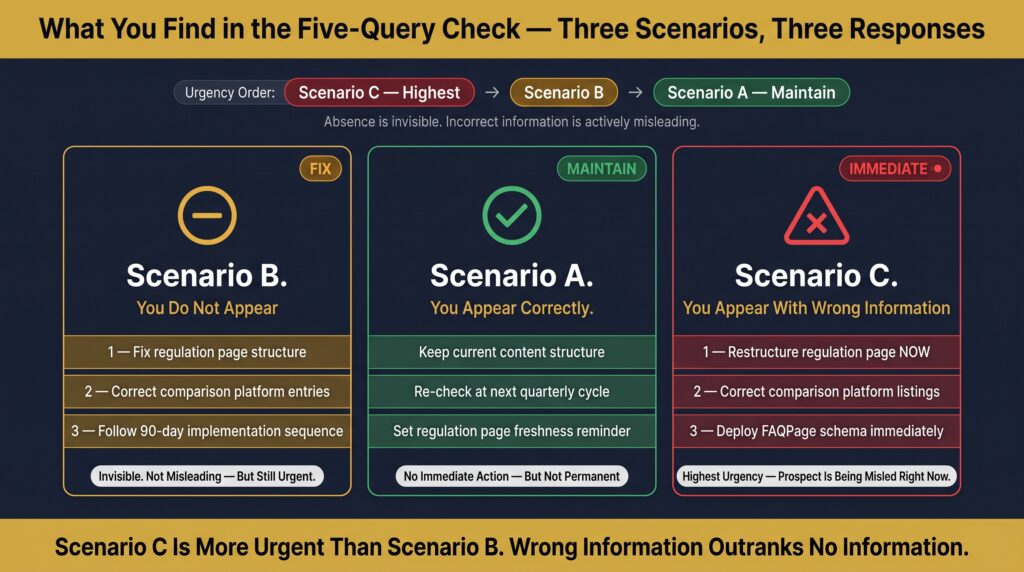
Every query result maps to one of three scenarios. The urgency order is not what it appears: Scenario C — where your broker appears with incorrect regulatory information — is more urgent than Scenario B, where your broker is simply absent. Absence is invisible. Incorrect information is actively misleading a prospect at the exact moment they are verifying your credentials.
Scenario A — You appear correctly. Your broker is named in the shortlist with accurate entity name, correct CIF licence number, and correctly described conditions. Response: maintain the current content structure. Run the full five-query check again at the next quarterly cycle to confirm consistency across all five engines. Set a freshness reminder for the regulation page. No immediate action required — but do not treat this as permanent. Any update to regulated conditions, an entity rebrand, or a new regulated jurisdiction requires a Perplexity re-check within 48 hours to confirm the change propagated.
Scenario B — You do not appear. Your broker is absent from the AI-generated shortlist, or Perplexity returns no confident answer to the regulatory verification query. Response in priority order: first, check the regulation page structure — if the CIF licence number is buried in a 57-word disclosure clause rather than stated in the opening sentence of the first content block, that is almost certainly the cause; the fix is in structuring content for AI citation. Second, check comparison platform entries — ForexBrokers.com, FX Empire, Investopedia — because these are what Perplexity draws on when building the shortlist; inaccurate or incomplete entries upstream produce incomplete AI answers downstream; full analysis at why AI cites comparison sites over broker sites. Third, follow the 90-day implementation sequence from E1.
Scenario C — You appear with incorrect information. Your broker appears in the AI answer, but with a wrong CIF licence number, an outdated entity name, wrong regulated conditions, or incorrect client fund protection details. This is the highest-urgency scenario. Response: restructure the regulation page immediately so the correct entity name and CIF licence number are in the first sentence of the first content block — this is what Perplexity retrieves for the verification query, and the extraction fails when the correct information is buried. Correct any comparison platform listings that may be feeding the inaccurate description into Perplexity’s synthesis. Deploy FAQPage schema with accurate branded regulatory Q&A pairs covering entity, licence number, and fund protection. The full diagnostic for why incorrect AI information appears for regulated brokers — covering all six root causes and their remediation sequence — is in why ChatGPT recommends competitors over your broker.
From Free to Enterprise: Tools for Tracking AI Engine Visibility
The five-query manual protocol is the baseline — free, query-specific, and requiring no tool integration. The decision to invest in specialist AI tracking tools depends on two factors: how many regulated jurisdictions the broker is monitoring simultaneously, and whether the team needs continuous Share of Model data (citation frequency and competitive positioning across all five engines at scale) rather than monthly spot-checks.
The critical evaluation criterion for a regulated forex broker that generic tool reviews do not address: most AI tracking tools monitor whether a brand appears and how often. For a regulated entity, the more important question is whether the broker appears with accurate regulatory information — not just whether it appears at all. The manual protocol is currently the most reliable way to assess this dimension, because it involves reading the full AI response rather than logging a brand mention count. Among the paid tools, Profound.ai’s query-level response tracking comes closest to enabling Scenario A/B/C classification at scale.
| Tool | Tier | Monthly Cost | What It Tracks | Forex-Specific Note |
|---|---|---|---|---|
| Manual 5-query protocol | Free | £0 | Shortlist visibility + regulatory accuracy across five priority queries, manually run across ChatGPT, Perplexity, and Google AI Overview | Highest specificity for regulated broker queries. The only method that reliably detects Scenario C — cited with incorrect regulatory information. 20–30 minutes per month. No tool can replicate the compliance-sensitivity of a manually reviewed regulatory query. |
| HubSpot AI Search Grader | Free | £0 | Basic brand visibility score across ChatGPT and Google AI Overview. Headline benchmark metric. | Good starting benchmark for a broker with no existing AI visibility baseline. Not query-specific for regulated finance — does not distinguish between being cited correctly vs incorrectly for regulatory queries. |
| Otterly AI | Entry | ~$29/mo | Brand mention frequency across ChatGPT, Perplexity, and Gemini. Citation volume tracking over time. | Tracks how often the brand is mentioned — does not separate correct regulatory citations from incorrect ones. Useful for volume trend tracking alongside the manual protocol, not as a replacement for it. |
| Ahrefs Brand Radar / SEMrush AI Toolkit | Mid | ~$99/mo | AI mention tracking integrated with organic ranking data. Combined SEO and AI visibility dashboard. | Most useful for brokers who want to correlate AI citation changes with organic ranking movements in one dashboard. Does not provide query-level regulatory accuracy assessment — pairs with the manual protocol for regulated brand monitoring. |
| Profound.ai | Enterprise | $150–400+/mo | Share of Model tracking across all five engines. Full response content captured at query level, enabling A/B/C scenario classification at scale. | Most granular tool in this category. Captures the full AI-generated response, not just a mention signal — meaning a broker can classify whether each citation is correct, incorrect, or absent without running manual queries. Best fit for brokers monitoring 20+ priority queries across five engines monthly. |
| Rankscale.ai | Enterprise | $150–400+/mo | Share of AI recommendations and competitive positioning across all five engines. Strong competitive Share of Model comparison. | Best used alongside Profound for full coverage — Rankscale for competitive Share of Model benchmarking, Profound for response content depth. At enterprise spend level, running both produces the most complete AI visibility picture available. |
Prices correct as of July 2026 — verify current pricing before acting. This table is flagged for quarterly review — tool pricing and feature sets in the AI visibility monitoring category change frequently.
The upgrade trigger for moving from manual to a paid tool: when the monthly manual check consistently finds Scenario B or C across more than two queries, or when the broker is tracking more than three regulated jurisdictions simultaneously. At that point, the manual protocol’s 20–30 minutes per month becomes inadequate for the monitoring volume, and Profound.ai or Rankscale.ai become the right-tier tools — both price at $150–400+/month, equivalent to Ahrefs/SEMrush, which is the correct signal about how seriously to take AI visibility as a marketing investment.
The Regulated Broker Tracking Calendar
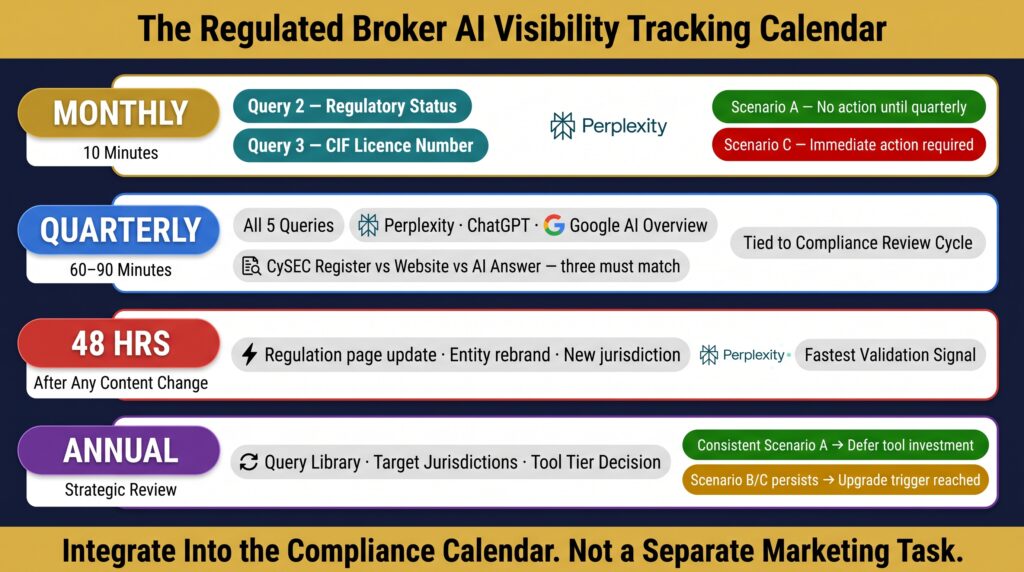
AI visibility tracking is maintained most reliably when it is integrated into existing compliance review cycles — not added as a separate marketing task that competes with quarterly planning calendars for time. A regulated broker already has a compliance calendar covering regulatory disclosure reviews, entity structure updates, and content accuracy checks. The tracking protocol belongs in that calendar, not in a separate marketing automation stack.
Monthly (10 minutes): Run Query 2 (regulatory status) and Query 3 (CIF licence number) in Perplexity only. These are the two highest-stakes queries — an incorrect result here is Scenario C, and Scenario C requires immediate action. If both return Scenario A, no further action until the quarterly check. Record the date and result code.
Quarterly (60–90 minutes, tied to compliance review): Run all five queries across Perplexity, ChatGPT, and Google AI Overview. Run the register cross-reference check — query Perplexity for “[your broker name] CIF licence” and compare the entity name cited against the current CySEC register entry and the broker’s current website presentation. If any mismatch is found, it is both a compliance submission task (register update) and a regulation page restructure task (website). Update the tracking spreadsheet and feed findings into the compliance review agenda for the same cycle.
Within 48 hours of any content change: Any update to the regulation page, any entity rebrand, any new regulated jurisdiction — re-query Perplexity for Query 2 and Query 3 and confirm the updated information is being cited correctly. Perplexity reflects content changes within 24–48 hours; Google AI Overview reflects them within two to six weeks. Perplexity is the right validation tool for confirming a regulation page fix has taken effect. The standing operational process for embedding this into the content update workflow is the content freshness programme.
Annual: Update the five-query library to reflect any changes in the broker’s primary target jurisdictions, primary competitors, or regulated entity structure. Review tool tier against the broker’s current AI visibility maturity — if the quarterly check has consistently returned Scenario A across all five queries for two consecutive quarters, the manual protocol is working and tool investment can be deferred. If Scenario B or C persists, the upgrade trigger has been reached.
The five-query protocol above tells you where the broker stands today. The AI/GEO visibility audit is the structured version — covering all five engines simultaneously with a full findings report, a Scenario A/B/C classification for every query, and a prioritised fix plan for every gap found.
FAQ
Q1: How do I check if Perplexity or ChatGPT is recommending my forex brokerage?
Run five queries in Perplexity monthly: the primary shortlist query for your target jurisdiction (“best regulated forex brokers for EU retail clients”), a regulatory status verification query (“is [your broker] regulated by CySEC?”), a CIF licence number query, a head-to-head comparison query against your primary CySEC competitor, and a client fund protection query. These five cover the five dimensions of AI visibility that matter for a regulated broker. Record the results for each query — whether your broker appeared correctly, appeared with incorrect information, or did not appear — and use those findings to identify which content structure improvements to prioritise.
Q2: What does it mean if an AI engine recommends my competitor instead of my forex brokerage?
It means your competitor’s regulatory content is more extractable than yours in the context of that specific query. AI engines recommend brokers they can describe confidently with verifiable regulatory information. If your competitor appears in an AI-generated shortlist and you do not, the most likely causes are: your CIF licence number is buried in formal legal disclosure language rather than stated in the first content block of your regulation page; your comparison platform listings are less complete or less accurate than your competitor’s; or your Organisation schema does not declare your entity structure clearly enough for AI retrieval to confirm your credentials without ambiguity.
Q3: What is the difference between appearing correctly and appearing incorrectly in an AI engine result?
Appearing correctly means an AI engine names your brokerage in a response with accurate regulatory information — the right entity name, the right CIF licence number, the right regulated conditions. Appearing incorrectly means the AI names your brokerage but states wrong information — an outdated licence number, the wrong regulated entity for the market being asked about, or conditions you no longer offer. The second scenario is more urgent than the first because a prospective client checking credentials in Perplexity receives incorrect compliance-sensitive information, which creates a trust and potentially a regulatory disclosure gap that appearing nowhere would not create.
Q4: What tools can a regulated forex broker use to track AI search visibility?
The starting point is the free five-query manual protocol — running specific branded regulatory queries in Perplexity and ChatGPT and recording the results monthly. HubSpot AI Search Grader provides a free basic brand visibility score. Paid options include Otterly AI at around $29 per month for brand mention monitoring, Ahrefs Brand Radar or Semrush AI Toolkit at around $99 per month for integrated SEO and AI tracking, and enterprise platforms like Profound.ai and Rankscale.ai at $150 to $400 or more per month for Share of Model tracking at query-specific granularity across all five major AI engines.
Q5: How often should a regulated forex broker check its AI engine visibility?
Monthly for the two highest-stakes queries — regulatory status and CIF licence number in Perplexity — which takes around ten minutes and immediately surfaces any incorrect information being cited about the broker’s regulated credentials. Quarterly for the full five-query protocol across all five AI engines, tied to the existing compliance review cycle. Within 48 hours of any update to the regulation page, entity name, or regulated structure, run Perplexity-specific checks to confirm the change has propagated — Perplexity reflects content changes within 24 to 48 hours, making it the fastest available feedback loop for regulated content updates.
Q6: What should a regulated forex broker do if an AI engine states incorrect regulatory information about it?
Treat it as a content structure problem, not a compliance violation — the broker did not produce the incorrect statement, but it does have the ability to correct it by making the accurate information more extractable. The immediate actions in priority order: restructure the regulation page so the correct entity name and CIF licence number appear in the first sentence of the first content block rather than buried in formal disclosure language; correct any comparison platform listings that may be feeding the inaccurate description into AI retrieval; deploy FAQPage schema with accurate branded regulatory question-and-answer pairs covering entity, licence number, and client fund protection.