
Why Forex Broker Ad Accounts Get Suspended…and what to do first?
A rejected ad and a suspended account are not the same problem, and most forex marketing content treats them as if they were.
Ad rejection is a single piece of creative being disapproved — fixable by editing and resubmitting, with no lasting account impact if isolated. Account suspension is the platform pausing or terminating the entire advertising account, typically following a pattern of repeated violations, a severe single violation, or trust and verification failures. The escalation path matters: most suspensions follow ignored or repeated rejections rather than occurring from a single ad — meaning the rejection pattern itself is usually the early warning sign that gets missed.
The mistake brokers make after a Google Ads account suspension is appealing immediately with the same landing page that triggered the suspension — the appeal fails, the account stays suspended, and now there’s a review flag on top of the original violation.
This guide covers suspension triggers across the full platform landscape a forex broker is likely to use — Google, Meta, Taboola, Outbrain, LinkedIn, and programmatic buying generally — plus a specific warning about the verified-account black market, and closes with a practical prevention and response framework.
Table of Contents
Rejection vs Suspension — Why the Distinction Matters for Prevention
A single rejected ad is rarely the actual problem — it is feedback. The actual risk is what happens when rejections are repeated, ignored, or worked around (resubmitting near-identical disapproved content, attempting to circumvent the specific reason for rejection rather than addressing it) rather than treated as a signal to review the underlying creative or account practice.
Platforms generally escalate enforcement in stages: an isolated rejection, a pattern of rejections across multiple ads, a formal warning, and finally suspension — though the exact thresholds and timelines are not publicly documented by any platform and vary by advertiser history and violation severity. Understanding this escalation pattern reframes rejection as the actionable early-warning system it actually is, rather than a routine annoyance to route around.
The practical implication: every rejection should trigger a root-cause review (what specifically violated policy, and could the same issue exist in other active or planned creative), not just a resubmission of a corrected version of that one ad.
Why Forex Broker Ad Accounts Get Suspended -Google Ads — Suspension Triggers Beyond Standard Rejection
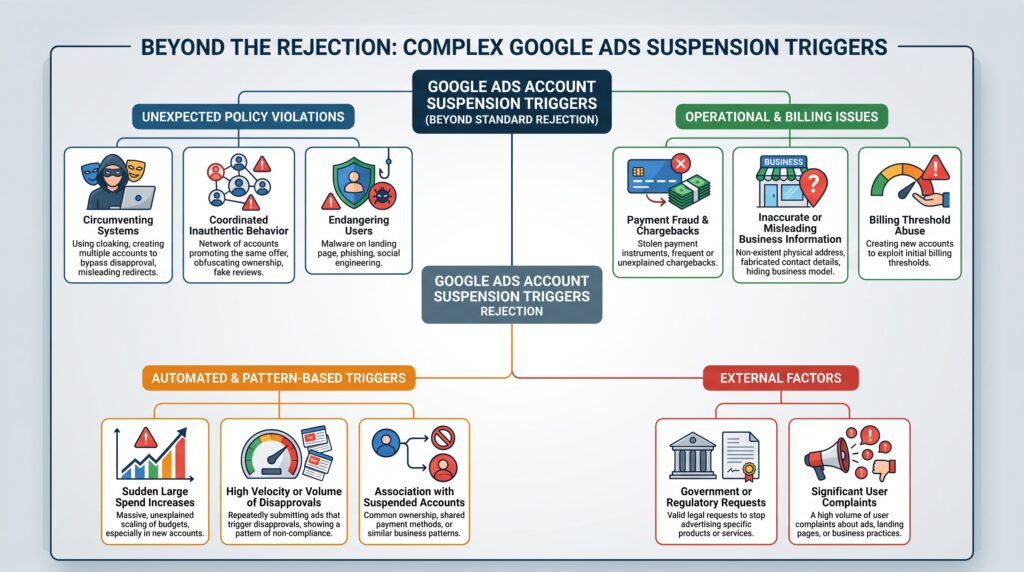
Beyond standard creative policy violations, Google Ads account-level suspension for financial services advertisers commonly traces back to three patterns:
Certification lapsing while campaigns remain active — per the renewal discipline established in the certification guide and the mapping document in the account structure guide, an expired certification with campaigns still running is a structural compliance gap that platforms are increasingly equipped to detect.
Policy circumvention patterns — resubmitting near-identical creative after a rejection without addressing the underlying issue, or using cloaking techniques to show different content to reviewers than to actual users. These patterns are specifically what review systems are designed to catch, and detection typically triggers more severe enforcement than a standard first-time rejection.
Payment and billing inconsistencies — a billing entity that doesn’t match the certified regulatory entity, or payment method changes that trigger broader account integrity review. This connects directly to the entity-matching discipline established in the certification application guide’s document checklist.
Meta — Suspension Triggers Beyond Standard Rejection
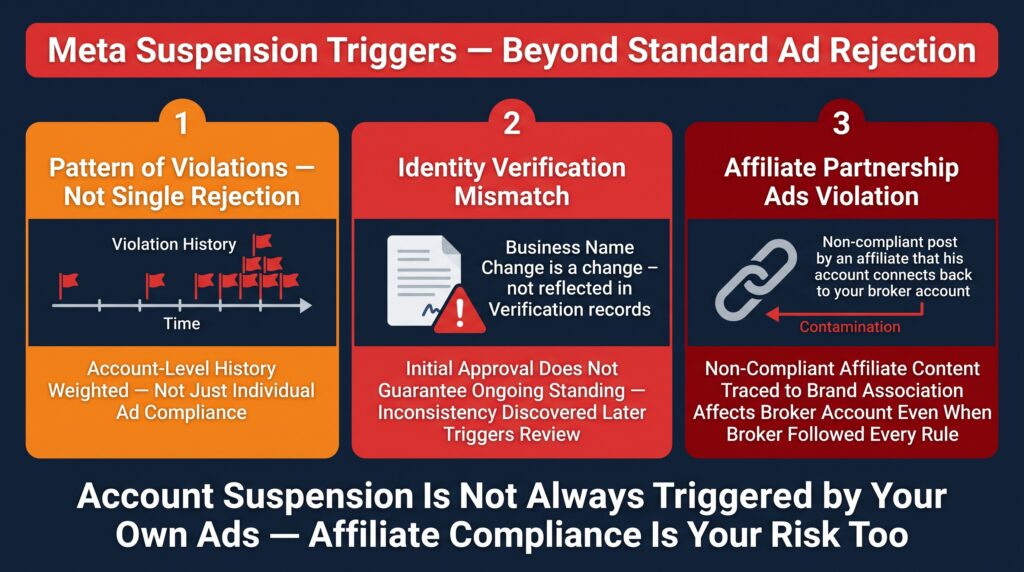
Meta account-level suspension for financial advertisers commonly follows three patterns distinct from isolated ad rejection:
A documented pattern of policy violations across multiple ads over time, rather than a single isolated disapproval — Meta’s enforcement systems weight account-level violation history, not just individual ad compliance.
Identity verification failures or mismatches discovered after initial approval — connecting directly to the identity verification requirement established in the Meta policy changes guide. A broker whose verification documentation was accepted initially but later found inconsistent (a business name change not reflected in verification records, for example) faces review that can escalate to suspension.
Partnership Ads format violations for affiliate-run content discovered during platform review — also covered in the Meta policy changes guide. If an affiliate’s non-compliant Partnership Ads usage is traced back to brand association with the broker, this can affect the broker’s own account standing even when the broker’s direct accounts followed every rule correctly — a risk extending the affiliate compliance responsibility established in the affiliate vs direct guide.
Outbrain — The Managed-Account-Only Model
Outbrain’s advertiser guidelines state explicitly that CFDs and forex can be promoted only through managed accounts, upon verification by Outbrain’s own team — a fundamentally different access model from Google or Meta’s self-serve certification application process. This means a forex broker cannot simply create an account and self-certify on Outbrain; the relationship requires direct engagement with an Outbrain account manager from the outset, with verification happening through that managed relationship rather than an automated application flow.
Why this changes the suspension risk profile: Without an established, properly verified managed-account relationship, a forex broker attempting to run native advertising through Outbrain via an improper channel — an unauthorised sub-account, an agency relationship not properly disclosed to Outbrain, or attempting to use a self-serve account for content requiring managed status — risks immediate termination rather than the standard rejection-and-resubmit cycle familiar from self-serve platforms.
The practical action: Before running any forex or CFD content on Outbrain, confirm the account is properly established as a managed account through Outbrain’s verification process, not assumed to operate under the same self-serve rules as Google or Meta.
Taboola — The Minimum Budget and Vetting Threshold
Taboola requires a minimum campaign budget — reported at approximately $2,000 — and operates its own agency account vetting process requiring an established advertiser track record. For a forex broker considering native advertising, this means Taboola is not a low-commitment test channel in the way a small Google Ads or Meta test budget might be. For current minimum spend figures, verify directly at Taboola’s advertiser policies.
The practical implication for budget planning: The minimum spend and vetting requirement should inform planning before attempting to onboard, connecting to the budget allocation framework in the CPA benchmarks guide — a broker should confirm the budget commitment and vetting timeline align with their broader paid acquisition plan before initiating Taboola onboarding, rather than treating it as an impulse channel addition.
LinkedIn — The April 2026 Disclosure Requirements
LinkedIn introduced new sponsored content disclosure requirements effective April 2026. Sponsored InMail messages now require explicit paid-content disclosure in the first line of the message, accompanied by a visible “Sponsored Messenger” badge on the sender’s profile. Recipients now have a one-click opt-out option specific to that advertiser, and opt-out rates are factored into campaign quality scores that affect delivery cost going forward. For current requirements, verify directly at LinkedIn’s current advertising policies.
Why this matters for forex brokers: A broker using LinkedIn for B2B-adjacent outreach — targeting potential IB or institutional partner relationships, for example — needs active sponsored content campaigns reviewed against these disclosure requirements. Campaigns that did not meet the new standards following the grace period that ended April 30, 2026 are subject to automatic pausing — a suspension-adjacent enforcement mechanism distinct from Google or Meta’s review processes, triggered by a quality and disclosure threshold rather than a single content policy violation.
The practical action: Audit any active LinkedIn sponsored content and InMail campaigns against the current disclosure requirements, and verify the sender’s “Sponsored Messenger” badge displays correctly before relying on LinkedIn for ongoing outreach.
*Note: The April 2026 LinkedIn update also requires that any sponsored content containing statistics, benchmarks, or performance claims must include verifiable source links within the creative. Forex broker campaigns referencing execution speeds, spread figures, or trading statistics on LinkedIn require source documentation added to the ad unit itself — not just available on the landing page
Programmatic and DSP Buying — General Considerations
Programmatic buying through a demand-side platform (DSP) introduces a different suspension risk profile than direct platform relationships, because the DSP itself, the underlying ad exchanges, and individual publisher sites may each apply separate content policies. A creative compliant with the DSP’s own policy can still be rejected or flagged at the exchange or publisher level, and a pattern of such rejections can affect the broker’s standing with the DSP relationship itself.
The practical implication: A broker using programmatic buying should confirm the specific DSP’s financial services advertising policy directly with their account representative rather than assuming it mirrors Google or Meta’s framework, since DSP policies vary considerably and are generally less standardised or publicly documented than the major self-serve platforms.
The Verified Account Black Market — A Risk to Actively Avoid
An active market exists for “verified” or pre-vetted advertising accounts — documented specifically for Taboola, with the underlying pattern plausibly extending to other platforms with similar vetting barriers. These accounts are marketed to advertisers seeking to bypass standard onboarding timelines and vetting requirements, particularly attractive given Taboola’s minimum spend and track-record vetting covered above.
WHY THIS IS A SEVERE RISK, NOT A SHORTCUT
Purchasing or using a transferred advertising account violates every major platform’s terms of service. Platforms can and frequently do suspend accounts identified as transferred or sold, often without warning and with limited recourse for the new “owner,” who has no legitimate standing to appeal on the original account holder’s behalf.
The compounded risk for a regulated forex broker specifically: Operating advertising through an account with falsified or undisclosed ownership history is both a platform policy violation and a potential compliance and reputational issue. The broker’s name and regulatory status would be associated with an account obtained through a method directly inconsistent with the verification integrity that the broker’s own certification process — covered in the Meta policy changes guide and certification application guide — is designed to satisfy honestly. A broker that has invested in proper identity verification and certification on its legitimate accounts undermines that entire compliance investment by using a black-market account on any platform.
FOR CEOS — THE ONE QUESTION TO ASK
Ask directly whether every active advertising account was established through the platform’s own official onboarding and verification process, with no exceptions. If any account was acquired through a third party offering “pre-verified” or “agency” access at a price, that account represents undisclosed risk regardless of how well it has performed so far.
Cross-Platform Account History as a Trust Signal
Most ad platforms weight account age, spend history, and violation history when assessing new campaign risk — a newer or previously-flagged account faces stricter scrutiny than an established, clean-history account running similar creative. This means the same compliant ad creative may be approved smoothly on an established account and trigger additional review or rejection on a newer or previously-flagged one.
The practical implication: A broker’s paid acquisition strategy should account for this by building account history deliberately — starting conservatively on any new platform or new account, maintaining clean compliance discipline from the very first campaigns, and avoiding the temptation to test boundary-pushing creative on a newer account where the platform’s trust threshold is lowest and the consequences of an early violation are most severe relative to the account’s limited track record.
The Affiliate-Caused Suspension Risk
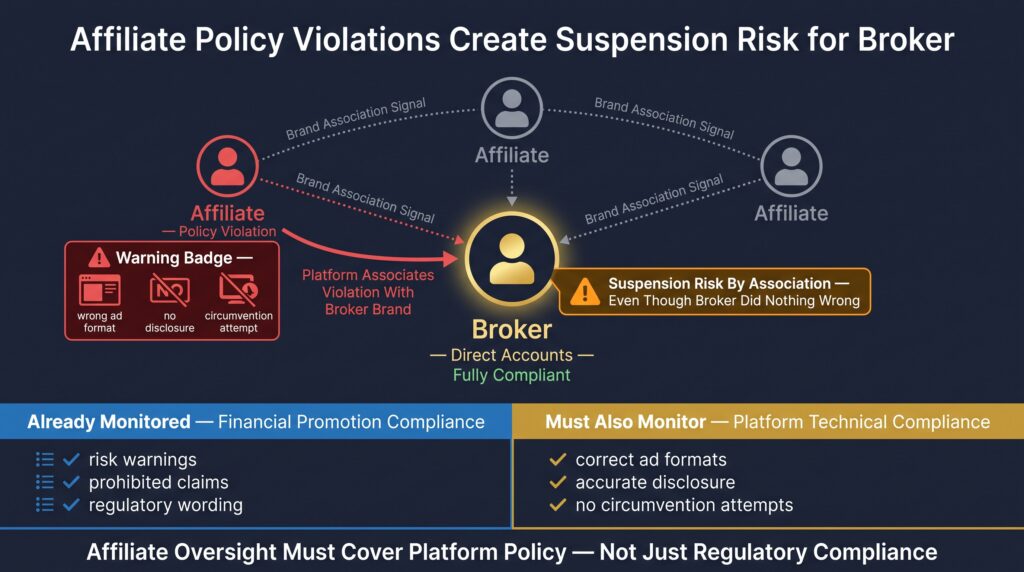
Per the compliance responsibility asymmetry established in the affiliate vs direct acquisition guide, a broker’s affiliates and IBs running content that violates platform policy can create suspension risk that traces back to the broker’s own brand and accounts, even when the broker’s own direct advertising accounts are not themselves the source of the violation. Platforms increasingly use brand and entity association signals when assessing policy compliance across an advertiser’s broader ecosystem, not just the specific account under review.
The practical action: A broker’s affiliate oversight process should explicitly include monitoring for platform policy violations in affiliate-run content — not only regulatory financial promotion compliance, which the affiliate guide already establishes as the broker’s responsibility, but also platform-specific technical compliance (correct ad formats, accurate disclosure, no policy circumvention attempts) that could create suspension risk by association if left unmonitored.
A Practical Prevention and Response Framework
Prevention:
- Maintain current certification status across every platform — the renewal discipline established in the account structure guide and certification guide.
- Keep identity verification documentation current, especially after any business or entity change — per the Meta policy changes guide.
- Build account history conservatively on each new platform rather than testing aggressive creative early.
- Never use purchased or transferred accounts under any circumstances.
- Monitor affiliate-run content for platform policy compliance specifically, not just regulatory compliance — per the affiliate vs direct guide.
Response, if suspension does occur:
- Document the circumstances thoroughly — what creative or activity preceded the suspension, what communication the platform provided.
- Engage the platform’s formal appeal process directly rather than attempting workarounds.
- Do not create a new account to circumvent a suspension — this typically results in immediate re-suspension once detected, and can permanently damage standing with that platform.
A well-documented formal appeal addressing the specific cited violation has a meaningfully better outcome than an attempted workaround.
If you want your full advertising account portfolio — across every platform you use — audited for suspension risk before it becomes a problem, that audit is part of the diagnostic.
FAQ
Q1: What is the difference between a rejected forex ad and a suspended ad account?
A rejected ad is a single piece of creative being disapproved by a platform, which is fixable by editing the content to address the specific policy violation and resubmitting it, with no lasting impact on the broader advertising account if the rejection is isolated. Account suspension is a more severe outcome where the platform pauses or terminates the entire advertising account, typically following a pattern of repeated violations, a severe single violation such as account ownership misrepresentation, or trust and verification failures rather than a single disapproved ad. Most account suspensions follow a period of ignored or repeated rejections rather than occurring from one isolated ad, meaning a pattern of rejections should be treated as an early warning sign of escalating risk rather than a routine occurrence to simply work around by resubmitting similar content repeatedly.
Q2: What commonly causes Google Ads or Meta account suspension for forex brokers?
For Google Ads, commonly observed suspension triggers beyond standard ad rejection include certification status lapsing while campaigns remain active, policy circumvention patterns such as resubmitting near-identical disapproved creative, and billing information inconsistencies where the payment entity does not match the certified regulatory entity. For Meta, commonly observed suspension triggers include a documented pattern of policy violations across multiple ads rather than a single isolated disapproval, identity verification failures or mismatches discovered after initial account approval, and Partnership Ads format violations in affiliate-run content that becomes associated with the broker’s brand during platform review. These patterns reflect practitioner observation of how enforcement typically escalates rather than officially published criteria from either platform, since neither Google nor Meta publishes the exact thresholds that trigger account-level suspension as opposed to individual ad rejection.
Q3: Can a forex broker self-serve advertise on Outbrain like Google or Meta?
No. Outbrain’s advertiser guidelines state explicitly that CFDs and forex can be promoted only through managed accounts, verified directly by Outbrain’s own team, which is a fundamentally different access model from Google or Meta’s self-serve certification application process. A forex broker cannot create a standard self-serve account and certify independently the way they would on Google Ads or Meta; the relationship requires direct engagement with an Outbrain account manager from the outset, with identity and regulatory verification happening through that managed relationship rather than an automated application flow. Attempting to run forex or CFD content through an unauthorised channel, such as an improperly disclosed agency arrangement or a standard self-serve account, risks immediate account termination rather than the standard rejection-and-resubmit cycle familiar from self-serve advertising platforms.
Q4: Is it safe to buy a verified advertising account to skip platform onboarding?
No. Purchasing or using a transferred advertising account violates the terms of service of every major advertising platform, and platforms can and frequently do suspend accounts identified as transferred or sold, often without warning and with limited recourse for the buyer, who has no legitimate standing to appeal on the original account holder’s behalf. For a regulated forex broker specifically, this risk is compounded beyond the platform violation itself, because operating advertising through an account with falsified or undisclosed ownership history creates a compliance and reputational issue, associating the broker’s name and regulatory status with an account obtained through a method directly inconsistent with the verification integrity that the broker’s own legitimate certification and identity verification processes are designed to demonstrate. A documented market exists for such accounts, particularly for platforms with minimum spend or vetting requirements such as Taboola, but using one undermines rather than accelerates a broker’s legitimate paid acquisition strategy.
Q5: Does account age affect forex ad approval and suspension risk?
Yes. Most advertising platforms weight account age, spend history, and prior violation history when assessing the risk of new campaigns, meaning a newer or previously-flagged account typically faces stricter scrutiny than an established account with a clean compliance history running similar creative. This means identical, fully compliant ad creative may be approved smoothly on an established account while triggering additional review or even rejection on a newer or previously-flagged one. The practical implication is that a forex broker’s paid acquisition strategy should build account history deliberately on each platform, starting with conservative, clearly compliant creative in the early period of a new account rather than testing boundary-pushing content when the platform’s trust threshold for that account is at its lowest and the consequences of an early violation are proportionally most severe.
Q6: What should a forex broker do if an ad account gets suspended?
If an advertising account is suspended, a forex broker should first document the circumstances thoroughly, including what creative or account activity preceded the suspension and what specific communication the platform provided about the cited reason. The recommended next step is engaging the platform’s formal appeal process directly with this documentation, rather than attempting workarounds such as creating a new account to circumvent the suspension. Creating a replacement account to bypass a suspension typically results in immediate re-suspension once the platform’s systems detect the connection to the previously suspended account, and this workaround attempt can permanently damage the broker’s standing with that platform beyond the original incident. A well-documented formal appeal that directly addresses the specific violation cited by the platform generally produces a meaningfully better outcome than an attempted workaround, and prevention through the certification, verification, and account history disciplines covered throughout this guide remains far more effective than any response after suspension has already occurred.