
Why ChatGPT Recommending My Forex Competitors and what we can do?
This article is about ChatGPT, Perplexity, Google AI Overview, Gemini, and Claude recommending competitor forex brokers in their answers — not about AI trading robots or automated trading systems.
You searched one of those engines for the best regulated forex broker for EU clients. Your competitor appeared. You didn’t. Or you did appear — but with the wrong licence number, the wrong entity, or a description of your conditions that you haven’t offered for two years. Here is exactly why this is happening and what you can do about it this week.
AI engines are increasingly the first stop for regulated product research — before prospects visit a broker’s website, before they check a comparison platform, often before they run a Google search. A broker invisible or incorrectly described in these engines is invisible in the pre-decision research phase for a growing share of high-value prospects. If you need context on what GEO/AEO is before the diagnosis, the GEO/AEO guide for forex brokers covers the foundations. This article assumes the problem is real and goes straight to the cause.
Table of Contents
Why This Is Happening — Six Forex-Specific Reasons Your Competitors Win on ChatGPT
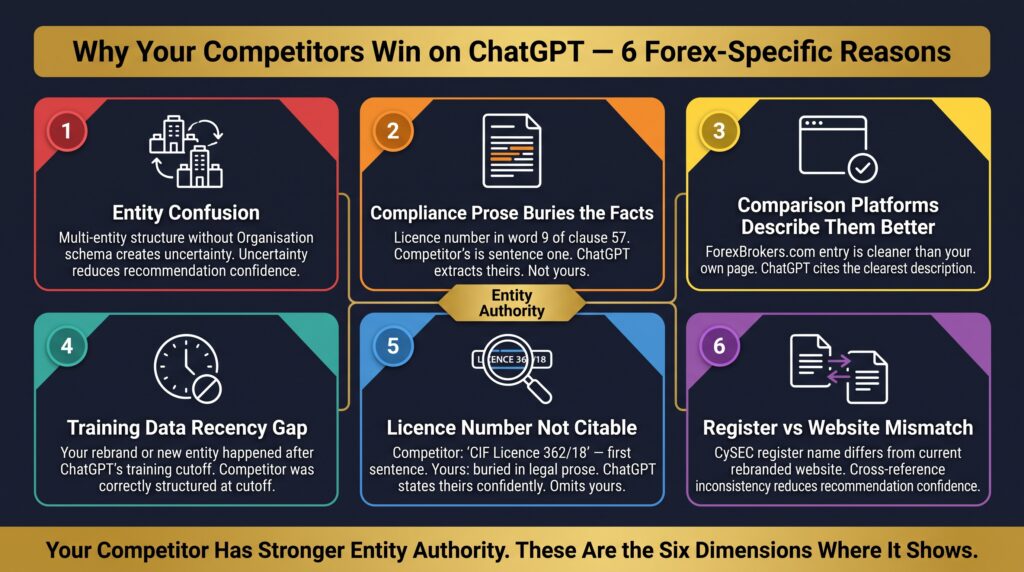
The fundamental mechanism is what researchers call entity authority — the accumulated signals that tell ChatGPT a brand is established, consistent, and trustworthy. Your competitor has stronger entity authority for their regulated credentials than you do. For a regulated forex broker, entity authority has six specific dimensions that general guides on AI visibility don’t cover.
Reason 1 — Entity confusion from a multi-entity structure. A CySEC + FCA + offshore broker has three or more legal entities operating under one brand name. Without Organisation schema declaring the entity map explicitly — which regulated entity serves which market, which CIF licence number belongs to which entity — ChatGPT may recommend your competitor because their entity structure is clear and verifiable, while your brand generates uncertainty about which entity is being recommended for which context. Uncertainty reduces ChatGPT’s recommendation confidence. Verified entity clarity increases it.
Reason 2 — Compliance-first content buries the extractable facts. Your regulation page was written by the legal team to satisfy disclosure requirements. The result: your CySEC licence number appears in the ninth word of a 57-word clause. Your competitor’s regulation page has restructured it so the licence number is in the first sentence of the first block: “[Competitor] Limited holds CIF Licence [X], authorised by CySEC.” ChatGPT extracts the competitor’s licence with confidence. It cannot extract yours cleanly — so it either omits it, states it incorrectly, or recommends the competitor whose credentials are more citable.
Reason 3 — Comparison platforms describe your competitor more clearly than you describe yourself. ForexBrokers.com, Investopedia, FX Empire, and similar comparison platforms invested in extractable format years before individual brokers had any reason to. ChatGPT’s training data includes these descriptions. If the comparison platform’s entry for your competitor is clean, specific, and accurate — and your own pages are marketing-language-dense — ChatGPT cites the comparison platform description and recommends the competitor whose description is clearest. This is documented in detail in why AI cites comparison sites over broker sites.
Reason 4 — Training data recency — your regulatory updates haven’t reached ChatGPT yet. ChatGPT’s training data has a cutoff. A broker that rebranded, obtained a new regulated entity, changed its leverage limits, or restructured its entity after that cutoff may be described by ChatGPT in its previous state. The competitor who was correctly structured at training cutoff gets recommended with the current description; you may get recommended with an outdated one that undermines ChatGPT’s confidence in your current regulatory credentials. This is not a content quality problem — it is a temporal gap specific to regulated entities with multi-year regulatory histories.
Reason 5 — Your licence number is buried; your competitor’s is citable. For a regulated forex broker, the CIF or FCA regulatory licence number is the most verifiable trust signal available. ChatGPT can cross-reference it against the regulator’s public database. If your competitor’s licence number appears in an atomic first-sentence block — “[Competitor] holds CIF Licence 362/18, regulated by CySEC” — ChatGPT can state it confidently. If yours is buried in legal disclosure prose, ChatGPT either omits it, states it with less confidence, or recommends the competitor whose credential is explicitly citable.
Reason 6 — Your regulator register entry and your website disagree. AI engines cross-reference the broker’s self-description with the regulator’s public register. If your trading name on the CySEC register reflects your founding entity name and your current website uses a rebranded name, the cross-reference creates inconsistency. ChatGPT treats inconsistency as a confidence reduction. Your competitor whose register entry matches their current website gets recommended with higher certainty — even if your regulatory credentials are equivalent or stronger.
The pattern across all six reasons is the same: ChatGPT is not recommending your competitor because their product is better, their spreads are tighter, or their platform is more reliable. It is recommending them because their regulatory credentials are more extractable. A broker with an inferior product but a clearly structured regulation page, an explicit licence number in the first sentence, and a consistent entity name across their website and the CySEC register will be recommended over a technically superior broker whose credentials are buried in legal prose. The competition for ChatGPT recommendations is a content structure competition, not a product quality competition.
Test It Yourself — Five Queries to Run on ChatGPT Right Now
Before fixing the problem, confirm exactly what ChatGPT currently says about your broker. Run these five queries — they cover the five dimensions of AI visibility that matter most for a regulated forex broker. Note which queries show a competitor instead of you, which include incorrect regulatory information, and which produce uncertainty or no answer about your broker at all.
| Query to Run on ChatGPT | What It Tests | What to Note |
|---|---|---|
| “Is [broker] regulated by CySEC?” | Regulatory status citation accuracy — whether ChatGPT can identify and state the broker’s regulatory status with confidence | Is the correct regulated entity named? Is the CySEC licence number stated? Is the answer confident or hedged with uncertainty? Does ChatGPT recommend verifying with a third party rather than stating the answer directly? |
| “[Broker] CIF licence number” | Licence number extractability — whether the most verifiable trust signal available is citable from the broker’s own content | Is the exact licence number stated correctly? If wrong or absent — this is a content structure problem, not a regulatory problem. The number exists on the CySEC register; it is not in an extractable position on the broker’s own pages. |
| “Best regulated forex brokers for EU retail clients” | Competitive positioning — whether the broker appears in AI-generated category recommendations alongside or instead of competitors | Does the broker appear in the list? Which competitors appear instead? Note the specific brokers ChatGPT recommends — they are winning on content structure and entity clarity, not necessarily on product quality. |
| “[Broker] vs [main CySEC competitor]” | Head-to-head entity clarity — whether both entities are correctly identified, correctly described, and compared on accurate regulatory facts | Are both entities correctly named and their CySEC licences correctly attributed? If ChatGPT describes the competitor more accurately than the broker — that is the content structure gap made visible in a single query. |
| “[Broker] client protection — ICF coverage” | Trust signal accuracy — whether the broker’s client protection regime is correctly described, including the €20,000 ICF compensation ceiling for CySEC-regulated entities | Is €20,000 ICF coverage correctly attributed to the CySEC entity? Is negative balance protection mentioned? Any error here is a compliance-adjacent exposure — a prospect researching client protection before depositing is receiving inaccurate information about the protection regime that applies to their funds. |
Any query that returned a competitor instead of you, incorrect regulatory information about your broker, or no answer at all has confirmed which of the six reasons above applies to your situation. For a structured version of this test covering all five AI engines simultaneously — ChatGPT, Perplexity, Google AI Overview, Gemini, and Claude — with a complete findings report, the AI/GEO visibility audit is the starting point.
What You Can Do About It — Five Actions in Priority Order
Each action below directly addresses one or more of the six reasons above. Start with Action 1 this week. Actions 1 and 2 can often be completed within the same compliance review cycle.
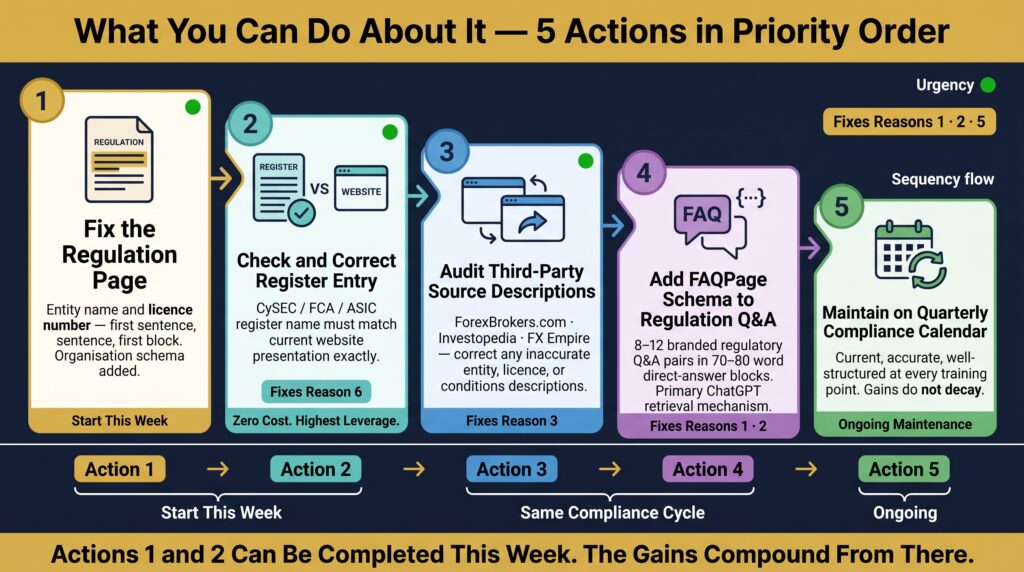
Action 1 — Fix the regulation page (addresses Reasons 1, 2, 5). Restructure the regulation page so your entity name and CIF licence number appear in the first sentence of the first atomic block — not embedded in a 57-word disclosure clause. Add Organisation schema declaring your entity name, licence number, and regulated subsidiaries for each jurisdiction. This is a single compliance review cycle and produces durable improvement across all five AI engines. Full implementation guide: structuring content for AI citation.
Action 2 — Check and correct the regulator register entry (addresses Reason 6). Compare your current CySEC, FCA, or ASIC public register entry against your current website presentation. If the names are inconsistent — different entity abbreviation, pre-rebrand entity name, missing regulated entities — submit a correction request through compliance. This is the highest-leverage zero-cost action available. A consistent register entry is the cross-reference signal ChatGPT uses to confirm your regulatory claims are accurate. It costs nothing except a compliance submission.
Action 3 — Audit and correct third-party source descriptions (addresses Reason 3). Check what ForexBrokers.com, Investopedia, FX Empire, and your main comparison platform listings say about your broker’s entity, licence number, and conditions. Any inaccuracy in these sources is what ChatGPT may be citing when it recommends your competitor over you. Submit corrections directly to the platforms. Full analysis: why AI cites comparison sites over broker sites.
Action 4 — Add FAQPage schema to your regulation page Q&A (addresses Reasons 1, 2). Eight to twelve branded regulatory Q&A pairs — “Is [broker] regulated?”, “[broker] CIF licence number”, “[broker] client fund protection” — answered in 70–80 word direct-answer blocks with FAQPage schema applied are what ChatGPT retrieves when constructing answers to branded regulatory queries. This is the single most impactful schema action for AI recommendation improvement. The trust signal layer this builds is covered in E-E-A-T signal maintenance.
Action 5 — Maintain freshness on a quarterly compliance calendar (addresses Reason 4). Training data recency is a structural issue for any broker with an evolving regulatory history. The mitigation is a regulation page that is current, accurate, and well-structured at every point in time — so that at any training cutoff, your regulatory credentials are described correctly. The content freshness programme covers the specific compliance-calendar workflow that makes this sustainable without overwhelming the compliance team.
Priority Sequence
Action 1 (regulation page restructure) → Action 2 (register entry check) → Action 3 (third-party corrections) → Action 4 (FAQPage schema) → Action 5 (freshness maintenance). Actions 1 and 2 can start this week. Actions 3 and 4 follow in the same compliance review cycle. Action 5 is the ongoing maintenance that ensures the gains do not decay.
Does the Same Apply to Perplexity, Google AI Overview, Gemini, and Claude?
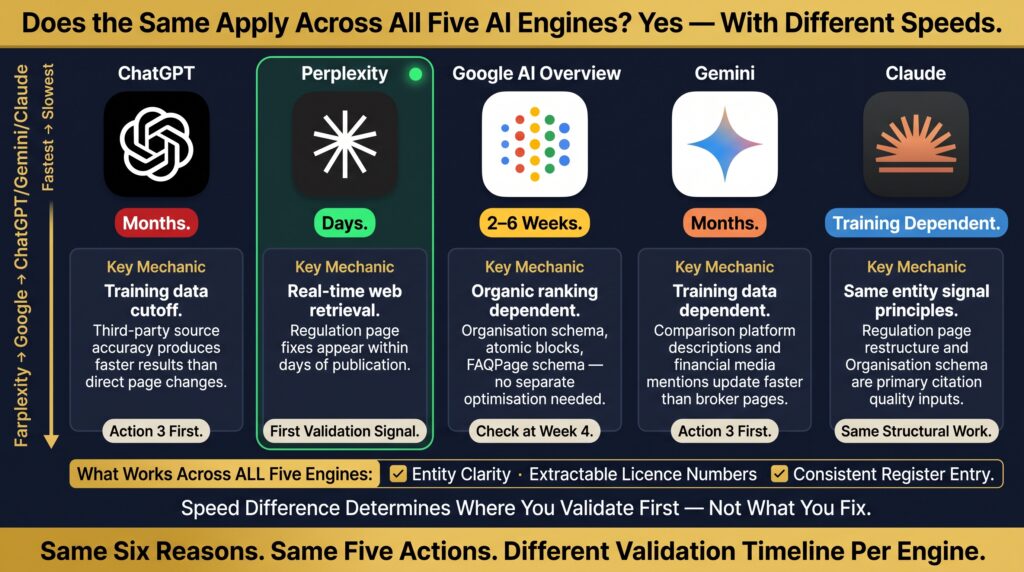
Yes — the same six reasons apply across all five AI engines. Entity clarity, extractable licence numbers, consistent regulator register entries, and accurate comparison platform descriptions all influence recommendation quality across ChatGPT, Perplexity, Google AI Overview, Gemini, and Claude. The differences are in speed and mechanism, which determines where you validate first.
Perplexity uses real-time web retrieval — fixes to the regulation page and third-party sources can appear in Perplexity answers within days of publication. This makes Perplexity the fastest validation signal: run the five-query test against Perplexity one to two weeks after each implementation change to confirm the update is being cited.
Google AI Overview typically picks up changes within two to six weeks for pages already ranking organically. The structural work that helps ChatGPT — Organisation schema, atomic blocks, FAQPage schema — also helps Google AI Overview without any separate optimisation.
ChatGPT and Gemini depend on training data and take months to reflect direct page changes. For these engines, third-party source accuracy (Action 3) produces faster results than regulation page restructuring — because training data updates incorporate comparison platform descriptions and financial media mentions more frequently than individual broker pages.
Claude — as a note of transparency — applies the same entity signal principles. The regulation page restructure and Organisation schema are the primary inputs for citation quality regardless of which engine you are optimising for.
“The AI/GEO visibility audit is the structured version of the five-query test — covering all five engines simultaneously and producing a full findings report with prioritised fix actions specific to your broker.”
FAQ
Q1: Why is ChatGPT recommending my forex competitor instead of my brokerage?
ChatGPT recommends forex brokers it can confidently describe with verifiable, extractable information about their regulatory credentials. When it recommends your competitor instead of your brokerage, the most common reasons are specific to how regulated broker content is structured. The competitor’s regulation page presents their CySEC or FCA licence number in an atomic first-sentence block that ChatGPT can extract directly, while your licence number is buried in formal legal disclosure prose. The competitor’s entity structure is declared in Organisation schema, eliminating confusion about which entity serves which market. Comparison platforms like ForexBrokers.com describe the competitor’s regulatory status more clearly and specifically than your own pages, and ChatGPT cites those more extractable third-party descriptions. The competitor’s regulator register entry is consistent with their current website presentation, while any name inconsistency in your entry creates uncertainty that reduces ChatGPT’s recommendation confidence. These are content structure and entity clarity problems, not product quality problems — and they are solvable through a single compliance review cycle of targeted regulation page restructuring.
91 words. Primary AI Overview capture — displaces optimoiai’s thin double-cited answer with a specific, forex-broker-specific diagnosis.
Q2: Does ChatGPT sometimes state incorrect regulatory information about a forex broker?
Yes, and this happens more frequently than most regulated broker marketing teams are aware of. ChatGPT may state an incorrect licence number, attribute the wrong regulated entity to a given market, describe leverage limits that changed after its training cutoff, or provide an outdated description of a broker that has rebranded or restructured its regulated entities. This happens because ChatGPT’s training data incorporates information from multiple points in time, and any sources that described the broker incorrectly at the time of training may contribute to inaccurate current descriptions. Additionally, if a comparison platform, financial forum, or news article described the broker incorrectly at any point, ChatGPT may have incorporated that error into its knowledge base. The broker’s compliance team typically reviews the broker’s own communications but has not reviewed what ChatGPT currently says about the broker’s regulatory credentials, which means these errors often go undetected until a prospect or regulator notices them.
Q3: How do I check whether ChatGPT is recommending my forex competitor over my brokerage?
Run five specific queries on ChatGPT to assess how it currently perceives your broker relative to competitors. First, ask “Is [your broker] regulated by CySEC?” and note whether your licence number is stated correctly. Second, search “[your broker] CIF licence number” directly and confirm ChatGPT can state your exact licence number without errors or uncertainty. Third, ask “Best regulated forex brokers for EU retail clients” and note whether your broker appears alongside or instead of competitors. Fourth, run “[your broker] vs [your main CySEC competitor]” and check whether ChatGPT correctly identifies both entities and their regulated structures. Fifth, ask “[your broker] client protection — ICF coverage” and verify that the investor compensation fund coverage is correctly attributed to your entity. Any query that returns a competitor instead of your broker, states incorrect regulatory information, or produces uncertainty about your credentials indicates which of the structural issues described above applies to your specific situation and should be prioritised for remediation.
Q4: Does having a CySEC or FCA licence automatically help my forex broker get recommended by ChatGPT?
Having a CySEC or FCA regulatory licence is a necessary foundation but does not automatically produce ChatGPT recommendations. The licence provides the verifiable credential that ChatGPT can in principle reference — a publicly queryable record in the CySEC register or FCA Financial Services Register that confirms the broker’s regulatory status. However, ChatGPT can only use this credential effectively if the broker’s own content makes it explicitly available. A regulation page that buries the licence number in formal legal disclosure prose rather than presenting it in an atomic, directly extractable block provides ChatGPT with the credential in a format it cannot confidently cite. The competitor broker with the same licence tier but a regulation page that presents the licence number in the first sentence of the first block, accompanied by Organisation schema declaring the entity and a direct link to the register entry, will be recommended with higher confidence. The licence is the asset; the structured content is what makes it citable.
Q5: How long does it take to see improvement in ChatGPT recommendations after fixing these issues?
The timeline for improvement varies by AI engine. Perplexity uses real-time web retrieval, meaning improvements to the regulation page and third-party source accuracy can appear in Perplexity answers within days to weeks of publication. Google AI Overview typically reflects changes within two to six weeks for pages already ranking organically. ChatGPT and Gemini depend primarily on training data, meaning changes to the broker’s own pages may take several months to appear — making third-party source correction (comparison platform entries, regulator register accuracy) more immediately impactful for these engines because their training data updates incorporate those sources. The most practical approach is to validate regulation page improvements against Perplexity first as the fastest feedback loop, then monitor Google AI Overview over the following month, and treat ChatGPT improvement as a longer-term objective that builds as training data is updated to reflect the corrected entity information and structured content.
Q6: What is the single most important action to take if ChatGPT is recommending competitor forex brokers instead of mine?
The single most important action is restructuring the regulation page so that the broker’s entity name and CIF or FCA licence number appear in the first sentence of the first content block rather than embedded in formal legal disclosure prose. This restructuring — combined with adding Organisation schema that declares the entity name, licence number, and regulated subsidiaries in machine-readable form — is a single compliance review cycle that directly addresses the most common reason ChatGPT recommends competitors: the competitor’s regulatory credentials are extractable and verifiable while the broker’s are buried in legal language that ChatGPT cannot confidently cite. This action also improves performance across Perplexity and Google AI Overview simultaneously, making it the highest-leverage single action available for AI recommendation improvement. The second action, which can be completed in parallel, is checking the regulator’s public register entry for the broker and submitting a correction if the entry uses a different name or entity description than the broker’s current website presentation, since this inconsistency actively reduces ChatGPT’s confidence in the broker’s regulatory claims.
90 words. The clear, specific, most-citable action answer — routes to E4 for the full implementation and gives the CMO exactly one thing to do.