This article is about how AI-powered search engines — specifically Perplexity and Google AI Overview — are changing how traders research and discover regulated forex brokers. It is not about AI trading robots, algorithmic trading systems, or automated trade execution.
A trader looking for a regulated forex broker used to start with a Google search. They got a page of links. They clicked. The broker that ranked had the best chance of being evaluated. That funnel still exists — but something has inserted itself above it. Perplexity and Google AI Overview now answer the first research question with a generated response: a synthesised shortlist, a direct recommendation, or a verified answer to “is [broker] regulated?” The broker either appears in that answer or it doesn’t.
The problem for a regulated broker’s marketing team is that exclusion produces no signal. No impression loss, no ranking drop, nothing in GA4. It is a leak upstream of every metric the team monitors: prospects who were never counted. If you need the foundational terminology before the implications, the GEO/AEO guide for forex brokers covers it. This article assumes the problem is real and goes straight to what it means.
Table of Contents
How the Trader Journey Has Changed: From Ten Links to a Generated Shortlist
In the broker marketing audits I run, the shift shows up consistently in one place — direct-navigation and branded-search traffic holds while new-prospect top-of-funnel volume softens quietly. Prospects who were shortlisted by Perplexity before they arrived are already pre-filtered and pre-informed. The funnel looks stable in GA4. The leak is upstream of it — at the shortlist formation stage that happened before the broker’s website was ever visited, in a Perplexity session the broker has no visibility into and no ranking position in.
The pre-2024 trader discovery journey was a sequence the broker’s marketing team could compete in at every stage. A prospective client searched Google for the best regulated forex broker for their region. They received a page of ten links. The broker that ranked had the best chance of being clicked, evaluated, and shortlisted. Investment in organic rankings, comparison-platform listings, and on-site content directly affected which stage of that journey the broker entered. The funnel was visible. The metrics were real.
The 2026 journey has a new first stage that happens before any of that. A trader types “best regulated forex brokers for EU clients” into Perplexity. Perplexity returns a generated answer: three to five brokers named, with reasons, with citations to comparison platforms and review sites. The trader is on a shortlist before they have visited a single broker website. They then run a verification query — “is [broker] CySEC-regulated?” — often in the same Perplexity session, which retrieves the regulator’s public register directly and answers with a citation. Only then, if the broker passed that check, does the broker’s own website enter the picture.
The structural change is not that traders have stopped using Google. They haven’t. It is that shortlist formation — the single most decision-shaping moment in the discovery journey — has moved from a surface the broker could rank on to a synthesis the broker may simply be absent from. The only competing article on this topic uses the verb “vet” in its title — which points at the verification stage, checking a broker already on the list. The earlier, more decisive stage — how the list got made in the first place — has been entirely unclaimed. That is the stage this article is about.
| Stage | Before 2024 | 2026 |
|---|---|---|
| Initial query | Google Search: “best regulated forex broker EU” — returns ten ranked links the broker could appear in through organic SEO investment | Perplexity or Google AI Overview: same query — returns a generated answer. No ranked links to compete for. No position to optimise toward. The broker is either in the answer or absent from it. |
| What the prospect receives | A list of ten links — the broker controls whether it appears through rankings, meta titles, and structured data. The prospect makes the shortlisting decision themselves across multiple clicks. | A generated shortlist of three to five named brokers with reasons and source citations. The AI system made the shortlisting decision. The prospect received a recommendation, not a list of options. |
| Shortlist formation | Happened across multiple visits — broker comparison platforms, review sites, and broker websites all participated. The broker’s own content influenced the shortlisting process directly. | Happens inside the AI-generated answer before any broker website is visited. The broker’s own website plays no role in this stage. The AI system’s training data and retrieval sources determine the shortlist — not the broker’s on-site content or SEO rankings. |
| Verification | A separate Google search — comparison platform, review site, or regulatory register. A multi-step process across multiple sessions that gave the broker multiple entry points to influence. | A follow-up Perplexity or ChatGPT query in the same session — often pulling directly from the regulator’s public register. The broker’s regulation page either produces a clean, citable answer or the AI cites the register entry instead, potentially with outdated or conflated entity information. |
| Broker website visit | Stage 2–3 of the discovery journey — the prospect arrived with an open mind, ready to be influenced by the broker’s own content, UX, and trust signals. | Stage 4–5 — the prospect arrives with a pre-formed opinion already in place. They know which brokers were recommended, they have already verified regulatory status, and they are visiting to confirm a decision already shaped by AI-generated answers they received before the first click. |
A broker absent from the AI-generated shortlist is eliminated before the funnel the marketing team measures even begins. There is no impression to track, no click to lose, no position to monitor. The absence is invisible — which is precisely what makes it consequential.
Perplexity vs Google AI Overview for Forex Broker Research — Which Engine Serves Each Query
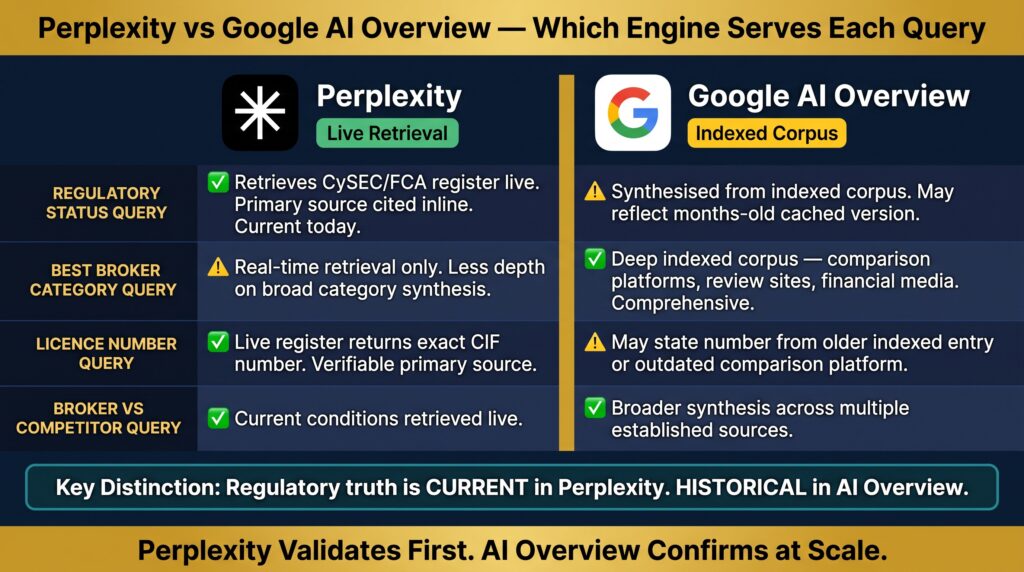
Perplexity and Google AI Overview are both AI-powered but they answer forex broker research queries differently, because they retrieve information differently. Understanding which engine serves which query type is not academic. It determines where a broker’s content investment produces AI visibility first — and where a marketing team validates that its changes have taken effect.
The load-bearing distinction for regulated broker research is this: for regulatory-status queries, the two engines differ in kind, not degree. Perplexity retrieves the CySEC or FCA public register live at query time and cites the entry inline — no index lag, primary source cited directly. Google AI Overview synthesises from its indexed organic corpus, which reflects content as it was indexed, not as it is today. A broker’s regulatory truth is therefore current in Perplexity and historical in AI Overview. For any broker that has recently updated its entity structure, rebranded, or obtained a new licence, the accurate version of that information is available in Perplexity immediately — and arrives in AI Overview on Google’s indexing schedule.
| Query a Trader Runs | Better Engine | Why — In Retrieval Terms |
|---|---|---|
| “Is [broker] regulated by CySEC / FCA?” | Perplexity | Retrieves the regulator’s public register live at query time and cites the entry inline. No index lag. The answer reflects the broker’s current regulatory status, not a cached version of a page that may be months old. For any compliance-sensitive regulatory query, Perplexity’s live retrieval produces a more accurate and more citable answer than a synthesised response from an indexed corpus. |
| “Best regulated forex brokers for EU retail clients” | Google AI Overview | Synthesises from a deep indexed corpus of comparison platforms, review sites, and established financial media — sources that have accumulated authority signals over years. For broad category queries where depth and breadth of synthesis matters more than recency, Google AI Overview’s indexed corpus produces a more comprehensive answer than real-time retrieval alone. |
| “[Broker] CIF licence number” | Perplexity | Live CySEC register access returns the exact licence number with a direct citation to the primary regulatory source. The prospect receives a verifiable primary-source answer in the same query. Google AI Overview may state the number from indexed content — which may reflect an older version of the broker’s entity or a comparison platform entry that has not been updated since the broker’s original authorisation. |
| “[Broker] vs [main competitor]” | Perplexity is also the faster feedback loop for content changes. A regulation page restructured for extractable licence data shows up in Perplexity within 24–48 hours of publication; the same improvement registers in AI Overview on Google’s index update cycle. This makes Perplexity the right validation tool for regulation page improvements — change the page, re-query 48 hours later, confirm the update propagated. The standing process for this is the content freshness programme.
How “Is [Broker] Regulated?” Became a Perplexity Query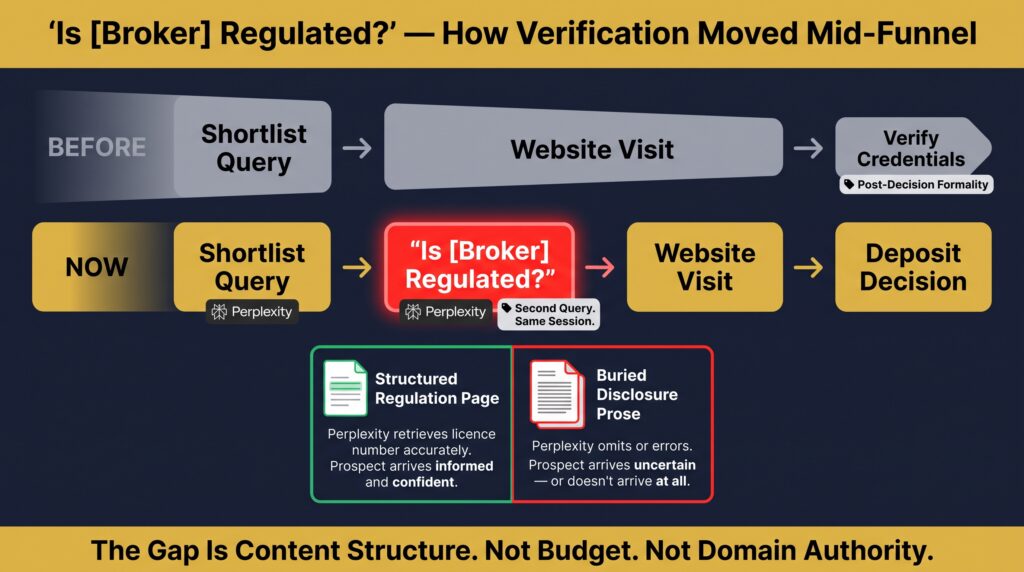 The verification query — “is [broker] regulated?”, “[broker] CIF licence number”, “[broker] client fund protection” — used to be a final-stage check. A prospect had already decided to evaluate a broker. They verified the credentials before depositing. That still happens. But verification has also moved mid-funnel, into the discovery research phase itself, because Perplexity answers it in the same session as the initial shortlist query. What was a post-decision formality is now sometimes the second query a prospect runs — immediately after the shortlist question, before the website visit. The highest-stakes branded queries a regulated broker faces are precisely the factual, register-backed queries Perplexity answers best. Perplexity can retrieve the CySEC register directly, cite the specific entry, and state the licence number in the same response. Google AI Overview answers the same query from its indexed corpus — meaning it answers it as well as the broker’s own page structure allows, subject to the indexing cycle. This creates a dual exposure. A broker with a structurally clean regulation page — licence number in the first sentence of the first content block, Organisation schema declaring the entity, FAQPage schema covering branded regulatory Q&A — gets accurate, source-linked Perplexity answers at the exact moment of maximum prospect scrutiny. A broker with licence data buried in a 57-word disclosure clause gets omission or error at that same moment. The gap is entirely about content structure, not about domain authority or budget. Implementation detail: structuring content for AI citation. Perplexity’s verification answer draws not only from the broker’s own pages but from comparison platforms and review sites. An error in a ForexBrokers.com entry propagates into Perplexity’s verification response — which makes comparison-platform accuracy an upstream input to the broker’s AI-search credibility, not just a listings maintenance task. The full argument for why this matters: why AI cites comparison sites over broker sites. Five Things a Regulated Forex Broker Marketing Team Does Differently Now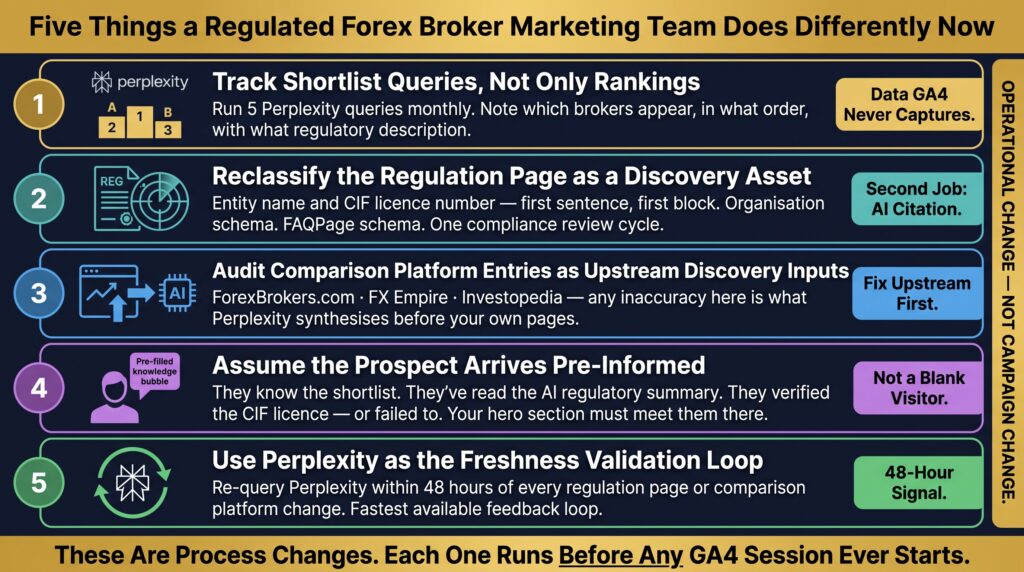 1 — Track the shortlist queries, not only rankings. Run five primary shortlist-formation queries in Perplexity monthly: “best regulated forex brokers for EU clients,” “best CySEC-regulated forex broker,” “[primary competitor] vs [your broker],” “regulated forex broker [primary market],” and the equivalent for your main target jurisdiction. Note which brokers appear, in what order, with what regulatory description. This is the data the marketing team currently has no process for collecting — because it happens before any GA4 session starts. The 90-day AI/GEO roadmap structures this as a standing monthly task. 2 — Reclassify the regulation page as a discovery asset. The regulation page was written by the legal team to satisfy CySEC disclosure requirements. It now has a second job: being what Perplexity retrieves and cites when a prospect verifies the broker’s regulatory status mid-funnel. Restructure it so the entity name and CIF licence number appear in the first sentence of the first content block. Add Organisation schema declaring the entity structure. Add FAQPage schema for eight to twelve branded regulatory Q&A pairs. This is a single compliance review cycle. Implementation: structuring content for AI citation. 3 — Audit comparison-platform entries as upstream discovery inputs. Check what ForexBrokers.com, FX Empire, Investopedia, and the broker’s primary comparison platform listings say about the entity name, licence number, and regulated conditions. Any inaccuracy in those entries is what Perplexity may be synthesising into its shortlist and verification responses. Correct them upstream before optimising the broker’s own pages — because the platforms feed the AI answer before the broker’s own content does. Full analysis: why AI cites comparison sites over broker sites. 4 — Assume the prospect arrives pre-informed. A prospect who started their research in Perplexity arrives at the broker’s website with an opinion already formed. They know which competitors appeared on the AI-generated shortlist alongside the broker. They have read the AI-summarised regulatory description. They have verified the CIF licence number — or failed to, because Perplexity couldn’t find it. First-visit messaging, the hero section, and the regulated credentials display must meet an already-informed visitor, not a blank one. This is a website positioning task that flows directly from AI search behaviour. 5 — Use Perplexity as the freshness validation loop. Every time a change is made to the regulation page, the comparison platform listings, or the entity description — re-query Perplexity within 48 hours for the branded regulatory queries. If the update has propagated, the new information appears in the Perplexity answer. If it hasn’t, the previous version is still being cited. This is the fastest available feedback loop for regulated content changes, faster than waiting for Google to re-index or for AI Overview to update. The standing operational process for this is the content freshness programme. The five instructions above are the starting point. A regulated broker’s full AI/GEO visibility posture — across Perplexity, Google AI Overview, ChatGPT, Gemini, and Claude — involves a structured audit of how each engine currently describes the broker’s entity, regulatory status, and competitive positioning relative to the brokers that appear in the AI-generated shortlists. The AI/GEO visibility audit is where that starts. FAQQ1: How are Perplexity and Google AI Overview changing how traders find forex brokers?Both Perplexity and Google AI Overview have inserted themselves at the beginning of the broker research journey. When a trader searches for the best regulated forex broker for their region, they now often receive a generated answer — a shortlist of named brokers with reasons and sources — before reaching the organic link list. This changes when and how a broker enters a prospect’s consideration set. A broker absent from the AI-generated shortlist is eliminated before the prospect visits any website, before any analytics session starts, and before any marketing team metric captures the loss. Q2: Is Perplexity or Google AI Overview better for researching a regulated forex broker?They serve different research stages. Perplexity is better for factual, verifiable queries — regulatory status, licence numbers, broker comparisons — because it retrieves information live from the web and cites sources inline, including the regulator’s own public register. Google AI Overview is better for exploratory research and broad evaluation queries like how to choose a regulated broker, because it draws on a deeper indexed corpus of educational and review content. Most trader research journeys use both: Perplexity for shortlist and verification queries, Google AI Overview for the exploratory questions that follow. Q3: Why do traders use Perplexity to verify whether a forex broker is regulated?Perplexity retrieves the relevant regulatory register — CySEC, the FCA Financial Services Register, or equivalent — live at the time of the query and cites it inline. This gives the trader a source-linked answer with the broker’s licence number and regulated entity name in the same response, without requiring a separate visit to the regulator’s website. The answer is also more current than Google AI Overview for brokers that have recently changed their regulatory structure, because Perplexity’s retrieval is not subject to Google’s index update schedule. For a prospect checking credentials mid-funnel, this is a faster and more traceable verification path. Q4: What does AI-generated broker discovery mean for a forex broker’s marketing strategy?It means the marketing team has a new top-of-funnel channel that does not appear in any existing analytics dashboard. A broker present in the AI-generated shortlist for regulated broker queries is in the prospect’s consideration set before the first website visit. A broker absent from that shortlist may never be evaluated at all. The practical implications are specific: the regulation page must be restructured for AI extractability, comparison-platform entries must be accurate as upstream discovery inputs, shortlist queries must be tracked monthly in Perplexity, and first-visit website messaging must account for a prospect who already has a formed opinion before arrival. Q5: How does a forex broker know if it is invisible in AI-generated broker discovery?Run five queries in Perplexity monthly: the primary shortlist query for your target jurisdiction, your main comparison query against a primary competitor, the verification query for your regulatory status, the query for your CIF or FCA licence number, and a client protection query for your investor compensation fund coverage. Note which brokers appear in the shortlist responses, whether your broker appears at all, and whether the regulatory information cited about your broker is accurate. If your broker does not appear in the shortlist response or appears with inaccurate information, you have identified the specific gap — and the article’s five instructions provide the remediation sequence. Q6: How quickly do improvements to a forex broker’s regulation page appear in Perplexity?Faster than in Google AI Overview. Perplexity retrieves content from the live web at query time rather than relying on a pre-built index, which means changes to the regulation page can appear in Perplexity’s answers within 24 to 48 hours of publication. Google AI Overview relies on Google’s indexing cycle, which typically reflects substantial page changes within two to six weeks for pages already ranking. This makes Perplexity the fastest validation tool for regulation page improvements: restructure the page, re-query Perplexity 48 hours later, and confirm the updated licence information is being cited correctly before treating the optimisation as complete.  Hristo Hristov
Growth Consultant · Fintech, Forex & Prop Firms
I work with forex brokers, prop firms, and regulated fintech businesses on acquisition, conversion, and growth. Every engagement starts with a diagnostic — finding exactly where growth is leaking before recommending what to change. Based in Limassol, Cyprus. Full story →
Work together
Need a growth strategy built for regulated financial markets?All engagements start with a diagnostic conversation — not a sales call. Book a Strategy Call →No agency pitch · No commitment required |