A standard paid advertising audit tells you whether your campaigns are performing. A compliance-aware diagnostic tells you whether your campaigns are legal — and for a regulated forex broker, those are two completely different questions.
Most forex brokers running paid acquisition have had their campaigns audited by a Google Ads agency. That audit looked at CTR, Quality Score, conversion rate, impression share, and ROAS. It almost certainly did not check whether the ad creative complies with FCA COBS 4 financial promotion requirements, whether the Google Ads financial services certification status matches the broker’s actual regulatory licences and target markets, whether the landing page meets the FCA risk warning format and prominence requirements, or whether retargeting audiences exclude restricted jurisdictions where the broker holds no regulatory authorisation.
Practitioner Observation
Practitioner Observation
In every paid acquisition review I have conducted with a regulated forex broker, the most consistent finding is the same: the Google Ads account is optimising toward registrations as the primary conversion event, not funded accounts. The campaign reports show strong CVR. The CPA looks acceptable. And the business is acquiring traders who never deposit — because the algorithm was never told what a real conversion looks like.
These are compliance questions. A Google Ads agency without financial services regulatory knowledge cannot check them — and most do not know they need to. The result is a forex broker paid programme that looks healthy in every dashboard metric and carries silent compliance exposure across two distinct regulatory layers.
This article documents the full compliance-aware paid ads diagnostic: what it covers, why standard audits miss each element, and what a clean programme looks like when both compliance layers have been assessed. It is the framework that every article in this cluster builds on — from Google Ads account structure to landing page compliance to Meta policy to the question of why ad accounts get suspended.
Table of Contents
The Dual Compliance Layer: What Standard Audits Are Missing
Regulated forex broker paid advertising must satisfy two distinct compliance frameworks that operate independently of each other. Most audits check one. The other is where the actual regulatory risk lives.
Layer 1 — Regulatory compliance. The FCA, CySEC, ASIC, and other financial regulators impose specific requirements on financial promotions — including digital advertising. These requirements are not enforced by Google or Meta. They are enforced by financial regulators who can issue fines, impose trading restrictions, and take public enforcement action against a regulated entity that runs non-compliant financial promotions. FCA COBS 4 applies to every ad creative, every landing page, and every retargeting sequence a regulated broker runs — not just the campaign structure. A Google Ads agency without financial services regulatory knowledge will optimise the campaign for performance while the compliance exposure builds silently in the background.
Layer 2 — Platform policy compliance. Google, Meta, and TikTok each have financial products and services advertising policies that govern who can advertise financial products, in which markets, with what creative, and targeting which audiences. These policies are entirely separate from regulatory requirements. A campaign can comply with FCA COBS rules and still be rejected by Google’s policy team. A campaign can pass Google’s policy approval and still violate FCA requirements. Most Google Ads audits check only Layer 2 — because that is the layer that generates disapprovals, account warnings, and suspension risk that appears in the interface and that the agency is accountable for managing.
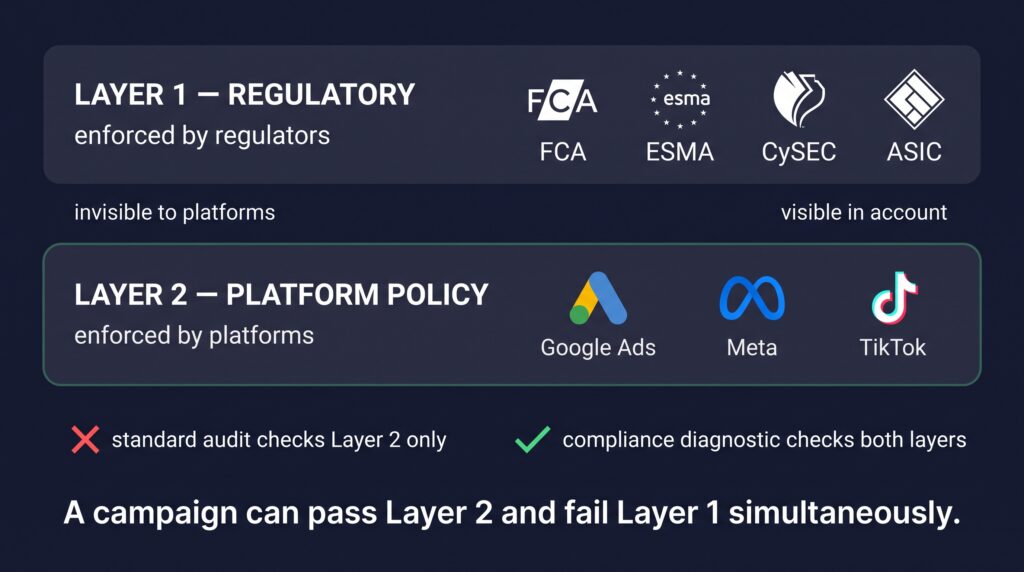
The most dangerous compliance state for a regulated forex broker: campaigns that pass platform policy review while violating regulatory financial promotion requirements. The platform cannot see regulatory non-compliance. Only a reviewer who knows both layers can catch it.
WHY THE GAP EXISTS
Platform policy compliance is measurable within Google Ads and Meta Ads Manager — disapprovals appear in the interface, certifications are visible in account settings, targeting restrictions generate policy warnings. Regulatory compliance is invisible in the advertising platform. No disapproval fires when a risk warning is below FCA guidance minimums. No account flag appears when a leverage claim violates CySEC retail client conditions. The agency cannot see it. An FCA supervision visit can.
Regulatory Layer: FCA COBS and What It Means for Your Ad Creative
FCA COBS 4 financial promotion requirements apply to all digital advertising by FCA-regulated forex brokers targeting UK retail clients — including Google Search ads, Meta display creative, YouTube pre-rolls, and any other digital format that constitutes an invitation or inducement to engage in investment activity.
Requirement 1 — The risk warning
All retail financial promotions for CFD and forex trading must include the percentage of retail investor accounts that lose money when trading CFDs with that specific broker. This percentage is derived from the broker’s own client data and must be updated periodically to reflect current figures. The warning must be displayed prominently in the creative — not in footnote text, not on hover, not at a font size that renders it unreadable. The FCA does not prescribe exact wording or minimum font size — the requirement is principles-based under Consumer Duty. The practical test is whether a reasonable retail investor viewing the ad in normal conditions would notice and understand the warning. If they would not, it is not prominent enough. Verify current prominence requirements with your compliance team — this article does not constitute legal advice.
Requirement 2 — Fair and balanced presentation
Under FCA COBS 4.2 and Consumer Duty, financial promotions must be fair, clear, and not misleading. For forex broker paid ads: any reference to profit potential must be balanced by equivalent prominence given to loss risk. No testimonials that imply typical results or that a typical retail client is likely to profit. No time-limited or other bonus offers to retail clients — these are prohibited under FCA retail client protection rules. A diagnostic check against these requirements is a creative review exercise, not a legal opinion: the question is whether a reasonable regulatory supervisor reading the ad would find it consistent with the broker’s obligations under COBS 4.2 and Consumer Duty.
Requirement 3 — Leverage and product restrictions
Under FCA PS19/18 — made permanent post-Brexit — UK retail client leverage caps restrict the marketing of leverage above the permitted maximum in financial promotions for retail clients. The permitted leverage for UK retail clients is between 30:1 and 2:1 depending on the underlying asset volatility — confirmed under COBS 22.5. An ad creative that references “up to 500:1 leverage” targeting UK retail audiences is both platform-policy compliant (Google will not automatically reject it) and regulatory non-compliant (it markets a product that FCA-regulated retail clients cannot legally access at that leverage level). A compliance diagnostic flags leverage claims in active creative and cross-references them against the permitted leverage for the target market’s regulatory retail client classification. Verify current leverage limits and any subsequent FCA updates with your compliance team — this article does not constitute legal advice.
Platform Layer: Google Ads Certification — The Check Most Agencies Skip
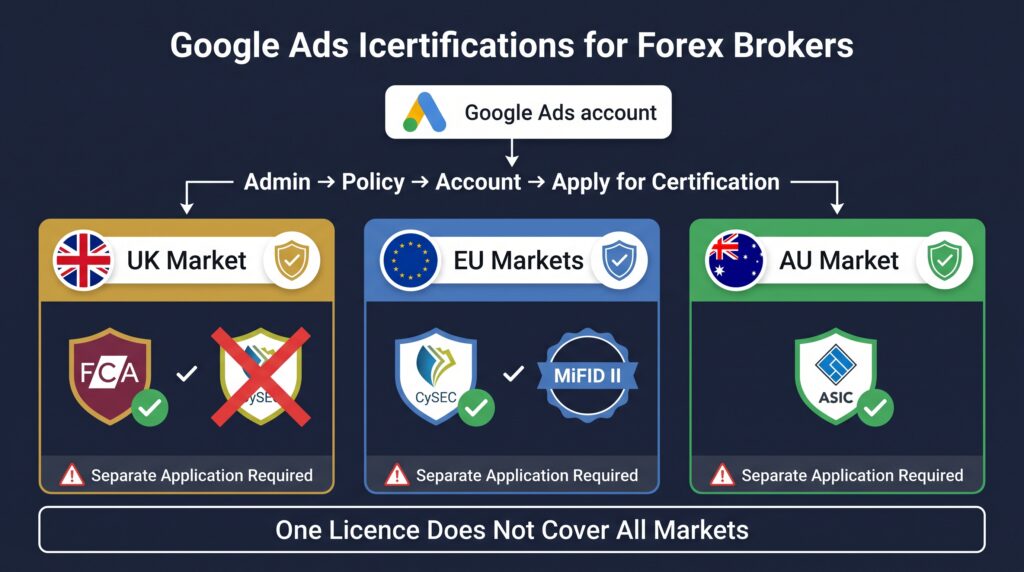
Google Ads requires financial products and services advertisers to obtain certification before running financial product ads in specific markets. For forex brokers, this certification is market-specific — each market where campaigns run requires separate certification based on the relevant regulatory authorisation for that market.
Navigation update (August 2026): Certification applications have moved in-account. Go to Admin → Policy → Account → Apply for certification. The Help Center application route is no longer supported. If the button is not visible, the rollout is still reaching your account — contact Google support directly.
UK market: Requires FCA authorisation documentation. A CySEC-regulated broker without FCA authorisation cannot obtain Google Ads UK financial product certification — and cannot legally run UK-targeted financial product campaigns.
EU markets: Requires MiFID II regulation evidence. CySEC authorisation qualifies for EU market certification. Post-Brexit, UK and EU certifications are separate applications.
Australian market: Requires ASIC documentation. ASIC authorisation is required for Google Ads certification for Australian audience targeting.
The three certification failures a diagnostic finds:
Certification gaps — campaigns running in markets where financial product certification has not been obtained. These campaigns pass initial launch but are vulnerable to account-level review. Every impression served is technically in breach of platform policy without the account team knowing.
Certification-licence mismatch — the broker holds a CySEC licence but has applied for UK Google Ads certification using documentation from a separate FCA entity that is not the advertising entity, or has applied for certification in markets where the current regulatory authorisation does not apply. The certification appears valid in the account but does not match the actual regulatory situation.
Lapsed verification — Google Ads certifications require periodic renewal. A certification obtained 18–24 months ago may have lapsed without the account team or agency noticing, leaving campaigns running without current certification status.
Note for affiliate partners: Affiliates and aggregators who publish comparison content, best broker rankings, or lead-generation pages that drive traffic toward CFD or forex sign-ups also require their own certification for each location they target. The certification requirement applies to the entire funnel, not just the broker.
The compliance-safe Google Ads account structure — how campaigns, ad groups, and targeting are organised to match certification status with market targeting — is covered in the Google Ads account structure guide for forex brokers.
Verify current requirements at the Google Ads Help Centre before publication. Requirements correct as of August 2026.
The compliance-safe Google Ads account structure — how campaigns, ad groups, and targeting are organised to match certification status with market targeting — is covered in the Google Ads account structure guide for forex brokers.
THE 10-MINUTE CHECK YOU CAN DO TODAY
Open your Google Ads account → Tools → Certification Status. If your account shows no financial services certification for the UK market but your campaigns are targeting UK audiences, that is the most immediate compliance and account risk in your paid programme. Verify every certified market matches a regulatory licence your entity actually holds. Verify there are no active campaigns targeting uncertified markets.
The Landing Page Compliance Chain — From Ad Click to Registration
A compliance diagnostic extends beyond the advertising platform into the broker’s own website. Every paid acquisition journey passes through three compliance checkpoints that must be verified as a continuous chain — not as individual isolated elements.
Step 1 — The ad creative. Does it comply with FCA COBS risk warning requirements? Does it respect ESMA leverage restrictions for the target market’s retail client classification? Does it satisfy the relevant platform’s financial product policy for the market where it is serving?
Step 2 — The landing page. Does it include the FCA-required risk warning in the correct format, size, and prominence? Does it make any claims that are inconsistent with what the ad creative said? Does it create a misleading commercial impression relative to the product the user is about to register for? The landing page is a financial promotion in its own right — the same COBS obligations that apply to the ad apply to every page in the click pathway.
Step 3 — The registration flow. Does the registration sequence maintain consistency with the ad’s promise and the landing page’s representation of the product? Does any step in the registration process introduce a commercial claim, bonus offer, or product representation that the compliance team has not approved as a financial promotion?
The most common chain failure in forex broker paid programmes: a compliant Google Search ad linking to a landing page whose risk warning is present but displayed below the fold, in a font size that renders it effectively invisible on mobile, or in a colour that does not meet contrast requirements — technically present but not prominent. The ad passes; the landing page fails; the chain is broken at Step 2. Standard campaign audits never reach Step 2.
Landing page compliance in full — what regulators check, what passes, and what fails — is covered in the forex broker landing page compliance guide.
Audience Exclusions — The Compliance Check That Protects the Licence
A regulated forex broker cannot legally solicit retail clients in jurisdictions where they hold no regulatory authorisation to do so. This is not a platform policy — it is a regulatory requirement that the advertising platform cannot enforce. A diagnostic checks whether GEO-targeting exclusions in every active campaign correctly reflect the broker’s current regulatory authorisation map.
The universal exclusions: Regardless of which licences the broker holds, two exclusions apply to every regulated forex broker’s paid programme. United States persons must be excluded across all campaigns — CFTC regulatory requirements apply to US citizens globally, regardless of their physical location at the time of ad impression. FATF-designated jurisdictions and any markets where the broker’s regulatory conditions specifically prohibit client solicitation must be excluded.
The licence-specific exclusions: A CySEC-regulated broker without FCA authorisation must exclude UK audiences from all retail client-targeted campaigns — post-Brexit, CySEC passporting no longer covers UK retail clients. A broker with only an offshore Tier 3 licence (VFSC, Seychelles FSA) must exclude the UK, EU, and Australian markets where financial product advertising requires the respective regulatory authorisation. Each additional market in the exclusion list corresponds to a regulatory licence the broker does not hold.
Maintaining the exclusion list: The exclusion list is a living document — it must be updated whenever the broker’s regulatory authorisation changes. A new FCA licence removes the UK exclusion. A regulatory action in a specific market may require adding an exclusion. The diagnostic check: compare the current Google Ads and Meta Ads exclusion lists against the broker’s current regulatory authorisation documents. Any market where campaigns are running without the corresponding authorisation is a compliance gap.
Retargeting Compliance — Two Layers Most Retargeting Programmes Miss
Retargeting for regulated forex brokers carries compliance requirements beyond the standard regulatory and platform layers: a GDPR consent layer that determines whether the audience lists themselves are legally constructed.
The GDPR consent layer. EU and UK GDPR require a lawful basis for processing personal data for advertising retargeting — in practice, this means explicit consent via a GDPR-compliant Consent Management Platform (CMP). A compliance diagnostic checks: whether the CMP on the broker’s website correctly captures advertising consent signals, whether Google and Meta pixels fire only within consented sessions, and whether Google Consent Mode v2 is implemented for EU traffic (required from March 2024). A retargeting programme running on non-consented data is both a regulatory compliance risk (ICO enforcement for UK operations, CNIL/DPA enforcement for EU operations) and an advertising quality risk — non-consented sessions produce lower-quality audience lists that corrupt the conversion model Smart Bidding uses to optimise.
The regulatory layer in retargeting. Retargeting ad creative shown to registered clients who have not yet funded their account must comply with FCA financial promotion requirements identically to prospecting creative — COBS makes no exception for retargeting audiences. Additionally, retargeting campaigns must maintain the same jurisdiction exclusions as prospecting campaigns: a user who registered via an organic search from a permitted jurisdiction may subsequently be physically located in an excluded jurisdiction when retargeted. Platform-level geo-exclusions on retargeting campaigns must apply the same jurisdiction rules as prospecting campaigns.
The full retargeting strategy — audience structure, funnel mapping from registration to funded account, and timing sequences — is covered in the forex broker retargeting guide.
CPA as a Diagnostic Signal — What the Numbers Tell You About Compliance
CPA is a performance metric in a standard campaign audit. In a compliance diagnostic, it is also a signal — a CPA that diverges significantly from regional benchmarks frequently indicates a compliance-adjacent campaign quality issue, not just a performance problem.
Forex broker CPA for paid acquisition ranges from approximately $150 to $450 or more depending on region, channel, and regulatory tier — the full benchmark analysis is in the forex broker CPA benchmarks guide. Three specific CPA patterns signal compliance investigation in a diagnostic.
Signal 1 — CPA significantly below benchmark with poor registration-to-funded-account conversion. Ad creative that makes overclaimed promises (excessive return suggestions, non-prominent risk warnings, implied typical results) generates high click volume because it is more attractive than compliant creative. But it attracts audiences who are responding to the overclaim — not to the actual product. High registrations with low FTD conversion is the footprint of creative that is converting on a promise the product cannot deliver. The diagnostic check: correlate low-CPA creative with registration-to-FTD conversion rate. If the creative with the lowest CPA-to-registration also has the lowest registration-to-FTD rate, the creative may be non-compliant and drawing the wrong audience.
Signal 2 — CPA below benchmark in a Tier 1 market. UK or Australian CPA below the regional benchmark frequently indicates that the campaign is acquiring clients outside the intended market — either because exclusions are incomplete, because broad keyword matching is capturing queries from lower-value markets, or because the ads are serving in adjacent lower-value geographies. The check: segment CPA by city level to confirm the audience is genuinely from the intended high-value geography.
Signal 3 — CPA variance between platforms for the same market. A significantly lower CPA on Meta versus Google for the same market and audience segment sometimes indicates that Meta is serving ads in placements or to audiences that Google’s financial product policy restrictions prevent. This is not automatically a problem — but it warrants a placement audit to confirm Meta inventory is consistent with a regulated financial entity’s brand position and compliance requirements.
What a Compliant Forex Broker Paid Programme Looks Like
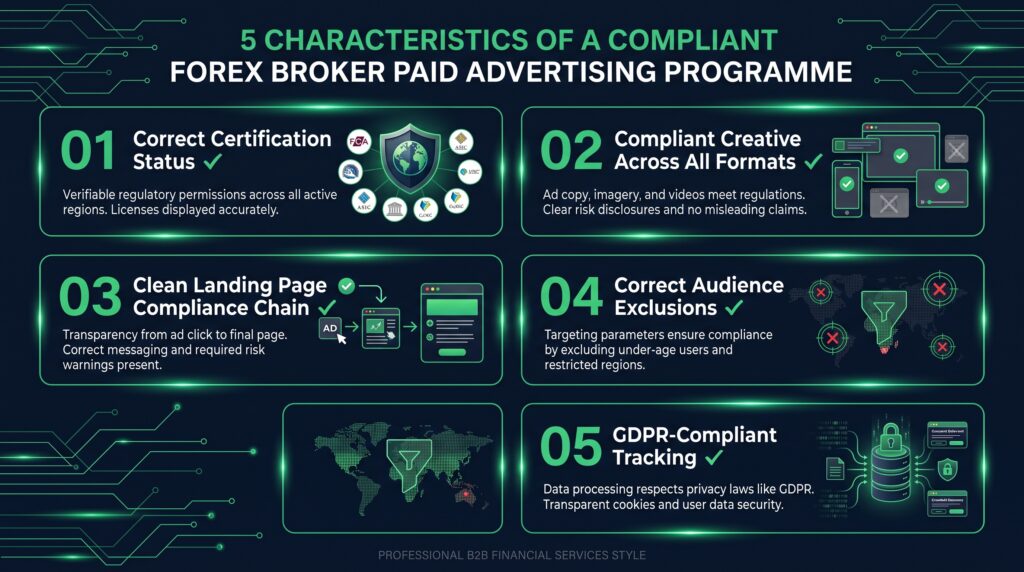
All five characteristics clean: the programme is in a position to scale aggressively for performance. All five characteristics verified: a paid acquisition diagnostic is complete.
Why this matters commercially: A programme with all five characteristics clean is in a position to optimise aggressively for performance — budget scaling, bid strategy adjustments, creative testing, retargeting expansion — without compliance exposure creating the risk of account suspension, regulatory inquiry, or FTD quality degradation from non-compliant creative attracting the wrong audience profile. The compliance diagnostic is not a brake on performance. It is the prerequisite that makes performance scaling safe.
The diagnostic covering all five characteristics — across both compliance layers, across every active market, across all platforms the broker uses for paid acquisition — is what determines whether the paid programme is ready to scale or needs remediation before the next budget increase.
If you want your paid acquisition programme assessed against both compliance layers — the regulatory requirements your ad creative must meet, and the platform certification and policy status that determines whether your campaigns can run at all — that is what the diagnostic covers.
FAQ
Q1: What does a compliance-aware forex broker paid ads diagnostic cover?
A compliance-aware forex broker paid ads diagnostic covers two layers that standard campaign audits typically miss. The first layer is regulatory compliance: whether every active ad creative meets FCA COBS 4 financial promotion requirements including mandatory risk warning disclosure and prominence, whether ESMA leverage restrictions are respected in ad copy for EU and UK retail client targeting, and whether the landing page and registration flow maintain compliance consistency with the ad creative. The second layer is platform policy compliance: whether Google Ads financial services certification status is current, matches the broker’s regulatory licences, and covers all markets where campaigns are running, whether Meta’s financial products advertising policy is correctly applied, and whether GEO-targeting exclusions remove all jurisdictions where the broker is not authorised to solicit retail clients. A standard campaign audit checks performance metrics such as CTR, CPC, Quality Score, and ROAS. A compliance diagnostic checks both performance and both compliance layers simultaneously, because a campaign can pass platform policy review and still violate regulatory financial promotion requirements without generating any automated disapproval or alert.
Q2: What is the dual compliance layer in forex broker paid advertising?
The dual compliance layer in forex broker paid advertising refers to the two distinct compliance frameworks that a regulated broker’s paid campaigns must satisfy simultaneously. The first layer is regulatory compliance, which is enforced by financial regulators such as the FCA, CySEC, and ASIC. This layer governs what claims can be made in ad creative, how risk warnings must be displayed, what leverage levels can be referenced, and which client segments and jurisdictions can be targeted. The second layer is platform policy compliance, which is enforced by Google, Meta, TikTok, and other advertising platforms. This layer governs certification requirements, creative content restrictions specific to each platform, and account-level authorisation for running financial product ads. These two layers operate independently. An ad campaign can comply with platform policy and be approved by Google while simultaneously violating FCA COBS financial promotion requirements, and vice versa. Most Google Ads agencies without financial services regulatory knowledge manage only the platform policy layer. A compliance-aware diagnostic checks both layers for every active campaign element.
Q3: What FCA COBS requirements apply to forex broker paid advertising?
FCA COBS 4 financial promotion requirements apply to all digital advertising by FCA-regulated forex brokers targeting UK retail clients, including Google Search ads, Meta display ads, YouTube pre-rolls, and any other digital format. The key requirements are that all financial promotions must be fair, clear, and not misleading; all promotions for CFD and forex trading must include the percentage of retail investor accounts that lose money with that specific broker, displayed prominently in the creative at a readable size and not relegated to footnote text; any reference to profit potential must give equivalent prominence to loss risk; bonus offers to retail clients are prohibited; and leverage levels marketed above the retail client cap of thirty to one on major currency pairs are prohibited. These requirements apply regardless of whether the ad creative passes Google’s or Meta’s financial product policy review, as the platforms cannot enforce FCA-specific regulatory requirements. All FCA financial promotion compliance requirements should be verified with your compliance team, as FCA guidance for specific digital advertising formats is updated periodically.
Q4: How does Google Ads financial services certification work for forex brokers?
Google Ads requires financial products and services advertisers to obtain certification before running financial product ads in specific markets. For forex brokers, the certification process is market-specific: UK market campaigns require FCA authorisation documentation, EU market campaigns require MiFID II regulatory evidence such as CySEC authorisation, and Australian market campaigns require ASIC documentation. The certification is not universal — obtaining certification for EU markets does not permit running financial product ads targeting UK audiences following Brexit, and each market where the broker runs campaigns requires its own certification based on the relevant regulatory authorisation. Common certification failures found in forex broker Google Ads accounts include certification gaps where campaigns run in markets for which certification was never obtained, certification-licence mismatch where the documentation submitted does not match the broker’s current regulatory authorisation for the target market, and lapsed verification where a previously valid certification has expired without renewal. All three failures allow campaigns to continue running without automatic disapproval while creating account-level policy risk. Current certification requirements should be verified directly in the Google Ads Help Centre as requirements have changed multiple times since 2020.
Q5: What audience exclusions does a regulated forex broker need in paid campaigns?
A regulated forex broker must maintain audience exclusions in paid campaigns for any jurisdiction where they do not hold retail client regulatory authorisation. The specific exclusions required depend on the broker’s regulatory licences but typically include all jurisdictions where the broker holds no financial services authorisation for retail client solicitation, United States persons regardless of their physical location because CFTC regulatory requirements apply to US citizens globally, and any specific high-risk jurisdictions designated by the broker’s regulatory conditions. For a CySEC-regulated broker without FCA authorisation, UK audiences must be excluded from all retail client-targeted campaigns. For any regulated broker, US person exclusion must be active across all campaigns including retargeting. The exclusion list must be maintained as a documented record updated whenever the broker’s regulatory authorisation changes, either expanding to new markets when a new licence is obtained or contracting when a regulatory action limits an existing authorisation. A compliance diagnostic checks the active exclusion list in both Google Ads and Meta Ads Manager against the broker’s current regulatory authorisation status and flags any markets where campaigns are running without the corresponding regulatory authorisation for retail client solicitation.
Q6: How does CPA benchmarking function as a compliance diagnostic signal for forex brokers?
CPA benchmarks function as a diagnostic signal in forex broker paid advertising because significant variance from regional CPA norms frequently indicates compliance-adjacent campaign quality issues rather than purely performance problems. Forex broker CPA for paid acquisition ranges from approximately $150 to $450 or more depending on region, channel, and broker regulatory tier. A CPA significantly below regional benchmarks is often explained by one of three compliance-adjacent issues: non-compliant creative that makes overclaimed promises attracting high click volume from lower-intent audiences who are responding to the overclaimed benefit rather than the actual product, resulting in high registration volume with low registration-to-funded-account conversion; GEO-targeting errors where campaigns acquire clients from lower-value markets outside the intended geographic scope, either because exclusions are incomplete or because broad keyword matching is capturing out-of-scope queries; or impression delivery from restricted ad placements on publisher sites that are inconsistent with a regulated financial entity’s brand position, which a placement audit within the diagnostic would identify. In each case, the low CPA is a signal to investigate the compliance quality of the creative or targeting rather than simply to scale budget toward the low-CPA campaigns.