
Forex Broker Ad Creative That Converts, what works?
The creative format that converts best in e-commerce or app marketing is sometimes the exact format that is structurally incompatible with regulated forex advertising — and most creative teams discover this only after their ad is rejected.
A creative team trained on general digital marketing best practice reaches for UGC and testimonial formats because they convert well across most verticals. For a regulated forex broker, this instinct can be directly counterproductive — not because the format itself is bad, but because FCA’s restrictions on testimonials implying typical results make this specific high-converting format one of the riskiest for regulated retail financial promotions. The same applies, in different ways, to video (risk warning persistence), carousel (per-card compliance), and comparison creative (dual substantiation burden).
This guide maps five common ad creative formats against the compliance constraint that determines their usability, explains what Google, Meta, and TikTok specifically approve and reject, and connects format selection to funnel stage so creative teams can build campaigns that convert within the compliance envelope rather than discovering the constraint through rejection.
Table of Contents
Forex Broker Ad Creative That Converts,The Format-by-Format Compliance Matrix
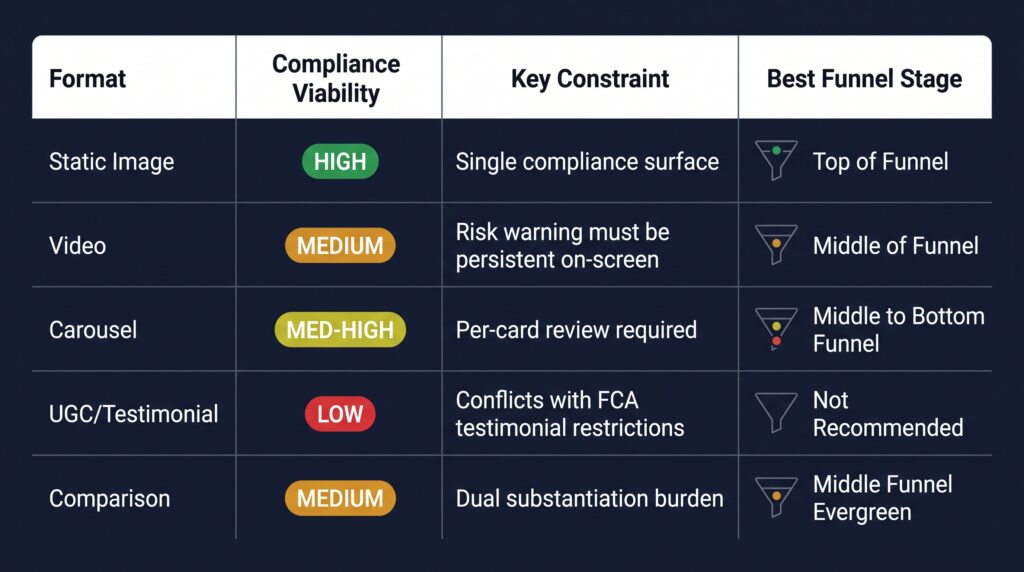
Use this table as your reference before briefing any new creative concept. Compliance viab ility determines how much review time and creative restructuring each format typically requires.
| Format | Compliance Viability | Key Constraint | Best Funnel Stage |
|---|---|---|---|
| Static Image | HIGH | Single fixed compliance surface — risk warning integrated at design stage, reviewed once | Top of funnel (awareness) |
| Video | MEDIUM | Risk warning must be persistent on-screen, not momentary — sound-off viewing makes this critical | Middle of funnel (consideration) |
| Carousel | MED-HIGH | Per-card compliance review required — not one review for the whole sequence | Middle-to-bottom funnel |
| UGC / Testimonial | LOW | “Typical results” implication conflicts directly with FCA testimonial restrictions | Not recommended unless reframed to process/experience only |
| Comparison | MEDIUM | Dual substantiation burden — comparative advertising law AND financial promotion standards simultaneously | Middle funnel (evergreen, well-documented only) |
Each format is detailed below with the specific compliance considerations and production guidance.
Static Image Ads — The Highest Compliance Viability Format
A static image gives full control over every visual and textual element simultaneously — the risk warning can be permanently integrated into the design at a fixed size, position, and contrast that meets FCA prominence standards (the same prominence test from the landing page compliance guide applies equally to ad creative). There is no risk of a spontaneous claim, no voiceover to script-review, no sequential cards each requiring separate review. The entire compliance surface area is one fixed image, reviewed once.
Best use cases: Brand awareness (regulatory credential messaging — “FCA regulated”, “CySEC licensed”), platform feature highlights (charting tools, execution speed, account types), and educational content. Static images are the lowest-compliance-risk, highest-volume format and should form the backbone of most regulated forex broker creative libraries.
The compliance checklist for static images:
- Risk warning integrated at the design stage, not added as an afterthought overlay
- Risk warning font size proportional to the headline — the prominence test applied to static creative
- No claim in the headline or body copy that requires substantiation the broker cannot provide
- Regulatory logo/credential usage matches current licence status exactly
Video Ads — The Persistent Risk Warning Requirement
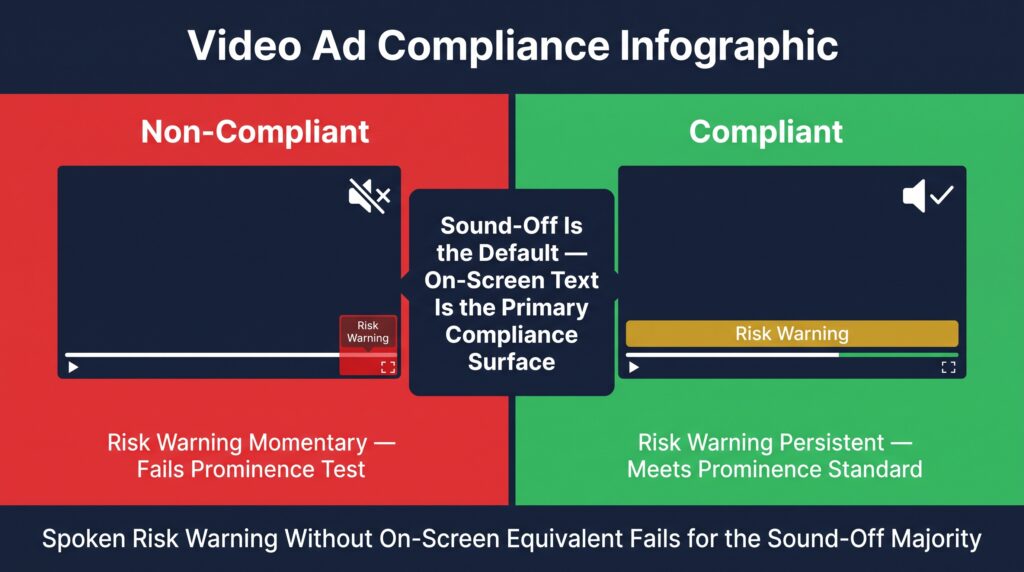
A risk warning that appears for one second at the end of a 30-second video does not meet the same prominence standard as a risk warning integrated as a persistent on-screen element throughout the video duration. The prominence test (visible without action required, sufficient contrast, readable size) applies continuously for video, not just at a single frame.
Voiceover and spoken claims: A spoken claim about returns, leverage, or trading conditions carries identical compliance obligations as a written claim. Every voiceover script requires the same compliance review rigor as written ad copy — “trade up to 30:1 leverage” spoken in a video is the same compliance event as the identical text in a static ad.
The sound-off reality: Most video ads on Meta and LinkedIn auto-play with sound off by default — meaning the on-screen text and persistent risk warning, not the voiceover, carry the primary compliance weight for the majority of impressions. A video that relies on a spoken risk warning without an equivalent on-screen text element fails the prominence standard for the sound-off viewing majority.
Best use cases: Platform demonstrations (screen recordings of the trading platform, execution speed visualization), founder or team credibility content, and educational explainers. Video performs strongly for middle-funnel consideration content where the compliance review investment is justified by the higher-intent audience.
Carousel Ads — Per-Card Compliance, Not Per-Campaign
Each card in a carousel is a potentially independent financial promotion element from a compliance perspective. If card 1 makes a spread claim and card 3 makes a platform feature claim, each card requires the same compliance review applied to a standalone ad — a carousel does not allow one card’s compliance coverage to extend to another. In most platform interpretations, the risk warning requirement applies per-card, not once for the entire sequence.
Why this matters for production planning: A five-card carousel is, from a compliance review perspective, closer to five separate ads than one ad with five visual variations. Creative teams should budget compliance review time accordingly — a carousel is not a time-saving format from a compliance administration standpoint even though it may appear more efficient to produce than five standalone ads.
Best use cases: Sequential product storytelling (account opening steps, platform feature tour) where the progressive disclosure benefit outweighs the compliance administration cost. Carousels work well for middle-to-bottom funnel content where the audience is already engaged enough to swipe through multiple cards.
UGC and Testimonial Formats — Why the Highest-Converting Format Elsewhere Is the Riskiest Here
User-generated content and testimonial-style creative consistently outperform polished brand creative in e-commerce, app install, and subscription marketing — authenticity signals trust, and seeing a relatable person’s experience reduces perceived purchase risk.
Why this exact mechanism is structurally risky for regulated forex. FCA’s financial promotion rules restrict testimonials that imply typical or replicable results without clear disclaimers. A UGC-style “I made a strong return trading with this broker” format — even performed by a genuine, consenting client — implies a typical or achievable outcome that the broker cannot substantiate as representative, given that the majority of retail CFD clients lose money. The format’s core persuasive mechanism — this worked for a relatable person, it could work for me — is in direct tension with the regulatory requirement that financial promotions not create a misleading impression of typical outcomes.
THIS DOES NOT MEAN UGC IS PROHIBITED — IT MEANS THE SCRIPT MUST CHANGE
Compliant UGC-style creative for regulated forex brokers focuses on process and experience claims rather than outcome claims: platform usability (“the app is easy to use”), customer service quality (“support responded quickly”), educational value (“I learned a lot from their resources”), or general satisfaction without quantified or implied financial outcomes. Any UGC content that touches on outcomes at all requires an explicit, prominent disclaimer addressing typicality and risk — applied with the same rigor as the standard risk warning.
The practical creative brief implication: When briefing a UGC-style video, the script should be reviewed by compliance before filming, not after — because reshoots are expensive and the temptation to keep a strong outcome-focused take that was filmed without compliance guardrails is high. Build the compliance constraint into the creative brief, not just the final review.
FOR CEOS — THE ONE QUESTION FOR EVERY UGC SCRIPT
Ask whether any line in the script references a specific financial outcome, return, or result — even implicitly (“it really paid off”, “the best decision I made”). If yes, that line needs either removal, reframing toward process and experience, or a prominent typicality disclaimer. This is the single highest-value compliance check for UGC-style forex creative.
Comparison Creative — The Dual Substantiation Burden
Comparison-style creative (“lower spreads than [competitor]”, feature comparison tables) requires substantiation under two separate frameworks at once. General advertising law requires comparative claims to be factually accurate, not misleading, and to compare like-for-like — the broker’s current spread against the competitor’s current spread for the same instrument and conditions, not the broker’s best-case figure against the competitor’s worst-case or outdated figure. FCA’s fair, clear, not misleading standard applies on top of this, as the comparison is also a financial promotion subject to the same substantiation obligation as any other broker claim.
Why this format fails most often: A comparison ad using outdated competitor data, or comparing the broker’s best-case spread to a competitor’s typical or average spread, fails substantiation on both layers simultaneously — it is both a general advertising law violation and a financial promotion compliance failure. The documentation requirement (current data for both the broker and the named competitor, refreshed periodically) is the highest of any format covered in this guide.
Best use cases: Highly effective for differentiation in competitive markets where the comparison data is genuinely favourable and well-documented. The compliance investment is justified primarily for evergreen brand differentiation creative, not for rapidly rotating campaign creative where the documentation burden cannot be sustained.
What Meta Actually Approves — Beyond Avoiding Rejection
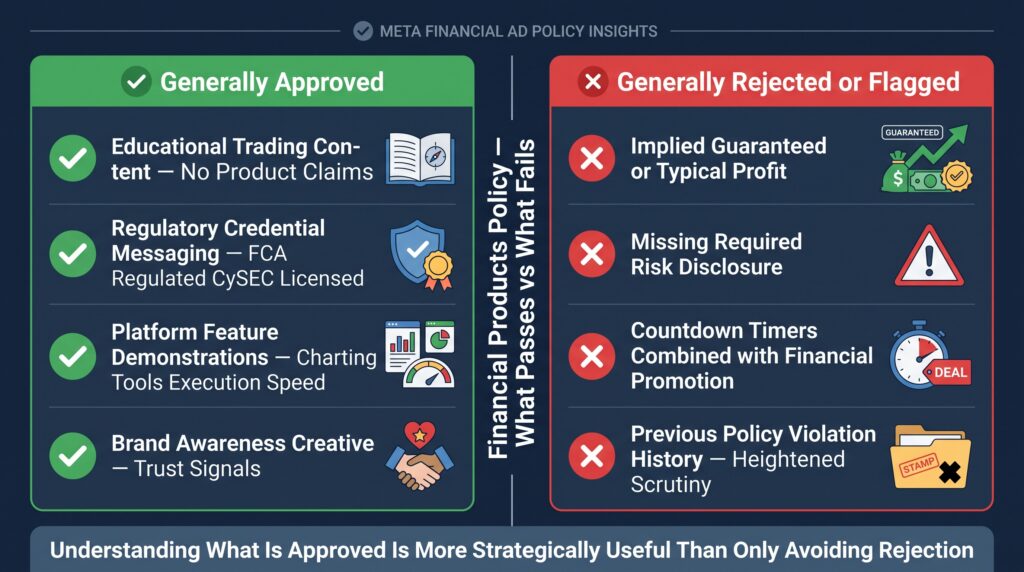
Beyond avoiding rejection, understanding what Meta’s financial products policy specifically permits is the more strategically useful frame.
What Meta generally approves: Educational content about trading concepts without specific product promotion claims. Brand awareness creative emphasizing regulatory credentials — “FCA regulated” or “CySEC licensed” messaging doubles as both a compliance-positive signal and a trust-building element. Platform feature demonstrations (charting tools, execution speed visualizations) framed as product capability rather than outcome promise.
What Meta generally rejects or flags: Any creative implying guaranteed or typical profit. Creative lacking the required risk disclosure for the financial product category. Creative using countdown timers or false urgency tactics combined with financial product promotion — a pattern Meta’s policy specifically targets as manipulative regardless of vertical. Creative that has triggered a previous policy violation on the same ad account, which can result in heightened scrutiny for subsequent submissions even when individually compliant.
The pre-launch verification:
- Financial services certification is current and matches the advertising entity (the same principle from the Google Ads account structure guide applies to Meta)
- The risk warning meets Meta’s specific format requirements in addition to FCA’s
- No countdown timer, false scarcity, or urgency mechanic is present
- The creative has not been flagged in a previous submission for the same or substantially similar content
Google Ads — Creative-Specific Restrictions Beyond Certification
The certification-to-campaign mapping covered in the Google Ads account structure guide determines whether a campaign can run at all. This section addresses the creative assets themselves.
Character limit constraints. Google Ads headline and description character limits make full risk warning inclusion within the ad text itself physically difficult. The practical resolution: the ad copy itself should avoid any claim that would require an on-ad disclaimer, with the full risk warning satisfied primarily through the landing page (covered in the landing page compliance guide) rather than attempted within the constrained ad text.
Responsive Search Ads (RSA) compliance risk. RSAs combine multiple headline and description variations algorithmically to generate ad combinations. This creates a compliance review challenge because Google’s system may combine individually-reviewed components into combinations that were not specifically reviewed together — a headline approved in isolation might combine with a description in a way that creates a misleading overall impression not present in either component alone. The practical mitigation: pin certain headlines or descriptions to control which combinations can occur, particularly for any component that makes a specific claim requiring context from a paired component.
Image extensions and asset-level review. Image extensions and other ad assets are subject to the same financial product policy as the primary ad text — an approved headline does not extend approval to an image asset added later without separate review.
TikTok — A Narrower Compliant Creative Space
TikTok’s financial services advertising policy is generally more restrictive than Google or Meta for forex/CFD products, often requiring additional verification or restricting financial product ads entirely in certain regulated markets. Where TikTok is viable for a specific broker — full analysis in the TikTok viability guide — the native UGC-style format that performs natively on the platform sits in direct tension with the testimonial/outcome-claim restrictions described above, making compliant, high-performing TikTok creative for forex a narrower space than on other platforms. Brand and educational content formats, rather than testimonial-style content, are typically the more compliance-viable approach on TikTok where the platform is used at all by a regulated broker.
Matching Format to Funnel Stage Within the Compliance Envelope
Format selection is not solely a creative or performance decision — it is jointly determined by compliance viability and funnel stage.
Top-of-funnel (awareness): Static and video brand creative with the most compliance latitude — broad reach content making the fewest specific product claims. Regulatory credential messaging and educational content work well here with minimal compliance review overhead.
Middle-funnel (consideration): Platform features, execution model transparency (covered in the ECN/STP execution model marketing guide), and regulatory credibility content. This stage justifies more specific claims and proportionally more compliance review — video demonstrations and comparison creative (despite its higher substantiation burden) are most relevant here, where the audience is engaged enough to value the detail.
Bottom-funnel (conversion/retargeting): The highest compliance rigor stage because it is closest to the actual financial promotion driving account opening. Retargeting creative is covered in full in the forex broker retargeting guide — the format and compliance principles from this article apply with the additional GDPR audience construction layer that retargeting introduces.
A creative team that understands both compliance viability and funnel stage simultaneously builds campaigns that convert without discovering compliance constraints through platform rejection.
If you want your current creative library reviewed against this compliance framework — and a content plan built around the formats your specific regulatory tier and platforms permit — that is part of the diagnostic.
RankMath FAQ Block — Include in WordPress Article + Copy into RankMath Schema
All 6 required. Plain text only — no HTML, no bold, no bullets. Q1 is the first forex-specific answer to this exact query in the index — current AI overview citations are all non-forex content. Q3 (UGC) and Q4 (video) target zero-competition long-tail queries with high creative-team search intent.
FAQ
Q1: Which ad creative formats are compliant for forex broker advertising?
Forex broker ad creative formats carry different compliance viability levels for regulated retail financial promotions. Static image ads have the highest compliance viability because the risk warning, claims, and design can be fully controlled and reviewed as a single fixed element. Video ads have medium compliance viability, requiring the risk warning to be present as a persistent on-screen element throughout the video rather than appearing briefly, and requiring voiceover scripts to receive the same compliance review as written copy since spoken claims carry identical regulatory obligations. Carousel ads have medium to high viability but require per-card compliance review, as each card in the sequence is treated as a potentially independent financial promotion element rather than sharing compliance coverage across the carousel. User-generated content and testimonial-style ads have the lowest compliance viability because FCA rules restrict testimonials implying typical or replicable trading results, which is the core persuasive mechanism of this format, though compliant versions focusing on process and experience rather than financial outcomes remain usable. Comparison creative carries medium viability with the highest documentation burden, requiring substantiation under both general comparative advertising law and FCA’s financial promotion standards simultaneously.
Q2: What does Meta approve and reject for forex broker ad creative?
Meta generally approves forex broker ad creative that includes educational content about trading concepts without specific product promotion claims, brand awareness creative emphasizing regulatory credentials such as FCA or CySEC licensing which functions as both a compliance signal and trust-building element, and platform feature demonstrations such as charting tools or execution speed visualizations framed as product capability rather than outcome promises. Meta generally rejects or flags creative implying guaranteed or typical profit, creative lacking the required financial product risk disclosure, and creative using countdown timers or false urgency tactics combined with financial product promotion, which Meta’s policy specifically targets as a manipulative pattern regardless of industry vertical. Before submitting financial product creative to Meta, verify that financial services certification is current and matches the advertising entity, that the risk warning meets Meta’s specific format requirements in addition to regulatory requirements, and that no urgency or scarcity mechanic is present in the creative.
Q3: Why are UGC and testimonial ads risky for regulated forex brokers?
UGC and testimonial-style ads are risky for regulated forex brokers because FCA financial promotion rules restrict testimonials that imply typical or replicable trading results without clear disclaimers, and this restriction directly conflicts with the core persuasive mechanism of the format. A UGC-style video showing a client describing a positive trading outcome, even if genuine and consensual, implies that the outcome is typical or achievable, which the broker cannot substantiate as representative given that the majority of retail CFD clients lose money. This does not mean UGC content is prohibited for regulated forex brokers, but it requires a different creative approach: compliant UGC focuses on process and experience claims such as platform usability, customer service quality, or educational value rather than financial outcome claims. Any UGC content that touches on outcomes at all requires an explicit and prominent disclaimer addressing typicality, applied with the same prominence standard as the broker’s standard risk warning. Creative briefs for UGC-style content should include compliance review of the script before filming rather than after, since reshoots are costly and the temptation to retain a strong but non-compliant outcome-focused take is high.
Q4: What are the risk warning requirements for forex broker video ads?
Forex broker video ads require the risk warning to function as a persistent on-screen element throughout the video duration rather than appearing briefly at any single point, because a risk warning that flashes for a short period at the end of a video does not meet the same prominence standard as one integrated continuously into the visual design, such as a lower-third banner. Voiceover and spoken claims about returns, leverage, or trading conditions carry identical regulatory obligations to written ad copy, meaning every video script requires the same compliance review rigor applied to static creative. This is particularly important because most video ads on platforms such as Meta and LinkedIn auto-play with sound off by default, meaning the on-screen text and persistent risk warning, not the voiceover, carry the primary compliance weight for the majority of impressions. A video relying on a spoken risk warning without an equivalent persistent on-screen text element fails the prominence standard for sound-off viewers, who represent the majority of the audience for auto-playing video placements.
Q5: Does each card in a forex broker carousel ad need its own compliance review?
Yes. Each card in a carousel ad is treated as a potentially independent financial promotion element from a compliance perspective. If one card makes a claim about trading spreads and another card makes a claim about platform features, each card requires the same individual compliance review applied to a standalone ad, because a carousel format does not allow one card’s compliance coverage to extend to another card in the sequence. In most platform interpretations, the risk warning requirement applies per card rather than once for the entire carousel sequence. This makes carousel ads more compliance-administration-intensive than they initially appear, despite their strong performance for sequential product storytelling such as walking a prospective client through account opening steps or a platform feature tour. Creative production planning should budget compliance review time for a multi-card carousel as though reviewing multiple separate standalone ads rather than treating it as a single piece of creative with several visual variations.
Q6: How should forex broker creative formats be matched to funnel stage?
Forex broker creative format selection should account for both compliance viability and funnel stage simultaneously. Top-of-funnel awareness content should use static and video brand creative with the most compliance latitude, such as regulatory credential messaging and educational content, because this stage makes the fewest specific product claims and carries the lowest compliance review overhead. Middle-funnel consideration content should focus on platform features, execution model transparency, and regulatory credibility messaging, which justifies more specific claims and proportionally more compliance review, with video demonstrations and comparison creative being particularly relevant despite comparison creative’s higher substantiation burden. Bottom-funnel conversion and retargeting content requires the highest compliance rigor because it is closest to the actual financial promotion driving account registration, and retargeting creative carries the additional requirement that audience lists be constructed from GDPR-consented data. Matching format to funnel stage within the appropriate compliance envelope allows a creative team to build campaigns that convert without discovering compliance constraints through platform rejection after the fact.