Forex Broker Email Sequences, what brings FTDs?
The registration-to-funded segment covered in the retargeting strategy guide is also the primary audience for email — and most forex broker email sequences treat this audience with generic nurture content that ignores both the specific onboarding friction and the financial promotion rules that apply to every email in the sequence.
This article applies the same audience logic established in the retargeting guide to email, the second channel operating on this identical segment simultaneously. Email introduces two genuinely new dimensions: longer-form explanation capacity that paid creative’s space constraints don’t allow, and a consent distinction — transactional versus marketing — that determines what content can legally be sent without separate marketing consent.
The email that almost never gets compliance review in a forex broker’s automated sequence is the KYC reactivation nudge — it sits between the CRM team and the marketing team, nobody owns it clearly, and it almost always contains implied urgency language that regulators treat as pressure selling.
Table of Contents
The Sequence Structure — Mirroring the Retargeting Timing Windows
The email sequence should follow the same three-window structure established in the retargeting guide: Days 1-3, high-frequency friction-specific emails sent close to registration when intent is highest. Days 4-14, tapering value-reinforcement emails. Days 15-21, a final compliant re-engagement email before the segment moves to standard low-frequency nurture or is excluded from active sequence sends.
Why coordinate rather than duplicate: Email and paid retargeting operating on identical timing without coordination creates message redundancy and potential fatigue. Email addresses the friction point first in a detailed, unhurried format; paid retargeting reinforces within 24-48 hours with a shorter, visual version of the same message; a final email provides the clear last-step reminder.
KYC Friction-Specific Email Content — Not Generic Nurture
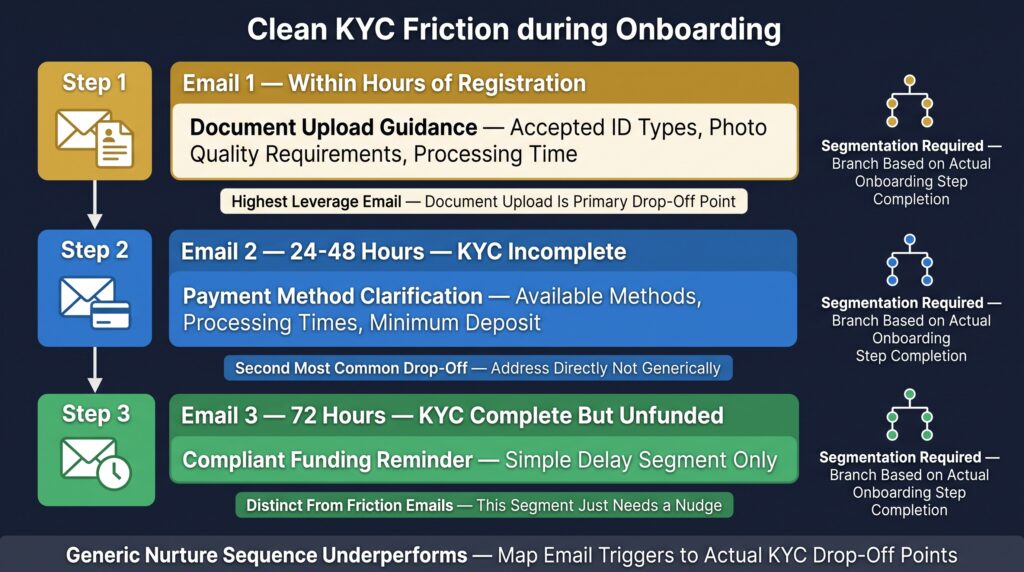
Apply the specific friction points from the KYC guide to email content with concrete sequencing:
- Email 1 (within hours of registration): Document upload guidance — a clear, simple explanation of accepted ID types, photo quality requirements, and expected processing time. This is the single highest-leverage email in the sequence because document upload is the most common drop-off point.
- Email 2 (24-48 hours, if KYC remains incomplete): Payment method clarification — available funding methods, processing times, and minimum deposit amounts. Addresses the second most common drop-off cause directly rather than generic encouragement.
- Email 3 (72 hours, if KYC complete but unfunded): A clean, compliant funding reminder — addressing the simple-delay segment specifically, distinct from the two friction-resolution emails above.
The segmentation requirement this implies: This structure only works if the email automation platform can branch based on actual onboarding step completion — sending Email 1 to everyone, but only sending Email 2 to those who haven’t completed KYC, and only sending Email 3 to those who have. A single linear sequence sent identically to everyone regardless of actual progress wastes the precision this segment-specific approach provides.
Transactional vs Marketing Emails — The Consent Distinction
The distinction: Transactional emails — KYC status updates, “your account is ready to fund,” password resets, login confirmations — generally fall under service communication obligations the broker must send to deliver the service, similar in principle to the contractual lawful basis discussed for retargeting data in the retargeting guide. Marketing emails — anything promoting trading conditions, platform features tied to financial outcomes, or incentive-adjacent messaging — require separate marketing consent under UK PECR (Privacy and Electronic Communications Regulations) or the equivalent EU ePrivacy framework, distinct from the service relationship itself.
Where this commonly goes wrong: Many forex broker email sequences blur this line — an “onboarding assistance” email that also highlights trading opportunities or platform benefits is functionally a marketing email wearing a transactional disguise. If that email is sent to a user who has not provided separate marketing consent, it may not be compliant, regardless of how helpful the framing sounds.
The practical test: Does this email exist to help the user complete a service step they have already committed to (transactional), or does it exist to encourage further engagement, deposit, or trading activity beyond the bare service delivery (marketing)? Email 1 and Email 2 from the previous section sit closer to transactional. Any email emphasizing trading opportunity, platform benefits, or incentive language sits in marketing territory and requires the corresponding consent.
Note: The EU ePrivacy Regulation intended to replace the Directive remains pending as of July 2026 — EU email marketing compliance currently operates under each member state’s national implementation of the 2002 ePrivacy Directive, which varies by country. Verify the specific requirements for each market with your DPO.
Marketing Emails Are Financial Promotions — The Same Rules as Your Ads
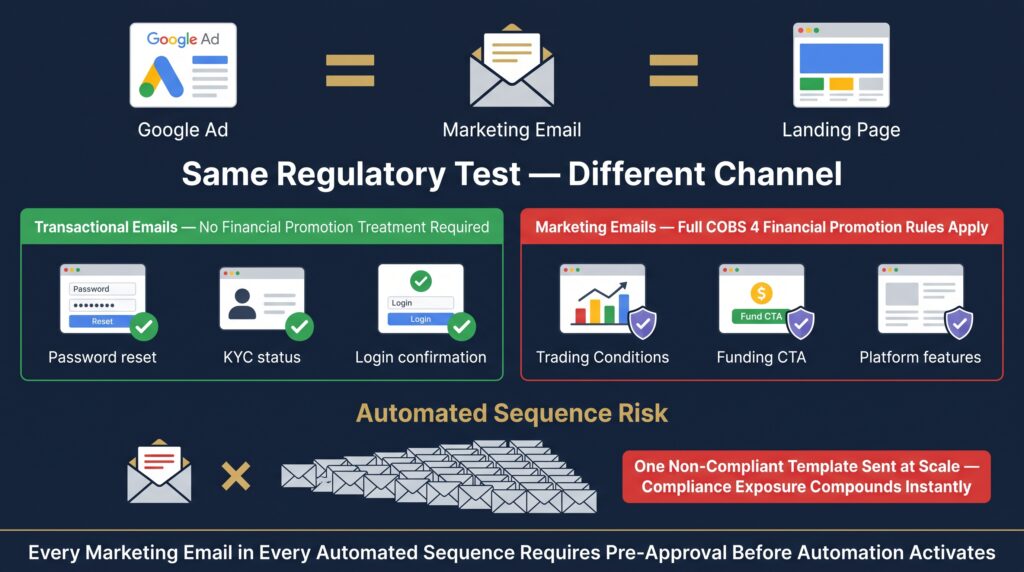
Any marketing email that discusses trading conditions, platform features tied to financial outcomes, or includes a call to action toward funding constitutes a financial promotion under FCA COBS 4 — exactly as much as a Google Ads creative or landing page. This is frequently overlooked because email feels like a lower-stakes, more personal channel than paid advertising, but the regulatory test does not distinguish by channel.
What this means practically: The risk warning prominence standard established in the landing page compliance guide applies to marketing emails that discuss trading conditions — included prominently in the email body, not buried in footer legal text, with a current, accurate loss percentage. The same prohibited claims (guaranteed returns, unsubstantiated performance statistics, retail client bonus offers) that apply to ad creative per the format-compliance matrix apply identically to email copy. Purely transactional emails (password reset, KYC status, login confirmation) do not require this treatment — making the transactional/marketing distinction from the previous section directly load-bearing for this requirement too.
The compliance sign-off workflow extension: Every marketing email should follow the same approval workflow established in the Google Ads account structure guide for ad creative — draft, compliance review against COBS requirements, approval with reference, then send. For automated drip sequences specifically, every email in the sequence needs pre-approval before the automation activates. A single non-compliant email automatically sent to thousands of registrants compounds the compliance exposure instantly and at scale — a risk that does not exist with manually reviewed one-off sends.
FOR CEOS — THE ONE QUESTION TO ASK YOUR EMAIL TEAM
Ask whether the automated welcome and nurture sequence has been through the same compliance sign-off process as the paid ad creative. If the answer is “the email team wrote it and it just goes out,” every email in that sequence is an unreviewed financial promotion running at scale to every new registrant.
Forex-Specific Deliverability Considerations
Financial services sending domains face a specific deliverability challenge beyond generic email marketing best practice: forex and trading-related keywords in subject lines and body content are commonly flagged by spam filters, largely due to historical association with high-volume forex scam and unregulated signal-seller email campaigns that have trained spam detection systems to treat this category with elevated scrutiny.
The practical implication: A legitimate regulated broker has to work harder on sender reputation and authentication than a comparably-sized business in a less spam-associated category. Standard authentication (SPF, DKIM, DMARC) is a baseline requirement, not optional. Subject line and content moderation should specifically avoid common spam-trigger patterns associated with forex scam email (excessive capitalization, guaranteed-return language, urgency-heavy framing) — which conveniently aligns with the compliance requirements from the previous section, since the same language patterns that trigger spam filters are frequently the same patterns that violate FCA financial promotion rules.
Segmentation by Actual Onboarding Step, Not Generic Categories
Effective segmentation for this funnel uses the broker’s actual CRM or onboarding step data, not generic engagement-based categories like “new leads” or “inactive leads.”
| Segment | Content Focus |
|---|---|
| Registered, no KYC started | Email 1 — document upload guidance |
| KYC document pending | Reminder if still pending after 48 hours |
| KYC approved, no deposit | Email 2 — payment clarification, Email 3 — funding reminder |
| Deposit attempted, failed | Specific payment-method troubleshooting — see note below |
The deposit-attempted-failed segment deserves specific attention. A user who attempted to deposit and had the transaction fail (card declined, payment method error, technical issue) is not the same as a user who has not attempted to deposit at all. This segment needs specific payment-method-troubleshooting content — not generic encouragement to fund, which ignores that they already tried and hit a technical obstacle. Treating this segment identically to the broader unfunded population misses the most addressable friction point of all: a concrete technical failure with a concrete fix.
Measuring Performance Against FTD, Not Just Open and Click Rates
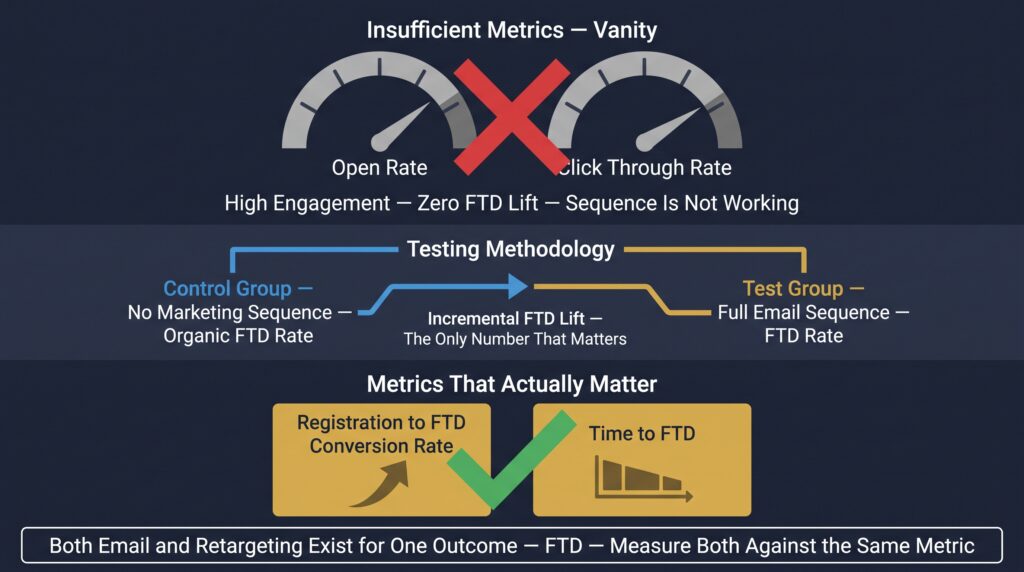
Standard email marketing metrics — open rate, click-through rate — are necessary diagnostic data but insufficient for evaluating this specific sequence. The metric that actually matters is registration-to-FTD conversion rate and time-to-FTD, connecting directly to the FTD framework. A sequence with excellent open rates but no measurable lift in FTD conversion relative to a baseline is not achieving its actual purpose, regardless of how engagement metrics look.
The testing methodology: Hold out a small control segment receiving no automated marketing sequence (or only the strictly transactional emails) to measure the actual incremental FTD lift the marketing sequence produces. This isolates the sequence’s genuine impact from the conversion that would have occurred anyway through other channels or organic motivation. Without this control comparison, it is impossible to distinguish “the sequence is working” from “these users were always going to fund regardless of the emails.”
This connects the email sequence’s success criteria to the same outcome metric that the parallel retargeting strategy is measured against — both channels exist to move the registration-to-funded segment toward the FTD event, and both should be evaluated against that shared outcome rather than channel-specific vanity metrics.
If you want this email sequence built and compliance-reviewed alongside your retargeting strategy — one coordinated plan for the registration-to-funded segment across both channels — that is part of the diagnostic.
FAQ
Q1: What email sequence converts forex broker registrations to funded accounts?
An effective forex broker email sequence for converting registrations to funded accounts targets the same registration-to-funded segment used in retargeting strategy, following a three-window timing structure. In the first 72 hours, high-frequency, friction-specific emails address the most common onboarding drop-off points directly: a document upload guide for users stalled at identity verification, and payment method clarification for users uncertain about funding options. From days 4 through 14, tapering value-reinforcement emails cover platform features and regulatory credibility. A final compliant re-engagement email is sent around days 15 through 21 before the segment moves to standard low-frequency nurture. The sequence should be segmented by actual onboarding step completion data from the broker’s CRM rather than sent as a single linear sequence to all unfunded registrants identically, since a user who has not started identity verification needs different content than a user who completed it but has not yet deposited.
Q2: How should KYC friction points inform forex broker email content?
Forex broker email content for the registration-to-funded segment should address the specific reason a user has not completed funding rather than using generic encouragement. The first email, sent within hours of registration, should address document upload friction by clearly explaining accepted identity document types, photo quality requirements, and expected processing time, since this is typically the most common onboarding drop-off point. A second email, sent if KYC remains incomplete after 24 to 48 hours, should clarify available payment methods and processing times to address funding uncertainty. A third email, sent if KYC is complete but the account remains unfunded after 72 hours, should provide a clean, compliant funding reminder addressing the segment that simply has not returned to complete the final step. This structure requires the email automation platform to branch based on actual onboarding step completion rather than sending the same sequence to every registered but unfunded user regardless of their actual progress.
Q3: What is the difference between transactional and marketing emails for a forex broker?
Transactional emails for a forex broker, such as identity verification status updates, account funding confirmations, password resets, and login notifications, generally fall under service communication obligations the broker must send to deliver the service the client has signed up for. Marketing emails, including any content promoting trading conditions, platform features tied to financial outcomes, or incentive-adjacent messaging, require separate marketing consent under data protection and electronic communications regulations distinct from the service relationship itself. This distinction matters because many automated onboarding email sequences blur the line, sending content framed as helpful account assistance that actually promotes trading opportunities or platform benefits, which may not be compliant if sent without separate marketing consent. The practical test is whether the email exists to help the user complete a service step they have already committed to, which is transactional, or to encourage further engagement, deposit, or trading activity beyond bare service delivery, which is marketing and requires corresponding consent. This interpretation should be verified with a data protection officer or legal counsel for the broker’s specific jurisdiction and processing setup.
Q4: Are forex broker marketing emails subject to the same compliance rules as paid ads?
Yes. Any marketing email that discusses trading conditions, platform features tied to financial outcomes, or includes a call to action toward funding constitutes a financial promotion under FCA COBS 4 rules, exactly as much as a paid advertisement or landing page. This means the same risk warning prominence requirements apply, with the warning included clearly in the email body rather than buried in footer legal text, using a current and accurate client loss percentage. The same prohibited claims that apply to advertising creative, including unsubstantiated performance statistics and retail client bonus offers, apply equally to email copy. Marketing emails should also follow the same compliance sign-off workflow used for advertising creative, with each email reviewed and approved before being added to an automated sequence. This is particularly important for automated drip sequences because a single non-compliant email, once activated, is sent automatically to every new registrant at scale, compounding the compliance exposure instantly rather than affecting a single manually reviewed send.
Q5: Why do forex broker emails commonly get flagged by spam filters?
Forex and trading-related keywords in email subject lines and body content are commonly flagged by spam filters due to historical association with high-volume forex scam and unregulated signal-seller email campaigns, which have trained spam detection systems to treat this content category with elevated scrutiny industry-wide. This means a legitimate regulated forex broker often has to work harder on sender reputation and email authentication than a comparably sized business in a less spam-associated category. Standard authentication protocols including SPF, DKIM, and DMARC should be treated as a baseline requirement rather than optional. Subject line and content patterns commonly associated with forex scam email, such as excessive capitalization, guaranteed-return language, and urgency-heavy framing, should be avoided, which conveniently aligns with financial promotion compliance requirements since the same language patterns that trigger spam filters frequently overlap with patterns that violate FCA financial promotion rules.
Q6: How should a forex broker measure the success of an email nurture sequence?
A forex broker should measure email nurture sequence success primarily by registration-to-funded-account conversion rate and time to first funded deposit, rather than relying only on standard email metrics such as open rate and click-through rate, which are useful diagnostic data but insufficient indicators of whether the sequence achieves its actual purpose. A sequence can show strong open and click rates while producing no measurable improvement in funding conversion compared to users who received no automated sequence at all. The recommended testing methodology involves holding out a small control segment that receives no automated marketing sequence, or only strictly transactional emails, to measure the genuine incremental lift in funded account conversion the sequence produces. This isolates the sequence’s actual impact from conversions that would have occurred anyway through other channels or the user’s own initiative, which is essential because without a control comparison it is not possible to distinguish a working sequence from users who were always going to fund regardless of the emails received.