
Meta Ads Account Structure for Forex Brokers, where to start?
The certification-and-market logic that structures a compliant Google Ads account applies just as directly to Meta — with two genuinely platform-specific differences that have no Google equivalent.
This guide assumes familiarity with the certification-to-campaign mapping principle established for Google Ads (or links you there if encountering the concept for the first time) and applies the same underlying logic to Meta’s account hierarchy: Business Manager, Ad Account, Campaign, Ad Set, Ad. Two Meta-specific wrinkles get full treatment here: Campaign Budget Optimization’s automated reallocation creating a distinct compliance risk, and Business Manager structure for brokers operating multiple regulated entities.
The structural issue I find most consistently in forex broker Meta accounts isn’t a non-compliant ad — it’s a Campaign Budget Optimization setup spanning a brand awareness ad set and a retargeting ad set simultaneously, which means Meta’s algorithm has been quietly reallocating spend between two completely different audience types and compliance risk profiles without any human making that decision.
This guide walks the hierarchy top to bottom — campaign segmentation, ad set logic, naming discipline, retargeting placement, the CBO tension, multi-entity structure, and affiliate content placement — closing with a single consolidated reference diagram.
Table of Contents
Campaign-Level Segmentation by Certification and Regulatory Market
Per the certification-to-campaign mapping established in the Google Ads account structure guide, the same principle applies to Meta with equal force: a campaign certified and geo-targeted for one regulatory market should never share scope with a different market’s content. A UK-certified, UK-targeted campaign and an EU-certified, EU-targeted campaign should be entirely separate Meta campaigns, never combined ad sets within one campaign — this isolation is what makes the certification-geo alignment established in the geo-targeting strategy guide auditable at the campaign level rather than requiring inspection of every individual ad set.
Why this matters more on Meta than it might initially seem: Meta’s interface makes it structurally easy to add a new ad set targeting a different geography within an existing campaign — a single click, no separate campaign creation friction. This ease is precisely what creates risk: a well-intentioned campaign manager “adding one more test market” to an existing certified campaign can silently create a certification-geo mismatch without realizing the structural boundary has been crossed.
The practical rule: One campaign equals one regulatory market and one certification status. If a new market needs testing, create a new campaign — even if it means more campaigns to manage, the auditability this provides is worth the additional administrative structure.
Ad Set Segmentation by Funnel Stage and Audience Type
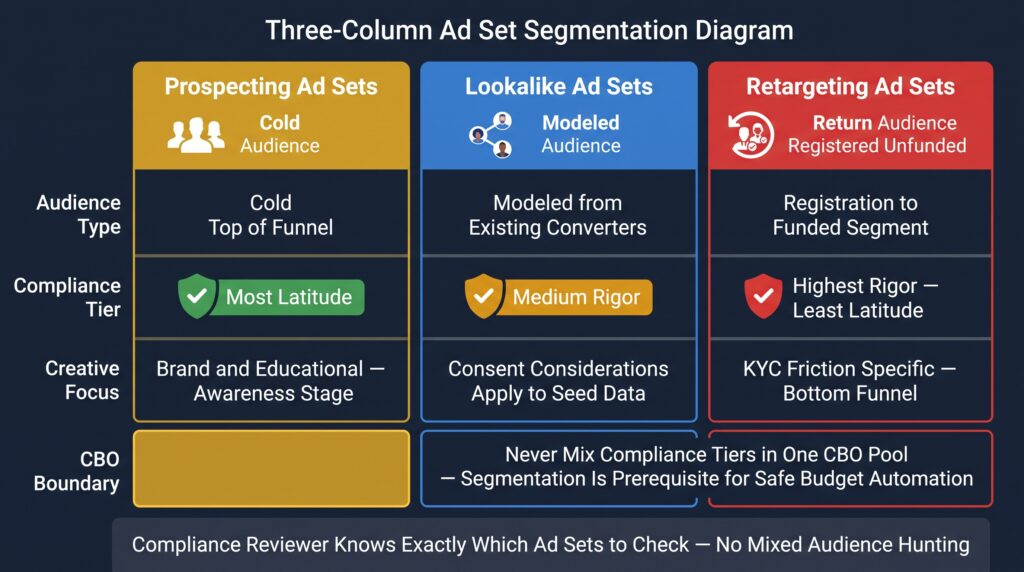
Within a correctly market-segmented campaign, ad sets should segment by funnel stage and audience type rather than purely by demographic testing variables. Per the funnel-stage framework in the ad creative formats guide, three broad ad set categories apply: prospecting (cold, top-of-funnel awareness audiences), retargeting (the registration-to-funded segment from the retargeting strategy guide), and lookalike (audiences modeled from existing converters, carrying the consent considerations established in the Meta policy changes guide).
Why this segmentation matters beyond performance optimization: Each of these three categories carries a different compliance rigor tier — prospecting has the most latitude, retargeting the least, per the bottom-funnel compliance principle established across the ad creative and retargeting guides. Structuring ad sets along this boundary, rather than mixing audience types within a single ad set for “efficiency,” keeps the compliance review scope clean: a compliance reviewer checking retargeting creative knows exactly which ad sets to examine, rather than needing to identify which specific audiences within a mixed ad set are retargeting versus prospecting.
This segmentation also directly enables the CBO boundary discussed later in this guide — compliance-tier-aligned ad set grouping is the prerequisite for safe automated budget optimization.
Naming Convention Discipline for Multi-Market Auditability
A consistent naming convention encodes regulatory market, certification status, funnel stage, and creative format directly into campaign and ad set names — making the account auditable at a glance rather than requiring every individual campaign to be opened to confirm compliance alignment.
A practical pattern: Campaign names following [Market]_[Entity]_[FunnelStage] — for example, “UK_FCA_Prospecting” or “EU_CySEC_Retargeting” — immediately signal certification scope and compliance tier without opening the campaign. Ad set names within that campaign can add the audience or format detail — “UK_FCA_Prospecting_LAL-1pct” for a 1% lookalike audience, for instance.
This directly supports the periodic certification and geo-targeting audit discipline established in the geo-targeting strategy guide and audit checklist — a reviewer scanning the campaign list can immediately spot a campaign whose name doesn’t match its actual targeting (a “UK_FCA” campaign somehow including EU geography, for example) as an anomaly worth investigating, without needing to open every single campaign individually.
Where Retargeting Audiences Sit in the Hierarchy
The registration-to-funded segment established in the retargeting strategy guide should occupy its own dedicated campaign, not be embedded as one ad set within a broader prospecting campaign. This isolation serves three purposes: the budget allocated to this highest-value segment is cleanly visible and separately controllable; the audience suppression logic — removing funded users from this audience immediately, per the funded-exit-signal principle — applies to a clearly bounded campaign scope rather than requiring extraction from a mixed-audience ad set; and the compliance review for this highest-rigor segment (bottom-funnel, closest to the actual financial promotion) is structurally separable from prospecting review.
The practical structure: A dedicated “[Market]_[Entity]_Retargeting” campaign, with ad sets inside it segmented by the specific KYC friction stage (document-pending, payment-pending, deposit-failed) if the broker’s CRM data supports that granularity.
Campaign Budget Optimization and the Compliance Tension
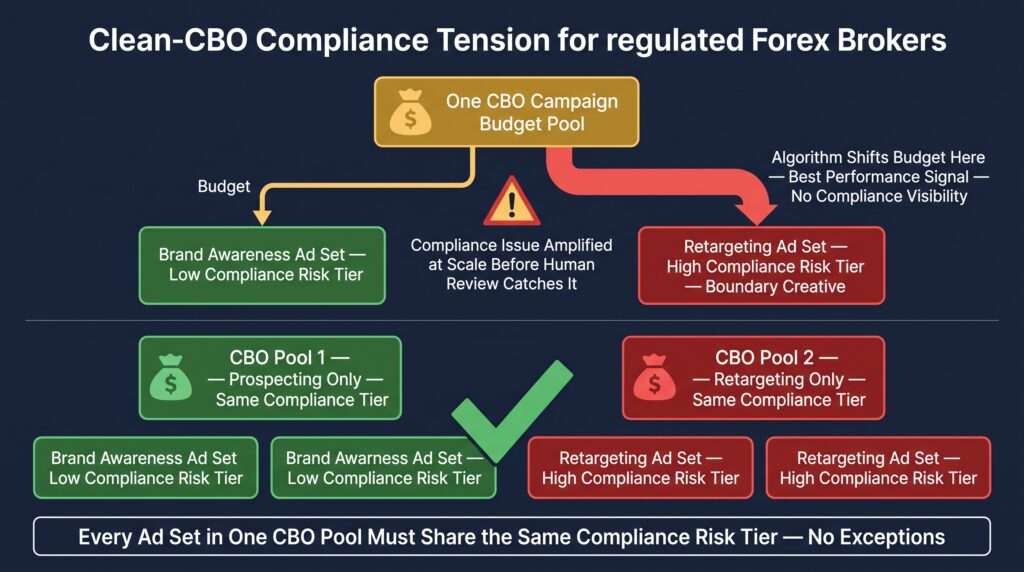
Meta’s Campaign Budget Optimization automatically shifts spend toward the best-performing ad set within a campaign, based on real-time performance signals. This is a genuinely useful efficiency feature — and a genuine compliance risk if the campaign structure doesn’t account for it.
THE SPECIFIC RISK
If a single CBO-managed campaign contains ad sets spanning different compliance risk tiers — a brand-awareness ad set alongside a retargeting ad set, for example — Meta’s algorithm can shift budget toward whichever ad set performs best, without regard to which one carries higher compliance scrutiny. An ad set running boundary-pushing but high-performing creative could receive disproportionate budget before a human compliance reviewer catches the issue, simply because the automated system optimizes purely for performance signals it can measure, with no visibility into compliance risk it cannot.
The practical control: Structure campaigns so every ad set within a single CBO-managed campaign shares the same compliance risk tier — per the segmentation established earlier in this guide. Never combine prospecting and retargeting ad sets under one CBO umbrella; never combine brand-awareness and high-claim performance creative within the same automated budget pool. This prevents automated reallocation from amplifying an undetected compliance issue before manual review catches it.
Note: Meta has renamed Campaign Budget Optimization to Advantage+ Campaign Budget in Ads Manager — the terms refer to the same feature and both remain in common use.”
Business Manager Structure for Multi-Entity Brokers
A broker operating multiple regulated entities — per the multi-licence structure discussed in the regulatory tier guide — should generally maintain separate ad accounts per entity within a shared Business Manager, mirroring the certification-per-entity principle established for Google Ads in the certification guide.
Why separate ad accounts, not just separate campaigns: Identity verification (per the Meta policy changes guide) and certification status are tied to the ad account level on Meta, not just the campaign level. Commingling two regulated entities’ campaigns within a single ad account creates ambiguity about which entity’s verification and certification status actually covers a given campaign — separate ad accounts keep each entity’s compliance history, verification status, and campaign activity cleanly and unambiguously separated, with the shared Business Manager providing centralized administrative oversight without merging the underlying compliance scope.
Where Affiliate and Partnership Ads Content Sits Structurally
Per the Partnership Ads format requirement established in the Meta policy changes guide and the affiliate compliance responsibility in the affiliate vs direct acquisition guide, partner-run content should be structurally identifiable within the account rather than blending invisibly into the broker’s own direct campaigns.
The practical structure: Either a dedicated campaign naming pattern (a “Partnership_” prefix, for example) within the broker’s existing ad account, or — for brokers running substantial affiliate volume — a separate ad account specifically scoped to partnership-tagged content. Either approach gives the affiliate creative oversight process a clear, auditable scope: a compliance reviewer checking affiliate content compliance knows exactly which campaigns to examine, rather than needing to identify which specific ads within the broker’s general campaign structure originated from a partner relationship.
The Consolidated Reference Architecture
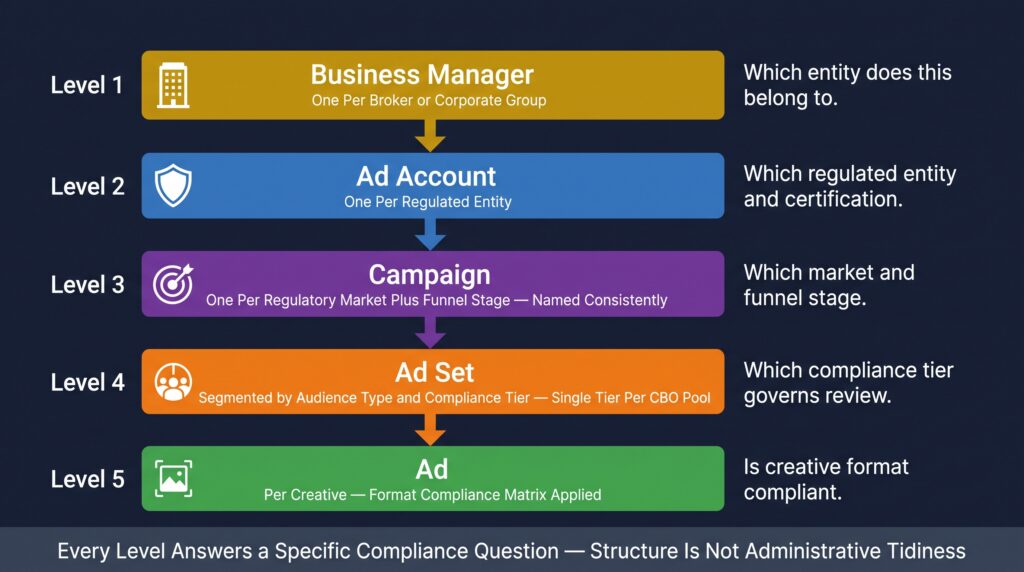
The complete hierarchy, top to bottom:
BUSINESS MANAGER
One per broker or corporate group
AD ACCOUNT
One per regulated entity
CAMPAIGN
One per regulatory market + funnel stage, named consistently
AD SET
Segmented by audience type + compliance tier, single tier per CBO pool
AD
Per creative, following the format-compliance matrix
This structure is not arbitrary administrative tidiness — every level of this hierarchy exists to make a specific compliance or operational question answerable at a glance: which entity does this belong to, which market and certification does it require, which compliance tier governs its review, and is its creative format-compliant. A marketing team setting up a new Meta presence, or auditing an existing one against this structure, should be able to map their current setup onto this hierarchy and immediately identify where the structure diverges from this framework.
If you want your current Meta account structure audited against this framework — certification alignment, naming consistency, and CBO compliance-tier boundaries — that audit is part of the diagnostic.
FAQ
Q1: How should forex broker Meta campaigns be segmented by regulatory market?
A forex broker’s Meta campaigns should be segmented so that each campaign covers exactly one regulatory market and one certification status, never combining multiple regulatory markets within a single campaign’s ad sets. A campaign certified and geo-targeted for the United Kingdom under FCA authorisation should be entirely separate from a campaign certified and targeted for European Union markets under CySEC authorisation, even though both may promote the same broker. This separation makes certification and geo-targeting alignment auditable at the campaign level, since Meta’s interface makes it structurally easy to add a new ad set targeting a different geography within an existing campaign, which can silently create a certification-market mismatch if a campaign manager adds a new test market without creating a separate campaign. The practical rule is one campaign equals one regulatory market and one certification status, even when this means managing more individual campaigns than a less compliance-aware structure would require.
Q2: How should ad sets be organized within a forex broker’s Meta campaign?
Ad sets within a correctly market-segmented Meta campaign should be organized by funnel stage and audience type rather than purely by demographic testing variables. The three broad categories are prospecting, covering cold top-of-funnel awareness audiences, retargeting, covering the registration-to-funded segment of users who have already registered but not yet funded an account, and lookalike audiences modeled from existing converters. Each of these categories carries a different compliance rigor tier, with retargeting carrying the highest scrutiny since its messaging sits closest to the actual financial promotion encouraging a deposit decision. Structuring ad sets along this boundary rather than mixing audience types within a single ad set keeps the compliance review scope clean, allowing a compliance reviewer to identify exactly which ad sets require the highest level of scrutiny without needing to disentangle mixed audience types within a single ad set.
Q3: What naming convention should forex brokers use for Meta campaigns and ad sets?
An effective naming convention for forex broker Meta campaigns encodes regulatory market, certification status, and funnel stage directly into the campaign name, such as a pattern combining market, regulatory entity, and funnel stage like UK underscore FCA underscore Prospecting or EU underscore CySEC underscore Retargeting. Ad set names within that campaign can add further detail such as audience type or creative format. This naming discipline makes the account auditable at a glance, since a reviewer scanning the campaign list can immediately identify a campaign whose name does not match its actual targeting configuration as an anomaly requiring investigation, without needing to open every individual campaign to manually verify alignment between its name and its actual certification, market, and audience settings.
Q4: Can Meta’s Campaign Budget Optimization create compliance risk for forex brokers?
Yes. Meta’s Campaign Budget Optimization automatically shifts advertising spend toward the best-performing ad set within a campaign based on real-time performance signals, which can create compliance risk if a single campaign contains ad sets spanning different compliance risk tiers. If a campaign combines a brand-awareness ad set with a retargeting ad set, for example, Meta’s algorithm can shift disproportionate budget toward whichever ad set performs best without any visibility into which one carries higher compliance scrutiny, potentially amplifying spend toward boundary-pushing but high-performing creative before a human compliance reviewer identifies the issue. The practical control is to structure campaigns so that every ad set within a single Campaign Budget Optimization managed campaign shares the same compliance risk tier, never combining ad sets from different funnel stages or audience types under one automated budget pool.
Q5: Should a forex broker with multiple regulated entities use separate Meta ad accounts?
Yes. A forex broker operating multiple regulated entities, such as a separate FCA-regulated entity for the United Kingdom and a separate CySEC-regulated entity for European markets, should generally maintain separate Meta ad accounts per entity within a shared Business Manager, mirroring the same per-entity certification principle that applies to Google Ads. This separation matters because identity verification and certification status are tied to the ad account level on Meta, meaning commingling two regulated entities’ campaigns within a single ad account creates ambiguity about which entity’s verification and certification status actually covers a given campaign. Separate ad accounts keep each entity’s compliance history, verification status, and campaign activity cleanly and unambiguously separated, while the shared Business Manager still provides centralized administrative oversight without merging the underlying compliance scope between entities.
Q6: How should affiliate-run Meta content be structured within a forex broker’s account?
Affiliate and partner-run content promoting a forex broker on Meta should be structurally identifiable within the account rather than blending invisibly into the broker’s own direct campaigns. A practical approach is using a dedicated campaign naming pattern, such as a consistent prefix identifying partnership content, within the broker’s existing ad account, or for brokers running substantial affiliate volume, maintaining a separate ad account specifically scoped to partnership-tagged content. This structural separation gives the affiliate creative oversight process a clear and auditable scope, allowing a compliance reviewer checking affiliate content compliance to know exactly which campaigns to examine rather than needing to identify which specific ads within the broker’s general campaign structure originated from a partner relationship, which becomes increasingly important given that brokers remain responsible for financial promotions distributed by affiliates regardless of who produced the creative.