
Structuring Forex Broker Content for AI Citation, why it is so important?
AI engines do not cite the most beautifully written regulatory disclosure. They cite the most extractable one — and for most forex broker regulation pages, those are not the same document.
When an AI engine retrieves a page to answer a query, it breaks the page into semantic blocks of approximately 300–500 words, scores each block for relevance, and pulls the highest-scoring blocks to synthesise a cited answer. A regulation page full of well-written marketing prose — “we are proud to be regulated to the highest standards, ensuring the safety and security of our clients” — scores poorly in that retrieval process. It contains no specific, verifiable, named-entity claim an engine can extract and reproduce. The same page rewritten with one fact per block, entity name stated explicitly, licence number stated explicitly, jurisdiction stated explicitly — scores well and gets cited.
This guide covers the three layers of implementation for a regulated forex broker: structure (how to format content for extraction), schema (how to mark it up so engines parse it structurally), and sourcing (how to create the corroborating signals that make financial claims citable rather than self-referential). For the strategic context and why AI citations matter for a forex broker specifically, see AEO/GEO strategy for forex brokers. This article is the implementation layer.
Table of Contents
The TL;DR Block — What the First 150 Words of Your Regulation Page Should Do
AI retrieval systems weight front-loaded content. The first chunks extracted from a page carry more scoring weight than later chunks — which means the opening 150–200 words of a broker’s regulation page are disproportionately important for AI citation. For most forex broker regulation pages, those 150 words currently contain a brand positioning statement, a founding date, and a general claim about commitment to excellence. For AI citation purposes, they should contain something entirely different.
The opening block of a regulation page should contain, in this order and without preamble: the exact legal entity name (not the brand umbrella — the specific regulated entity that holds the licence); the regulator by full name and abbreviation; the licence number as a standalone citable fact; the jurisdiction and applicable regulatory framework; and the key client protection provisions such as negative balance protection, ESMA leverage limits for retail clients, and the applicable deposit protection scheme.
No setup. No “we are proud to.” No award badges in the first paragraph. No “since [year]” founding narrative. These belong further down the page — they are not what an AI engine is checking when it evaluates whether to cite a regulatory claim from a YMYL financial source.
| BEFORE — Typical Regulation Page Opening | AFTER — Restructured for AI Citation |
|---|---|
| “[Broker] is a leading provider of forex and CFD trading services, founded in [year] with a commitment to providing our clients with a secure, transparent, and professional trading environment. We are regulated by the relevant financial authorities and hold all necessary licences to operate across our target markets. Our award-winning platform and dedicated support team ensure that every client receives the highest standards of service.” Result: Uncitable. No entity name, no licence number, no regulator named, no jurisdiction stated. An AI engine retrieving this block finds nothing specific to extract. | [Broker] Limited is authorised and regulated by the Cyprus Securities and Exchange Commission (CySEC), CIF Licence Number [X]. CySEC is the financial services regulator for the Republic of Cyprus. [Broker] Limited operates under EU MiFID II, offering investment and ancillary services to retail and professional clients. Retail clients are protected under ESMA leverage limits (maximum 1:30 for major currency pairs), negative balance protection, and are eligible for compensation under the Investor Compensation Fund (ICF) up to €20,000. Result: Three atomic blocks. Three verifiable facts. Entity name, licence number, jurisdiction, client protection regime — all in the first paragraph, all citable independently. |
Any restructuring of the regulation page opening block should go through compliance review before publishing — even if it only reorders existing approved content. Reordering approved claims typically moves through compliance in 3–7 business days rather than the longer window required for new substantive claims.
Atomic Chunking for Regulatory Content — One Fact Per Block
Atomic chunking is the practice of structuring every section of content so that each two-to-four-sentence block independently expresses one complete, verifiable fact. The governing principle, well-established in AI content structuring research: one core fact per block. If a block contains two important facts, split it into two blocks. If important context belongs with a claim, it goes in the sentence immediately after — as a second block — not woven into the same sentence as the primary claim.
For a regulated forex broker, the practical challenge is that regulatory disclosures are typically written by legal teams for compliance purposes. They are comprehensive, formally worded, and deliberately contextualised. The licence number, the regulator name, and the jurisdiction appear together in a single clause — because legally, that is the complete disclosure. For AI citation purposes, that single clause is a problem.
The Extractability Failure — Before
“The Company, being authorised and regulated by the Cyprus Securities and Exchange Commission under CIF Licence Number [X], in accordance with the provisions of Directive 2014/65/EU (MiFID II) as implemented in the Republic of Cyprus, offers investment and ancillary services to its clients subject to the conditions and limitations set forth herein.”
Legally accurate. Formally complete. Not extractable. The key fact — the licence number — is the ninth word of a 57-word dependent clause. An AI engine scoring this block for the query “Is [broker] regulated and what is the licence number?” retrieves the block but scores it poorly because the answer is not cleanly isolated.
Three Atomic Blocks — After
Block 1: [Broker] Limited is authorised and regulated by the Cyprus Securities and Exchange Commission (CySEC), CIF Licence Number [X].
→ Answers: “Is [broker] regulated?” and “What is the CySEC licence number?”
Block 2: CySEC is the financial services regulator for the Republic of Cyprus. [Broker] operates under EU MiFID II, which applies to all EU member state retail and professional clients.
→ Answers: “What is CySEC?” and “Which regulatory framework applies?”
Block 3: [Broker] provides investment and ancillary services to retail and professional clients within the conditions of its CySEC authorisation.
→ Answers: “What services does [broker] offer under its licence?”
The legal content of both versions is identical. The atomic version is citable; the formal version is not. The test for any regulatory content block: can it be extracted, removed from all surrounding context, and still answer a specific question accurately? If not, split it.
Restructured regulatory content requires compliance review before publishing even when the underlying facts are unchanged — the presentation change affects how the content reads legally. Restructured existing approved content typically moves through compliance in 5–7 business days.
The most common resistance from broker legal teams is “but we need the context around the licence number.” The answer is: add the context as a second atomic block, after the core fact. Context does not need to be in the same sentence — it needs to be in the next sentence.
Structuring Forex Broker Content for AI Citation-Direct-Answer Leads on Every Regulatory Page Section
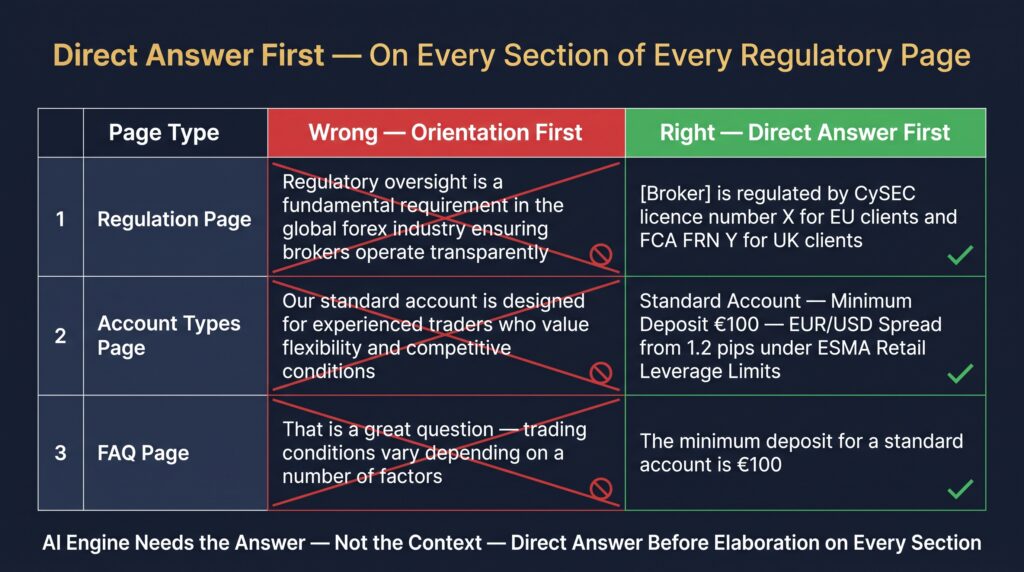
Every H2 section on a broker’s regulation, conditions, or FAQ page should open with a direct answer to the question implied by the heading — before any elaboration follows. This principle is well-established in AI content structuring research and applies with particular force to regulated broker content where the questions being asked are specific and the answers must be verifiable.
A section headed “Is [Broker] Regulated?” should not open with “Regulatory oversight is a fundamental requirement in the global forex industry, ensuring that brokers operate transparently and in the best interests of their clients.” That is an orientation sentence — useful to a human reader who needs context, not useful to an AI engine that needs the answer. The section should open with “[Broker] is regulated by CySEC, licence number [X], for EU clients, and by [regulator] for [market] clients.”
Applied to the three pages most important for AI citation on a broker’s site:
Regulation page: Every H3 section (about the specific regulator, about the licence, about client protection) opens with the direct regulatory fact. The historical context, the regulator’s founding year, the broker’s own founding date — these follow the direct answer, not precede it.
Account types page: Every H3 for each account type opens with the minimum deposit and the key spread or condition. Not “our standard account is designed for experienced traders who value flexibility and competitive conditions.” The direct answer: “Standard account: minimum deposit €100, EUR/USD spread from 1.2 pips under ESMA retail leverage limits.”
FAQ page: Every FAQ answer opens with a direct, complete answer in the first sentence. The question structure already sets the context — the answer needs to follow immediately. “The minimum deposit for a standard account is €100” is the direct answer. “That is a great question — trading conditions vary depending on a number of factors” is not.
The Direct-Answer Test
Could someone read only the first sentence of each section on this page and walk away with accurate, actionable information about the broker? If yes, the page is structured for AI citation. If no, the opening sentences are orientation text that should be deleted or moved after the direct answer.
Why Accordion FAQs Create Two Problems for a Regulated Broker
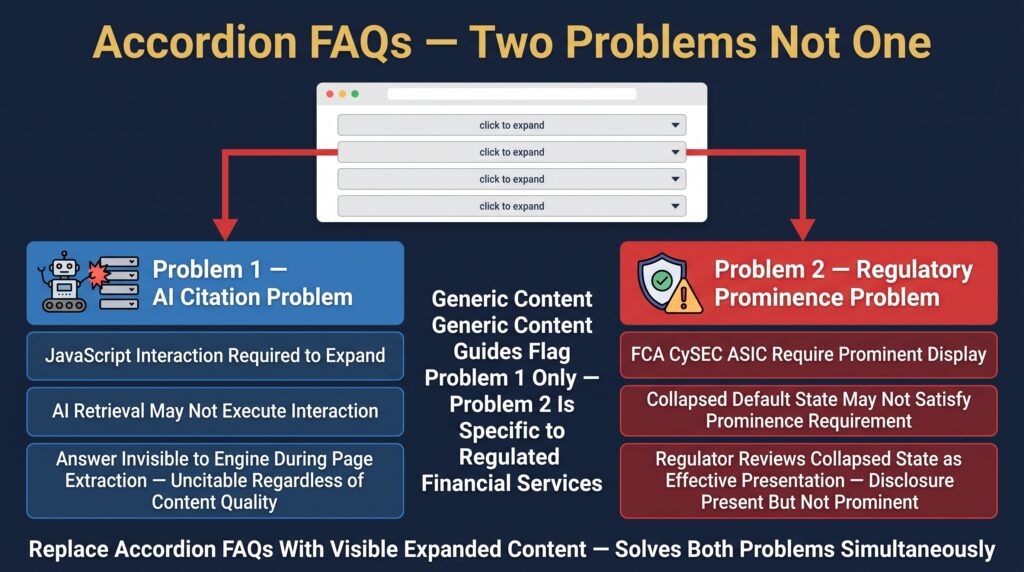
Accordion FAQ implementation — the pattern where FAQ answers are collapsed by default and revealed only on user click — is commonly flagged in AI content structuring guides as harmful for AI citation. The reason: accordion-collapsed content is hidden behind JavaScript interaction, and AI language model retrieval systems may not reliably expand and read collapsed accordion elements during page extraction. An FAQ answer collapsed inside an accordion may simply not appear in the retrieved version of the page during an AI search cycle, making it uncitable regardless of content quality.
For a regulated forex broker, this is only half the problem. The second issue is specific to regulated financial services and does not appear in any generic content structuring guide.
Financial services regulators — including the FCA, CySEC, and ASIC — require that risk disclosures and regulatory information be prominently displayed and clearly visible to users. “Prominently displayed” has a specific regulatory meaning: the information should be visible in the normal state of the page, not requiring user action to reveal. A risk warning or regulatory disclosure that is collapsed by default in an accordion may not satisfy this prominence requirement. A regulator reviewing the broker’s site may treat the collapsed state as the effective presentation seen by the user — meaning the disclosure, while technically present, was not prominently displayed at the time of the visit.
Expanding compliance-relevant FAQ content from accordion to plain visible HTML solves both problems with one change. The AI system can read the content because it is in the DOM. The regulator can see it because it is visible by default. There is no scenario in which keeping compliance-related content collapsed in an accordion is correct for a regulated broker.
Before restructuring any FAQ page, review all accordion-collapsed content for regulatory disclosures or risk warnings. Some brokers use collapsed FAQ sections to nominally satisfy a disclosure requirement in hidden state — expanding or removing the accordion may change the compliance status of the page. Compliance review should explicitly cover this point before any FAQ restructuring goes live.
Broker-Specific Schema — Organization, LegalName, Identifier, and FAQPage
Schema markup gives AI engines a structured, machine-readable layer above the visible HTML — explicit declarations about what an entity is, what it does, and what its verifiable identifiers are. For a generic SaaS company, Organisation schema declares name, URL, logo, and social profiles. For a regulated forex broker, the schema layer needs to go further — and the specific fields that matter most are ones that standard schema guides never mention.
The core Organisation schema fields for a regulated broker:
legalName — the full legal entity name registered with the regulator, not the trading brand name. “XYZ Trading Limited” not “XYZ Broker.” This is the field that helps an AI engine distinguish the broker from brand variants, clone sites, and other entities sharing a similar name.
identifier — the regulatory licence number, declared as a PropertyValue with name set to the regulator name (e.g. “CySEC Licence”) and value set to the licence number (e.g. “XXX/YY”). This is the most AI-citation-valuable schema field a regulated broker can add — it creates a machine-readable, verifiable link between the entity and its regulatory credential.
areaServed — the jurisdiction (e.g. “European Union” for a CySEC-regulated entity, “United Kingdom” for FCA). Declares which market the entity serves under which regulatory framework.
For multi-entity brokers: Each regulated entity should have its own subOrganization block within the parent Organisation schema, with its own legalName, identifier, and areaServed. This is the schema structure that most directly addresses the regulatory-entity disambiguation problem — it tells the engine that the broker operates multiple distinct regulated entities under one brand, with different licences for different markets.
| Schema Type | Key Field | What It Does for AI Citation | Implementation |
|---|---|---|---|
| Organization | legalName | Disambiguates the regulated entity from the brand name, clones, and subsidiaries | Homepage + regulation page. RankMath → Schema → Organization or code injection. |
| Organization | identifier (PropertyValue: name + value) | Declares the licence number as a machine-readable credential the engine can verify against the regulator’s public register | One PropertyValue per regulated entity. name = “CySEC Licence” / value = “[X]”. |
| subOrganization | legalName + identifier + areaServed | Declares each separate regulated entity — solves multi-entity confusion where the engine conflates EU and offshore entities | One subOrganization block per regulated entity. Code injection. |
| FAQPage | question + acceptedAnswer | Explicit Q&A extraction signal — tells the engine to treat the section as a question-answer pair, increasing citation probability for FAQ-format queries | RankMath → Schema → FAQ on regulation page and conditions pages. Questions written as natural-language queries: “Is [broker] regulated?” |
Full treatment of FAQPage schema and its specific impact on AI visibility in does FAQ schema actually improve AI visibility for forex brokers.
Factual-Claim Density and Sourcing — The Broker’s Competitive Advantage
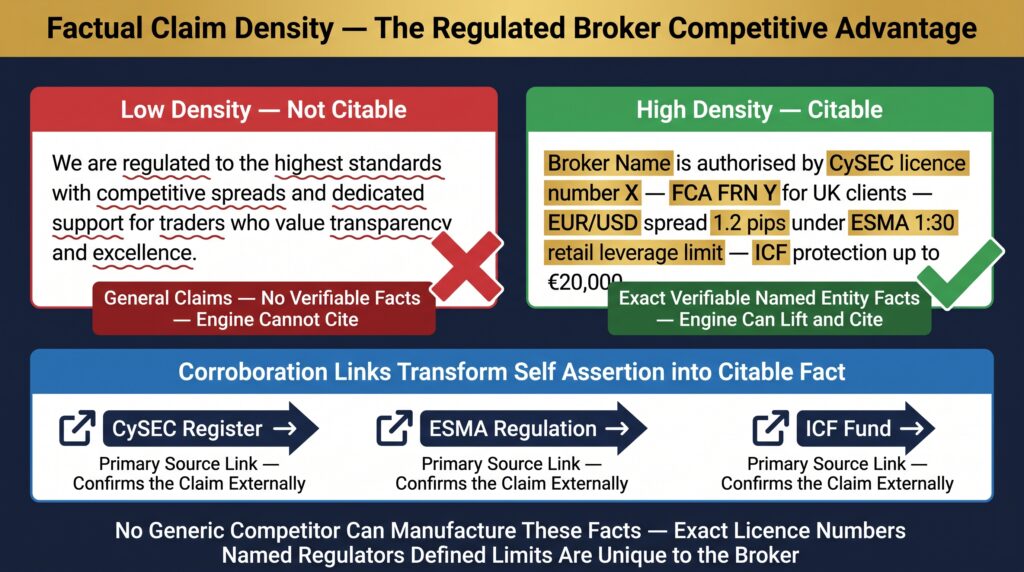
Factual-claim density — the concentration of specific, verifiable, named-entity facts per paragraph — is one of the strongest predictors of AI citation. AI engines score blocks for how directly and specifically they answer a query. A block dense with verifiable facts (specific numbers, licence numbers, named regulators, named jurisdictions, defined leverage limits) scores higher than a block dense with general claims or marketing language.
A regulated forex broker holds a set of verifiable named-entity facts that no generic content competitor can manufacture: an exact CySEC or FCA licence number; a specific regulated entity name; a defined leverage limit under ESMA guidelines (maximum 1:30 for major currency pairs for retail clients); a named deposit protection scheme with a specific coverage amount (Investor Compensation Fund up to €20,000 for CySEC-regulated entities). These facts are not approximate — they are exact, verifiable, and unique to the broker. Stating them explicitly in atomic blocks is the definition of high factual-claim density for a YMYL financial query.
The sourcing layer: Factual-claim density does its full work only when claims are verifiable. For a regulated broker, this means linking to the primary sources that confirm each claim: a link to the CySEC public register entry for the licence number; a link to the relevant ESMA regulation for the leverage limits; a link to the Investor Compensation Fund for the deposit protection amount. These outbound links to primary regulatory sources are the AI engine’s corroboration signal — the claim is not just stated, it is linked to the authoritative external source that would confirm it. This transforms a self-assertion into a corroborated, citable fact. Full treatment of YMYL trust signals and how AI models weigh them for financial content in YMYL trust signals for financial content.
Why Content Quality Per Page Beats Volume for a Regulated Broker’s AI Citations
There is a narrative in forex content marketing that AI tools enable volume production at scale — 50 to 100 articles per month — and that volume creates ranking and citation advantage by covering more keyword territory. Volume is not inherently wrong. Thin content at volume is.
AI citation works at the page level. A page with high factual-claim density, correctly atomised regulatory blocks, verifiable licence numbers, proper schema, and outbound links to primary regulatory sources produces more AI citation value than ten pages of generic content that says “we are regulated” without naming the specific entity, licence number, or jurisdiction. The engine retrieves and scores each page independently — volume does not compound citation quality if the individual pages lack the signals that trigger citation.
For a regulated forex broker specifically, the production constraint is not volume — it is factual accuracy at scale. An AI-generated article that states the wrong regulator, an outdated licence number, or a generic regulatory claim that does not match the broker’s actual entity structure is not a content quality problem. It is a compliance exposure that scales with the volume of content produced. One well-structured regulation page with verified entity data beats fifty pages of marketing copy for every query involving the broker’s regulatory status.
The practical implication: regulated brokers should produce content at whatever volume their quality and accuracy standards can sustain — not compress those standards to hit a volume target. The 90-day AEO/GEO implementation roadmap and the forex broker SEO audit both reflect this: factual accuracy and entity clarity, not volume, are the correct production constraints for a regulated brand.
Insert pattern-based observation about quality-over-volume in broker AEO programmes. Suggested: “The brokers I see making the most AI citation progress in 2026 are not the ones producing the most content — they are the ones who have methodically restructured their 5–10 core regulatory and conditions pages to be extraction-ready.” Delete once written.
“If you want to know which of your existing pages have the highest AI citation potential — and which regulatory content blocks are currently invisible to LLMs — that analysis is part of the AI/GEO visibility audit.”
FAQ
Q1: How should a forex broker structure its regulation page for AI citation?
A forex broker’s regulation page should be structured using three principles to maximise AI citation. First, front-load the key regulatory facts in the first 150 to 200 words: the exact legal entity name, the regulator by full name and abbreviation, the licence number as a standalone fact, the jurisdiction, and the applicable client protection regime such as negative balance protection or the relevant deposit protection scheme. Second, use atomic blocks throughout the page — one self-contained fact per paragraph, so that each block can be extracted by an AI system and still answer a specific question accurately without requiring surrounding context. A section about the CySEC licence should open with the entity name and licence number in the first sentence, not embedded inside a dependent clause. Third, add FAQPage schema via a plugin such as RankMath for any question-and-answer sections on the page, using natural-language question formats that match the exact queries prospects ask, such as “Is [broker] regulated?” and “What is [broker]’s CySEC licence number?” Any restructuring of regulatory content should be submitted for compliance review before publication.
Q2: What is atomic chunking and why does it matter for forex broker content?
Atomic chunking is the practice of structuring every section of content so that each two-to-four-sentence block independently expresses one complete, verifiable fact. It matters for AI citation because AI engines using retrieval-augmented generation break pages into three hundred to five hundred word semantic blocks, score each block for relevance to a user query, and pull the highest-scoring blocks to synthesise a cited answer. A block that opens with a clear, specific claim scores higher than a block that buries the key fact inside contextualising prose. For a regulated forex broker, atomic chunking is especially important for regulatory content: a licence number embedded in a sixty-word dependent clause is not citable in the same way as the same licence number in a standalone sentence. The governing rule is one core fact per block, and any important information that cannot be included in the same block without obscuring the primary claim should be moved to a separate atomic block immediately following it.
Q3: What schema markup should a regulated forex broker use on its regulation page?
A regulated forex broker should use a combination of Organisation schema and FAQPage schema on its regulation page. For Organisation schema, the most important fields are legalName, which should state the specific legal entity name rather than the trading brand name; identifier, which should declare the regulatory licence number as a structured property value with the regulator name and the licence number as key-value pairs; and areaServed, which declares the jurisdiction the entity covers such as the European Union under MiFID II. For brokers operating multiple regulated entities under one brand, each entity should be declared as a subOrganization with its own legalName, identifier, and areaServed fields. FAQPage schema should be added to any question-and-answer sections on the regulation page using a plugin, with questions written as the exact natural-language queries a prospect would ask about the broker’s regulatory status. This combination gives AI engines both the structured entity data from Organisation schema and the explicit question-answer extraction signal from FAQPage schema.
Q4: Why is accordion FAQ implementation problematic for a regulated forex broker?
Accordion FAQ implementation creates two separate problems for a regulated forex broker. The first is an AI citation problem: accordion-collapsed content is hidden behind JavaScript interaction, and AI language model retrieval systems may not reliably expand and read collapsed accordion elements during page extraction. A FAQ answer collapsed in an accordion may simply not appear in the retrieved version of the page during an AI search cycle, making it uncitable regardless of its content quality. The second is a regulatory compliance problem specific to financial services: regulators including the FCA, CySEC, and ASIC require that risk disclosures and regulatory information be prominently displayed and clearly visible to users. A risk warning or regulatory disclosure that is collapsed by default in an accordion may not satisfy this prominence requirement, as the regulator may treat the collapsed state as the effective presentation seen by the user. Expanding all compliance-relevant FAQ content from accordion to plain visible HTML addresses both problems simultaneously: the AI system can read it and the regulator can see it as prominently displayed.
Q5: How does factual-claim density help a forex broker’s content get cited by AI engines?
Factual-claim density refers to the concentration of specific, verifiable, named-entity facts per paragraph — licence numbers, regulator names, jurisdictions, specific product conditions such as exact spread values and minimum deposit amounts, and named client protection provisions. AI engines using retrieval-augmented generation score content blocks for how directly and specifically they answer a query, and blocks with high factual-claim density score higher than blocks containing general claims or marketing language. A regulated forex broker holds a set of verifiable named-entity facts that generic marketing content cannot match: an exact CySEC or FCA licence number, a specific regulated entity name, a defined leverage limit under ESMA guidelines, and a named deposit protection scheme with a specific coverage amount. Stating these facts explicitly in atomic blocks, and linking them to the verifiable primary sources such as the regulator’s own public register, transforms self-assertions into corroborated citable claims. Outbound links to primary regulatory sources serve as the corroboration signal that tells AI engines the claim can be verified rather than taken on the broker’s word alone.
Q6: Why is high-volume AI content production the wrong strategy for a regulated forex broker’s AEO programme?
High-volume AI content production is the wrong strategy for a regulated forex broker’s AEO programme for two specific reasons. First, AI citation works at the page level rather than the volume level: a page with high factual-claim density, correctly atomised blocks, verifiable regulatory claims, and proper schema produces more AI citation value than fifty pages of generic AI-generated content that lacks specific licence numbers, verifiable regulatory claims, and structured entity data. Volume does not compound citation quality. Second, a regulated broker cannot publish content containing regulatory claims without compliance review, which typically takes five to fourteen business days per piece. A volume production strategy that bypasses or compresses this review creates two risks: non-compliant content published at scale and an archive of AI-generated pages that may contain inaccurate generic regulatory claims that AI engines could extract and attribute to the broker. The correct approach for a regulated broker is to methodically restructure the five to ten core regulatory and conditions pages to be extraction-ready, which produces more AI citation value than any volume-based content strategy.