
FAQ Schema and AI Visibility for Forex Brokers, what we need to do?
Which one is true-FAQ schema improves AI visibility for a forex broker or it It doesn’t ?Both statements are true — depending entirely on which questions you schema, how you write the answers, and what you put in place first.
FAQ schema is an AI extraction signal. It tells retrieval systems that a specific block of content is a question-answer pair — the question is X, the answer is Y — making it easier to pull cleanly as a citation for queries matching that question format. For a regulated forex broker, FAQ schema on the right questions (branded regulatory queries, entity conditions, compliance-relevant facts) with the right answers (atomic, verifiable, 70–80 words) adds a meaningful citation signal. FAQ schema on generic marketing language, accordion-collapsed content, or pages where the broker’s entities are still confused in AI models produces no citation improvement. It makes uncitable content more marked up — which is not the same thing.
This article covers when and why FAQ schema improves AI citation for a regulated broker, the implementation sequence that prevents it from misfiring, the eight questions worth prioritising, the answer-length target, where not to use it, the compliance workflow, and how to verify the result. For the broader structured content framework FAQ schema sits inside, see structuring forex broker content for AI citation.
Table of Contents
Why FAQ Schema Helps — The RAG Extraction Signal
When an AI engine retrieves a page to answer a query, it scores content blocks for relevance to the query’s question format. FAQPage schema tells the engine explicitly: this block is a question-answer pair — the question is X, the answer is Y. This is the most direct possible signal to an LLM retrieval system that a content block was designed to answer a question. Without the schema, the engine must infer the Q&A structure from heading and paragraph patterns. With the schema, it has a machine-readable declaration.
For YMYL financial content, this explicit signal matters more than for general content. AI engines apply heightened scrutiny to financial claims before citing them — the content must not only be formatted correctly but must also carry the trust signals that make financial claims citable: verifiable facts, named entities, regulatory specificity. FAQ schema provides the format signal; the content inside the schema provides the trust signal. Both are required. FAQ schema without trustworthy content is a well-labelled empty container — and that is why every guide that says “add FAQ schema to improve AI visibility” is only half the answer. See YMYL trust signals for financial content for the full trust signal stack.
On the “45–70% Improvement” Claim
Some AI visibility resources claim FAQ schema for financial services content improves citation rates by 45–70%, citing SEMrush’s YMYL analysis. SEMrush’s YMYL guidance establishes that financial content faces elevated scrutiny — it does not produce a specific citation improvement percentage from schema implementation. The direction is correct: YMYL financial content does require meaningfully more trust signals than general content for equivalent AI citation rates, and structured data including FAQPage schema is one component of that signal stack. One component — not the whole solution.
Organisation Schema First — The Sequencing Principle
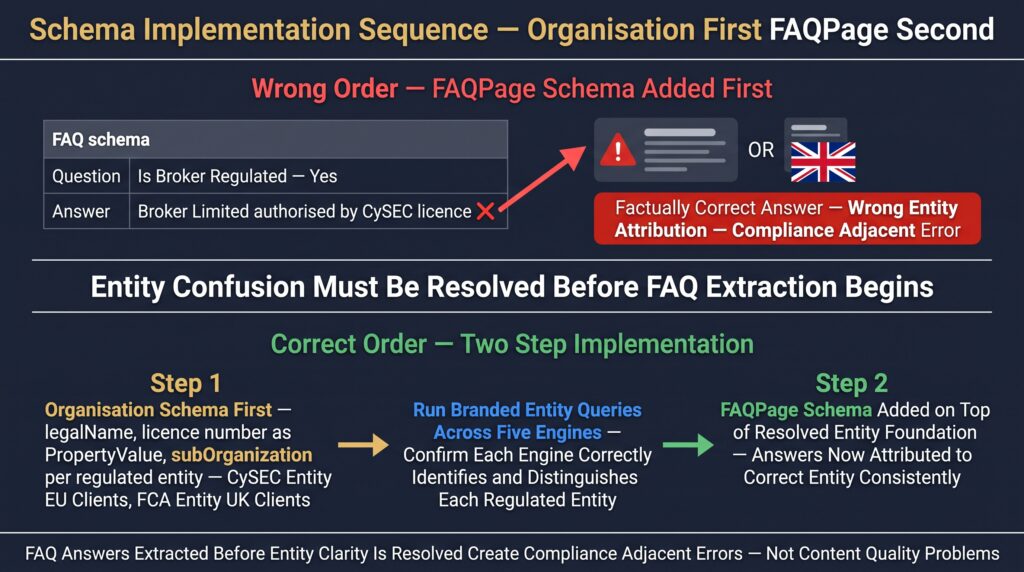
For a regulated forex broker operating multiple entities under one brand — a CySEC entity for EU clients, an FCA entity for UK clients — AI models frequently confuse which entity holds which licence and which client segment each serves. This is one of the most common findings in the AI/GEO visibility audit. Adding FAQPage schema to the regulation page before resolving this entity confusion creates a specific risk.
The engine extracts a schema-marked Q&A pair — “Is [broker] regulated? — Yes, [broker] Limited is authorised by CySEC, CIF licence [X]” — and attributes it to the wrong entity, or conflates it with the UK-regulated subsidiary. The answer is factually correct. The attribution is wrong. For a regulated broker, that is a compliance-adjacent error, not a content quality problem.
The sequencing fix: implement Organisation schema with legalName, identifier (licence number as a PropertyValue), and subOrganization per regulated entity first — as covered in structuring content for AI citation. Run the branded entity queries across the five engines to verify each engine correctly identifies and distinguishes the broker’s regulated entities. Once entity clarity is confirmed, add FAQPage schema on top of a resolved entity foundation. The FAQ answers then get attributed to the correct entity consistently..
The Eight FAQ Questions Worth Prioritising — and the 70–80 Word Target
Only add FAQPage schema to questions AI engines are actually being asked about the broker. The eight priority questions come from the branded factual query layer — the queries where the broker is the only authoritative source and comparison sites have no structural citation advantage. Generic FAQ content (“what is forex trading?”, “why should I choose [broker]?”) generates no AI citation value from FAQ schema — the question format doesn’t match specific branded queries an engine is trying to answer.
| Question | Why It Matters for AI Citation | Key Elements in the Answer | Compliance |
|---|---|---|---|
| “Is [broker] regulated?” | Most common branded regulatory query. Highest AI citation value and highest compliance sensitivity. | Entity name, regulator name, licence number, jurisdiction, applicable framework (MiFID II etc.) | SIGN-OFF REQUIRED |
| “What is [broker]’s CySEC licence number?” | Named-entity factual query. Verifiable from regulator register. AI engine wants exact CIF number. | Exact CIF number, CySEC full name, entity legal name, date of authorisation if available. | SIGN-OFF REQUIRED |
| “What leverage limits apply to retail clients?” | ESMA-specific compliance question. High query volume from prospects researching regulated brokers. | ESMA limits by instrument (1:30 major FX, 1:20 minor FX, 1:5 crypto etc.), negative balance protection. | SIGN-OFF REQUIRED |
| “What client protections does [broker] offer?” | Composite trust-signal question. AI engine evaluates this to assess whether the broker is safe to cite. | Negative balance protection, ICF eligibility and coverage amount, segregated client funds, regulator oversight. | SIGN-OFF REQUIRED |
| “What is [broker]’s minimum deposit for [account type]?” | High search volume; specific verifiable fact the broker uniquely controls. Comparison sites cannot be more precise. | Exact amount, currency, account type name, any conditions attached to the minimum. | REVIEW RECOMMENDED |
| “Which entity does [broker] use for EU clients?” | Entity disambiguation query — directly addresses multi-entity confusion AI models frequently have about the broker. | Exact legal entity name, CySEC licence number, registered address, which client segment served. | SIGN-OFF REQUIRED |
| “Is [broker] regulated by the FCA?” | UK-specific regulatory query. High trust value if the broker has an FCA entity — the FCA register is a primary AI trust source. | FCA entity name, FRN number, UK regulatory scope, FSCS eligibility and coverage if applicable. | SIGN-OFF REQUIRED |
| “How does [broker] protect client funds?” | Client fund safety — YMYL highest trust signal. AI engine evaluates this before citing the broker in safety-related answers. | Segregated accounts, bank name(s), regulator-mandated requirement, ICF coverage amount per client. | SIGN-OFF REQUIRED |
The 70–80 word answer length target. For YMYL regulatory FAQ answers, 70–80 words hits the optimal extraction window. Below 40 words, answers often lack the verifiable specifics — entity name, licence number, jurisdiction, protection regime — that AI engines require to cite a financial source with confidence. Above 150 words, RAG systems may split the answer across two semantic chunks, producing a citation of an incomplete answer. The target: open with the direct factual claim in the first sentence, support with 2–3 specific verifiable details, close with the relevant protection or condition.
The broker FAQ pages I audit most often answer “Is [Broker] regulated?” with “Yes, [Broker] is regulated and operates under strict regulatory oversight to protect our clients.” Seventeen words. Zero citable facts. No entity name, no licence number, no jurisdiction, no protection regime. The AI engine reads it, finds nothing to verify, and cites the CySEC register entry or the Finance Magnates article instead — both of which state the specific facts the broker’s own FAQ page chose not to.
Where NOT to Add FAQ Schema — Three Misuse Cases
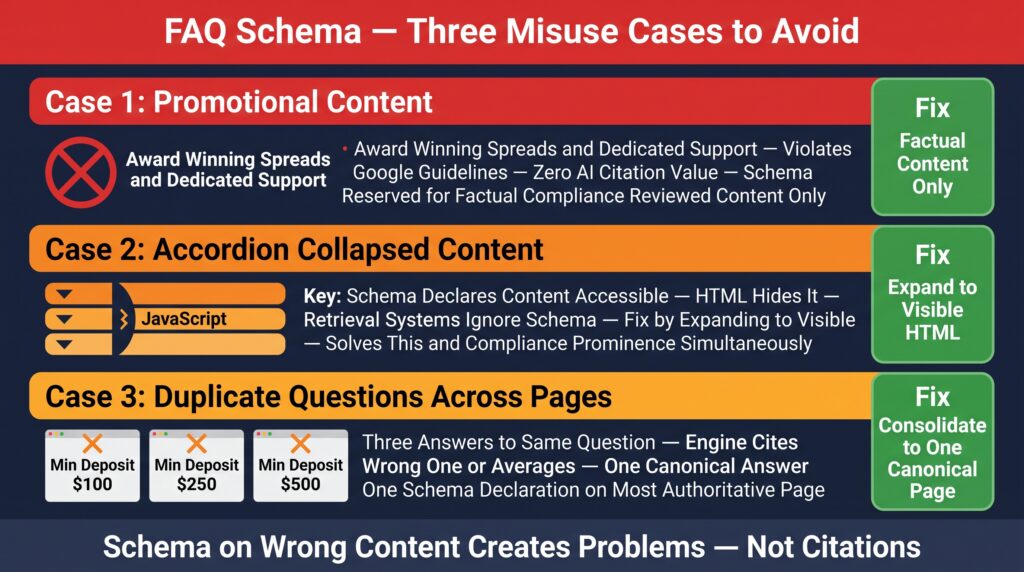
Most implementation guides tell you how to add FAQ schema. For a regulated forex broker, knowing where not to add it is equally important.
Case 1 — Promotional content. Google’s FAQPage schema guidelines explicitly prohibit promotional content. Any FAQ answer describing product benefits, bonus conditions, or trading advantages in marketing language rather than factual terms is promotional content. Adding schema to “What makes [broker] different? — Our award-winning spreads and dedicated support” violates Google’s guidelines and carries no AI citation value. Schema should be reserved for factual, compliance-reviewed regulatory and conditions content only.
Case 2 — Accordion-collapsed content. FAQ schema on accordion-hidden content creates a mismatch: the schema declares a Q&A pair as accessible content, but the HTML hides the answer behind a JavaScript interaction. Some AI retrieval systems ignore the schema when they find this inconsistency. The fix — expanding FAQ content from accordion to visible HTML — solves both this problem and the compliance prominence requirement covered in structuring content for AI citation. One action, two separate problems resolved.
Case 3 — Duplicate questions across pages. A broker with FAQ sections on its regulation page, account types page, and general FAQ page often answers the same question differently in each location. Duplicate FAQ schema for the same question produces conflicting extraction signals — the engine finds three different answers to “what is [broker]’s minimum deposit?” and may cite the wrong one or produce an averaged response. Consolidate to one canonical answer per question, one FAQPage schema declaration, on the most authoritative page for that question type.
The Compliance Workflow — Four Steps Before Publishing FAQ Schema
Every FAQ answer about a regulated broker’s regulatory status, entity structure, account conditions, or client protection regime is a regulated communication. Adding FAQ schema to non-compliance-reviewed content makes the non-compliant claim more extractable by AI engines. The four-step workflow for a regulated broker:
Step 1 — Draft the FAQ answers as atomic blocks. 70–80 words, one verifiable fact per block, entity name and licence number explicit. Do not publish before compliance review.
Step 2 — Submit to compliance with the schema flag. The review should cover factual accuracy of every regulatory claim, consistency with approved marketing materials, consistency with regulator register entries, and prominence requirements. Note in the brief that these answers will be schema-marked — this context matters for the reviewer. Timeline: 5–7 business days for reformatted approved content; 7–14 business days for new regulatory claim statements, consistent with Phase 2 of the 90-day roadmap. For an organic-search baseline before implementing any schema changes, see the forex broker SEO audit.
Step 3 — Implement after clearance. Add FAQPage schema via RankMath (Schema → FAQ) or code injection. Verify with the Rich Results Test before publish.
Step 4 — Run the pre/post query check documented in H2 #6. You cannot measure whether schema changed AI citation behaviour without a baseline to compare against.
How to Verify It Actually Worked
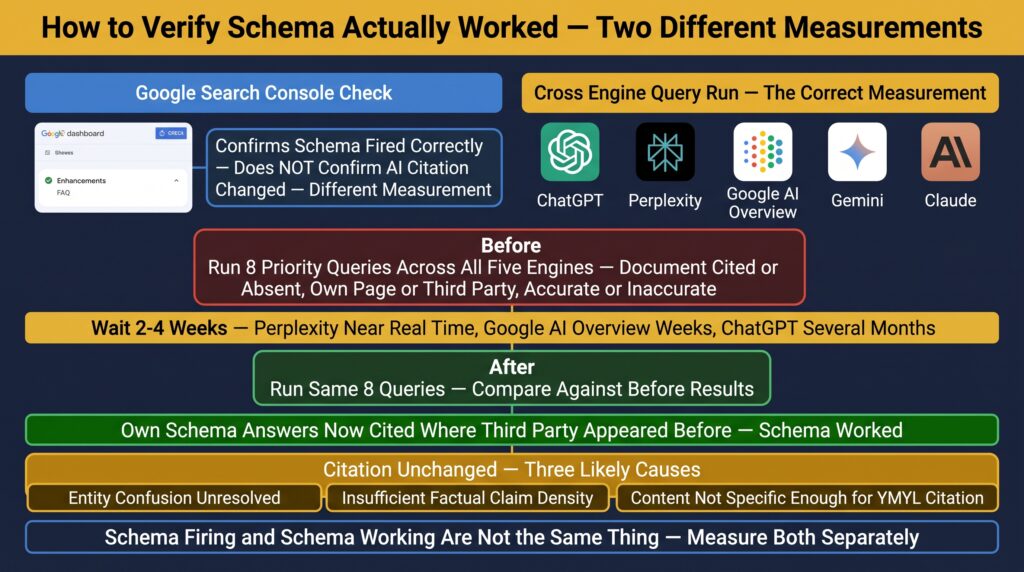
Google Search Console will tell you whether the FAQ schema rendered correctly as rich results — check Enhancements → FAQ after indexing. This confirms the schema fired; it does not confirm whether AI citation behaviour changed. Those are different measurements.
The correct AI visibility measurement is the cross-engine query run. Before adding schema, run the eight priority questions as natural-language queries across ChatGPT, Perplexity, Google AI Overview, Gemini, and Claude. For each result, document: is the broker cited? Is the answer from the broker’s own page or a third-party source? Is the answer accurate?
After implementation, allow 2–4 weeks for engines to update retrieval — Perplexity updates near-real-time, Google AI Overview typically within weeks, ChatGPT may take several months. Run the same eight queries again and compare. If the broker’s own schema-marked FAQ answers are now being cited where third-party sources appeared before, the schema worked. If citation behaviour is unchanged, one of three issues is likely: entity confusion is still unresolved (Organisation schema first), the answers lack sufficient factual-claim density for YMYL citation, or the compliance-constrained content is not specific enough for the engine to treat as authoritative.
The platform split I see most clearly in post-schema measurement is Perplexity updating citation behaviour within 1–2 weeks of implementation while ChatGPT base model shows no change for 3–4 months — not because the schema failed, but because ChatGPT is drawing from Common Crawl training data that updates on a different cycle entirely. Brokers who measure only on ChatGPT in the first month conclude the schema didn’t work. Brokers who measure on Perplexity first see the signal, confirm the implementation is correct, and wait for ChatGPT to catch up.
“The measurement step — running the pre/post cross-engine query check — is built into the AI/GEO visibility audit.”
FAQ
Q1: Does FAQ schema actually improve AI visibility for a forex broker?
FAQ schema improves AI visibility for a regulated forex broker when three conditions are met. First, the questions must match real branded queries AI engines are actually being asked about the broker, such as the broker’s regulatory status, licence number, client protection regime, and account conditions — not generic industry questions. Second, the answers must be atomic blocks of 70 to 80 words containing specific, verifiable facts including the entity name and licence number, rather than generic marketing language. Third, Organisation schema declaring the broker’s legal entity name and regulatory identifier must already be in place so that the FAQ answers are attributed to the correct regulated entity. FAQ schema on generic marketing content, accordion-collapsed pages, or pages with unresolved entity confusion does not improve AI citation rates and may amplify existing problems.
Q2: Which FAQ questions should a forex broker prioritise for AI citation schema markup?
A regulated forex broker should prioritise FAQ schema markup for eight categories of branded factual questions where the broker is the only authoritative source: whether the broker is regulated and by which authority, the exact regulatory licence number, which regulated entity serves which client market, what leverage limits apply to retail clients under ESMA or other applicable frameworks, what client protection provisions are in place including negative balance protection and deposit scheme eligibility, what fund segregation arrangements are in operation, the minimum deposit for each account type, and any client-facing conditions that are specific to the broker’s regulatory authorisation. These questions correspond to the branded factual query layer identified in AI citation research as the category where individual broker sites can win AI citations that comparison sites cannot structurally displace. Every answer to these questions requires compliance review before publication.
Q3: Why should Organisation schema be implemented before FAQPage schema on a forex broker’s regulation page?
For a regulated forex broker operating multiple entities under one brand name, AI engines frequently confuse which regulated entity corresponds to which licence and which client market. Adding FAQPage schema to the regulation page before resolving this entity confusion creates a risk: the engine extracts a schema-marked question-answer pair containing correct regulatory information but attributes it to the wrong entity, which is a compliance-adjacent error even when the underlying facts are accurate. Organisation schema with the legalName and identifier fields declaring each regulated entity and its licence number, and subOrganization entries for each distinct regulated subsidiary, should be verified as correctly understood by AI engines before FAQPage schema is added. Once the AI engine correctly identifies and distinguishes the broker’s regulated entities, FAQ schema on the regulation page adds the question-answer extraction signal on top of a correct entity foundation.
Q4: How long should FAQ answers be for AI citation purposes on a regulated broker’s regulation page?
FAQ answers on a regulated forex broker’s regulation page should target 70 to 80 words for optimal AI citation extraction. Below 40 words, answers for YMYL financial queries often lack the specific verifiable details — entity name, licence number, jurisdiction, and client protection provisions — that AI engines require to cite a financial source with confidence. Above 150 words, retrieval-augmented generation systems may split the answer across two semantic chunks, producing a citation that quotes an incomplete answer. The 70 to 80 word range allows enough specificity to include the verifiable regulatory facts required for YMYL citation while remaining within a single extractable chunk. Every answer in this range should open with the direct factual claim — the answer to the question — in the first sentence, before any supporting context follows.
Q5: What pages should a regulated forex broker avoid adding FAQ schema to?
A regulated forex broker should not add FAQPage schema to three categories of pages. First, pages with promotional FAQ content: Google’s FAQPage schema guidelines explicitly prohibit promotional content, and FAQ answers describing product benefits or trading advantages in marketing language rather than factual terms violate this guidance and carry no AI citation value. Second, pages where FAQ content is collapsed in accordion elements: FAQ schema on accordion-hidden content creates a mismatch between the schema declaration and the HTML presentation, which some AI retrieval systems resolve by ignoring the schema. Third, pages where the same question is answered differently in multiple locations on the site: duplicate FAQ schema for the same question across the regulation page, account types page, and general FAQ page produces conflicting extraction signals that reduce rather than increase citation clarity.
Q6: How can a regulated forex broker measure whether FAQ schema actually improved AI citation?
The correct measurement for FAQ schema’s AI citation impact requires a cross-engine query run before and after implementation. Before adding schema, run the eight priority FAQ questions as natural-language queries across ChatGPT, Perplexity, Google AI Overview, Gemini, and Claude, and document which source each engine cites and whether the broker’s own content appears in the answer. After implementation, allow at least two to four weeks for engines to update their retrieval, with Perplexity typically updating fastest and ChatGPT potentially taking several months. Then run the same eight queries and compare whether the broker’s own schema-marked FAQ answers are now being cited where third-party sources were cited previously. Google Search Console rich results data confirms the schema rendered correctly but does not measure AI citation behaviour change, so both checks are needed for a complete assessment.