AI Visibility Audit, what we usually find?
Most regulated forex broker sites have the same ten AI visibility problems. The order in which they appear varies. The problems themselves almost never do.
What follows are the consistent findings from AI/GEO visibility audits of regulated forex broker sites — checking what ChatGPT, Perplexity, Google AI Overview, Gemini, and Claude know about the broker, whether that knowledge is accurate, which pages the engines cite and why, and where the broker’s own content fails the extractability test. Each finding is presented with the root cause, the AI visibility cost, and the fix direction pointing to the relevant implementation guide.
By the end, you should be able to self-diagnose your broker. The findings you recognise are the ones worth addressing first.
Table of Contents
Finding #1 — The Engine Doesn’t Know Which Entity the Broker Is
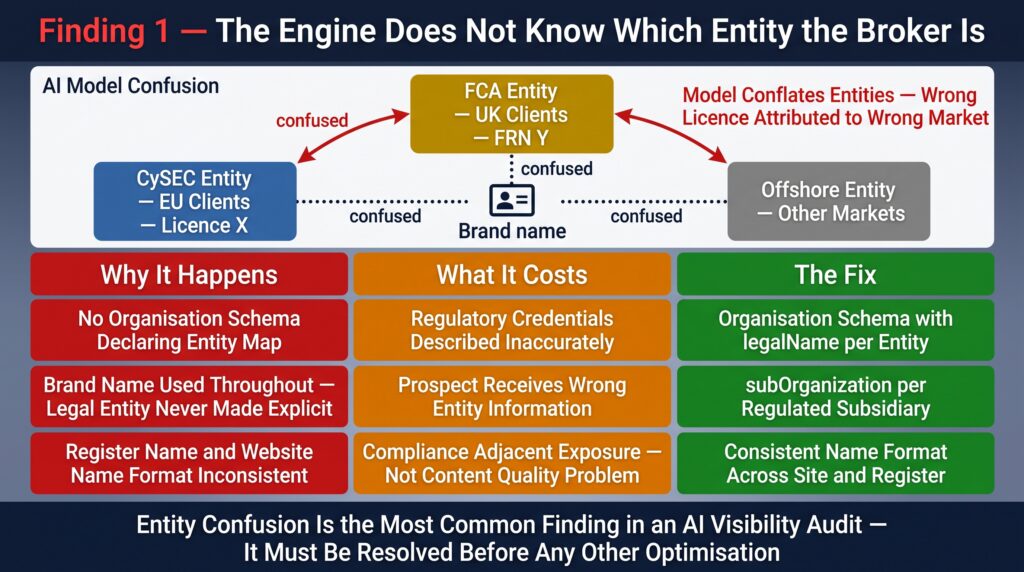
What it is. AI models frequently confuse a multi-entity broker’s regulated subsidiaries — which entity serves EU clients under CySEC, which serves UK clients under the FCA, which is an offshore entity. The model may cite the wrong licence number for a market, conflate two entities into one description, or describe the brand as a single undifferentiated entity when it legally operates as several separate regulated companies.
Why it happens. No Organisation schema on the homepage or regulation page declaring the entity map. The broker’s own site uses the brand name throughout without making the legal entity structure explicit in machine-readable form. The regulator register listing and the broker’s website use slightly different name formats, which compounds the confusion.
What it costs. The broker’s regulatory credentials are being described inaccurately in AI answers. A prospect asking “which entity does [broker] use for EU clients?” receives an answer that may be wrong. For a regulated brand, that is not a content quality problem — it is a compliance-adjacent exposure.
Entity confusion is the finding I expect before I run the first query on any multi-entity broker audit — the question is never whether it exists, it is which platform states it most confidently. The most common version: a broker with a CySEC entity and a separate offshore entity finds ChatGPT attributing the offshore entity’s conditions to the CySEC-regulated product, because a comparison site indexed three years ago conflated them and that conflation is now the dominant source in the model’s training data.
Fix direction. Organisation schema with legalName, identifier (licence number), and subOrganization per regulated entity is the resolution. Full implementation in structuring content for AI citation.
Finding #2 — The Licence Number Is in the Wrong Sentence
What it is. The regulation page contains the CySEC or FCA licence number, but it is embedded inside a formal disclosure clause: “The Company, being authorised and regulated by the Cyprus Securities and Exchange Commission under CIF Licence Number [X], in accordance with the provisions of Directive 2014/65/EU…” The key fact is grammatically subordinate to the legal framing surrounding it.
Why it happens. Regulation pages are drafted by legal teams for compliance disclosure purposes, not for AI extraction. The prose satisfies the regulatory prominence requirement as a formal disclosure — it does not satisfy the extractability requirement for AI citation. The two requirements have never been reconciled on most regulation pages.
What it costs. The engine retrieves the regulation page and scores the block poorly for the query “what is [broker]’s CySEC licence number?” — because the direct factual answer is not in the first sentence of any block. Third-party sources that state the licence number more directly are cited instead. The broker loses the citation on the one query where it is the only authoritative source.
Fix direction. Atomic block restructuring of the regulation page opening — entity name and licence number in the first sentence, context in the second. Full before/after in structuring content for AI citation. Compliance review required before publishing the restructured version.
Finding #3 — AI Is Saying Something Factually Wrong About the Broker. The Broker Doesn’t Know.
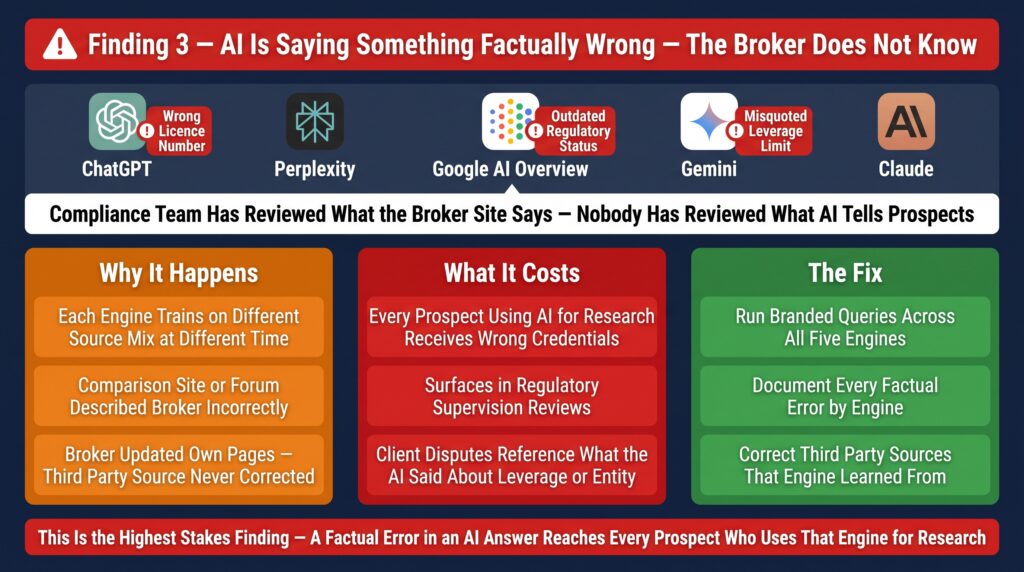
What it is. This is the finding with the highest stakes. In the majority of broker AI visibility checks across the five engines, at least one engine states something factually wrong about the broker — a wrong licence number, a confused entity, an outdated regulatory status, a misquoted leverage limit. The broker’s compliance team has reviewed what the broker’s own site says. Nobody has reviewed what ChatGPT, Perplexity, and Google AI Overview are telling prospects about the broker’s regulatory credentials.
Why it happens. Each engine trains on a different source mix at a different time. If a comparison site, a financial forum, or an old news article described the broker incorrectly at any point, the engine may have incorporated that incorrect description into its knowledge base. The broker updated its own pages — the third-party source the engine learned from was never corrected.
What it costs. A factual error in an AI answer about a broker’s regulatory credentials reaches every prospect who uses that engine for research. It may also surface in regulatory contexts: a supervision review, a journalist fact-checking a broker profile, a client dispute referencing what “the AI said” about the broker’s leverage limits or entity structure. These are not hypothetical scenarios.
In the broker AI visibility checks I run as a first step, factual errors in at least one engine are the rule rather than the exception — the question is never whether an error exists, it is which engine states the most damaging one most confidently. The errors that carry the highest compliance risk are almost never on the broker’s own pages. They are on a comparison site that ranked well three years ago and has not been updated since.
Fix direction. Run the five-engine branded query check — open ChatGPT, Perplexity, and Google AI Overview, query “is [broker] regulated,” “[broker] CySEC licence number,” and “[broker] vs [main competitor],” and document every factual error. The AI/GEO visibility audit documents the full error landscape across all five engines with source identification and prioritised remediation.
Finding #4 — Compliance-Relevant Content Is Collapsed in an Accordion
What it is. FAQ sections on the regulation page or the general FAQ page contain compliance-relevant answers — regulatory disclosures, risk warnings, entity descriptions — collapsed in accordion elements. The content is present but hidden behind a click interaction by default.
Why it happens. Standard UX practice for long FAQ pages applied without considering AI extractability. The accordion is a design decision, not a compliance decision — the team building the page was not thinking about LLM retrieval or regulatory prominence requirements simultaneously.
What it costs. Two problems in one. LLM retrieval systems may not reliably read collapsed accordion content, making the compliance Q&A invisible to AI extraction. Additionally, financial regulators require that risk disclosures be prominently displayed — collapsed content may not satisfy this requirement if a regulator treats the collapsed state as the effective presentation seen by users.
Fix direction. Expand all compliance-relevant FAQ content from accordion to visible HTML. This resolves both issues simultaneously and is the prerequisite for adding FAQPage schema. Full treatment in FAQ schema implementation guide and structuring content for AI citation.
Finding #5 — A Comparison Site Describes the Broker More Accurately Than the Broker’s Own Pages
What it is. For branded factual queries — “is [broker] regulated?”, “[broker] CySEC licence number”, “[broker] minimum deposit” — AI engines cite ForexBrokers.com, Investopedia’s broker review, or a similar comparison platform rather than the broker’s own regulation or conditions page. The third-party source wins even on the queries where the broker is the only authoritative source.
Why it happens. Comparison platforms invest in extractable content formats: licence number in a dedicated field, entity name in another, spread in another — structured, specific, atomic. The broker’s own pages state the same facts buried in marketing prose. The AI engine’s retrieval system scores blocks that open with direct factual claims higher than blocks that embed facts in qualifying language. The comparison site’s format beats the broker’s compliant but unstructured format.
What it costs. The broker loses citation authority on the branded factual queries where it should have an absolute advantage. Over time, the comparison site’s description of the broker becomes the AI engine’s canonical reference — meaning any error in the comparison listing propagates into AI answers about the broker without the broker’s knowledge.
Fix direction. The regulation and conditions pages need to be more extractable than the comparison site listing. Full structural framework in structuring content for AI citation. Why the comparison site wins structurally and what the correct response is: why AI cites comparison sites over broker sites.
Finding #6 — No Schema on the Pages That Matter Most
What it is. Blog articles and product landing pages often have Article schema, FAQPage schema, and sometimes HowTo schema applied — implemented for SEO rich results. The regulation page, conditions page, and entity disclosure page — the three pages with the highest AI citation value — typically have no schema beyond the auto-generated Article type from the CMS.
Why it happens. Schema implementation has been prioritised where it produces visible SEO results. Regulation pages don’t generate significant organic traffic, so they haven’t been prioritised for schema work. The connection between Organisation schema on the regulation page and AI citation accuracy is not yet on most brokers’ radar.
What it costs. Without Organisation schema declaring the legal entity name and licence number as structured fields, the engine has no machine-readable entity declaration — it must infer entity information from prose, which is less reliable. Without FAQPage schema on the regulation page Q&A sections, the explicit Q&A extraction signal is absent from the highest-priority compliance content on the site.
Fix direction. Organisation schema (legalName + identifier + subOrganization) on the regulation page is the priority. FAQPage schema follows once entity clarity is confirmed. Implementation guide in structuring content for AI citation and FAQ schema implementation guide.
Finding #7 — Position 1 on Google, Invisible in ChatGPT and Perplexity
What it is. The broker ranks in positions 1–3 on Google for its own brand name and several competitive terms. In ChatGPT and Perplexity, the same branded queries return answers that don’t cite the broker’s own pages — they cite comparison sites, review platforms, or financial media. The SEO investment has produced organic rankings; the AI citation presence has not been built.
Why it happens. Strong organic SEO was built on backlink acquisition and keyword optimisation — which improves Google rankings but does not directly improve AI citation accuracy. The broker’s highest-ranking pages are often long-form content with embedded regulatory facts, which scores well for keyword relevance but poorly for RAG extraction. Ranking well and being extractable are not the same requirement, and they are addressed by different tools.
What it costs. A growing share of high-intent prospect research happens inside AI engines before a search results page is reached. A broker invisible in AI answers loses pre-qualified prospects to whatever the engine does cite. The SEO investment protects Google rankings; it does not protect AI citation presence, which requires a separate diagnostic.
Fix direction. See AEO/GEO strategy overview for why SEO and AI visibility require different approaches. The forex broker SEO audit and the AI/GEO visibility audit are complementary diagnostics — one for organic rankings, one for AI citation presence.
Finding #8 — The Regulator Register and the Broker’s Website Disagree
What it is. The broker’s trading name on the CySEC, FCA, or ASIC public register does not match the name presentation on the broker’s own website. The register may show an older legal entity name, a different abbreviation, or a name that predates a rebranding. The broker’s website uses the current brand; the regulator’s official record uses the founding entity name.
Why it happens. Register listings were set at authorisation and haven’t been updated to reflect brand evolution or entity restructuring. Updating a regulator register entry requires a formal application — it is a compliance task, not a marketing task, and it typically isn’t treated as an AI visibility priority.
What it costs. AI engines cross-reference the broker’s self-description with the regulator register as a trust-verification step. Discrepancies between the two reduce the engine’s confidence in the broker’s own regulatory claims, making it more likely to cite third-party sources rather than the broker’s own pages for regulatory information. The broker’s most authoritative third-party source — the regulator — is actively undermining the broker’s own content.
Fix direction. Check the public register listing against the broker’s current website description and submit a correction request through compliance if there are discrepancies. This is the single highest-leverage free action for AI citation improvement. Full context in why AI cites comparison sites over broker sites.
Finding #9 — Five Engines, Five Different Answers About the Same Broker
What it is. Running the same branded query across ChatGPT, Perplexity, Google AI Overview, Gemini, and Claude produces meaningfully different answers. One engine cites the correct licence number; another cites an outdated one. One engine correctly describes the EU entity; another describes the brand without distinguishing entities. One engine has no information about the broker at all.
Why it happens. Each engine trains on a different source mix, retrains on a different schedule, and weights recency and authority differently. Perplexity’s real-time retrieval reflects current information fastest; ChatGPT’s training cutoff means it reflects a snapshot from a previous point in time. The five engines produce five independent views of the broker, built from different evidence bases.
What it costs. Most brokers check only ChatGPT — the most visible engine — and conclude their AI visibility is acceptable. This is a systematically unreliable conclusion. A prospect using Perplexity for broker research sees a different, potentially worse, description than a prospect using ChatGPT. Checking one engine is not an AI visibility audit.
Fix direction. The AI/GEO visibility audit runs all five engines simultaneously and documents the variance. Understanding which engines have the most severe accuracy gaps informs where to prioritise third-party source corrections and content updates.
Finding #10 — The Compliance Team Doesn’t Know AI Visibility Is Their Problem Too
What it is. AI visibility at regulated forex brokers is being managed by the marketing or SEO team, without compliance involvement. The compliance team reviews the broker’s own regulated communications — advertising, marketing materials, client-facing disclosures. They have not been asked to review what AI engines are telling prospects about the broker’s regulatory credentials. This is the organisational root cause behind many of the nine findings above.
Why it happens. AI visibility is categorised as a digital marketing function. AI-generated descriptions of the broker don’t fit neatly into any existing compliance category — the broker didn’t create them and can’t directly control them. They fall through the gap between marketing responsibility and compliance oversight. Neither team has full visibility into the problem, and neither team has been asked to own it.
What it costs. Without compliance involvement, the content restructuring, schema implementation, and third-party source correction work described in findings #1–#9 doesn’t get prioritised. The marketing team doesn’t know AI errors carry compliance-adjacent exposure. The compliance team doesn’t know the errors exist. The first time compliance learns about AI description accuracy is often when a regulatory enquiry, client complaint, or media article references what “the AI said” about the broker’s licensing.
The marketing/compliance gap on AI visibility is not specific to any one broker — it follows directly from how the organisational categories were built. Compliance owns regulated communications the broker creates and controls. AI-generated descriptions of the broker are neither created nor controlled by the broker, so they fit no existing compliance category. The gap is not a failure of either team — it is a structural blind spot that nobody has been asked to close yet, because the question of who owns AI description accuracy has not been formally raised in most broker organisations.
Fix direction. Bring compliance into the AI visibility conversation before starting any implementation work. The 90-day AEO/GEO roadmap builds compliance sign-off into every phase for this reason. The AI/GEO visibility audit produces a documented error report that gives compliance a concrete starting point — named errors, named sources, named engines — rather than a theoretical concern.
“If you recognised your broker in three or more of these findings, the AI/GEO visibility audit tells you exactly which ones apply, how severe each gap is, and what to fix first.”
FAQ
Q1: What do AI visibility audits typically find in regulated forex broker sites?
AI visibility audits of regulated forex broker sites consistently reveal ten categories of problems. The most common are: entity confusion, where AI engines conflate a multi-entity broker’s regulated subsidiaries and attribute the wrong licence to the wrong market; regulation page structure failures, where licence numbers are buried in formal disclosure clauses rather than stated in extractable atomic blocks; factual errors in AI answers, where at least one engine states incorrect regulatory information about the broker and the broker is unaware; accordion-collapsed FAQ content that is invisible to LLM retrieval systems and may also fail regulatory prominence requirements; comparison sites that describe the broker more accurately and extractably than the broker’s own pages; absence of Organisation and FAQPage schema on the regulation and conditions pages; strong Google rankings coexisting with near-total absence from ChatGPT and Perplexity answers; regulator register listings that disagree with the broker’s own website presentation; significant variance between what five different AI engines say about the same broker; and compliance teams that have not been brought into the AI visibility conversation despite the compliance-adjacent risk of AI factual errors about regulated credentials.
Q2: Why do regulated forex broker sites typically have poor AI citation performance despite strong SEO?
Regulated forex broker sites commonly achieve strong Google search rankings through backlink acquisition and keyword optimisation while remaining poorly cited in AI-generated answers because SEO and AI citation optimisation address different signals. Search engine rankings reward authority signals including backlinks, domain age, and content volume. AI citation rewards extractability signals including atomic content blocks, direct-answer leads, machine-readable schema declarations, and verifiable named-entity facts. A broker’s highest-ranking pages are typically long-form content with embedded regulatory facts, which scores well for keyword relevance but poorly for RAG extraction. The regulation page, conditions page, and entity disclosure page — which carry the highest AI citation value — are typically deprioritised for SEO because they generate limited organic traffic, meaning they receive no schema investment, no content restructuring, and no FAQPage optimisation. The result is a broker with excellent Google presence and minimal AI citation presence, addressed by different diagnostic tools.
Q3: Why do AI engines sometimes state incorrect regulatory information about a forex broker?
AI engines state incorrect regulatory information about forex brokers because each engine trains on a different mix of sources from different points in time, and some of those sources contain errors that the broker has never identified or corrected. If a comparison site, a financial media article, or a forum post described the broker’s regulatory status incorrectly at any point, the engine may have incorporated that incorrect description into its knowledge base. The broker updated its own website when the information changed, but the third-party source the engine trained on was never corrected. Additionally, AI engines do not update continuously — a broker that obtained a new regulated entity or changed its licence status six months ago may still be described in its previous state by training-data-dependent engines such as ChatGPT. Perplexity, which uses real-time retrieval, is more likely to reflect current information, but even real-time retrieval can surface outdated third-party articles that describe the broker incorrectly.
Q4: What is the compliance risk of AI engines stating incorrect information about a forex broker’s regulatory credentials?
A forex broker’s financial services regulator, prospective clients, financial journalists, and parties in client disputes may all encounter AI-generated descriptions of the broker’s regulatory credentials. If those descriptions are incorrect — stating the wrong licence number, a wrong leverage limit, or an incorrect regulated entity for a given market — the broker faces three specific risks. First, a prospective client makes a decision based on incorrect regulatory information provided by an AI engine that appeared authoritative. Second, a regulatory supervisor references an AI-generated description of the broker’s structure during a supervision review. Third, a client dispute references what the AI stated about the broker’s terms, creating an evidentiary complication even when the broker’s own disclosures were correct. The common thread is that AI-generated regulatory descriptions are reaching third parties and can be attributed to the broker’s public profile even when the broker did not create them and cannot directly edit them.
Q5: Why do AI engines cite comparison sites instead of the broker’s own pages for branded regulatory queries?
AI engines cite comparison sites for branded regulatory queries about a specific broker because comparison site listings are typically more extractable than the broker’s own regulation pages. Comparison site listings state the broker’s licence number in a dedicated field, the regulated entity name in another field, and the key conditions in structured data — each fact is isolated, specific, and directly answerable as a standalone claim. The broker’s regulation page states the same facts embedded in formal legal disclosure language that satisfies compliance requirements but buries the key facts inside multi-clause sentences. The AI engine’s retrieval system scores blocks that open with direct factual claims higher than blocks that embed facts in qualifying prose. The comparison site’s extractable format beats the broker’s compliant but unstructured format. The fix is to make the broker’s own regulation page more extractable than the comparison site listing, not to compete with comparison sites on their comparative format.
Q6: How can a forex broker check what AI engines are currently saying about it?
A forex broker can conduct a basic five-engine query check in approximately 30 minutes by opening ChatGPT, Perplexity, Google AI Overview, Gemini, and Claude and running a standard set of branded queries across all five. The queries should include whether the broker is regulated and by which authority, the broker’s exact regulatory licence number, which regulated entity serves EU or UK clients, what leverage limits apply to retail clients, and how the broker compares to its main competitor. For each engine, the check should document whether the broker is cited at all, whether the information stated is factually accurate, and which source the engine is citing for its answer. Factual errors found in this check — wrong licence numbers, confused entities, outdated regulatory status — should be traced to their third-party source and corrected at that level. This basic check is the first five minutes of a full AI visibility audit, which systematically documents the complete error landscape across all five engines with source identification and prioritised remediation recommendations.