
This article is about GEO (Generative Engine Optimization), AEO (Answer Engine Optimization), and AI Search Optimization as content visibility disciplines — not about algorithmic trading tools, automated signal systems, or trading AI, which sometimes use similar terminology in different contexts.
Three labels, one discipline. GEO, AEO, and AI Search Optimization all describe the same practice: optimising content so that AI engines cite your brand accurately and favourably in generated answers. The terms emerged from different communities and emphasise different dimensions of the same shift. This guide uses all three interchangeably, explains what each one emphasises, and covers what the discipline means specifically for a regulated forex broker.
Table of Contents
GEO, AEO and AI Search Optimization — What Each Term Emphasises
The terminology proliferation happened because different communities arrived at the same problem from different directions. Academic researchers studying AI output quality coined “Generative Engine Optimization” — emphasising the type of engine. SEO practitioners looking for a parallel to their existing discipline coined “Answer Engine Optimization” — emphasising user intent. CMOs and brand marketers adopted “AI Search Optimization” — accessible language that avoids the acronym debate. None of these communities was wrong. All three terms describe the same underlying practice.
| Term | Full Form | Who Uses It | What It Emphasises | In Practice |
|---|---|---|---|---|
| GEO | Generative Engine Optimization | Academic researchers, industry strategists | The type of engine — generative AI systems that produce original answers rather than returning ranked links | Same practice |
| AEO | Answer Engine Optimization | SEO practitioners, agency marketers | The user intent — optimising for the direct answer a user receives rather than the ranked page they click through to | Same practice |
| AI Search Optimization | AI Search Optimization | CMOs, brand marketers | The channel — AI-powered search as a distinct discovery channel requiring its own optimisation strategy | Same practice |
| All three terms describe the same underlying practice: optimising content to be cited accurately in AI-generated answers across ChatGPT, Perplexity, Google AI Overview, Gemini, and Claude | Same practice | |||
What AI Search Actually Does — and Why It Changes the Game for Regulated Products
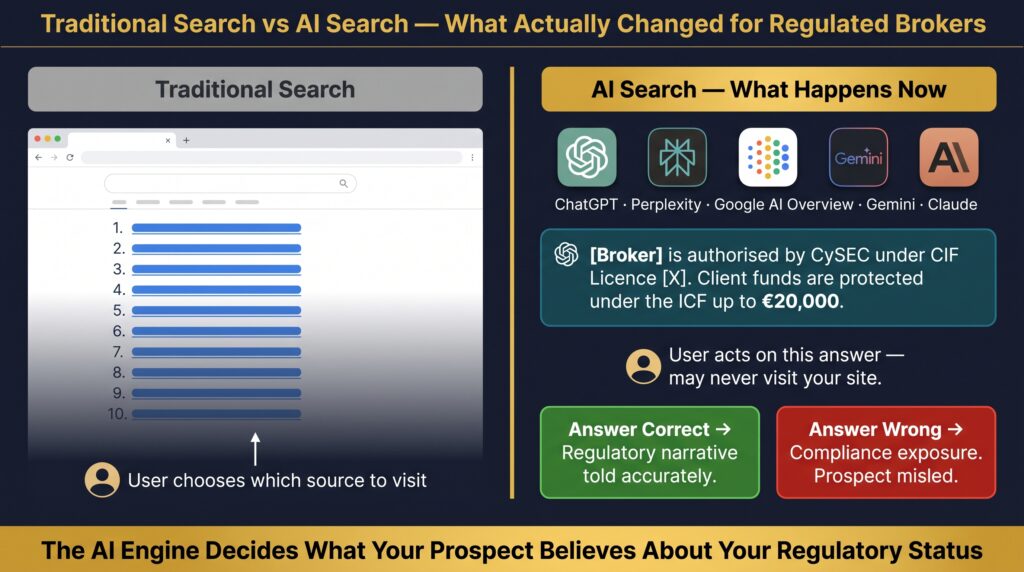
Traditional search presents ten links and lets the user decide which to visit. AI-powered search — ChatGPT, Perplexity, Google AI Overview, Gemini, Claude — generates a direct answer and cites the sources it used to construct that answer. The user may never visit any of those sources. The answer is delivered in the interface. This zero-click dynamic has two consequences: the AI engine decides which sources are trustworthy enough to cite, and the answer it delivers is what the user believes.
For a regulated forex broker, the question “is [broker] regulated?” now generates an AI answer that a prospect may act on before visiting the broker’s own website. If that answer is correct — correctly identifying the CySEC licence, the regulated entity, the client protection provisions — the broker’s regulatory narrative is being told accurately in the channel where research increasingly starts. If the answer is wrong — wrong licence number, confused entity, outdated leverage limit — the broker’s regulatory credentials are being misrepresented to prospects in a channel the broker has not been managing.
How to build content that earns accurate AI citation is a separate implementation question. For the full strategy, the AEO/GEO strategy overview for forex brokers covers the execution framework in detail. This guide focuses on what the discipline is and why it matters for your specific context.
Why GEO/AEO Matters More for Regulated Forex Brokers Than for Most Brands
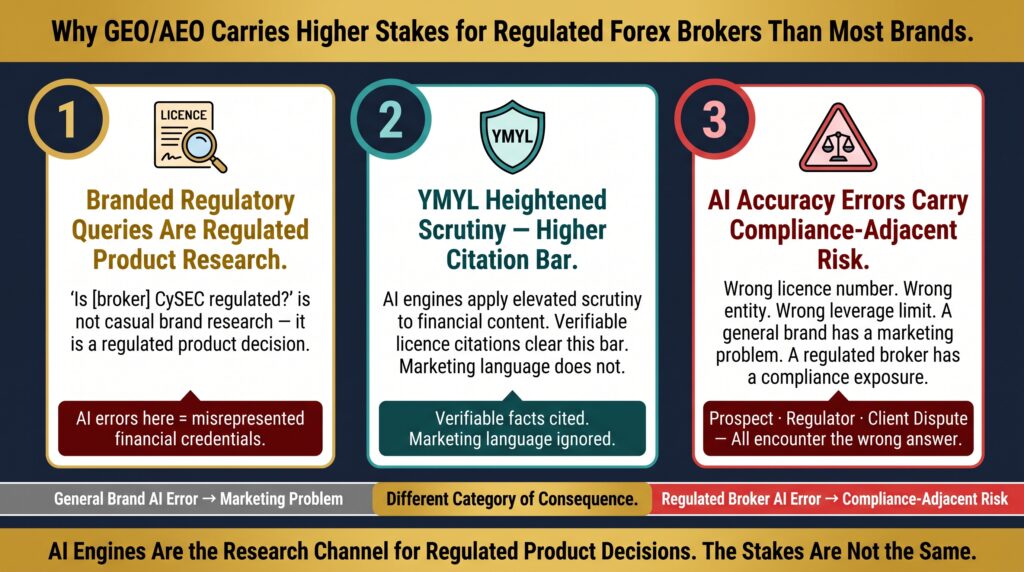
GEO and AEO carry greater stakes for regulated forex brokers than for most brands. Three reasons, each specific to the regulated financial services context.
Reason 1 — Branded regulatory queries are regulated product research. When a prospect asks an AI engine “is [broker] CySEC regulated?” or “what is [broker]’s CIF licence number?”, they are performing due diligence on a licensed financial product before committing to a brokerage relationship. This is not casual brand research — it is a regulated product decision. An AI engine that answers this query incorrectly is not producing a brand awareness miss; it is potentially misrepresenting a licensed financial firm’s regulated credentials. As the AI visibility audit findings documented, this happens more frequently than most regulated broker marketing teams are aware — because nobody is systematically checking what AI engines say about the broker’s regulatory credentials.
Reason 2 — YMYL heightened scrutiny means AI engines apply a higher citation bar to regulated financial content. The YMYL (Your Money or Your Life) classification applies to financial content that can significantly affect a person’s financial situation. AI engines apply analogous scrutiny when deciding whether to cite a source for financial services content. A regulated broker whose regulatory pages carry verifiable entity declarations and explicit licence citations clears this scrutiny more readily than a broker whose regulation page contains marketing language without verifiable facts. The trust signal framework that determines whether regulated broker content meets this scrutiny level is covered in E-E-A-T signal maintenance.
Reason 3 — AI accuracy errors carry compliance-adjacent risk. A general brand whose AI citation is inaccurate suffers a marketing problem. A regulated forex broker whose AI citation states the wrong licence number, wrong entity, or wrong leverage limit faces a different category of consequence. A prospect may make a financial decision based on incorrect AI-stated regulatory credentials. A regulator conducting a supervision review may encounter AI-generated descriptions of the broker’s licensing that differ from the public register. A client dispute may reference what “the AI said” about the broker’s conditions. These scenarios do not apply to most brands. They are specific to regulated financial services firms operating in a market where AI engines are increasingly the research channel for regulated product decisions.
What GEO/AEO Implementation Actually Involves for a Regulated Broker
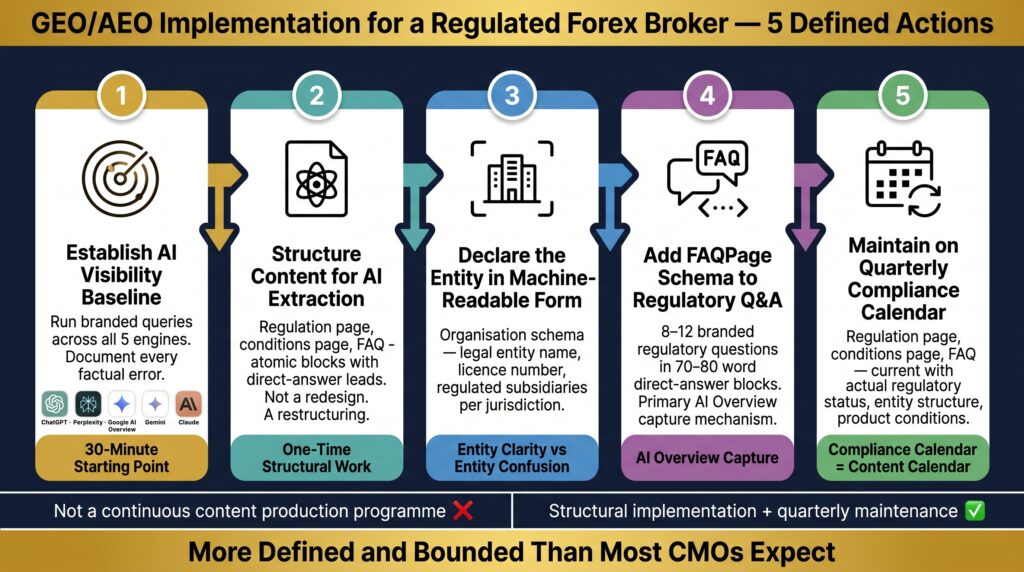
GEO and AEO implementation for a regulated forex broker is more defined and bounded than most CMOs expect. It is not a continuous content production programme — it is a structural implementation followed by a quarterly maintenance workflow.
Action 1 — Establish the AI visibility baseline. Before optimising, establish what AI engines currently say about the broker across all five engines: ChatGPT, Perplexity, Google AI Overview, Gemini, and Claude. Run branded queries (“is [broker] regulated?”, “[broker] CySEC licence number”, “[broker] vs [main competitor]”) and document every factual error. This 30-minute check is the starting point for any GEO/AEO programme and the first step in the AI/GEO visibility audit.
Action 2 — Structure content for AI extraction. The regulation page, conditions page, and FAQ page need restructuring so key facts appear in atomic blocks with direct-answer leads rather than embedded in formal disclosure prose. This is not a redesign — it is a restructuring of how existing information is presented. Full implementation guide: structuring content for AI citation.
Action 3 — Declare the entity in machine-readable form. Organisation schema on the regulation page, declaring the legal entity name, regulatory licence number, and regulated subsidiaries for each jurisdiction, is the machine-readable entity declaration that tells AI engines which regulatory credentials belong to this brand. For a multi-entity broker (CySEC + FCA + offshore), this schema is the difference between entity clarity and entity confusion in AI answers.
Action 4 — Add FAQPage schema to the regulatory Q&A section. The most common branded regulatory questions — eight to twelve, answered in 70–80 word direct-answer blocks — with FAQPage schema applied are the primary AI Overview capture mechanism for branded factual queries. These are what the AI engine retrieves when it constructs an answer to “is [broker] regulated?”
Action 5 — Maintain accuracy on a quarterly compliance calendar. GEO/AEO for a regulated broker is not a one-time project. The regulation page, conditions page, and FAQ section must stay current with the broker’s actual regulatory status, entity structure, and product conditions. The content freshness programme covers the specific cadence and compliance workflow — including why the compliance calendar is the content calendar for this type of work.
The Compliance Constraint
Every action above that involves regulated content — entity schema, regulation page restructuring, FAQPage schema for regulatory Q&A — requires compliance review before publication. Frame the programme as a compliance workflow improvement (which it genuinely is) rather than a digital marketing initiative. Compliance team involvement from action 1 onwards is what makes the programme durable.
Where to Start — A Self-Diagnostic for Regulated Forex Broker Marketing Teams
Different starting points apply depending on what the broker already has in place.
“I don’t know what AI engines currently say about my broker.” Start today: open ChatGPT, Perplexity, and Google AI Overview and search “is [broker] regulated?”, “[broker] CySEC licence number”, and “[broker] vs [main competitor]”. Note every factual error. Document what each engine cites as its source. This is 30 minutes of work. For a structured version with all five engines and a full findings report: AI/GEO visibility audit.
“I know my AI citation is poor but don’t know where to start fixing it.” Start with the regulation page — highest AI citation value, typically weakest on explicit trust signals. Structuring content for AI citation covers the full implementation. Before starting, read the 90-day AEO/GEO roadmap to understand how to sequence the work with compliance review built in.
“I’m trying to decide whether to invest in GEO/AEO or traditional SEO first.” The answer depends on four variables specific to your broker’s situation. AI search vs SEO — where to invest first provides the decision matrix.
“My SEO is strong but I want to understand how AI search is different.” The strongest SEO programme does not automatically produce strong AI citation — the two require different signals and different page priorities. The forex broker SEO audit establishes your organic baseline. The AI/GEO visibility audit establishes your AI baseline. Understanding both tells you which gap is larger and where the marginal investment goes next.
“If you’re ready to act on what GEO/AEO means for your broker specifically, the AI/GEO visibility audit is the right starting point — it tells you exactly where your broker currently stands across all five AI engines.”
FAQ
Q1: What is GEO (Generative Engine Optimization) for a forex broker?
Generative Engine Optimization, or GEO, is the practice of structuring content so that AI-powered search engines — including ChatGPT, Perplexity, Google AI Overview, Gemini, and Claude — accurately cite and present your brand in the generated answers they produce for user queries. For a regulated forex broker, GEO applies primarily to the regulation page, conditions page, and FAQ section — the pages AI engines retrieve when users ask branded factual questions such as whether the broker is regulated, what its CySEC or FCA licence number is, and what leverage limits apply to retail clients. GEO for a regulated broker involves structuring regulatory content in atomic blocks with direct-answer leads, adding Organisation schema to declare the entity name and licence number in machine-readable form, and adding FAQPage schema to the regulatory question-and-answer section. Unlike traditional SEO, which optimises for keyword relevance and backlink authority, GEO optimises for factual extractability and entity clarity — the signals AI retrieval systems use to decide whether a source is trustworthy enough to cite for regulated financial content.
Q2: What is the difference between GEO, AEO and AI Search Optimization?
GEO (Generative Engine Optimization), AEO (Answer Engine Optimization), and AI Search Optimization are three labels for the same discipline — optimising content so that AI-powered search engines cite your brand accurately in generated answers. The terms emerged from different communities. GEO was coined by academic researchers studying how generative AI engines select content, emphasising the type of engine producing the output. AEO was coined by SEO practitioners drawing a parallel to search engine optimization, emphasising the user intent of seeking a direct answer rather than a list of links. AI Search Optimization is the accessible label used by CMOs and brand marketers who prefer plain language over acronyms. In practice, all three describe the same activities: structuring content for AI extraction, building entity clarity through schema, earning citations in trusted third-party sources, and maintaining content freshness on a compliance calendar for regulated brands. The label matters less than the practice. In the forex broker context, all three terms refer to the same programme of making regulatory content correctly structured, verifiably accurate, and consistently maintained so that AI engines can confidently cite it for branded regulatory queries.
Q3: Why does GEO/AEO matter more for regulated forex brokers than for most brands?
GEO and AEO carry greater stakes for regulated forex brokers than for most brands for three specific reasons. First, branded regulatory queries — asking an AI engine whether a broker is regulated, what its licence number is, or what leverage limits apply — are regulated product research queries where a prospect may make a financial decision based on the AI engine’s answer. If that answer is wrong, it is not a brand awareness problem — it is a potential misrepresentation of a licensed financial firm’s regulated credentials. Second, the YMYL (Your Money or Your Life) classification that Google applies to financial content, and that AI engines apply analogously, means AI engines apply higher trust standards to broker regulatory content before citing it — requiring verifiable entity declarations and explicit primary source links that general content does not need. Third, AI accuracy errors about a regulated broker’s credentials carry compliance-adjacent risk: a regulator encountering AI-generated descriptions of a broker’s licensing that differ from the public register, or a client dispute referencing AI-stated leverage limits that differ from disclosed conditions, creates a category of consequence that does not apply to most brands.
Q4: How does GEO/AEO differ from traditional SEO for a regulated forex broker?
Traditional SEO for a regulated forex broker optimises content for Google search rankings through keyword targeting, backlink building, and technical performance improvements. GEO and AEO optimise for AI engine citation through factual extractability, entity clarity, and trust signal explicitness. The two disciplines overlap but do not replace each other. Traditional SEO builds organic ranking authority that accelerates Google AI Overview freshness response — a strong organically-ranking regulation page benefits from AI visibility work more quickly than one without organic authority. GEO and AEO work that makes regulatory content more extractable — atomic blocks, Organisation schema, FAQPage schema — simultaneously improves traditional SEO through featured snippet eligibility and rich results generation. The key practical difference for a regulated broker is the page priority: traditional SEO prioritises pages with high organic traffic potential, while GEO and AEO prioritise pages with high AI citation value — the regulation page, conditions page, and FAQ regulatory section — which often receive less traditional SEO investment than blog articles despite having the highest AI citation importance.
Q5: What does GEO/AEO implementation actually involve for a regulated forex broker?
GEO and AEO implementation for a regulated forex broker involves five specific actions. First, establishing an AI visibility baseline by running branded query checks across ChatGPT, Perplexity, Google AI Overview, Gemini, and Claude to document what each engine currently says about the broker’s regulatory credentials. Second, restructuring the regulation page so that entity name, licence number, and regulatory status appear in atomic content blocks with direct-answer leads rather than embedded in formal disclosure prose. Third, adding Organisation schema to declare the legal entity name, regulatory licence number, and regulated subsidiaries for each jurisdiction in machine-readable form. Fourth, adding FAQPage schema to the regulatory question-and-answer section with 70 to 80 word direct-answer blocks for the most common branded regulatory queries. Fifth, maintaining the programme through a quarterly compliance review calendar to keep the regulation page, conditions page, and FAQ section current with the broker’s actual regulatory status and product conditions. All actions involving regulated content require compliance review before publication, which means the programme operates on a compliance calendar rather than a standard content publishing timeline.
Q6: Where should a regulated forex broker start with GEO/AEO?
A regulated forex broker should start GEO and AEO with a baseline assessment of what AI engines currently say about the broker’s regulatory credentials. This involves running branded queries across ChatGPT, Perplexity, Google AI Overview, Gemini, and Claude — specifically asking whether the broker is regulated, what its licence number is, which regulated entity serves EU or UK clients, and how the broker compares to its main competitor. This 30-minute check reveals whether the broker is cited at all, whether citations are factually accurate, and which AI engines present the most significant accuracy gaps. For a broker with established organic search rankings, the next step is typically the structural AI visibility work — regulation page restructuring, Organisation schema, and FAQPage schema — which requires one compliance review cycle and produces durable improvement. For a broker still building organic rankings, the SEO foundation comes first because strong organic rankings accelerate Google AI Overview freshness response. The investment priority framework for choosing between AI visibility and traditional SEO as the first programme is covered in a dedicated decision matrix guide.