
A forex broker’s Google Ads dashboard shows healthy numbers. CTR is up. CPC is down. Registrations are rolling in at a cost-per-registration that looks reasonable on paper. The monthly agency report is full of green arrows. Nobody is asking the question that actually determines whether Google Ads is profitable: what did each First Time Deposit cost?
This article is written for forex broker marketing teams running direct acquisition campaigns — the broker’s own team or agency acquiring depositing clients through Google Search. It is not for affiliates, introducing brokers, or IB networks. The conversion logic, compliance requirements, and bid structure are different for those audiences, and the framework here does not apply to them. For a full breakdown of why standard paid ads audits miss compliance risk for forex brokers alongside other channels, see the cluster overview.
Two problems kill Google Ads profitability for most forex brokers before bidding strategy is even relevant. The first is compliance — running campaigns without understanding what Google actually allows for CFD and forex advertising. The second is optimisation target — optimising for registrations instead of First Time Deposits. This article addresses both in sequence, then covers the FTD-first bid configuration and the monthly review protocol that tells you whether the campaign is working or needs to be restructured.
Table of Contents
Before Strategy, Compliance: What Google Actually Allows for Forex Broker Advertising
Every Google Ads strategy article for forex brokers skips this section and jumps straight to keywords and bid strategy. Google’s own AI doesn’t. When you search how to make Google Ads profitable for a forex broker, Google’s AI Overview cites Google’s restricted financial products and services policy — not a campaign structure guide. That is not a random result. It is telling you where most forex broker Google Ads problems start: not with poor bidding, but with running campaigns before the compliance layer is confirmed.
Forex and CFD advertising falls under Google’s restricted financial products and services category. You cannot serve ads for forex broker acquisition in most regulated markets without first meeting Google’s certification and compliance requirements. The restriction operates at the account level — a policy violation can result in account-level suspension, not just individual ad disapprovals. A suspended account loses all campaign history, quality scores, and audience data. Rebuilding from zero costs months of optimisation time and budget.
Meta operates an equivalent certification requirement for forex broker advertising — the compliance-first logic applies across both platforms. Google’s layer is covered here; Meta’s is covered in the linked article.
The Certification Requirement: What It Means for Your Forex Broker Account
To advertise CFD and forex products on Google in regulated markets, brokers must complete Google’s certification process for financial services advertisers. The certification requires documentation of your regulatory licence — your FCA authorisation number, CySEC CIF number, ASIC AFS licence, or equivalent — and confirmation that your advertising complies with the regulations of the jurisdiction you are targeting.
Three points that are consistently missed by broker marketing teams. First, certification is jurisdiction-by-jurisdiction. Being certified to advertise in the UK does not automatically authorise your campaigns in Australia or the EU. A broker running multi-market acquisition campaigns must confirm certification per target market before any campaign launches. Second, certification approval takes time — typically two to four weeks from application submission. This is a prerequisite that needs to go into campaign launch planning, not something to address after the account is already live and spending. Third, certification must be kept current. If your licence details change — new regulatory entity, updated CIF number, corporate restructure — the certification requires updating. Running campaigns on outdated certification documentation is a suspension risk.
What Ad Copy Is Prohibited: The Four Content Rules Forex Broker Ads Must Follow
Four content categories cause the majority of ad disapprovals for forex broker campaigns. Each has a compliant alternative that carries the same message without triggering a policy violation.
Performance claims — any statement, implied or explicit, that trading generates returns, income, or wealth. “Earn with forex,” “grow your money,” “profitable trading platform” — all prohibited. The compliant alternative: execution quality claims, product feature descriptions, and factual regulatory statements. “FCA-regulated broker with spreads from 0.0 pips” is compliant. “Earn returns with FCA-regulated trading” is not.
Leverage figures in ad copy in markets where ESMA or FCA leverage restrictions apply. Beyond the regulatory compliance issue at the broker level, Google independently flags high leverage figures in ad text for CFD products in regulated markets. State execution quality, not leverage ratios.
Risk-free or no-loss framing — “risk-free demo” as an acquisition hook for real-money trading campaigns is treated differently from a genuine standalone demo product promotion. A demo account that functions as the entry point to live account registration requires careful copy that does not imply trading is without financial risk at any stage.
Guaranteed outcomes or unconditional incentives — “guaranteed execution,” “always-on spreads,” “free cash to start trading.” Feature claims must be factual without guaranteeing performance: “spreads from 0.0 pips” is compliant; “always 0.0 pip spreads guaranteed” is not. The word “guaranteed” in any financial product context is a near-automatic disapproval trigger.
Why Landing Page Structure Causes Account-Level Suspension — Not Just Ad Disapprovals
Google’s policy review evaluates the destination URL, not just the ad text. The single most common cause of account-level suspension for forex brokers is the landing page the ad sends traffic to — not the ad copy itself.
Three landing page patterns that most frequently trigger account-level suspension. Risk warning placement: the FCA and ESMA-mandated risk warning — the CFDs are complex instruments disclosure with the required loss percentage — must be prominently displayed above the fold, not buried in the footer in grey text at 9 pixels. A risk warning that technically satisfies the regulator’s disclosure requirement but is not visible to a user at a glance does not satisfy Google’s policy evaluation. Performance claims on the landing page even when ad copy is clean: if the ad is policy-compliant but the landing page says “join 10,000 profitable traders,” the violation is on the page, and the policy consequences apply to the account, not just the ad. Ad-to-landing-page mismatch: an ad for a free demo account that lands on a live account registration page with no visible demo option.
In my experience, account-level suspensions for forex brokers are almost always landing page issues, not ad copy issues. The ad text review happens first and catches copy problems early. The landing page evaluation happens at a different stage and catches everything the ad review missed — by which point the account may already be suspended.
Why Most Forex Broker Google Ads Campaigns Are Unprofitable: Three Structural Mistakes
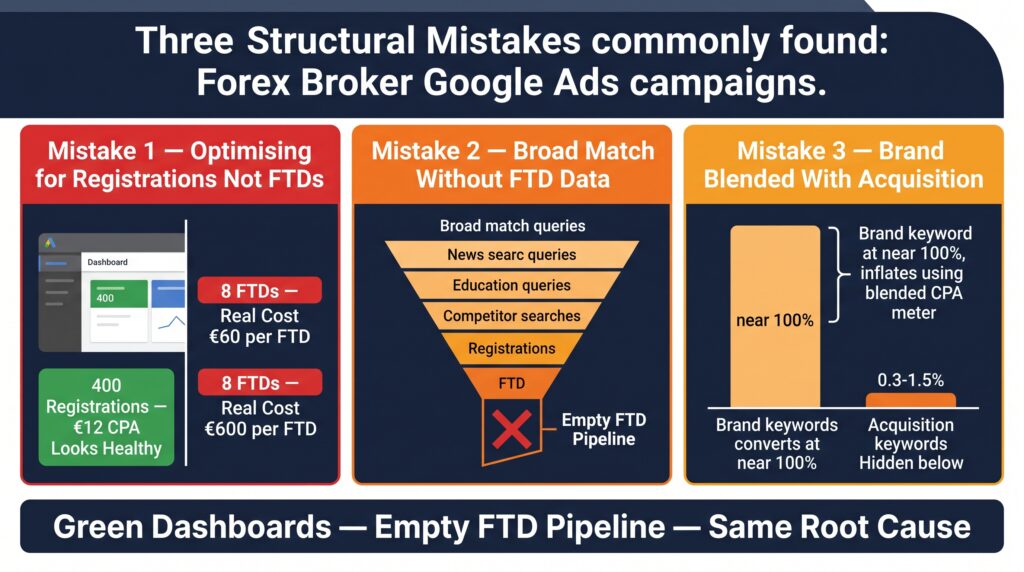
Assuming compliance is confirmed and the account is in good standing, three structural decisions determine whether a forex broker’s Google Ads budget generates First Time Deposits or simply spends. Most accounts I audit are making at least one of these. Many are making all three simultaneously.
The three mistakes: (1) Optimising for registration volume instead of FTD volume. (2) Running broad match without FTD data in the conversion funnel. (3) Blending brand campaigns with acquisition campaigns. Each of these produces green dashboards while collapsing the only metric that actually matters — cost per depositing client.
Mistake 1: Optimising for Registration Volume Instead of FTD Volume
Google’s Smart Bidding algorithm optimises for whatever conversion event you give it. If that event is “registration complete” — a form fill on the sign-up page — Smart Bidding maximises the number of registrations within your target CPA. Registrations are free events in your CRM. They generate zero revenue. A campaign producing 400 registrations at €12 cost-per-registration looks, on every standard dashboard metric, like it is performing. If eight of those 400 become First Time Deposits, your real cost-per-FTD is €600. If your target CPA was €300, you have been running at double your target while the agency report showed green metrics throughout.
The downstream effect compounds the problem. When Smart Bidding optimises for registrations, it finds the cheapest registrations — which are often the least qualified traffic: demo seekers, students, retail price-checkers, and traders who have already signed up with a competitor and are comparing platforms without deposit intent. These audiences register at low cost and deposit at near-zero rate. The registration-to-FTD conversion rate collapses. The campaign is not broken — it is doing exactly what it was told. The instruction was wrong.
The pattern is the same across accounts that make this switch. Registration volume drops initially — Smart Bidding is recalibrating toward a harder-to-reach conversion event. That drop is not failure. It is the algorithm filtering out the traffic that was registering and not depositing. The registration-to-FTD rate typically recovers within 60–90 days and settles significantly higher than the pre-switch baseline.
The fix is the FTD-first bid structure covered below. The most important configuration step comes first: FTD must be tracked as an offline conversion import before any bid strategy change is meaningful.
Mistake 2: Running Broad Match Without FTD Data in the Conversion Funnel
Broad match in Google Ads is designed to work alongside Smart Bidding. The algorithm uses your conversion data to understand which queries and audiences produce the outcome you are optimising for, then expands match coverage to semantically similar queries that are likely to produce the same outcome. Without FTD in the conversion funnel — because it is not tracked, or because conversion volume is too low for the algorithm to learn from — broad match expands based on semantic similarity alone.
Semantic similarity to “forex broker trading platform” includes: forex news searches, trading education queries, informational searches like “what is a pip” or “how does leverage work,” competitor brand name queries from existing traders, and trading software tool queries. All of these produce registrations at low cost-per-registration. None of them reliably produce First Time Deposits at a target CPA that makes the channel commercially viable.
The compounding problem: the registrations from unqualified broad match traffic feed more conversion signal into Smart Bidding’s model. The algorithm interprets this as the campaign working correctly. It bids more aggressively on the same query categories. Budget increases its share on traffic that generates registrations without deposit intent. The FTD pipeline stays empty. The dashboard shows a campaign performing well.
Broad match should only be introduced when FTD conversion data exists in the funnel and Smart Bidding has reached the minimum data threshold to learn from it. Until then, phrase match and exact match with a tightly managed and actively maintained negative keyword list is the correct campaign structure for a regulated forex broker’s Google Ads account.
| Match Type | Recommended Condition | Why It Matters for Forex |
|---|---|---|
| Exact Match | Always — from campaign launch through all phases | Controls precisely which queries trigger ads. Essential for brand keyword separation and high-intent acquisition terms (“open forex account,” “cfd broker regulated”). |
| Phrase Match | From launch — with active weekly negative keyword review | Captures intent-matched variants without the full expansion risk of broad. Requires consistent search term monitoring to prevent informational query leakage. |
| Broad Match | Only after 30+ FTDs/month in the conversion funnel and Smart Bidding is calibrated | Without FTD data, broad match expands into news, education, and competitor queries that register cheaply and deposit at near-zero rate. |
Mistake 3: Blending Brand Campaigns with Acquisition Campaigns
Brand keywords — searches for the broker’s own name, combined with terms like “login,” “deposit,” “my account,” or “trading platform” — convert at rates approaching 100% because the searcher already knows the broker and has a specific intent. They are existing clients returning to deposit or log in, or referred prospects who have already made their decision through another channel.
Acquisition keywords — “best forex broker,” “CFD trading platform,” “low spread forex” — convert to registration at 2–8% and to First Time Deposit at 0.3–1.5%. The conversion rates are not comparable. They should not share a campaign structure or a CPA calculation.
When both run within the same campaign structure, brand keyword conversions inflate the overall conversion rate and apparent ROAS. Smart Bidding sees high conversion volume and optimises aggressively — but the high-converting queries are existing client logins, not new depositing client acquisitions. The CMO’s reporting shows a healthy blended CPA that does not reflect the real cost of acquiring a net-new depositing client. A board presentation based on blended Google Ads CPA is presenting a figure that overstates acquisition performance by a margin that depends on brand traffic volume.
The structural fix: separate brand campaigns from acquisition campaigns always. Brand campaigns run on exact match brand terms, capped budget, manual or target CPM bidding. Acquisition campaigns have separate budget, separate conversion tracking, and separate CPA analysis against a separate target. The two CPA figures are reported separately — never blended. A Google Ads account that does not have this separation cannot accurately measure what it costs to acquire a new depositing client.
The FTD-First Bid Structure: How to Configure Google Ads Around the Only Metric That Matters
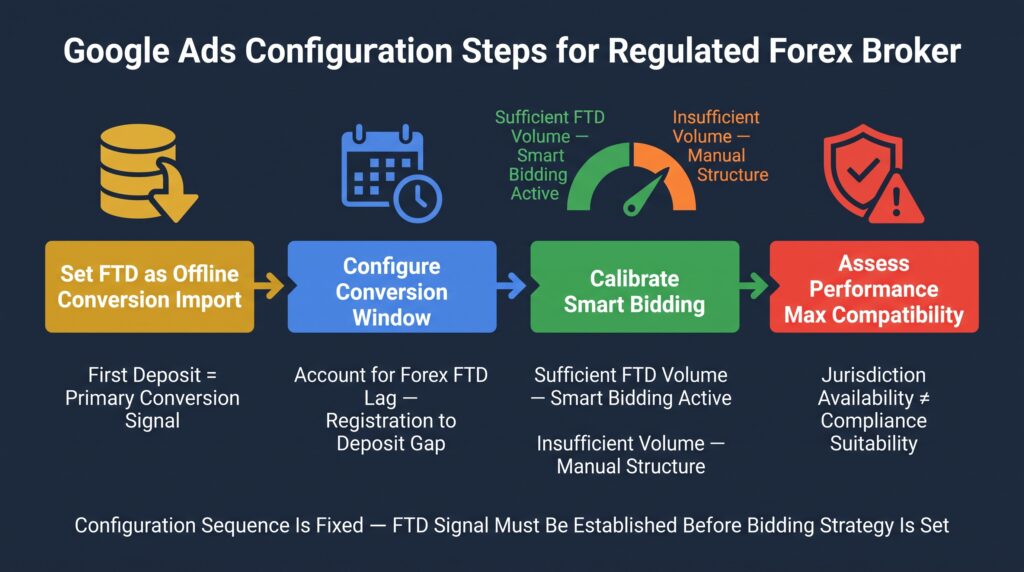
Compliance is confirmed. Campaign structure is separated. Now the bid strategy. The FTD-first structure is not a campaign type — it is a configuration sequence. Four steps, in order. Skipping any one of them produces the same result as not completing the sequence: a campaign that optimises for the wrong signal or has no reliable signal at all.
Step 1: Setting FTD as Your Offline Conversion Import
FTD is not a website event. The full sequence: a client clicks the Google Ad → registers on the broker’s website (trackable via standard Google tag) → submits KYC documents via a portal that may or may not be part of the main site → receives KYC approval from the broker’s compliance team → deposits via a payment gateway → the broker’s back-office system qualifies the deposit as a First Time Deposit when it meets the minimum deposit threshold. The FTD event lives in the CRM and PSP infrastructure. There is no pixel that can capture it on the website.
This means FTD requires an offline conversion import. The mechanism: at registration, the Google Click ID (GCLID) generated by the ad click is captured and stored alongside the client record in the broker’s CRM. When the client’s first deposit is qualified as an FTD, the GCLID and the conversion value are uploaded to Google Ads — via the offline conversion import API for automated daily uploads, or via CSV for lower-volume accounts. Google’s algorithm attributes the FTD event back to the original click, keyword, ad, and audience segment. Smart Bidding then has a real signal to optimise toward.
Without this setup, every bid decision Smart Bidding makes is blind to the actual outcome of the traffic it is buying. All other steps in the FTD-first framework depend on this one being completed first.
Step 2: Configuring Conversion Windows for the Forex Broker FTD Lag
Google Ads default conversion window is 30 days from click. For e-commerce, this is reasonable — a purchase decision typically happens within 30 days of the original click. For a forex broker, the click-to-FTD timeline is structurally longer.
The typical sequence after a click: registration happens the same day in most cases, within one to four hours. KYC document submission follows within one to seven days, depending on client readiness and the broker’s onboarding UX. KYC review and approval takes one to five business days, varying by broker compliance team capacity and jurisdiction complexity. The funding decision and initial deposit happens one to fourteen days after KYC approval, depending on the client’s intent strength and the broker’s deposit experience. FTD qualification triggers when the deposit meets the broker’s minimum threshold. Total window from click to FTD: commonly seven to thirty days for most markets, and extending to forty-five to sixty days for FCA-regulated UK brokers where KYC is more intensive, or where minimum deposit thresholds are higher.
The practical problem: with a 30-day default conversion window and an average click-to-FTD lag of 21 days, Smart Bidding is always working from an incomplete picture of the most recent three weeks of FTD conversions. It makes bid decisions based on a trailing data window that systematically misses recent results.
The fix: set the conversion window for the FTD offline conversion action to 60 days. Apply this setting specifically to the FTD import — not globally to all conversion actions. In Google Ads, each conversion action has its own window setting. The registration conversion can remain at 30 days. Only FTD needs the extended 60-day window to correctly capture the full click-to-deposit sequence for Smart Bidding’s learning period.
Step 3: Smart Bidding Calibration — tCPA, tROAS, and the Minimum FTD Data Threshold
Smart Bidding requires sufficient conversion volume to optimise correctly. Google’s general guidance is a minimum of 30 to 50 conversions per campaign per month before switching to target CPA bidding. For forex broker FTD campaigns, reaching this threshold takes time — FTD volume on a newly launched acquisition campaign is typically low in the first 60 to 90 days as campaign history builds and Quality Scores develop.
The decision framework: if FTD volume is below 30 per month, do not use Smart Bidding with FTD as the primary conversion goal. Run manual CPC with phrase and exact match keywords, a tightly managed negative keyword list with weekly search term review, and separate brand campaigns already confirmed. Import FTD as an offline conversion for visibility and trend analysis, but do not assign it as the Smart Bidding optimisation target until data volume is sufficient. Track registration-to-FTD conversion rate weekly as the proxy metric for campaign health during this phase — it tells you whether campaign traffic quality is improving even before FTD volume is high enough to feed Smart Bidding.
Once FTD volume reaches 30 or more per month consistently: transition to tCPA bidding. Set the initial tCPA target at 130 to 150% of the calculated cost-per-FTD from the manual bidding period — give the algorithm room to learn before tightening the target. Switching to an aggressive tCPA target immediately causes the algorithm to restrict spend sharply while it calibrates against a target it cannot yet consistently reach.
tCPA versus tROAS: use tCPA when the broker’s average FTD value is relatively uniform across the acquisition funnel — same minimum deposit for all client segments, same product type. Use tROAS when FTD value varies meaningfully: different deposit tiers, different product lines with different margin profiles, or different client segments with materially different lifetime values. Most regulated retail forex brokers with a single account type and a fixed minimum deposit will use tCPA. Brokers with tiered accounts or multiple product types should model tROAS against their actual deposit distribution before committing to it.
How long does it take to reach 30 FTDs per month from a standing start? UK market: CPL runs £150–£400 for regulated forex broker campaigns on Google Ads, reflecting the Finance sector’s low conversion rate (2–4%) and high keyword competition. FTD conversion rate from registered leads is 8–12% for an optimised funnel. At a £20,000/month budget you are generating roughly 50–130 registered leads per month. At 8–12% FTD conversion that produces 4–16 FTDs — meaning 30 FTDs/month from Google Ads alone requires £40,000–£80,000/month at UK market CPL levels, or a multi-channel approach combining Google Ads with organic, affiliate, and IB referral to reach the tCPA activation threshold.
Add the Smart Bidding learning phase — new accounts typically run 20–30% higher CPA for the first 60 days — and the realistic timeline to reach 30 FTDs/month with sufficient data quality for tCPA activation is 12–20 weeks at that budget level.
UAE and MENA markets reach the same FTD volume threshold faster at lower budget due to higher FTD conversion rates (12–18%) and lower CPL ($80–$200). Verify with your media agency against your specific market and funnel conversion data.
For new broker acquisition campaigns with no existing conversion history, the correct 2026 bidding progression is: start with Maximize Clicks to build traffic and surface which keywords drive registrations — this is Google’s own recommended starting point for brand new campaigns. Once the campaign has generated 15–30 registration conversions in a 30-day window, switch to Maximize Conversions without a target to let the algorithm optimise toward actual conversion events. Once the campaign reaches 30 FTDs in a 30-day window, introduce Target CPA set at 20–30% above your observed CPA to give the algorithm room to operate without over-constraining delivery.
Step 4: Performance Max Eligibility — Why Most Forex Brokers Cannot Use It
Performance Max is Google’s automated campaign type that serves across all Google inventory — Search, Display, YouTube, Gmail, and Maps. For many verticals it is now the default recommendation, and Google’s tools increasingly guide advertisers toward it. For forex broker CFD acquisition campaigns in most regulated markets, Performance Max eligibility is restricted.
The restricted financial products certification that applies to standard Search campaigns applies equally to Performance Max. In markets where CFD advertising operates under additional constraints — the UK following FCA intervention on risk warning requirements, most EU retail markets following ESMA leverage restrictions — PMax campaign types for CFD acquisition face inventory and targeting restrictions that reduce their practical utility even where technically eligible.
For most regulated forex brokers, the correct approach in 2026: launch and optimise Search campaigns with the FTD-first structure as the foundation. Evaluate Performance Max as a secondary campaign type once Search is producing stable FTD volume and conversion data exists. Do not launch PMax as the entry point for a new broker account — the compliance layer, the FTD conversion import, and the Smart Bidding calibration need to happen in Search first.
Google’s June 2026 Smart Bidding Exploration expansion now applies to PMax campaigns without product feeds — which is the type a forex broker would use. This further reduces advertiser control over where ads appear. Worth adding:
“Note: Google’s June 2026 Smart Bidding Exploration update expanded automated inventory exploration to all PMax campaigns without product feeds. This further reduces placement control for forex broker PMax campaigns and reinforces Search as the correct primary campaign type for regulated CFD acquisition.”
What to Measure and When to Cut: The Forex Broker Google Ads Profitability Review
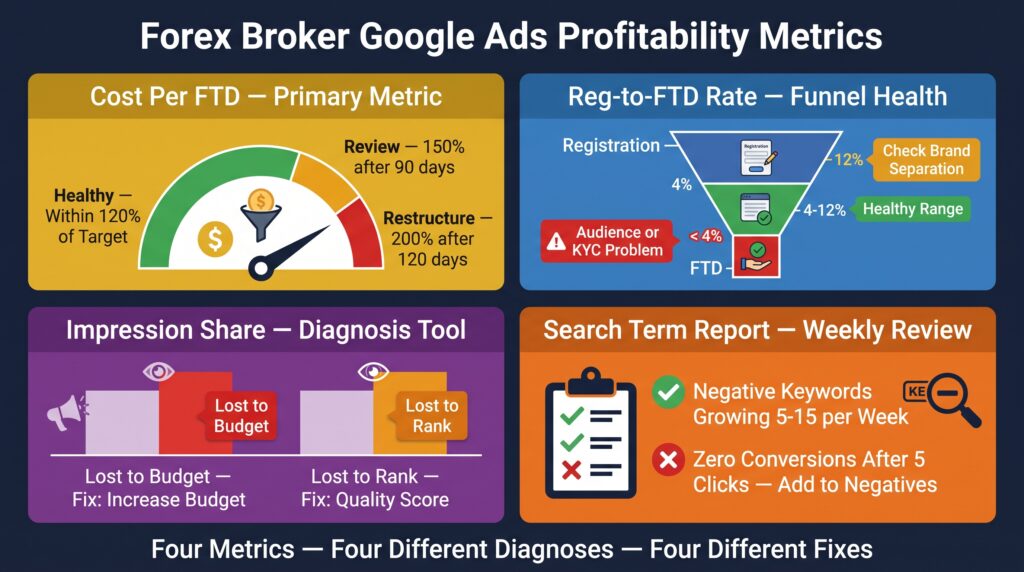
The FTD-first structure is in place. The monthly review protocol is what determines whether the campaign is working, needs optimisation, or requires structural change. Four metrics, in priority order.
Cost Per FTD is the primary metric. It is the only number that tells you whether Google Ads is profitable as an acquisition channel. Benchmark it against the broker’s blended CPA from other acquisition channels. If Google Ads is producing FTDs at more than 150% of the blended channel CPA after 90 days of active optimisation, the campaign requires structural review — not a budget increase. Budget increase at that point makes a structurally broken campaign larger, not better. When a broker tells me their Google Ads is not working, the first number I ask for is cost-per-FTD. If they do not have it tracked — that is the problem, not the campaign.
Registration-to-FTD conversion rate is the funnel health metric. It measures how effectively campaign traffic converts through the full broker onboarding sequence from registration to first deposit. Benchmark range: 4 to 12%, varying by market, minimum deposit requirement, KYC complexity, and onboarding UX quality. Consistently below 4% indicates either a campaign audience quality problem — traffic that is registering without deposit intent — or a KYC and onboarding friction problem that is losing qualified depositors at the verification stage. Consistently above 12% often signals brand keyword contamination: existing clients registering again via paid search. If this figure appears unusually high, verify that brand campaign separation is functioning correctly.
Impression share lost to budget versus lost to rank diagnoses the specific cause of underperformance when it exists. Impression share lost to budget means the campaign is winning auctions but running out of daily budget before capturing all available impressions — the fix is budget increase or reallocation. Impression share lost to rank means the campaign is not winning auctions at sufficient frequency — the fix is Quality Score improvement, ad relevance refinement, or keyword and audience restructuring. These have different diagnoses and different fixes. Reporting them as a single blended impression share figure is a common agency reporting error that obscures which problem actually exists and needs to be addressed.
Search term report quality requires weekly review. Every search term that triggered a paid click and produced zero conversions across five or more clicks should be reviewed for the negative keyword list. Every search term that is clearly informational — forex news queries, trading education searches, platform comparison queries where intent is research rather than account opening — represents audience leakage from an incomplete negative keyword structure. The negative keyword list for a forex broker Google Ads account should grow by five to fifteen terms per week during the first 90 days of a campaign. If it is not growing, the search term review is not being done.
| Metric | Healthy Range | Pause / Review Signal | Scale Signal | Restructure Signal |
|---|---|---|---|---|
| Cost Per FTD | Within 120% of blended channel of your target Cost Per FTD | Above 150% of target after 90 days | Below 90% for 30+ days sustained | Above 200% after 120 days — campaign structure, not budget, is the problem |
| Reg-to-FTD Rate | 4–12% (market and deposit-tier dependent) | Below 3% for two consecutive months | Above 12% — verify brand separation first | Below 2% consistently — audience quality or onboarding UX requires full review, not a bid change |
| IS Lost to Budget | Below 20% | Above 40% with strong FTD performance | Increase budget when CPA is healthy and IS lost to budget is high | N/A — budget problem, not structural |
| IS Lost to Rank | Below 15% | Above 30% — QS audit needed | N/A — fix rank before scaling | Above 40% sustained — keyword list, ad relevance, or landing page experience requires full structural review |
If any of the three mistakes described here look familiar in your account — or if your cost-per-FTD number does not exist yet — that is exactly where a PPC audit starts.
FAQ
Q1: How do you make Google Ads profitable for a forex broker?
A1: Making Google Ads profitable for a forex broker requires two sequential layers. First, compliance clearance — confirming Google’s certification for financial services advertisers in your target markets, ensuring ad copy meets restricted financial products policy, and verifying landing pages are compliant. Second, the FTD-first bid structure — tracking First Time Deposit as an offline conversion import, configuring the correct conversion window for the forex broker FTD lag, and calibrating Smart Bidding only once FTD data volume reaches the minimum threshold. Campaigns optimising for registration volume instead of FTD volume are the most common reason Google Ads is unprofitable for forex brokers regardless of budget.
Q2: What is cost per FTD in Google Ads for a forex broker?
A2: Cost per FTD — Cost Per First Time Deposit — measures what Google Ads spends to acquire one net-new depositing client. It is calculated by dividing total Google Ads spend by the number of clients who completed their first qualifying deposit within the attribution window. It is distinct from cost-per-registration, which measures a free CRM event that generates zero revenue. Cost per FTD is the only metric that determines whether Google Ads is profitable as an acquisition channel for a forex broker.
Q3: Why are forex broker Google Ads accounts restricted or suspended?
A3: The three most common causes of account-level suspension for forex brokers: running campaigns without completing Google’s certification for financial services advertisers in the target jurisdiction; ad copy that makes prohibited performance claims, implies guaranteed outcomes, or includes risk-free language; and landing page policy violations — particularly missing or insufficiently prominent risk warnings, or performance claims on the destination page even when the ad itself is compliant. Violations can result in account-level suspension, not just individual ad disapproval.
Q4: How many FTDs per month do you need before switching to Smart Bidding?
A4: Smart Bidding requires a minimum of 30 to 50 conversions per campaign per month to optimise correctly. For forex broker FTD campaigns where initial deposit volume is low, manual CPC with phrase and exact match keywords is the correct approach until FTD data reaches this threshold. Switching to Smart Bidding before sufficient FTD conversion data exists causes the algorithm to optimise on insufficient signal, producing unpredictable and typically poor results during the learning period.
Q5: Can forex brokers use Performance Max campaigns on Google Ads?
A5: Performance Max campaigns for CFD and forex broker acquisition are subject to the same restricted financial products certification as standard Search campaigns. Eligibility varies by jurisdiction — brokers must confirm the certification applies to PMax campaign types in their specific target markets. For most FCA and CySEC-regulated brokers, the lower-risk approach is to launch and optimise Search campaigns with the FTD-first structure first, then evaluate Performance Max as a secondary campaign type once conversion data and campaign history exist.