
TikTok Ads for Forex Brokers, what we need to know?
The format-compliance matrix established earlier in this series flagged a specific tension on TikTok worth its own full treatment: the platform’s native UGC style and FCA’s testimonial restrictions pull in opposite directions — this article is that full treatment.
TikTok’s entire content model rewards authentic, relatable, outcome-adjacent storytelling — the exact style most likely to imply a typical or replicable trading result, which FCA’s financial promotion rules restrict without disclaimers. This is not a minor creative constraint to work around with a disclaimer; it is the central fact determining whether TikTok is viable for a given forex broker at all.
Every forex broker marketing team that asks me about TikTok comes in with the same creative concept — a relatable trader sharing their experience — and it’s almost always the first format I have to redirect them away from, because it’s the one that most directly conflicts with FCA restrictions on implying typical trading results.
This guide gives the honest answer — conditionally viable, with a narrower compliant creative space than Meta or Google — and walks through the specific mechanics: the UGC restriction, risk warning placement within TikTok’s format, where TikTok fits in the broader channel mix, the platform’s own certification policy, creator partnership compliance, and audience fit as a strategic, not just compliance, question.
Table of Contents
The UGC Restriction — TikTok’s Defining Compliance Problem for Forex
Per the format-compliance matrix in the ad creative formats guide, FCA’s financial promotion rules restrict testimonials implying typical or replicable trading results. TikTok’s native content model is built almost entirely around exactly this kind of authentic, first-person, outcome-adjacent storytelling — a creator or trader sharing what happened to them, framed in a way that implicitly invites the viewer to imagine the same outcome.
Why this is structural, not incidental: On Meta or Google, a broker can choose to run UGC-style content or not — it is one format option among several, with static and video brand creative as equally native alternatives. On TikTok, content that doesn’t follow this authentic, personal-narrative style tends to underperform the platform’s own algorithm and feel visibly out of place to its audience, who are accustomed to a specific content language. This means the platform’s single highest-performing native format is also its single highest-compliance-risk format for a regulated forex broker — a structural mismatch that doesn’t exist to the same degree on other platforms.
What remains viable within this constraint: Content focused on process and experience rather than outcome — explaining how a platform feature works, what a trading concept means, what the broker’s regulatory credentials represent — can use TikTok’s authentic, native presentation style without triggering the testimonial restriction, since it makes no implicit claim about replicable financial results. This is a narrower creative brief than “share your trading story,” but it is genuinely compliant and still native to the platform’s content language.
The Honest Verdict — Conditionally Viable, Narrower Creative Space
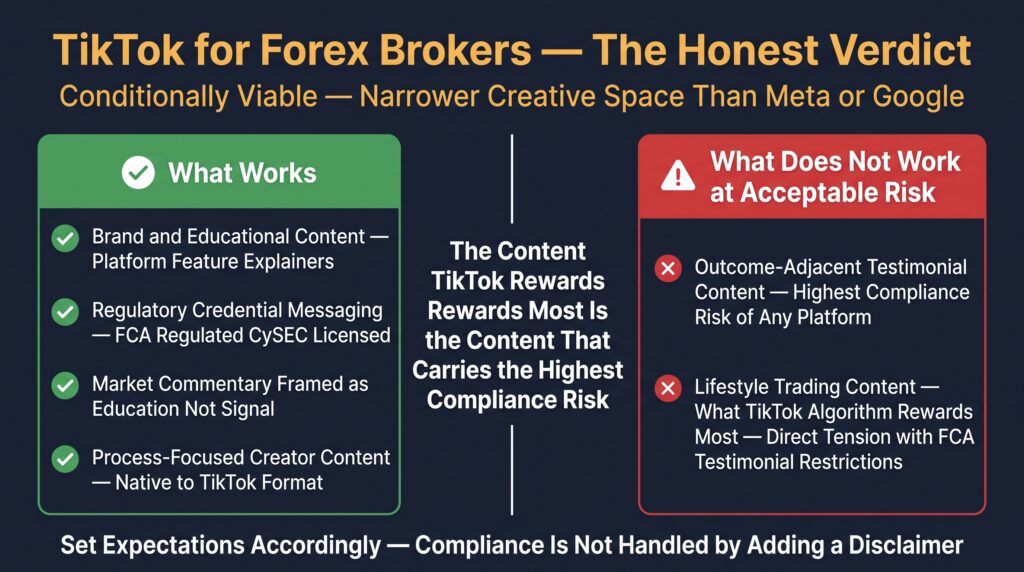
TikTok is conditionally viable for forex brokers — but the compliant creative space is narrower than on Meta or Google, and brokers should set expectations accordingly rather than assuming TikTok works the same way once compliance is “handled” with a disclaimer.
WHAT WORKS
Brand and educational content — platform feature explainers, regulatory credential messaging, market commentary framed as education rather than signal, and process-focused creator content — all of these can be both compliant and genuinely native to TikTok’s format.
WHAT DOESN’T WORK AT ACCEPTABLE RISK
Outcome-adjacent testimonial and lifestyle-trading content — the format TikTok’s algorithm and audience respond to most strongly — carries the highest compliance risk of any platform covered in this cluster, given the direct tension with FCA’s testimonial restrictions described above.
The practical recommendation: Treat TikTok primarily as a brand-awareness and educational channel rather than a direct-response performance channel, at least within current compliance constraints. This is not a verdict against the platform — it is a verdict about which job the platform can compliantly do for a regulated forex broker, which is a narrower job than its full native content range suggests.
Risk Warning Mechanics Within TikTok’s Format
TikTok’s short-form, vertical, sound-on-by-default format creates risk warning challenges distinct from the sound-off context established for Meta in the ad creative formats guide. A risk warning must remain visually persistent per the same underlying prominence standard, but should not rely on appearing only late in the clip or solely through rapid spoken disclosure — TikTok’s fast-scroll consumption pattern means a meaningful share of viewers may scroll away before a warning appearing only in the final seconds is ever seen.
The practical implication: On-screen text risk warnings should appear within the first few seconds of a TikTok ad, not only persistently throughout — front-loading the disclosure increases the probability that even a viewer who scrolls away quickly has seen it. Voiceover risk warnings carry the same compliance weight as written disclosure, but should not be the sole disclosure mechanism given how easily sound-on content is still scrolled past without full audio attention.
This is a platform-specific implementation detail layered on top of the broker’s existing regulatory risk warning obligations — the underlying requirement doesn’t change, but the format-specific placement strategy that satisfies it does.
Where TikTok Fits in the Broker’s Channel Mix
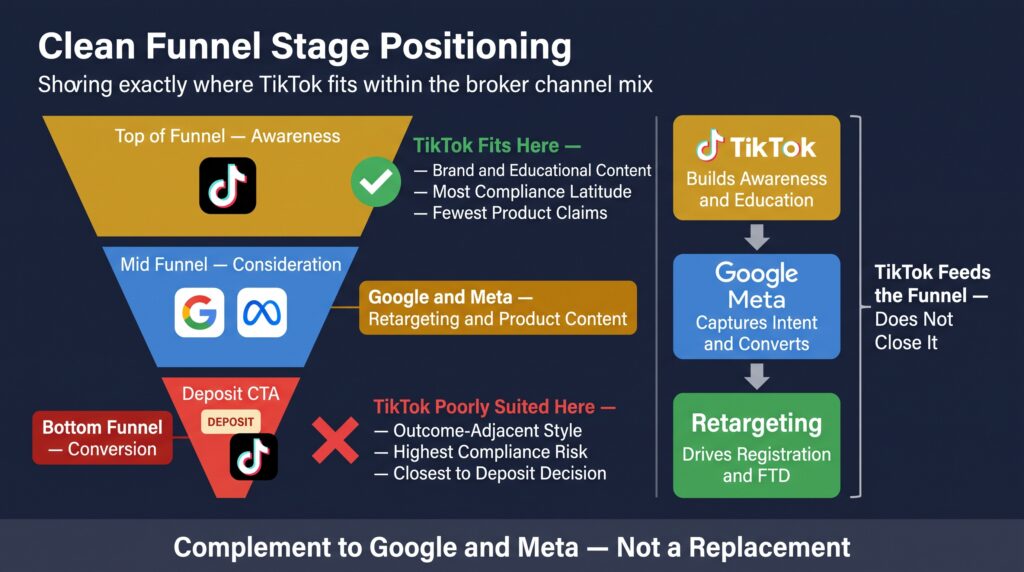
Per the funnel-stage framework in the ad creative formats guide, TikTok’s viable compliant content — brand and educational — fits best at the top-of-funnel awareness stage, the stage with the most compliance latitude generally since it makes the fewest specific product claims.
TikTok is poorly suited to the bottom-funnel, highest-compliance-rigor stage covered in the retargeting strategy guide, where messaging closest to driving an actual deposit decision carries the most regulatory weight — exactly the stage where TikTok’s native outcome-adjacent style would be most compliance-risky if attempted.
The practical positioning: TikTok functions best as a complement to, not a replacement for, the broker’s existing Google and Meta programmes — building top-of-funnel brand awareness and audience education that feeds into the more conversion-focused work happening on other channels, rather than attempting to drive direct registration or funding decisions through TikTok creative itself.
TikTok’s Financial Services Advertising Policy and Certification
Running TikTok ads for a forex broker is highly restricted due to strict financial policies. To succeed, you must submit formal broker licenses (like CySEC, FCA, or ASIC) through a TikTok Sales Representative for pre-approval. You must target users 18 and older, and you can never use “get rich quick” promises, luxury cars, or guaranteed returns in your videos.
1. The Strategy: Education Over “Flexing”
Because of the strict policies against aggressive financial claims, your ads should act as short, educational explainers or utilize AI-generated spokespersons.
- Focus on the basics: Explain terms like “leverage” or “pip” in 30 seconds.
- Use Spark Ads: Partner with licensed financial creators to boost their organic videos. Note that Spark Ads still go through the same financial services review process and do not bypass CFD advertising restrictions — the advantage is authenticity and engagement, not policy circumvention.
2. Compliance Rules (What Not to Do)
TikTok closely monitors Forex and CFD traffic to prevent scams. To avoid getting your business ad account banned:
- No “Exit Hooks”: Avoid phrases like “quit your 9-to-5” or “$500 a day.”
- Mandatory Disclaimers: Embed clear, regional risk warnings directly into your video and landing page.
3. Campaign Setup and Optimization
When you successfully pass the restricted industry business verification, you can set up your campaigns to track real results. Note: passing restricted industry verification does not automatically permit direct CFD product advertising in regulated markets — market-specific restrictions apply regardless of verification status.
- Tracking: Optimize your campaigns for First-Time Deposits (FTD) rather than just clicks to ensure your ad spend goes after serious traders.
- Exclusions: Exclude restricted areas and markets where your broker is not authorized to operate.
4. Market Tier Reality — The Most Important Strategic Point
TikTok’s enforcement is not uniform across markets. In Tier 1 regulated markets (UK, EU, Australia) CFD product advertising remains largely prohibited even after verification — education-first organic content is the primary viable approach. In Tier 3 markets (LATAM, Southeast Asia, Sub-Saharan Africa) enforcement is materially lighter and brokers run paid CFD campaigns more freely, making TikTok a viable direct acquisition channel in those regions specifically. Budget planning should reflect this market-tier distinction — TikTok requires content investment in Tier 1 markets and can support paid acquisition in Tier 3 markets.
*Verify current TikTok financial services advertising policy directly with a TikTok Sales Representative before campaign planning. Policies are subject to ongoing change and market-specific variation.
.
The practical action: Verify TikTok’s current certification and market-availability requirements directly with TikTok’s advertising team before assuming the same certification approach used for Google or Meta transfers directly, and extend the certification mapping document established in the account structure guide to include a TikTok-specific column once the platform’s requirements for the broker’s specific markets are confirmed.
Creator and Influencer Partnerships — A Compounded Compliance Risk
TikTok’s creator and influencer ecosystem is central to the platform’s native advertising model, but creator-produced content promoting a forex broker compounds two restrictions simultaneously: the UGC/testimonial risk described above, and the affiliate compliance responsibility asymmetry established in the affiliate vs direct acquisition guide — a creator partnership is functionally similar to an affiliate relationship from a compliance oversight perspective, since the broker remains responsible for the financial promotion regardless of who produced it.
Why this needs specific attention: A broker considering TikTok creator partnerships needs creator content reviewed with the same rigor as any affiliate-produced creative covered in the affiliate compliance framework, with an added complexity: creator content is often filmed in an unscripted, authentic style that resists the same structured pre-approval workflow established in the account structure guide for standard ad creative. A creator briefed only generally (“share your honest experience”) is more likely to drift into outcome-adjacent testimonial territory than one briefed specifically on process and experience framing.
THE PRACTICAL ACTION
Any creator brief should explicitly exclude outcome and result-implying language, consistent with the UGC reframing principle from the ad creative formats guide, and creator content should go through compliance review before publishing despite its authentic, less scripted production style.
Audience Fit — A Strategic Question Beyond Compliance
Beyond compliance, a genuine strategic question determines TikTok’s actual usefulness for a specific broker: does the platform’s audience demographic align with that broker’s typical client profile? TikTok’s audience generally skews younger than Google Search’s or LinkedIn’s typical financial services audience.
This demographic profile may align well with brokers specifically targeting a younger, first-time trader segment building initial trading literacy and brand awareness, but less well with brokers primarily targeting institutional clients, high-net-worth retail investors, or an older, more established trader demographic who may not be meaningfully present on the platform at all.
The practical implication: This audience fit question should inform the viability verdict alongside the compliance question covered throughout this article — a platform can be compliantly usable in principle but still strategically mismatched to a specific broker’s actual target client profile, making the genuine viability question two-part: is it compliant, and is it the right audience.
A Practical Decision Framework — Should This Broker Use TikTok
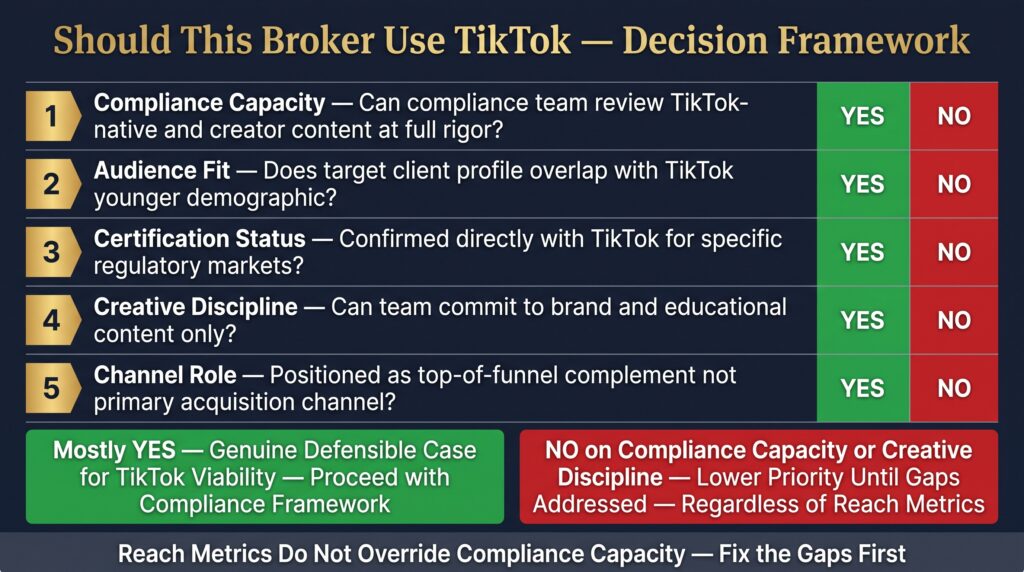
A practical framework for assessing TikTok viability for a specific broker:
1.Compliance capacity. Does the compliance team have capacity to review TikTok-native content at the same rigor applied to other platforms, including unscripted creator content?
2.Audience fit. Does the broker’s target client profile meaningfully overlap with TikTok’s generally younger audience demographic?
3.Certification status. Has TikTok’s certification and market-availability status been confirmed directly with TikTok for the broker’s specific regulatory markets?
4.Creative discipline. Can the marketing team commit to brand and educational content only, resisting the temptation to chase the platform’s higher-performing but higher-risk native style?
5.Channel role. Is TikTok being positioned as a top-of-funnel awareness complement to existing Google and Meta programmes, rather than a primary acquisition channel?
A broker answering yes to most or all of these has a genuine, defensible case for TikTok viability. A broker answering no to several — particularly compliance capacity or creative discipline — should treat TikTok as a lower-priority channel until those gaps are addressed, regardless of how attractive the platform’s reach metrics appear in isolation.
If you want a TikTok feasibility assessment specific to your regulatory tier, target audience, and current compliance capacity — not a generic platform verdict — that assessment is part of the diagnostic.
FAQ
Q1: Why is TikTok’s content style risky for forex broker advertising compliance?
TikTok’s content model is built around authentic, first-person, outcome-adjacent storytelling, where a creator shares a personal experience in a way that implicitly invites viewers to imagine achieving the same result. This content style is in direct tension with FCA financial promotion rules, which restrict testimonials implying typical or replicable trading results without clear disclaimers. On other advertising platforms such as Meta or Google, this type of user-generated content is one creative option among several equally native formats, including static images and produced video. On TikTok, content that does not follow this authentic, personal-narrative style tends to underperform the platform’s algorithm and feel out of place to its audience, meaning the platform’s single highest-performing native format is also its highest-compliance-risk format for a regulated forex broker, a structural mismatch that does not exist to the same degree on other advertising platforms.
Q2: Is TikTok actually viable for forex broker advertising in 2026?
TikTok is conditionally viable for forex brokers, but the compliant creative space is narrower than on Meta or Google, and brokers should set expectations accordingly. Brand and educational content, including platform feature explainers, regulatory credential messaging, and process-focused creator content that avoids implying specific financial outcomes, can be both compliant and genuinely native to TikTok’s format and audience expectations. Outcome-adjacent testimonial and lifestyle-trading content, which is the format TikTok’s algorithm and audience respond to most strongly, carries the highest compliance risk of any major advertising platform given its direct tension with financial promotion testimonial restrictions. The practical recommendation is to treat TikTok primarily as a brand-awareness and educational channel rather than a direct-response performance channel, positioning it as a complement to existing Google and Meta programmes rather than a primary acquisition channel, at least within current compliance constraints.
Q3: How should risk warnings be displayed on TikTok ads for forex brokers?
Risk warnings on TikTok ads for forex brokers should appear as a persistent on-screen text element starting within the first few seconds of the video, rather than appearing only later in the clip or relying solely on spoken disclosure through voiceover. This is because TikTok’s fast-scroll consumption pattern means a meaningful share of viewers may scroll away before a warning appearing only in the final seconds of a clip is ever seen. Voiceover risk warnings carry the same compliance weight as written disclosure, but should not be the sole disclosure mechanism, since sound-on content is still frequently scrolled past without full audio attention from the viewer. Front-loading the on-screen disclosure increases the probability that even a viewer who scrolls away quickly has still seen the required risk warning before doing so.
Q4: Where does TikTok fit in a forex broker’s overall paid advertising channel mix?
TikTok’s compliant content for a regulated forex broker, primarily brand and educational material, fits best at the top of the marketing funnel, which is the stage with the most compliance latitude because it makes the fewest specific product claims. TikTok is poorly suited to bottom-of-funnel activity such as retargeting registered users toward funding their accounts, since that stage carries the highest compliance rigor and is closest to the actual financial promotion encouraging a deposit decision, precisely where TikTok’s native outcome-adjacent content style would carry the most risk if attempted. The practical positioning is to treat TikTok as a complement to a broker’s existing Google and Meta advertising programmes, building top-of-funnel brand awareness and audience education that feeds into the more conversion-focused activity happening on other channels, rather than expecting TikTok to drive direct registration or funding decisions on its own.
Q5: Are creator and influencer partnerships compliant for forex broker TikTok campaigns?
Creator and influencer partnerships for forex broker TikTok campaigns carry compounded compliance risk that requires specific attention. They combine the user-generated content testimonial risk, since creator content commonly implies personal trading outcomes, with the broader affiliate compliance responsibility that applies to any third-party-produced promotional content, since a regulated broker remains responsible for financial promotions distributed by partners regardless of who produced the creative. This is further complicated because creator content is often filmed in an unscripted, authentic style that resists the same structured pre-approval review workflow used for standard advertising creative. The practical approach is to provide creators with a brief that explicitly excludes language implying financial outcomes or results, focusing instead on process and experience, and to route all creator content through compliance review before publishing despite its less formally scripted production style.
Q6: Does TikTok’s audience match typical forex broker target clients?
This depends significantly on the specific broker’s target client profile. TikTok’s audience generally skews younger than the typical audience reached through Google Search or LinkedIn for financial services advertising, which may align well with forex brokers specifically targeting a younger, first-time trader segment focused on building initial trading literacy and brand familiarity. This demographic profile aligns less well with brokers primarily targeting institutional clients, high-net-worth retail investors, or an older and more established trader demographic who may not be meaningfully present on the platform. This audience fit question should be assessed alongside the platform’s compliance constraints, since a platform can be compliantly usable in principle while still being strategically mismatched to a specific broker’s actual target client profile, making the complete viability assessment a combination of both compliance feasibility and audience alignment.