
Affiliate vs Direct Paid Acquisition for Forex Brokers, which to choose?
Most content comparing affiliate and direct paid acquisition for forex brokers is written for the affiliate’s benefit, not the broker’s — which is a problem if you are the CMO deciding where the next marketing dollar goes.
Articles exist on which partner programme structure (IB vs affiliate) to offer. Articles exist on whether running paid ads is worth it for an affiliate. Almost nothing addresses the broker’s own resource-allocation question: should marketing investment prioritise partner-driven acquisition over building direct in-house paid capability, and under what conditions does each scale more effectively?
This article compares the two channels tactically — scaling economics, compliance responsibility, and the conditions favouring each. The full growth architecture and channel mix strategy conversation, spanning the broker’s entire acquisition stack, is a deeper strategic question worth a separate conversation.
Table of Contents
Affiliate vs Direct Paid Acquisition for Forex Brokers — How Each Channel Behaves as Budget Increases
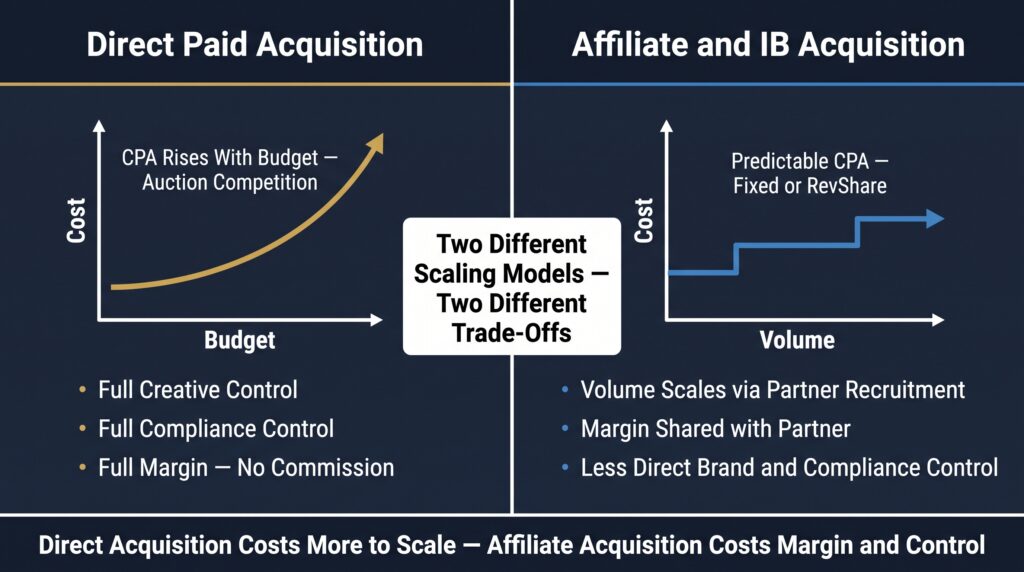
Direct paid acquisition scaling. CPA generally increases as budget scales within a given market, because auction dynamics mean more spend is competing for the same finite high-intent search and social inventory. The broker retains full control over creative, targeting, and compliance (per the account structure principles in the Google Ads account structure guide), and retains full margin on each acquired client since there is no partner commission to pay.
Affiliate/IB acquisition scaling. Marginal cost per acquisition is often more predictable — fixed CPA or RevShare agreements set in advance — and volume can scale by recruiting additional partners rather than only by increasing bid competition in a single auction. The trade-off: the broker shares margin with the partner and has materially less direct control over how that partner represents the brand and complies with financial promotion rules.
Neither channel scales “better” universally. The comparison depends on market maturity, available compliance oversight capacity, and margin tolerance — covered below.
The Compliance Responsibility Asymmetry — The Most Underappreciated Factor
Under FCA and CySEC rules, a regulated broker remains responsible for financial promotions distributed by its affiliates and IBs — even though the broker did not produce that creative directly. This is the critical and commonly underestimated asymmetry between the two channels.
What this means in practice: Direct paid acquisition gives the broker’s compliance team full visibility and control over every piece of creative before it runs, via the approval workflow established in the Google Ads account structure guide. Affiliate/IB acquisition requires the broker to extend that same compliance oversight to creative produced by third parties — partners who may have less regulatory training and a stronger incentive to prioritise conversion rate over compliance precision, since their compensation is typically tied to performance, not to the broker’s regulatory standing.
THE SCALING IMPLICATION
Scaling through affiliates without a corresponding scale-up in compliance monitoring of partner creative is taking on regulatory risk that compounds with every new partner added. A broker with 5 active IBs can plausibly review each partner’s creative output manually. A broker with 50 active IBs cannot — without either a dedicated partner compliance function or a structured, scalable partner creative approval system. This compliance capacity question, more than CAC, is often the real constraint on how far affiliate-driven scaling can go before regulatory risk becomes unmanageable.
FOR CEOS — THE ONE QUESTION FOR AFFILIATE SCALING READINESS
Before approving an increase in IB recruitment targets, ask the compliance team: “What is our current process for reviewing partner-produced creative, and does it scale linearly with partner count, or does it break down past a certain number?” If the answer is “we review what we can, when we can,” the affiliate channel is scaling faster than the compliance function supporting it.
Brand Control and Consistency Trade-offs
Direct paid acquisition maintains full brand voice and creative consistency, since all creative passes through the broker’s own approval workflow per the format-compliance matrix. Affiliate/IB acquisition introduces brand voice variability — different partners producing creative independently, with varying quality and adherence to brand guidelines, layered on top of the compliance variability already noted above.
For brokers in early brand-building phases, this variability can meaningfully dilute brand positioning at a stage when consistency matters most. For brokers with established brand recognition, partner-driven creative variability tends to matter less, because the underlying brand association is already strong enough to absorb some inconsistency in how individual partners present it.
CAC and LTV Across Channels
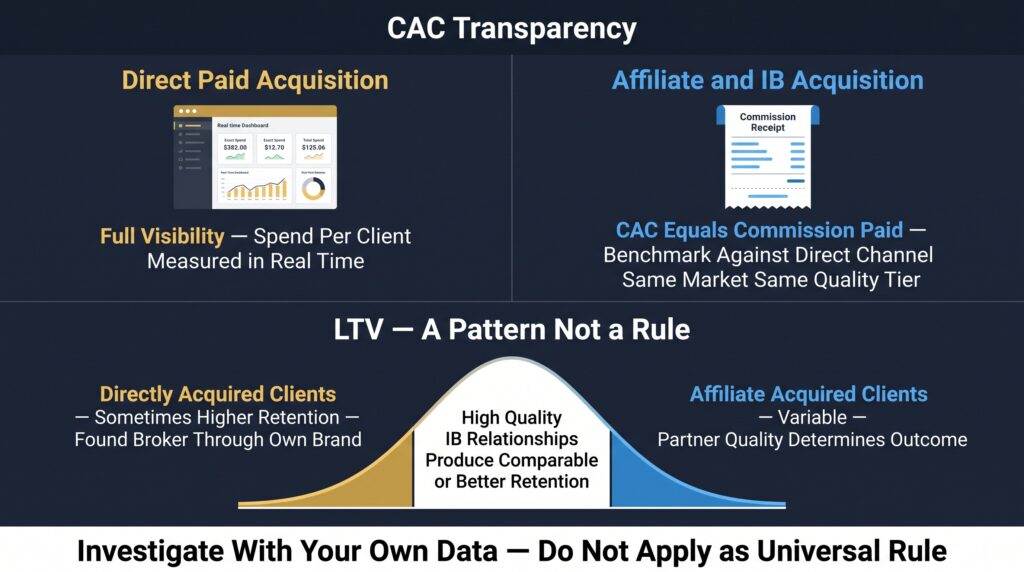
CAC transparency. Direct paid acquisition CAC is typically more transparent and immediately measurable — the broker sees exact spend per acquired client in real time. Affiliate/IB CAC is effectively the commission paid per acquired client, which can and should be benchmarked against direct CAC for the same market and client quality tier, using the CPA benchmarks guide as the direct-channel reference point.
LTV — a pattern, not a rule. Directly-acquired clients who found the broker through its own brand and content sometimes show higher retention than affiliate-acquired clients recruited primarily on a partner-side commission incentive rather than genuine broker preference. This pattern is real but should not be overstated as universal — partner quality varies enormously, and high-quality, well-aligned IB relationships frequently produce client retention comparable to or better than direct acquisition. The pattern is a factor to investigate with the broker’s own data, not an assumption to apply uncritically.
When Affiliate/IB Acquisition Scales Faster
Three conditions favouring affiliate/IB scaling:
- New geographic market entry. Where the broker lacks local language creative capability, local payment method familiarity, or local regulatory nuance that an established local IB already possesses — the partner’s existing market knowledge substitutes for capability the broker would otherwise need to build from scratch.
- Saturated or expensive direct channels. When direct paid channels in a given market are saturated or prohibitively expensive due to auction competition — high-CPA markets per the CPA benchmarks guide — where partner relationships can access client segments that direct paid bidding cannot reach cost-effectively.
- Compliance capacity as the binding constraint. When the broker’s own compliance team capacity, not budget, is the binding constraint on direct paid scaling, and partner relationships allow growth without proportionally increasing the broker’s own creative production and review burden — explicitly accepting the compliance oversight trade-off in exchange for growth velocity.
When Direct Acquisition Scales Better
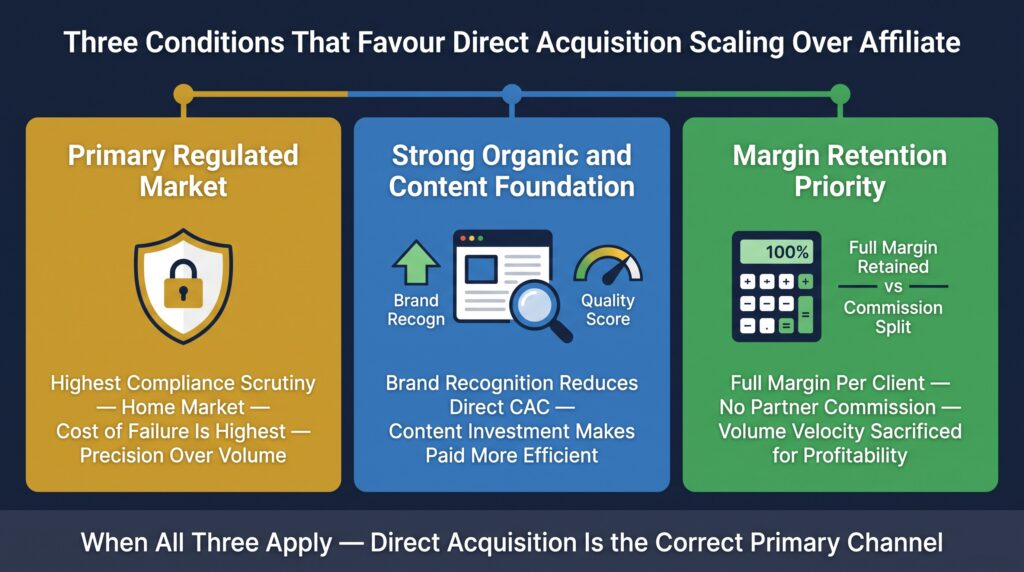
Three conditions favouring direct scaling:
- The broker’s primary regulated market. Where compliance precision is most scrutinised — typically the home market, where regulatory supervision is most active and the cost of a compliance failure is highest.
- A strong organic and content foundation. When the broker has built the kind of content investment that improves paid performance through brand recognition and Quality Score advantages described in the Google Ads account structure guide, making direct acquisition more cost-efficient than it would be without that foundation.
- Margin retention priority. When margin retention matters more than acquisition volume velocity, since direct acquisition retains full margin per client rather than sharing it with a partner.
The Hybrid Reality — Most Established Brokers Run Both
The “which scales better” framing implies an either/or choice. In practice, most established forex brokers run both channels simultaneously with deliberate allocation logic rather than treating it as an exclusive decision.
A common pattern: direct paid acquisition for markets and segments where the broker has strong brand recognition and the compliance infrastructure to manage creative tightly — often the broker’s home or primary regulatory market. Affiliate/IB acquisition for market expansion into regions where local partner relationships and market knowledge provide access the broker’s own paid team cannot efficiently replicate, with the compliance oversight trade-off accepted as the cost of that market access.
The decision is not binary — it is an allocation question across markets and growth stages, revisited periodically as the broker’s compliance capacity, brand strength, and market presence evolve.
A Practical Allocation Framework
Four questions to work through when deciding how to allocate budget between the two channels:
| Question | Favours Direct | Favours Affiliate/IB |
|---|---|---|
| 1. Compliance capacity | Low capacity to review partner creative at scale | Dedicated partner compliance function in place |
| 2. Market maturity | Established market with brand recognition | New market entry needing local knowledge |
| 3. CAC by channel (market-specific) | Direct CPA competitive vs commission rates | Direct auction saturated or prohibitively expensive |
| 4. Brand-building priority | Early-stage brand building, consistency critical | Established brand, can absorb partner variability |
Working through these four questions produces an allocation recommendation specific to the broker’s actual situation — rather than a universal answer to a question that does not have one.
If you want this allocation decision modelled against your specific market, compliance capacity, and current CAC by channel, that analysis is part of the diagnostic — or, for the broader growth strategy question, a conversation worth having separately.
FAQ
Q1: Does affiliate or direct paid acquisition scale better for forex brokers?
Neither affiliate nor direct paid acquisition scales universally better for forex brokers — the comparison depends on market maturity, compliance oversight capacity, and margin priorities, and most established brokers run both channels with deliberate allocation logic rather than choosing exclusively. Direct paid acquisition typically scales better in a broker’s primary regulated market, where compliance precision is most scrutinised, where existing brand and content investment improves paid performance, and where retaining full margin per client matters more than acquisition volume growth. Affiliate and IB acquisition typically scales better when entering a new geographic market where local partner relationships provide language, payment method, and regulatory familiarity the broker would otherwise need to build independently, when direct paid channels in a given market are saturated or prohibitively expensive, or when the broker’s compliance team capacity rather than budget is the binding constraint on direct paid scaling. The practical decision should be based on a structured allocation framework assessing compliance capacity, market maturity, comparative CAC, and brand-building priority for the specific market in question, rather than a single universal answer.
Q2: Is a forex broker responsible for compliance on affiliate-produced ad creative?
Yes. Under FCA and CySEC rules, a regulated forex broker remains responsible for financial promotions distributed by its affiliates and introducing brokers, even though the broker did not produce that creative directly. This creates a structural asymmetry between direct and affiliate-driven paid acquisition: direct paid acquisition gives the broker’s compliance team full visibility and control over every piece of creative before it runs through an established approval workflow, while affiliate and IB acquisition requires extending that same compliance oversight to creative produced by third parties who are typically compensated based on performance rather than on the broker’s regulatory standing, creating a structural incentive misalignment between conversion rate and compliance precision. Scaling through affiliates without a corresponding scale-up in compliance monitoring of partner-produced creative is taking on regulatory risk that compounds with every additional partner added to the programme. A broker with a small number of active partners can plausibly review each one’s creative output manually, but this approach typically breaks down past a certain partner count without either a dedicated partner compliance function or a structured, scalable creative approval system.
Q3: What are the scaling economics differences between affiliate and direct paid acquisition?
Direct paid acquisition for forex brokers generally sees cost per acquisition increase as budget scales within a given market, because auction dynamics mean more spend is competing for the same finite high-intent search and social inventory, but the broker retains full control over creative, targeting, and compliance and keeps full margin on each acquired client since no partner commission is paid. Affiliate and introducing broker acquisition typically has more predictable marginal cost per acquisition through fixed CPA or revenue share agreements, and can scale in absolute volume by recruiting additional partners rather than only by increasing bid competition within a single auction, but the broker shares margin with the partner and has materially less direct control over how that partner represents the brand and complies with financial promotion rules. Neither approach scales more efficiently in every situation, and the better choice depends on the broker’s specific market maturity, available compliance oversight capacity, and tolerance for sharing margin with partners.
Q4: When should a forex broker prioritise affiliate and IB acquisition over direct paid ads?
A forex broker should prioritise affiliate and introducing broker acquisition over direct paid advertising under three main conditions. The first is entering a new geographic market where the broker lacks local language creative capability, local payment method familiarity, or local regulatory nuance that an established local introducing broker already possesses, substituting partner market knowledge for capability the broker would otherwise need to build independently. The second is when direct paid channels in a given market are saturated or prohibitively expensive due to auction competition, making partner relationships a more cost-effective route to client segments that direct paid bidding cannot reach efficiently. The third is when the broker’s own compliance team capacity, rather than marketing budget, is the binding constraint on direct paid scaling, and partner relationships allow continued growth without proportionally increasing the broker’s own creative production and compliance review burden, with the broker explicitly accepting reduced direct compliance control as the trade-off for growth velocity.
Q5: When should a forex broker prioritise direct paid acquisition over affiliates?
A forex broker should prioritise direct paid acquisition over affiliate and introducing broker channels under three main conditions. The first is in the broker’s primary regulated market, where compliance precision is most scrutinised by regulators and the cost of a compliance failure in financial promotions is highest, making full direct control over creative approval most valuable. The second is when the broker has built a strong organic content foundation that improves paid performance through brand recognition and quality score advantages within advertising platforms, making direct acquisition more cost-efficient than it would be without that foundation. The third is when margin retention matters more to the business than raw client acquisition volume growth, since direct acquisition retains the full margin on each client rather than sharing it with a partner through commission or revenue share arrangements. These conditions often apply most strongly to a broker’s home market, where both regulatory scrutiny and brand investment tend to be most developed.
Q6: Should a forex broker choose either affiliate or direct paid acquisition exclusively?
No. Most established forex brokers run both affiliate and direct paid acquisition simultaneously with deliberate allocation logic rather than treating the decision as an exclusive either-or choice. A common allocation pattern uses direct paid acquisition for markets and segments where the broker has strong brand recognition and sufficient compliance infrastructure to manage creative tightly, often the broker’s home or primary regulatory market, while using affiliate and introducing broker acquisition for market expansion into regions where local partner relationships and market knowledge provide access the broker’s own paid team cannot efficiently replicate, with the reduced direct compliance control accepted as the cost of that market access. The practical decision is an allocation question across markets and growth stages rather than a single universal choice, and should be revisited periodically as the broker’s compliance capacity, brand strength, and market presence evolve over time. A structured framework assessing compliance capacity, market maturity, comparative customer acquisition cost, and brand-building priority for each specific market produces a more useful allocation recommendation than attempting to answer the question once for the entire business.